
You're probably reading this with one eye on the calendar and the other on your inbox. Maybe you've already told yourself you'll deal with the drinking, the pills, or the sleep medication after the next board meeting, after the next hearing, after the next case closes, after the next quarter lands. That delay is exactly how private addiction treatment becomes less about comfort and more about whether you'll enter care before the situation forces the issue.
The hard truth is that high-profile clients don't just need treatment, they need treatment that doesn't expose them unnecessarily. The label private addiction treatment can mean two very different things, one is just a payment stream, the other is confidentiality-grade care with a small census, controlled communications, and real clinical intensity. If you're a professional, an owner, a physician, an attorney, or anyone whose reputation can be damaged by a careless admissions process, that distinction changes everything.
Why Privacy Changes the Treatment Decision
A senior executive can usually afford a better room. What they can't afford is a sloppy admission that sends information to the wrong place, or a program that looks premium online but handles billing, phone access, and family calls like a standard rehab. That's why the decision isn't “Can I pay for private treatment?” It's “Can I get into care without widening the circle?”
The people most capable of paying are often the people most exposed by getting help. Their license, board seat, client relationships, referral network, and public credibility can all become collateral if privacy isn't designed into the program from the start. When fear of exposure keeps someone out of detox, the cost isn't theoretical, it delays medically supervised stabilization and makes the first days of care harder to enter cleanly.
Practical rule: If a program can't explain exactly how it protects privacy across admissions, billing, work access, and aftercare, it's not executive-appropriate, no matter how polished the brochure looks.
That's why privacy should be treated like a clinical variable, not a luxury. The more visible someone is, the more likely they are to put off care until the situation becomes urgent. A discreet setting with disciplined communication rules makes it more likely they'll walk in, stay through withdrawal, and tolerate the early discomfort long enough to stabilize.
Capo Canyon's own overview of its reputation-protection approach is a useful example of how privacy gets framed operationally, not just cosmetically, in this discussion of balancing recovery and privacy. That's the right lens. Privacy isn't about making treatment feel upscale. It's about reducing the barriers that keep the right people from getting treatment at all.
Defining Private Addiction Treatment Beyond the Marketing
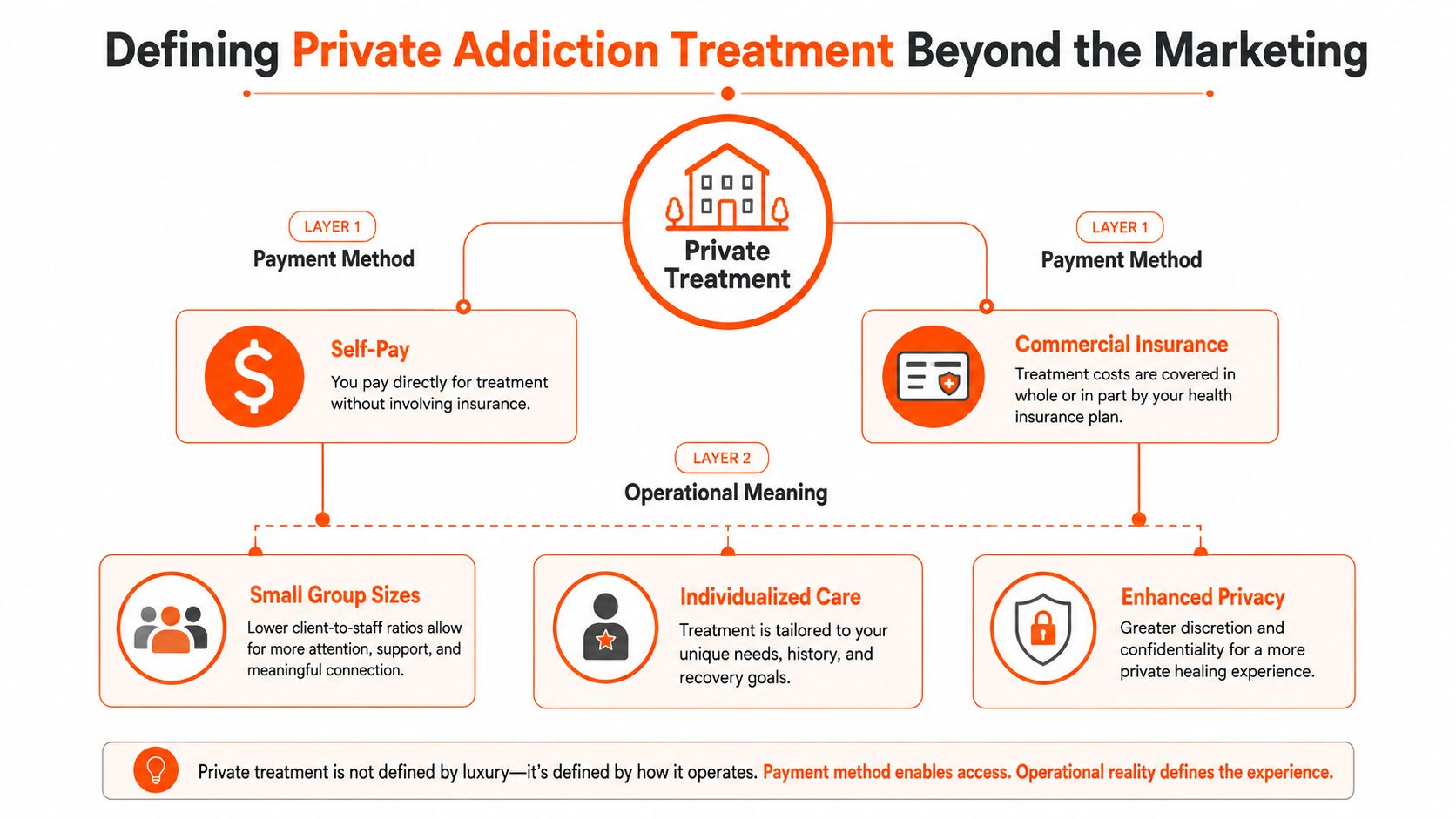
Start with the simplest meaning. Private addiction treatment can mean a self-pay program or one financed through commercial insurance rather than a public system. That defines how care is paid for, not how care is run. A facility can be privately financed and still be crowded, impersonal, and weak on confidentiality.
What the label should signal
A real private program should show operational features that high-profile clients can verify before they commit. The strongest quality signal is a measurement-based care loop, repeated assessments, explicit goals, outcome tracking, and treatment-plan changes as symptoms shift. The clinical text in NCBI's treatment material stresses repeated reassessment, monitoring progress, and maintaining an individual record that preserves privacy, while a private-program outcome paper argues that quality improves when programs track standardized outcomes at intake, during treatment, and at discharge rather than relying on anecdotes NCBI treatment guidance.
That means you should look for more than branding. A credible private program should be able to answer plain questions about who sees your chart, how often your care is reassessed, and how the team changes treatment when anxiety, withdrawal, or medication response shifts. If they can't answer that cleanly, you're looking at marketing, not a care model.
Simple filter: Payment stream tells you who's paying. Operations tell you whether the program delivers true privacy.
Use this checklist when reviewing a facility website or talking to admissions:
- Confidential admissions: They should explain how they handle calls, paperwork, and family verification without oversharing.
- Small census: Fewer clients usually means more individual attention and less exposure.
- Named clinical staff: You should know who is managing detox, psychiatry, case management, and therapy.
- Outcome tracking: Ask how they measure progress, not just whether they “tailor care.”
- Controlled access: Private doesn't mean hidden, it means access is intentionally limited.
- Treatment-plan flexibility: If symptoms worsen, the plan should change quickly.
NCBI's treatment text says programs should repeatedly reassess medical, psychological, and social needs, monitor progress with written notes and biological testing, and keep an individual record that preserves privacy NCBI treatment guidance. That is the standard to use. Concierge meals, nicer rooms, and tasteful branding are secondary.
Levels of Care Compared Across the Treatment System
Private residential care sits in a narrow but important part of the treatment system. It is not automatically better, and it is not the right answer for every person. It makes sense when the case calls for controlled surroundings, frequent clinical contact, and a level of discretion that outpatient care usually cannot provide.
The distinction shows up in completion patterns. In a large U.S. analysis, outpatient care accounted for 84.6% of treatment episodes but had a 51.9% completion rate, while residential treatment had a 64.5% completion rate, and residential clients were more than three times as likely to complete treatment as those in outpatient settings Recovery Answers analysis. That does not make residential the answer for everyone. It shows that structure matters, especially when someone cannot reliably stay engaged at home.
Treatment Levels at a Glance
| Level of Care | Setting | Completion Profile | Privacy Control |
|---|---|---|---|
| Outpatient | Patient lives at home and attends scheduled sessions | Lower completion than residential in the cited U.S. analysis | Moderate, because the client stays visible in daily life |
| Residential | Live-in treatment with structured supervision | 64.5% completion in the cited analysis Recovery Answers analysis | Higher, because the environment is controlled |
| Private residential | Residential care with smaller census and tighter communications | Strong fit for complex or high-visibility cases, if the program is clinically deep | Highest when the facility intentionally designs for confidentiality |
| Standard inpatient | High-structure medical setting, often used for acute stabilization | Best viewed as stabilization first, rehabilitation second | Variable, usually clinical rather than discreet |
The point is placement, not prestige. Private residential works best when a person needs enough containment to get through detox, enough therapy to address root causes, and enough privacy to stay in treatment without professional fallout.
Capacity shapes that choice too. SAMHSA's 2022 national survey counted 14,854 substance use treatment facilities and 1,623,647 clients in treatment on March 31, 2022, with an 86.8% survey response rate SAMHSA. KFF's analysis of the same data notes that treatment beds average 34 beds per 100,000 people, which helps explain why smaller private residential programs fill a real capacity niche in major markets KFF analysis. In plain terms, you are not shopping in an endless market. Better-run private programs tend to be selective because their model depends on tight operations, not sheer volume.
What the Executive and Private Pathways Include
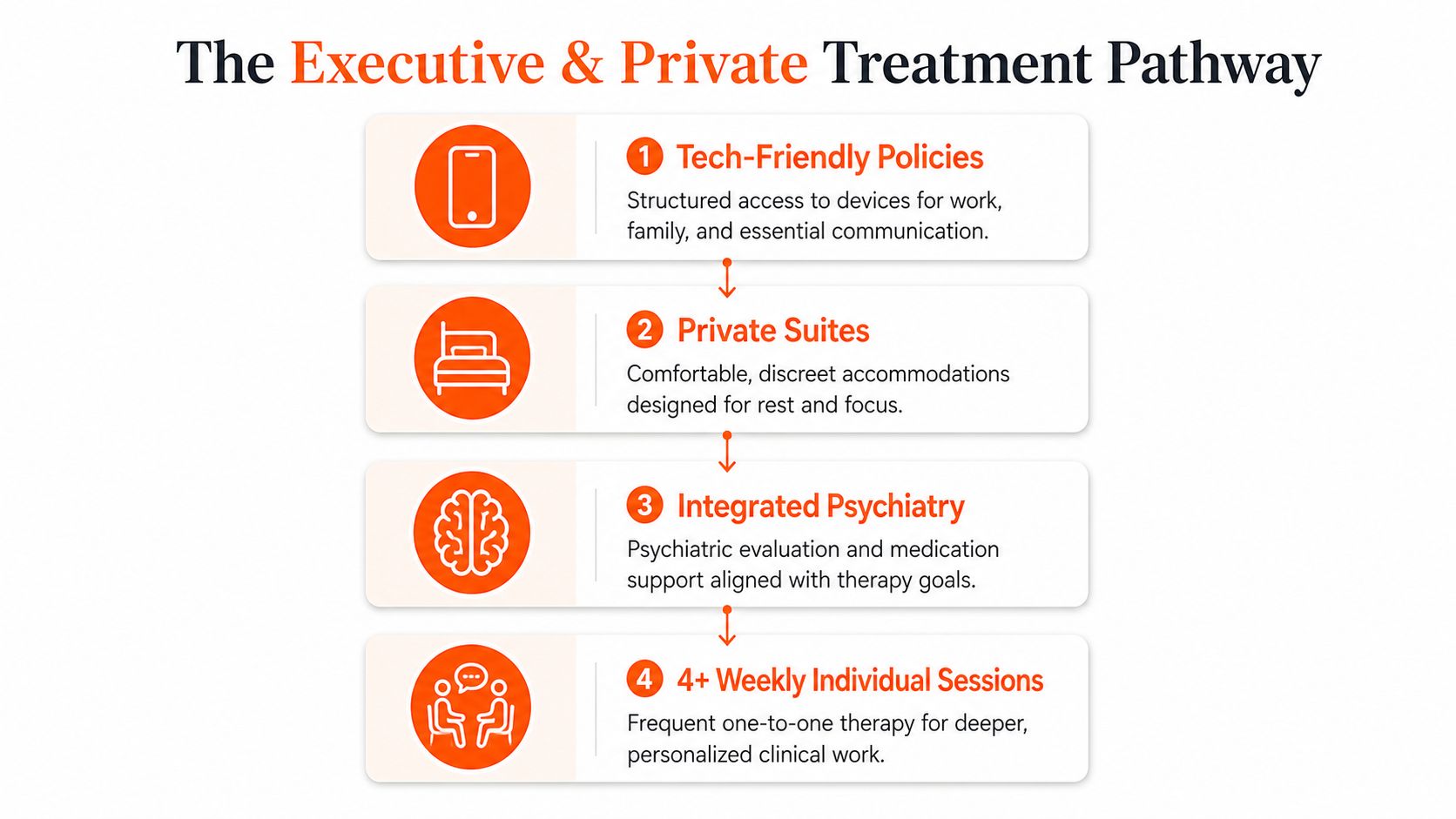
An executive pathway changes treatment in practical ways, not decorative ones. Laptops and phones are not allowed because the program is indulgent. They are allowed because some patients cannot disappear from work for weeks without creating new crises that become relapse triggers. For licensed professionals and business owners, controlled access to technology can support clinical stability, not serve as a perk.
The features that matter
A credible executive pathway usually includes private rooms, integrated psychiatry, dual-diagnosis treatment, and a small census. Capo Canyon describes a small census of approximately five clients at a time, 24/7 nursing, on-site psychiatric support, and minimum four weekly individual sessions across therapy, case management, and psychiatry. It also says it allows cell phones and laptops and offers private bedrooms, chef-prepared meals, and care for co-occurring conditions such as anxiety, depression, trauma, bipolar disorder, and ADHD. If you are evaluating any facility, those are the operational details that matter, not whether the furniture photographs well.
Small census gives clinicians more time to adjust medication, address withdrawal symptoms, and catch psychiatric drift before it turns into a setback. For a client with anxiety, depression, trauma, bipolar disorder, or ADHD, untreated symptoms can drive relapse risk. The faster the team responds, the less likely the stay becomes a static, one-size-fits-all routine.
Here is the practical reading of the executive features.
- Tech-friendly policy: Useful when the client must keep essential work contact alive.
- Private suites or bedrooms: They lower exposure and give people a place to rest, work, or decompress.
- Integrated psychiatry: Required when substance use and mental health issues overlap.
- Frequent individual sessions: A sign that the program values direct clinical work, not just group attendance.
- Diet-customized meals: Helpful when withdrawal, medication changes, or medical issues affect appetite and tolerance.
A day-at-a-glance description of this kind of flow is laid out in Capo Canyon's executive rehab overview. Use that kind of detail as a benchmark. If a program cannot explain how its daily structure works, it probably cannot deliver the high-touch experience it advertises.
Costs, Insurance, and the Confidentiality Mechanics
The money question is not just “Can I afford it?” It's “Who learns about it?” That's the part most comparison sites gloss over. Billing paths can create paper trails, and those paper trails can land in places the client never intended.
What billing changes, and what it doesn't
Private pay usually gives the client the cleanest confidentiality posture because there's no insurer processing every service line. Commercial insurance can reduce out-of-pocket burden, but it can also create explanation-of-benefits notices and other disclosure points that may reach spouses, employers on shared plans, or administrative stakeholders depending on the policy structure. That's why the better admissions teams talk plainly about billing disclosure before anyone signs.
Out-of-network arrangements can sometimes preserve more discretion than a fully in-network setup, but only if the program explains how claims are handled and what gets sent where. The key issue is not whether insurance is “bad.” It's whether the client understands the privacy tradeoff before treatment begins. If the person is a physician, attorney, pilot, or board-level executive, that tradeoff can matter as much as the clinical model.
Ask admissions who receives the claim, what the insurer sees, and whether there's any way to reduce disclosure before the first service is billed.
The same logic applies after discharge. Privacy risks don't stop at the treatment door. Sober living referrals, aftercare handoffs, and communication with referring clinicians all need guardrails. If the program is casual about those transitions, it can undo the privacy it promised during intake. Strong programs coordinate continuity without oversharing.
A direct question is better than a vague comfort check. Ask whether the program can separate clinical coordination from unnecessary disclosure, and ask how it handles communication with employers, family, and outside providers. The right answer should sound specific, not rehearsed.
Capo Canyon's insurance page is a useful reference point for the kinds of questions clients should ask about coverage and disclosure, especially if they want to understand how private-pay and insurance options can affect privacy, does insurance cover addiction treatment. If a facility can't walk you through the confidentiality mechanics with that level of clarity, keep looking.
How to Evaluate a Facility Before You Commit
A good facility tour feels like a clinical interview, not a sales pitch. You're not just judging whether the place looks calm. You're checking whether it can safely treat a complicated person without leaking information or relying on testimonials to cover weak infrastructure.
Start with verification, not vibes
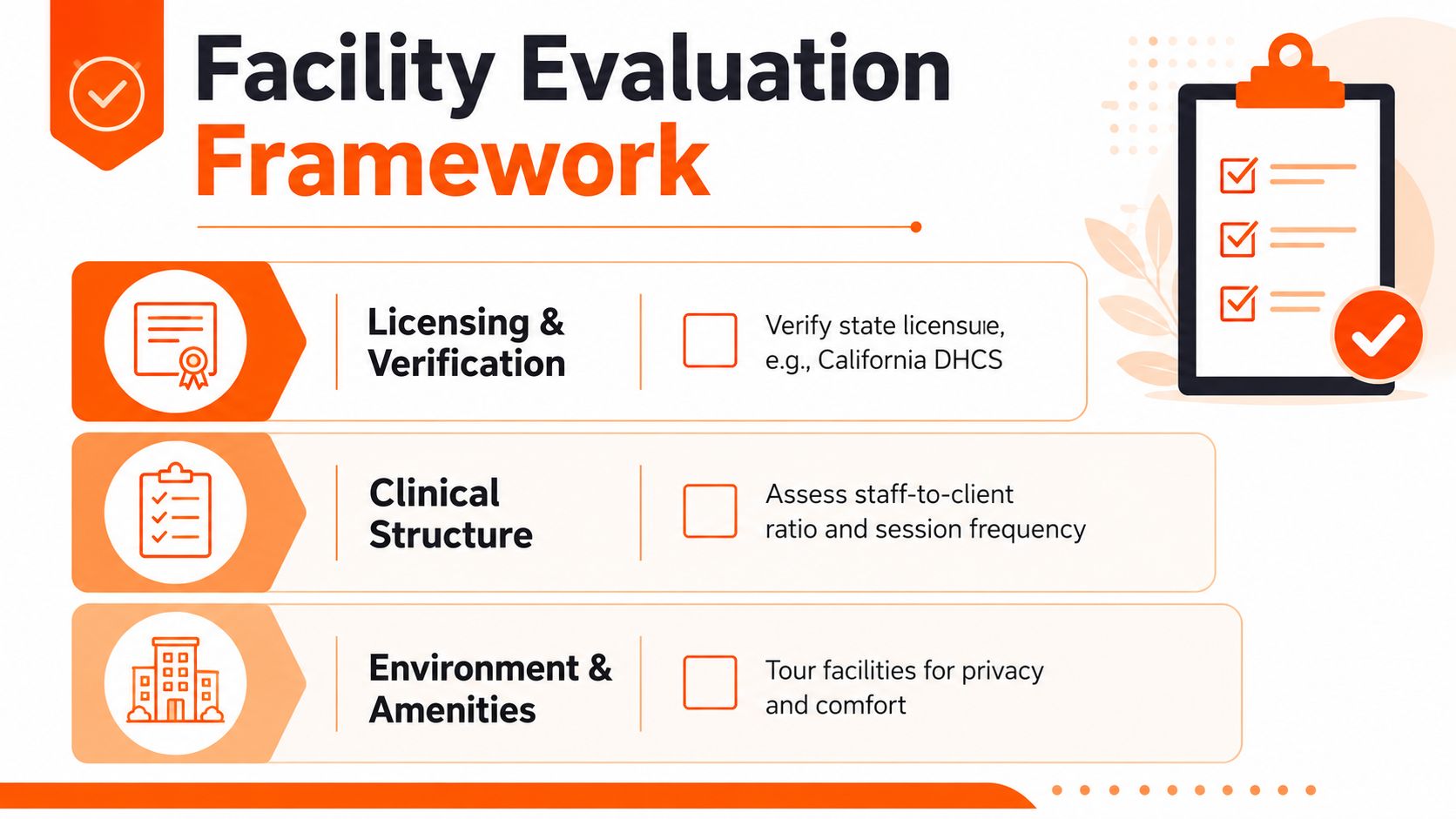
First, confirm licensure. Capo Canyon says it is licensed by the California Department of Health Care Services, DHCS #300359AP. That's the kind of concrete detail you want for any facility, because licensing tells you the program is operating under real regulatory oversight rather than soft branding. Once licensure is confirmed, move to the structure of care.
Then ask about staffing and clinical depth. A private setting should be able to explain staff-to-client ratio, frequency of individual therapy, dual-diagnosis capability, and medication-assisted treatment availability without hesitation. The federal quality guidance on addiction treatment highlights personalization, continuous monitoring, and adequate time in treatment as key signs of higher-quality care, and it also notes large variation in supportive services and medication availability across facilities RTI quality guidance. That variation is exactly why you need specifics.
Questions to ask on the tour
- Licensing and oversight: “Who licenses you, and what does that license cover?”
- Clinical contact: “How many individual sessions do clients receive each week?”
- Psychiatry and medication: “Is psychiatric support on-site, and how fast can medication be adjusted?”
- Dual diagnosis: “How do you treat anxiety, depression, trauma, bipolar disorder, or ADHD alongside substance use?”
- Family involvement: “What gets shared with family, and what stays confidential?”
- Outcome tracking: “How do you measure progress from intake to discharge?”
If a facility leans hard on testimonials but can't produce clinical details, that's a warning sign. The same goes for a place that talks a lot about comfort and barely at all about monitoring, medication, or reassessment. Good private care should be able to document its work.
Preparing for Admission Without Losing the Run of Things
The smartest executives treat admission like a business transition. They don't vanish. They triage. They decide who needs to know, what needs to be covered, and what can wait until after stabilization. That approach reduces chaos before intake and lowers the odds that work pressure will pull them out too early.
The 72-hour checklist that keeps things calm
Start with a small circle. Tell only the people who need to know, and be specific about what you want them to handle. One person can cover calendar triage, another can handle client communication, and another can field urgent family matters. If too many people know, the privacy risk goes up for no benefit.
Then lock down the first detox window. Phones and laptops may be permitted in some executive programs, but you should still assume the first hours or days will be medically focused. Clear your inbox, set realistic out-of-office language, and tell trusted contacts that replies may be delayed. That's better than half-working while trying to stabilize.
Practical rule: Leave with fewer decisions pending, not more. Admissions goes smoother when work is already in motion before you arrive.
What to bring should stay simple. Bring the documents the facility requests, the prescriptions it needs to review, and the clothing you'll wear. Leave behind anything that complicates confidentiality or distracts you from treatment, especially devices or materials you don't need right away. If the program allows tech access, that doesn't mean you should use it the moment you walk in.
Before discharge, ask for an aftercare bridge. You want the next step arranged before you leave, not improvised under pressure. That includes therapy follow-up, medication continuity, and any sober living or referral coordination that fits the case. The best admissions process ends with a plan that protects both recovery and privacy instead of dumping the client back into a high-pressure role without support.
Questions Families and Referring Clinicians Ask Most
Can someone keep their license while in care? Usually yes, if the program handles communication carefully and the client follows the relevant reporting rules. Can an EAP be involved without oversharing? Yes, but only if admissions and case management define what gets disclosed and what stays private. If a co-occurring condition flares, the program should change the plan quickly rather than treat it as an inconvenience. Aftercare should be set before discharge, with medication, therapy, and work reintegration coordinated in advance.
Capo Canyon Recovery focuses on private, medically supervised detox and residential treatment for executives and professionals who need privacy, structure, and real clinical support while staying connected to essential responsibilities. If you're weighing treatment options for yourself or someone you advise, visit Capo Canyon Recovery and look for a program that can explain its confidentiality, staffing, and aftercare in plain English before you ever step inside.