
Yes, you can overdose on NyQuil, and the danger comes from acetaminophen, dextromethorphan, and doxylamine in the same dose. The question many ask is narrower than the actual problem, because the bigger issue is whether someone took too much once, kept stacking doses, or used it on purpose for sleep or intoxication.
The Short Answer and the Bigger Picture
Yes, can you od on nyquil is a real safety question, and the answer is yes. The risk is built into the product itself, because NyQuil contains three active ingredients, each with its own toxicity pathway, so one extra dose can create more than one problem at the same time.
Acetaminophen is the liver risk. Dextromethorphan affects the brain and can produce misuse-related symptoms at high doses. Doxylamine is sedating and anticholinergic, which means it can cause marked drowsiness, confusion, dry mouth, blurred vision, and urinary retention. That combination is why NyQuil overdose is not just “took a little too much cold medicine,” it can become a mixed toxic exposure with overlapping symptoms.
The label matters here. According to the product label, adults and children 12 years and older should take 30 mL every 6 hours, with no more than 4 doses in 24 hours. That puts the labeled adult maximum at 120 mL in a day. Exceeding that limit can push one or more ingredients above safe levels, especially if the person is also taking another cold, flu, or pain product.
Practical rule: if the bottle, a daytime cold medicine, and a headache tablet all contain overlapping ingredients, each dose can be “correct” by itself and still become unsafe in combination.
That is why this topic needs a wider lens. Some overdoses are accidental. Some are intentional, usually for sleep or to get high. Others happen when someone tries to manage symptoms across a whole day and unknowingly doubles up. The rest of the article separates those paths so you can judge which one matches the situation in front of you.
What Is in NyQuil and Why It Matters
NyQuil works like a container with three pressure valves. If one valve opens too far, the system fails in a different way. If all three are pushed at once, the presentation can look mixed, which is exactly why people misread it.
The liver valve is acetaminophen
Acetaminophen is the ingredient that raises the biggest concern for serious injury. At higher exposure, the liver can't process it safely, and injury can advance before the person looks very ill. That delayed pattern is one reason a person may seem “okay” and still be heading toward a medical emergency.
The brain valve is dextromethorphan
Dextromethorphan, often called DXM, is the cough suppressant. At excess doses it can affect the brain in ways that go beyond simple sleepiness, including hallucinations, seizures, and breathing problems. NIH StatPearls notes that dextromethorphan abuse has been tied to a recurring burden of emergency care in the United States, with about 6,000 emergency department visits each year, and 50% of those visits involving patients ages 12 to 20.
The sedation valve is doxylamine
Doxylamine is the sedating antihistamine. It explains why NyQuil can make someone drowsy enough to fall asleep, but excess amounts can also cause anticholinergic effects such as dry mouth, blurred vision, and urinary retention. In a mixed overdose, that sedation can hide more serious symptoms because the person just looks “very sleepy” at first.
The label is the boundary line. Adults and children 12 and older should take 30 mL every 6 hours, no more than 4 doses in 24 hours, for a labeled maximum of 120 mL per day. Going past that is not just a dosing error, it can load the liver, brain, and anticholinergic system all at once.
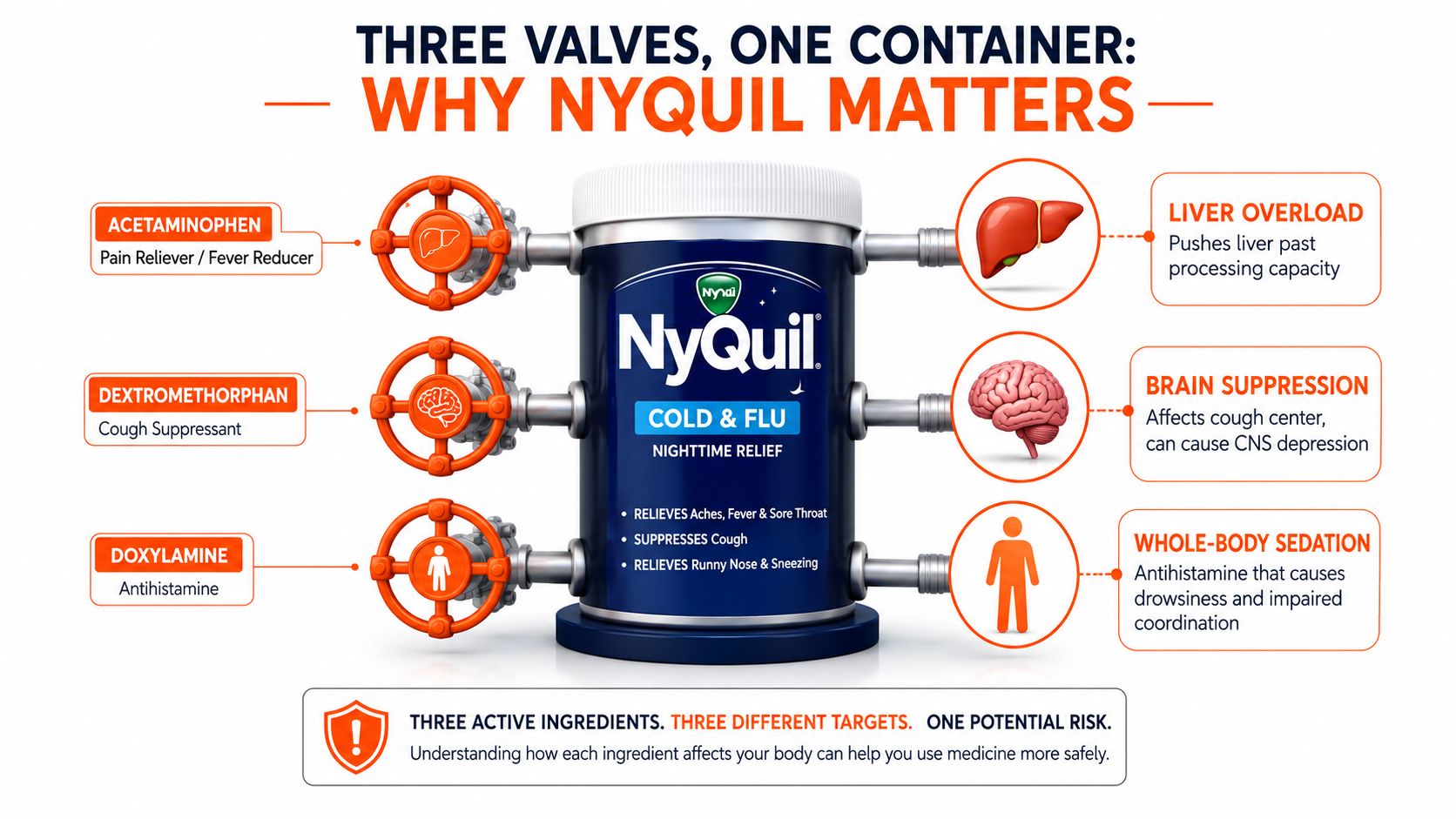
Clinical takeaway: think in ingredients, not in the brand name. Brand recognition makes people underestimate overlap.
How an Overdose Happens
A bottle in the medicine cabinet can become a problem in a few different ways. The pattern is often less about one obvious mistake and more about how people use the product while they are tired, sick, stressed, or trying to fall asleep.
One pathway is a single large intentional dose. That can happen during panic, insomnia, or intoxication-seeking, and it is more urgent because the person may no longer judge how much they took clearly. Another pathway is repeated misuse over several days, often for sleep. That pattern matters because sedation can hide accumulation, and the person may keep taking more when the first dose does not seem to help.
A third pathway is stacking products. This is the one families, coworkers, and clinicians often miss. A person takes a daytime cold medicine, a pain reliever, and then NyQuil at night, assuming each label stands alone. The body does not separate them that way. It processes the shared ingredients together.
A common example is a busy executive with a cold. They take a daytime flu product for work hours, then a headache tablet after dinner, then NyQuil at bedtime. Each bottle may follow its own directions, yet the total acetaminophen exposure can still become unsafe. That is the core polypharmacy problem, and it explains why careful use of separate boxes can still lead to overdose across the day.
The same pattern can show up in households, on travel, and in office settings where one person is sharing advice, not medication history. A colleague may look only “very sleepy,” while the more serious issue is that they have mixed products or taken NyQuil for reasons beyond cold relief, such as sleep or intoxication. For a broader look at how medication misuse affects the body, see this overview of prescription drug abuse effects on the body. The habit of combining products without tracking ingredients is what makes OTC overdose easy to miss.
Useful check: if two products are both meant for cold, flu, pain, or sleep, read the active ingredients, not just the front label.
Symptoms by Severity and Timeline
The warning signs usually cluster into levels, and that helps you decide whether this is a call to Poison Control, a call to 911, or a situation that already needs emergency care.
Early signs that can look mild
Early symptoms often include drowsiness, dizziness, dry mouth, nausea, blurred vision, and mild confusion. These can be easy to dismiss because they overlap with ordinary cold illness or simple fatigue. That is exactly why they're dangerous in a medication context, because the person may already be intoxicated while still appearing conversational.
Worsening signs that should raise concern
As the exposure grows, the picture can shift to vomiting, slurred speech, marked confusion, urinary retention, hallucinations, and an unsteady heartbeat. Dextromethorphan misuse is the ingredient most tied to perceptual changes, and MedlinePlus describes overdose as a serious condition that can involve hallucinations, palpitations, seizures, and breathing problems (MedlinePlus).
Emergency signs that need immediate help
The emergency tier includes seizures, slow or stopped breathing, loss of consciousness, and clear signs of liver injury. Yellowing of the skin or eyes is especially important, but acetaminophen injury can begin without obvious signs before that appears. Drug safety references note that symptoms may be delayed rather than immediate, especially when acetaminophen is the driver (Drugs.com medical answer).
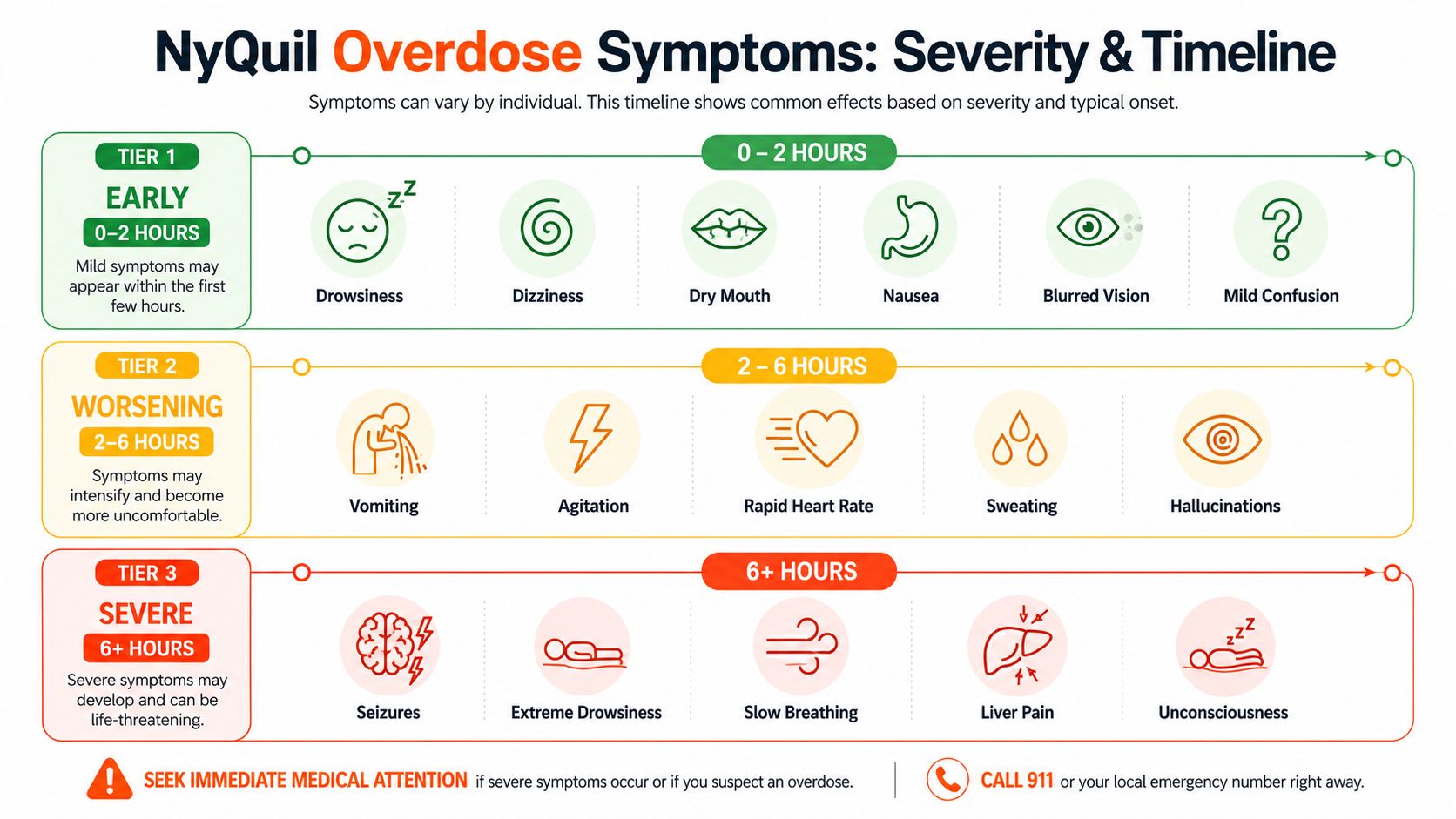
The timeline trap is the part families miss. A person can look reasonably okay at first and still develop liver injury later, so “I feel fine right now” is not a safe conclusion.
If the person is hard to wake, breathing slowly, seizing, or becoming progressively more confused, treat that as an emergency even if they keep insisting they're fine.
For a fuller treatment of medication misuse warning signs, this overview on prescription drug abuse and the body gives a useful framework for recognizing when symptoms are no longer just side effects.
What to Do in the First Minutes
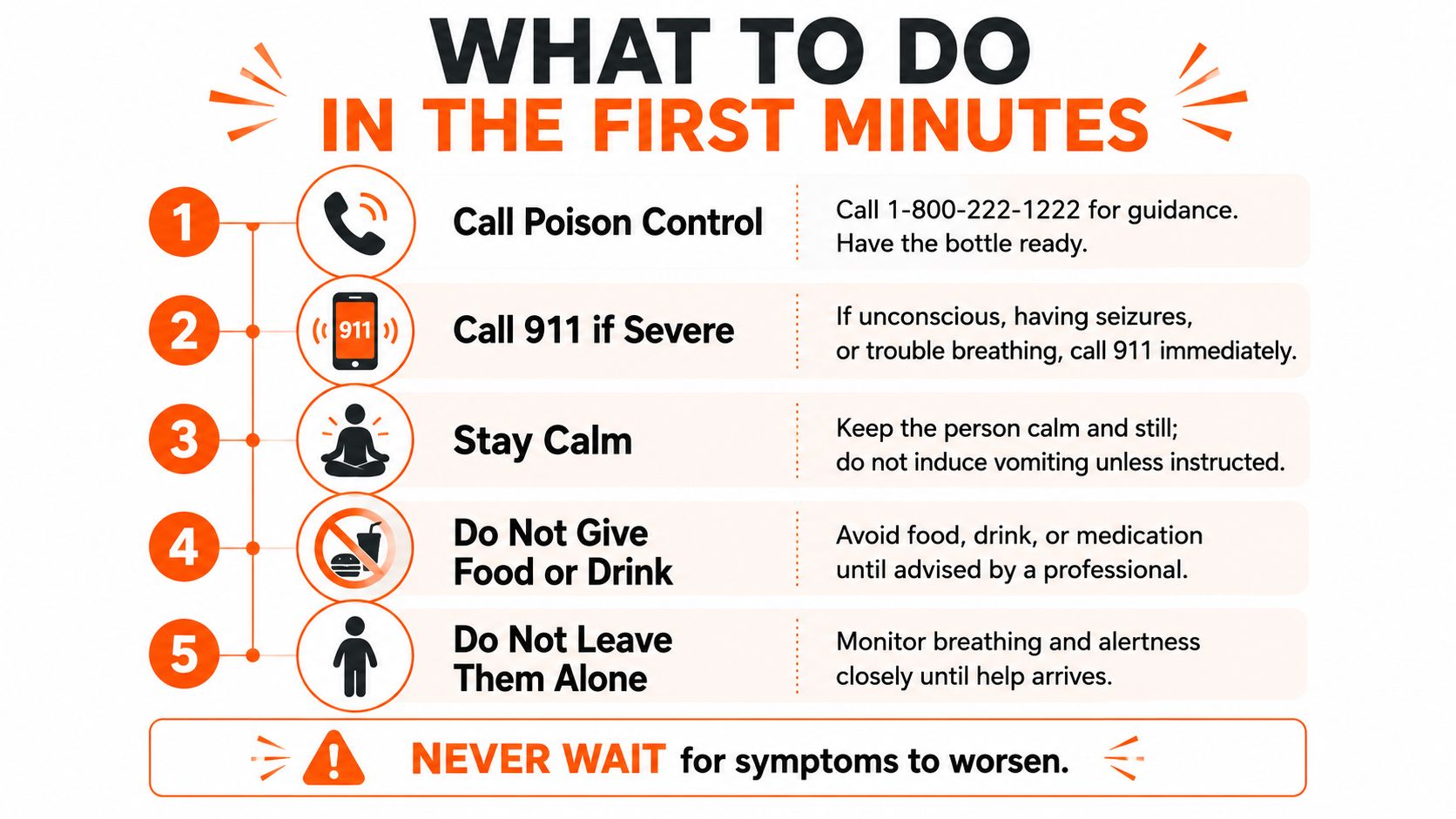
The first minutes are about action, not interpretation. If the person is awake, breathing normally, and you're not sure whether the dose crossed a line, call Poison Control at 1-800-222-1222 in the United States. If there's trouble breathing, a seizure, unconsciousness, or a suspected large dose, call 911 right away.
Have the bottle in front of you before you call. You'll want the age, weight, exact product, amount taken, when it was taken, other substances used, and current symptoms. That gives the clinician or dispatcher enough information to judge whether this is a monitoring issue or an emergency response.
Do not induce vomiting. Do not give home activated charcoal. Do not assume sleep will fix it. And do not wait for the person to “wear it off,” because acetaminophen injury and mixed sedative effects can progress while the surface picture stays quiet.
What not to do
- Don't force vomiting: it doesn't remove the risk safely and can create new problems.
- Don't give extra medicine: that includes more acetaminophen, more sleep aids, or alcohol.
- Don't leave the person alone: breathing and alertness can change quickly.
- Don't delay because of embarrassment: this is a medical call, not a moral judgment.
Paramedics and emergency departments handle plain overdose calls as medical events. That matters for professionals who are worried about consequences, because getting help is the correct move and it does not require you to wait until the situation becomes much worse.
How Hospitals Treat a NyQuil Overdose
Emergency care starts with stabilization. Clinicians focus on airway, breathing, circulation, then move to monitoring the patient's heart rhythm, temperature, and neurologic status. If the person is too sedated to protect their airway, they may need breathing support, because doxylamine and dextromethorphan can both suppress normal function.
For acetaminophen toxicity, the key treatment is N-acetylcysteine, or NAC. It works best when given early, because the earlier it is started, the more liver tissue it can protect. That timing is one reason medical teams push hard for early arrival rather than “watch and wait.”
Dextromethorphan-related agitation, hallucinations, or serotonin-type symptoms are usually managed with supportive care, sedation when needed, and close observation. Some patients require ICU-level monitoring if they are very symptomatic or if complications such as hyperthermia or rhabdomyolysis appear, which NIH StatPearls also notes in its overdose guidance (NIH StatPearls).
| NyQuil Ingredient | Primary Risk | Typical Overdose Signs | Clinical Response |
|---|---|---|---|
| Acetaminophen | Liver injury | Nausea, delayed liver symptoms, jaundice, abdominal pain | NAC, lab monitoring, liver support |
| Dextromethorphan | CNS toxicity, misuse effects | Hallucinations, confusion, palpitations, seizures, breathing problems | Supportive care, sedation if needed |
| Doxylamine | Sedation, anticholinergic toxicity | Severe drowsiness, dry mouth, blurred vision, urinary retention, delirium | Airway monitoring, IV support, symptom control |
The public-health context matters because this is not rare or theoretical. Dextromethorphan abuse has a documented emergency department burden in the U.S., and that burden is concentrated in younger patients, which is one reason families and supervisors should not dismiss “just cough medicine.”
For people who may need structured follow-up after stabilization, Capo Canyon's medication stabilization page describes a setting designed for close monitoring during medication-related recovery.
After the Emergency, How Recovery Works
Surviving an overdose solves the immediate medical crisis, but it does not answer why NyQuil became the tool of choice. For some people, the driver is insomnia. For others, it is anxiety, chronic pain, or a habit of using over-the-counter medication to self-manage stress. That pattern can also include intentional misuse for sleep or intoxication, and in some households the warning signs show up long before a second emergency. If the behavior keeps repeating, the next step is a level of care that can stabilize the person and separate the behavior from the trigger.
Medically supervised detox is more structured than many families expect. It usually includes 24/7 nursing, medication monitoring, psychiatric oversight, and a daily routine that keeps the patient medically and emotionally observed. That matters after OTC misuse because the problem is often not only the acute overdose, it is the repeated decision to use a medication outside its intended role. Repeated use can also happen alongside other medications, including other acetaminophen products, which raises the risk of hidden harm even when each dose seems ordinary on its own.
Clinical point: a person can be medically stable after the overdose and still be at risk for the same behavior the next night if the insomnia or anxiety is untouched.
Families and colleagues of executives often miss this part because the person may still look functional. They may keep working, answer messages, and minimize what happened. A private, structured setting helps because it removes access to the medication, adds observation, and gives clinicians room to address the sleep problem, the anxiety, or the misuse pattern itself. For people who need help understanding where that level of care fits, Capo Canyon's detox vs rehab guide explains the difference between those settings and why the choice matters.
For executives, licensed professionals, and other people who cannot disappear into a large program, privacy becomes part of the treatment plan. A small-census residential setting, private bedrooms, and tech-friendly policies can let someone stay connected to essential work without turning treatment into a public event. Capo Canyon Recovery is one option in that category, with detox, medication stabilization, and residential care built for people who need discreet support and ongoing professional responsibilities.
The point is not luxury for its own sake. It is a setting where the person can be monitored, protected from repeated misuse, and treated for the underlying condition that made nightly NyQuil feel necessary.
Common Questions About NyQuil Overdose
Can you mix NyQuil with alcohol? No. Alcohol adds to sedation and respiratory risk, and it can make liver injury more concerning when acetaminophen is in the picture.
What if someone took too much a few hours ago and seems mostly fine? Call Poison Control now. Acetaminophen injury can stay quiet at first, so “mostly fine” doesn't rule out harm.
Is nightly NyQuil use the same as overdose? Not always, but it can become a sign of tolerance, psychological dependence, or a sleep problem being treated with the wrong tool. The pattern matters even if one single dose wasn't an overdose.
How can someone get help privately? Look for licensed programs with confidential intake, private rooms, and discreet communication policies. People in high-visibility jobs often need treatment that protects both medical safety and career privacy.
If NyQuil has become part of how you or someone you work with sleeps, copes, or gets through the day, treat that pattern seriously before it turns into a repeat emergency. Capo Canyon Recovery offers medically supervised detox, medication stabilization, and private residential care for people who need discretion as well as clinical oversight.