
You're trying to get an executive into treatment quickly. The bed is available, the family has agreed on a plan, and the patient may already be experiencing withdrawal. Then admissions asks for the insurance card, policy details, clinical records, and authorization before the stay can begin. A missing group number or an unclear benefit answer can turn an urgent admission into a day of phone calls.
That delay matters. Up to 20% of initial claims may contain eligibility errors, and 48% of providers report that registration or check-in data is somewhat or not accurate, according to industry reporting on insurance verification in healthcare. Verification catches errors in member identification, active coverage, plan type, benefits, and network status before they become denials or unexpected bills.
For executives, the insurance verification process is a logistics problem with a short decision window. You need the right documents, the right questions, and a written record of every payer answer. You also need to understand what happens after eligibility is confirmed, because verified coverage doesn't automatically mean residential detox or inpatient treatment is approved.
Why Insurance Verification Comes Before Anything Else in Treatment
An executive may have agreed to enter detox tonight, yet admission can stall while a treatment center checks the plan. The center must confirm active coverage, behavioral health benefits, network status, and any prior authorization requirement. Until those answers are documented, the available bed and the patient's admission plan remain uncertain.
Insurance verification is a front-end clinical and financial gatekeeper. It identifies the level of care the payer may review, whether detox or residential treatment falls within the benefits, what records utilization reviewers expect, and whether the facility can bill under the plan. Eligibility issues account for a substantial share of claim denials, as noted earlier in the healthcare revenue-cycle guidance on verification.
Practical rule: An active card does not complete verification. It starts the process.
A documented check gives the family a clearer estimate of deductible exposure, coinsurance, copays, exclusions, and out-of-network penalties. It also prevents an executive from entering treatment assuming the payer will cover a service that requires separate approval. Read the benefit response against the planned stay, especially if residential detox may continue into residential care.
The 24 to 48 hour decision window
Urgent admissions rarely allow a slow administrative process. Families are weighing withdrawal risk, work obligations, travel, privacy, and the patient's willingness to accept help. A coverage problem discovered after treatment begins can disrupt placement and create an avoidable financial dispute.
Use the first day to assemble records, start the eligibility check, and call the payer with a specific question list. Ask whether residential detox is covered, what cost sharing applies, whether the facility is in network, and whether authorization is required for each level of care. Request the payer's reference number and the representative's name.
Use the second day to resolve mismatched member details, obtain the benefit summary, and submit clinical records for review. When the Explanation of Benefits arrives, check the service description, dates, billed amount, allowed amount, deductible, coinsurance, patient responsibility, denial or adjustment reason, and appeal instructions. An EOB is not an authorization letter, and it does not replace a written coverage determination.
Escalate beyond a phone call when the representative gives conflicting answers, refuses to identify the applicable benefit, or cannot explain a denial. Ask for the response in writing and submit a written payer escalation with the patient identifiers, call reference number, requested level of care, clinical rationale, and the exact decision needed. Keep the record with the admissions and insurance verification process so the treatment team can coordinate placement without guessing about reimbursement.
The workflow is simple to state and demanding to execute: verify the right benefit, document every answer, secure authorization promptly, and recheck coverage during the stay.
What Information to Gather Before You Call the Insurer
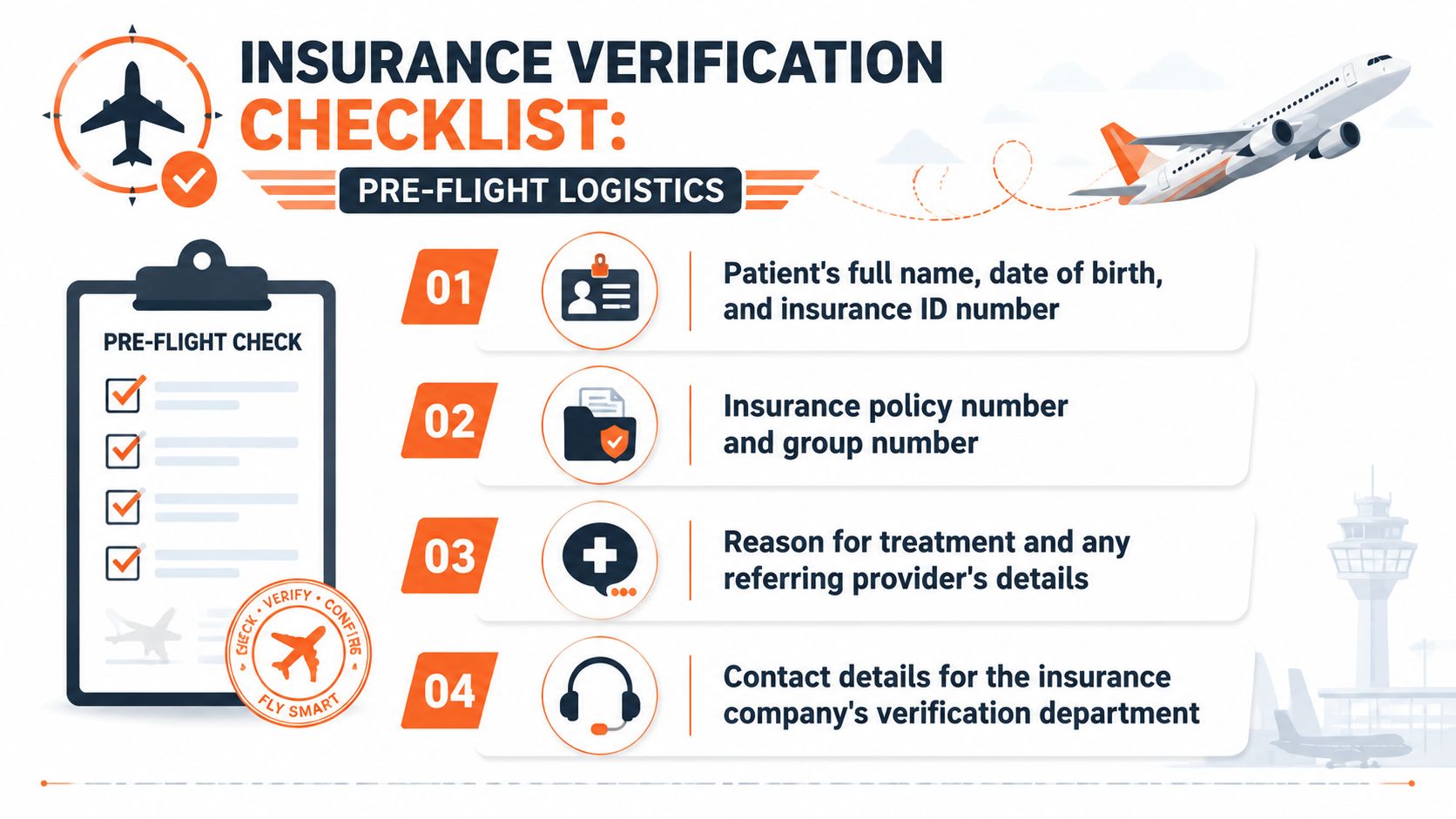
Treat the first call like a pre-flight checklist. The insurer's representative can only verify what matches the payer's records, and a single mismatch can send the conversation back to the beginning. Put every document in one secure folder before anyone calls.
Patient and policy identification
Start with the patient's legal name exactly as it appears on the insurance card, date of birth, member ID, policy number, and group number. Add the policy holder's full name, date of birth if available, and relationship to the patient. The policy holder may be a spouse, parent, or employer-sponsored account holder rather than the person entering treatment.
The phone number on the back of the card should be your first payer contact. Identify the product type, such as HMO, PPO, EPO, or POS, because network rules and referral requirements can differ sharply between products. Keep a copy of the insurance card, a recent Explanation of Benefits, and the Summary Plan Description if the employer provides one. Those documents often clarify benefit language that a front-line representative may summarize quickly.
Clinical facts for behavioral health
The verification team will need enough clinical context to identify the correct behavioral health pathway. Prepare the primary substance involved, current withdrawal symptoms, recent use, prior treatment episodes, co-occurring mental health concerns, and the referring clinician's name and contact details.
You don't need to improvise a clinical narrative during the call. Ask the treating or referring provider for an assessment, medication list, diagnosis information, and notes describing why the proposed level of care is appropriate. For an executive, a concise account of work impairment, safety concerns, relapse risk, and failed lower levels of care can help the authorization team assemble a coherent record.
Employer and scheduling details
For employer-sponsored coverage, save the HR or benefits administrator's contact information. The insurer handles claims and benefits, but an employer's plan administrator may clarify plan documents, eligibility dates, or a group-level issue that customer service can't resolve.
Write down the target admission date, preferred level of care, facility tax identification information if available, and the names of anyone authorized to speak with the payer. Organization reduces repeated calls and prevents contradictory information. It also gives the admissions team a complete packet instead of scattered screenshots and partial messages.
How the Verification Call and Electronic Check Actually Work
A reliable insurance verification process uses two tracks. The first is a live call to the payer's behavioral health or provider-services department. The second is an electronic eligibility inquiry through the insurer's portal or a clearinghouse. Neither track should be treated as infallible.
Begin the call with a precise request: “I'm verifying behavioral health benefits for a planned substance use treatment admission.” Give the patient's identifiers, facility details, proposed level of care, and anticipated admission date. Ask the representative to confirm active eligibility for that date, not merely whether a policy exists.
Ask benefit questions that match the admission
Use a written script so the call doesn't drift into generalities. Ask:
- Level of care: Are medically supervised detox, residential treatment, inpatient services, PHP, and IOP covered separately?
- Cost sharing: What deductible applies, how much has been met, and what copay or coinsurance applies to each level?
- Maximum exposure: What is the out-of-pocket maximum, and which treatment charges count toward it?
- Limits: Are there day, session, frequency, diagnosis, or benefit-period limits?
- Exclusions: Does the plan exclude substance use treatment, certain medications, or specific facility types?
- Network status: Is the facility contracted for this exact product, and are behavioral health services administered by another company?
- Authorization: Is prior authorization required before admission, and who submits it?
- Review process: What clinical records are required, and where should they be sent?
A phone answer is useful only when you can prove what was said. Record the representative's name or identifier, department, date, time, call reference number, and the exact wording of important coverage statements. If the representative says the facility is in network, ask whether that applies to the facility, the clinician, and the patient's specific plan.
Compare the electronic result with the phone answer
An electronic 270/271 eligibility transaction can return core eligibility and benefit information through a payer portal or clearinghouse. It may show active coverage, plan identifiers, and selected benefit fields, but it can omit behavioral health exclusions, facility-specific network details, or authorization requirements.
Portal data may also differ from the phone answer because the systems refresh at different times or route behavioral health benefits to a separate administrator. Treat discrepancies as an escalation trigger. Ask the payer to identify which department controls the benefit and request written confirmation when the financial exposure is significant.
Electronic checks can take one to four business hours, while phone verification may be completed the same day, depending on the payer and the information available, as outlined in eligibility verification research for healthcare providers. If the representative can't reconcile conflicting information, request a supervisor before ending the call.
In-Network vs Out-of-Network and What It Changes
Network status can change the economics of treatment more than the headline benefit percentage suggests. An in-network facility has a contract with the payer and accepts negotiated rates for covered services. An out-of-network facility may bill at its own rate, leave the patient responsible for a separate deductible, and expose the patient to balance billing.
For a residential detox admission, ask the payer to verify the facility against the exact plan product, not just the insurance company's name. A national insurer may operate multiple products with different networks. “The carrier is accepted” doesn't answer whether this facility is contracted for this member's plan.
The financial difference
In network, the payer's allowed amount typically controls the claim calculation. The patient may still owe a deductible, copay, or coinsurance, but the contracted provider generally can't bill above the negotiated amount for covered services.
Out of network, the plan may apply a higher deductible or separate out-of-network cost sharing. The payer's allowed amount may be lower than the facility's billed charge, and the patient could be billed for the difference. Some plans offer no out-of-network behavioral health benefit at all.
| Factor | In-Network | Out-of-Network |
|---|---|---|
| Contracted rate | The facility accepts the payer's negotiated rate for covered services. | The facility may use its own charges, subject to the plan's allowed amount. |
| Deductible | The plan's in-network deductible generally applies. | A separate or higher out-of-network deductible may apply. |
| Out-of-pocket maximum | Covered patient responsibility usually accumulates under the in-network maximum. | Charges may accumulate under a different maximum or may not count fully. |
| Balance billing | Usually restricted by the provider contract for covered services. | The patient may face the difference between the billed charge and allowed amount. |
| Single-case agreement | Usually unnecessary because a contract already exists. | The facility may request a one-time agreement with the payer. |
| Claim submission | The facility commonly submits the claim. | The patient or facility may need to submit reimbursement paperwork. |
Ask specifically whether the facility can negotiate a single-case agreement. This one-time contract can establish a negotiated rate when no standard contract exists, but it must be confirmed before admission. Ask who initiates it, whether the payer will treat the facility at in-network rates, what services it covers, and whether the agreement includes the entire planned episode.
Families should also ask how to file an out-of-network claim, whether the insurer reimburses the patient or provider, and whether travel or lodging benefits exist. The financial decision belongs before admission, not after the first bill. For additional context on coverage questions, review how insurance may cover addiction treatment, then confirm every detail directly with the payer.
Prior Authorization After a Successful Verification
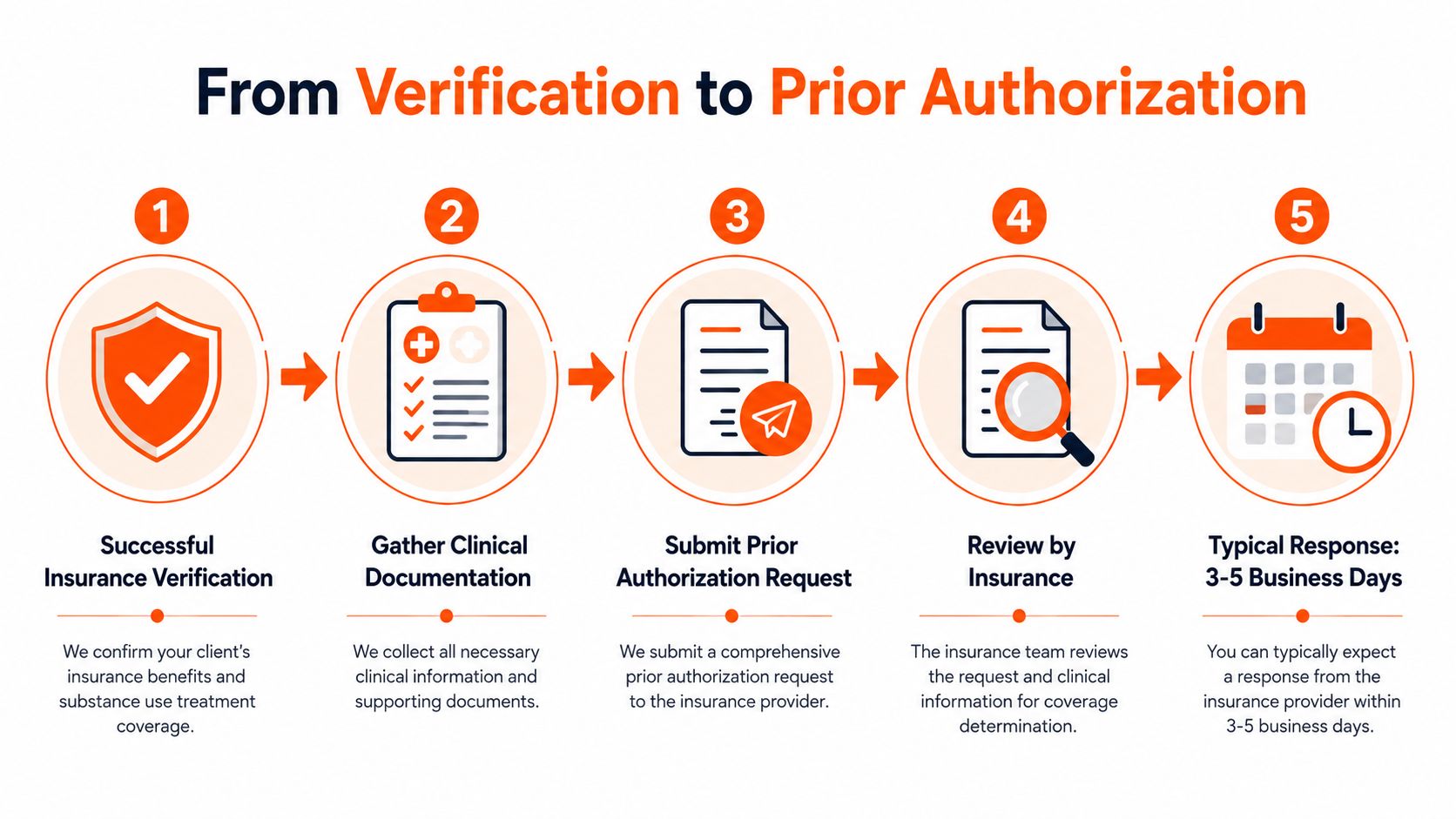
Eligibility answers one question: is the patient covered under the plan? Prior authorization answers a different question: will the payer approve the proposed service at the requested level of care? A patient can have active benefits and still face a denial if the request lacks clinical support, exceeds a plan limit, or arrives without the required documentation.
Federal reporting has made authorization performance more visible. Under CMS-0057-F, insurers must report approval and denial shares, appeal overturn rates, and processing times. For the first public reporting cycle covering 2025, insurers disclosed 85.4 million standard prior-authorization determinations and 9.6 million denials, according to KFF's analysis of prior-authorization metrics. Median standard denial rates were 7.2% for Medicare Advantage, 12.1% for Medicaid managed care, 14.0% for CHIP, and 14.1% for Marketplace plans, according to the same source.
Build the clinical packet before submission
The reviewer needs a defensible reason for the requested level of care. Send a physician or qualified clinician assessment, diagnosis information, substance-use history, current withdrawal or safety concerns, medication details, and documentation of prior treatment attempts. Include the clinical criteria supporting detox or residential treatment, not just a statement that the patient wants admission.
A strong packet also explains why a lower level of care is insufficient, what risks require structured treatment, and how the team will approach discharge planning. Include a preliminary discharge plan with continuing-care needs, family involvement, psychiatric follow-up, medication management, and recovery supports. Do not wait for a denial to discover that the record lacks this context.
Understand the decision clock
Urgent reviews may receive faster handling than standard requests, but the payer's stated deadline controls. Standard reviews can take several business days, and missing records can restart the practical clock even when the formal request has been submitted. Ask for the authorization case number, submission timestamp, assigned reviewer or department, and the exact deadline for a decision.
Common denial reasons include incomplete medical-necessity documentation, unclear criteria for the requested level of care, missing prior treatment history, and benefit limits already reached. A denial isn't the time for a general complaint. Request the clinical rationale, identify the missing evidence, and ask whether a peer-to-peer review is available.
If the payer denies the request, move quickly. Have the treating clinician participate in peer-to-peer review when permitted, then submit a written appeal within the plan's required window. Keep the case management services team informed so clinical records, payer communications, and discharge planning remain aligned.
Common Pitfalls and How to Reverify Mid-Treatment
A clean admission-day verification doesn't guarantee uninterrupted payment for a residential stay. Coverage can change, the payer can demand continued-stay evidence, and a transition from detox to residential care can create a new authorization requirement.
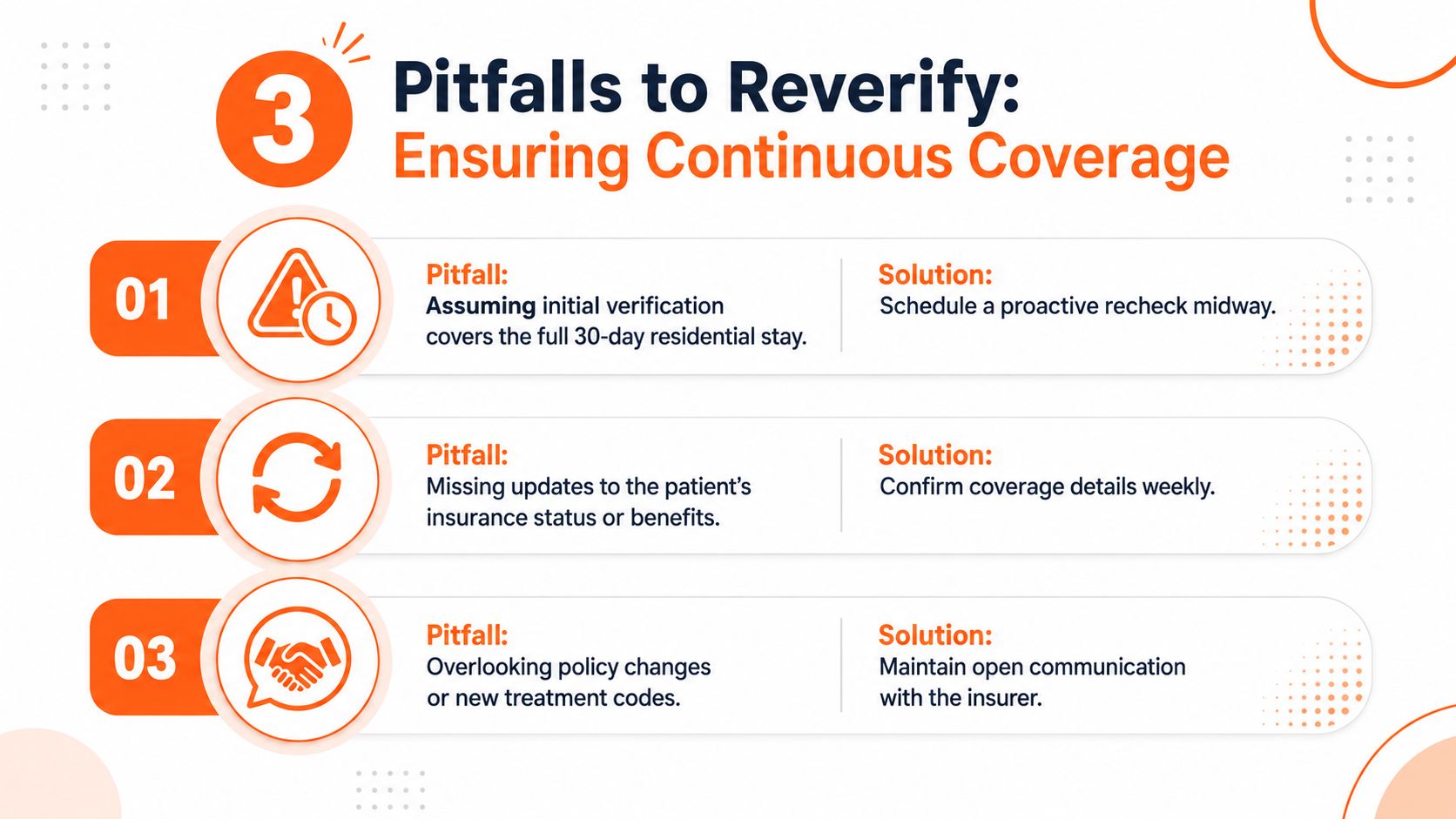
Three failures appear repeatedly:
- Assuming the first approval covers the entire stay: An authorization may cover only an initial period or level of care. Schedule a proactive review before the approved period ends.
- Missing benefit or eligibility changes: Employment changes, plan updates, and administrative corrections can alter coverage. Confirm the patient's status at regular touchpoints.
- Treating level-of-care transitions as automatic: Detox, residential, PHP, and IOP may use different benefit rules, codes, or review standards. Ask for the next approval before the transition occurs.
Set reverification checkpoints
Put calendar reminders on day 7, day 14, and day 21 of a planned residential episode. At each checkpoint, document active eligibility, remaining authorized days, continued-stay requirements, next review date, network status, and the name and reference number associated with the payer contact.
Read every Explanation of Benefits when it arrives. For residential detox, check the service dates, facility identity, procedure or revenue codes, allowed amount, deductible application, coinsurance, denial or adjustment codes, and patient responsibility. The EOB isn't an invoice, but it can reveal a mismatch before discharge creates a large balance.
Escalation rule: If a phone representative gives an answer that conflicts with the authorization letter or EOB, request written clarification. A written payer escalation is appropriate when the dispute affects a treatment transition, a material balance, or a pending discharge.
A Practical Timeline for Working With Capo Canyon Recovery
Executives and families need a sequence they can act on, not a vague promise that someone will “check the insurance.” Use the first 48 hours to move four workstreams forward: intake, eligibility, clinical documentation, and authorization.
Day one
At hour zero, contact admissions and provide the patient's identifying information, insurance card, target admission date, and planned level of care. Explain whether the patient is experiencing withdrawal, has immediate safety concerns, or needs a private executive setting.
Within the first two hours, complete the secure intake and upload or send the insurance documents and clinical records you already have. The admissions team can identify missing information before the payer call rather than after a representative asks for it.
By the end of day one, initiate the electronic benefits check and live payer verification. Request answers about deductible status, out-of-pocket maximum calculations, residential and PHP benefits, detox coverage, network classification, authorization requirements, and any travel reimbursement clause.
Day two
By midday on day two, request a written coverage summary or documented call outcome. Resolve conflicts between the portal response and the representative's answer, and obtain the payer reference number.
By the close of day two, submit the prior-authorization request with the clinical assessment, diagnosis, treatment history, medical-necessity rationale, and preliminary discharge plan. Confirm where the request was sent and when the payer's review clock began.
Admission coordination should proceed once the authorization reference number and level-of-care decision are confirmed. If the payer has not decided, ask what remains missing and whether the case can be escalated for an urgent review.
For a private, licensed detox and residential program in Mission Viejo, Capo Canyon Recovery offers insurance verification and admissions coordination for executives and professionals, including benefit and out-of-pocket review. Call the admissions line with your insurance card and clinical information ready, and ask the team to verify the plan, coordinate prior authorization, and identify the next concrete step toward admission.