
You're probably looking at a client who can't disappear for 30 days, can't have the wrong person find out they're in treatment, and can't afford a sloppy handoff after detox. That's exactly where case management services stop being paperwork and start functioning as the clinical control layer that keeps medical care, therapy, family communication, and aftercare moving in the same direction.
For executives, entrepreneurs, and licensed professionals, the significant risk isn't just withdrawal or cravings. It's the gap between levels of care, the missed callback, the uncoordinated discharge, the privacy breach, and the assumption that a capable person will somehow work through a chaotic recovery system on their own. That's why specialized programs build coordination into the treatment model instead of treating it like a back-office task, and why many high-profile clients look for options such as Capo Canyon Recovery's executive-focused rehab approach.
Why Executives Need More Than Standard Treatment Coordination
A chief financial officer checks into detox on a Sunday night with a phone full of board emails, a licensing issue hanging over the week, and a spouse who wants answers before the story leaks anywhere else. A standard rehab response often treats that person like every other admission, which sounds equal in theory and fails in practice. The client doesn't just need a bed, meals, and a schedule, they need someone tracking what must be protected, what can wait, and what communication has to happen correctly.
That's where case management services matter most. In substance-use treatment, case management is a structured function that coordinates, plans, provides, evaluates, and monitors services and recovery resources on behalf of the client, in collaboration with the client, so the work goes beyond scheduling appointments and sending referrals. The clinical value comes from keeping referrals, monitoring, and care-plan changes aligned over time, especially when treatment has to coexist with work obligations, family systems, and privacy concerns. The Orange County HIV case-management standards describe a model that starts with assessment, moves into an individualized care plan, and then continues with monitoring and re-evaluation, which is the same logic high-acuity addiction care depends on for continuity and adherence support.
Why fragmented care breaks down fast
Executives and licensed professionals usually don't fail because they lack motivation. They fail when detox, psychiatry, therapy, family contact, and aftercare each operate on separate tracks, with no one holding the overall picture. A client can look stable in one meeting and already be disengaging from the next step if no one is checking transitions in real time.
Practical rule: if nobody owns the handoff, the handoff will fail.
In high-profile treatment, that failure can mean more than discomfort. It can mean a missed medication adjustment, a family misunderstanding, a licensing concern that grows quieter but not smaller, or a return to work before the recovery plan is ready. Strong coordination doesn't remove the demands on the client, it prevents those demands from becoming hidden relapse triggers.
What Case Management Services Actually Do in Addiction Treatment
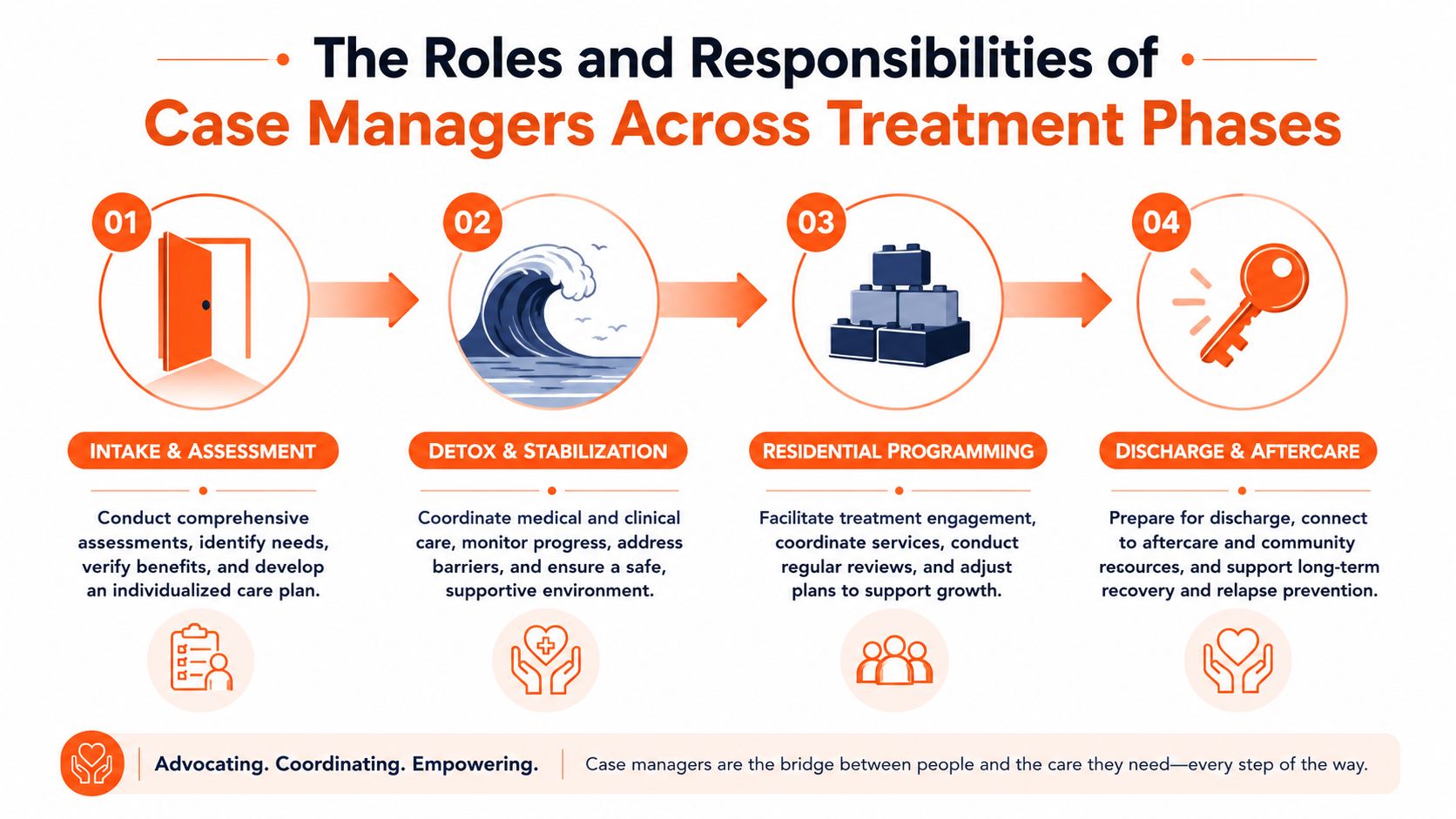
The cleanest way to understand case management is to treat it as a clinical coordination function, not an admin desk. The case manager doesn't just place calls. They hold the plan together while multiple providers are working on different parts of the same problem, and they keep checking whether the plan still fits what the client needs.
The core workflow
A sound model starts with initial needs assessment. That means more than asking what substances were used. It means identifying medical risk, psychiatric symptoms, family dynamics, legal or licensing pressure, work obligations, and the practical barriers that could interfere with treatment if nobody addresses them early. From there, the case manager helps build a detailed individualized care plan that ties services to the client's actual risks and responsibilities.
Then comes access. Case management is only useful if it creates timely access to medically appropriate services and not just a long list of names and numbers. If a client needs psychiatry, family work, or a step-down level of care, the case manager helps sequence those pieces so the client doesn't get stranded between them.
The final piece is ongoing review. Continuous monitoring and re-evaluation with adaptations are what separate active case management from static paperwork. If a client becomes withdrawn, inconsistent, or ambivalent, the case manager should detect that pattern early and adjust the plan before it becomes a dropout or relapse event.
What the role looks like in real life
In a higher-acuity addiction program, the case manager becomes the control layer between detox nursing, psychiatry, individual therapy, family work, and aftercare. If medication stabilization needs a psychiatric change, the case manager makes sure the update reaches the rest of the team. If a family meeting changes the discharge plan, the case manager keeps aftercare from lagging behind clinical reality.
Good case management doesn't add another layer of bureaucracy. It reduces the number of loose ends a client has to carry.
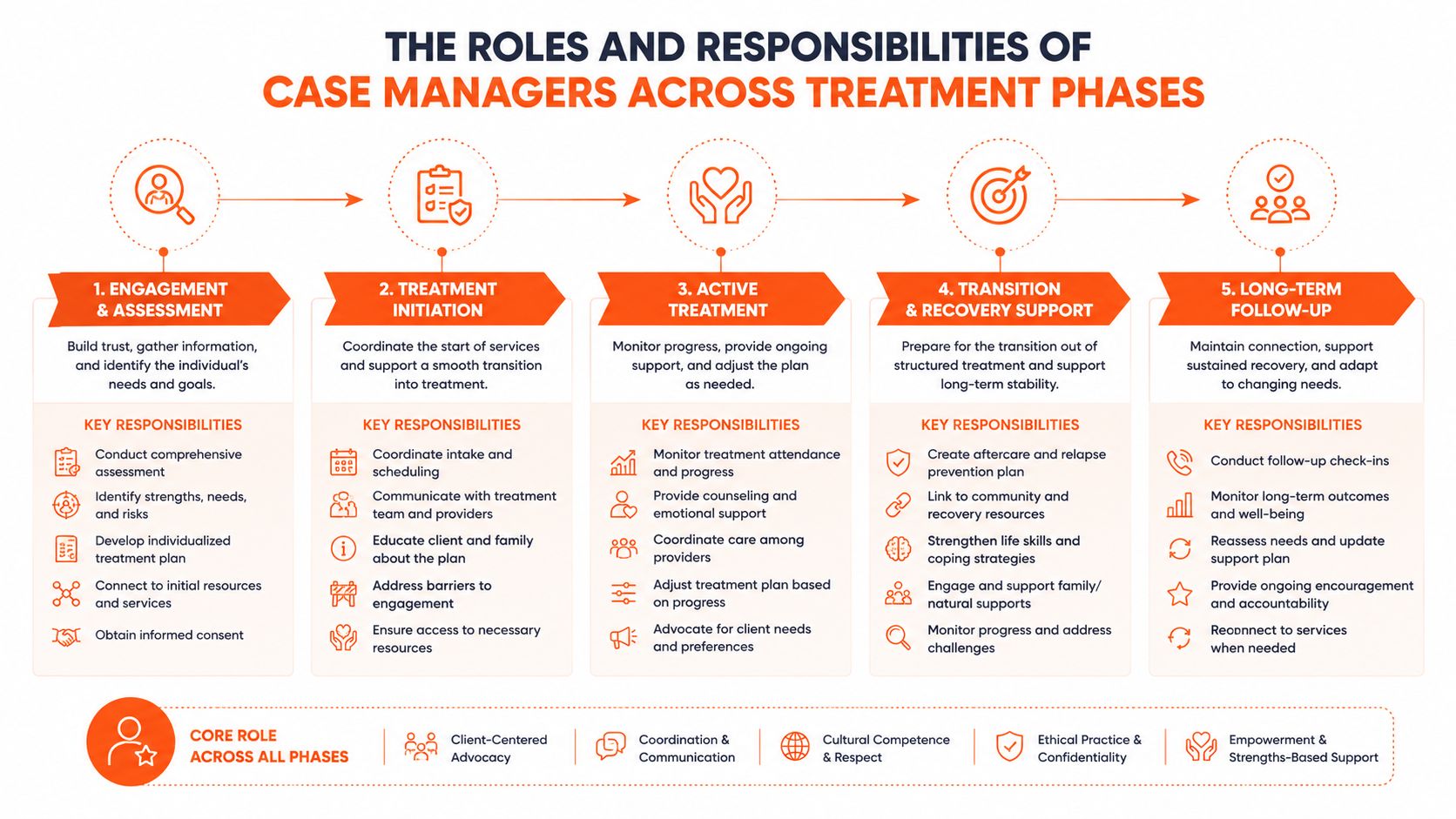
The Roles and Responsibilities of Case Managers Across Treatment Phases
In detox, the case manager is usually the first person translating clinical needs into a usable plan. That starts with intake information, but it shouldn't stop there. A credible assessment needs to identify co-occurring mental health symptoms, family strain, legal pressure, and any work or licensure obligations that could create conflict once treatment begins.
During stabilization and residential care
Once the client is in detox or residential treatment, the case manager coordinates with psychiatry, nursing, and therapy so that medication changes, symptom reporting, and progress notes don't live in silos. The point is not to duplicate the clinician's job, it's to make sure the right people know what changed and why. That matters when a client presents differently in group therapy than they do during a private session, or when a psychiatric symptom needs to be tracked alongside substance-use recovery.
Family involvement also needs structure. Some clients need it, some need boundaries, and some need both at different moments in the same stay. The case manager helps decide when family contact supports recovery and when it complicates it, then keeps those decisions consistent across the care team.
For executives and licensed professionals
In executive or professional tracks, the role becomes more delicate because the client can't disconnect from every obligation. Selective communication may need to happen with a spouse, assistant, attorney, or licensing contact, but only with clear boundaries and confidentiality safeguards. The case manager protects the treatment plan while helping the client maintain essential continuity outside the facility.
That's also where a more boutique model can help. Capo Canyon Recovery describes a small-census residential setting, tech-friendly policies, and minimum weekly individual sessions across therapist, case manager, and psychiatry, which reflects the kind of frequent review these clients often need.
Aftercare starts before discharge
Discharge planning should begin while the client is still in treatment, not on the day they leave. The case manager coordinates outpatient therapy, recovery supports, sober living if needed, and follow-up touchpoints that can catch early disengagement. In serious addiction care, aftercare isn't a handout, it's a monitored transition.
How Executive Programs Deliver Case Management Differently
Boutique executive programs and large-volume facilities can both say they provide coordination, but the experience on the ground is very different. In a high-volume setting, a case manager may be covering too many clients to notice the subtle signs that someone is pulling back from treatment or avoiding an aftercare conversation. That's where standard coordination becomes reactive.
A small-census program can move differently. Fewer clients means more direct observation, more immediate plan changes, and more room for the case manager to work alongside the client instead of chasing them through a crowded schedule. It also makes it easier to coordinate private meetings, work accommodations, and family contact without turning every request into a delay.
Privacy and technology change the workflow
Executives don't just worry about substance use. They worry about exposure. A tech-friendly policy that allows phones and laptops means the case manager has to help set boundaries around work communication, not just confiscate devices and hope for the best. That includes deciding when a client can check in with the office, where they can work privately, and how to avoid turning treatment time into an always-on workday.
Private rooms, desks, and Wi-Fi support that model when they're used intentionally. They can help a client handle necessary tasks without sacrificing recovery structure. They can also reduce the friction that makes a high-profile person resist treatment in the first place.
The trade-off no one should ignore
Boutique care is not automatically superior. It works when the program uses the extra space to increase monitoring, deepen coordination, and keep confidentiality tight. If the smaller census only means a prettier setting, then it's not solving the problem.
A private room is useful. A private room with a coordinated plan is useful enough to matter.
Who Actually Receives Case Management and Who Falls Through the Cracks
A common assumption is that the clients with the biggest needs naturally get the most coordination. That isn't always true. In a Veterans Affairs audit, only 4% of RCMP members with a mental health disability condition received case management, compared with 40% of Canadian Armed Forces veterans with a similar condition, and the report identified RCMP clients with complex needs as a reach gap, according to the departmental audit and evaluation report on case management reach.
That gap matters in addiction treatment because the most complex clients are not always the easiest to keep engaged. Some are high-functioning, polite, and superficially compliant, which can mask the fact that they need more help than they request. Others avoid contact because they fear exposure, job consequences, or being seen as dependent.
The uncomfortable screening question
Who gets assigned a case manager first, the client with the loudest crisis or the one who disappears if no one reaches out? Programs that rely on self-advocacy alone tend to over-serve people who already know how to work through systems. High-need clients often need outreach, not just availability.
A PubMed study of homeless women found that about 56% had case managers, and having one was associated with better odds of using food stamps and finding shelter without difficulty, but not with improved access to WIC or reduced unmet medical needs, according to the PubMed article on case management and access among homeless women. That pattern is a warning, not a verdict. Case management helps with some access barriers, but it may miss the ones that require more assertive follow-up.
What good programs do differently
The better question is whether the program has a system for tracking who is drifting away before they leave the building or stop answering calls. That means the case manager should be looking for skipped meetings, delayed decisions, and vague discharge planning as warning signs, not benign inconveniences. It also means the program should know when standard coordination isn't enough and direct outreach is needed.
The Case Management Workflow from Intake Through Aftercare
The workflow starts before admission. Pre-admission coordination usually includes insurance verification, early screening, and some rapport-building so the client doesn't feel like they're walking into a blank process on day one. For executives, that early contact can also surface sensitive issues, such as confidentiality concerns, travel constraints, or whether outside communication needs to be filtered through a spouse, assistant, or legal representative.
Intake and assessment
At intake, the case manager helps make sense of the full picture. That includes substance-use history, but it should also identify anxiety, depression, trauma, bipolar symptoms, ADHD, and other co-occurring concerns that may need integrated psychiatric support. If those conditions are missed, the discharge plan usually becomes too narrow to hold.
Detox to residential transition
The handoff from medically supervised detox to residential programming is one of the most vulnerable points in care. The client may feel better physically, but still be mentally unstable, exhausted, or unsure about what comes next. The case manager keeps medication stabilization, therapy scheduling, and family communication aligned so the transition doesn't feel like a reset to zero.
Discharge and aftercare
Discharge planning should be active, not passive. Outpatient therapy, follow-up psychiatry, sober living when appropriate, and support group placement all need to be set up before the client leaves. In programs with a continuing-care model, a dedicated continuing care structure helps the client stay connected after discharge instead of treating graduation as the finish line.
A discharge packet is not aftercare. Real aftercare is scheduled, tracked, and followed up.
The best workflows include a plan for early warning signs. If the client starts missing contact, the case manager should know what the next step is, not wait until the situation has already worsened.
Privacy, Legal, and Insurance Considerations in Executive Case Management
For executives and licensed professionals, privacy isn't a side issue. It shapes whether they enter treatment at all. Modern case management platforms are increasingly built as cloud-based, web-based, API-enabled systems with role-based access control, encryption in transit and at rest, and audit trails, which matters because sensitive coordination has to happen without exposing every detail to every staff member. Public-sector procurement guidance also emphasizes browser access, mobile support, single-database storage, and high-availability design, plus a normalized data model with entities such as Case, Person, Task, Event, Document, Referral, Outcome, and Audit or History, all of which support traceability in regulated workflows.
That architecture has a direct clinical purpose. Staff need to coordinate with psychiatry, therapy, and aftercare while still protecting records from unnecessary access. For clients with reputational or licensing concerns, that balance is part of the treatment itself.
What to ask before admission
A referring physician or assistant should ask how the program handles HIPAA, 42 CFR Part 2, and requests from outside parties. Employers, licensing boards, attorneys, and family members may ask for information, but the program should have clear rules for what can be released, to whom, and under what authorization. If the answer is vague, the program may not be ready for high-profile cases.
Insurance is another gatekeeper. Some services are covered, some require private pay, and some clients need a blended arrangement. A solid case manager helps verify benefits, explain limits, and advocate when an insurer tries to cut the level of care before the client is clinically ready.
For a practical overview of coverage questions, Capo Canyon Recovery's insurance guidance is the kind of resource a family or assistant should review early, alongside the program's privacy policies and discharge process.
What quality looks like in practice
The test is whether the program can keep care moving without leaking information or losing the client between levels. Strong case management doesn't promise that every barrier disappears. It does reduce the chance that privacy failures, insurance friction, and weak aftercare coordination become the reason treatment falls apart.
If you're coordinating care for an executive, licensed professional, or high-profile client, ask for a treatment model that shows exactly who owns assessment, transition planning, confidentiality, and follow-up. Capo Canyon Recovery works with detox, residential care, and aftercare coordination in a private setting, so it's worth reviewing whether that structure fits the level of discretion and continuity your client needs. Visit Capo Canyon Recovery to start a confidential conversation about treatment coordination, privacy, and aftercare planning.