
Yes, insurance usually does cover addiction treatment. Federal law requires ACA-compliant plans to include substance use disorder treatment, and among privately insured adults with drug use disorders, awareness of coverage rose from 73.5% before the ACA expansion to 77.5% after it, but what your plan pays for still depends heavily on the policy, network, and level of care you need.
If you're reading this late at night, toggling between your insurance card, work calendar, and search results, you're in the same place many executives and families land. You need a straight answer fast. You also need to know whether getting help will blow up your schedule, expose private details, or trap you in a fight with an insurer while the situation gets worse.
My view is simple. Stop asking whether insurance covers rehab in the abstract. Ask whether your specific plan covers your specific level of care at your chosen facility, and whether that option fits your privacy and professional reality. Those are different questions, and mixing them up costs people time.
Why Your Insurance Legally Must Cover Addiction Treatment
It is 10:30 p.m. You are looking at an insurance card in one hand and tomorrow's calendar in the other, trying to answer three questions fast. Can treatment start soon, will this stay private, and will the insurer pay? Start with this: if your plan is ACA-compliant, addiction treatment is generally a covered benefit. The law is on your side, even if the process rarely feels simple.
Two federal rules drive that protection. The Mental Health Parity and Addiction Equity Act says insurers cannot make substance use disorder benefits harder to access than medical or surgical care through stricter financial rules or tighter treatment limits. The ACA strengthened that protection by making substance use disorder treatment an essential health benefit in compliant plans, a shift discussed in this PLOS One analysis of ACA coverage awareness and treatment access.
That legal framework matters, especially for professionals who cannot afford sloppy insurance guidance. You may need detox, residential care, intensive outpatient treatment, medication support, or a combination. Your insurer cannot exclude addiction care from the plan. It can, however, control access through medical necessity reviews, prior authorization, network rules, deductibles, copays, and concurrent reviews during treatment.
That is the part many families miss.
A member services rep may say, “Yes, behavioral health is covered.” That answer is incomplete and, in practice, often useless until you get four specifics confirmed:
- The level of care covered: Detox, residential treatment, outpatient care, and medication-assisted treatment are often reviewed differently.
- The facility status: Your plan may cover treatment while excluding the program you want because it is out of network.
- The approval rules: Prior authorization, referrals, and ongoing utilization review can delay admission or shorten stays.
- Your actual cost: Covered does not mean fully paid.
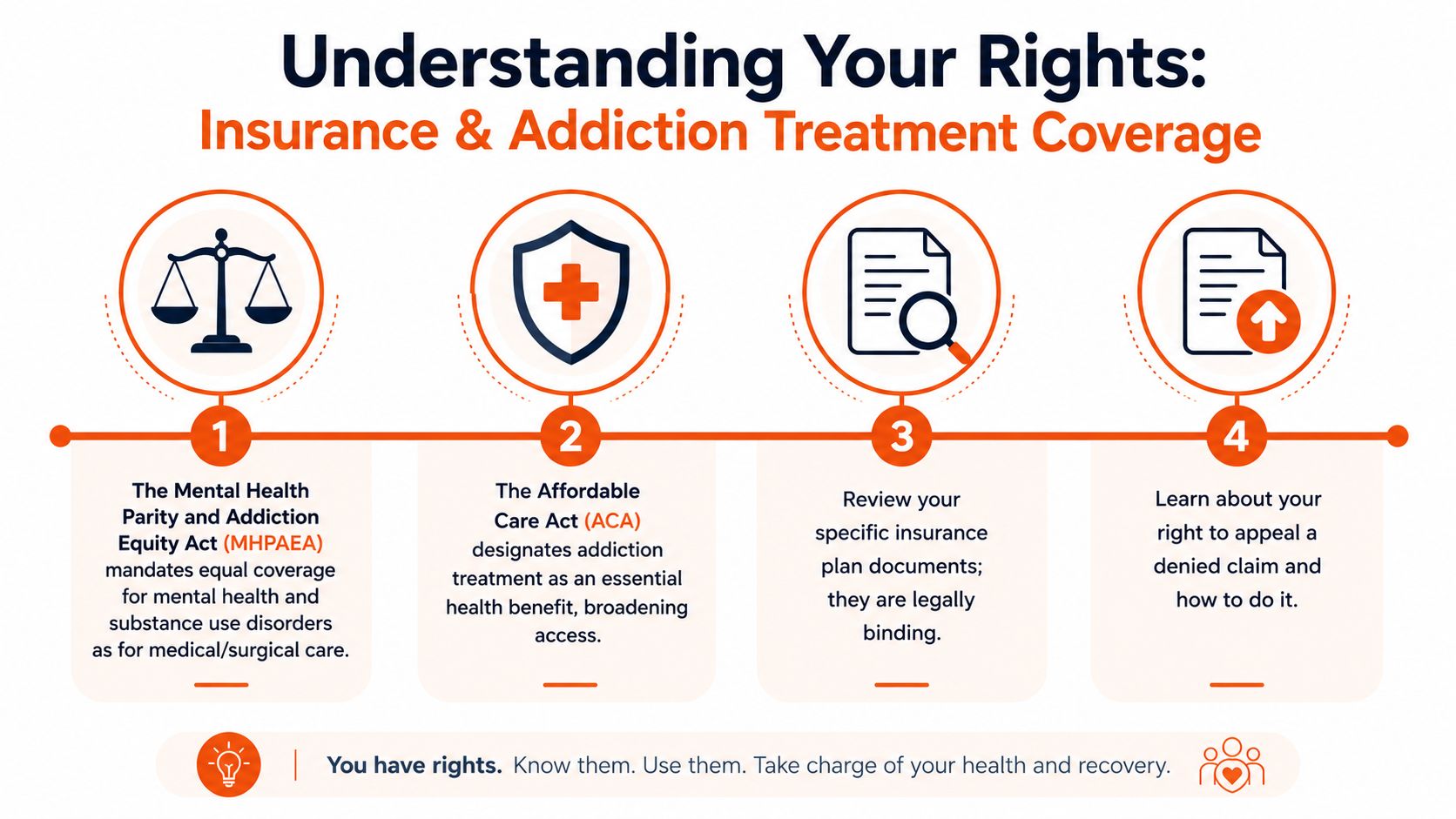
What those laws mean for you in real life
Use the law as a pressure tool, not a comfort phrase. If an insurer applies tighter standards to addiction treatment than it would to a comparable medical condition, challenge it. Ask for the medical necessity criteria in writing. Ask whether the same review standards apply to medical and surgical benefits. If the answers are vague, treat that as a warning sign and keep pushing.
Privacy worries are real, especially for executives, physicians, attorneys, founders, and other professionals whose schedules and reputations feel tightly exposed. In most cases, verifying benefits does not mean informing your employer. Keep the circle small: the insurer, the treatment provider, and one trusted family member, assistant, or advisor who can help track approvals and paperwork. That protects time and discretion.
If anxiety is fueling delay, denial, or panic-driven decision making, these anxiety learning resources can help you get grounded before you start making calls.
Here is the plain answer. Insurance usually must cover addiction treatment under these federal protections. Your job is to make the insurer define exactly how that coverage applies to your level of care, your preferred facility, and your privacy needs.
Decoding Your Plan PPO HMO Medicaid and More
Insurance language gets people stuck because the acronyms sound technical when they're really about one thing: how much freedom you have to choose care.
A PPO is the flexible option. You can usually see a wider set of providers, and you often don't need a primary care referral before entering treatment. That matters if you need to move fast, want a discreet facility outside your immediate area, or are trying to avoid discussing addiction treatment with multiple gatekeepers.
An HMO is more controlled. It usually requires you to stay inside a defined network and get referrals through a primary care doctor. That can work fine for routine care. It can be a problem when you need urgent detox, want a specific residential setting, or need treatment far enough from home to protect privacy.
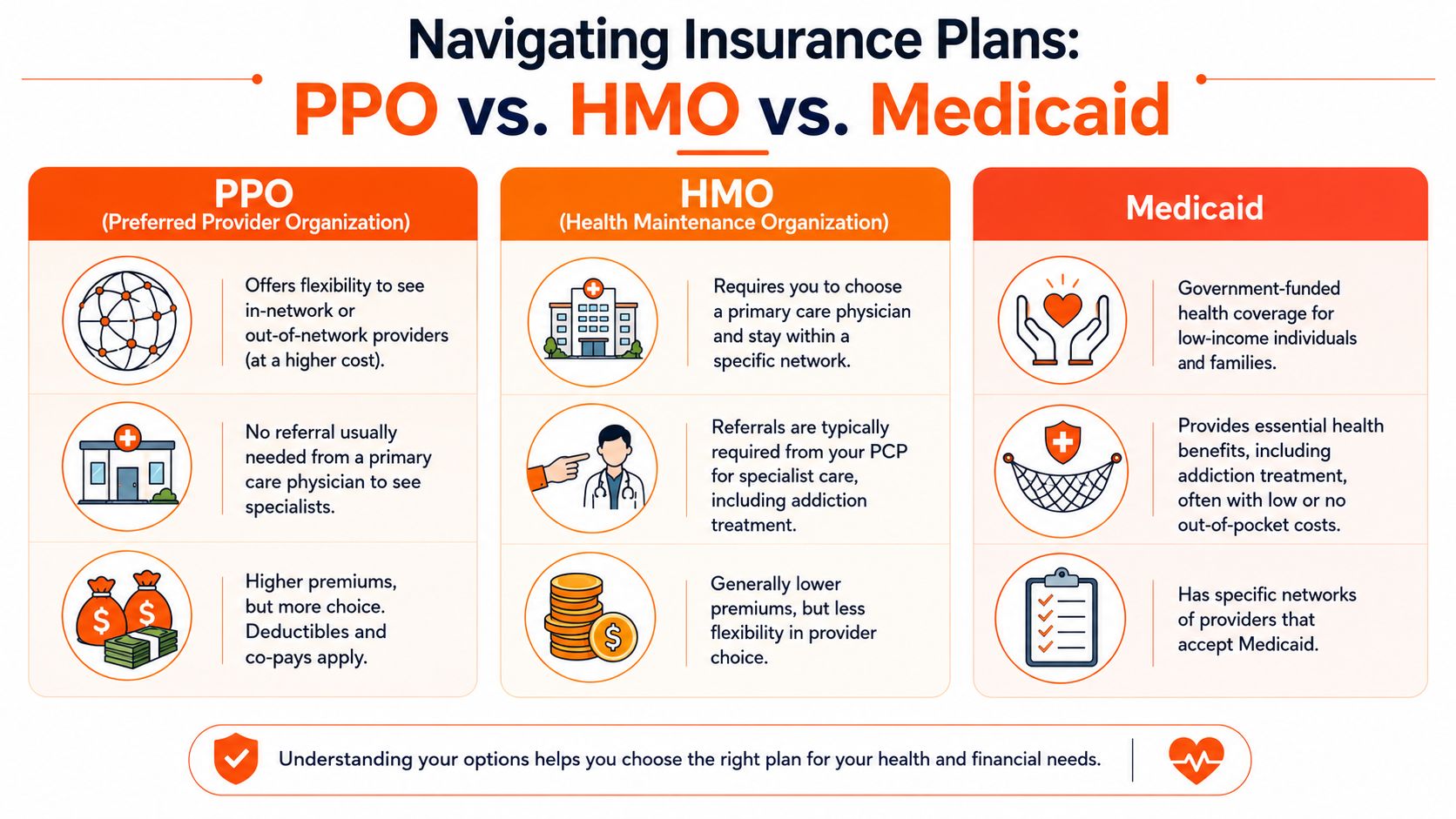
The practical difference between common plan types
| Plan type | What usually helps | What usually slows people down |
|---|---|---|
| PPO | More provider choice, out-of-network options may exist | Higher out-of-pocket exposure |
| HMO | Lower cost structure, simpler in-network rules once approved | Referral requirements and tighter network limits |
| Medicaid | Essential behavioral health benefits are included | Provider availability and covered levels of care can vary significantly |
| Employer EAP | Fast, confidential starting point for assessment and referral | Usually not a substitute for full treatment coverage |
Under the ACA, substance use disorder treatment is one of the 10 essential health benefits, and the MHPAEA requires financial requirements like deductibles for substance use disorder services to be no more restrictive than those used for medical and surgical benefits, as explained in this overview of ACA and parity requirements for addiction treatment coverage.
Medicaid, Medicare, and EAPs
Medicaid deserves special attention because people hear "covered" and assume "available." Those aren't the same. Medicaid programs can be highly useful, but access often depends on state policy, the provider network, and whether the facility accepts that coverage.
Medicare can also cover behavioral health and substance use treatment, but the path is often more administrative and less intuitive for families trying to move quickly. If Medicare is involved, I strongly recommend getting the facility's admissions team or case manager involved early rather than trying to decode every rule yourself.
Then there's the Employee Assistance Program. Many executives ignore it because they assume it isn't confidential or because it sounds too minor for a serious problem. That's a mistake. An EAP can be a smart first call when you need an assessment, a short-term counseling bridge, or help locating treatment options without immediately trying to decipher your entire health plan.
If you're trying to protect your role, your license, or your reputation, a PPO often gives you more maneuvering room. An HMO can still work, but only if you confirm the referral and authorization path before a crisis makes the decision for you.
If your goal is speed, privacy, and choice, understand your plan category before you do anything else. It shapes almost every decision that follows.
What Services Are Typically Covered by Insurance
When people ask whether insurance covers rehab, they're usually asking the wrong question. Insurers don't think in terms of "rehab" as one thing. They think in levels of care.
That means coverage is often split across medical detox, residential treatment, partial hospitalization, intensive outpatient, and standard outpatient services. Each level is reviewed separately, often approved separately, and sometimes challenged separately. If you don't know the level of care being recommended, you can't get a useful answer from the insurer.
The services most people need to ask about
Start with the common categories:
- Medical detox: This is often the first step when withdrawal risk is a concern. It addresses stabilization, monitoring, and medication support.
- Residential treatment: This is live-in care with a structured daily schedule, therapy, and clinical oversight.
- PHP and IOP: These are intensive day-based treatment options for people who don't need overnight care or who are stepping down from residential treatment.
- Outpatient therapy and psychiatric care: This includes ongoing therapy, medication management, and relapse prevention after higher levels of care.
- Medication-assisted treatment: Coverage has improved in many plans, but how it's handled still depends on the carrier, formulary, and provider setup.
The hard truth is that insurers often approve care in pieces. They may authorize a short initial stay, then require the facility to submit ongoing clinical updates to justify more time. That's why families feel blindsided. They thought they got "approved," but what they really got was approval for the first segment.
Why residential care is where disputes often show up
Residential and intensive outpatient coverage vary a lot. Some Medicaid plans may cover outpatient detox while excluding residential treatment entirely. In the commercial market, plan design matters just as much. A United Healthcare short-term plan described in the policy review literature had deductibles ranging from $1,000 to $10,000 and a term maximum of $3,000 for substance abuse programs, while plans with more extensive benefits offered broader coverage with 20-30% deductibles, according to the analysis of addiction treatment coverage variability across plans and states.
That single point should change how you approach this. Don't ask, "Do you take United?" Ask, "Does this exact plan cover residential, detox, PHP, and IOP at this facility, and what are the financial limits?"
Residential treatment is where many families discover that "covered" still leaves major gaps.
Here's the mindset I recommend:
- Use clinical language. Ask about detox, residential, PHP, IOP, outpatient, and medication management by name.
- Expect stepwise approval. Initial authorization is rarely the whole story.
- Prepare for reviews. Facilities often have to send documentation to continue care.
- Don't confuse network status with fit. A covered in-network option may still be clinically weak or operationally unrealistic for someone managing work, legal, or professional obligations.
If you're trying to understand the administrative side of therapy billing and avoid confusion around longer therapy sessions, this guide to preventing improper psychotherapy payments gives useful context on how insurers scrutinize behavioral health claims.
For executives, one more point matters. The insurer's preferred level of care and the level of care that protects your privacy and functioning may not be the same. That's why benefit verification has to happen alongside a real clinical assessment, not instead of one.
How to Verify Your Benefits and Get Approved
This is the part where people either get traction or lose a week. Be methodical. Don't wing it.
You need two calls. First, call the insurer. Second, call the treatment provider you're considering and ask them to verify benefits independently. Good admissions teams do this every day. They know what language insurers use, what documents get requests moving, and when a "maybe" from member services is a no.
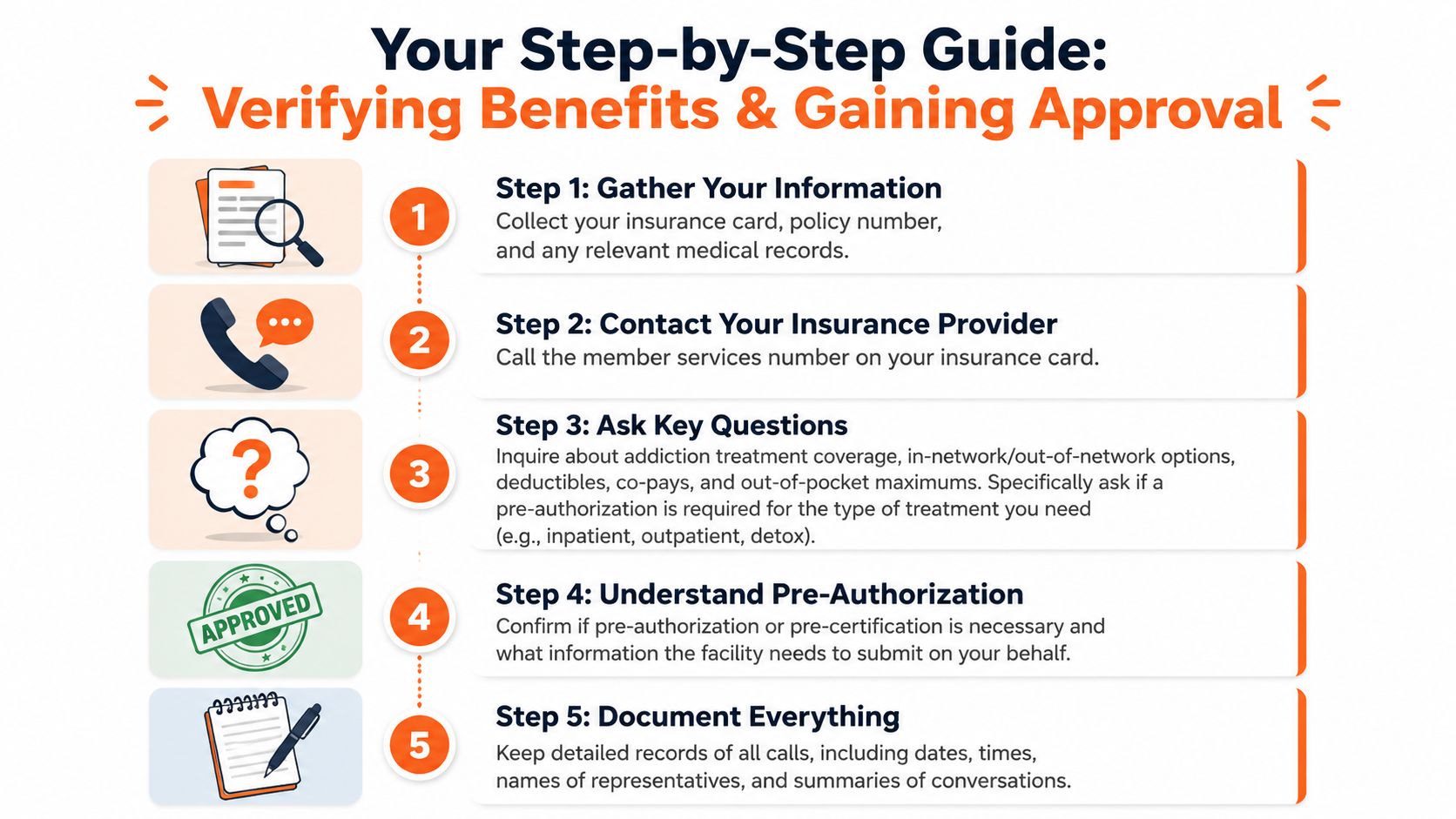
What to say when you call
Use the behavioral health or mental health number on the card if one is listed. If not, call member services and ask to be transferred to behavioral health benefits.
Ask these questions in this order:
- Do I have benefits for substance use disorder treatment?
- What levels of care are covered under my plan? Ask specifically about detox, residential, partial hospitalization, intensive outpatient, and outpatient.
- Does coverage require pre-authorization or pre-certification?
- Do I need a referral from a primary care physician?
- What is my deductible status, and what cost-sharing applies once it's met?
- What is my out-of-pocket maximum?
- Is this facility in network, out of network, or non-contracted under my exact plan?
- How are continued stays reviewed after initial authorization?
- Are there exclusions, visit limits, or facility-type restrictions I need to know about?
- Can you email or portal-message a summary of these benefits?
What to document every time
Don't trust your memory. Write everything down while you're on the phone.
- Representative details: Full name, department, call reference number if available.
- Timing: Date and exact time of the call.
- Plan language: The exact words used for covered levels of care and authorization requirements.
- Financial terms: Deductible, copay, coinsurance, and out-of-pocket maximum details.
- Next step: What the facility must submit and where it must be sent.
If prior authorization is unfamiliar, this primer on navigating healthcare prior authorization is worth reviewing before you call. It helps you understand why so many approvals hinge on documentation rather than on the diagnosis alone.
Let the facility do the heavy lifting
A treatment center's admissions team can usually verify benefits faster and more accurately than a stressed family member. They know how to match the clinical presentation to the insurer's criteria and what records need to be gathered. If you want a starting point, you can use Capo Canyon Recovery's insurance verification page to have a provider-side team check benefits directly.
What matters most: Get the answer in writing when possible, and make sure the facility confirms it separately. Insurance call centers are full of partial answers.
If you're an executive, add one more question: "How will billing and communication be handled to protect privacy?" That's not paranoia. It's responsible planning.
Executive Treatment Needs and Private Pay Options
Insurance approval isn't the same thing as the right treatment decision. For executives, physicians, attorneys, founders, pilots, and other high-responsibility professionals, the wrong setting can create a second crisis.
A standard in-network program may technically satisfy the insurer. It may still be a poor fit if it has large groups, little privacy, no private room, rigid communication restrictions, or no capacity to work around urgent professional obligations. If your reality includes board meetings, licensing concerns, client confidentiality, or the need to stay reachable for critical decisions, those details matter.
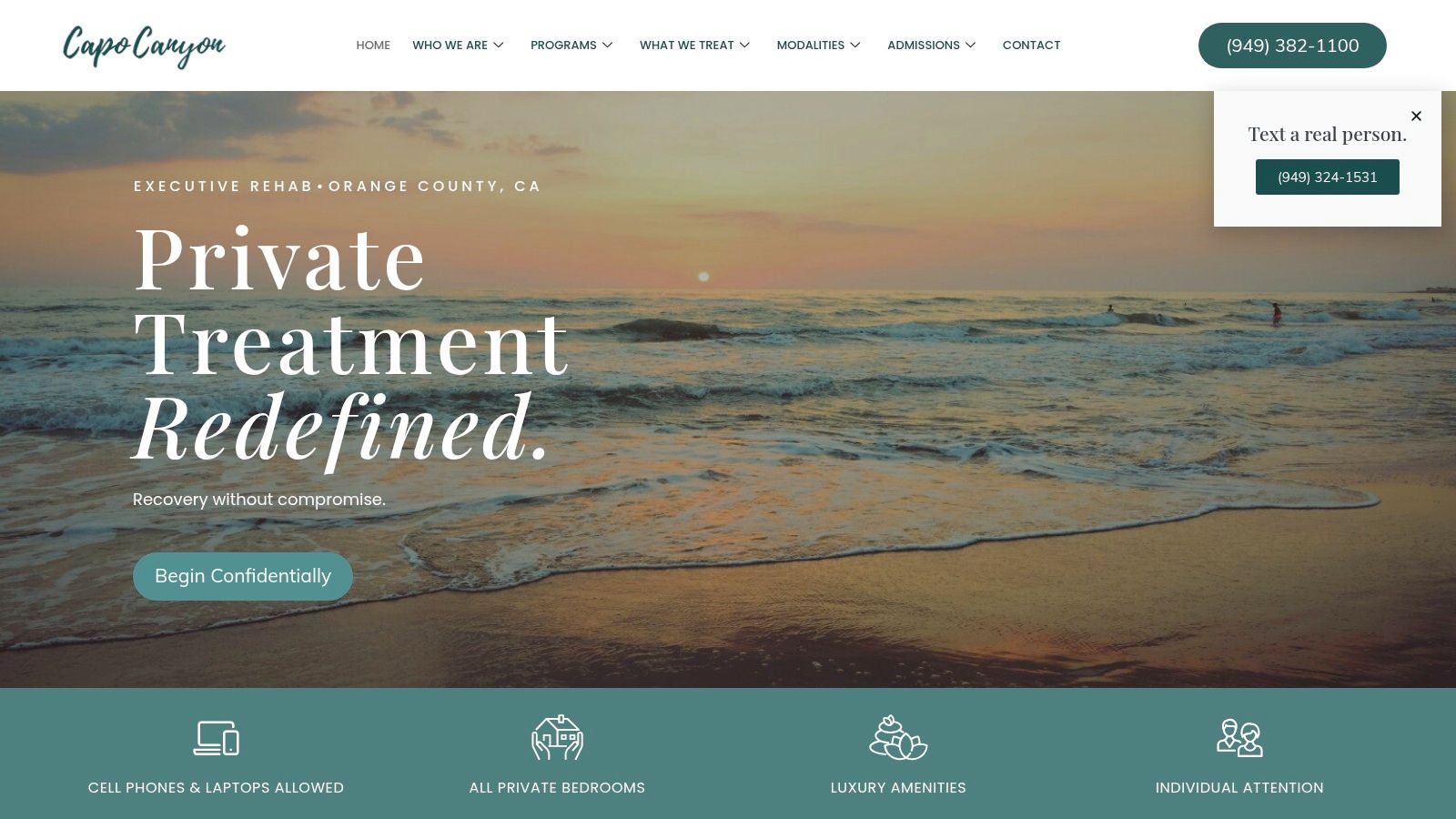
When insurance-driven care isn't enough
Insurers are built to manage cost. Families are trying to protect health, privacy, and long-term functioning. Those goals overlap sometimes, but not always.
Here are situations where private pay or an out-of-network option often makes strategic sense:
- You need discretion: A smaller census and private environment reduce exposure.
- You can't disappear completely from work: Some executive-focused programs allow phones and laptops in a structured way.
- You have a dual diagnosis picture: Anxiety, depression, trauma, or ADHD often need integrated psychiatric care, not a narrow substance-only approach.
- You need higher-touch treatment: More individual sessions and tighter clinical coordination can matter in complex or severe cases.
How to think about the cost decision
Don't frame it as "insurance versus self-pay." Frame it as coverage plus gap planning.
Some families use insurance for the covered portion and self-pay for the difference if the preferred program is out of network or offers amenities and staffing the insurer won't reimburse at the same level. Others choose a fully private route because confidentiality and treatment fit outweigh the economics of staying in network.
A private option should earn that investment. It should offer concrete differences in environment, staffing, access, communication policy, and clinical structure. If you need help evaluating the numbers behind that decision, review this breakdown of rehab cost considerations.
Paying privately doesn't automatically mean better care. But if privacy, technology access, individualized treatment, and a small setting are non-negotiable, insurance alone may not buy what you actually need.
The right question isn't whether your plan approved a bed. It's whether the program protects recovery without blowing up the rest of your life.
What to Do When Your Insurance Says No
A denial feels personal when you're already scared. Most of the time, it isn't personal. It's administrative, and that means it can be challenged.
Insurers continue to deny substance use disorder care at higher rates than medical or surgical care, despite federal parity laws dating back to 2008. The imbalance sits inside a larger funding problem too. In 2014, mental health treatment spending accounted for 6.4% of all health spending, while substance use disorder treatment accounted for 1.2%, according to SAMHSA's review of health insurance and substance use treatment financing.
That means a denial isn't unusual. It's a hurdle built into the system.
Your first moves after a denial
Ask for the denial in writing if you don't already have it. You need the exact reason, the specific service denied, and the deadline for appeal.
Then do this:
- Get the clinical case organized: Ask the treatment provider for records, recommendations, and medical necessity documentation.
- File the internal appeal fast: Follow the insurer's process exactly and keep copies of everything.
- Push for specificity: If they say the care isn't medically necessary, ask what criteria they used.
- Request external review if needed: If the internal appeal fails, you may have the right to an independent review.
Don't fight alone
The treatment provider can often help write the appeal packet, supply documentation, and explain why the recommended level of care is appropriate. If detox is involved, don't let paperwork delay safe evaluation. Keep the medical issue and the insurance dispute separate in your mind.
If you're looking at private detox while the insurance question is still being sorted out, this page on private detox options near you can help you understand one path forward.
A denial is not the end of the road. It's the point where you stop taking verbal summaries at face value and start building a documented case.
If you need discreet, executive-focused guidance on insurance verification, detox, residential treatment, or private-pay options, Capo Canyon Recovery is one place to start. Their team works with professionals and families who need clarity on coverage, privacy, and treatment fit without adding more chaos to an already difficult moment.