
You're probably reading this with two tabs open. One is work. The other is a search for Private Detox Near Me.
That usually means the situation has stopped being theoretical. A spouse has drawn a line. A doctor has raised concern. You've tried to control it on your own and found out that willpower doesn't reliably manage alcohol withdrawal, benzodiazepine dependence, opioid cravings, or stimulant crashes. At the same time, stepping away from your phone, your team, your clients, or your license feels impossible.
That conflict is real. It's also one of the biggest reasons professionals wait too long to get help.
The Executive's Dilemma Needing Help Without Losing Control
A lot of high-functioning people don't look like they're in crisis. They're still taking calls, closing deals, showing up at school events, and answering emails at midnight. From the outside, everything appears intact. Inside, the margin is gone.
The pattern is familiar. A business owner starts drinking earlier to steady nerves. A physician increases a prescription dose to sleep after long shifts. An attorney needs pills to land and more pills to wake up. None of them think, “I need rehab.” They think, “I need to get through this week.”
Then one night turns into a serious scare, or one morning begins with shaking, panic, vomiting, or the inability to function without using. That's when the search changes from curiosity to urgency.
Why professionals delay
The fear usually isn't about whether treatment might help. It's about what treatment will cost professionally. Data from California addiction treatment directory findings in Los Angeles shows 68% of executives delay treatment due to fear of work disruption, while only 12% of rehab directories explicitly highlight tech-friendly policies or private workspaces during medical detox.
That gap matters. It means many individuals searching for private detox near me are trying to solve two problems at once:
- Medical risk: Withdrawal can become dangerous fast.
- Professional continuity: Someone still has to handle payroll, board communication, legal matters, patient coverage, or family office decisions.
Practical rule: If a program talks about privacy but says nothing concrete about phones, laptops, private workspace, or who can contact you, it probably hasn't built care around executive reality.
Families run into the same issue. They're not just trying to get their loved one safe. They're trying to stabilize the rest of life at the same time. In some households, that means handling childcare, estate operations, travel changes, or domestic staffing with the same level of discretion expected in treatment. Resources on discreet private staffing solutions can help families protect privacy at home while a loved one gets care.
There is a form of treatment built for this exact problem. It isn't casual. It isn't lenient. It's structured medical care designed for people who need both safety and controlled connection to real-world responsibilities. If you want a concrete example of what that looks like, review an executive detox program in Orange County with privacy, comfort, and clinical support.
What Is Private Medically Supervised Detox
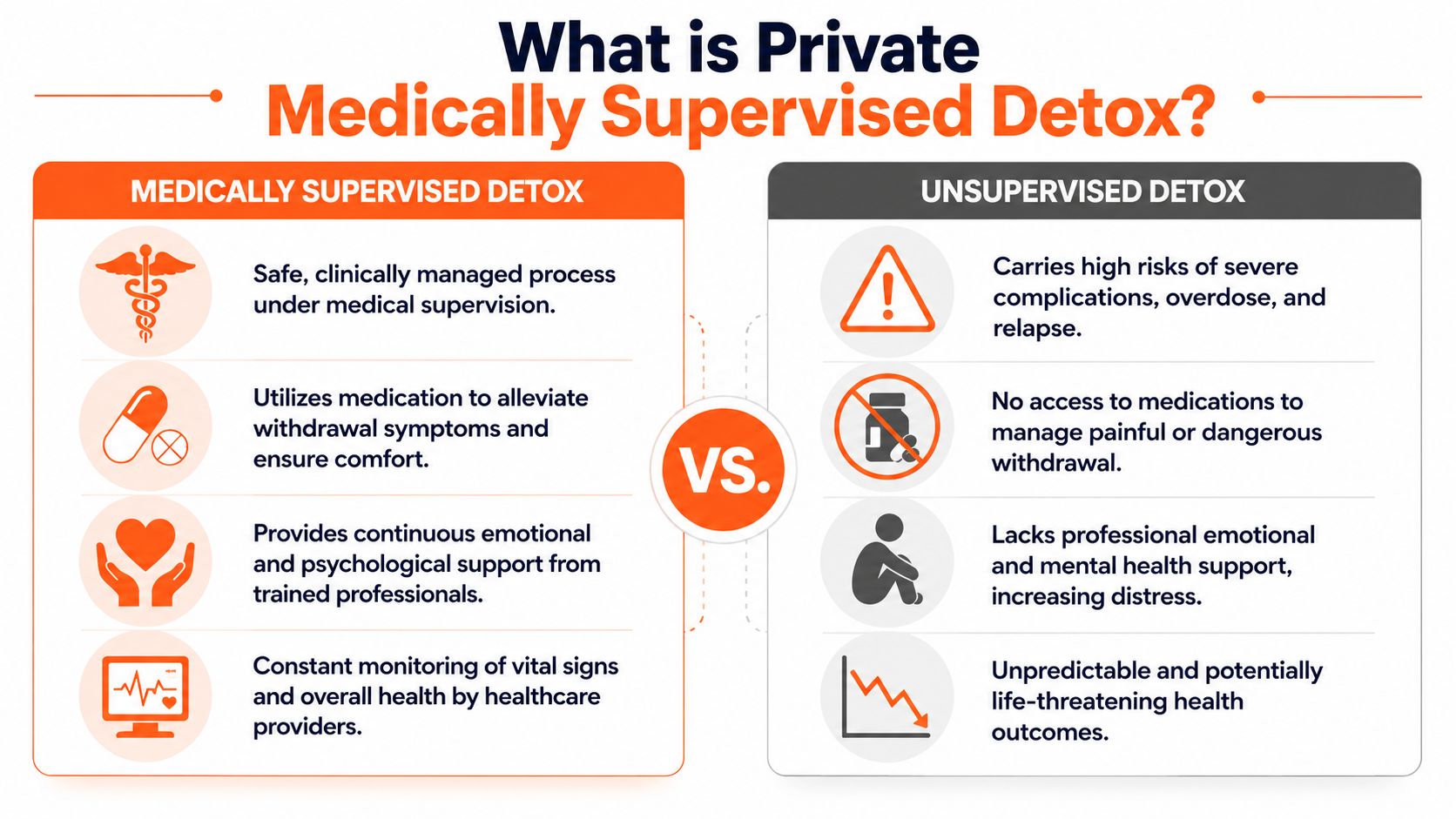
Medical detox is the first phase of treatment. Its job is simple and critical. It helps your body clear alcohol or drugs while a clinical team manages withdrawal safely.
That means 24/7 monitoring, medical evaluation, symptom management, and psychiatric support when needed. It is not the same as resting at home, cutting back, or asking a friend to “keep an eye on you.” Withdrawal can become unstable quickly, and the first goal is stabilization.
A private detox adds a second layer. It reduces exposure, noise, and friction so the patient can complete the process. For professionals, that difference often determines whether they stay.
What private changes in practice
A generic detox program can be clinically legitimate and still feel impersonal. Shared rooms, rigid communication rules, and a crowded census create stress at the exact moment someone is physically unstable.
A private executive detox is different because it treats comfort and discretion as clinical tools, not decoration.
| Feature | Standard Detox Program | Private Executive Detox |
|---|---|---|
| Environment | Often more institutional, with less personal space | More residential, quiet, and designed for rest |
| Privacy | Limited separation from other patients | Private room and more controlled exposure |
| Work access | Often highly restricted | Tech-friendly policies may allow essential communication |
| Attention | Staff divided across a larger group | Smaller census allows more individualized observation |
| Comfort | Basic amenities | Private workspace, calmer setting, tailored meals |
| Professional fit | One-size-fits-all scheduling | Care plan may account for high-responsibility roles |
Why completion matters
The detox process doesn't help if the patient walks out before stabilization. That's one reason program design matters so much. According to American Addiction Centers' treatment success and completion statistics, relapse rates for addiction range from 40% to 60%, and less than 43% of people who enter drug and alcohol treatment complete it. That same source notes that private executive detox centers report significantly higher completion rates than public programs because they reduce barriers for professionals, including through small census sizes and executive-friendly policies.
That aligns with what I tell families every day. If a program creates unnecessary obstacles in the first few days, people leave. If it creates safety, structure, and dignity, people stay long enough to benefit.
Detox should lower chaos, not add to it.
What private doesn't mean
Private doesn't mean permissive. It doesn't mean the patient controls the clinical plan. It means the program removes avoidable stress while keeping medical judgment in charge.
The best private detox settings share a few traits:
- Continuous medical oversight: Nurses and prescribing clinicians actively manage withdrawal symptoms.
- Tight confidentiality: Access, communication, and patient information are controlled carefully.
- Smaller census: Fewer patients often means more direct attention.
- Executive accommodations: A phone or laptop policy supports urgent obligations without letting work consume treatment.
When you search Private Detox Near Me, this is the true distinction you're trying to find. Not nicer furniture. Better clinical containment with fewer reasons to bolt.
Key Criteria for Choosing a Private Detox Facility
Most websites make every center sound the same. They aren't. If you're comparing options, use a hard standard and don't compromise on the basics.
Start with medical safety
Ask whether the facility is properly licensed and whether detox is medical, not merely supervised. You want licensed nursing, prescribing oversight, medication management, and a clear process for escalation if symptoms worsen.
Detox is the most acute phase of care. In California, state-level rehab cost and treatment data shows that a standard 7-day private medical detox can cost around $4,025 before insurance, reflecting the intensive 24/7 nursing and psychiatric oversight involved. The same source notes that 17,476 individuals were assessed for co-occurring mental health and substance use disorders in California in the 2023/24 fiscal year, which is one reason integrated care affects both complexity and cost.
If a center is vague about who is medically responsible for you, move on.
Privacy has to be operational
Every detox center says it values confidentiality. That statement means very little by itself. Ask how privacy works in daily life.
Look for specifics such as:
- Room setup: Private bedroom, not “private when available.”
- Admissions process: Discreet intake and controlled communication.
- Census size: Fewer residents usually means less exposure.
- Visitor and device rules: Clear boundaries, not improvisation.
A private setting should protect your reputation without making you feel hidden or punished.
Executive accommodations need to be explicit
If work continuity matters, don't assume anything. Ask whether phones and laptops are permitted, under what conditions, and where the patient can handle essential tasks.
A good executive track usually includes:
- Defined tech policy: Not staff-by-staff discretion.
- Private workspace: Somewhere to take a critical call without destabilizing the unit.
- Clinical guardrails: Staff help keep work from swallowing treatment.
That balance is hard to fake. Programs either have it or they don't.
Dual diagnosis care must begin during detox
A lot of people searching for private detox near me aren't dealing with substance use alone. Anxiety, depression, trauma, bipolar disorder, and ADHD often drive the cycle and complicate withdrawal.
Ask whether psychiatric care starts immediately or gets postponed until “after detox.” That delay is a mistake. If panic, insomnia, depression, or agitation are active during withdrawal, the psychiatric side can't wait.
A detox center that separates withdrawal from mental health is asking the patient to white-knuckle both.
Cost transparency tells you a lot
Private care is expensive. That doesn't mean pricing should be murky. Ask for a clear explanation of what is included, what may be billed separately, whether insurance is verified before admission, and what happens if the recommended stay changes.
One example of a local program built around these criteria is Capo Canyon Recovery, a Mission Viejo facility licensed by DHCS that provides detox and residential care for executives and professionals, including tech-friendly policies, private rooms, and integrated psychiatric support.
Your Vetting Checklist Questions to Ask Before Committing
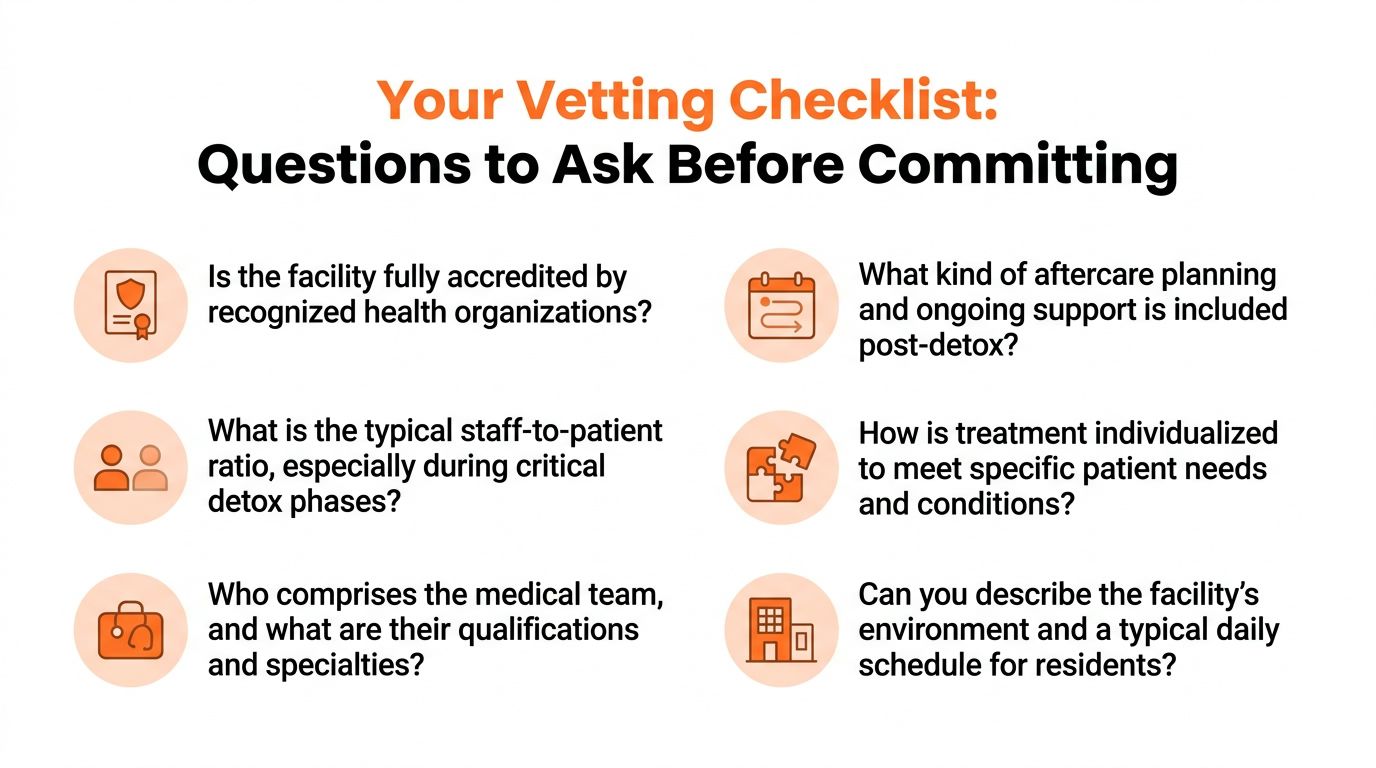
Admissions calls go better when you stop asking broad questions like “Do you treat professionals?” and start asking narrow ones that force clear answers.
Ask about psychiatric coverage first
The biggest miss I see is families forgetting to ask who handles mental health during detox. According to a 2026 SAMHSA-related analysis summarized here, only 19% of private detox programs offer integrated psychiatric oversight during detox itself. The same source states that 76% of clients seeking private detox have co-occurring conditions, which is why asking whether a psychiatrist is on-site during detox is so important.
Ask these questions directly:
- Who manages psychiatric symptoms during detox? Ask whether a psychiatrist or psychiatric NP is involved from day one.
- Is psychiatric care on-site or by referral later? If it's delayed, that's a red flag.
- How do you handle anxiety, depression, trauma symptoms, bipolar disorder, or ADHD during withdrawal? The answer should be concrete, not vague.
Ask operational questions that reveal the real program
Marketing language falls apart under precise questions. Use that to your advantage.
- Who is physically present overnight? You want to know whether nursing is on-site and active.
- What substances do you detox most often? Experienced teams answer this calmly and specifically.
- How many clients are typically in the program at one time? Census affects privacy and attention.
- What's your cell phone and laptop policy during detox? Don't accept “it depends” without details.
- Do patients have a private room and a place to work if needed? Essential for executives and licensed professionals.
- How do you protect confidentiality for high-profile clients? Listen for process, not slogans.
If you want a structured list to use during calls, this guide on what to ask before choosing a detox center is worth keeping open while you speak with admissions.
If the admissions team can't answer basic clinical questions, they're either undertrained or hiding the program's limitations.
Ask about what happens after detox
Detox without a next step is incomplete. Before committing, ask:
- What level of care do you usually recommend after detox?
- Who creates the discharge or step-down plan?
- How is family involved if appropriate?
- What happens if the patient wants to leave early?
A strong program will answer with a coordinated plan, not a handoff and a phone number.
The First 72 Hours What to Expect During Private Detox
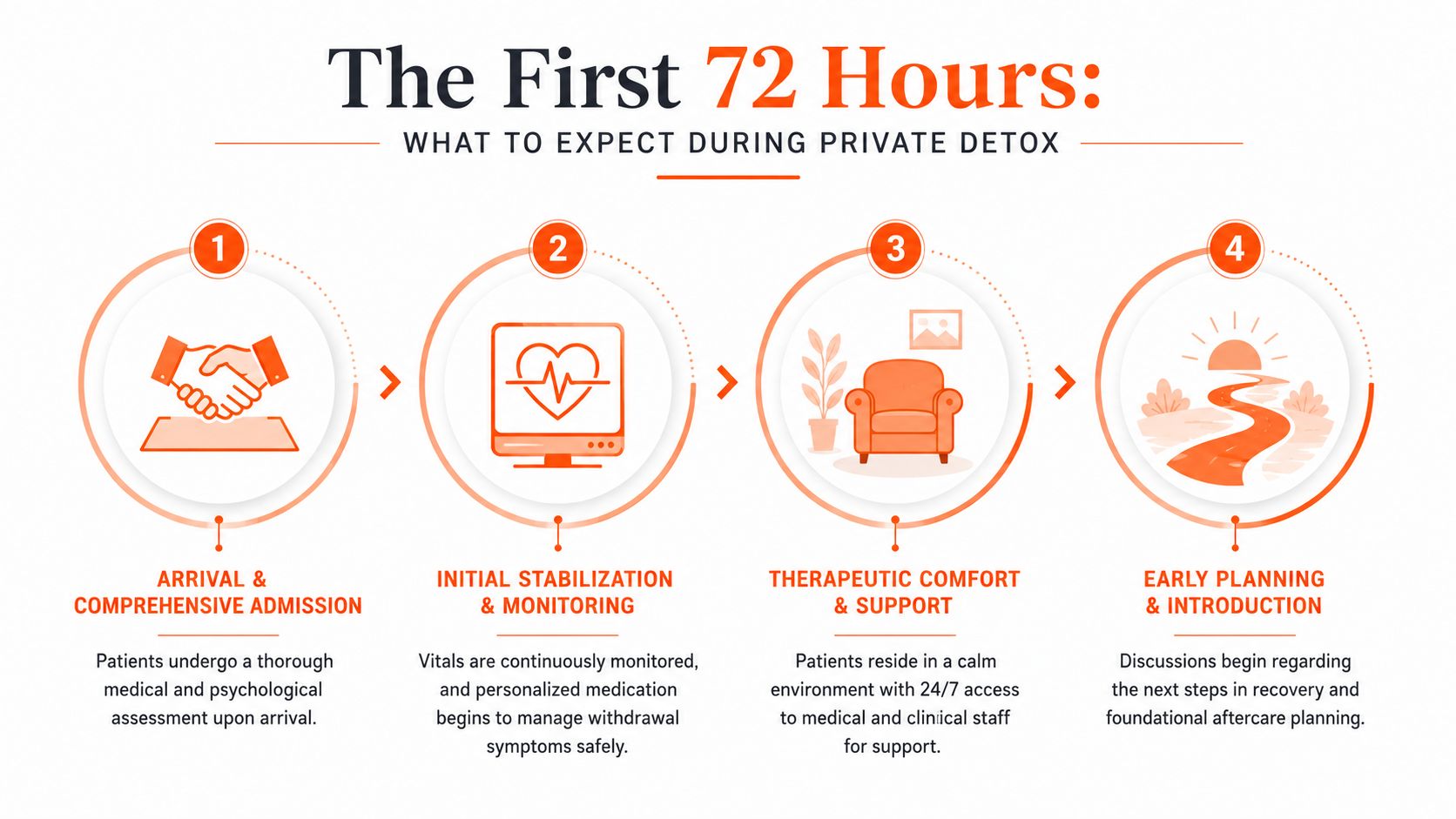
The first three days matter because they replace uncertainty with structure. People usually arrive exhausted, ashamed, physically uncomfortable, and bracing for something punitive. A well-run private detox feels very different.
Arrival and admission
On arrival, the team starts with assessment. That usually includes substance use history, recent use, current symptoms, medications, physical health concerns, mental health review, and immediate risk issues. The point isn't paperwork for its own sake. The point is to build a safe detox plan.
Then the patient gets settled. In a private setting, that often means a private room, time to decompress, and a direct introduction to the core staff. The environment should lower stimulation, not add to it.
Stabilization begins quickly
Once the team has the clinical picture, detox becomes active care. Medications may be used to reduce withdrawal symptoms, protect sleep, lower agitation, and support medical safety. Nurses monitor vital signs, watch for changes, and keep adjusting based on how the patient is doing.
For the patient, this period often feels less dramatic than expected. There may be sweating, nausea, shakiness, fatigue, headache, poor sleep, irritability, or anxiety, depending on the substance involved. But there is also relief because someone is finally tracking it closely.
Most patients calm down once they realize they won't have to muscle through withdrawal alone.
The human side of private care
The first 72 hours aren't just medical. They're also about preserving dignity while the body settles. Patients rest. They eat when they can. Staff check in often. If the center allows controlled technology access, a professional might handle one urgent email thread, speak to a partner, or delegate a critical issue, then return attention to treatment.
That's the right use of executive accommodations. Not business as usual. Just enough continuity to prevent avoidable fallout.
A private facility may also introduce early therapy, case management, and psychiatric follow-up during this window. Those conversations are usually practical at first. What's triggering cravings, what symptoms are intensifying distress, what family or work issue needs containment, and what level of care should come next.
By the end of the third day
Most patients are not “finished” in 72 hours, but many are more stable, more oriented, and far less afraid than when they arrived. The fog starts to lift. Appetite may improve. Sleep may begin to normalize. The patient can think more clearly about the next step instead of just surviving the next hour.
That shift is why detox works best when the setting is calm, competent, and tightly managed.
The Local Advantage Finding Private Detox in Orange County
Location matters more than people realize. When someone searches for private detox near me, they're not just looking for mileage. They're looking for a place that can admit quickly, protect privacy, and make the first days of care feel manageable.
Orange County works well for that. The setting is quieter than a hospital-based urban experience, but still close to major professional and family networks. That matters for executives, physicians, attorneys, pilots, founders, and families who may need fast admission without creating more public exposure than necessary.
Why staying local often helps
A nearby private detox can make logistics cleaner:
- Faster admission: Less delay when the decision is finally made.
- Easier family coordination: A spouse, sibling, or attorney can stay involved without major travel.
- Better continuity: Local step-down planning is often simpler after detox.
- Less disruption: Important for people balancing treatment with protected professional obligations.
For Orange County families, staying close can also reduce the excuse-making that keeps treatment on hold. If the right level of care is nearby, there's less room to postpone.
A useful starting point is this resource on choosing a local detox in Orange County and why staying close to home matters. It's especially relevant if you're weighing whether local treatment can still offer enough discretion and clinical structure.
What to look for locally
Don't choose based on scenery alone. In Orange County, the programs worth your time are the ones that combine medical detox, psychiatric access, privacy, and executive practicality in one place. If a center can't clearly explain how it handles work continuity and dual diagnosis during detox, keep calling.
Local convenience only helps if the clinical model is solid.
Beyond Detox Planning for Lasting Recovery
Detox is stabilization. It is not recovery by itself.
That distinction matters because people often feel a burst of relief once withdrawal eases. The body settles, sleep improves, the crisis softens, and everyone wants to believe the hard part is over. It isn't. The underlying drivers of use are still there unless treatment goes further.
What comes after detox
Most patients need a next phase that gives them structure while they rebuild judgment, routines, and emotional stability. That may involve residential treatment, dual diagnosis care, individual therapy, group work, medication follow-up, and case management.
For professionals, this next phase should also answer practical questions:
- How will work communication be handled?
- What does family involvement look like?
- What support is needed for licensing, monitoring, or leave issues?
- What is the plan for re-entry after treatment?
Without those answers, people leave detox physically improved but strategically unprepared.
Recovery gets stronger when the handoff is seamless
The best detox programs don't treat discharge like an exit. They treat it like a transfer to the next right level of care. That means the case manager, therapist, psychiatric team, and family are aligned before the patient steps down.
A safe detox protects the body. A good treatment plan protects the life the patient is going back to.
If you're a family member, don't focus only on getting your loved one through admission. Ask what happens on day five, day ten, and after discharge. If you're the one searching for private detox near me, keep this simple. You do not need to map out the next six months tonight. You only need a program that can safely get you through the door, stabilize you, and build the next step with you.
The decision doesn't have to be dramatic. It just has to be made.
If you need a discreet place to start, Capo Canyon Recovery offers confidential insurance verification and direct access to a clinical team that understands executive and family concerns around privacy, work continuity, and dual diagnosis during detox. A private call can clarify whether detox is appropriate, what admission would look like, and how quickly care can begin.