
You're still functioning. You're making calls, answering emails, showing up to meetings, and hitting deadlines. From the outside, nothing looks urgent.
But the internal math has changed. You're drinking before dinner because it's the only way to come down. You're using stimulants to get back up. You're telling yourself this is a rough quarter, a trial season, a temporary pattern. Meanwhile, sleep is fragmented, patience is shorter, and the gap between your professional image and your private reality keeps widening.
That gap is where many people begin looking for Orange County rehab. Not because they've lost everything, but because they can finally see what's at risk.
High-functioning addiction often hides behind competence. A person can keep a company running, argue a case, close a deal, or see patients all day while their nervous system is under constant chemical pressure. The question isn't whether you can still perform. The question is whether your current system is stable enough to keep carrying the weight.
Recognizing the Signs It's Time for a Higher Level of Care
A common pattern looks like this: a business owner starts using alcohol to shut off after high-conflict days. Then one drink becomes several because the first one no longer does the job. A physician uses sedatives to sleep after call, then needs stimulants to function the next morning. A lawyer tells herself she's fine because she's still billing hours, even though her spouse has stopped believing her promises.
That's not failure. It's progression.

High performance can mask clinical severity
Professionals often miss the level of care they need because they compare themselves to a stereotype. They think rehab is for someone who can't work, can't hide it, or has already had a public collapse. In practice, the more subtle form of denial is productivity.
Signs that point toward residential treatment rather than trying to manage it alone include:
- You need substances to regulate state changes. You don't just use to have fun. You use to wake up, sleep, calm down, focus, socialize, or face pressure.
- Your off-switch is gone. You intend to have one or two drinks, one pill, one night off. Then the plan keeps moving.
- Your private life is absorbing the damage. Missed family commitments, emotional volatility, secrecy, and isolation often show up before visible professional consequences.
- You've tried to control it and haven't held the line. Rules, breaks, tapering, switching substances, and “only on weekends” plans keep collapsing.
- Mental health symptoms are intensifying. Anxiety, panic, irritability, depression, trauma activation, or racing thoughts are no longer background issues.
The ability to keep working doesn't mean the problem is mild. It often means the person has become highly skilled at compensating.
Orange County's overdose burden makes this urgency concrete. In 2020, Orange County recorded over 13,000 emergency department visits, 6,600 hospitalizations, and more than 1,000 deaths related to drug and alcohol overdose according to Orange County Health Care Agency overdose data. Those numbers don't describe a fringe problem. They describe a public health reality that includes people who looked “fine” until they weren't.
A strategic decision, not a surrender
If you're reading this and wondering whether you need detox or inpatient care, that question matters more than the excuses around it. When substance use has become part of how you manage work, mood, and identity, a higher level of care is often the most efficient path back to control.
A practical starting point is reviewing the signs you might be ready for drug or alcohol detox. The point isn't to label yourself. It's to stop treating a clinical problem like a scheduling problem.
The Critical First Step Safe Detox and Residential Transition
The first phase of treatment isn't about insight. It's about stabilization.
When alcohol, benzodiazepines, opioids, or other substances have been used regularly, stopping abruptly can create serious medical and psychiatric complications. Even when withdrawal isn't life-threatening, it can be destabilizing enough to push people back to use within hours or days. That's why detox at home fails so often for professionals who are still trying to answer texts, manage conflict, and power through symptoms.
What safe detox actually requires
A proper detox starts with assessment. Medical history, substance pattern, current medications, psychiatric symptoms, sleep disruption, and withdrawal risk all shape the plan. The goal is to prevent the body from swinging into crisis while giving the brain a chance to settle.
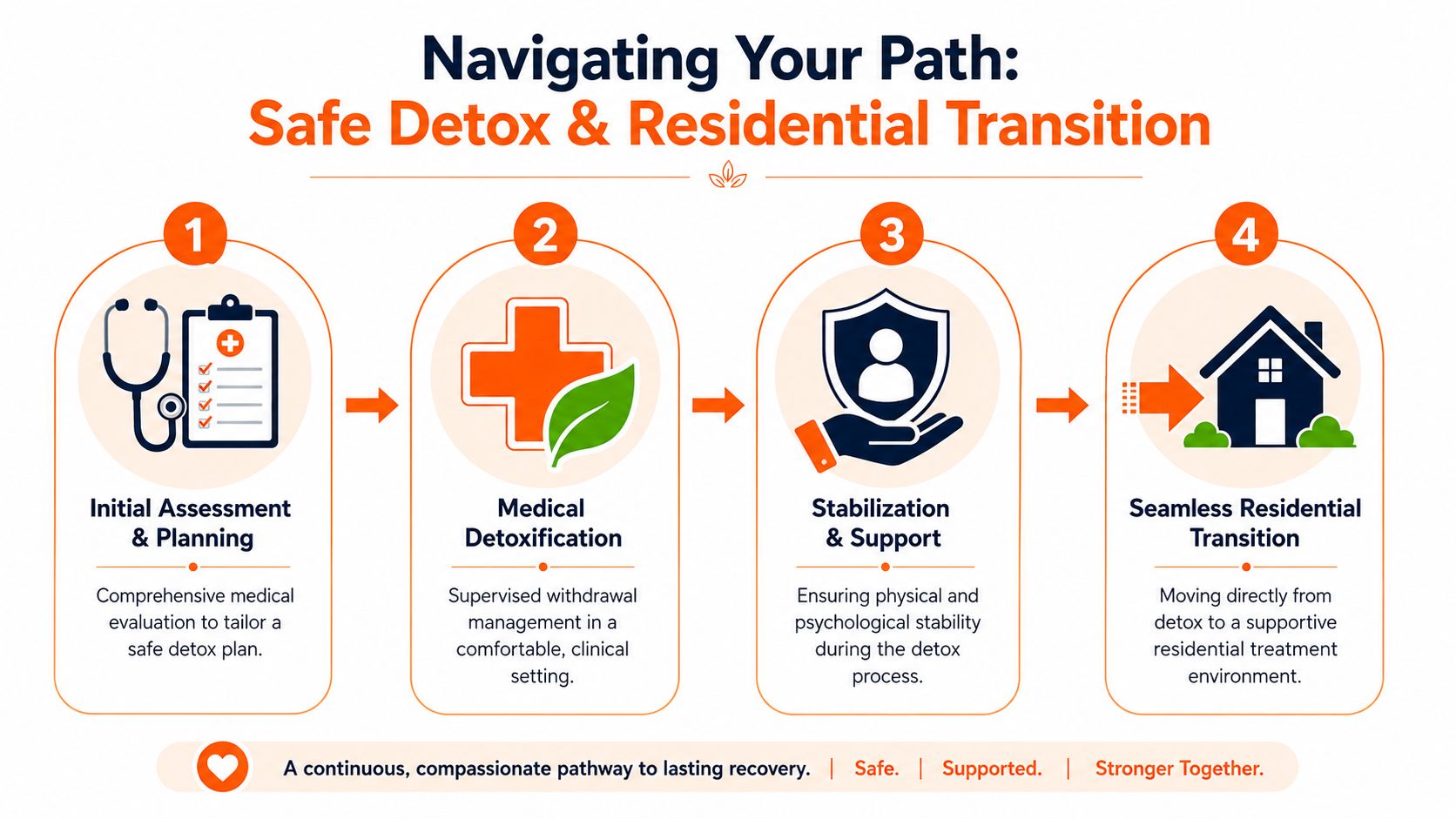
The process usually includes:
Medical evaluation
Clinicians determine withdrawal risk, review prescriptions, and identify co-occurring mental health concerns that may flare during detox.Medication-supported withdrawal management
The team uses medications when clinically indicated to reduce danger, discomfort, agitation, insomnia, cravings, or autonomic instability.Psychiatric monitoring
Anxiety, depression, trauma symptoms, and mood instability often sharpen during early withdrawal. These aren't side issues.Immediate continuation into residential care
Once the body is safer, treatment shouldn't pause. The next step is structured inpatient work.
Why the handoff matters
Many people make it through detox and assume the hard part is over. It isn't. Detox removes the substance. It does not rebuild judgment, stress tolerance, impulse control, or emotional regulation.
That's where the residential transition becomes decisive.
A smooth move from detox into inpatient care reduces the chance that a person leaves while physically fragile and psychologically overconfident. It also protects against the classic executive mistake: feeling slightly better, reopening the laptop fully, and deciding treatment can wait.
Practical rule: If a program treats detox as a standalone event rather than the opening stage of a longer continuum, expect weaker follow-through.
In Orange County, only 44% of patients were admitted to residential programs, yet inpatient rehab had 53% of patients stop their primary drug use after treatment according to Orange County addiction treatment statistics summarized by Windward Way. That trade-off matters. Less intensive care may feel easier to fit into a calendar, but it often asks too much self-management from a person who's already depleted.
Questions to ask before admission
A serious Orange County rehab program should be able to answer these without hesitation:
| Question | Why it matters |
|---|---|
| Is detox medically supervised around the clock? | Withdrawal can change quickly, especially with alcohol, sedatives, and complex medication histories. |
| Will psychiatry be involved early? | Untreated panic, insomnia, depression, or mood instability can derail detox fast. |
| What happens the day detox ends? | A vague answer usually means a weak transition plan. |
| Can work obligations be managed without disrupting clinical care? | For executives, this isn't a luxury issue. It's a retention issue. |
If you're preparing for admission, reviewing the intake process for drug and alcohol detox can reduce uncertainty and help you ask better questions before you commit.
Crafting Your Personalized Clinical Recovery Plan
Once withdrawal is under control, treatment has to become more precise. Generic rehab fails high-acuity professionals for a simple reason: the surface behavior is only part of the problem. The substance may be alcohol, cocaine, Adderall, opioids, or sedatives, but underneath that use there's usually a repeatable internal pattern involving stress, mood, trauma, perfectionism, insomnia, or emotional avoidance.
A solid Orange County rehab plan should reflect that complexity.
Dual diagnosis is not optional
Dual diagnosis means treating substance use and co-occurring mental health conditions at the same time. For professionals, those conditions often include anxiety, depression, trauma, bipolar disorder, or ADHD. If they remain untreated, sobriety becomes brittle. The person may stop using briefly, but the original drivers stay active.
Thorough treatment protocols show better outcomes when care extends beyond 90 days and includes integrated dual diagnosis treatment according to rehab success rate guidance on treatment duration and co-occurring care. In clinical terms, that means recovery works better when it's long enough and deep enough to address more than cravings.
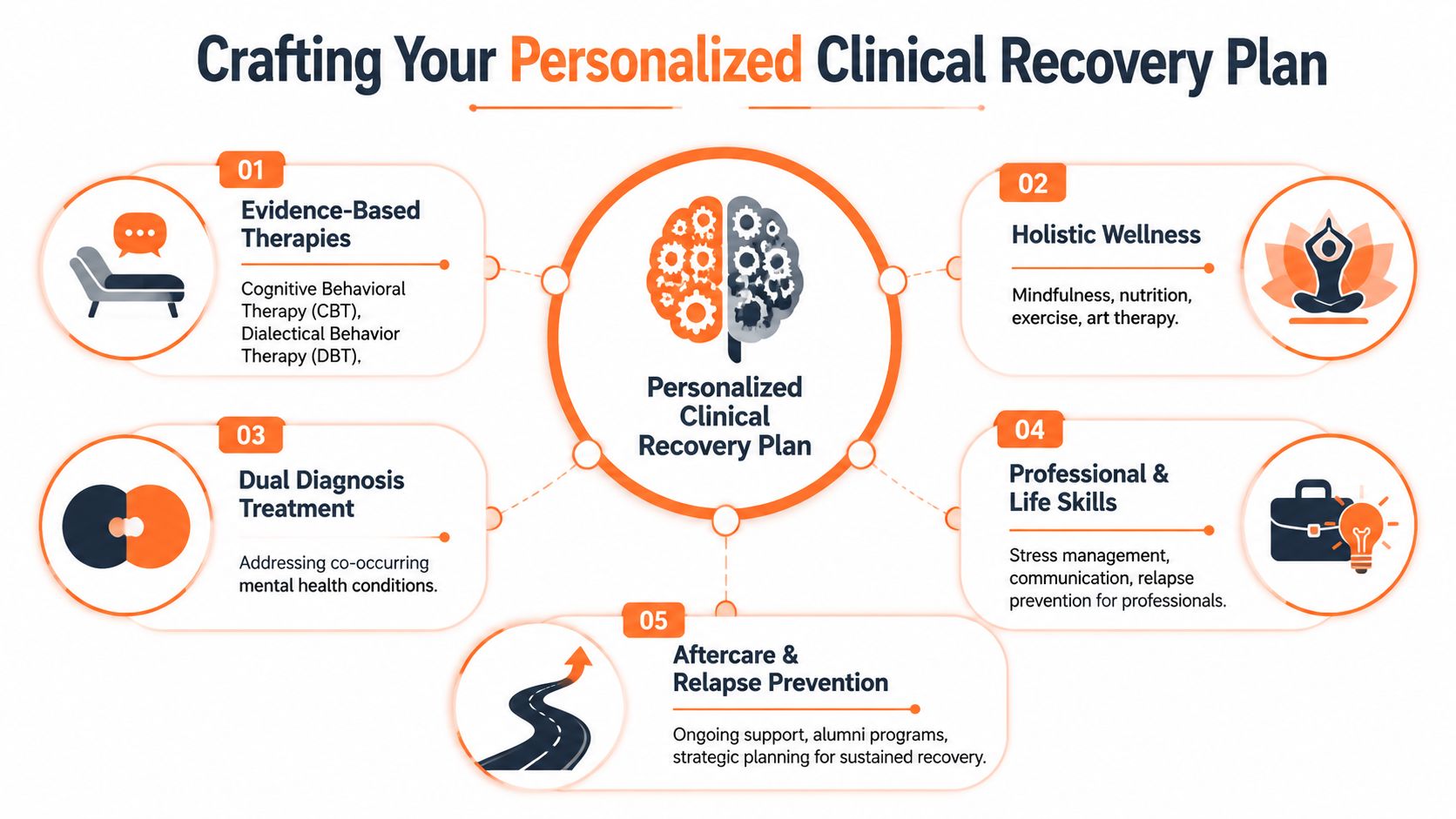
What the main therapies actually do
Different modalities serve different functions. A strong plan uses them intentionally rather than stacking jargon.
CBT helps identify the thought loops that precede use. For an executive, that may be “I can't miss this deadline unless I take something” or “I deserve a drink because this day was impossible.” CBT teaches clients to examine those thoughts and replace them with decisions grounded in evidence rather than urgency.
DBT focuses on emotional regulation, distress tolerance, and interpersonal effectiveness. This matters for professionals who swing between overcontrol at work and collapse in private. DBT is especially useful when anger, panic, shame, or relational volatility intensify relapse risk.
EMDR targets trauma-related distress that remains stuck in the nervous system. A person may understand their history intellectually and still react to pressure as if they're in danger. EMDR helps reduce the emotional charge attached to those experiences.
ACT teaches clients to stop organizing life around escape. Instead of trying to eliminate every uncomfortable thought or feeling, the person learns how to move in line with values even when discomfort is present.
Personalization means frequency, not branding
Many programs promise individualized care. The pertinent question is how often the client sees clinicians who can move the work forward.
A rigorous plan for a professional usually includes multiple individual sessions each week across disciplines, not just occasional therapist contact plus groups. That may involve a primary therapist, psychiatrist, case manager, and family systems work when appropriate. The point is repeated clinical contact that can catch problems early.
Recovery planning for professionals should include direct work on sleep, work identity, perfectionism, disclosure decisions, medication review, and crisis-response habits. If those topics never enter treatment, the plan is incomplete.
Clinical work should match professional reality
A senior executive doesn't relapse because someone handed them a brochure for alcohol. They relapse because a familiar stress sequence unfolds and they have no reliable way to regulate it without substances. Effective treatment maps that sequence in detail.
A personalized plan should answer:
- What internal state usually comes first? Exhaustion, resentment, panic, emptiness, agitation.
- What situation triggers the chain? Travel, conflict, success, isolation, boredom after intensity.
- What belief keeps the cycle going? “I can't stop now,” “No one can know,” “I'll deal with it later.”
- What replacement responses are realistic? Brief regulation practices, support contact, medication review, schedule changes, therapy interventions, work boundaries.
That level of specificity is where clinical treatment stops being abstract and starts becoming usable.
Integrating Recovery into Your Daily Professional Life
Returning to work after treatment doesn't require a dramatic reinvention. It requires a better operating system. Most relapses in professionals don't begin with a conscious decision to self-destruct. They begin with small permissions: skipping breakfast, taking late calls in bed, avoiding support, working through anxiety, and treating recovery tasks as optional because work feels more urgent.
That pattern has to be interrupted on purpose.
Protect the first and last hour of the day
The most unstable part of many professionals' routine is the transition into and out of work. That's where cravings, anticipatory anxiety, and reward-seeking habits are strongest.
Use a required structure:
- Morning anchor: Wake, hydrate, medication if prescribed, brief movement, and ten minutes of quiet before screens.
- Midday reset: A scheduled pause for food, breathing, or a short walk, especially before a known trigger such as negotiations or performance reviews.
- Evening closure: A fixed ritual that marks the end of work. Shower, journal, family dinner, meeting, or therapist-assigned practice.
You don't need a perfect wellness routine. You need repeatable regulation.
Set work boundaries that are operational, not aspirational
“Less stress” is not a plan. Boundaries must be concrete enough to survive a bad week.
Try rules like these:
- No intoxication-based networking. If client entertainment always centers on alcohol, decide in advance how long you'll stay, what you'll drink, and who knows your exit plan.
- No major decisions when dysregulated. If you're flooded, angry, or craving, delay non-urgent calls and emails.
- No private isolation after overload. A hotel room, a late office, or an empty house can become high-risk fast.
For people who travel often or need recovery-supportive wellness settings, curated resources can help you optimize performance with vetted centers that understand privacy, structure, and professional demands.
Learn your trigger categories
Most workplace triggers fall into a few buckets:
| Trigger type | Common example | Better response |
|---|---|---|
| Activation | High-stakes presentation, conflict, market swing | Grounding, coaching call, delay impulsive choices |
| Depletion | Travel fatigue, poor sleep, skipped meals | Nutrition, rest, simplify schedule |
| Reward seeking | Deal closes, trial ends, big win | Celebrate with people and activities that don't center substances |
| Shame | Mistake, criticism, fear of exposure | Immediate support contact instead of secrecy |
Don't ask whether a work demand is “valid.” Ask whether you can meet it without sacrificing the conditions that keep you sober.
Recovery has to fit inside real professional life. That means using calendars, assistants, physicians, therapists, and family systems intelligently. If your work is complex, your recovery structure should be equally deliberate.
Building a Long-Term Relapse Prevention Strategy
Sobriety isn't maintained by motivation alone. It's maintained by systems. The people who do well long term usually stop thinking in short bursts of self-control and start thinking like chronic disease managers. They expect stress, complacency, loss, success, travel, conflict, and hormonal or psychiatric shifts. Then they build for those realities in advance.
Relapse prevention starts before a craving
Many people imagine relapse as a sudden event. Clinically, it's usually a sequence. The first changes are subtle: less honesty, less rest, more irritability, fewer support contacts, weaker routines, more rationalizing. By the time the substance enters the picture, the relapse process has often been underway for days or weeks.
A durable plan identifies early-warning indicators in plain language.
Examples include:
- Behavioral drift: cancelling therapy, skipping meetings, dropping routines
- Emotional drift: resentment, numbness, agitation, grandiosity, hopelessness
- Cognitive drift: “I'm different now,” “One night won't matter,” “No one needs to know”
- Environmental drift: spending more time with drinking culture, unstructured travel, secretive online behavior
Aftercare should be structured, not symbolic
The strongest discharge plans have layers. One therapist alone may not be enough. One support group may not be enough. A strong aftercare strategy often combines several forms of support so that if one weakens, another is still active.
Useful components may include:
Ongoing therapy
Continue the work that began in treatment. Trauma, mood symptoms, family tension, and identity shifts don't resolve on discharge day.Peer support
That might be a 12-step program, SMART Recovery, or another recovery community that you'll attend consistently.Psychiatric follow-up
Medication changes, sleep instability, anxiety spikes, and concentration problems need active oversight.Case management or recovery coaching
This helps when the challenge is implementation, not insight.Family involvement
Partners and relatives often need guidance on boundaries, trust repair, and how to stop participating in the old cycle.
Long-term recovery improves when the client and family stop treating discharge like graduation and start treating it like deployment.
Plan for success, not just crisis
An overlooked relapse trigger is positive momentum. People finish treatment, feel sharper, get flooded with praise, and rush back into full workload. The resulting overextension can be dangerous.
A better strategy is phased re-entry:
- return to key responsibilities first
- delay nonessential travel when possible
- keep therapy appointments fixed on the calendar
- preserve sleep and meal timing
- review relapse cues weekly, not only when distressed
Relapse, when it happens, should be evaluated clinically rather than morally. The question is not “Why did you fail?” The question is “What part of the system broke down, and how do we repair it fast?” That approach keeps shame from driving a deeper spiral.
How to Choose a Discreet Tech-Friendly Rehab in Orange County
For professionals, the provider you choose may matter as much as the decision to seek treatment. Many centers advertise privacy, luxury, and device access. Those features can be useful, but they don't tell you whether the program can handle the clinical pressure that comes with an executive staying partially connected to work.
A laptop in treatment is not a clinical model. It's just a device.
What discreet care should mean in practice
Confidentiality has to be operational. It should show up in admissions, insurance handling, room arrangements, staffing, and communication rules.
Data cited on executive rehab shows 65% of adults with substance use disorder also have a co-occurring disorder, 82% fear workplace discrimination if diagnosed, and 90% of executives delay treatment because of this fear according to executive rehab confidentiality and co-occurring disorder data. That fear is rational. A provider should be able to explain how privacy is protected while still delivering legitimate dual diagnosis care.
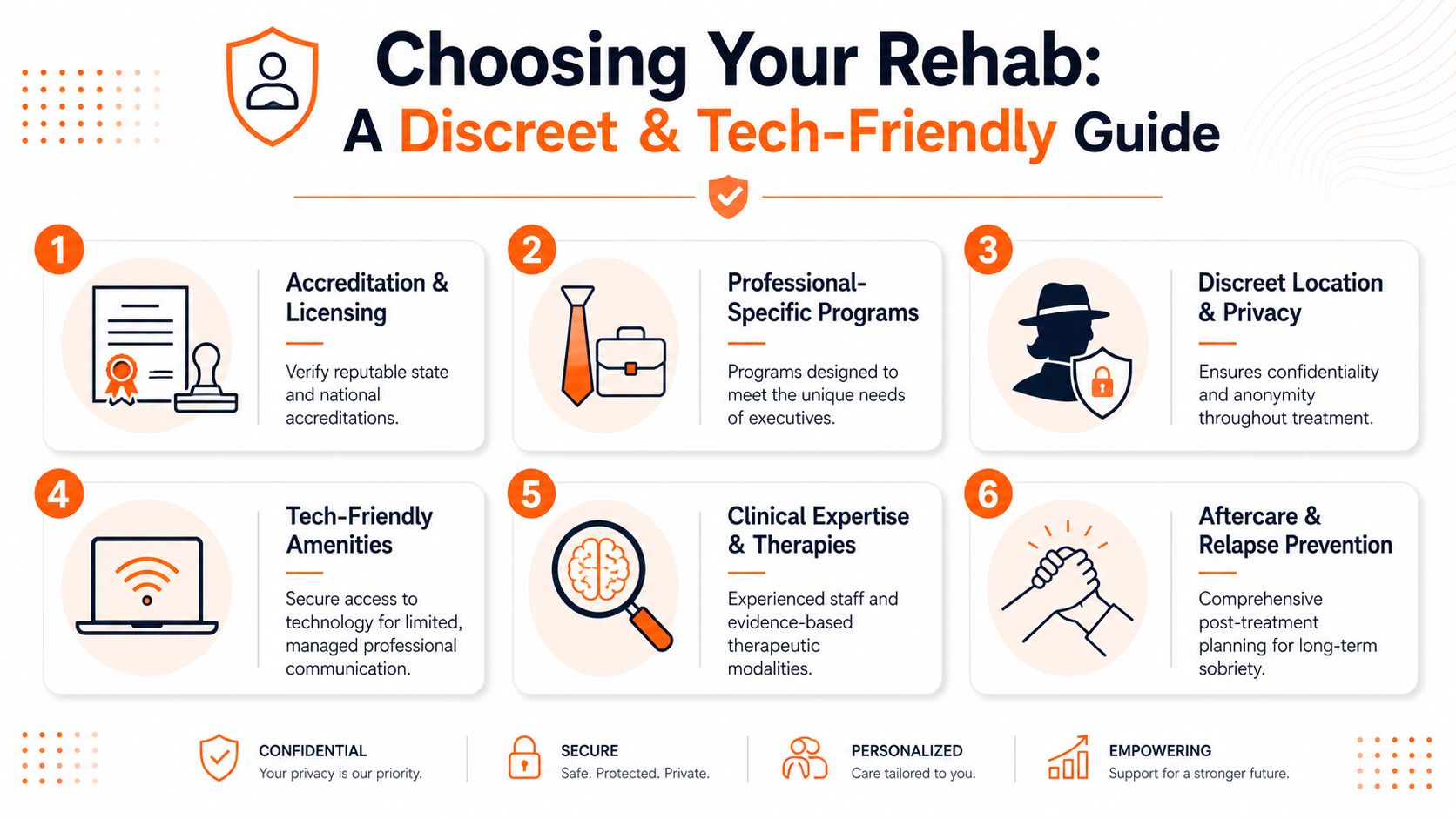
The six criteria that actually matter
Clinical depth
Ask whether the program treats co-occurring psychiatric conditions on-site and in real time. Anxiety, trauma, bipolar disorder, ADHD, and depression can destabilize treatment fast if they're treated as secondary.Small census
A smaller setting usually allows more privacy, more individualized scheduling, and less exposure to the social chaos that can derail high-functioning clients.Managed tech access
Device use should be structured. The question isn't whether phones are allowed. It's whether staff can help contain the stress that work access creates.Private space for work and rest
Executives often need a place to take a critical call, complete an urgent review, or decompress without doing that work in the middle of a chaotic communal space.Detox-to-residential continuity
If detox and inpatient treatment feel disconnected, treatment momentum is easier to lose.Aftercare planning for licensed or high-visibility roles
Re-entry issues are different for physicians, attorneys, founders, pilots, and other regulated professionals. The plan should reflect that.
Ask sharper admissions questions
A useful admissions call should cover more than amenities. Ask things like:
| Ask this | Listen for this |
|---|---|
| How is device use scheduled and monitored clinically? | A clear framework, not “we're flexible.” |
| Who manages psychiatric symptoms that arise during work-related stress? | Specific psychiatric and nursing involvement. |
| How many clients are typically in the program at one time? | A direct answer, not vague language. |
| How is confidentiality handled with insurance and employer concerns? | Practical procedures, not generic reassurance. |
One Orange County option that fits this executive model is Capo Canyon Recovery, which offers detox and residential care, a small census, dual diagnosis treatment, private rooms, and a tech-friendly policy for clients who must maintain limited professional contact. If device access is a major concern, this guide on using your phone and laptop in rehab as an executive outlines the right questions to ask any provider.
Choose the program that can hold both realities at once: your career is serious, and your treatment still has to remain treatment.
Frequently Asked Questions About Executive Rehab
How do I handle insurance and payment discreetly
Start by asking the admissions team how they verify benefits, who receives communications, and how clinical information is shared. A competent program should explain privacy procedures in plain language. If you're paying privately, ask what documentation is still created and who can access it.
How much time do I really need away from work
That depends on medical severity, psychiatric complexity, and whether detox is required. The wrong answer is choosing the shortest stay that creates the least discomfort at work. The right answer is choosing the level of care that gives you a real chance to stabilize and stay engaged.
Can I stay in contact with family
Usually yes, but timing and structure matter. Early treatment may limit contact if family communication becomes destabilizing or distracts from detox and assessment. Later, family therapy and guided communication often become a major part of the work.
What credentials should the clinical staff have
Ask about licensed therapists, nursing coverage, psychiatric involvement, and experience treating dual diagnosis cases. If you have a complex medication history, trauma history, or a safety-sensitive profession, those details matter.
Can I work during treatment
Sometimes, in a limited and managed way. The key issue isn't convenience. It's whether the program can keep work from hijacking treatment. Limited access for mission-critical responsibilities can be appropriate. Full immersion in the same pace and intensity that fed the addiction usually is not.
What if I'm not sure whether I need detox or residential care
That's common. Start with a confidential clinical assessment. The goal is to determine withdrawal risk, mental health needs, and the safest level of care. You don't need to diagnose yourself before making the call.
Capo Canyon Recovery provides licensed detox and residential addiction treatment in Mission Viejo for executives, licensed professionals, and other adults who need privacy, dual diagnosis care, and a structured program that can accommodate essential work responsibilities. If you're evaluating Orange County rehab options and need a confidential starting point, visit Capo Canyon Recovery.