
You're responsible for decisions, people, and outcomes all day, yet a private concern keeps interrupting your judgment: what happens if stress, cravings, or another difficult night pushes you back toward substance use? Many executives delay treatment because they expect vague conversations about the past rather than a structured method they can evaluate.
CBT for addiction recovery offers a more practical framework. It helps you identify the situations that activate use, examine the thoughts that intensify an urge, and rehearse a safer response before pressure peaks. The approach is useful, but it isn't a universal solution. Its value depends on the substance involved, the phase of treatment, co-occurring mental-health conditions, and whether therapy is delivered alone or as part of a coordinated plan. The most useful question isn't, “Does CBT work?” It's, “For whom, for which substance, at what stage, and alongside what other care?”
Why CBT Matters in Addiction Recovery
A person entering treatment may be physically stable enough to participate while still feeling uncertain about therapy. They may wonder whether talking about thoughts can really change drinking, drug use, or compulsive behavior. CBT answers that concern with a clear operating model: thoughts influence emotions, emotions influence behavior, and behavior reinforces future expectations.
That doesn't mean a person chooses addiction through faulty thinking. Substance use can involve biological dependence, withdrawal, learned habits, trauma, psychiatric symptoms, and environmental pressure. CBT gives clinicians a way to work with the behavioral and cognitive parts of that system while medical professionals address withdrawal, medication needs, and physical safety.
A structured alternative to generic counseling
Generic counseling might give someone space to describe what happened. CBT adds a working agenda. A therapist may ask the client to:
- Track triggers: Record situations, people, emotions, and thoughts that precede use.
- Test automatic conclusions: Examine whether a thought is accurate, useful, or distorted by shame, fear, or urgency.
- Practice coping responses: Rehearse actions for cravings, conflict, fatigue, and high-pressure decisions.
- Review results: Assess what happened after the client used a skill and adjust the plan.
This structure often suits high-functioning professionals who want therapy to connect to observable decisions. The work is collaborative, but it's also active. Clients usually practice between sessions rather than waiting for insight to appear in the therapy room.
Practical rule: A strong CBT plan should tell you what the client is practicing, what risk it addresses, and how the clinical team will review progress.
CBT has become a common evidence-based component of residential and outpatient addiction care because clinicians can adapt its tools to different substances, settings, and treatment goals. Still, “common” doesn't mean “sufficient.” A residential program may use CBT alongside detox support, psychiatric evaluation, group therapy, medication management, family involvement, and aftercare planning. The approach matters because it supplies a cognitive and behavioral toolkit, not because it replaces the rest of treatment.
For an executive, that distinction protects against two opposite mistakes. One is dismissing therapy as unstructured conversation. The other is treating CBT as a standalone guarantee. Effective care uses its structure while matching the treatment plan to the individual.
The CBT Loop Explained Through a Real Scenario
Consider a senior leader leaving a tense board meeting. A director challenged a major decision, the discussion ended without resolution, and the leader drives home replaying every exchange. The external event is the trigger. The automatic thought might be, “I've lost control, and I can't face tomorrow unless I shut this off.”
That thought creates anxiety, anger, and humiliation. Those emotions increase physiological tension and narrow attention toward immediate relief. The person remembers that alcohol or another substance has provided quick relief before. The behavior follows, and the short-term reduction in distress teaches the brain that using is an effective response to similar pressure.
CBT maps this sequence without reducing it to a single cause:
- Situation: A public challenge or unresolved work conflict.
- Thought: “I can't tolerate this,” or “I need something now.”
- Feeling and body response: Anxiety, shame, agitation, racing thoughts, or physical tension.
- Behavior: Buying alcohol, contacting a supplier, isolating, or using.
- Consequence: Immediate relief followed by impaired sleep, regret, conflict, or renewed pressure.
The therapist doesn't tell the client to “think positively.” Instead, the client learns to pause between the thought and the behavior. They may write down the prediction, ask what evidence supports it, identify what the thought leaves out, and choose a response that reduces danger. That response could include calling a recovery contact, leaving the high-risk environment, eating, resting, using a grounding exercise, or attending a scheduled support meeting.
The goal isn't to eliminate every uncomfortable thought. It's to make the sequence visible early enough that the person has options. Repeated practice turns the method into a usable skill, much like rehearsing a crisis protocol before a business disruption occurs. The client learns to respond to a trigger rather than allowing the trigger, thought, emotion, and behavior to run as one automatic chain.
Core CBT Techniques Used in Addiction Treatment
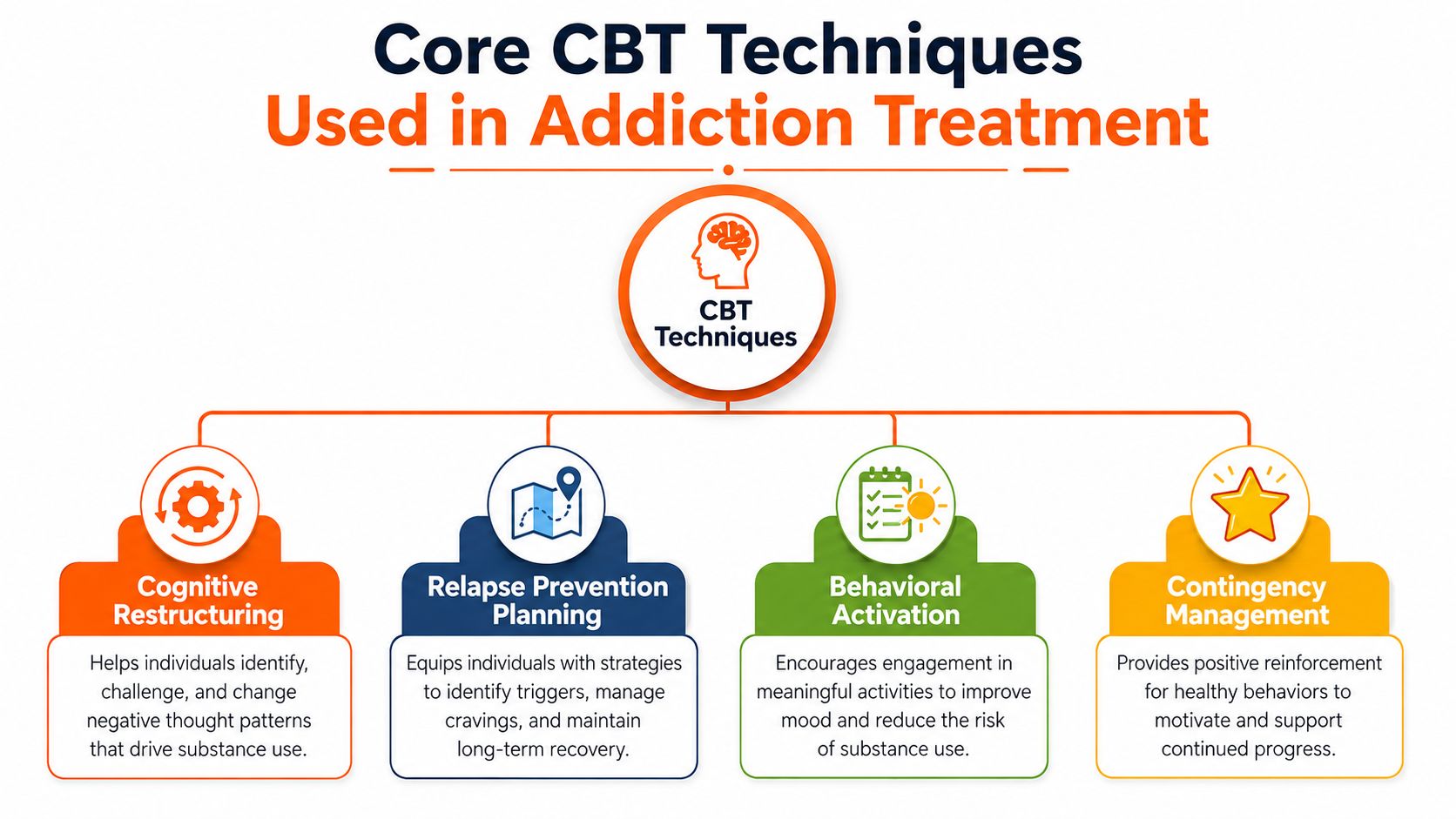
CBT becomes easier to understand when you see what happens during an actual treatment day. The techniques overlap, but they solve different problems. Cognitive restructuring changes the interpretation. Behavioral activation changes the routine. Coping-skills training prepares for pressure. Relapse-prevention planning organizes the response when risk rises.
Cognitive restructuring
A client may say, “The damage is done, so there's no point stopping today.” The therapist helps separate facts from conclusions. The client might identify the thought as all-or-nothing reasoning, list what has happened, and create a more accurate alternative: “There are consequences I need to address, but stopping now still changes what happens next.”
The exercise isn't forced optimism. It's reality testing. Between sessions, the client may keep a thought record with the situation, automatic thought, emotion, evidence, alternative interpretation, and resulting action.
Relapse-prevention planning
A relapse plan converts warning signs into decisions made in advance. The client identifies high-risk situations, such as conflict, travel, isolation, fatigue, access to substances, or contact with certain people. For each situation, the plan names an early action and an escalation step.
For example, if an intense craving appears after a difficult call, the first action might be leaving the office and contacting a clinician. If the craving continues, the next step could involve a support person, urgent clinical contact, or a safer supervised setting. The plan works best when it's specific enough to follow under stress.
Behavioral activation
Substance use often crowds out sleep, exercise, relationships, hobbies, and ordinary responsibilities. Behavioral activation rebuilds activity deliberately rather than waiting to feel motivated. A therapist might ask a client to schedule a walk, prepare a meal, attend a peer meeting, or complete a manageable work task, then record how the activity affected mood and craving.
The intervention addresses an important practical problem: an empty, dysregulated day can leave more room for rumination and impulsive decisions. Small actions create structure while the client's energy and confidence recover.
Coping-skills training
Coping skills are rehearsed responses for moments when thinking becomes less flexible. Practice may include urge surfing, paced breathing, grounding, refusal language, problem-solving, communication, and planning around exposure to substances. A therapist might role-play a business dinner where alcohol is offered, then help the client develop a short response that protects privacy without creating unnecessary discussion.
These skills need repetition. The client isn't expected to remember a long list during a craving. Treatment narrows the list to a few actions that can be practiced, measured, and carried into aftercare.
What the Evidence Shows
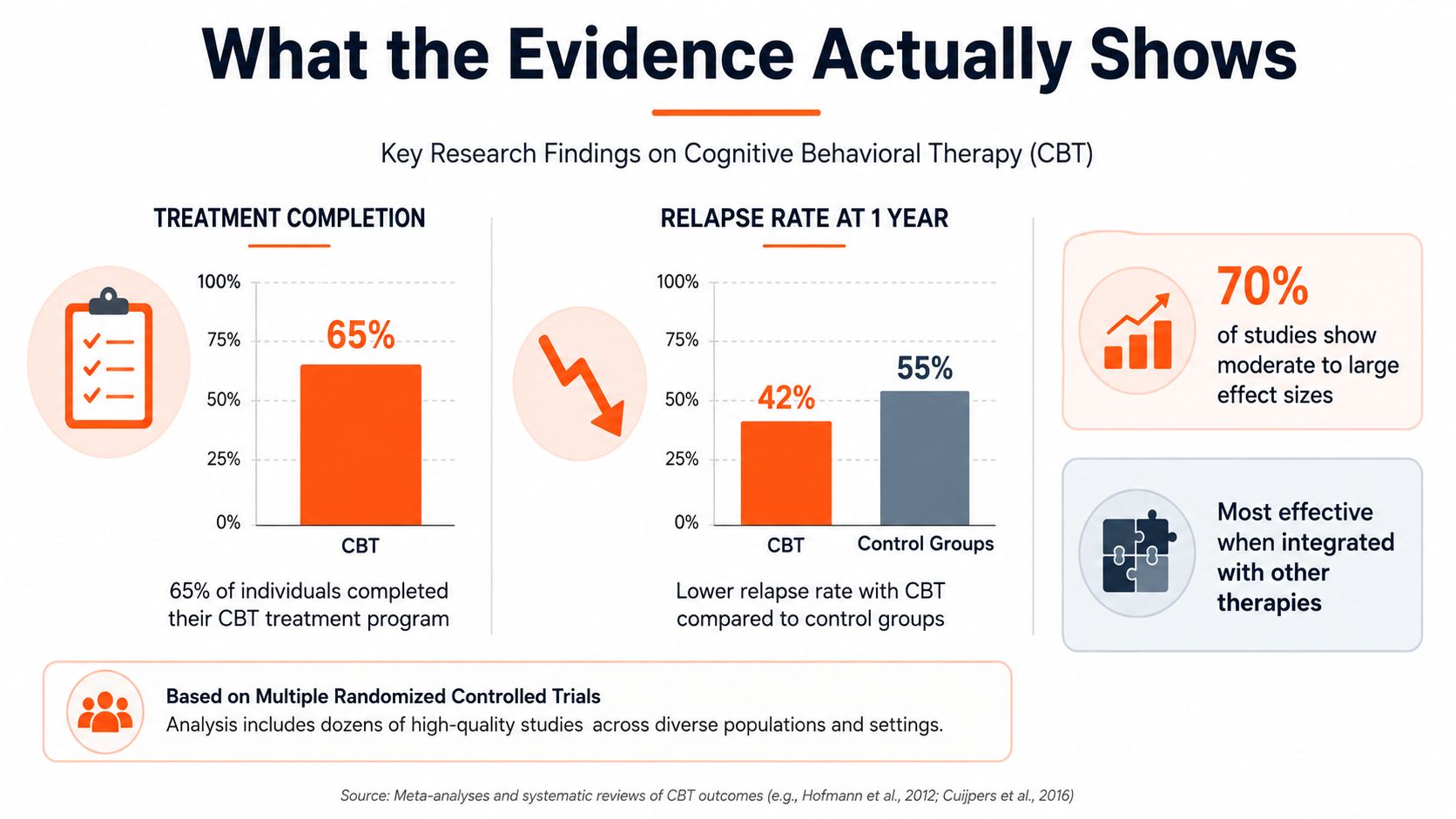
CBT deserves neither inflated praise nor casual dismissal. Research indicates that its effects vary by substance, format, and treatment context. Support is strongest for alcohol and tobacco, while findings for other drugs are more mixed. The useful question is not merely whether “CBT works for addiction,” but whether evidence supports its use for a particular substance, treatment phase, comparison group, and delivery format. The 2025 meta-analysis of stimulant-use trials found increased short-term abstinence compared with minimal care, although the evidence had low certainty and substantial variation across studies.
CBT can also contribute to a treatment plan without being superior in every comparison. Some clients may benefit most from behavioral skills combined with medication, incentives, medical monitoring, peer support, or another therapy selected for their clinical needs. The treatment model functions more like a toolkit than a single uniform solution.
Treatment phase changes the interpretation
A 2025 multilevel meta-analysis found that relapse reduction was sharpest during the first three months after CBT, then partially rebounded and stabilized after six months. The review evidence on CBT and relapse patterns supports planning beyond discharge rather than treating the end of residential care as the end of treatment.
The pattern does not mean CBT stops helping after the early period. It suggests that gains need reinforcement as clients return to work, travel, family stress, social exposure, and independent decision-making. Treatment phase therefore changes how outcomes should be judged. Early improvement and longer-term maintenance are related, but they are not the same result.
Dual diagnosis requires integration
A 2025 systematic review found that CBT-based interventions helped some substance-use or mental-health outcomes in dual-diagnosis populations, but they often were not clearly better than usual addiction approaches. The practical conclusion is clear: integrated care is the central issue, not CBT alone.
A person with alcohol use and panic symptoms may need psychiatric assessment, medication decisions, exposure-based work, coping skills, and relapse planning. Someone with trauma symptoms may need carefully timed trauma treatment rather than immediate cognitive challenge around every painful belief. Programs evaluating evidence-based addiction treatment should explain how clinicians coordinate these components and decide which intervention fits each phase.
Inside a Typical CBT Session at a Residential Program
A residential CBT session usually begins with a brief check-in. The client and therapist review sleep, mood, cravings, substance-related thoughts, major events, and any safety concerns. This information helps the therapist decide whether the session should focus on a planned skill, an urgent trigger, withdrawal-related distress, or coordination with the medical and psychiatric team.
The pair then set an agenda. A client might choose to examine a difficult conversation with a spouse, review a craving log, or practice a response to an upcoming professional obligation. The therapist guides the work, but the client participates in selecting the problem and evaluating whether the skill fits real life.
Individual and group work serve different purposes
Individual CBT offers privacy for sensitive material, including professional consequences, family conflict, trauma symptoms, or fears about reputation. Group CBT adds rehearsal and perspective. A participant can hear how another person identifies a trigger, practice refusal language aloud, and receive feedback from peers who understand the pressure of recovery.
A session may focus on cognitive restructuring, trigger mapping, behavioral activation, or coping practice. The therapist keeps the exercise concrete. Instead of discussing “stress” as a general concept, the client might analyze a specific evening, identify the first warning sign, and choose an action for the next similar situation.
Homework extends the treatment beyond scheduled care. It may involve completing a thought record, practicing a grounding method, scheduling a healthy activity, contacting a support person, or testing a new communication response. The next session reviews what happened, including failures, because an unsuccessful attempt contains information about timing, intensity, access, or fit.
Residential schedules can also coordinate CBT with medical monitoring, psychiatry, case management, family work, and psychoeducation. That coordination keeps therapy connected to discharge planning. The client isn't just learning an idea. They're building a repeatable response that must function outside the protected treatment environment.
How CBT Fits With DBT, EMDR, and Dual Diagnosis Care
CBT is often one part of a broader clinical design. DBT can add emotion-regulation, distress-tolerance, mindfulness, and interpersonal-effectiveness skills when impulsivity or intense emotions make substance use more likely. CBT may then help the client examine the thoughts attached to the emotional surge and plan behavior for the next high-risk situation.
ACT approaches motivation through values and committed action. A client may recognize that honesty, health, family presence, or professional responsibility matters, even while cravings remain. CBT can translate that recognition into specific plans, such as identifying the thought that blocks a valued action and rehearsing a different response.
Trauma-focused modalities require careful assessment and timing. EMDR or Brainspotting may be considered when trauma symptoms contribute to avoidance, hyperarousal, shame, or substance use. CBT can support stabilization and day-to-day coping while the treatment team determines whether and when trauma processing is clinically appropriate.
Medication and psychiatric care belong in the same conversation
Anxiety, depression, ADHD, bipolar symptoms, and trauma can change how a person experiences cravings, sleep disruption, concentration problems, and emotional distress. Medication stabilization and monitoring may therefore be part of the plan. Therapy and medication aren't competing explanations. They address different clinical needs and should be coordinated by a team that can monitor response and risk.
The evidence supports this integrated emphasis. The dual-diagnosis review cited above found benefits in some outcomes without showing that CBT consistently outperformed usual addiction care. That's why a program's ability to assess and coordinate care may matter more than its use of a single branded modality. Readers researching dual diagnosis treatment should ask how psychiatric care, substance-use treatment, trauma work, and skills training interact.
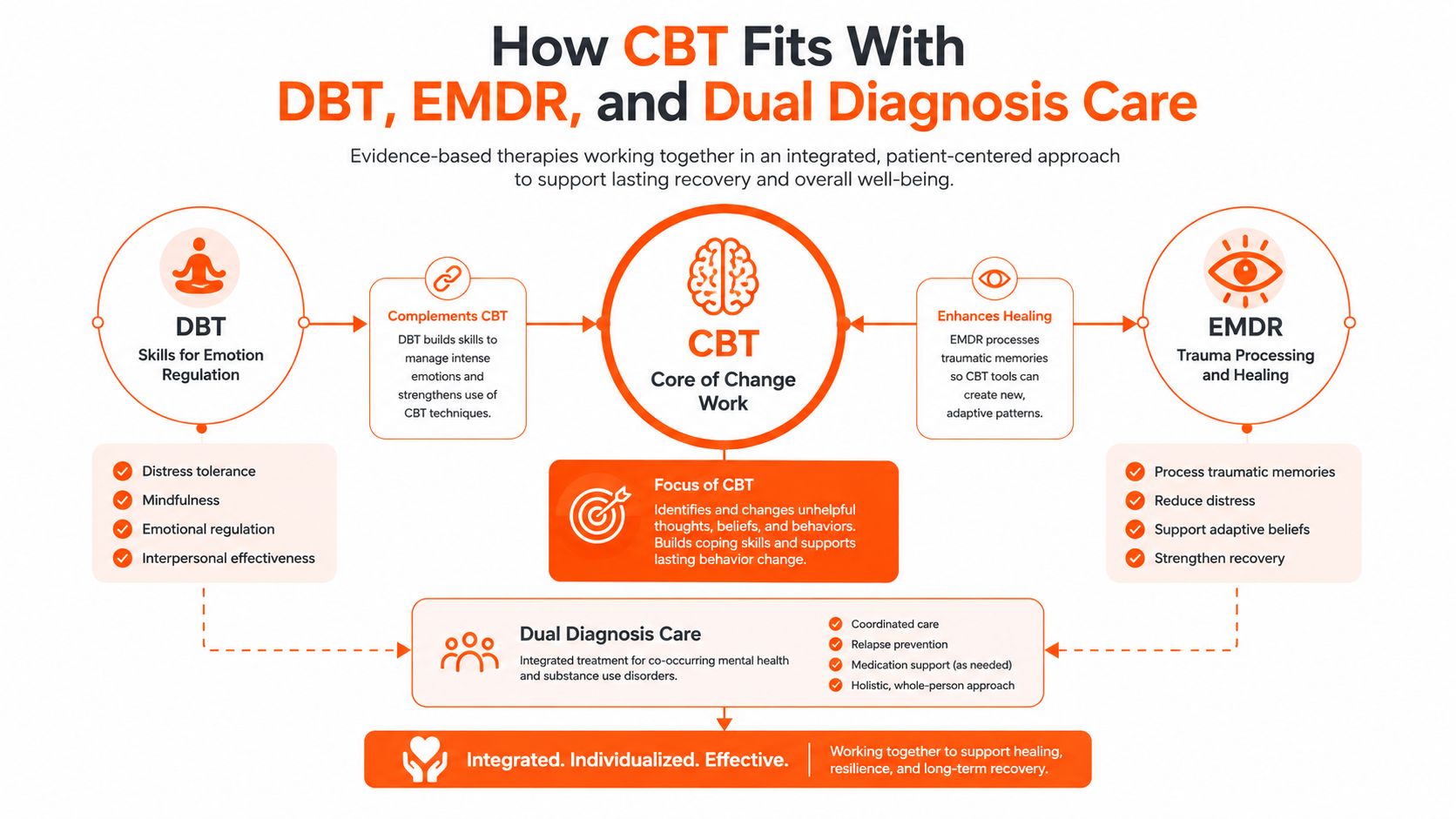
The executive advantage comes from coordination. A professional with multiple demands may need private individual work, practical coping rehearsal, psychiatric oversight, family involvement, and an aftercare plan that fits real responsibilities. One therapy can't provide all of that.
Relapse Prevention as an Ongoing Practice
A relapse-prevention plan shouldn't sit in a folder after discharge. It should function as a living operating document that changes when the client's environment changes. Early work identifies predictable risks, such as work travel, conflict, fatigue, isolation, access to substances, or a return to a social setting organized around use.
The client and treatment team then attach actions to each risk. A plan might specify who to call, where to go, what to remove from the environment, which appointment to schedule, and how to respond after a lapse. The aim is faster, safer intervention, not perfection. A lapse becomes a clinical signal that the plan needs revision, not evidence that treatment has failed.
Maintenance protects early gains
The evidence summarized in the 2025 meta-analysis indicates that relapse reduction is strongest in the first three months after CBT, then partially rebounds and stabilizes after six months. That pattern makes aftercare design a core treatment question. A person may need booster sessions, continuing therapy, medication follow-up, peer support, family accountability, or structured digital exercises.
Newer digital CBT research reported meaningful gains in abstinence, craving, and anxiety. The emerging implication is not that an app should replace a clinician. Digital tools may extend practice between appointments, while hybrid models combine clinician judgment with reminders, worksheets, check-ins, and accessible coping exercises.
Executives should also plan for predictable disruptions. Travel, board deadlines, business dinners, and confidential work obligations can interfere with appointments or recovery routines. An aftercare coordinator can help build alternatives before the disruption occurs, rather than asking the client to improvise while under pressure.
Practical maintenance questions include:
- Booster access: Can the client schedule follow-up CBT when risk increases?
- Digital support: Does the program recommend a secure, clinically appropriate tool?
- Medication continuity: Who manages prescriptions, monitoring, and changes?
- Crisis escalation: What happens if cravings intensify or a lapse occurs?
- Work reintegration: How will treatment routines adapt to travel and professional demands?
A strong plan treats recovery skills as ongoing practice. The objective is stabilization that can withstand ordinary stress, not a promise that difficult thoughts or urges will never return. For additional planning ideas, review these relapse-prevention tips alongside guidance from a qualified treatment team.
Choosing a Program That Uses CBT Effectively
A program can advertise CBT without delivering a meaningful CBT process. Before admission, ask how clinicians use the approach, how often clients practice skills, how progress is reviewed, and how the plan changes when a client's substance use or psychiatric symptoms don't respond as expected.
Start with the clinical basics:
- Qualified delivery: Ask which licensed or credentialed clinicians provide individual and group CBT.
- Session frequency: Confirm how many individual sessions are included and whether sessions involve therapy, case management, psychiatry, or multiple disciplines.
- Personalized targets: Ask how the team identifies triggers, automatic thoughts, coping gaps, and measurable treatment goals.
- Integrated care: Find out how CBT connects with DBT, ACT, EMDR, medication management, family therapy, and medical oversight.
- Aftercare design: Ask whether the discharge plan includes continuing therapy, booster sessions, digital support, medication follow-up, and crisis procedures.
The setting also affects engagement. Executives and licensed professionals may need privacy, smaller groups, private rooms, reliable internet, and limited technology restrictions so they can handle essential responsibilities without turning treatment into a remote-work arrangement. Those accommodations should support participation, not allow work to crowd out clinical care.
Ask how the program handles detox and residential transitions. A person in withdrawal may need nursing and psychiatric oversight before intensive cognitive work is realistic. Once medically stable, the team can increase skills practice, identify high-risk patterns, involve family when appropriate, and coordinate the next level of care.
Capo Canyon Recovery is one option for people evaluating private addiction treatment. Its programs include medically supervised detox, residential care, dual-diagnosis services, CBT alongside DBT, ACT, EMDR, and Brainspotting, medication monitoring, individual therapy across disciplines, and aftercare coordination. The executive track includes a small residential environment, private rooms, and a tech-friendly policy for essential professional communication.
Use the first conversation to test fit rather than accept broad promises. Ask for a sample schedule, the credentials of the clinicians, the process for handling co-occurring conditions, and the specific support available after discharge. A thoughtful program should answer plainly and explain how its clinical decisions will be adapted to the person, substance, treatment phase, and risks involved.
If you're evaluating private treatment for yourself, a colleague, or a family member, visit Capo Canyon Recovery to learn how its medically supervised detox, residential care, CBT-based treatment, dual-diagnosis services, and executive accommodations fit together. Contact the team to discuss clinical needs, privacy requirements, professional obligations, and the next appropriate step.