
You may be functioning at a high level and still feel strangely absent from your own life.
You answer emails, make decisions, join calls, keep promises, and push through exhaustion. Then the workday ends and your body still acts like the meeting never stopped. Your jaw stays tight. Sleep won't come easily. A small stressor feels bigger than it should. Maybe alcohol, pills, or another coping pattern started as a way to turn the volume down. For many professionals, that pattern isn't a failure of discipline. It's an attempt to manage a nervous system that no longer knows how to settle.
That is where yoga enters the conversation differently. Not as a performance practice. Not as a lifestyle trend. In trauma recovery, yoga can become a structured way to notice your body safely again, regain choice, and build enough internal stability to do deeper clinical work.
An Introduction to Yoga for Trauma Recovery
A lot of people hear "yoga healing trauma" and picture a crowded studio, loud music, difficult poses, and pressure to relax on command. If you're an executive, physician, attorney, founder, or other high-responsibility professional, that image may make you want to skip the whole idea.
That reaction makes sense.
When you've lived through trauma, chronic stress, burnout, or substance use, your relationship with your body often changes. You might live from the neck up. You notice problems only when they interrupt performance. Hunger becomes background noise. Fatigue gets overridden. Anxiety shows up as productivity. Numbness gets mistaken for control.
When functioning isn't the same as feeling well
I often think of the professional who says, "I can run a company, but I can't sit still for five minutes." Or, "I can close a deal, but I can't tell if I'm tired, angry, or scared until I'm already overwhelmed." Those aren't signs of weakness. They're signs that the body has learned to prioritize survival and output over reflection.
Trauma can leave a person feeling either too much or too little. Some professionals feel constantly activated. Others feel detached, flat, or unreal. Many move between both states depending on the day.
Yoga, when adapted for trauma, helps restore a basic skill that stress and addiction often disrupt. It helps you inhabit your body without getting flooded by it.
For a professional who needs privacy and structure, that matters. A trauma-informed yoga session doesn't ask you to perform. It asks you to notice. Where is there tension? What happens when you lengthen an exhale? Can you feel your feet on the floor? Can you choose to stop, modify, or rest without feeling you've failed?
Why this can matter in recovery
That kind of practice can become a bridge back to yourself. It supports awareness, steadiness, and a sense of control that many people lose when trauma and substance use become intertwined. In a clinical setting, it also fits naturally alongside other forms of treatment. If you want a sense of what that can look like inside a recovery program, this overview of yoga therapy for executives in rehab gives a practical example of how yoga can be integrated into care.
You don't have to be flexible, spiritual, or enthusiastic about yoga for it to help. You only need enough willingness to notice what's happening in your body and enough support to do that safely.
The Science of a Traumatized Nervous System
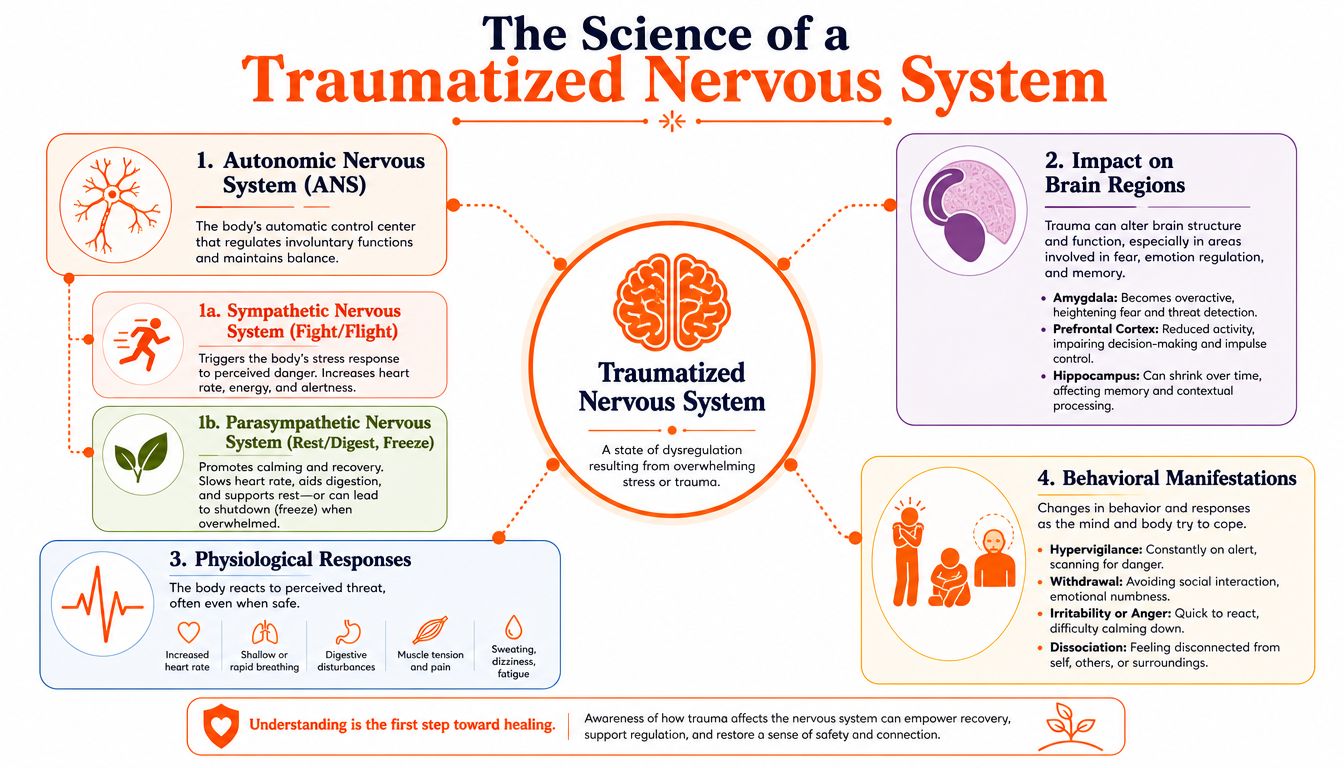
A traumatized nervous system is not irrational. It's protective. The trouble is that it can stay protective long after the danger has passed.
Many professionals understand this once they stop viewing their symptoms as personality problems. The issue often isn't that you're "too intense," "too sensitive," or "bad at coping." The issue is that your internal alarm system has learned to detect threat quickly and turn itself down slowly.
Your body's accelerator and brake
A simple way to understand this is to picture a car.
Your sympathetic nervous system acts like the accelerator. It mobilizes energy. Heart rate rises. Muscles tense. Attention narrows. This is useful when you need to react fast.
Your parasympathetic nervous system functions more like a brake. It helps with rest, digestion, recovery, and settling. In some trauma states, a person can also experience a kind of shutdown response, where the system pulls back hard and the person feels numb, heavy, foggy, or disconnected.
Trauma can make the accelerator too easy to trigger, or the brake too abrupt, or both. That leads to familiar patterns:
- Fight-like activation means irritability, impatience, jaw tension, anger, or feeling cornered quickly.
- Flight-like activation can feel like overworking, relentless busyness, racing thoughts, or the inability to stop.
- Freeze or shutdown may show up as exhaustion, blankness, disconnection, avoidance, or feeling emotionally far away from your own life.
Why symptoms seem to come out of nowhere
People often tell me, "Nothing happened. Why am I reacting like this?" Usually something did happen, but it happened below the level of conscious analysis.
A tone of voice. A calendar overload. A conflict that echoes an older wound. Withdrawal symptoms. Lack of sleep. The body picks up signals before the thinking mind explains them.
This is why trauma work often includes body-based practices. You can't reason your way out of every nervous system response in real time. Sometimes you need skills that work at the level where the reaction is happening.
If you want a practical companion resource on this topic, these Acheloa Wellness, Inc. resources from Acheloa Wellness, Inc. offer accessible education on nervous system regulation in everyday language.
What executives often miss
High performers frequently mistake activation for effectiveness. They say they're "good under pressure" because they can produce while flooded. But producing in a dysregulated state has costs. Sleep worsens. Relationships thin out. Cravings intensify. The body starts asking for relief in whatever form is available.
A more useful question isn't "Why can't I calm down?" It's "What has my body learned to expect?"
Practical rule: If your system has been trained by trauma, chronic stress, or addiction, calm may feel unfamiliar before it feels safe.
That doesn't mean healing isn't working. It means your nervous system is learning a new baseline.
How Yoga Reconnects Mind and Body for Healing
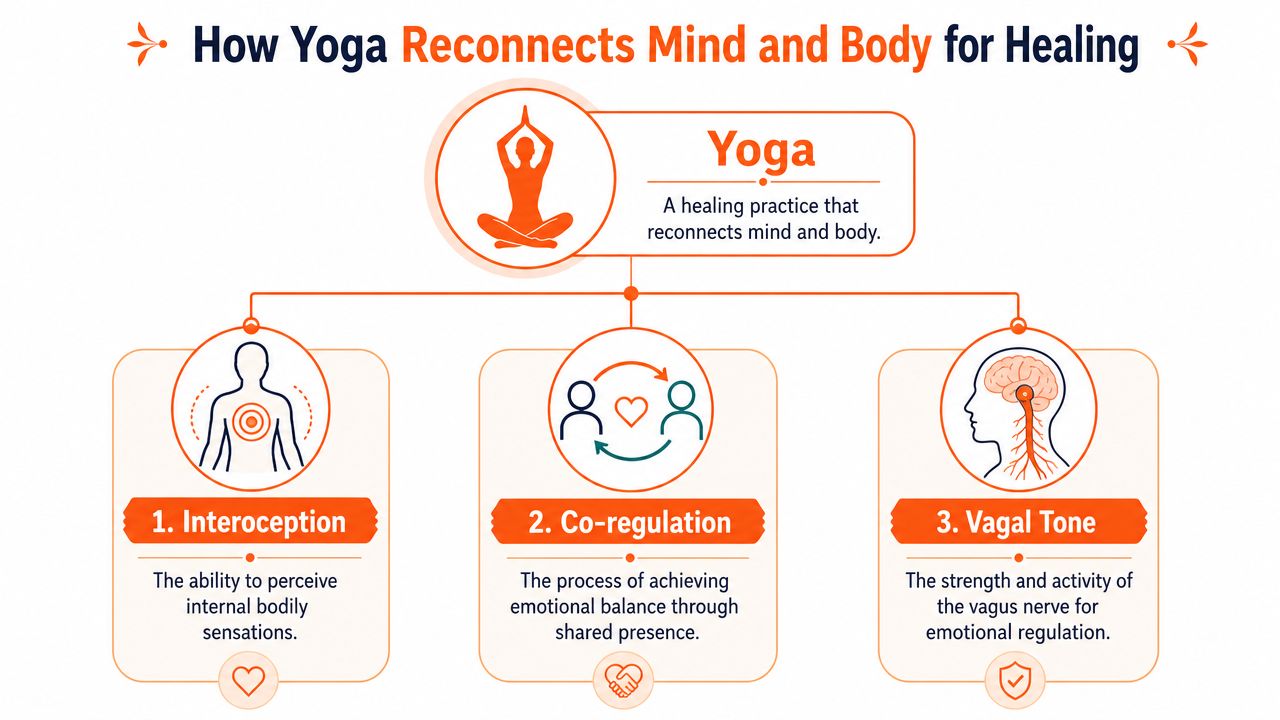
Trauma often disrupts the feedback loop between body and mind. You may know what you think, but not what you feel physically. Or you may feel everything physically and have no language for it. Trauma-informed yoga helps restore that communication through repeated, low-pressure experiences of noticing and choosing.
Interoception and proprioception in plain language
Interoception means sensing what's happening inside your body. It includes noticing your breath, heartbeat, stomach tension, warmth, shakiness, or the first signs of overwhelm.
Proprioception means sensing where your body is in space. It helps you feel your feet pressing into the floor, your back against a chair, or your hands resting on your thighs.
These skills sound basic, but trauma can interfere with both. A person may not notice they're escalating until they're already panicked, angry, or numb. In yoga, a teacher might invite you to lift your shoulders, pause, and release. That tiny sequence teaches something important: sensation changes, and you can stay present while it does.
Breath is not just calming. It's informative
Breathwork, often called pranayama, is useful because it gives the nervous system a rhythm to organize around. But trauma-informed work uses breath carefully. For some people, deep breathing right away feels unsafe or overwhelming. The goal isn't to force relaxation. The goal is to build tolerance for noticing breath without pressure.
That might look like:
- Counting an exhale softly rather than taking a dramatic inhale
- Keeping eyes open if closing them increases anxiety
- Using movement with breath so attention isn't trapped inside the body
- Stopping early when the practice becomes too intense
This is one reason integrated care matters. Programs that combine somatic work with psychiatric and therapeutic support can adapt the practice to the person's actual needs. For readers exploring broader models of mind-body psychiatric care Philadelphia from Integrative Psychiatry of America is a useful example of how yoga may sit alongside mental health treatment rather than outside it.
Why the evidence matters
Yoga isn't just "nice to have." In a randomized controlled trial of 64 women with chronic, treatment-resistant PTSD, 52% of participants in the trauma-sensitive yoga group no longer met diagnostic criteria for PTSD after 10 weeks, compared to only 21% in the control group according to Yoga Therapy Associates trauma research.
That finding matters because it reframes yoga from a wellness add-on into a legitimate somatic intervention. It doesn't mean every person will respond the same way. It does mean body-based treatment deserves serious consideration, especially when talk-based approaches have stalled or when a person has become highly disconnected from bodily cues.
| What yoga practice builds | Why it helps in trauma recovery |
|---|---|
| Body awareness | You catch stress earlier instead of only after escalation |
| Sensory grounding | You have concrete anchors such as feet, breath, and posture |
| Choice under stress | You practice modifying, pausing, or stopping without shame |
A trauma-informed yoga practice works less like a workout and more like rehearsal for regulation.
Essential Principles of Trauma-Informed Practice
Not all yoga is trauma-informed. That distinction matters more than many people realize.
A standard class may be safe for some people and too activating for others. A trauma-informed class changes the structure, language, and expectations so the participant can stay oriented, autonomous, and emotionally safer in the room.

Choice is part of the treatment
In trauma-informed practice, choice isn't a courtesy. It's part of how the work helps.
If trauma involved powerlessness, coercion, unpredictability, or violation of boundaries, then healing often includes repeated experiences of being able to choose what happens in your body. That means you can rest, skip a pose, change position, or keep your eyes open without needing to explain yourself.
If you'd like a concise outside perspective on the broader philosophy behind this approach, these Be Your Best Self & Thrive insights from Be Your Best Self & Thrive Counseling, PLLC offer a helpful overview of trauma-informed care principles.
How the language changes the room
Trauma-informed teachers usually use invitational language rather than commands.
Compare the difference:
Less helpful: "Everyone close your eyes and sink deeper."
More supportive: "If it feels comfortable, you might lower your gaze or keep your eyes open."
Less helpful: "Hold this pose. Don't come out yet."
More supportive: "You can stay here, adjust, or take a rest if your body needs something different."
Less helpful: "Relax."
More supportive: "Notice what tension feels like right now, without forcing it to change."
That shift reduces pressure and supports nervous system stability. It also respects the fact that some people cannot access calm through direct instruction.
What to look for before you join a class
A safer trauma-informed environment often includes several features:
- Predictable structure: The teacher explains what will happen and doesn't rely on abrupt transitions.
- Minimal surprise touch: Physical adjustments are avoided or require explicit consent.
- Function over appearance: The focus stays on sensation and agency, not on perfect form.
- Permission to modify: Props, pauses, and alternate positions are treated as normal.
For people evaluating a treatment setting, the same principles apply at a larger scale. This overview of a trauma-informed approach to care shows how those ideas can extend beyond yoga into the full treatment environment.
If a class makes you feel trapped, watched, or pushed past your limits, the problem may not be you. It may be the setup.
Yoga as a Vital Complement to Clinical Treatment
One of the biggest misunderstandings about yoga healing trauma is the belief that yoga should erase trauma memories on its own. That's not how it works.
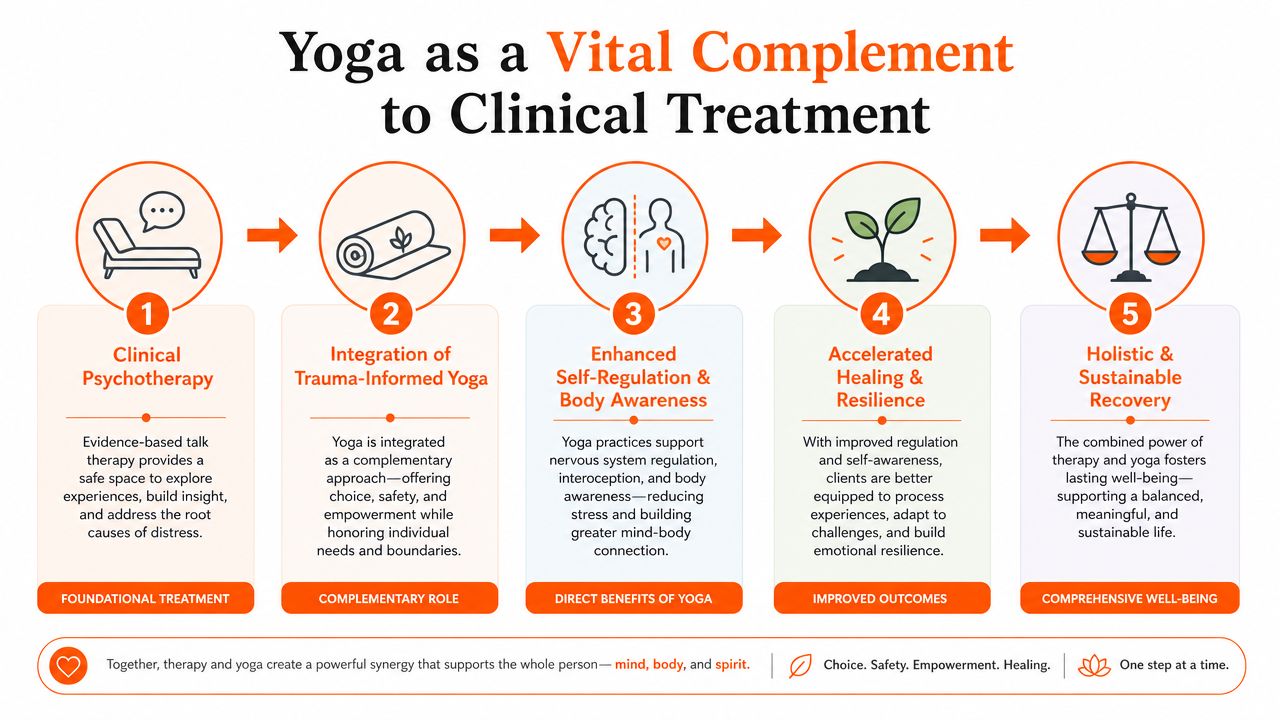
Yoga can be powerful, but it has a specific role. Expert consensus clarifies that yoga cannot reliably heal trauma memories via memory reconsolidation but is essential for building the "window of tolerance" needed to tolerate trauma therapy like EMDR. It is a preparatory modality that enhances somatic safety, as described by the Trauma Informed Care Training Institute discussion of yoga.
What the window of tolerance really means
The window of tolerance is the range in which you can feel emotion, think clearly, and remain present enough to process experience without tipping into panic or shutdown.
For many people with trauma and addiction, that window is narrow. A difficult therapy session can feel too exposing. A trigger can flip into craving. Withdrawal can make body sensations feel threatening. In these situations, yoga offers aid. It gives the person a way to recognize activation early and return to a more workable state.
That can make evidence-based therapies more usable, including:
- EMDR: The person may be better able to stay present during distressing material.
- DBT: Body awareness can support skills like distress tolerance and emotional regulation.
- Brainspotting: Somatic tracking often becomes more accessible when a person can identify physical cues with less fear.
- Addiction treatment: Cravings, agitation, and sleep disruption often become easier to observe without immediately acting on them.
Why this matters in dual-diagnosis care
When trauma and substance use overlap, treatment has to do more than remove the substance. It has to address what the substance was doing for the nervous system.
Some people drank to slow down intrusive activation. Others used substances to feel anything at all. Yoga can help in both directions because it teaches regulated noticing. Instead of automatically escaping a sensation, the person learns to identify it, rate it, and work with it in small doses.
That doesn't replace psychotherapy, medication management, or medical detox when those are needed. It supports them.
The executive reality
Professionals often delay treatment because standard programs feel incompatible with real life. Privacy matters. Reputation matters. Some clients need uninterrupted access to essential work communication. Others will not enter a large, impersonal setting.
The research literature notes an important gap here. While data shows yoga has high retention and moderate effects on trauma symptoms, a critical gap exists in research for high-functioning executives where privacy, cost, and the ability to maintain professional obligations are primary barriers to care, according to the PMC review on yoga and trauma-related symptoms.
That gap is one reason specialized residential care exists. A boutique executive program can combine trauma therapy, addiction treatment, psychiatric oversight, and somatic practices while still allowing essential professional continuity. One example is how a drug rehab center incorporates yoga, where yoga is integrated into a broader clinical plan rather than treated as a standalone fix.
A setting designed for executives may also reduce common barriers by offering a smaller census, private rooms, and a tech-friendly policy so clients can maintain critical responsibilities without abandoning treatment.
A practical way to think about sequencing
A simple sequence often works best:
- Stabilize first through detox, sleep support, psychiatric care, and nervous system regulation.
- Build body awareness with trauma-informed yoga and other somatic practices.
- Process trauma carefully with therapies such as EMDR or Brainspotting when the person can stay within tolerable limits.
- Rehearse daily recovery so regulation skills carry into work, relationships, and aftercare.
That sequence isn't rigid. But it reflects something many professionals need to hear. You don't have to force the deepest trauma work on day one. Your body may need preparation before it can safely do that work.
Recovery moves faster when the body stops fighting the treatment.
Finding Your Path to Healing as a Professional
If you've recognized yourself in this article, the next step isn't to prove how much you can endure alone. It's to choose care that matches the complexity of your life.
You may need treatment that protects confidentiality, addresses addiction and trauma together, and allows enough connection to work that you can step in without creating professional collapse. That isn't avoidance. It's good treatment planning.
What to look for in a professional-focused program
A strong option for professionals usually includes:
- Small, discreet care settings: Fewer clients often means more privacy and less overstimulation.
- Integrated treatment: Detox, psychiatry, individual therapy, group work, and somatic support should function as one plan.
- Real executive accommodations: Access to a phone or laptop, a private room, and structured support for essential communication can remove barriers that keep people out of care.
- Trauma competence: The program should understand that symptom control, memory processing, and addiction recovery are related but not identical tasks.
The evidence base still has limits for executive populations. As noted in the earlier research, barriers around privacy, cost, and maintaining professional obligations remain central concerns for high-functioning professionals, and specialized executive programs are designed around those realities.
Healing doesn't require you to become a different kind of person. It requires the right environment, the right sequencing, and enough support to reconnect with your body safely. For many professionals, that is the beginning of recovery.
If you're looking for confidential, structured care that addresses trauma, addiction, and the practical demands of professional life, Capo Canyon Recovery offers detox and residential treatment with integrated clinical services, trauma-focused therapies, private rooms, and a tech-friendly environment for essential work access. A private assessment can help you determine whether that level of care fits your needs now.