
You're answering emails at midnight, telling yourself you're still in control. Your assistant has started covering for missed calls. Your spouse notices the edge in your voice. You've built a career on being the person who handles pressure, and now the one thing you can't afford is anyone finding out how bad it's gotten.
That's the executive addiction pattern I've seen most often. Not chaos on the surface. Competence on the surface, collapse underneath.
For high-achievers, the barrier usually isn't recognizing the problem. It's the brutal math that follows. If I step away, what happens to the company? If I ask for help, what happens to my license, my board seat, my clients, my reputation? Those fears are real. They're also the reason many smart people wait too long and end up needing more care than they would have if they'd acted sooner.
The Executive's Dilemma Balancing Success and Secrecy
A founder can hide a lot behind performance. So can a surgeon, a trial attorney, a pilot, or a partner at a firm. High-functioning doesn't mean healthy. It often means you've gotten very good at compensating until the compensation starts failing.
I've watched executives try every workaround before treatment. They cut back on weekdays. They switch substances. They promise their family they'll stop after the next deal closes, the next quarter ends, the next trial wraps, the next board meeting passes. None of that solves the core problem. It just gives the illness more time to tighten its grip.
The fear of exposure isn't paranoia. With private information prone to leaking and lingering, reputation risk is part of the treatment conversation. If you need a reminder of how vulnerable personal information can become once it leaves the right hands, the GoSafe Dark Web monitoring perspective is a useful reality check. High-profile people understand this instinctively. Once something sensitive gets out, you don't get to call it back.
That's why the right program isn't merely “rehab with nicer amenities.” It's a controlled environment designed to protect your recovery and your livelihood at the same time. If treatment planning ignores brand damage, licensure concerns, family fallout, and business continuity, it's not built for executives.
Why standard rehab often feels impossible
Traditional programs often ask clients to disconnect fast and completely. For some people, that works. For executives, it can trigger panic and resistance before treatment even begins. If your company relies on your decisions, or your profession carries reporting and credentialing consequences, a generic model can feel like a threat rather than a solution.
That doesn't mean you need less treatment. It means you need treatment designed around reality.
A confidential rehab program should reduce exposure, limit unnecessary disclosures, and make room for essential work continuity without turning treatment into a remote office.
Practical rule: If a program treats your privacy concerns like vanity, leave. Those concerns are clinical barriers to care, and serious programs know it.
Some people also need support beyond treatment itself because the issue isn't only health. It's public perception, family governance, legal sensitivity, and leadership transition. In those situations, reputational risk management for professionals and executives belongs in the broader planning conversation.
The cost of waiting
The most dangerous sentence in executive admissions is, “I just need to hold it together a little longer.”
That delay usually means one of three things happens first: a medical event, a professional event, or a family event. An arrest. A failed drug screen. A complaint to a board. A divorce filing. A humiliating public mistake. Executives rarely call at the first sign of trouble. They call when concealment stops working.
Confidential rehab is the off-ramp. Used early, it protects much more than privacy. It protects options.
What True Confidentiality in Rehab Entails
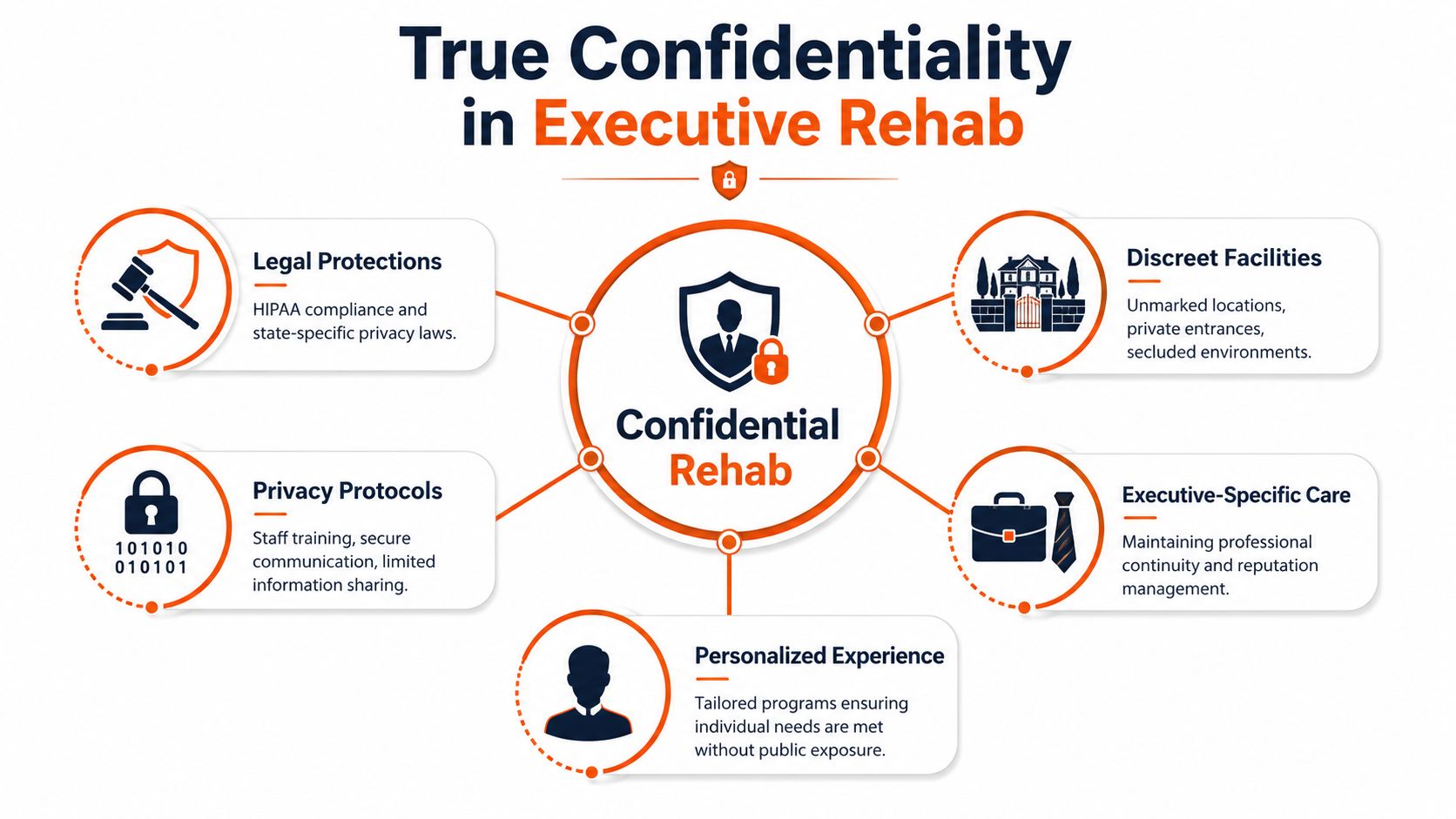
Most treatment websites say “private” when they really mean “we won't gossip.” That's not enough. True confidentiality is legal, operational, and clinical. If any one of those layers is weak, the whole promise is weak.
The legal foundation matters first. Many people know HIPAA, but executives and licensed professionals need to ask about 42 CFR Part 2. As explained in this overview of confidentiality in rehab and 42 CFR Part 2 protections, 42 CFR Part 2 provides stricter privacy protections for substance use disorder treatment records than HIPAA, including protection against use in legal prosecution. That matters if you're worried about professional consequences, public records exposure, or sensitive legal overlap.
HIPAA is the floor, not the ceiling
HIPAA is baseline healthcare privacy. It's necessary. It is not, by itself, the standard you should accept when addiction treatment could intersect with licensure, litigation, employment questions, or public visibility.
Ask direct questions:
- Legal framework: Is the program governed by 42 CFR Part 2 for substance use treatment records?
- Release controls: Who can access your information, and under what written authorization?
- Disclosure practice: How does the program handle inquiries from employers, family members, attorneys, or outside clinicians?
- Documentation separation: Are addiction treatment records handled with extra safeguards?
If admissions staff can't answer clearly, that's a warning sign. You're not asking for special treatment. You're asking whether the program understands the stakes.
Confidentiality is an operating system
The next layer is operational. A program can cite privacy laws and still mishandle your case if its day-to-day practices are sloppy. Real confidential rehab includes discreet communication, careful admissions procedures, need-to-know access inside the facility, and disciplined staff training.
Here's the standard I recommend:
| Area | What to ask |
|---|---|
| Admissions | How are intake calls, paperwork, and arrival handled discreetly? |
| Communication | Who can contact you, and how are messages screened? |
| Staff access | Which staff members can view your file? |
| Facility design | Are there private spaces, controlled entry points, and separation from other clients when needed? |
| Record handling | How are sensitive records stored, shared, and limited? |
Privacy isn't a slogan. It's a chain of decisions, and every weak link raises your exposure.
Licensed professionals need more than reassurance
Physicians, attorneys, pilots, first responders, and other credentialed professionals often carry an extra fear. It's not just embarrassment. It's licensure, reporting obligations, credentialing reviews, and peer scrutiny.
That's why I tell callers to stop asking, “Is it private?” and start asking, “How exactly is it protected?” Those are two different questions. The first gets you marketing language. The second gets you facts.
Essential Features of an Executive Rehab Program
A serious executive program looks different from standard residential care because it solves for two problems at once. It has to treat addiction well, and it has to remove the practical barriers that keep high-stakes clients from engaging fully.
One of the clearest operational differences is technology. According to this explanation of executive rehab program structure and privacy protocols, confidential executive rehab programs may permit cell phones and laptops during defined 60–90 minute work blocks, while standard facilities often restrict devices for the first 1–3 weeks. The same source notes that these programs use strict NDAs for staff, creating a layer of confidentiality that goes beyond standard HIPAA practice.

What I'd consider non-negotiable
If you're evaluating confidential rehab, don't get distracted by luxury language. Focus on function.
- Structured tech access: You need a program with clear, limited, clinically supervised windows for phone and laptop use. Not unlimited device time. Not a total blackout if your role makes that unrealistic.
- Staff NDAs: Every staff member who touches your case should be bound by confidentiality agreements, including administrative personnel.
- Private workspace: A bedroom alone isn't enough if you may need to handle critical communication discreetly.
- Small census: Fewer clients usually means fewer variables, less exposure, and better individual attention.
- Psychiatric and medical integration: Executives often present with burnout, insomnia, anxiety, depression, trauma, or medication complications. A rehab that can't manage those issues will miss the underlying cause of the problem.
Why tech-friendly doesn't mean treatment-light
Some people hear “phones allowed” and assume the program is soft. That's backward. For the right client, supervised access is what makes treatment possible and sustainable.
A tech-friendly policy works only when it has boundaries. Device access should be scheduled, purposeful, and secondary to the clinical day. If your phone stays in your hand all afternoon, you're not in treatment. You're hiding at work inside treatment.
That's why the best executive programs use a controlled structure. Clients handle essential responsibilities, then return to therapy, medical care, and group work. It's not a loophole. It's a containment strategy.
Admissions advice: Ask for the exact device policy. If the answer is vague, assume the program hasn't thought through the executive reality.
The environment should lower friction
You should also pay attention to the setting itself. A strong executive track usually includes private rooms, quiet space, and enough separation to let you rest, think, and stabilize. High achievers are often overstimulated before they arrive. They don't need a louder version of their current life.
The daily rhythm matters too. If you want a practical sense of how a program may balance therapy, structure, and professional continuity, this look at what a typical day in an executive rehab can involve is the right kind of framework to compare against.
Here's the simplest test: if a program can't tell you how it protects privacy at the front desk, in the chart, in the group room, and during your work window, it isn't executive-focused.
How Privacy Directly Impacts Treatment Success
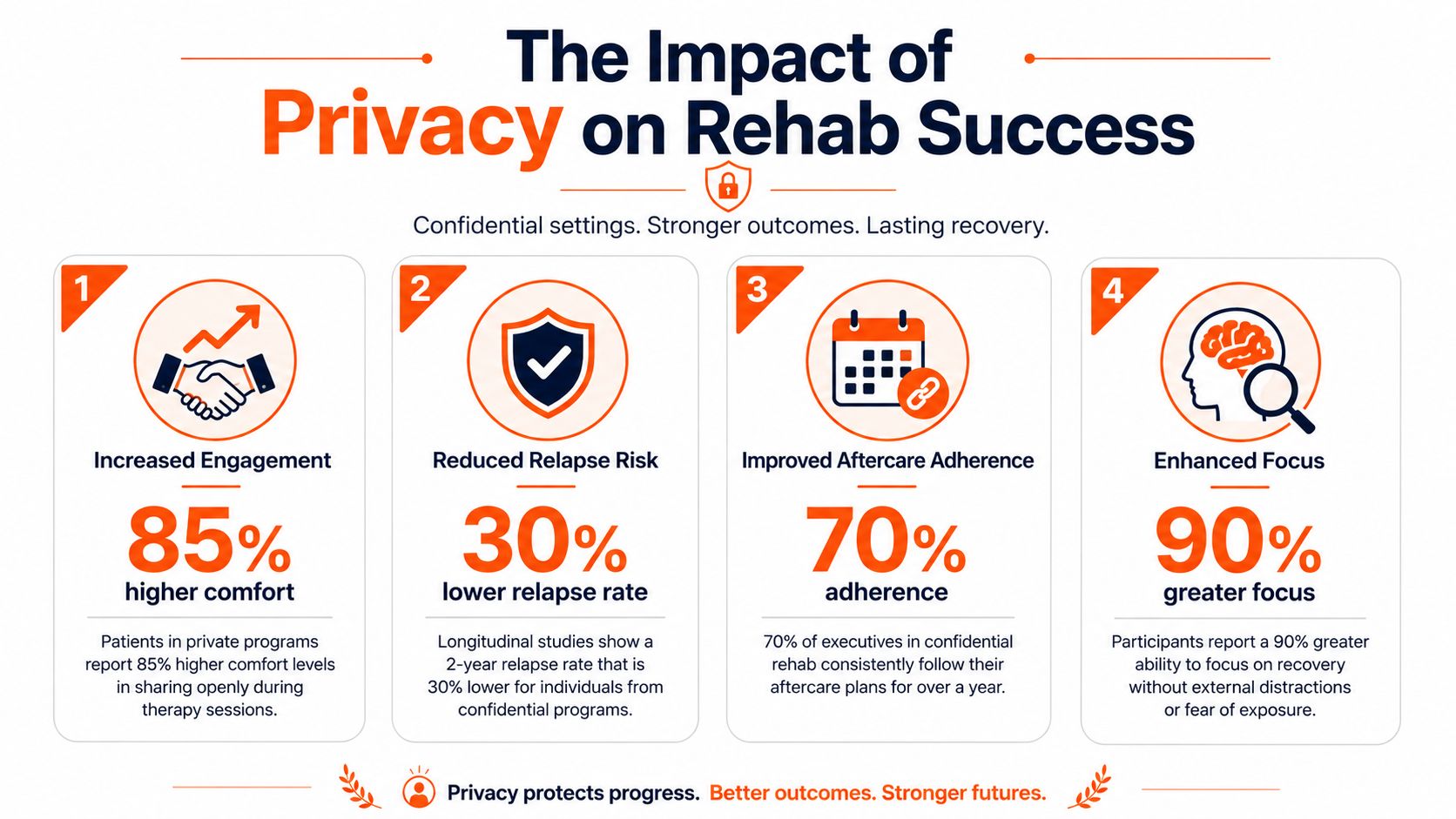
Privacy in rehab isn't a perk for image-conscious clients. It changes behavior inside treatment. When people stop scanning for exposure, they start telling the truth. That's when treatment gets traction.
This isn't just intuition. According to SAMHSA completion data and executive privacy benchmarks discussed here, the overall completion rate for people seeking drug and alcohol treatment is 47%, while residential treatment centers reach 70%, and detoxification programs reach 67%. The same source states that premium executive facilities using extensive NDAs and separate medical record systems reported zero privacy breaches over the past five years, and that 85% to 95% of people who successfully complete these specialized residential programs report abstinence from all drugs nine months after discharge.
Why completion rises when privacy is protected
People complete treatment when they feel safe enough to stay. That safety isn't abstract. It comes from a private setting, competent structure, and reduced fear that treatment itself will trigger professional damage.
Executives drop out for predictable reasons:
- Career panic: They believe stepping away means losing control.
- Exposure anxiety: They fear discovery more than withdrawal.
- Mismatched programming: They enter a program that doesn't fit their responsibilities or identity.
- Shame in group settings: They don't trust the room enough to speak openly.
Confidential rehab addresses those barriers directly. Better completion doesn't happen because the furniture is nicer. It happens because the environment lowers resistance.
A private system changes the clinical conversation
When a client believes records are handled carefully, staff are bound tightly, and identity is protected, the admissions posture changes fast. Defensiveness drops. People disclose the alcohol use, the stimulant misuse, the benzo dependence, the panic attacks, the hidden depression, the affair, the prescription fraud risk, the near miss at work. Those details are uncomfortable. They're also where treatment starts.
Most relapses are rehearsed in silence long before they happen in public.
That's why I push back when people call privacy an amenity. It is a treatment engagement tool. It increases the chance that a client will remain in care long enough to benefit from it.
What a secure setting really buys you
A secure environment gives you three things that matter clinically:
| Benefit | Why it matters |
|---|---|
| Honesty | Clients disclose more when they're not guarding their identity. |
| Consistency | They're less likely to bolt when work pressure spikes. |
| Focus | Less energy goes to image management, more goes to recovery work. |
If a program treats confidentiality as branding rather than infrastructure, don't expect strong follow-through. The people who do best are usually the ones who can stop fighting the setting and start using it.
Integrating Mental Health Care in a Confidential Setting
Many executives don't drink or use because they're careless. They drink or use because they're exhausted, anxious, depressed, wired, numb, or carrying trauma they've never addressed. Substance use is often the visible problem. It isn't always the primary one.
That's why confidential rehab has to do more than protect your name. It has to treat the condition under the behavior. If a program separates addiction from mental health, it will miss the engine driving relapse.

The executive profile is rarely simple
High-pressure roles amplify certain patterns. Chronic sleep loss. Performance anxiety. Burnout mistaken for depression. Depression disguised as “loss of edge.” Trauma hidden behind workaholism. Medication misuse that started with a reasonable prescription and drifted into dependence.
The programs I trust don't make clients choose between talking about the addiction and talking about the panic, grief, trauma, or bipolar symptoms underneath it. They treat both together.
According to clinical outcome reporting on extended care and co-occurring treatment models, programs that provide a full continuum of care, from detox through inpatient and outpatient support, produce better long-term outcomes than short-term treatment alone. The same source notes that treatment lasting at least 90 days across levels of care yields the best long-term recovery outcomes, that accredited facilities with multi-layered privacy protocols and extended care models show 43% better long-term recovery outcomes than standard facilities, and that relapse risk falls to less than 15% for people who remain sober for five or more years after engaging in such integrated models.
What integrated care should look like
If you're vetting a confidential rehab program, ask whether the following are built into the plan:
- Medical stabilization: Detox and medication management shouldn't be improvised.
- Psychiatric oversight: Anxiety, depression, trauma, ADHD, bipolar symptoms, and sleep issues need real evaluation.
- Frequent individual therapy: Executives often reveal the most in one-to-one sessions before they'll do so in a group.
- Evidence-based modalities: CBT, DBT, ACT, EMDR, and related approaches should be available when clinically indicated.
- Aftercare planning: Recovery falls apart when discharge is treated like a finish line instead of a transfer of care.
Privacy makes deeper work possible
Confidentiality also changes how mental health treatment lands. Executives are often willing to admit they drink too much before they'll admit they're scared, lonely, depressed, or traumatized. A well-protected setting makes that second conversation more likely.
If this overlap between addiction and mental health sounds familiar, dual diagnosis treatment for executives in one integrated program is the model worth comparing against when you ask programs about their clinical depth.
If your drinking is propping up untreated anxiety, stopping the drinking without treating the anxiety won't hold.
Short-term symptom control can look impressive for a few weeks. Lasting recovery usually requires more patience than that, and much more integration.
Finding a Confidential Rehab That Fits Your Needs
Individuals often approach rehab selection with misplaced priorities. They start with location, comfort, or appearances. Start with risk instead. What, exactly, are you trying to protect, and what, exactly, needs to be treated?
If you're a business owner, your key issue may be continuity and discretion. If you're licensed, it may be record sensitivity and credentialing fear. If you're a public figure, it may be exposure control. If you've tried treatment before, the missing piece may be mental health integration rather than another detox.
The market still pushes an outdated idea that effective treatment must equal total disconnection. That's not always clinically smart for executives. As noted in this discussion of treatment barriers and tech-friendly confidential care, high-profile clients increasingly seek confidential treatment that allows cell phones and laptops under strict confidentiality agreements, yet many guides still frame “confidential” as “disconnected.” That gap matters. A program that ignores your real-world obligations may lose you before treatment starts.
Questions I'd ask before I'd ever recommend a program
Call admissions and ask these plainly. If the answers sound polished but thin, keep looking.
How do you protect addiction treatment records specifically?
You want a concrete explanation, not “we're HIPAA compliant.”Who signs NDAs and who can access my information?
Ask about clinical staff, support staff, and administrative personnel.What is your phone and laptop policy?
Get the exact rules. You're looking for structure, not improvisation.How do you handle co-occurring mental health conditions?
If the answer is vague, expect fragmented care.What happens after detox or residential treatment ends?
Strong programs think in stages, not episodes.
Green flags and red flags
A quick comparison helps cut through marketing.
| Sign | What it usually means |
|---|---|
| Clear privacy answers | The program has real systems, not just promises. |
| Defined tech policy | They've worked with executives before. |
| Integrated psychiatric care | They understand dual diagnosis, not just abstinence. |
| Personalized planning | They treat role-specific barriers as part of care. |
| One-size-fits-all language | You're talking to a general program dressed up for executives. |
Choose fit over fantasy
You do not need the most isolated program. You need the most appropriate one. Sometimes that means a quiet, boutique setting. Sometimes it means stronger medical oversight. Sometimes it means a facility that understands licensed professionals and keeps treatment functional while you step out of crisis.
The wrong choice is usually obvious in hindsight. It's the place that looked impressive but couldn't answer basic questions about privacy, psychiatric care, and work continuity.
Your benchmark should be simple:
- Privacy that is legally and operationally real
- Clinical care that treats addiction and mental health together
- Structure that supports recovery without creating unnecessary professional damage
If a program can't deliver all three, it's not confidential rehab in the way executives need it.
If you're looking for a program built for professionals who need discretion, clinical depth, and the ability to stay connected to essential responsibilities, Capo Canyon Recovery is worth a direct conversation. Their Orange County program offers medically supervised detox, residential treatment, dual diagnosis care, private rooms, a small-census setting, and a tech-friendly executive track designed for high-stakes careers. If your situation is urgent, don't wait for a cleaner moment. Reach out and get clear answers now.