
You know you need help. The problem isn't deciding whether treatment matters. It's deciding how to disappear from the calendar without setting off questions you can't control.
For an executive, physician, attorney, founder, pilot, or public-facing professional, addiction treatment can feel like a second crisis layered on top of the first. The clinical problem is private. The reputational consequences can become public fast if the process is handled poorly. Those in this position aren't asking, “Should I get better?” They're asking, “Can I protect my license, my clients, my board relationships, and my family while I do it?”
That fear is rational. It also leads people into bad decisions. They delay care. They try outpatient support when they already know they need a higher level of treatment. They overexplain to employers. They underprepare their digital life. They assume privacy will take care of itself.
It won't.
The Executive's Dilemma Navigating Privacy and Recovery
A common version of this starts late at night. The executive has closed the laptop, ignored the second drink becoming the fourth, and admitted something they've avoided for months. They can't keep performing at this level while managing the fallout privately. They need treatment.
Within minutes, the next wave hits. Who will notice? What goes on the calendar? What does HR need to know? What if a colleague sees a car in the wrong parking lot, a missed meeting, an unusual gap in response time, or a phone call answered from a quiet room that sounds nothing like the office?
That is the executive's dilemma. Recovery requires honesty. Professional life often punishes visible vulnerability when it appears without context, boundaries, or a plan.
Generic corporate articles on reputational risk management don't help much here. They talk about brand crises, social media monitoring, and stakeholder messaging. They rarely address the deeply personal version of the same problem. An individual professional doesn't have a communications department standing by. They have one name, one license, one network, and one set of relationships that took years to build.
The first job isn't to manage appearances. It's to create enough privacy and stability for treatment to work.
Handled correctly, reputation planning supports recovery. It doesn't compete with it. If you're choosing care, you're not trying to hide wrongdoing. You're trying to reduce unnecessary exposure while you deal with a medical and behavioral issue responsibly.
That distinction matters. It changes the tone of every decision that follows.
A practical starting point is to understand what privacy looks like in treatment and what questions to ask before you commit. This guide on balancing recovery and privacy captures the central issue well. Privacy isn't cosmetic. It gives you room to do hard clinical work without fueling avoidable speculation.
What Reputational Risk Means for You Personally
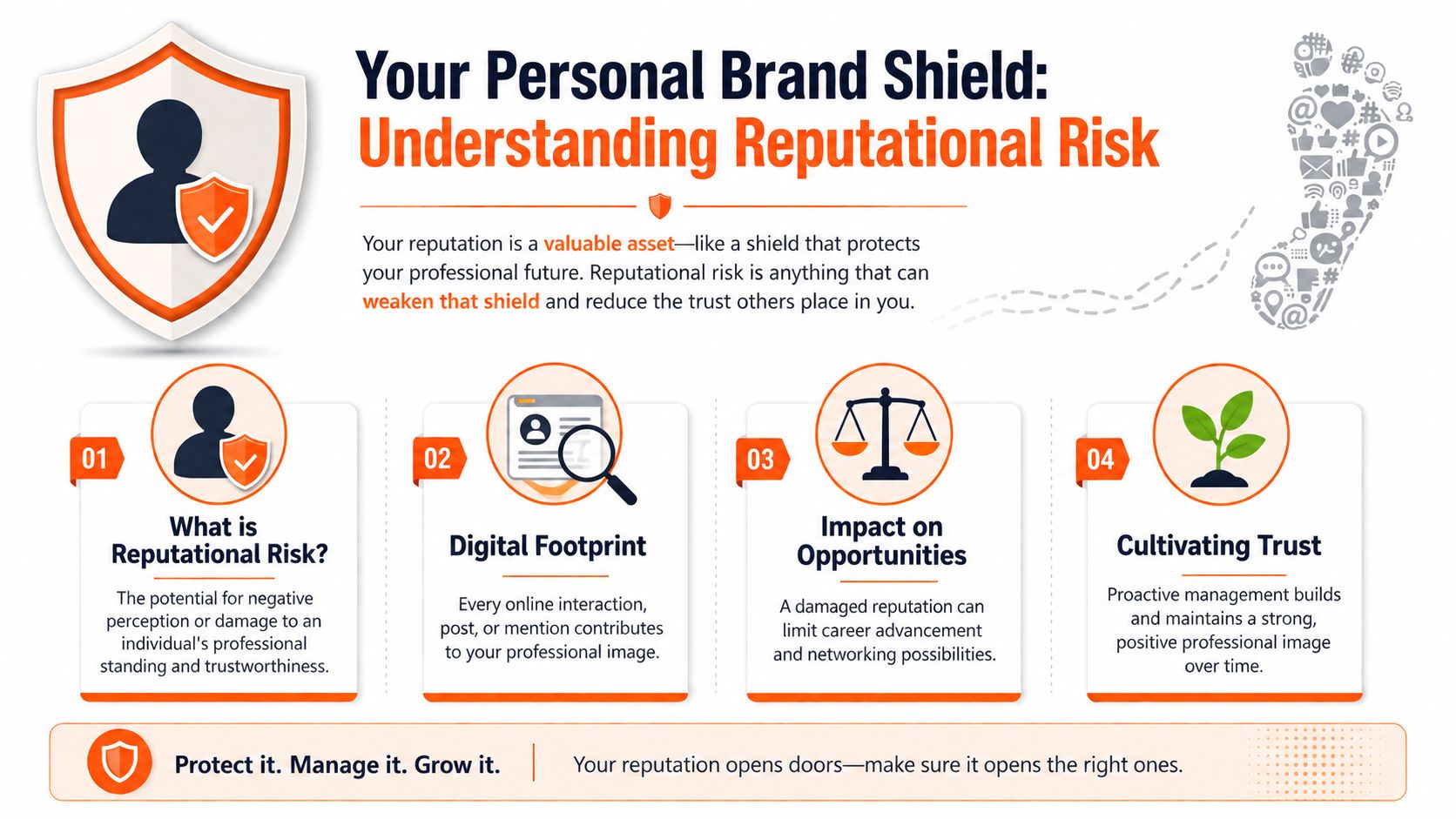
For a company, reputation affects valuation, customer confidence, recruiting, and resilience in a crisis. For an individual, it functions more like a trust score with memory. People you work with may never say they use one, but they do. They decide whether to hire you, refer to you, promote you, invest with you, brief you on sensitive matters, or put you in front of a client based partly on that score.
According to a World Economic Forum analysis cited in industry coverage, over 25% of a company's market value is directly attributable to its reputation (analysis referenced here). For an executive or founder, personal standing is often tied to that value in practical terms. Investors, employees, clients, and counterparties don't separate the enterprise from the person leading it as neatly as legal documents do.
Why individual risk behaves differently
A corporation can absorb a scandal through layers of distance. It has brand architecture, spokespeople, counsel, and sometimes enough scale to outlast a story cycle. A person doesn't.
When the risk is personal, several things happen at once:
- Identity and role merge. If you're known as the disciplined founder, the reliable surgeon, or the composed managing partner, any sign of instability can trigger doubt well beyond the original issue.
- Networks amplify quickly. Colleagues, assistants, referrers, and even well-meaning family members can spread partial information without malicious intent.
- Search results linger. A single inaccurate mention, social post, or forum comment can become part of your professional backdrop.
- Regulated environments raise the stakes. Licensed professionals often have obligations, review processes, or employer policies that require careful wording and timing.
Think of reputation as a balance sheet item
Two common mistakes are made. They either treat reputation as vanity, or they treat it as something too fragile to survive truth. Both are wrong.
Reputation is closer to an operating asset. It helps you close deals, retain influence, and recover from mistakes. That means reputational risk management for an individual is not public relations in the shallow sense. It's the discipline of reducing avoidable damage while you act responsibly.
A simple way to frame it is this:
| Personal reputation function | What it affects |
|---|---|
| Credibility | Whether people believe your judgment under pressure |
| Reliability | Whether stakeholders trust you with ongoing responsibility |
| Discretion | Whether others feel safe sharing sensitive information |
| Leadership signal | Whether teams interpret treatment as instability or accountability |
Practical rule: If a disclosure doesn't improve care, satisfy a real obligation, or protect a critical relationship, don't volunteer it.
That isn't secrecy for its own sake. It's restraint. During treatment, restraint is usually what preserves both privacy and dignity.
Identifying Key Reputational Threats During Treatment
Most professionals worry about “people finding out.” That's too vague to manage. Reputational risk management works better when you separate the threats into categories and deal with each one on its own terms.
According to Aon's Global Risk Management Survey, damage to reputation or brand ranks eighth globally as a critical risk facing organizations in 2025 (Aon's survey findings). For high-visibility leaders, that broad organizational risk often shows up through very personal channels.
Digital exposure risk
Treatment creates unusual digital patterns. You sign intake forms. You communicate from a new location. You may hand over devices temporarily, join telehealth sessions, or log in from networks you don't control. If a facility has weak privacy procedures, your confidentiality can be compromised by ordinary operational sloppiness rather than dramatic misconduct.
Watch for these risk points:
- Portal and paperwork handling. Ask how records are stored, who can access them, and how releases are authorized.
- Device use during treatment. If you're allowed a phone or laptop, clarify where and when you can use them privately.
- Social media leakage. Even a harmless staff post, geotag, or background image can reveal more than intended.
- Synthetic media risk. If you're public-facing, impersonation and manipulated content deserve attention. Counsel dealing with online identity attacks often points executives toward resources like deepfake legal guidance for tech companies because false audio, video, or image content can distort a sensitive situation very quickly.
Professional and regulatory risk
For licensed and regulated professionals, the issue isn't only reputation. It's process. A vague or premature statement to an employer, credentialing body, or board can create avoidable complications.
Different roles trigger different questions:
- Physicians and clinicians may need to think about credentialing, impairment concerns, and documentation.
- Attorneys may need to consider client continuity and conflicts around sudden absence.
- Pilots, executives in finance, and public safety professionals often face stricter operational scrutiny.
- Founders and board members may need to coordinate with investors, governance counsel, or key partners.
The mistake here is improvisation. People try to sound reassuring, then reveal more than necessary.
Social and relational risk
The final category is often underestimated. Gossip doesn't require bad intent. It only requires uncertainty. Once people notice an unexplained absence, they fill the gap themselves.
A few common pathways:
- Internal rumor chains start with assistants, schedulers, or team members adjusting calendar coverage.
- Client concern grows when normal responsiveness changes without a clean explanation.
- Family overdisclosure happens when loved ones seek support from the wrong people.
- Referrer drift occurs when therapists, EAPs, or trusted professionals aren't aligned on what can be shared and with whom.
This is why broad reassurance usually fails. Specific containment works better.
A Framework for Protecting Your Professional Standing
Established reputational risk management models use phases such as identification, monitoring, crisis response, and recovery. MetricStream describes mature practice as a multi-phase framework involving identification, trigger monitoring, scenario-tested crisis response, and transparent recovery, often with cross-functional input from legal, HR, and communications (framework overview). For an individual in treatment, the same logic applies. The actors change.
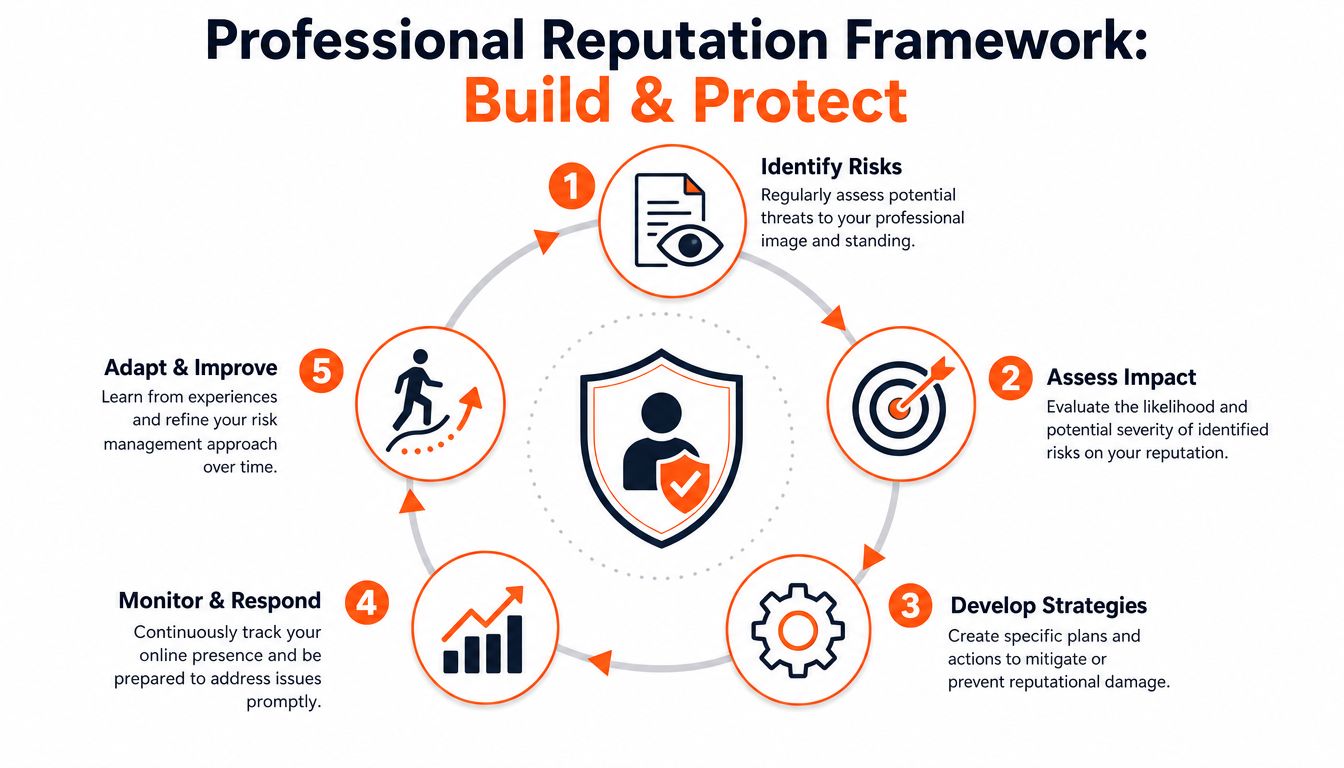
Phase one before admission
Start with an audit, not an announcement.
Map the people and systems that could be affected by your absence. That usually includes your employer or partners, one legal adviser, one family point person, one clinical contact, and any assistant or operations lead who controls scheduling.
Create three lists:
- Must know now
- May need limited information later
- Should not be told unless circumstances change
Then review your visible footprint. Look at your calendar habits, voicemail, auto-replies, social activity, travel patterns, and any standing appearances that would expose your absence if canceled clumsily.
Phase two secure intake
This phase is operational. You're assessing whether the treatment environment supports confidentiality in practice, not just in marketing language.
Ask direct questions such as:
| Question | Why it matters |
|---|---|
| How are private rooms and quiet calls handled? | Privacy often breaks through routine interruptions |
| What is your phone and laptop policy? | Work continuity can either stabilize or destabilize treatment |
| Who can confirm my presence to outsiders? | Front-desk leakage is a real problem |
| How are releases of information documented? | Informal sharing creates lasting trouble |
If the answers are vague, keep looking.
Phase three controlled disclosure
You don't need one grand statement. You need several precise ones. The wording for an employer should not match the wording for family. The wording for a board contact should not match the wording for clients.
Tell each audience only what they need to carry out their role responsibly.
For many professionals, “I'm addressing a medical issue and will be unavailable for a defined period, with coverage arranged for urgent matters” is enough. Where legal or licensing obligations require more, get that language reviewed before you send it.
Phase four in-treatment continuity
Many plans often fail under these circumstances. People either stay too connected and never settle into treatment, or they vanish so abruptly that colleagues assume the worst.
The middle path works better. Maintain one channel for essential communication, delegate aggressively, and set a response cadence that doesn't invite speculation. If you have an assistant, give that person scripts, escalation rules, and permission to say less rather than more.
Phase five return and recovery
Returning to work is not a reveal. It's a reentry.
Your goal is to resume competence without inviting unnecessary forensic interest into your private life. Some professionals choose full privacy. Others disclose selectively after the fact. Either approach can work if it's deliberate and consistent.
The wrong approach is to come back with shifting explanations, obvious defensiveness, or a burst of overperformance that signals instability.
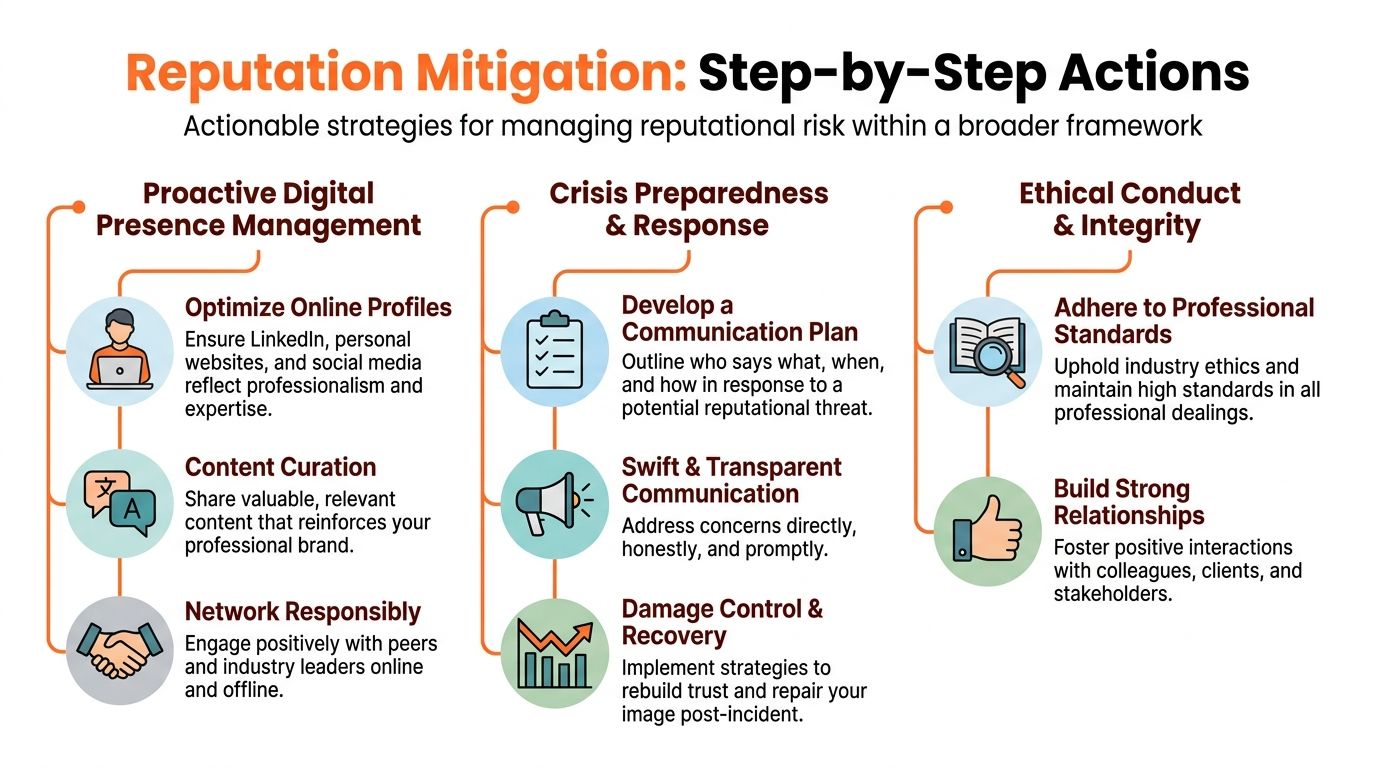
Actionable Mitigation Strategies Step by Step
Frameworks are useful because they impose order. They don't protect you by themselves. Protection comes from execution.
Leading practice in reputational risk management calls for assessing threats by magnitude and likelihood, along with 24/7 early warning systems that monitor media and internal data for emerging issues (AIRMIC technical guidance). An individual can use the same logic without building a corporate command center. You just need a smaller, sharper version.
Build your small response circle
Keep it tight. In most cases, that means one clinical contact, one legal adviser if needed, one family coordinator, and one work-side operator. If you add too many people, you increase leak points and conflicting narratives.
Use this test before adding anyone: does this person solve a real problem that can't be handled by someone already in the circle?
Vet the treatment environment like a security-sensitive decision
Don't evaluate a program only on comfort or clinical language. Ask how privacy works in ordinary daily life.
Look for practical safeguards such as:
- Private rooms and workspaces so calls don't happen in shared settings
- Clear device rules so you know when and how to handle essential work
- Low census environments if anonymity matters
- Defined communication procedures for family, employers, and outside professionals
- Documented confidentiality practices rather than verbal assurances
If continuing limited work matters, review policies in advance. Guidance on working while in rehab is useful because it addresses the tension directly. Staying connected can preserve stability, but only if it's bounded and clinically appropriate.
Prepare scripts before anyone asks questions
You need short, repeatable language. Not polished speeches.
Examples of useful script categories:
- Employer statement focused on medical leave, timeline, and coverage
- Client or external contact statement focused on availability and continuity
- Family boundary statement clarifying what may and may not be shared
- Assistant script for scheduling changes and urgent escalation
Write them down. Edit them for tone. Then stop revising. Under stress, people overshare when they improvise.
If you feel the urge to explain in detail, that's usually the moment to shorten the message.
Manage your devices and accounts carefully
During treatment, your phone can protect you or expose you. The same is true of email and messaging apps.
Take these steps before admission:
- Review account access. Remove unnecessary shared access to calendars, inboxes, and cloud folders.
- Update key contacts. Make sure urgent messages route to the right delegate.
- Turn off passive exposure. Disable location sharing, social check-ins, and background app permissions you don't need.
- Separate urgent from nonessential channels. One monitored path is better than six.
- Plan for breach response. If you're concerned about compromised data or account misuse, a plain-language guide on how to handle a data breach can help you think through first moves without panic.
Create an early warning routine
You probably don't need expensive software. You do need attention.
Set up a practical monitoring system:
| Monitor | What to watch |
|---|---|
| Search results | New mentions of your name or business |
| LinkedIn and social channels | Unusual tagging, comments, or speculation |
| Internal feedback loop | What your assistant, spouse, or counsel is hearing |
| Referral network | Any drift in what trusted intermediaries are saying |
This routine matters because reputation problems often start as small signals. A strange comment. A forwarded screenshot. A half-true story. Early correction is usually quiet. Late correction becomes drama.
Plan aftercare with reputation in mind
The strongest post-treatment reputational strategy is behavioral consistency. Keep appointments. Respect limits. Avoid dramatic declarations. Don't convert recovery into a branding exercise unless your role and values require public advocacy.
You don't need to perform redemption. You need to become reliable again in visible ways.
Managing Communication with Family Employers and Referrers
Poor communication creates most secondary damage. Not the treatment itself. Not the leave. The confusion around them.
Individual-focused reputational risk management matters most. A critical gap in mainstream guidance is the lack of frameworks for risks tied to individuals rather than institutions. The Corporate Governance Institute notes this blind spot, and cites St. John's University data showing 72% of institutions review peer reputational risks to adapt their own strategies (discussion of individual-associated reputational risk). That should tell you something important. People around you are already interpreting personal events through a reputational lens, whether anyone says so aloud or not.
Family needs boundaries, not just reassurance
Family members often become accidental broadcasters. They're scared, they want support, and they may assume that telling a sibling, friend, or colleague is harmless. It isn't always.
Give family a simple framework:
- what they may say
- what they may not say
- who handles incoming questions
- when they should refer someone back to you or your designated contact
This reduces emotional improvisation. It also spares loved ones from carrying information they don't know how to manage.
Employers need clarity and calm
Most employers don't need a confession. They need continuity, timeline expectations, and confidence that work won't collapse.
A controlled conversation with an employer usually includes:
| Topic | Keep it focused on |
|---|---|
| Reason for leave | Medical need, not personal detail |
| Duration | Best current estimate, with room for clinical adjustment |
| Coverage | Who handles urgent matters |
| Communication | One point of contact and response boundaries |
If you need help framing that discussion, this guide on how to talk to your employer about going to rehab is useful because it stays grounded in workplace reality rather than idealized language.
Referrers and professional allies need a closed loop
Therapists, EAPs, physicians, interventionists, and trusted colleagues can either stabilize the situation or complicate it. The difference is whether everyone understands the communication boundary.
Give referrers explicit instructions about:
- who may receive updates
- what level of detail is appropriate
- whether your employer, spouse, or counsel is included
- when silence is preferable to a partial update
A closed loop beats a friendly one. Warmth helps. Precision protects.
This isn't cold. It's careful. In sensitive treatment situations, careful communication is often the kindest thing you can do for everyone involved.
Turning Risk into Resilience Your Path Forward
Seeking treatment doesn't create reputational risk by itself. Disorder, inconsistency, and unmanaged disclosure do. That's why the right frame is not damage control. It's leadership under pressure.
When professionals handle this well, they make a series of disciplined choices. They define who needs to know. They choose a setting that respects privacy in daily operations. They communicate with restraint. They keep a narrow line of essential continuity. They return to work with steadiness rather than theatrics.
That is reputational risk management in its most personal form. It protects two assets at once. Your health, and the trust that supports your career.
A specialized environment can make that process far easier. Privacy, limited census, private rooms, clinical depth, and the ability to remain connected to essential work are not luxuries in this context. They are operational protections that give treatment a real chance to work.

If you're weighing treatment against professional exposure, don't force yourself into that false choice. With planning, boundaries, and the right care setting, recovery can proceed without handing your reputation over to rumor, confusion, or avoidable digital risk.
If you need a treatment setting built for privacy, discretion, and professional continuity, Capo Canyon Recovery offers medically supervised detox and residential care for executives, licensed professionals, and high-profile clients who can't afford a careless approach to recovery. Their private rooms, tech-friendly policy, small census, and individualized clinical support are designed for people who need serious treatment without surrendering control of every other part of their life.