
You may be managing a company, a practice, a book of clients, or a team that still expects answers before sunrise. On the outside, nothing has slipped enough to force the issue. Internally, you know the cost of keeping the machine running. Sleep is thinner. Alcohol, stimulants, sedatives, or pain medication have stopped feeling optional. And the idea of treatment raises its own fear. If you step away, what happens to the deals, the inbox, the people who depend on you, and the identity you've spent years building?
High-performing professionals rarely need more pressure. They need a treatment model that respects how they think. Most have already tried willpower, self-correction, and private promises. That usually works in business. It often fails with addiction because addiction distorts judgment, reward, stress tolerance, and routines all at once.
That's why golf in rehab can make sense to executives in a way that standard “activities” often don't. Used properly, golf isn't filler. It can be a structured therapeutic tool that works with the executive mindset: focus, strategy, patience, discipline, and measured adaptation under pressure.
Rethinking Recovery for High-Performing Leaders
A typical executive doesn't arrive at treatment because life is disorganized. They arrive because they've become highly organized around a problem. They've built systems to conceal it, compensate for it, and keep producing despite it. That's one reason treatment can feel so threatening. Recovery asks a person who is used to controlling outcomes to enter a process where control has to be rebuilt differently.
The clinical reality is sobering. An estimated 40–60% of individuals relapse while in recovery, and less than 43% of people who enter treatment complete their program according to rehab success rate data summarized by Legacy Treatment. The same source notes that longer programs of 90 days or more and continued engagement are linked to higher success rates. For a professional who's used to solving problems fast, that matters. Recovery isn't a quick correction. It's a sustained restructuring of how stress, reward, relationships, and daily decisions are handled.
Why standard rehab assumptions miss this audience
Executives often carry a few private beliefs into treatment:
- “If I were stronger, I'd have handled this myself.” That belief blocks honesty and delays care.
- “If I disconnect completely, my life will unravel.” For many professionals, this fear isn't vanity. It's practical.
- “If treatment feels passive, I'll reject it.” High performers usually engage better when the work is active, applied, and measurable.
That last point is where golf can become clinically useful.
Recovery works better when treatment gives a high-functioning client a place to practice regulation, not just talk about it.
A different entry point into treatment
Golf presents a familiar kind of challenge. It demands decision-making, tempo control, emotional restraint, and the ability to recover from a bad shot without blowing up the next one. Those aren't abstract virtues. They're the same capacities many professionals rely on at work, and the same capacities substance use steadily erodes.
In a well-run program, golf in rehab isn't there to make treatment feel luxurious or to distract from the hard work. It gives clinicians another setting in which a client's patterns become visible. Impatience shows up. Perfectionism shows up. Competitive overreach shows up. So does resilience.
That matters because many high-achieving clients don't respond first to advice. They respond to direct experience. On a course or range, the feedback is immediate. Grip too hard, rush the shot, force the outcome, lose attention for a moment, and the result changes. That's useful clinical material.
The Clinical Science of Golf Therapy
Golf becomes therapeutic when it is prescribed with intent, not offered as entertainment. The value isn't in “being outdoors” alone. It's in the combination of steady movement, focused attention, environmental calm, and regulated effort.
Research summarized by Healthy Life Recovery on golf in addiction recovery notes that golf is used as a rehabilitative exercise because it enhances endorphin release, which can help mitigate withdrawal discomfort. The same source states that the natural environment of a golf course provides a serene setting that has been proven to reduce stress and foster mindfulness.
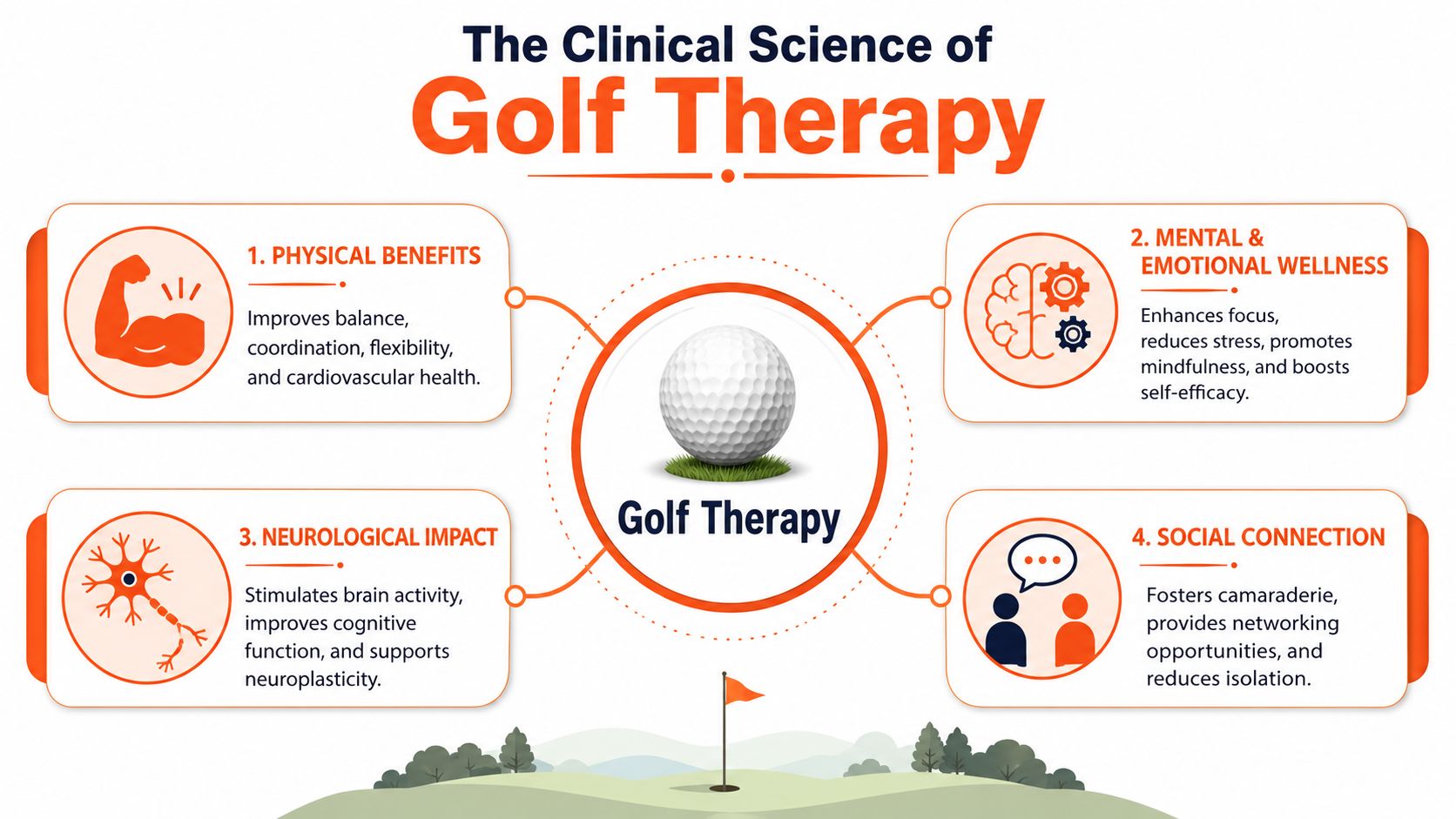
What happens physically
Many clients enter treatment physically depleted. Sleep is disrupted. Appetite is erratic. Stress chemistry runs high. Early recovery often includes restlessness, low mood, body discomfort, and difficulty settling.
Golf helps because it introduces movement without demanding the kind of intensity that turns recovery into another performance test.
- Endorphin support: Gentle, sustained physical activity can support mood and reduce discomfort during early recovery.
- Practical exertion: Walking, swinging, and repeated controlled movement create a manageable physical load.
- Lower barrier to participation: Clients who would resist a hard training session often tolerate golf much better.
For some clients, this matters as much psychologically as physically. The activity feels purposeful. It doesn't feel punitive.
What happens mentally
Golf requires selective attention. You can't hit a clean shot while mentally replaying an argument, drafting a board memo, and catastrophizing about the future. The mind has to narrow its field.
That narrowing often creates a form of active mindfulness. Not passive relaxation. Not zoning out. Attention with a task attached to it.
A good way to think about it is this:
| Clinical challenge | What golf asks for |
|---|---|
| Rumination | Attention to the next shot |
| Agitation | Slower tempo and breath control |
| Perfectionism | Reset after imperfect results |
| Emotional reactivity | Composure between outcomes |
This is one reason golf in rehab can complement other healthy routine-building practices. A structured movement plan often improves engagement in recovery overall. Clients who respond to activity-based regulation may also benefit from a disciplined fitness routine in addiction recovery, provided it's introduced at the right clinical stage.
Practical rule: Golf helps most when the goal is regulation, not performance.
What doesn't work
Golf isn't automatically therapeutic. It stops being useful when it's used in the wrong way.
- Too much intensity: A client who turns every round into a pressure test may reinforce the very stress patterns treatment is trying to interrupt.
- No clinical context: If nobody processes what happened on the course, the learning can be lost.
- Ignoring physical readiness: Clients still need assessment for stamina, injuries, balance, and withdrawal-related limitations.
That last point is not optional. Recreational therapies like golf should sit inside a broader clinical plan with medical and psychological oversight, not replace evidence-based care.
Why Golf Resonates with the Executive Mindset
Some therapeutic activities are beneficial but hard to sell to a skeptical professional. Golf usually doesn't have that problem. It speaks a language many executives already understand.

A round of golf rewards planning, patience, sequencing, and emotional control. You assess conditions, choose a line, commit to a shot, tolerate uncertainty, and adjust after feedback. That looks a lot like executive functioning under pressure. For clients who resist anything that feels sentimental or unstructured, golf offers a cleaner entry point. It lets them practice recovery skills in a setting that still feels credible.
It protects identity while building a new routine
One of the most delicate parts of executive treatment is identity disruption. Many professionals don't just fear withdrawal or reputational exposure. They fear becoming unrecognizable to themselves.
That concern isn't trivial. A source summarized by Recovery.com on golf and executive recovery describes a near-total absence of evidence specifically addressing executive recovery through golf, while also noting that executives show 3x higher relapse rates when work disconnection occurs. The same source states that a 2025–2026 dataset found 68% of executive patients cite maintaining work connection as critical to recovery success, while only 12% of rehab centers offering golf explicitly integrate it into executive treatment tracks.
Those figures don't prove that golf is the solution. They do highlight a real treatment gap. High-pressure professionals often need a model that reduces the false choice between recovery and relevance.
It gives ambition a healthier target
A useful round of golf demands discipline without chaos. The client has to notice frustration, resist overcorrection, and stay with process. That's a better use of executive drive than white-knuckling through cravings while trying to maintain the appearance of total control.
Golf also offers a sober social framework that doesn't revolve around bars, private dinners, or alcohol-centered networking. For many professionals, that matters after discharge. They need replacement settings, not just abstinence instructions.
Consider the difference:
- Old pattern: client entertainment tied to drinking, pressure, and late-night overstimulation
- New pattern: connection, conversation, and status-neutral activity without chemical dependence
Some clients trust golf faster than they trust therapy. That's fine. If it gets them practicing patience, honesty, and emotional regulation, clinicians can work with that.
It fits how executives learn
Many leaders learn best through direct feedback. They don't need abstract advice about frustration tolerance. They need a moment where they feel the consequence of rushing, then try again differently.
Golf delivers that kind of feedback cleanly. Not harshly. Cleanly.
That's why the modality often resonates with clients who would never describe themselves as “into wellness.” They don't have to be. They just have to notice that the same traits helping them build a company can undermine recovery when pushed without flexibility. Golf makes that visible without shaming the person for having those traits in the first place.
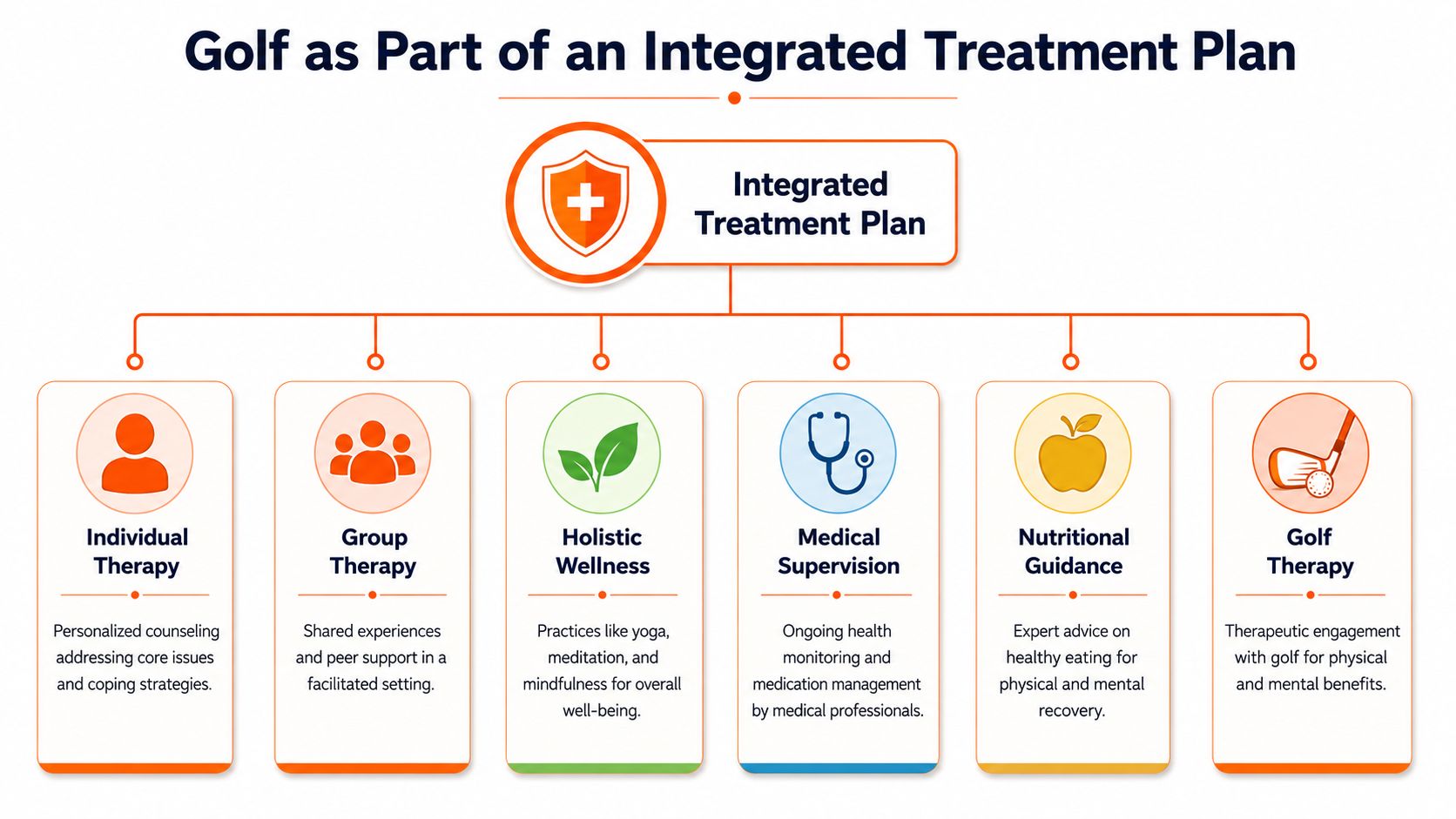
Golf as Part of an Integrated Treatment Plan
Golf works in treatment when it serves the clinical plan. It doesn't work when it replaces one.
Clinical research discussed in a golf rehabilitation overview indicates that golf-based rehabilitation can improve movement coordination, balance, and quality of life. The same source notes that for people with mental health or substance use disorders, golf can reduce stress hormones and boost endorphins, helping mitigate anxiety, depression, and social isolation. Those are meaningful benefits, but they become far more useful when the treatment team translates them into psychotherapy, psychiatric care, and daily recovery structure.
How the course informs the therapy room
The golf setting often reveals patterns faster than conversation alone. A client who minimizes stress may become visibly agitated after one poor shot. Another may swing between overconfidence and self-criticism. Another may detach completely after frustration.
Those observations can be folded into core treatment modalities:
- CBT work: identifying distorted thoughts such as all-or-nothing thinking, catastrophizing, or harsh self-appraisal
- DBT skills: practicing distress tolerance and emotional regulation in real time
- Trauma-informed care: watching for shutdown, hypervigilance, or performance-based self-worth
- Dual diagnosis treatment: connecting anxiety, depression, ADHD, or trauma symptoms to substance use patterns
Golf creates the moment. Therapy helps the client understand it and change it.
Medical screening still matters
Not every client should head straight to the course. Some need detox stabilization first. Some need medication adjustment, psychiatric evaluation, or physical clearance. Others may need a modified approach because of pain, gait instability, recent injury, or fatigue.
When adaptive access matters, clinicians and families can review tools such as Caddie Wheel resources for adaptive sports, which give a practical sense of how golf participation can be made more accessible for people with mobility or physical limitations.
A clinically sound program looks at golf the way it looks at any modality. It asks whether the activity is appropriate, what the risks are, what the intended therapeutic target is, and how outcomes will be observed.
What an integrated plan actually includes
At the program level, golf should sit beside, not above, the main treatment pillars.
| Treatment element | What it addresses |
|---|---|
| Individual therapy | Substance use drivers, stress patterns, trauma, relapse planning |
| Psychiatry and medication oversight | Withdrawal, mood, sleep, cravings, co-occurring conditions |
| Group therapy | Interpersonal feedback, accountability, isolation reduction |
| Holistic and movement-based care | Regulation, physical recovery, routine restoration |
| Golf in rehab | Applied focus, emotional regulation, social reconnection, physical engagement |
One practical example is Capo Canyon Recovery, which offers medically supervised detox and residential care for professionals, including an executive treatment track, dual diagnosis treatment, private rooms, and a tech-friendly policy that allows essential work continuity. In that kind of setting, golf can be added as part of a broader personalized plan rather than treated as a standalone solution.
A Day in a Medically Supervised Executive Program
The idea of treatment becomes less intimidating when it's concrete. Most executives aren't worried about having structure. They're worried about losing agency, privacy, and the ability to manage what only they can manage.
A clinically supervised executive day usually balances stabilization, therapy, movement, meals, and limited professional contact. It shouldn't feel chaotic, and it shouldn't feel like a resort schedule with clinical work pasted on top.
What the rhythm often looks like
A structured golf rehabilitation model can include a six-week protocol that combines one-to-one physiotherapy, small-group golf lessons, and a targeted exercise regimen, with reported benefits for cardiovascular fitness, balance, and cognitive function according to Therapeutic Golf Rehabilitation information from NeuPhysio. In an addiction setting, that doesn't mean every day becomes a golf day. It means golf is scheduled intentionally, at the right time, and with the right level of support.
A representative day for an executive client may include:
- Morning clinical check-in: nursing observation, medication support if needed, and a brief orientation to the day
- Primary therapy session: individual work focused on cravings, stress, trauma, family dynamics, or relapse risk
- Golf-related movement block: a range session, skills practice, or a supervised round depending on clinical readiness
- Protected work window: time to review urgent email, coordinate with trusted colleagues, or handle essential decisions
- Afternoon group or psychoeducation: skill-building around boundaries, communication, and coping
- Evening decompression: chef-prepared meal, reflection time, and preparation for the next day
Why this balance works better for professionals
Executives usually engage more fully when treatment doesn't force a false split between “real life” and recovery. Some responsibilities can be delegated. Some can't. A good executive program distinguishes between necessary connection and compulsive overinvolvement.
That's different from letting work run the treatment process. The structure still holds. Therapy still happens. Medical supervision still comes first. But the client isn't pushed into panic by unnecessary isolation.
Recovery doesn't require professional disappearance. It requires enough structure that work stops driving the nervous system every hour of the day.
If you want a closer sense of how that schedule can operate in practice, this overview of a typical day at an executive rehab gives a useful reference point.
Your Next Step Toward Discreet and Effective Recovery
If you're considering golf in rehab, the right question isn't whether golf is enjoyable. The right question is whether it helps you engage in treatment in a way that sticks. For many professionals, it does. It offers a familiar framework for practicing focus, restraint, adaptation, and stress regulation without reducing treatment to talk alone.
What matters more is the container around it. The program needs medical supervision, psychiatric support, evidence-based therapy, and enough privacy that you can stop performing long enough to fully recover. It also needs enough flexibility that necessary work contact doesn't become a hidden trigger for relapse.
What to look for before you choose a program
A high-pressure professional should ask practical questions first.
- Privacy protections: How many clients are in residence at one time, and how is confidentiality protected?
- Clinical depth: Are detox, psychiatry, and dual diagnosis care handled on site?
- Executive fit: Can you maintain essential communication without turning treatment into remote work?
- Therapeutic purpose: If golf is offered, is it integrated with therapy or treated as a perk?
The answers matter because your risk profile is different from someone whose main barrier is attendance. Professionals often need treatment that reduces reputational exposure, addresses co-occurring anxiety or depression, and respects the reality that stepping away from responsibility can itself become destabilizing.
A realistic standard for discreet care
The best sign that a program understands executives is not polished branding. It's operational detail. Private rooms. Small census. Real nursing coverage. Psychiatric availability. A schedule that protects clinical work while allowing limited, appropriate contact with the outside world.
Privacy should also be addressed directly, not implied. If reputational risk is one of the reasons you've delayed care, it helps to review how a program handles confidentiality, communication, and separation from public exposure. This guide to balancing recovery and privacy at Capo Canyon lays out the kind of safeguards professionals usually want to understand before making a decision.
Choosing treatment doesn't mean giving up the qualities that made you effective. It means putting those qualities to work in a setting where they can support recovery instead of defending the addiction. Golf can be part of that process. Not as a shortcut, and not as a symbol. As a practical tool, used at the right time, for the right person, inside real treatment.
If you're looking for a discreet executive program that understands work continuity, privacy, dual diagnosis care, and the role of structured modalities like golf in rehab, contact Capo Canyon Recovery to discuss options confidentially.