
You may be searching for rehab by the beach late at night, with two tabs open in your browser. One tab shows ocean views, private rooms, and words like serenity. The other is your real life: unread messages, a calendar full of obligations, and the private fear that if you stop moving for a week, everything you've been holding together might come apart.
That instinct makes sense. When someone is exhausted, overwhelmed, or burned by the cycle of drinking, pills, stimulants, or compulsive self-medication, a calmer setting feels safer than a hospital-like one. But the beach itself doesn't treat addiction. It can support treatment. It can lower noise, create space, and help the nervous system settle enough to engage. The actual work still happens in therapy, in structure, in accountability, and especially in the relationships formed during treatment.
For many professionals, the most uncomfortable part of that sentence is the last one. Group therapy often sounds like the least appealing part of care. It raises immediate questions about privacy, status, and control. Those concerns are valid. They also point directly to why well-run group therapy is often one of the most effective parts of executive treatment.
The Search for Serenity and the Reality of Recovery
The appeal of rehab by the beach is obvious. Individuals don't want recovery to begin in a harsh environment. They want quiet, dignity, and some relief from the pace that's been grinding them down.
That desire isn't superficial. It's human. A well-chosen setting can help someone sleep, regulate, and stay in treatment long enough to benefit from it.
What gets missed is the difference between a healing backdrop and the treatment itself. The view matters less than what happens inside the day. If the program doesn't engage you, challenge you, and help you build new ways of living, the scenery becomes decoration.
What the stakes actually are
The outcomes in addiction treatment are serious enough that choosing based on aesthetics alone is risky. Between 40% and 60% of people relapse after treatment, and only 43% of individuals who enter treatment complete the full program, according to clinical reporting on rehab outcomes.
That doesn't mean treatment doesn't work. It means treatment has to be chosen carefully.
Practical rule: If a program talks more about the beach than about engagement, retention, and clinical depth, keep asking questions.
A beautiful setting can help someone say yes to treatment. It can reduce resistance in the first few days. It can make hard conversations more tolerable. But those benefits only matter if they support real therapeutic work.
Why group therapy belongs in that conversation
Professionals often assume the most important part of treatment will be one-on-one sessions. Individual therapy is essential, but it isn't enough by itself for many people. Addiction often grows in isolation, secrecy, role performance, and emotional distance. Group therapy puts those patterns into the room where they can be seen and changed.
That's why I don't think of rehab by the beach as a retreat. I think of it as a setting that can make intensive clinical work more possible. The environment should help you stay present for treatment, not distract you from it.
For a high-achieving person who's used to managing perception, avoiding dependence, and carrying pressure alone, a strong group can become the first place where honesty feels safer than image management.
What Group Therapy Looks Like in Executive Rehab
Most professionals hear “group therapy” and picture a crowded room, generic advice, and forced sharing. That model exists. It's also the reason many people dismiss group work before they've experienced a well-run version of it.
In an executive setting, the structure should look very different. Think less crowded lecture hall, more confidential advisory board.
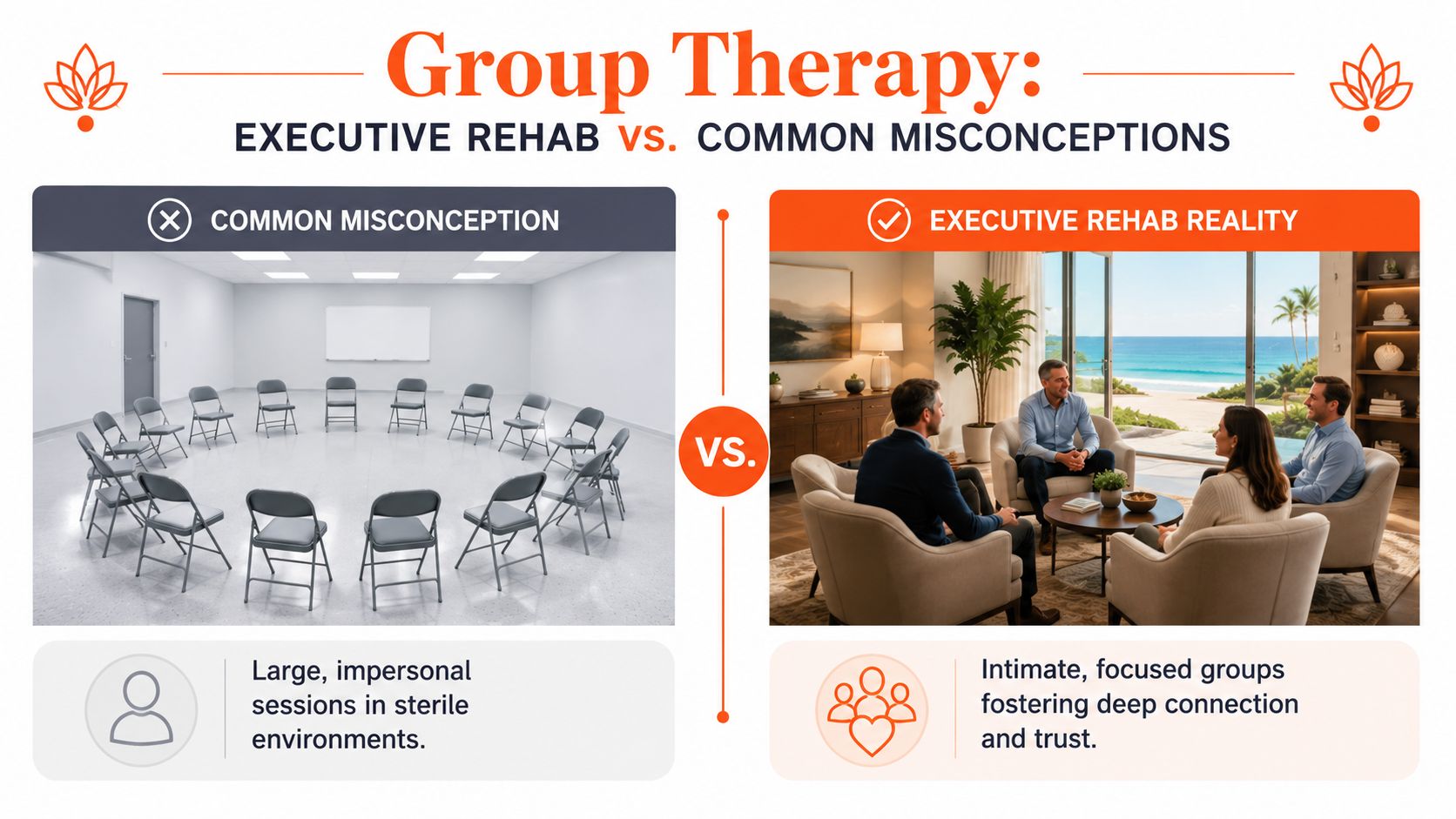
Small groups change the entire experience
When a program keeps the census low, the group stops feeling anonymous. People learn each other's patterns. The therapist can slow the room down, redirect unhelpful dynamics, and make sure no one disappears into the background.
That's the difference between being “in a group” and engaging with the group. In a boutique executive environment, you're not one face in a crowd. You're part of a clinically managed peer system.
A strong daily rhythm matters too. If you want a practical sense of how group work fits into treatment, a typical day at an executive rehab should include structured therapy blocks, private time, clinical support, and enough consistency that the work doesn't feel chaotic.
Two kinds of groups you should expect
Not all groups do the same job. Good programs usually use both of these formats:
- Psychoeducational groups help you learn concrete skills. In these groups, clients practice tools drawn from CBT, DBT, ACT, relapse prevention, emotional regulation, and communication training.
- Process groups focus on what's happening between people in real time. In these groups, defensiveness, avoidance, perfectionism, control, and shame become visible enough to work on.
- Theme-based groups may center on trauma, family systems, grief, professional identity, or co-occurring anxiety and depression.
- Accountability groups help clients name what they're minimizing, what they're avoiding, and what they need to do next.
Why this format works for executives
Professionals often do well in treatment when the group is selective, focused, and well facilitated. They usually don't need more vague encouragement. They need accurate reflection.
A good group doesn't ask you to perform vulnerability. It helps you recognize the cost of performing competence all the time.
That's why one-size-fits-all group work tends to fail with this population. It either feels too exposed or too shallow. Executive rehab works best when the group is intimate enough for trust and perceptive enough to challenge polished defenses without humiliation.
The Clinical Power of Shared Experience for Professionals
Professionals are often surrounded by people and still utterly isolated. They manage teams, clients, patients, cases, investors, or families all day while hiding the part of life that feels least controllable. That split creates a specific kind of loneliness. On the outside, they look capable. Internally, they may feel ashamed, frightened, and convinced no one in their world would understand.
Group therapy directly interrupts that distortion.
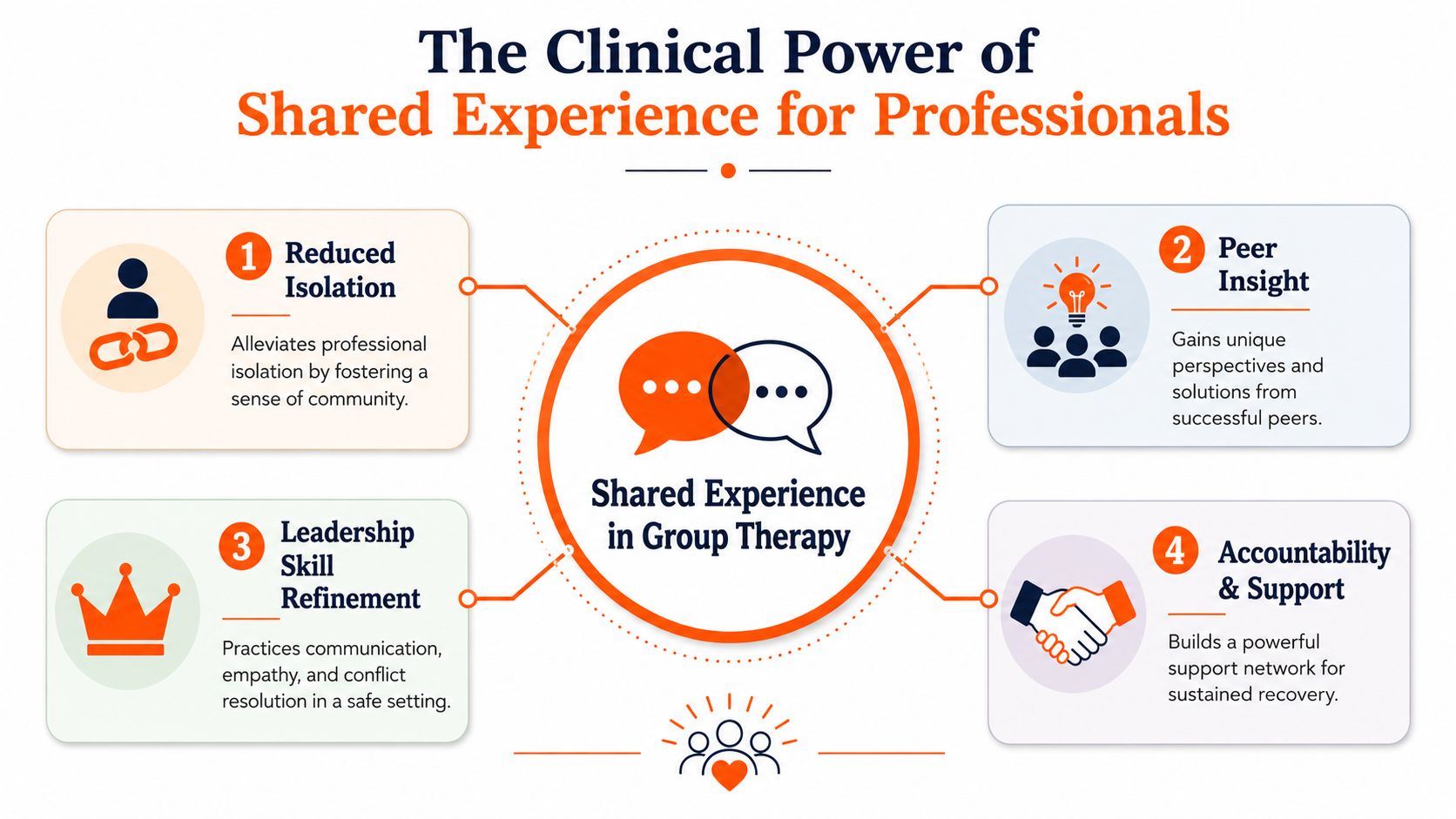
Relief from isolation
One of the most powerful moments in treatment is hearing another accomplished person say something you've never admitted out loud. Not because your stories are identical. Usually they aren't. The relief comes from recognizing the same fear underneath them.
That experience matters clinically. It lowers shame. It softens the belief that you're uniquely broken. It also makes honesty more possible.
Long-term recovery depends on staying in treatment long enough for change to take hold. The strongest predictor of sustained recovery is an adequate length of stay of 90 days or more, and integrated treatment for co-occurring conditions produces superior outcomes, with 85.7% of clients showing measurable improvement in one clinical summary, as outlined in this review of treatment duration and integrated care. Group work supports both goals because it increases connection, engagement, and relevance.
Why professionals benefit in a distinct way
Executives and licensed professionals often arrive with strengths that helped them succeed and now interfere with treatment.
| Professional strength | How it can backfire in recovery | How group helps |
|---|---|---|
| Decisiveness | Cutting off uncomfortable exploration too early | Peers slow the pattern down |
| Self-reliance | Refusing help until crisis forces it | Trust builds through repetition |
| Verbal skill | Explaining feelings instead of feeling them | The room notices the gap |
| Leadership identity | Confusing role with worth | Real connection replaces performance |
Altruism and real accountability
Another underappreciated factor in group therapy is usefulness. Many professionals feel worthless when addiction strips away their reliability. In group, they often regain a sense of value by helping someone else identify a blind spot, articulate a boundary, or stay honest.
That isn't just “feeling better.” It's a clinical advantage. When people contribute meaningfully, they re-enter relationship without needing to dominate it.
You don't recover only by being understood. You also recover by learning how to show up honestly for other people.
Group also exposes interpersonal habits that private therapy can miss for a while. The executive who talks over people, the physician who intellectualizes pain, the founder who hears feedback as threat, the attorney who cross-examines instead of listens. None of these patterns make someone bad. They do make sustained recovery harder if they stay untouched.
In the right setting, peers can name those habits with more impact than a therapist alone. Not because the therapist is less skilled, but because feedback lands differently when it comes from people who recognize the same pressures and can still tell the truth.
How Individual and Group Therapy Work Together
Privacy-conscious clients often assume they have to choose between depth and discretion. They don't. The most effective residential treatment plans use individual and group therapy as a linked system, not as separate tracks.
Individual therapy gives you a protected space to identify the core issues driving substance use. Group therapy shows you how those issues appear in relationship. One creates insight. The other tests whether that insight holds up when another human being is in the room.
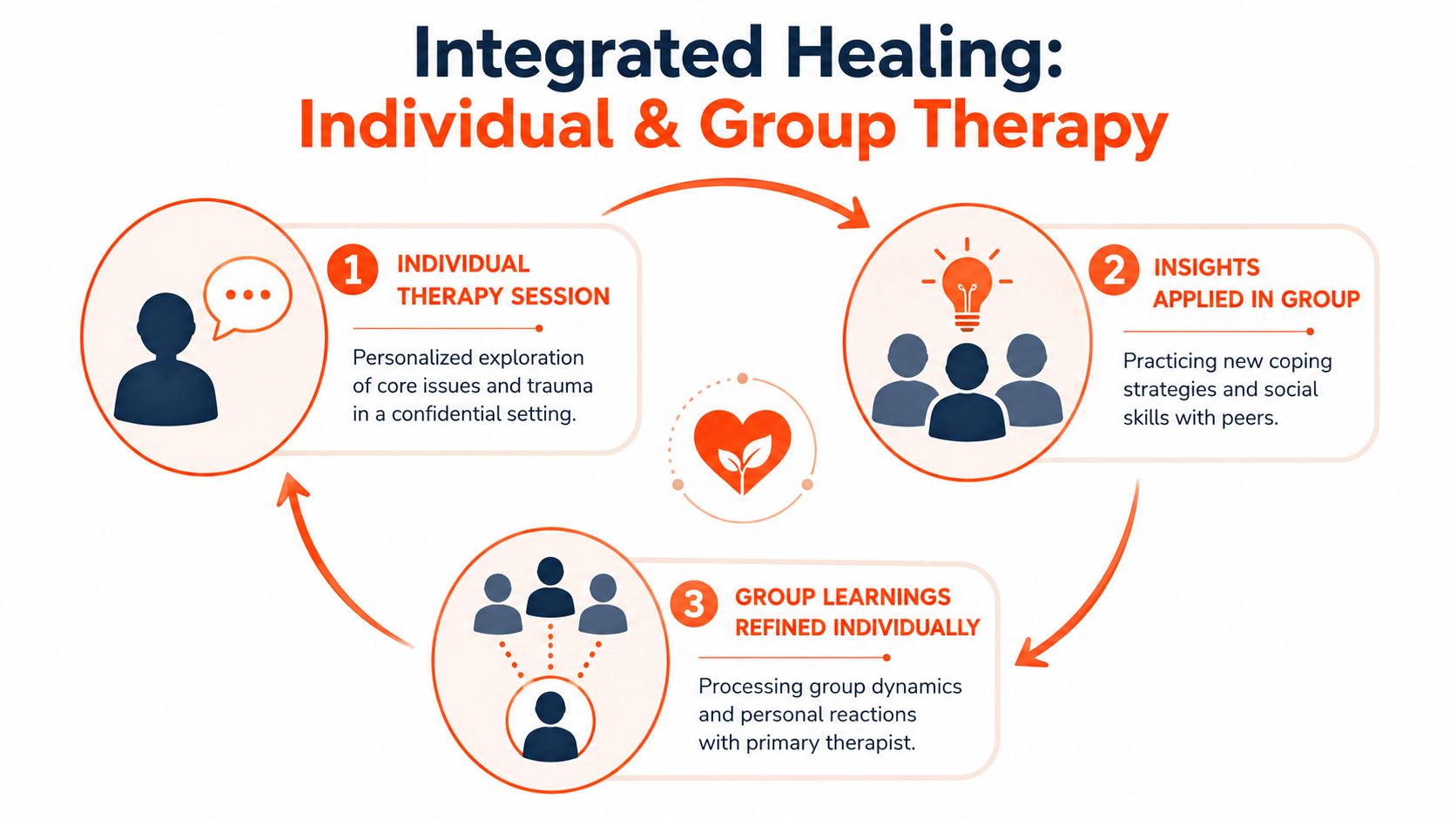
What happens in individual sessions
In one-on-one work, a therapist can help you unpack material that may be too personal, complex, or raw to introduce first in a group. That might include trauma, grief, panic symptoms, compulsive behavior, family history, professional burnout, or the private narrative that says you can never let people see weakness.
Here, treatment gets highly specific. A skilled therapist helps you identify patterns, not just symptoms.
What the group reveals faster
Then you enter the group and those patterns become observable. You say you want connection, but you withdraw when the focus shifts toward you. You insist you're open to feedback, but your body tightens and your language becomes defensive. You describe yourself as supportive, but you use advice to stay emotionally distant.
That isn't failure. That's data.
Clinical insight: Group therapy is often the fastest way to see how you function under stress with other people, which is where relapse risk often hides.
The value of residential treatment is that this work happens in a structured, trigger-free environment, not in the middle of your normal pressures. According to the Australian Treatment Outcomes Study summary in the Scottish literature review, extensive residential rehabilitation offered a 16-fold increase in achieving abstinence at a three-year follow-up compared with withdrawal management alone. That kind of foundation isn't built by detox only. It's built by repeated therapeutic practice in a contained setting.
The feedback loop that makes progress stick
The best treatment plans use a cycle like this:
- An issue gets identified privately. A client notices in individual therapy that he avoids conflict by overworking and drinking.
- The pattern appears in group. He gets quiet when challenged, then shifts into problem-solving for everyone else.
- Peers and therapist reflect it back. He sees the pattern in real time, not as theory.
- The next individual session deepens the work. Shame, fear of failure, and old family roles get explored with more precision.
- The client returns to group and practices differently. He stays present, names discomfort, and receives feedback without shutting down.
This loop is where growth accelerates. Insight alone can stay abstract. Relational practice makes it durable.
A Look Inside a Group Session
A strong group session in a beachside executive program doesn't feel casual, even when the room is comfortable. The furniture may be softer, the setting quieter, and the light better than what people expect from treatment. The tone is still clinical. Safety comes from structure, not from luxury.
Most sessions begin with a brief check-in. Each person names where they are emotionally, what they're carrying into the room, and whether there's anything unresolved from earlier in the day. That opening matters because it helps the therapist track the emotional temperature of the group before going deeper.
How the session usually unfolds
After check-ins, the facilitator narrows the focus. Sometimes the theme comes from the clinical team. Sometimes it comes from something immediate, such as tension between two group members, fear about calling home, resentment about limits, or anxiety about going back to work.
A typical session often includes:
- A clear frame from the therapist so the room doesn't drift into storytelling without purpose.
- Direct but contained participation where members speak from their own experience instead of diagnosing each other.
- Gentle interruption of avoidance if someone jokes, intellectualizes, or redirects when the material gets personal.
- A grounded closing so clients leave settled enough to continue the day safely.
For professionals, one practical concern often sits in the background throughout treatment: work. A 2024 industry report on beach rehab selection factors found that 68% of professionals ranked the ability to stay connected to work as a top-three factor when choosing treatment. That concern doesn't disappear in group. It shapes it. People may discuss fear of losing authority, income, clients, or licensure while they're away.
That's one reason executive programs need to handle technology thoughtfully rather than through rigid blackouts. A clinically sound, process group therapy approach can coexist with structured device access when the program knows how to protect treatment time and still respect real-world obligations.
The rules that make the room safe
Group therapy works when expectations are explicit.
- Confidentiality comes first. What is said in group stays in group.
- Use “I” statements. Clients speak from their own experience, not from assumptions about others.
- No rescuing. Support is welcome. Taking over someone else's process is not.
- Feedback has to be usable. Honest doesn't mean harsh. Direct doesn't mean careless.
By the end of a good session, nobody feels “fixed.” That's not the point. People usually leave with more clarity, more emotional contact, and a more accurate picture of what they do when they feel exposed.
When Group Work Requires Special Consideration
Group therapy is powerful, but it isn't automatically right in the same way for every person on day one. A quality program assesses readiness. It doesn't force everyone into the same format and call that treatment.

When timing matters
Some clients need stabilization before they can use a group well. That can include people dealing with acute psychosis, severe paranoia, profound panic in social settings, intense trauma activation, or major cognitive disorganization during withdrawal. In those cases, individual support, psychiatric care, and careful pacing may need to come first.
That isn't a failure of the client or of group therapy. It's basic clinical judgment.
Why the beach setting can be overstated
The marketing for rehab by the beach often suggests that ocean access is naturally calming. For some people, it is. For others, it isn't.
Recent reporting summarized by Addiction Resource's review of oceanfront facilities states that 45% of individuals in some beach rehabs experience heightened anxiety due to environmental factors, and 52% of adults with substance use disorders also have a co-occurring mental health condition. That matters. Open-air settings, noise, shifting weather, and reduced privacy can be soothing for one client and overstimulating for another.
What a clinically sound program should do
A serious dual diagnosis program pays attention to fit.
- Screen for co-occurring conditions. Anxiety, depression, trauma, bipolar disorder, and ADHD can all affect how someone tolerates group.
- Adjust the pace. Some clients need observation and preparation before entering deeper process work.
- Protect the environment. Calm doesn't happen because there's water nearby. It happens because the setting is contained, predictable, and well managed.
- Curate the mix. Group composition matters. The room has to be safe enough for honesty and sturdy enough for challenge.
If a center treats the beach as the intervention, be cautious. If it uses the setting to support evidence-based care, that's a different conversation.
Choosing a Program and Preparing for the Work
If you're evaluating rehab by the beach, look past the photos first. Ask how the program runs. Ask who leads the groups. Ask what happens when a client is guarded, dysregulated, or clinically complex.
A strong admissions conversation should be able to answer practical questions without slipping into vague reassurance.
Questions worth asking
- How large are the groups? Smaller groups usually allow more accountability, better containment, and less hiding.
- Who facilitates them? Ask whether the leaders are licensed clinicians and how group findings are integrated into the treatment plan.
- How do you handle confidentiality? Privacy shouldn't be implied. It should be operationalized.
- What happens if someone isn't ready for full process work? Good programs have options, not rigid scripts.
- How do individual and group therapy coordinate? You want a team that shares clinical observations and uses them productively.
- How do you support professionals with real work obligations? Device policy, boundaries, and scheduling all matter.
It also helps to notice how organized a clinic seems behind the scenes. Operational consistency affects the patient experience more profoundly than generally understood. For clinics trying to improve intake coordination, follow-up, and patient communication, tools built for support for mental health clinics are becoming relevant because they reduce friction around access and engagement.
How to prepare yourself
If you're the one entering treatment, don't aim to be the “best” client in the room. Aim to be available to the process.
Start by listening closely. Then say one thing in group that you'd normally edit out.
If location is part of your decision, it's reasonable to weigh regional factors too. Some people prefer the privacy, climate, and treatment concentration associated with detox and rehab in Southern California. Just make sure the setting supports the clinical model instead of substituting for it.
The beach can help you exhale. The group is often where you finally stop hiding. Recovery usually needs both a calm environment and a room where the truth can be spoken, heard, and worked through with other people who understand the cost of keeping it all inside.
If you're looking for private, executive-focused addiction treatment that combines clinical depth with discretion, Capo Canyon Recovery offers medically supervised detox and residential care in Orange County for professionals who need individualized support, dual diagnosis treatment, and the ability to stay connected to essential responsibilities while doing real recovery work.