
You may be reading this between meetings, after another promise to cut back, or after a family conversation that made it hard to keep minimizing what's happening. You know treatment is needed. What stops many professionals is not denial of the problem. It's the fear that rehab means disappearing from work, losing control of urgent decisions, or creating a professional crisis while trying to solve a medical one.
That fear is understandable. It's also based on an outdated picture of treatment.
For the right person, it's possible to work while in rehab without turning treatment into a half-measure. In fact, maintaining a responsible connection to work can support recovery when it's built into care correctly, with structure, limits, and clinical oversight. The key is choosing a program that treats work as one part of the treatment plan, not as a loophole that lets the illness keep running the day.
The Professional's Dilemma Can You Work While in Rehab
Many executives and licensed professionals arrive at this decision point with the same private calculation. If they leave completely, the business suffers, clients notice, colleagues speculate, and licensing questions may follow. If they stay fully engaged in work and try to push through, substance use usually gets worse, not better.
That is the false choice people often assume they have.
Clinical reality is more nuanced. People who are employed full-time when entering addiction treatment are 9.1% more likely to complete treatment than those who are unemployed, according to Recovery Research Institute findings summarized by Recovery Answers. Completion matters because treatment only works when a patient can stay engaged long enough to stabilize, build insight, and practice new behaviors under pressure.
Why work can help and when it hurts
Work can provide structure, identity, accountability, and a reason to protect recovery. For many professionals, that matters. A treatment plan that respects those realities often reduces panic and resistance at admission.
But work only helps when it's contained. Unrestricted access to email, deal flow, trading screens, staff issues, or crisis calls can quickly become another form of avoidance.
Practical rule: Work should support treatment adherence, not replace it.
A good executive program doesn't ask, “Can this client keep their laptop?” It asks harder clinical questions:
- What work duties are essential: Not everything feels urgent. Very little is essential.
- What level of care is medically appropriate: Detox, psychiatric instability, and dual diagnosis needs always come first.
- What boundaries will prevent relapse behavior: Timing, supervision, privacy, and accountability all matter.
When those questions receive truthful answers, work doesn't have to be the enemy of rehab. For many professionals, it becomes part of the bridge back to a stable life.
Redefining Rehab for the Modern Executive
The old model of rehab assumed that healing required total disconnection from the outside world. For some patients, that still makes sense. For others, especially leaders carrying legitimate responsibilities, that one-size-fits-all approach creates unnecessary resistance before treatment even starts.
A modern executive program has to do more than allow Wi-Fi.

What the executive work-flex model actually means
Recent data cited from a 2025 JAMA Psychiatry review found that 32% of executive addiction cases involve concurrent high-stakes professional obligations, while 78% of standard rehab programs offer no formal protocol for integrating work without triggering relapse, as reported in Ambrosia's discussion of working while in rehab. That gap explains why so many high-performing clients delay care. They aren't asking for special treatment. They're asking for a treatment structure that reflects how their lives function.
A clinically integrated model usually includes:
- Designated work windows: Specific times for email, calls, approvals, or urgent decisions.
- Private workspace: A desk, quiet room, and secure internet are basic requirements, not luxury add-ons.
- Device rules: Phone and laptop use should be defined, not improvised.
- Psychiatric and clinical oversight: If work is increasing anxiety, impulsivity, or craving, the plan has to change immediately.
What doesn't work
Programs sometimes advertise themselves as executive-friendly because they permit devices. That alone means very little.
A laptop in an unstructured environment can undermine treatment fast. Patients skip groups, stretch “urgent work” into half a day, or use business pressure to avoid emotionally difficult therapy. Staff may notice the pattern, but if no formal protocol exists, the line keeps moving.
A tech-friendly rehab program works only when the treatment team controls the schedule, monitors the impact, and protects the clinical core of the day.
The strongest programs treat professional access as a therapeutic privilege tied to stability and honesty. If a patient is in withdrawal, emotionally dysregulated, or using work to escape treatment, access needs to tighten. If the patient is grounded, transparent, and handling responsibilities within limits, work can remain in the plan.
That is the difference between convenience and clinical design.
The Vital Role of Case Management in Your Recovery
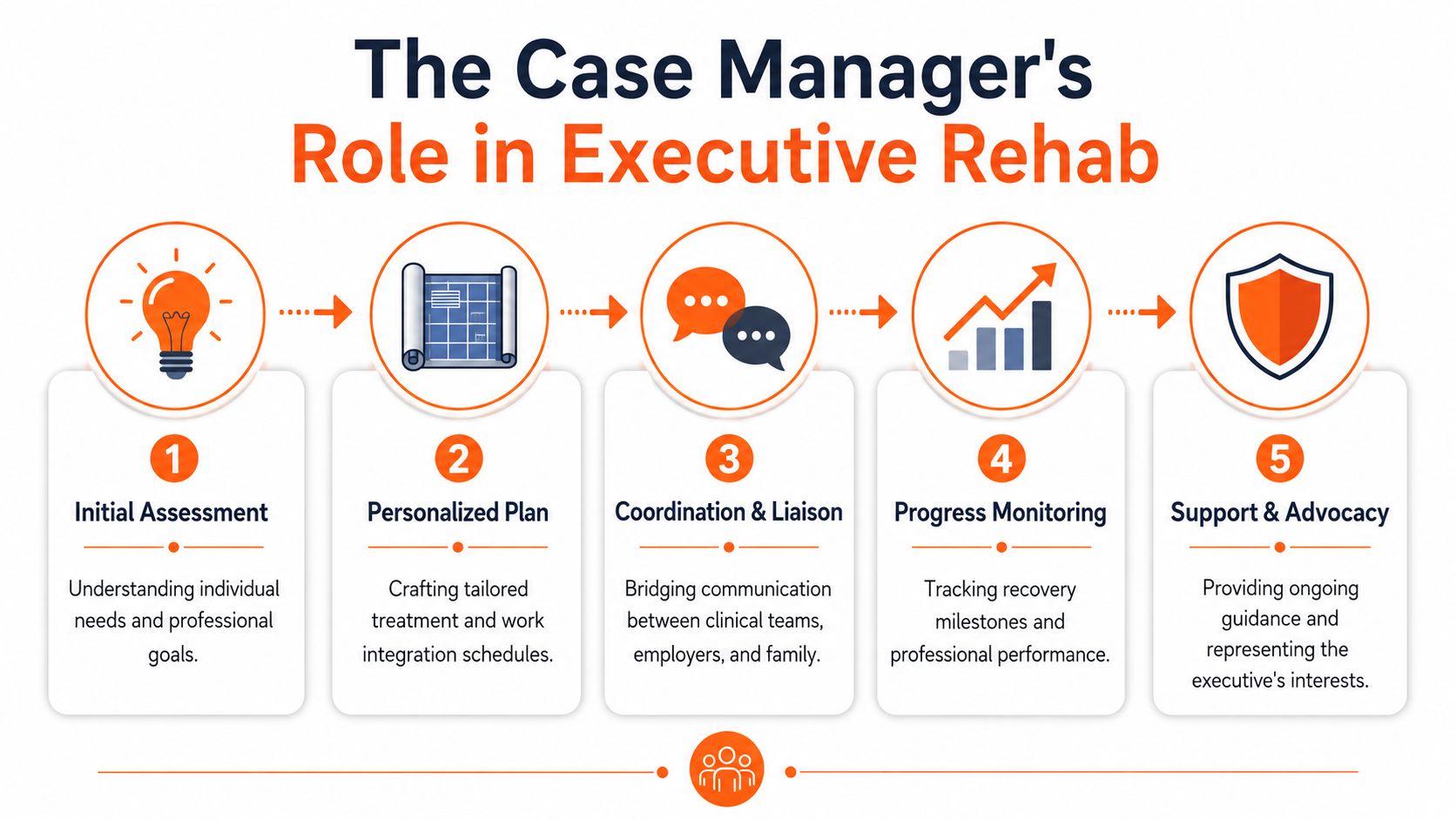
In an executive treatment setting, the case manager is often the person who makes the entire model work. Families sometimes assume case management is mostly paperwork. It isn't. In a well-run program, the case manager functions like an air traffic controller, tracking moving parts, preventing collisions, and making sure treatment and real-life obligations don't pull the patient in opposite directions.
Intake is where the work plan starts
The process begins before the first work block is ever approved. A case manager needs a clear picture of the patient's role, deadlines, communication demands, and risk factors. That means identifying what must continue and what can be delegated, paused, or handed to counsel, partners, or senior staff.
This is also where clinical realism matters. A surgeon, founder, attorney, pilot, or business owner may feel indispensable. Sometimes that's true in part. It's rarely true in every area they claim.
A sound intake review usually sorts responsibilities into categories:
| Responsibility type | Typical decision |
|---|---|
| Mission-critical approvals | May stay with patient in limited windows |
| Routine email and updates | Often reduced or delegated |
| High-conflict personnel issues | Usually postponed during stabilization |
| Financial oversight | Kept narrow and structured |
| Public-facing appearances | Commonly paused |
The treatment plan has to include work, not orbit around it
Once clinical and professional needs are clear, the case manager helps build a schedule around both. That doesn't mean fitting therapy around meetings. It means identifying where work can safely sit inside a recovery day.
Important coordination tasks often include:
- Scheduling clinical appointments first: Detox care, psychiatry, therapy, and groups are the anchor points.
- Creating limited communication windows: Patients do better when they know exactly when they can respond and when they cannot.
- Working with family or trusted colleagues: Someone may need to handle logistics, messaging, or operational backup.
- Preparing for legal or workplace communication: Some clients need help planning what to say, to whom, and when.
Monitoring is just as important as planning
The first version of a plan is rarely the final one. Some patients become calmer when they know their company isn't collapsing. Others get activated the moment they open Slack or email.
That's why ongoing review matters. A capable case manager watches for signs that work is helping stability or feeding dysregulation.
If a patient starts bargaining for more device time, missing emotional content in therapy, or escalating around business stress, the issue isn't productivity. It's clinical drift.
In stronger executive programs, case management also extends beyond discharge. Return-to-work planning, outpatient referrals, family coordination, and accountability structures need to be lined up before the patient leaves residential care. Recovery is more durable when re-entry is planned rather than improvised.
How Different Treatment Pathways Accommodate Work
A surgeon may be able to answer one protected message between groups and still make clinical progress. That same surgeon should not be charting through withdrawal, skipping psychiatric evaluation, or taking operating-room call from detox. The level of care has to match the medical and psychiatric reality first. Work is added only if it supports treatment rather than competing with it.
The practical question is not whether a program allows a laptop. The practical question is which setting can contain the illness, protect judgment, and still preserve the parts of a professional role that cannot wait.
Outpatient treatment works only when stability already exists
Outpatient care can fit active employment because the patient sleeps at home and comes in for scheduled treatment blocks. SAMHSA's overview of intensive outpatient treatment describes IOP as a structured level of care for people who do not need 24-hour supervision but do need more support than standard weekly therapy. In practice, that means outpatient is usually appropriate when withdrawal risk is low, the home environment is reasonably stable, and the patient can follow limits on work, substances, and sleep outside program hours.
PHP and IOP do not solve impaired self-management. They depend on it.
A strong outpatient plan may work for a professional who can step away from work for treatment blocks, has reliable transportation, and is not returning each night to the same triggers that fueled the problem. If you are comparing formats, this guide to flexible rehab schedules for busy professionals shows how reputable programs build work access around treatment instead of the other way around.
Executive residential care is built for higher-acuity professionals
Residential executive treatment serves a different purpose. It is for people who need medical monitoring, medication adjustment, daily clinical contact, or separation from an environment that keeps the illness going, but who may still need tightly controlled access to business communication.
In a well-run executive program, device access is structured. It happens in scheduled windows, in private space, and with clear boundaries about what kind of work is realistic. Brief leadership communication, review of urgent documents, and attendance at selected meetings may be appropriate. Full workdays are not. Neither are high-conflict negotiations, all-day inbox management, or any task that predictably spikes craving, panic, or grandiosity.
For some clients, remote attendance matters. Programs that support secure video calls for healthcare can protect confidentiality better than improvised calls taken in public or shared spaces, which matters when a patient must speak with counsel, partners, HR, or a board representative during treatment.
How I advise families and professionals to choose
Use a simple clinical filter.
Outpatient may be enough if the patient can remain sober between sessions, show up consistently, sleep, eat, and work without obvious deterioration. Executive residential care is usually the safer choice if detox is needed, mood or anxiety symptoms are destabilizing judgment, relapse keeps happening in unstructured settings, or the person's professional role gives them enough status to hide how impaired they have become.
The expensive mistake is choosing the lowest level of care because it appears less disruptive. Professionals often lose more by trying to protect every work obligation than by stepping into the right treatment setting for a few weeks and doing the job correctly.
Protecting Your Privacy and Professional License
For licensed professionals, the fear is rarely just “Will my employer find out?” The deeper concern is often, “What happens if treatment triggers board scrutiny, credentialing consequences, or a record that follows me?” That concern is real, and it deserves a serious answer.
A 2025 National Academies of Sciences report found that 45% of licensed professionals delay treatment due to fear of license revocation, even when ADA protections apply, as cited by Lakeview Health's discussion of working while in rehab. Delay is dangerous. It gives the illness more time to affect judgment, prescribing, charting, driving, client care, or workplace conduct.
Privacy is not the same as secrecy
A professional-grade program should never promise magical immunity from every regulatory consequence. What it should provide is a disciplined privacy structure that limits unnecessary exposure and helps the patient respond thoughtfully rather than reactively.
That usually means looking closely at:
- Census size: Smaller programs reduce visibility and casual exposure.
- Communication pathways: Sensitive calls should happen in private, secure settings.
- Documentation practices: Release forms, disclosures, and outside contacts should be deliberate, not automatic.
- Case management support: Patients often need coordinated guidance when work, legal counsel, and licensing issues overlap.
For professionals handling sensitive medical, legal, or board-related conversations, secure technology matters. Many families ask what kind of platform is appropriate for remote clinical or professional communication. A practical reference is this guide to secure video calls for healthcare, which explains the privacy standards people should look for when confidential conversations can't happen in person.
Why small, discreet settings matter
Large facilities can do good clinical work, but they are not always ideal for someone whose name, role, or license creates added exposure risk. In a smaller environment, the team can monitor access points more carefully, protect work periods, and avoid the chaos that often comes with high-volume settings.
That matters for physicians, attorneys, pilots, executives, first responders, and public-facing leaders who need treatment without making themselves the subject of unnecessary attention. For a closer look at how programs tailor care for this population, this overview of rehab for working professionals is a helpful reference.
The goal is not to hide from clinical reality. The goal is to enter treatment in a setting that respects confidentiality while helping you address professional obligations lawfully and carefully.
The best outcomes usually come when privacy planning starts early, before anyone sends a rushed email, over-discloses to the wrong person, or mistakes generic HR advice for license-specific guidance.
A Day in the Life Balancing Treatment and Work
Most professionals relax once they can see the day on paper. A good executive schedule doesn't feel loose or chaotic. It feels organized, protected, and realistic.
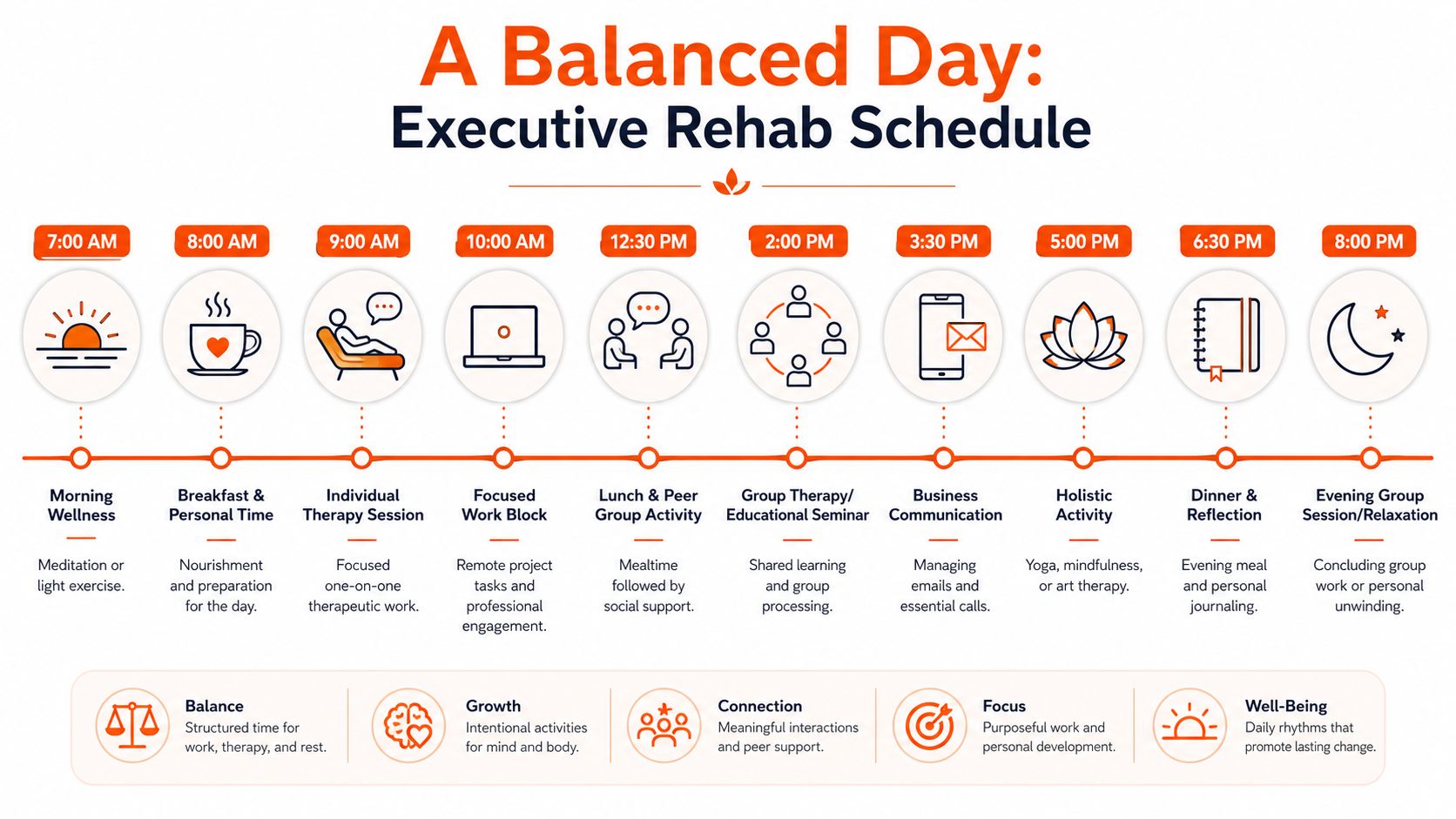
A typical day starts with a steady morning routine, not a rush into email. Patients may begin with light exercise, mindfulness, breakfast, and a brief orientation to the day. The first major clinical block is often individual therapy or a psychiatric check-in, when the mind is clearer and defenses are lower.
Late morning or early afternoon is usually the best place for a protected work block. In a properly designed setting, that means a private room, desk, secure Wi-Fi, and a clear purpose. Patients aren't casually scrolling. They're handling specific tasks: approving a document, joining a key call, reviewing numbers, or responding to essential messages.
What a balanced schedule looks like
A well-built day often includes these elements:
- Clinical anchors first: Therapy, medical review, and group work remain essential.
- Focused work windows: Limited time for high-value responsibilities.
- Peer and psychoeducational work: Patients still need community, reflection, and accountability.
- Evening decompression: Journaling, mindfulness, family contact when appropriate, and rest.
Why the environment matters
Professionals don't just need internet access. They need enough calm to think clearly. A private bedroom with a desk can make a major difference because it separates focused work from the noise and overstimulation that can derail both productivity and emotional regulation.
This is also where reputation concerns often surface. Some clients worry less about treatment itself than about the digital footprint around their profession. For anyone thinking through visibility, public perception, and career impact, these reputation insights for professional licenses offer useful context.
If you want a more concrete look at scheduling, this guide to what a typical day at an executive rehab looks like shows how treatment and essential work responsibilities can coexist in one structured routine.
A stable schedule lowers shame. People stop imagining rehab as disappearance and start seeing it as a disciplined reset.
Checklist for Choosing the Right Executive Program
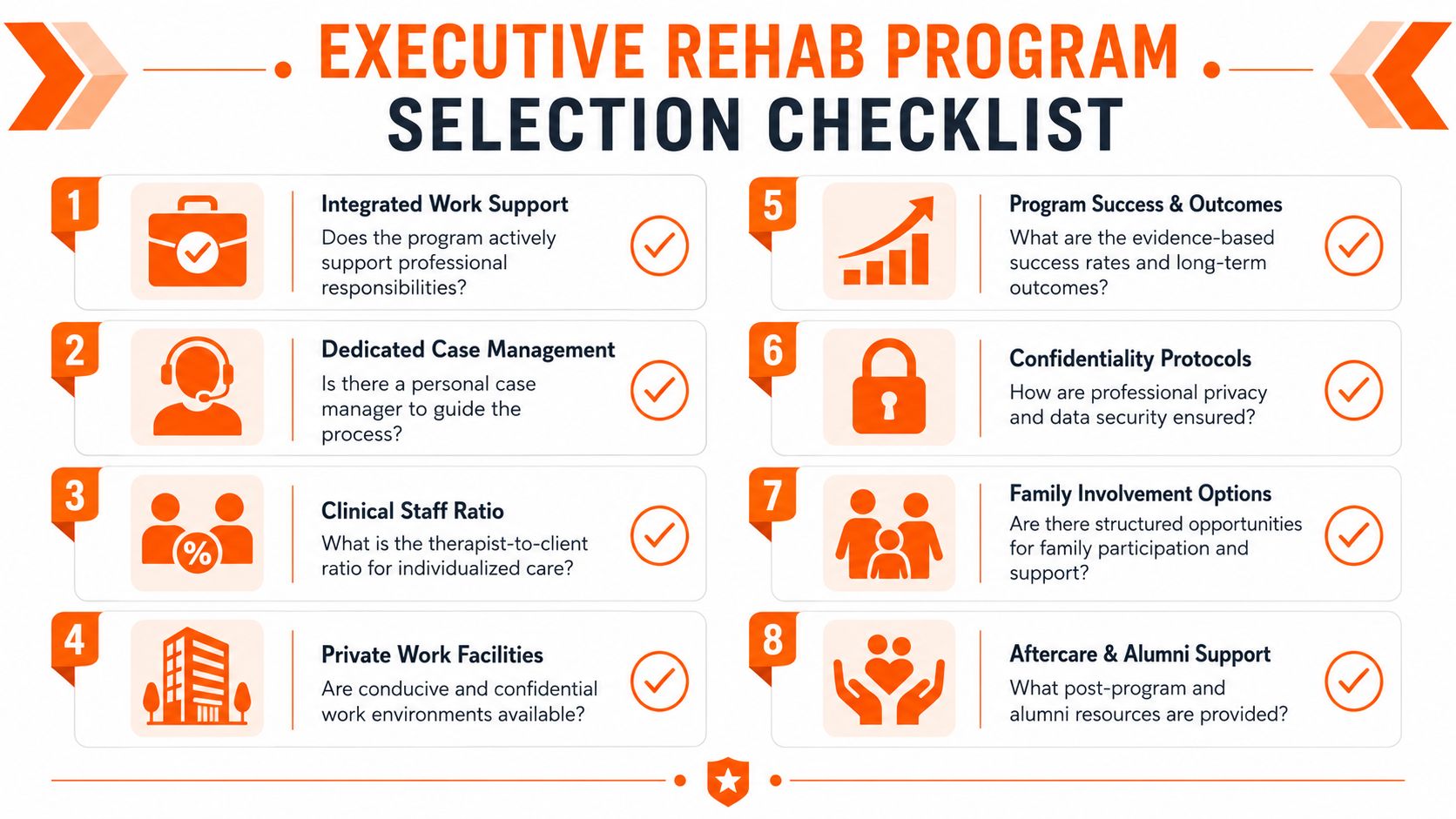
Not every program that says it serves professionals knows how to support them. Ask direct questions. The answers tell you whether a facility has a real executive framework or just permissive device rules.
Questions that reveal clinical quality
Use this checklist when speaking with admissions, a clinical director, or a referring professional.
- What is your exact phone and laptop policy: Ask whether access is scheduled, supervised, and tied to clinical progress.
- How is work time built into the day: A serious program can explain where work blocks sit relative to therapy, groups, and medical care.
- What happens if work starts interfering with treatment: You want a clear escalation process, not vague reassurance.
- How much individual attention is guaranteed: Ask how often patients meet with therapy, psychiatry, and case management.
- Do you treat dual diagnosis conditions onsite: If anxiety, depression, trauma, bipolar disorder, or ADHD are present, integrated care matters.
- How do you protect confidentiality for high-profile or licensed professionals: Listen for specifics about privacy practices, communication control, and discretion.
- Can you help coordinate with family, counsel, employers, or boards when needed: Programs should be able to support these conversations carefully.
What strong answers sound like
A strong program answers with process. It can describe the schedule, the limits, the clinical oversight, and the decision-making. It doesn't rely on sales language like “luxury,” “flexibility,” or “concierge” without explaining how care is delivered.
A weaker program often sounds permissive but vague. You'll hear that clients can “usually” keep devices, “often” work if needed, or “generally” have privacy. Those words are warnings. Professionals need defined protocols.
Practical red flags
Watch for these problems during your search:
| Red flag | Why it matters |
|---|---|
| Unlimited device access | Often leads to avoidance and treatment drift |
| No dedicated case management | Work and recovery logistics fall apart |
| Generic answers on privacy | Suggests the program hasn't handled complex professional cases well |
| Minimal psychiatric availability | Problematic for detox, medication needs, or dual diagnosis |
| Large, impersonal milieu | Harder to protect confidentiality and tailor schedules |
One final test helps families most. Ask the program to describe a realistic first week for someone who needs treatment and also needs limited access to work. If the answer is concrete, the team probably does this well. If the answer stays abstract, keep looking.
Your Career and Your Health Can Thrive Together
A physician who delays treatment to keep clinic hours, an attorney worried about a bar complaint, or an executive trying to hold together a board presentation often asks the same question: will getting help cost me the career I built? In a well-run executive program, it does not have to. The goal is not simple device access. The goal is a treatment plan that stabilizes health, protects privacy, and makes limited work contact clinically useful instead of disruptive.
That distinction matters. Professionals do best when work is handled inside the treatment plan, with clear limits, case management, and direct attention to licensing or legal concerns that can raise the stakes of every decision. With that structure in place, people often regain judgment, consistency, and follow-through faster than they would by trying to keep functioning while symptoms worsen at home.
Recovery should strengthen your life outside treatment, including your ability to return to work safely and credibly. Finding a program that follows that philosophy is the next step.
If you're looking for a private, clinically rigorous program that understands the circumstances of executive life, Capo Canyon Recovery offers detox and residential care designed for professionals who need confidentiality, individualized treatment, and carefully structured support for essential work responsibilities.