
You can be in a quiet room, phone face down, trying to decide whether to answer the email, pour a drink, or text the person you just argued with. The craving is there, the shame is there, and your mind is already spinning through tomorrow's consequences. That's often the moment people start looking for the modules of DBT, because they don't need theory first, they need a way to get through the next hour without making the night worse.
Why DBT Is Taught in Separate Modules
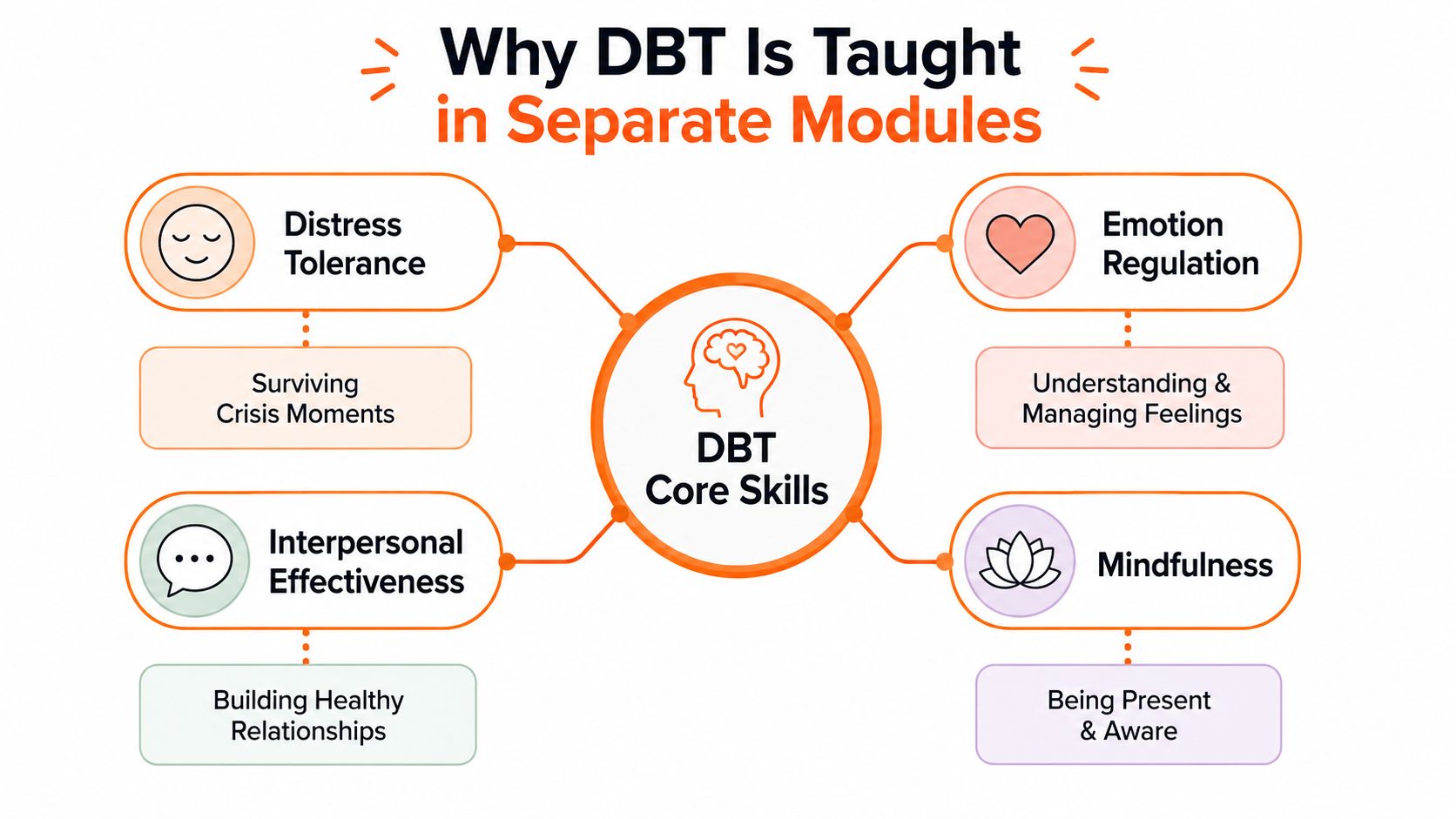
A client in early recovery usually doesn't have one problem. She may be fighting a craving at 11:30 p.m., replaying a humiliating relapse conversation, and dreading a tense message from work all at once. DBT breaks that overload into separate jobs, because staying present, surviving crisis, changing emotional habits, and handling relationships are different skills, not one skill with four names.
DBT's four skills modules are mindfulness, distress tolerance, emotion regulation, and interpersonal effectiveness. Yale Medicine describes the standard sequence as beginning with 2 weeks of mindfulness, followed by 5 to 7 weeks each for distress tolerance, interpersonal effectiveness, and emotion regulation, with the full skills sequence taking about 6 months and many patients repeating modules so the course lasts a year or longer. That modular structure is one reason DBT has moved beyond borderline personality disorder into use for substance use disorders, major depressive disorder, bipolar disorder, ADHD, and eating disorders (Yale Medicine).
Acceptance skills and change skills
The cleanest way to think about the modules of DBT is to split them into two jobs. Mindfulness and distress tolerance are acceptance skills, they help you notice what's happening and get through it without escalation. Emotion regulation and interpersonal effectiveness are change skills, they help you shape patterns that keep repeating.
That split matters in recovery. When someone is flooded, the first task is often not insight, it's stabilization. A private residential program can sequence the work the same way a clinician would think about it, first calming the nervous system, then helping the client make better choices once the intensity drops. Capo Canyon's overview of DBT describes the approach in that broader clinical context, which makes it easier to see how a treatment team can combine DBT with other care in a residential setting (Capo Canyon DBT overview).
Practical rule: if the client is panicking, the first question is “What keeps this from getting worse?” not “What caused every part of it?”
The separation into modules also helps people feel less lost. Instead of trying to memorize a giant workbook all at once, they learn one cluster of skills, practice it, and then move to the next cluster. That pace is especially useful for adults in residential care who are trying to manage withdrawal, shame, sleep disruption, and real-life obligations at the same time.
Mindfulness as the Foundation Module
Mindfulness is the first module because it gives clients something sturdier than impulse. It means noticing what's happening inside and around you without immediately obeying it. In early recovery, that might look like noticing, “My jaw is tight, my chest is hot, and I want to call my dealer,” before the craving turns into action.
DBT mindfulness is usually taught through the what and how skills. The what skills are to observe, describe, and participate. The how skills are to do that nonjudgmentally, one-mindfully, and effectively. Put in plain language, the module teaches people to notice facts, name them clearly, and stay with one task instead of getting yanked around by every thought.
If you want a quick practice, do this for two minutes. Sit still, breathe slowly, and name three things you can feel in your body, three thoughts that are present, and three urges that are active. Don't argue with any of them. Just label them, then return to the breath. A short exercise like that can make the difference between reacting on autopilot and buying yourself a few seconds of choice, which is often where recovery starts.
A meditation routine can support that habit when a person is detoxing, sleeping badly, or feeling emotionally raw, and Capo Canyon's recovery guidance on meditation fits naturally with that kind of grounding work (meditation during recovery).
What mindfulness looks like in daily recovery
In real life, mindfulness shows up in tiny decisions. You pause before opening a triggering text from a parent. You notice the exact minute a craving starts instead of calling it “bad luck” after the fact. You hear yourself getting defensive in a group session and choose to wait before speaking.
That's why mindfulness comes first in the modules of DBT. If a person can't notice the wave, the next skill doesn't have much to work with. Mindfulness doesn't solve every problem, but it creates the gap between feeling and acting, and that gap is often the first meaningful win in early sobriety.
Distress Tolerance for Surviving Crisis Moments
Distress tolerance is the DBT module for moments when you can't fix the problem yet. The bank is closed, the argument isn't resolved, the craving has hit hard, or it's 2 a.m. and your mind won't stop looping. This module doesn't promise relief on command. It teaches you how not to add gasoline to a painful moment.
The core skills that people actually use
The DBT distress tolerance toolbox includes TIPP, self-soothing, ACCEPTS, and radical acceptance. TIPP uses temperature, intense exercise, paced breathing, and progressive relaxation to bring the body down fast. Self-soothing uses the five senses. ACCEPTS helps with distraction through activities, contributions, comparisons, emotions, pushing away, thoughts, and sensations. Radical acceptance means stopping the fight against what already happened so you can respond instead of ruminate.
A person in early recovery might use TIPP after a wave of panic hits in the middle of the night. They might splash cold water on their face, do a brisk walk, slow the breath, then unclench the shoulders. If the urge is still loud, self-soothing can help, a warm shower, a clean blanket, a familiar scent, or soft music. If the mind keeps circling the same thought, ACCEPTS gives it somewhere else to go long enough for the urge to lose momentum.
When the crisis can't be solved tonight, the goal is to get through tonight safely.
This is why distress tolerance belongs with mindfulness as an acceptance-oriented module. Both are about stabilizing the moment instead of forcing a solution too early. That difference matters in detox and residential care, where clients often need a sequence of small, concrete steps before they're ready for deeper change work.
Emotion Regulation for Reducing Vulnerability
Emotion regulation is where DBT starts changing the pattern, not just surviving the episode. The module treats emotions as signals, not orders. A craving, a burst of rage, or a shame spiral may tell you something important, but it doesn't have to decide your next move.
From reactivity to intention
The first step is learning to identify and name emotions clearly. Many adults in early recovery skip that part because they're used to calling everything “stress” or “fine.” DBT slows that down. A client learns to check the facts before reacting, which means asking whether the feeling matches the situation or whether old assumptions are driving it.
Then comes opposite action, the skill that asks for the behavior opposite the emotion's urge when the facts don't justify the reaction. If shame says hide, opposite action may mean showing up. If fear says avoid, it may mean making the call. The point is not to deny emotion, it's to stop emotion from being the only voice in the room.
The PLEASE skill is the body-based part of the module. It reminds people to treat PhysicaL illness, balance Eating, avoid mood-Altering substances, balance Sleep, and get Exercise. That's not glamorous, but it's often the foundation of steadier mood in residential care.
For substance use specifically, emotion regulation matters because relapse is often tied to mood crashes, impulsive decisions, and shame after a slip. This module gives clients a way to notice the pattern earlier and interrupt it before the cycle tightens. In that sense, it pairs naturally with the interpersonal module, since many emotional blowups become relational blowups too.
Interpersonal Effectiveness for Relationships and Boundaries
Interpersonal effectiveness is the module that helps a person speak clearly without burning bridges or disappearing to keep the peace. That matters in families, in recovery groups, and in workplaces where reputation still counts. For executives and licensed professionals, it can be the difference between asking for support and spiraling.
Three goals at once
DBT frames this module around three goals, getting what you want, keeping the relationship, and maintaining self-respect. Many are used to choosing one of those at the expense of the others. They ask too aggressively and damage the connection, or they protect the relationship and abandon their own needs.
The DEAR MAN script helps with effective asking. It guides the speaker to describe the situation, express feelings, assert the request, reinforce the benefit, stay mindful, appear confident, and negotiate when needed. The GIVE skill helps preserve relationships through gentleness, interest, validation, and an easy manner. The FAST skill protects self-respect by keeping responses fair, not overapologizing, sticking to values, and being truthful.
A professional in recovery might use DEAR MAN to tell a colleague, “I can't take that client meeting at 7 p.m., but I can review the deck by noon tomorrow.” A parent might use GIVE to say no without becoming cold. A physician, lawyer, founder, or first responder may need FAST because shame can push them to say yes when they should be setting a limit.
Clinician's note: healthy boundaries sound calmer than most people expect, and they usually take fewer words than the old conflict style.
This module supports relational repair, which is often a hidden task of early sobriety. People may need to apologize, renegotiate roles, or ask for space while they stabilize. Interpersonal effectiveness gives them a structure so those conversations don't become another crisis.
How the Modules Are Sequenced in Real Programs
A person in early recovery may walk into treatment feeling flooded by cravings, shame, conflict, and a short fuse. In that state, a rigid syllabus can feel too abstract to use. Real DBT programs adjust the order of the modules so the person can get relief first, then build the next skill on top of that foundation.
Textbooks often present DBT as if everyone moves through the same track at the same pace. In practice, clinicians start where the person is most stuck. Yale Medicine describes a common sequence that begins with mindfulness, then moves through the other core modules over time, with repetition built in when a skill needs more practice (Yale Medicine). That pacing fits adults who are dealing with real-life instability, not classroom neatness.
| Standard DBT Skills Modules at a Glance | |||
|---|---|---|---|
| Module | Function | Typical Weeks | Example Skills |
| Mindfulness | Notice and label experience without reacting | 2 weeks | Observe, describe, participate |
| Distress Tolerance | Get through crises without making them worse | 5 to 7 weeks | TIPP, self-soothing, ACCEPTS |
| Interpersonal Effectiveness | Ask, say no, and set boundaries | 5 to 7 weeks | DEAR MAN, GIVE, FAST |
| Emotion Regulation | Reduce vulnerability and shift patterns over time | 5 to 7 weeks | Check the facts, opposite action, PLEASE |
The order is not fixed when a person arrives in residential care with more than one problem at once. A client who is emotionally flooded may need acceptance skills earlier so they can stay in the room long enough to learn. Someone whose main struggle is impulsive conflict or weak boundaries may benefit from change skills sooner. Clinicians often observe that healthy boundaries sound calmer than people expect, because the goal is not to win an argument, it is to speak clearly and stay regulated.
Residential programs also sequence DBT around the realities of early recovery. A person may need a crisis skill before they can sit through a relapse trigger discussion, or a mindfulness practice before they can name what is driving the urge to use. In a private setting, that work can be paced around individual sessions, group sessions, and homework without forcing the person to pretend life is orderly. Programs that treat co-occurring disorders can also adapt the sequence for depression, anxiety, trauma, ADHD, or bipolar symptoms, which often change how quickly someone can absorb new material, as seen in dual diagnosis treatment at Capo Canyon.
The repetition matters. If a client cannot use a skill under stress, the answer is usually more practice, not a different label for failure. A treatment team may return to the same module after a rough week, or slow the pace when shame, fatigue, or cravings make new learning harder. That flexibility is one reason DBT modules fit residential care for executives and other adults who need privacy, schedule flexibility, and support that matches the shape of recovery.
Why DBT Modules Fit Substance Use and Co-Occurring Disorders
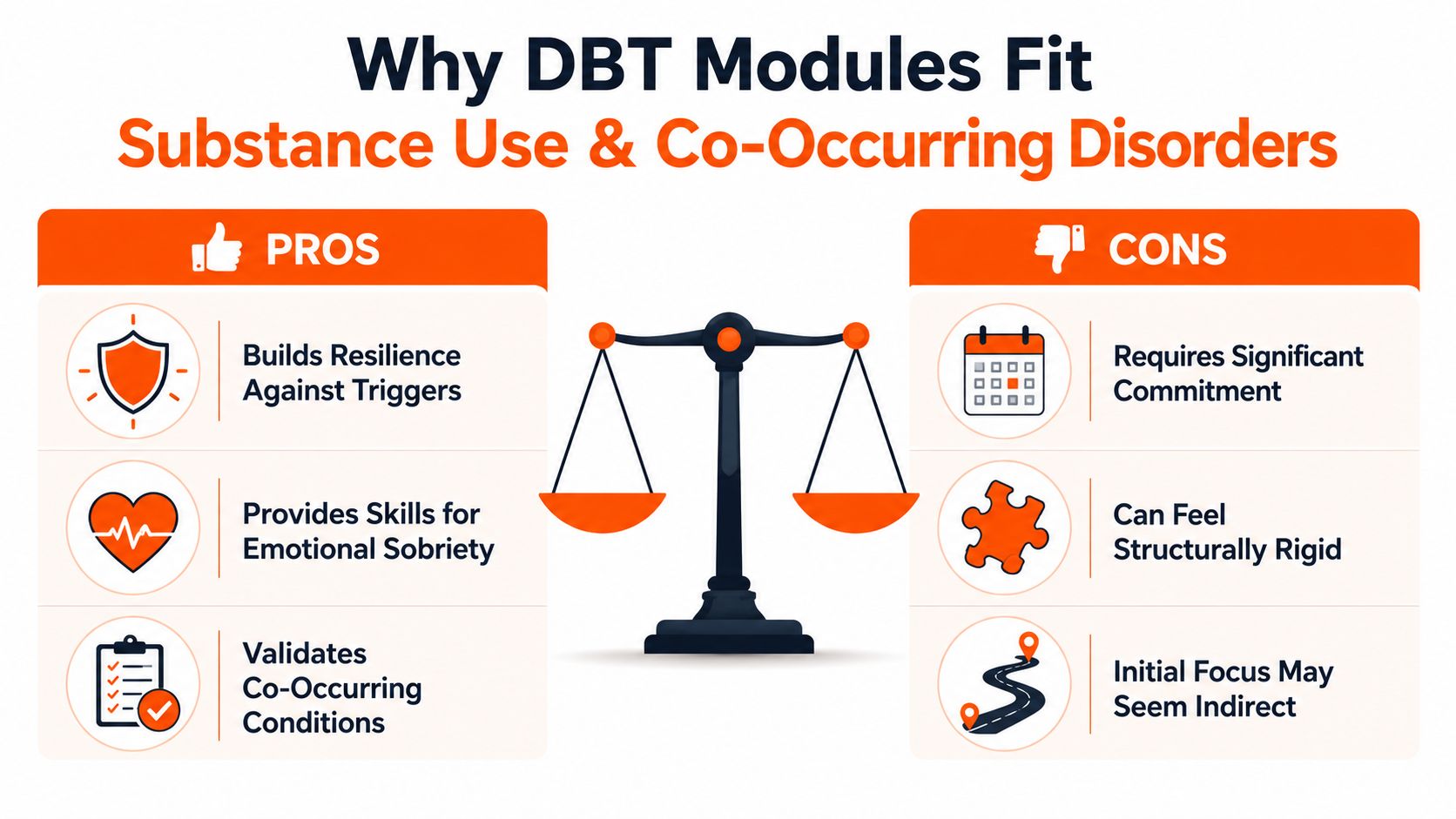
Clients often assume DBT is only for crisis-heavy psychiatric care. The fit is broader. People searching for the modules of DBT are often trying to make sense of alcohol use, drug use, depression, anxiety, trauma, ADHD, or bipolar symptoms that have made daily life feel unsteady. DBT fits that reality because each module addresses a different part of the recovery mess.
Why the fit is strong
A craving can arrive like a wave. Distress tolerance gives a person something concrete to do while that wave is passing. Mindfulness helps them notice the craving before it becomes automatic. Emotion regulation targets the impulsivity, mood crashes, and shame that often keep relapse going. Interpersonal effectiveness helps repair relationships that may have strained or broken during active use.
The skills themselves also have support in the research. A major 2024 systematic review and meta-analysis of stand-alone DBT skills training reported improvement in borderline personality disorder clinical severity, depression, and global psychopathology, along with a pooled dropout rate of 29%, which means about 71% retention. Analysts at PubMed reported those findings.
That matters in dual diagnosis care because early drop-off is common in many therapies. DBT's skills-first approach gives clients concrete actions before they are ready to examine every part of the story. For substance use treatment, that can be the difference between a person feeling flooded and a person staying long enough to benefit.
Capo Canyon's dual diagnosis treatment places DBT in that broader context, alongside care for co-occurring conditions and substance use.
What clients often misunderstand
DBT does not have to wait for a person to be in full psychiatric crisis. The modules can help with cravings, shame, conflict, and emotional flooding even when the full protocol is not the main focus. In early recovery, that is often the practical need, because a person may have to get through one intense hour before they can think about the whole week. Residential programs often rely on DBT for clients who need structure without losing flexibility.
What to Expect from DBT in a Private Residential Program
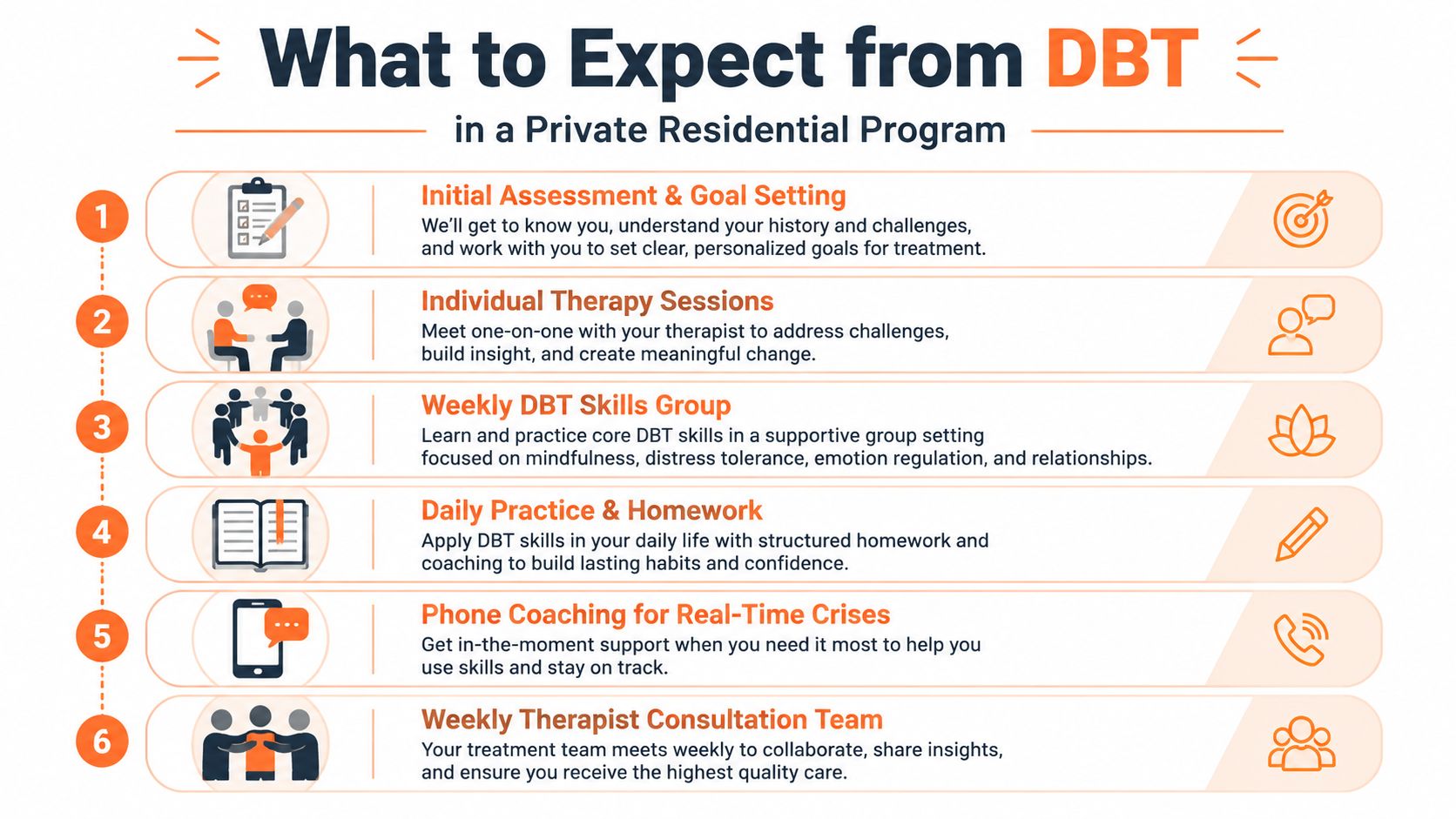
In a private residential setting, DBT usually shows up as part of a bigger clinical plan, not as a stand-alone class. A boutique program can weave the modules into individual therapy, group work, and psychoeducation, so the client learns the skill, practices it, and then talks through how it landed in real life. That matters for executives and professionals who need privacy, schedule flexibility, and the ability to stay connected to essential work responsibilities.
How the setting changes the experience
Capo Canyon Recovery is a licensed detox and residential treatment center in Mission Viejo, Orange County. It serves a small census of approximately five clients at a time, which creates a more confidential environment than a large group census and allows for individualized attention. The program also supports cell phones and laptops, which can matter for professionals who can't disappear from critical responsibilities for weeks at a time.
DBT is also paired there with other evidence-based approaches, including CBT, ACT, EMDR, and Brainspotting, so the treatment plan can address both behavior change and the underlying material driving use. The setting includes individual therapy, group therapy, medication support, and case management, which helps the DBT skills land in a broader recovery routine rather than staying abstract.
A private residential program should also be able to answer practical questions clearly. Ask how the modules are sequenced, whether individual sessions happen alongside group, how the team adapts DBT for dual diagnosis, and how privacy is protected for licensed professionals or high-profile clients. Those questions matter more than marketing language because the test is whether the program can fit the modules to the client's actual life.
If you're comparing treatment options, ask for a clear explanation of how the modules of DBT would be used with your symptoms, your schedule, and your work obligations. If a private residential setting is the right level of care, start with Capo Canyon Recovery and ask how its DBT-informed approach is structured for executive privacy, dual-diagnosis support, and daily skill practice.