
You're in a meeting, your phone keeps buzzing, and you've already answered three urgent messages before finishing your coffee. By late afternoon, your patience is thin, your sleep feels off, and you know the pressure isn't going away tomorrow. Dialectical behavior therapy, or DBT, was built for exactly this kind of overload, because it gives people a structured way to handle intense emotions without relying on guesswork.
For busy professionals, that structure matters. DBT isn't just about talking through stress, it's about learning specific skills for staying steady in demanding situations, then practicing those skills until they hold up in real life. If you've been wondering what is dialectical behavior therapy, the short answer is that it's a skills-based treatment that combines acceptance and change in a way that's practical, repeatable, and measurable.
Introduction to Dialectical Behavior Therapy
A stretched executive often doesn't need more theory. They need a clear method for the moment their body is in overdrive, their thoughts are racing, and the next email feels like the final straw. DBT gives that method through a four-module skills curriculum, plus a therapy structure that keeps the work grounded in daily behavior rather than abstract reflection.
That's part of why DBT fits people who want a roadmap instead of open-ended exploration. Yale Medicine describes DBT as a treatment developed for high-risk emotional and behavioral patterns, and its clinical use now extends beyond the original population into other conditions involving emotion dysregulation, including depression, PTSD, eating disorders, and substance use disorders (Yale Medicine). For a professional who needs privacy and efficiency, the appeal is straightforward, it's not therapy as passive discussion, it's therapy as skill acquisition.
Why the model feels different
DBT combines two ideas that can seem incompatible at first, acceptance and change. Acceptance means your reactions make sense given your history and your current stress load. Change means those reactions don't have to stay in control of your day.
Practical rule: if a therapy doesn't give you something concrete to use before the next crisis, it may not be enough for high-pressure living.
That's the core reason DBT resonates with many executives. It treats emotional overwhelm as a set of patterns that can be understood, tracked, and modified. Capo Canyon Recovery's evidence-based therapy page places DBT within a broader clinical approach that also includes other structured modalities, which matters when someone needs care that still respects work obligations and confidentiality (Capo Canyon evidence-based therapy).
Origins and Development of DBT
DBT began with a very specific clinical problem, chronic suicidality in people with borderline personality disorder. Marsha Linehan developed the model in the late 1970s and 1980s, and early outcomes were strong enough that the approach moved quickly from a narrow intervention into a widely studied treatment model (Yale Medicine). That origin matters because DBT was never designed as a vague wellness framework, it was built for severe, real-world instability.
The research base grew fast. By the time of a major clinical review, eight published, well-controlled randomized clinical trials had already shown DBT to be an efficacious and specific treatment for BPD and related problems (Yale Medicine). Later summaries describe DBT as one of the most extensively studied psychotherapies, with over 30 randomized controlled trials supporting its effectiveness across multiple indications (Yale Medicine). That trajectory tells you something important, the model didn't stay confined to one diagnosis because clinicians kept seeing the same core problem, emotion dysregulation, across many different presentations.
The theory behind the structure
DBT isn't a single technique. It's a full treatment model with five linked functions, improving motivation, building capabilities, generalizing skills to real life, structuring the treatment environment, and maintaining therapist competence (APA PsycNet). Those functions are delivered through four modes, individual therapy, skills training, phone coaching, and a therapist consultation team (APA PsycNet).
This architecture is deliberate. If someone only learns a skill in a calm office, that's not enough. DBT assumes the skill has to survive an argument, a work deadline, a sleepless night, and the kind of emotional spike that usually leads to impulsive behavior. That's why the model evolved from a treatment for a very specific risk profile into a broader approach used in complex, high-acuity care.
DBT Core Skills
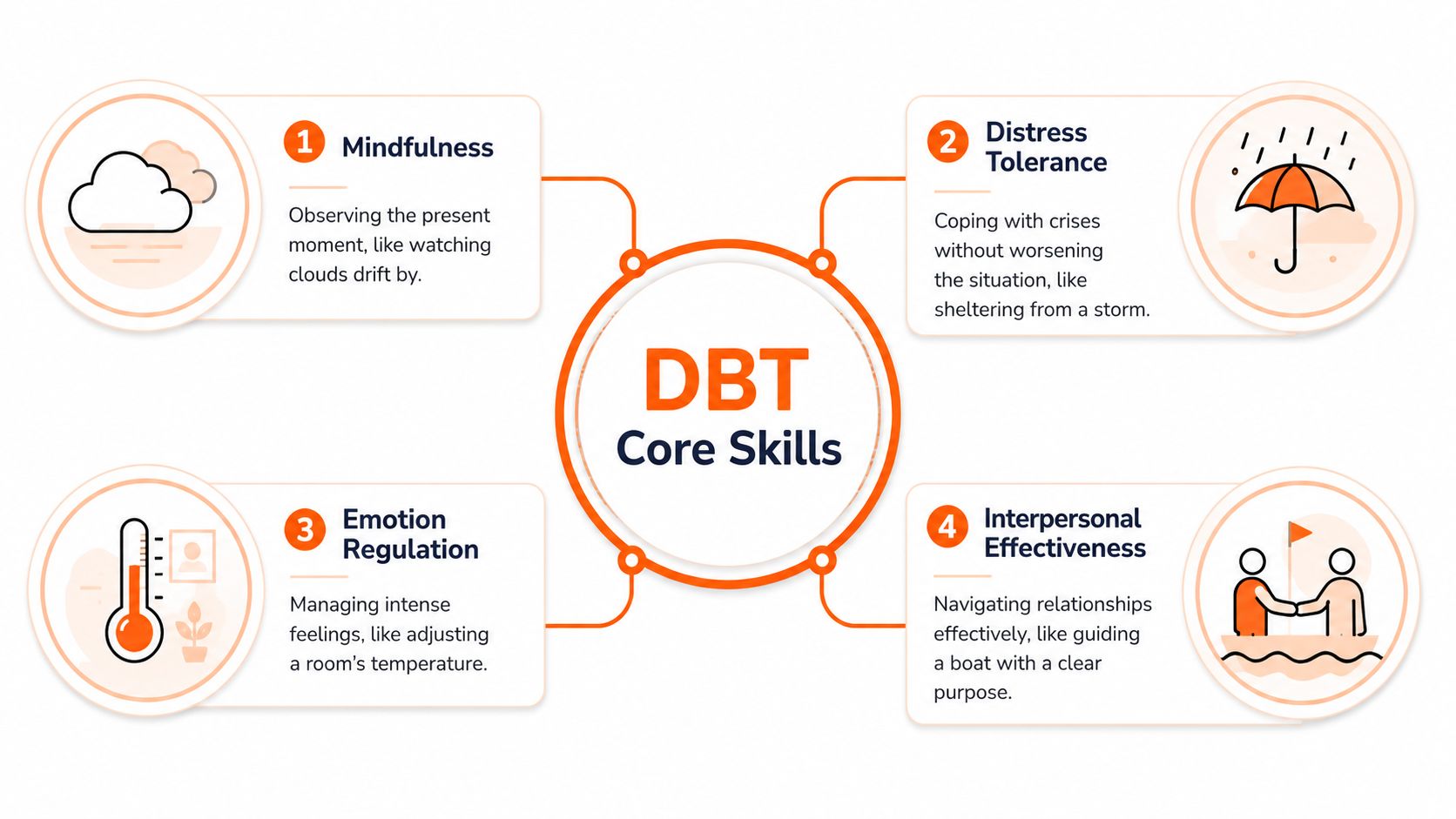
DBT's skills module works best when you think of it as a chain. A trigger shows up, the body reacts, the mind starts predicting disaster, and behavior follows fast. The four modules are designed to interrupt different points in that chain, so the person has more than one way to respond.
Mindfulness
Mindfulness in DBT is not a vague invitation to relax. It's a practical method for noticing what's happening before you react to it. In executive terms, it's like checking the dashboard before you hit the gas, you look at the signals first, then decide what the next move should be.
That matters because many people don't act on the event itself, they act on the first wave of interpretation. If you can notice tension, urge, or self-criticism earlier, you have a better chance of changing course. Capo Canyon Recovery's mindfulness resource sits naturally alongside DBT because attention training is often the first doorway into deeper skills work (Capo Canyon mindfulness).
Distress tolerance
Distress tolerance is the emergency protocol. It doesn't promise to erase stress, it teaches you how to get through a crisis without making the situation worse. In DBT terms, that's the difference between surviving a hard moment and escalating it with an impulsive choice.
For high-achieving professionals, this skill is often the first one that feels immediately useful. You can't always pause a board meeting, delay a difficult call, or stop a family conflict on demand. Distress tolerance gives you a set of options for those moments when your instinct is to escape, argue, or shut down.
Emotion regulation and interpersonal effectiveness
Emotion regulation is the module that helps people identify what they're feeling, understand what makes the feeling stronger, and use strategies like opposite action to shift the trajectory. It's not about suppressing emotion, it's about changing the pattern that keeps emotion in the driver's seat. The goal is less emotional whiplash, more range.
Interpersonal effectiveness then turns to relationships, teaching people to ask for what they need, set boundaries, and say no without creating unnecessary fallout. DBT treats relationship skill as a stabilizing force, not a side issue, because conflict often feeds the same emotional spiral that makes everything else harder.
DBT works best when the skill is practiced close to the moment of stress, not only discussed after the fact.
DBT Treatment Structure
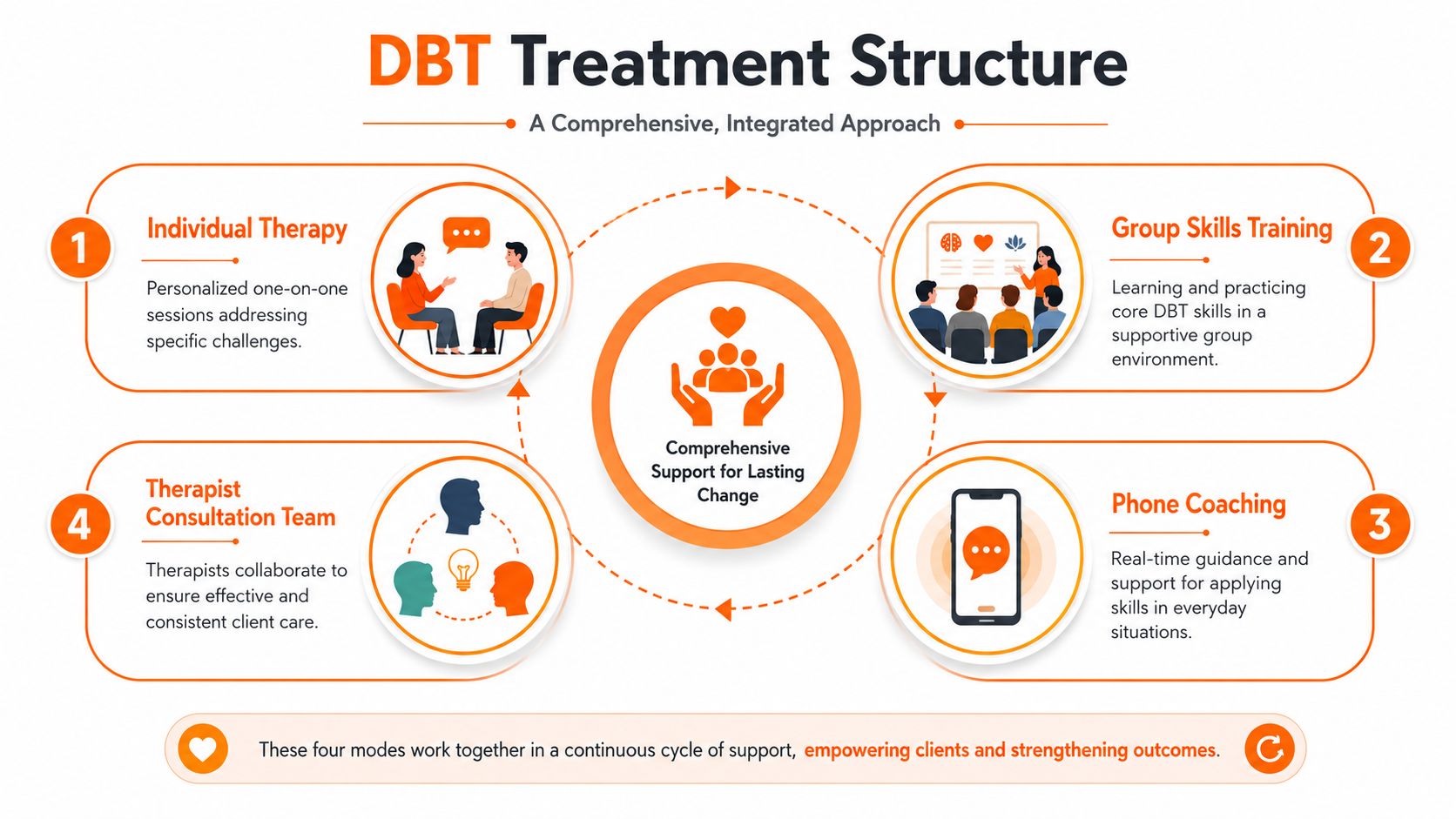
The structure is what makes DBT hold together. Individual sessions keep the work personal, group skills training teaches the tools, phone coaching carries the tools into daily life, and the consultation team helps the therapist stay consistent and effective (APA PsycNet). When those pieces are running together, the treatment becomes more like a coordinated operating system than a weekly appointment.
Why all four modes matter
A professional might understand a skill intellectually and still miss the moment to use it. That's why the phone coaching piece matters, because real crises don't wait for the next session. The model assumes that support has to exist between sessions if the patient is expected to use the skills under pressure.
The consultation team is less visible to the client, but it's essential. Therapists meet with other DBT clinicians to stay aligned with the model and avoid drifting into inconsistent care (APA PsycNet). That's a quality issue, and in high-risk settings, quality matters as much as compassion.
The practical rhythm
Harvard Health notes that standard DBT can include individual therapy, weekly skills groups, phone/text coaching, diary cards, and consultation teams, and that busy professionals often need flexible adaptations to complete the program (Harvard Health). That observation is important for executives because it explains why full DBT can feel demanding even when the therapist is excellent.
At Capo Canyon Recovery, DBT can sit inside a broader residential plan that already includes private rooms, tech access, and individualized treatment scheduling. For someone whose work can't disappear entirely, that combination can reduce the friction that usually makes thorough care hard to complete.
DBT for Substance Use and Co-Occurring Disorders
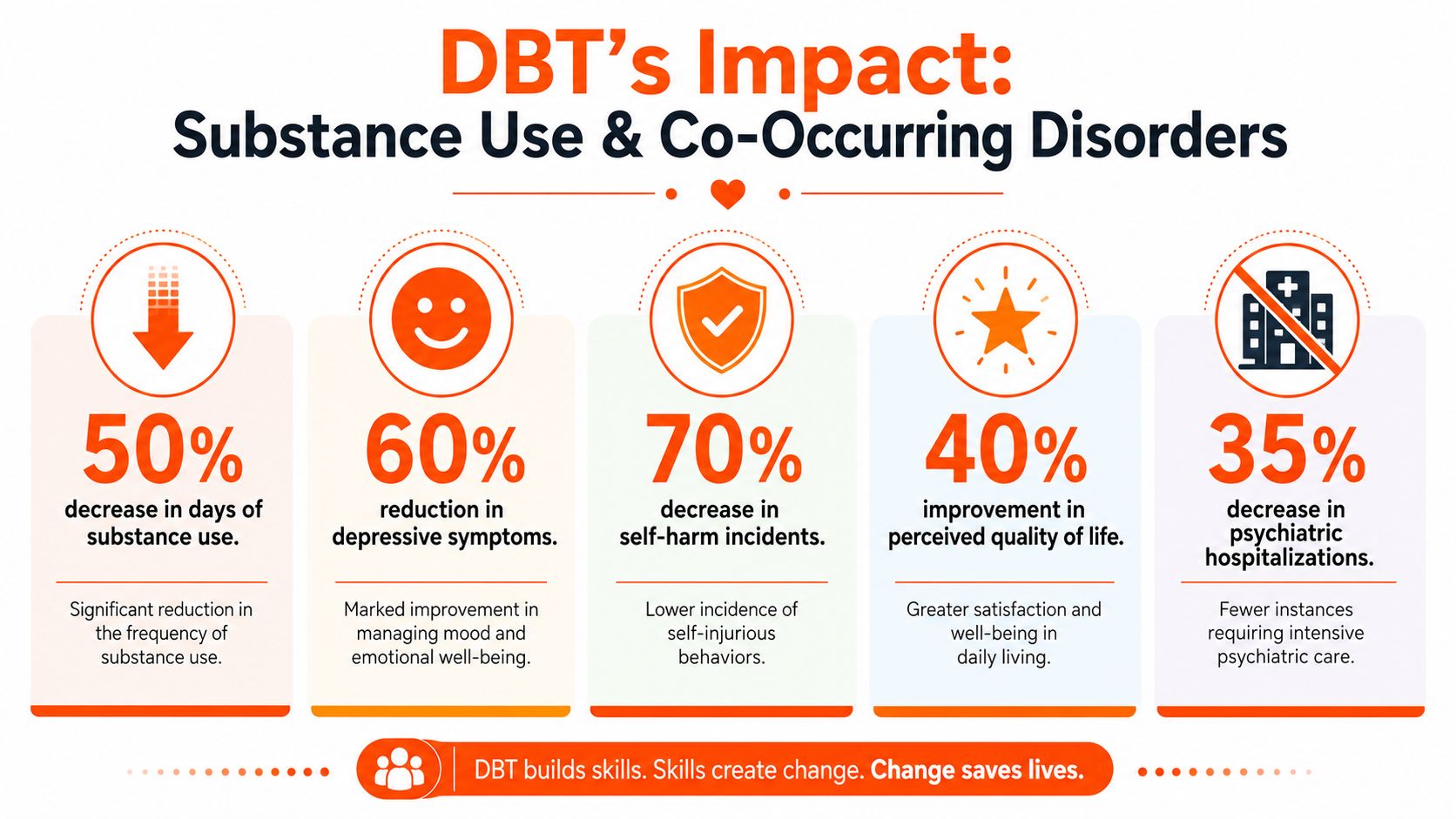
DBT became a common option in dual-diagnosis care because it doesn't treat substance use as a standalone habit problem. It looks at the emotional chain underneath the use, the trigger, the urge, the crisis behavior, and the aftermath. That's a useful fit when alcohol, drugs, or compulsive behavior show up as a way to manage pressure, numbness, or intense affect.
The outcome data that's often cited for DBT's broader relevance is still rooted in high-risk populations. A landmark study reported that 77% of patients who completed full DBT no longer met diagnostic criteria for BPD at one year, and the same evidence base found superior reductions in drug use over 12 months for women with BPD and substance use disorders (TherapyExplained). Those findings don't mean DBT is a universal answer, but they do show that the model can reduce behaviors that often travel together.
Why co-occurring care often needs DBT
The value of DBT in dual diagnosis is that it targets both the symptom and the coping style that keeps it alive. When a person uses substances to escape overwhelming emotion, a traditional lecture about consequences rarely changes the pattern. DBT gives them something to do in the moment instead.
For executives, that matters because co-occurring disorders often stay hidden longer than people expect. Work performance can mask distress, and privacy concerns can make help-seeking slower. A program that integrates DBT with psychiatric care, addiction treatment, and confidentiality protections can be more realistic than a one-size-fits-all outpatient setup.
Implementing DBT at Capo Canyon Recovery

Standard DBT can ask a lot from a client, and that's before you add executive schedules, travel demands, or concerns about who will find out. Harvard Health notes that real-world DBT often includes weekly skills groups, phone/text coaching, diary cards, and consultation teams, which is why flexibility matters so much for busy professionals (Harvard Health). Capo Canyon Recovery is one option that can place DBT inside a private residential setting with tech access, private rooms, and an executive track.
What adaptation looks like in practice
The first step is usually scheduling. If someone needs to stay reachable for essential work, the plan has to account for that without undermining treatment. That can mean aligning DBT groups, individual sessions, and coaching windows around the day's most nonnegotiable responsibilities.
Privacy is the second piece. A small census and private rooms reduce the exposure that often makes professionals hesitate to enter treatment. When a person is worried about reputation, the treatment environment itself has to lower the social noise so the clinical work can happen.
How the work stays usable
DBT only helps if the tools get used outside the therapy room. That's where diary cards, brief between-session check-ins, and clear goal-setting matter. They turn a stressful week into something trackable, which makes progress easier to discuss without turning the process into a vague conversation about “doing better.”
Here's the practical logic:
- Protect confidentiality first. If someone doesn't feel safe, they won't engage openly.
- Preserve essential work access. Total disconnection can create more stress than it removes.
- Keep the schedule predictable. DBT works better when the client knows what comes next.
- Make the skills concrete. A coping plan has to survive real meetings, not just therapy language.
That's a key advantage of adaptation. It doesn't dilute DBT, it makes the model usable for people who can't afford to disappear from life entirely.
What to Expect During DBT at Capo Canyon
A typical executive week in DBT starts with structure. Morning mindfulness work can help settle the nervous system before the day fills up, then individual therapy gives the clinician and client a place to review the week, identify the highest-priority behavior, and decide what needs attention first. The pace stays purposeful.
Midday is often where the model becomes most useful. A stressful call, a difficult message, or a sudden wave of shame can trigger the exact reaction DBT is designed to interrupt, and brief coaching or skill rehearsal can help the person choose something other than the old reflex. The point isn't perfect calm, it's better timing.
By later in the week, emotion regulation and interpersonal effectiveness work can make the emotional pattern easier to spot. A client starts to see that the same stressor keeps producing the same response, and the treatment then shifts from crisis management to pattern change. That's when the therapy starts feeling less like damage control and more like a real operating plan.
Referrals and FAQs for DBT Care
A referral usually starts with a clinician, case manager, or EAP that recognizes the need for structured care. For executives, the intake question is often less about whether therapy is needed and more about whether the setting can protect privacy while still providing enough support to stabilize the situation. Insurance verification, self-pay arrangements, and admission timing are usually sorted during the intake process.
If you're preparing for a referral, bring the basics, current symptoms, recent treatment history, medication information, and any concerns about work access or confidentiality. The clearer the intake picture, the easier it is to determine whether DBT should stand alone or be part of a broader treatment plan.
Common questions people ask:
- Does DBT have to be full-program treatment? No. Full-program DBT is the standard model, but some settings adapt the format to fit the person's level of need.
- Can professionals stay connected to work? Sometimes, yes, if the program is built to support privacy and limited work access.
- Do I need a specific diagnosis? Not always. DBT is often chosen because of symptom patterns, especially emotion dysregulation and impulsive coping.
If you're trying to decide on next steps, contact Capo Canyon Recovery to ask about an executive-friendly intake, how DBT fits into their residential program, and what documentation they need to review your referral.