
You've got the version of this problem that never shows up in public: the calendar is full, the board still expects answers, the inbox keeps moving, and you're using coffee, alcohol, cannabis, or something prescribed “just to get through the week.” The catch is that the thing that feels like a productivity problem may be ADHD and substance abuse showing up at the same time, and that combination changes what good treatment looks like.
Understanding the ADHD and Substance Abuse Connection
A senior leader can look polished on the outside and still be running on a shaky internal system. Deadlines get met, but only after late nights, escalating caffeine, or a quiet dependence on something that takes the edge off focus, restlessness, or overwhelm.
That pattern is easy to misread as stress management. In practice, it often reflects untreated ADHD symptoms colliding with a workplace that rewards speed, constant context-switching, and emotional control.
The clinical link is not subtle. In the U.S. National Comorbidity Survey Replication, 15.2% of adults with ADHD also met criteria for a substance use disorder, compared with 5.6% of adults without ADHD, according to SAMHSA's review of the evidence in this clinical summary. A peer-reviewed review summarized there also found 23.1% of people diagnosed with ADHD had a substance use disorder.
Practical rule: If a person with ADHD is also using substances to sleep, focus, calm down, or “take the edge off,” treat that as a dual-diagnosis question, not a character issue.
For executives and other high-functioning professionals, that matters because the outward signs can stay hidden for years. Performance masking can delay care, while the underlying pattern keeps getting reinforced by high stress, privacy concerns, and a culture that rewards pushing through.
ADHD treatment options for adults only make sense when the clinical picture is accurate. If substance use is part of the picture, the treatment plan needs to account for both conditions from the start.
The Scope of Co-Occurring ADHD and Addiction
A busy professional can look stable on the outside and still be carrying a substance problem that has been folded into daily routines. In ADHD care, that matters because the overlap is broad enough to change how screening is done, especially when the person is high-functioning and has learned to compensate.
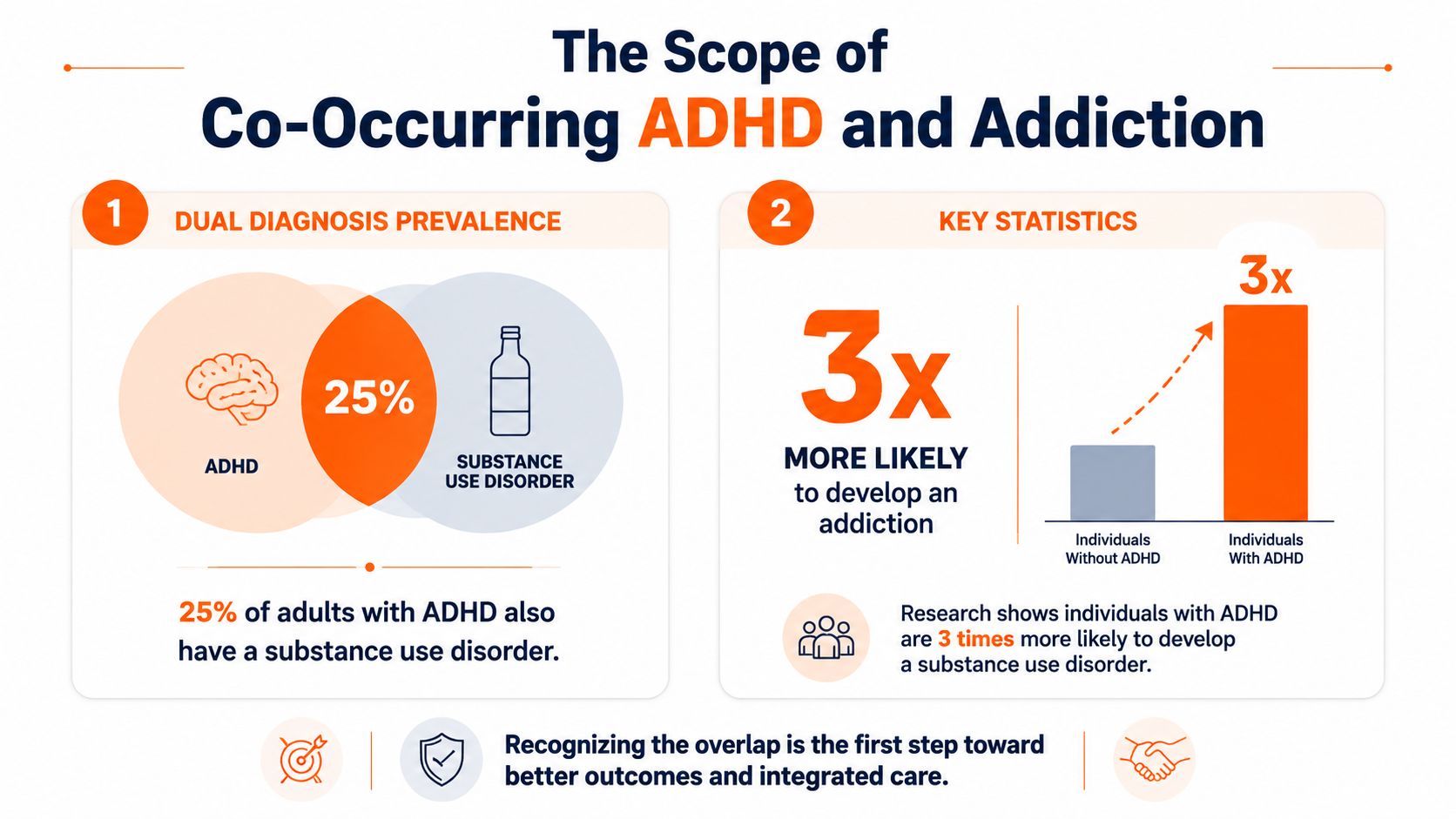
Clinicians reviewing the evidence in the national behavioral health review note that people with ADHD were about 2 to 3 times more likely to develop nicotine, alcohol, marijuana, cocaine, or other substance use disorders than those without ADHD. The point is not that ADHD leads to addiction in every case. The point is that the risk is high enough to require active assessment, not casual reassurance.
Why the numbers matter in practice
A Canadian nationally representative survey, summarized in Alcohol and Alcoholism, found lifetime SUD prevalence of 51.3% in adults aged 20 to 39 with ADHD, compared with 23.6% in peers without ADHD. Within that same sample, lifetime alcohol use disorder was 36% versus 19%, cannabis use disorder 23% versus 10%, and other drug use disorder 18% versus 5%.
Those differences are large enough to matter in day-to-day care. They point to a dual-diagnosis pattern that can hide in plain sight, especially in adults who are still meeting deadlines, traveling often, and keeping up appearances while relying on substances to stay organized, sleep, or decompress. A 2021 report summarized in the same source also described young adults with ADHD as 69% more likely to have had an SUD than those without ADHD.
What clinicians should take from that
The risk is not tied to one substance class. A population-based epidemiologic study found higher ADHD symptoms were associated with increased odds of regular nicotine use, multiple-drug use, and alcohol dependence, with odds ratios of 1.33, 2.54, and 3.58 respectively, as reported in Journal of Attention Disorders. The association held across ADHD subtypes, with no substance preference and no sex differences.
For executives and other professionals, that broad pattern changes the clinical question. “It's only wine at night” or “it's just marijuana” can still reflect a coping system that has become part of how someone manages attention, stress, and recovery after work. The substance may be socially normalized. The treatment question is whether it has become a stable workaround for untreated symptoms.
Most people do not present saying, “I have two disorders.” They present saying, “I can't shut my brain off,” or “I need something to get through the day.”
Why ADHD Increases Substance Abuse Risk
The mechanism is not mysterious once you look at behavior and reward together. ADHD creates problems with attention regulation, impulse control, and follow-through, while substances can temporarily mimic relief by changing how a person feels, focuses, or sleeps. That makes them feel like a fast solution, even when they worsen the underlying cycle.

Self-medication is often about function, not pleasure
People with untreated ADHD don't always use substances to “get high” in the way outsiders assume. They may be trying to quiet mental noise, blunt emotional reactivity, improve sleep, or force themselves into a workable state for a meeting, flight, presentation, or long day of decision-making.
That's why the self-medication pattern can stay hidden inside successful careers. An executive may say the alcohol helps them decompress, or the stimulant prescription helps them perform, while the issue is that their nervous system never learned a durable way to regulate attention and stress.
Why untreated ADHD keeps the loop going
Once the substance becomes part of the coping routine, it starts covering symptoms that should have been treated directly. The person gets short-term relief, then rebounds into worse organization, more fatigue, and greater frustration tolerance problems. That leads to more use, not less.
A useful way to think about it is this, substances can become a workaround for executive dysfunction. The workaround may help tonight, but it usually makes tomorrow harder.
If someone says a substance is the only thing that helps them focus, sleep, or tolerate work, that's often the point where a full ADHD assessment becomes essential.
The clinical implication is straightforward. You don't solve ADHD-driven substance use by preaching abstinence alone, and you don't solve ADHD by treating only the addiction. Both conditions need to be named, measured, and addressed in the same care plan.
The Assessment Gap in Addiction Treatment
Addiction treatment often assumes the diagnosis will be obvious once the substance use is stabilized. In real clinics, that assumption breaks down. ADHD can hide behind withdrawal, sleep loss, depression, anxiety, and the general chaos of early recovery.
An authoritative clinical review noted that undiagnosed ADHD in an SUD clinic population in south London was around 12%, according to NCBI Bookshelf. That's a meaningful missed-diagnosis rate in a setting where the condition should be on the checklist.
Why ADHD gets missed
The first problem is symptom overlap. Restlessness, distractibility, impulsivity, and poor sleep can all appear during withdrawal or early abstinence, which makes it easy to mistake chronic ADHD for a temporary recovery issue. The second problem is attribution bias, clinicians may assume every attention problem comes from substance use and stop looking.
That mistake has downstream costs. Untreated or unrecognized ADHD is linked to poorer engagement, more severe comorbidity, polydrug use, and suicidal behaviors in the review summarized by NCBI. For a professional trying to hold a career together, that can look like repeated partial recoveries, not one obvious crisis.
The treatment gap after diagnosis
A recent Penn State report found that in teens and young adults with ADHD, stimulant prescribing dropped after a substance use disorder diagnosis. Ongoing stimulant treatment fell by about 15%, and new stimulant prescriptions fell by more than 17%, as reported in Penn State Health News. That doesn't prove stimulants should always continue, but it does show how often treatment gets interrupted.
For executives, the practical risk is undertreatment. A person may enter recovery and lose access to ADHD care at the exact moment when executive function support matters most. That can destabilize work performance, increase shame, and make relapse more likely.
What dual diagnosis means in addiction care is simple in theory and often missed in practice. If both disorders are present, both have to be assessed with enough detail to separate chronic ADHD from substance-related symptoms.
Evidence-Based Treatment Approaches for Dual Diagnosis
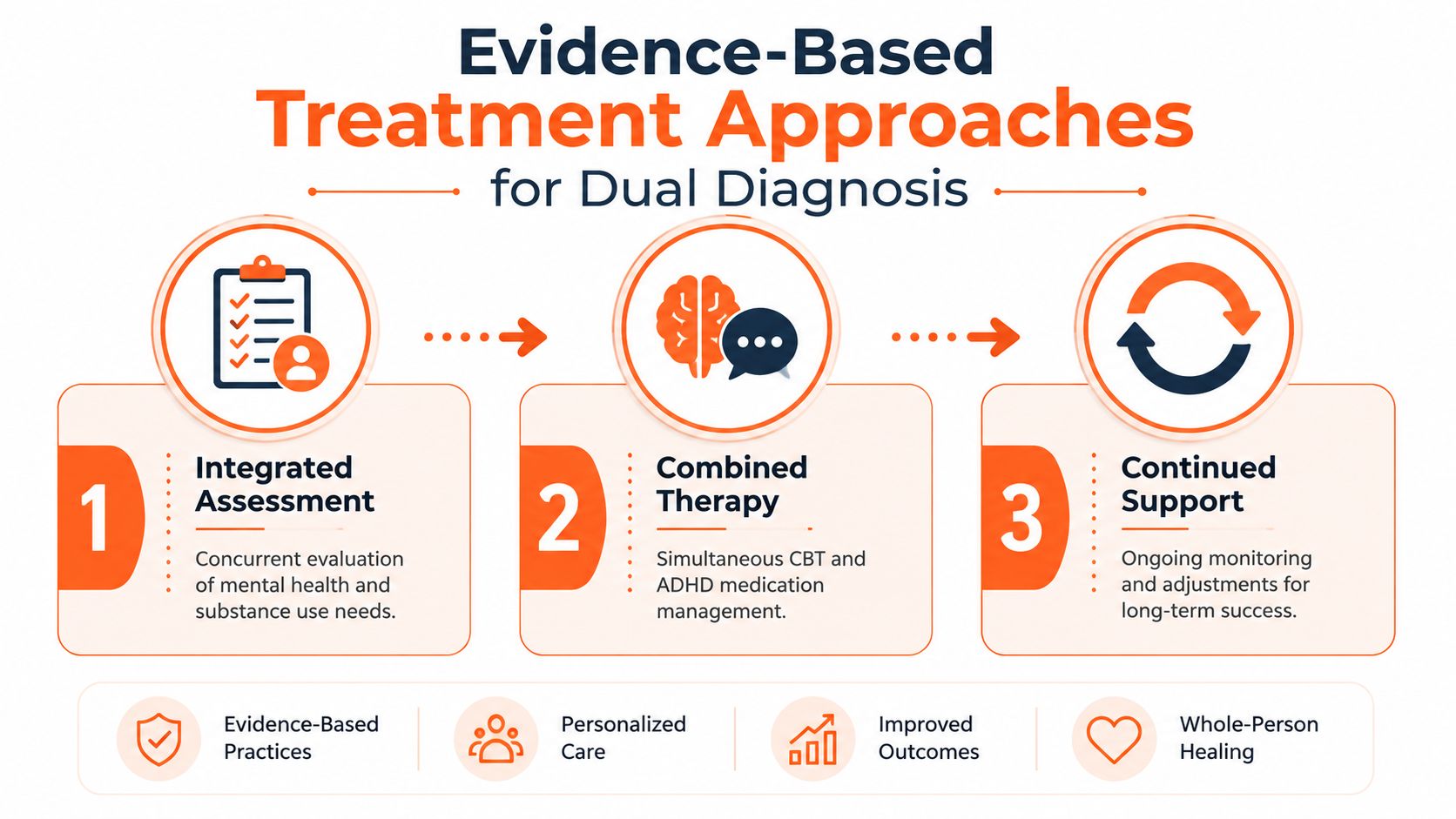
Good treatment starts with sequencing, not guesswork. If substance use is active and destabilizing, the first goal is often safety and stabilization. If the person can't sleep, is medically unsafe, or is cycling through intoxication and withdrawal, ADHD medication decisions need to wait until the clinical picture is clearer.
What integrated care looks like
The strongest practical model is integrated care, because both disorders shape the other. A review in PMC reports that about one quarter of adults entering SUD treatment meet ADHD criteria, and that people with both disorders often have earlier onset, faster progression to SUD, more polydrug use, more hospitalizations, and lower adherence.
That's why a dual-diagnosis program needs to do more than label symptoms. It should coordinate psychiatry, therapy, monitoring, and relapse prevention in one plan instead of handing the person from one silo to another.
What treatment usually includes
A sound plan often combines medication management and psychotherapy, but the order matters.
- Stabilize substance use first when needed. If alcohol, opioids, or another drug is driving medical instability, that has to be addressed before fine-tuning ADHD treatment.
- Reassess ADHD once withdrawal settles. That helps separate baseline symptoms from temporary recovery effects.
- Use behavioral therapy alongside medication. CBT, DBT, and ACT can help with planning, emotional regulation, urges, and shame-driven avoidance.
- Monitor closely for misuse or diversion. This is especially important in people with a history of stimulant misuse or high access to controlled substances.
- Adjust over time. Dual diagnosis care isn't static, because work stress, sleep, travel, and recovery stability all affect symptom burden.
Medication can improve ADHD symptoms, but its effect on substance outcomes is inconsistent unless the SUD is already stabilized, according to the review above. That's the practical trade-off many programs don't say out loud. Treating the attention problem without managing the addiction can be premature. Treating the addiction while ignoring ADHD can leave the person unable to use recovery skills well enough to stay engaged.
Executive and Professional Treatment Considerations
A senior partner who has been missing deadlines, drinking more after client dinners, and hiding stimulant use will not benefit from a program that expects him to step away from work without a plan. That is the reality for physicians, attorneys, founders, and senior managers, where treatment has to account for privacy, continuity, and the consequences of being absent.
A medically supervised setting can reduce the administrative burden while keeping care clinically focused. Capo Canyon Recovery is one example of a program that offers detox, residential treatment, dual diagnosis care, and an executive track with a tech-friendly policy that allows cell phones and laptops, which can matter for people balancing treatment with critical work obligations. For professionals who need treatment designed for professionals, an executive dual-diagnosis program can address both recovery and the practical demands of maintaining work responsibilities.

Why privacy changes engagement
Executives often delay care because exposure feels riskier than symptoms. They worry about boards, partners, staff, clients, licensing boards, and reputation. If a program cannot protect confidentiality or lower the sense of public scrutiny, the patient may avoid care altogether or leave before treatment has time to work.
Small census and individualized attention matter because they reduce the feeling of being lost in a crowd. For a person who already struggles with attention, a high-volume program can become another system to track, and that can raise the chance of disengagement.
What to look for in a professional program
- Dual-diagnosis capability so ADHD is not treated as an afterthought.
- Medical oversight for detox, medication changes, and psychiatric monitoring.
- Flexible access to work tools when the patient has unavoidable responsibilities.
- Frequent individual therapy rather than relying only on group programming.
- Clear medication monitoring so stimulants, non-stimulants, and other psychiatric medications are handled carefully.
The best fit is not always the most restrictive program. It is the one that can hold both realities at once, the need for real recovery and the need to remain functional in a demanding professional role.
Taking the Next Step Toward Integrated Recovery
If you're trying to decide whether your situation is “stress,” “burnout,” or something more complicated, look at pattern, not just intensity. Repeated self-medication, chronic disorganization, missed deadlines, sleep disruption, and a history of substance use together warrant a dual-diagnosis evaluation.
A good program won't force you to choose between protecting your career and getting honest clinical care. It will tell you how it screens for ADHD, how it handles active or recent substance use, how medication is monitored, and how the plan changes as sobriety stabilizes.
The right question isn't, “Can I keep working while I get help?” It's, “Can this program treat both conditions without making me less safe, less private, or less functional?”
For executives and other professionals, that answer has to include discretion, medical oversight, and a realistic plan for maintaining essential obligations. If a treatment team can't explain all three, keep looking.
Capo Canyon Recovery provides medically supervised detox, residential dual diagnosis treatment, and an executive track designed for professionals who need privacy and limited disruption to essential work. If you're evaluating care for ADHD and substance abuse, visit Capo Canyon Recovery to review how its program supports stabilized recovery while accommodating the realities of professional life.