
You can be in a board meeting, on a flight, or staring at your inbox at 2 a.m. and still know something is off. A colleague says you've sounded guarded, your sleep is broken, and small details feel loaded with meaning. For many high-functioning adults, that's the point where substance induced psychosis stops being a distant clinical term and becomes a real safety issue.
This condition can look like panic, burnout, intoxication, or a “bad reaction,” but it's more serious than any of those labels suggest. It's a psychiatric emergency that needs medical evaluation, not a wait-and-see approach. In real-world care settings, it shows up often enough that clinicians screen for recent substance exposure as part of first-line psychosis assessment, because SIP accounts for a meaningful share of first-episode psychoses entering care and can appear in up to 25% of first hospital admissions for psychosis (Cambridge Psychological Medicine).
Understanding Substance Induced Psychosis
A senior executive can look “fine” on the outside and still be sliding into psychosis on the inside. They may keep presentations polished, keep travel schedules intact, and still become convinced that coworkers are talking about them, that emails contain hidden messages, or that someone is watching their home. That gap between external performance and internal reality is one reason substance induced psychosis gets missed early.
What It Is, and What It Isn't
Substance induced psychosis means hallucinations, delusions, confused thinking, or severe paranoia that arise in the context of substance use, withdrawal, or medication exposure. It is not the same thing as ordinary intoxication, and it's not just a “rough night” or a temporary change in mood. It's also different from a panic attack, though the two can overlap in how terrifying they feel.
The key issue is timing. Symptoms appear in connection with the substance, and they can outlast the period of obvious intoxication. That's why clinicians treat the situation seriously even when the person is articulate, employed, and able to keep up appearances.
Practical rule: if reality testing is breaking down, the safest assumption is that the person needs urgent psychiatric evaluation, not more reassurance.
The term also matters because it helps families and employers stop guessing. A person isn't “choosing” bizarre beliefs, and they aren't being dramatic. They're experiencing a disturbance in perception and thought that can escalate quickly without treatment.
Why High-Functioning People Miss the Warning Signs
Professionals often compensate well at first. They delegate, overwork, isolate, or explain away odd experiences as stress, jet lag, or lack of sleep. That can delay care until the symptoms become obvious, public, or dangerous.
A common misconception is that psychosis only happens after years of obvious addiction. The data don't support that simplification. In Scandinavian registry and catchment-area studies, annual incidence rates were about 6.5 to 14.1 per 100,000 person-years, and SIP accounted for 6.5% to 10.3% of first-episode psychoses entering early intervention services (Cambridge Psychological Medicine). That means clinicians are not dealing with a rare curiosity. They're dealing with a real pattern in acute psychiatric care.
How Different Substances Trigger Psychotic Episodes
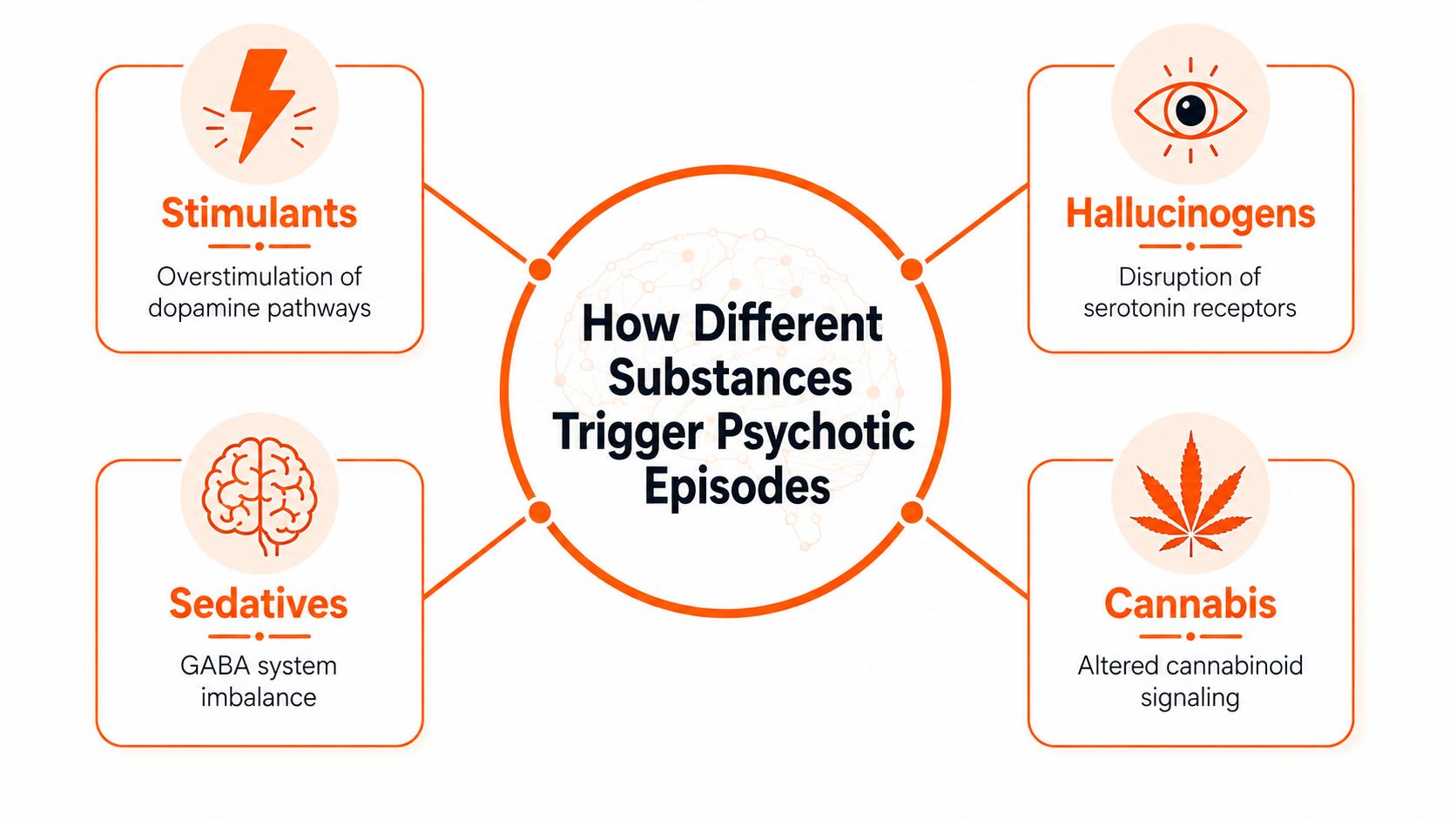
Different drugs strain the brain in different ways, so the clinical picture is not the same from one substance to the next. A person who becomes suspicious after stimulants may need a different stabilization plan than someone who becomes disoriented after a hallucinogen, a dissociative, or sedative withdrawal. Contemporary reviews describe substance-specific and polysubstance risk as a major issue in modern care, especially with cannabinoids, amphetamines, cocaine, hallucinogens, alcohol, nicotine, kratom, cathinones, and some medications (Open Psychology Journal).
The Brain Pathways Are Not the Same
The best-supported mechanisms differ by class. Stimulants and cathinones primarily increase synaptic dopamine, cannabis-related agents act through CB1 receptor agonism, classic psychedelics act via 5-HT2A agonism, and dissociatives such as ketamine and PCP produce psychosis-like states through NMDA receptor antagonism (PMC review). A senior executive may describe the experience as stress or burnout, but the underlying biology can point in very different directions.
That difference matters at the bedside. Dopamine-heavy episodes tend to look like paranoia, hallucinations, and formication, the crawling-skin sensation some people describe. Psychedelic states more often bring visual distortions and dissociation. NMDA blockade can create both positive and negative symptoms, plus behavioral disturbance. For families and colleagues, it may all look like someone is “not themselves,” while the clinical team is trying to identify which system has been pushed out of balance.
Clinical insight: the symptom profile often gives a clue about the dominant neurochemical disturbance, which helps the team choose the right level of observation and medication.
Why Stimulants and Cannabis Need Special Attention
For stimulants, the mechanism is especially direct. Amphetamines raise dopamine in the synaptic cleft by blocking reuptake and reversing transporters, while also increasing intracellular dopamine and norepinephrine, which can drive striatal hyperdopaminergia and downstream cortical glutamate release (PMC stimulant review). Repeated or high-dose exposure can sensitize D2 signaling, so symptoms may continue after the person has stopped using the drug. When stimulants are mixed with sleep loss, pressure to perform, or private self-medication, the risk rises further. For a worried family member, understanding ativan withdrawal timelines can also help distinguish stimulant-driven agitation from benzodiazepine withdrawal, which can produce a very different kind of instability.
Cannabis is different, but it is not benign. Reviews of Substance-Induced Psychosis consistently identify cannabinoids as psychotogenic, and modern high-potency products complicate the picture because the user may not know how much exposure they've had (Open Psychology Journal). Polysubstance use makes the picture even murkier, because the brain is not reacting to one clean variable. In practice, that is often the challenge with high-functioning professionals, the substance exposure may be hidden, the schedule may still look intact, and the psychosis can be mistaken for stress until it is no longer subtle.
Recognizing the Warning Signs and Symptoms
The early signs are often subtle enough to get rationalized away. A partner may notice the person sleeping far less, jumping from idea to idea, or becoming suspicious of harmless comments. A colleague may see missed deadlines, odd interpretation of normal feedback, or abrupt withdrawal from a usually social routine.
Early Signals Families and Teams Often Notice First
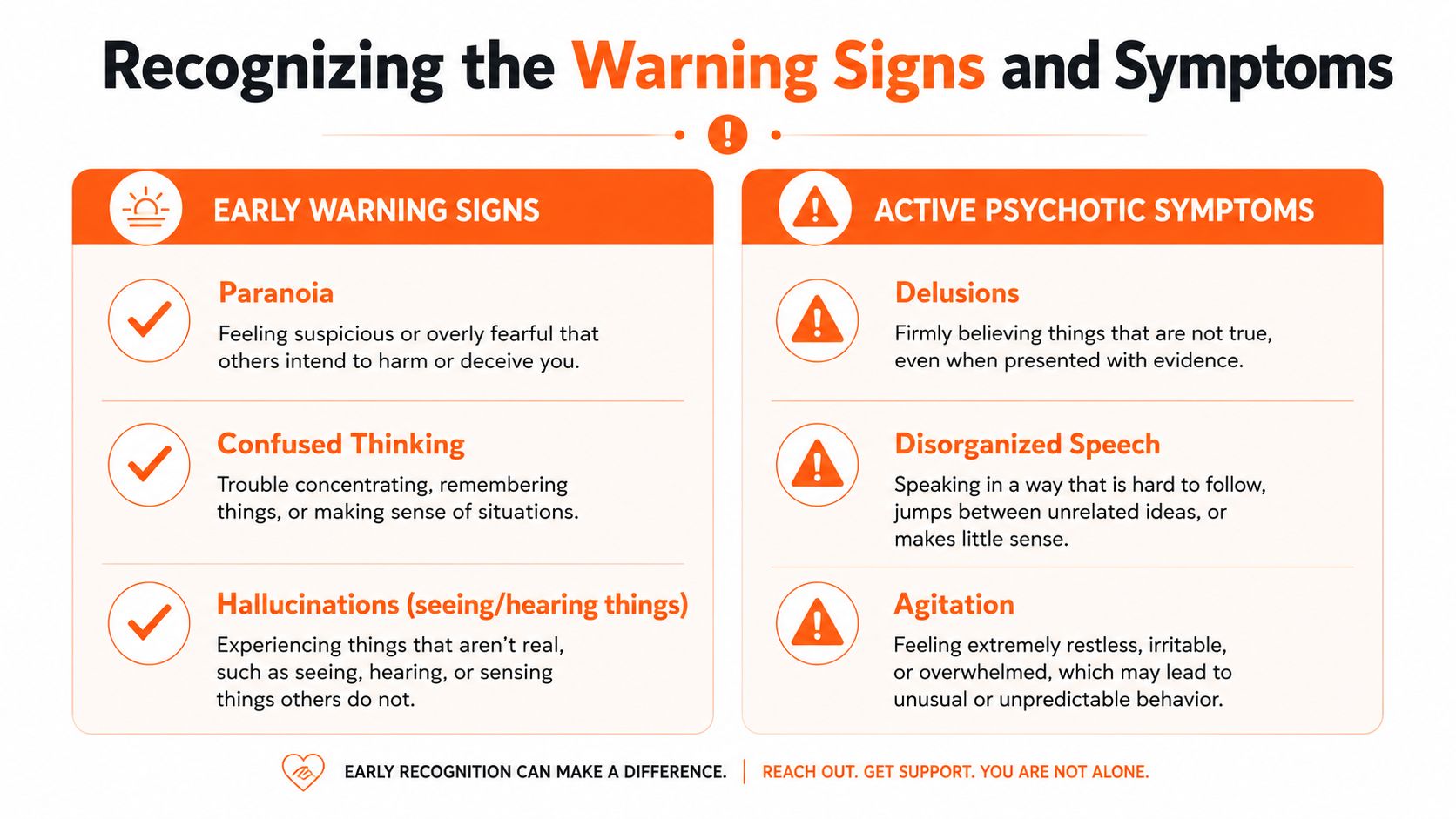
These warning signs don't prove psychosis by themselves, but they should lower the threshold for a psychiatric check. The person may become guarded, sleep poorly, or start reading threat into ordinary interactions. They may also seem unusually preoccupied, detached, or difficult to redirect.
- Paranoia: The person starts assuming others have bad intentions without evidence.
- Confused thinking: They lose track of conversations, goals, or ordinary sequence.
- Hallucination-like experiences: They may mention seeing or hearing things others don't notice.
The reason these signs matter is simple. A person who still appears high-functioning can still be losing contact with reality in specific moments, and those moments can become longer and more frequent.
Symptoms That Need Immediate Medical Attention
Once the person is describing fixed false beliefs, hearing voices, or speaking in a way that doesn't connect logically, the situation is urgent. Severe agitation is especially concerning because it can raise the risk of accidental harm, conflict, or medical complications. The literature on acute management notes that some presentations need only monitoring, while stimulant- or agitation-driven cases may require short-term antipsychotics and sometimes benzodiazepines (Open Psychology Journal).
- Delusions: Strong beliefs that are clearly false and not corrected by evidence.
- Disorganized speech: Thoughts come out in fragments or abrupt shifts.
- Agitation: The person seems unable to settle, reason, or safely engage.
If the person is a professional who insists they're “still functioning,” don't let that reassure you. A person can answer emails, attend meetings, and still be psychotic.
Substance Induced Psychosis vs Primary Psychotic Disorders
The fear I hear most often from families is blunt. “Does this mean schizophrenia?” The honest answer is that one episode of psychosis does not automatically mean a lifetime diagnosis, but it does mean the person needs careful follow-up.
| Feature | Substance Induced Psychosis | Primary Psychotic Disorder |
|---|---|---|
| Typical timing | Appears around substance use, intoxication, withdrawal, or medication exposure | Develops independently of substance exposure |
| Course | Often improves after the substance clears and the person stabilizes | Persists across time and usually needs long-term management |
| Key clue | Symptoms line up with recent use and may recede with sobriety | Symptoms continue during sobriety or recur without substance use |
| Diagnostic focus | Recent substance history, toxicology, and observation over time | Symptom persistence, functional decline, and broader psychiatric history |
The difference that matters most is sobriety. If symptoms disappear when the substance is gone, that supports SIP. If they continue or return without new exposure, clinicians worry about a primary psychotic disorder or an underlying vulnerability that the substance exposed rather than caused.
For families who are also sorting out co-occurring use and mental health symptoms, dual diagnosis treatment for executives is a useful framework to understand why both problems have to be addressed together.
The Evaluation and Diagnosis Process
The evaluation starts with safety, not labels. A good clinician wants to know what was used, when it was used, whether there's been sleep loss, and whether any medical issue could be driving the presentation. That includes collateral information from family, partners, or coworkers, because someone in psychosis may not give a reliable history.
What Clinicians Usually Look At First
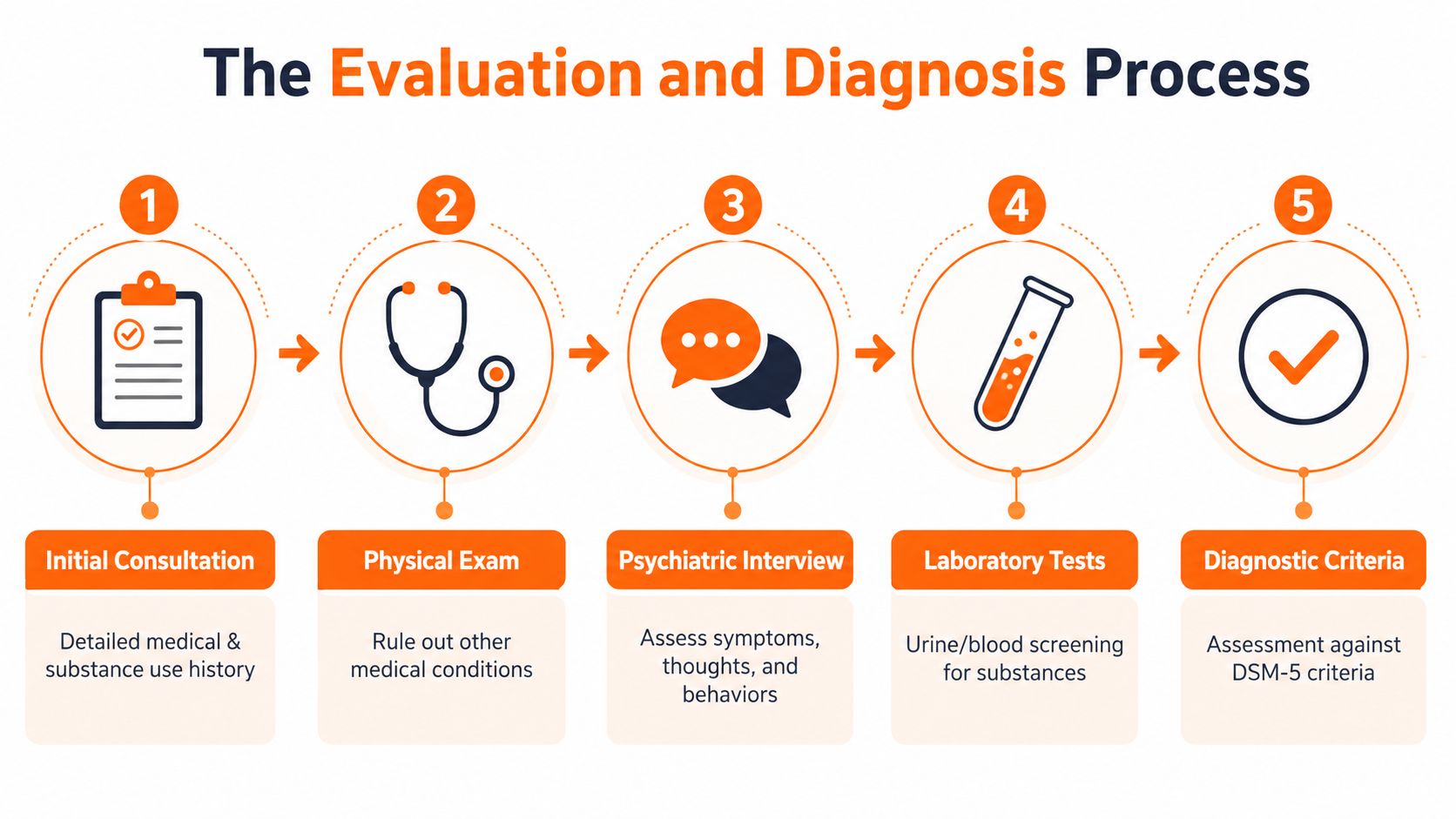
The first pass is a broad medical screen. That can include a physical exam, psychiatric interview, and toxicology testing, with neurological assessment if the picture is unclear. The purpose isn't to “catch” the patient. It's to rule out other causes and confirm whether substances are part of the picture.
- Initial consultation. Clinicians collect a detailed medical and substance-use history.
- Physical exam. They look for signs that another medical condition is involved.
- Psychiatric interview. They assess thoughts, speech, perception, and behavior.
- Laboratory tests. Urine or blood screening helps identify recent substance exposure.
- Diagnostic criteria review. The team compares findings against standard psychiatric criteria.
Privacy Matters, Especially for Professionals
Executives and licensed professionals often delay care because they fear exposure more than symptoms. They worry about board notifications, employer contact, and reputational fallout. In practice, a confidential, medically supervised setting can lower that barrier and make honest disclosure more likely.
The most useful information is often what the patient is embarrassed to say first.
That's why direct, nonjudgmental questions matter. Did sleep disappear before the paranoia started? Was there a stimulant binge? Was cannabis used daily? Those details can change the diagnosis and the care plan.
Treatment Approaches for Acute and Long-Term Recovery
Acute treatment starts with stabilization, not lectures. If someone is frightened, disorganized, or agitated, the first job is to keep them safe, hydrated, monitored, and medically assessed. In severe cases, short-term antipsychotic medication can reduce hallucinations and delusions, and benzodiazepines may be used cautiously when agitation is intense (Open Psychology Journal).
Acute Care and What Comes After
Once the immediate crisis settles, the plan has to address the underlying pattern of use. Detox alone doesn't teach someone how to respond to stress, travel, insomnia, pressure, or the habits that kept the substance cycle going. Without that work, recurrence stays on the table.
Effective care usually combines several layers:
- Medically supervised detox: This matters when withdrawal or intoxication is part of the problem, especially if the person needs 24/7 nursing and psychiatric oversight.
- Medication management: Antipsychotics, sleep support, and careful monitoring can help symptoms settle.
- Individual therapy: CBT, DBT, trauma-focused work, EMDR, ACT, and Brainspotting can be matched to the person's triggers and coping style.
- Family involvement: Loved ones often need coaching on boundaries, observation, and communication.
- Integrated psychiatric care: Co-occurring anxiety, depression, bipolar symptoms, ADHD, or trauma need treatment too.
The reason integrated treatment matters is straightforward. If the person keeps using to manage insomnia, panic, or shame, the psychosis risk doesn't really go away. If the psychotic symptoms are treated while the substance use driver is ignored, relapse becomes more likely.
When Symptoms Don't Resolve Quickly
Some people improve quickly once the substance clears. Others don't. Persistent symptoms need a deeper psychiatric reassessment, because the substance may have uncovered a vulnerability that now needs ongoing care.
That's where setting matters. A discreet residential program, or in some cases a specialized dual-diagnosis setting like Capo Canyon Recovery's executive treatment track, can provide medication monitoring, therapy, and work-sensitive structure without forcing the person to choose between care and every professional responsibility.
Why Executives Need Discreet, Tech-Friendly Treatment
Executives don't just fear treatment, they fear interruption. They worry about leaving a business at a critical moment, losing access to essential communication, or exposing a private struggle to people who don't need to know. Those concerns are real, and they're a major reason some high-functioning professionals delay care until the situation becomes more severe than it needed to be.

What a Work-Compatible Setting Actually Solves
A tech-friendly, private setting does more than preserve convenience. It makes it easier for a person to enter care before the crisis escalates into a public or legal problem. Private bedrooms, Wi-Fi, workspace access, and a policy that allows essential phone and laptop use can keep a patient connected to core responsibilities while still giving the team room to stabilize symptoms.
That matters because treatment adherence improves when the patient doesn't feel forced into an all-or-nothing choice. For a physician, attorney, founder, or senior manager, the ability to answer a limited set of critical messages can be the difference between stepping into treatment now and waiting until the situation gets worse.
What to Look For in a Program
- Small census: Less noise, more privacy, and more individualized attention.
- 24/7 medical oversight: Especially important if intoxication, withdrawal, or agitation is part of the picture.
- Psychiatric support on site: Psychosis needs real psychiatric assessment, not just generic counseling.
- Flexible communication policies: Essential for continuity of work and family contact.
- Private rooms and workspaces: They reduce stress and support recovery routines.
For some people, that combination is the only realistic way to accept help early. It also reduces the pressure to hide symptoms, which is one of the biggest barriers in this population.
Prognosis, Prevention, and Moving Forward
A client I think about often was doing everything right on paper, until sleep loss and stimulant use tipped him into paranoia. He got help quickly, accepted monitoring, and stepped away from the substance that had been driving the crisis. He didn't need a perfect life plan, he needed a safer one.
Prognosis depends on the substance, the severity of the episode, and whether symptoms stop when the drug is removed. The most important prevention step is straightforward, sustained abstinence from the trigger substance, followed by psychiatric follow-up if symptoms linger or return. Families can help by watching for sleep loss, social withdrawal, and suspicious thinking, then acting early instead of arguing with the content of the delusion.
Recovery is possible, but it works best when it's treated as a medical issue with behavioral consequences, not a moral failure. If you recognize these signs in yourself or someone you care about, don't wait for a crisis to become obvious. Get an urgent psychiatric assessment and choose a setting that can handle both the substance issue and the mental health risk.
If you're trying to figure out what kind of care fits a private, high-responsibility life, Capo Canyon Recovery provides medically supervised detox, residential treatment, and dual diagnosis support in a confidential setting. Their executive-friendly model is built for people who need psychiatric care without losing sight of work obligations, privacy, or family communication.