
You've probably already had the same thought a lot of privacy-sensitive, high-functioning people have before treatment, if you step into group therapy, what exactly do you have to give up? For an executive, physician, attorney, or other licensed professional, that question isn't petty or avoidant. It's a real clinical concern about reputational exposure, loss of control, and whether a room full of strangers can possibly feel safe enough to be useful.
The short answer is that group therapy benefits are real, but they're often misunderstood. The strongest version of group work is not a confession circle. It's a structured clinical setting where people learn from one another, practice new behavior, and get relief from the burden of feeling uniquely broken. Research on group psychotherapy shows meaningful symptom improvement, durable gains in depression treatment, and strong effectiveness for anxiety disorders, including in mixed-diagnosis groups that don't require perfectly matched cohorts (group psychotherapy review, anxiety meta-analysis, depression review).
Why High-Functioning People Hesitate to Join Group Therapy
A lot of people who look highly composed on the outside are doing a quiet calculation on the inside. If you've spent years protecting your license, your reputation, your team, or your family, the idea of speaking in front of peers can feel like a bad trade. You're not just asking, “Will this help?” You're asking, “What could this cost me?”
That hesitation makes sense. For high-functioning adults, the main fears usually aren't about whether therapy works in general, they're about who will know, how much needs to be shared, and whether other participants might be too similar to be comfortable. An attorney may worry about professional overlap. A physician may worry about disclosure travel across a small local network. An executive may worry that being seen as vulnerable will weaken authority. None of that is irrational.
Privacy concerns are clinical concerns
The best way to think about this is simple. Privacy isn't a personality flaw, it's part of treatment matching. A thoughtful program has to consider confidentiality norms, group composition, and how much personal detail a member needs to disclose in order to benefit. That's especially true for boutique residential settings, where small groups can lower the social risk while still preserving the interpersonal work that makes group treatment useful.
Practical rule: if a program treats your confidentiality questions like resistance, keep looking.
The more useful question is not whether you feel comfortable at the start. Many don't. The question is whether the setting is built so that a privacy-sensitive person can participate without overexposing themselves. In other words, the goal is not maximum disclosure. The goal is enough structure that you can stay present, learn, and test new behavior safely.
What Group Therapy Actually Is and How It Works
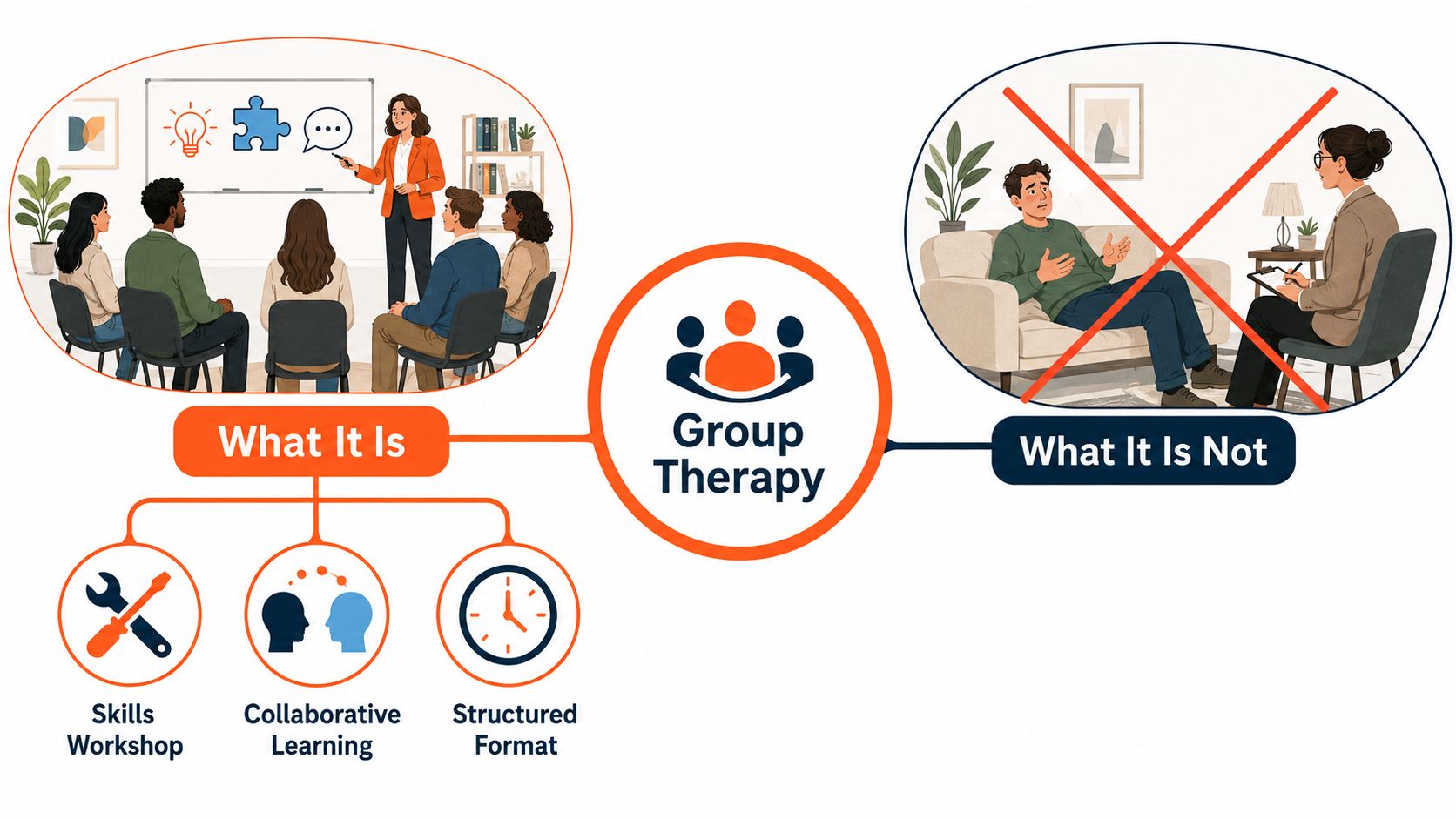
Think of group therapy less like a confession and more like a small skills workshop. One clinician guides a focused conversation, keeps the room emotionally safe, and helps people notice patterns as they happen. The room becomes a live laboratory where people can practice asking for help, setting boundaries, tolerating discomfort, or responding differently to shame.
That structure matters because several therapeutic mechanisms operate at once. Universality means hearing, “I'm not the only one.” Cohesion means the group begins to feel like a stable, reliable place. Social learning happens when one member's way of coping gives another person a better option. Interpersonal processing lets members see how they come across to others in real time. Those effects are very different from talking about problems alone.
For readers who want a deeper look at how sessions are organized in practice, this overview of process group therapy is a useful companion. The basic point is that clinically led group work is more structured than many people assume, and far more purposeful than casual conversation.
Group therapy is not the same as peer support
A support group can be helpful, but it isn't the same thing as psychotherapy. Peer-led spaces usually emphasize shared experience and fellowship. Group psychotherapy is led by a licensed clinician who uses the conversation to target symptoms, behavior change, and relational patterns. That difference explains why the room doesn't just “vent.” It works.
The distinction matters for privacy-sensitive adults because structure creates safety. A well-run group doesn't demand oversharing. It asks members to engage enough to do clinical work, then uses the therapist's facilitation to keep the conversation grounded, relevant, and contained.
Five Evidence-Based Benefits of Group Therapy
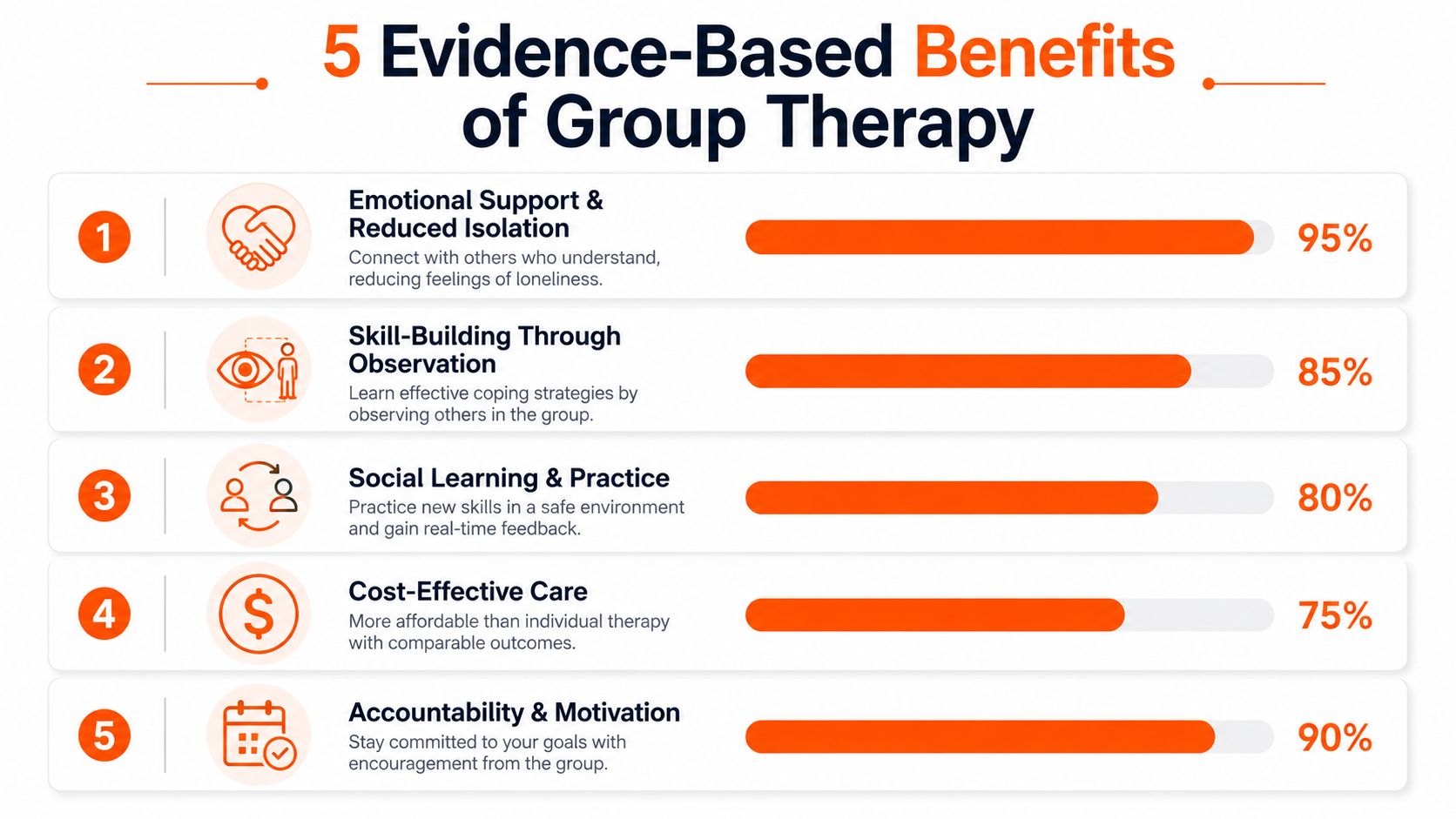
A senior executive who is used to keeping concerns private may hear “group therapy” and picture disclosure without boundaries. In practice, a well-run group is closer to a structured clinical lab than a casual conversation. The room is designed so that privacy, containment, and selective self-disclosure support the work rather than derail it.
The strongest evidence comes from a pattern across studies, not from one dramatic claim. A major review of group psychotherapy reported that 45 of 48 studies on depression found it effective, and 43 of 46 studies with adequate data found significant symptom reduction. It also found that group therapy outperformed no treatment in 15 studies, with effect sizes of 1.026 immediately after treatment and 1.178 at follow-up, and it noted that a 10-session format saved 37.5% compared with individual therapy while another study found costs only 8% to 17% as much as individual therapy (group psychotherapy review). Those findings matter, and so do the clinical mechanisms behind them.
1. Emotional support and reduced isolation
For many privacy-sensitive adults, the first benefit is not emotional openness. It is the relief of being understood without having to translate every detail. Hearing another person describe the same fear, urge, or shame can weaken the private narrative that says, “This is only happening to me.”
That shift matters because isolation often keeps symptoms stuck in place. Once a member sees that others with high functioning, polished careers, and strong external control still struggle in similar ways, defensiveness often drops enough for honest work to begin.
2. Skill-building through observation and rehearsal
People learn faster when they can watch a skill before they try it. In group, the therapist can coach distress tolerance, communication, or boundary-setting while members observe how another person puts the skill into practice. Then the room gives feedback, which makes the learning concrete instead of abstract.
This is especially useful for licensed professionals and executives who are used to competence in performance settings but less practiced in receiving real-time interpersonal feedback. Group turns that feedback into something contained and useful, more like supervised rehearsal than exposure for its own sake.
3. Social learning from peers
The comparative research is striking because group and individual therapy often improve core symptoms at similar rates, while group work adds stronger relational gains. In one comparative study, group participants improved 15.8% on anxiety scores and 20% on depression scores, versus 16.6% and 21.9% in individual therapy, with overall recovery gains of about 9% in both groups. But group participants did better on interpersonal outcomes, including becoming better able to ask for help, which improved in 35% of group participants versus 22% in individual care, and in relying on others, which improved in 28% versus 24% (comparative study summary).
For readers who want a fuller explanation of how that peer process supports recovery, see our peer support in recovery page. The point is not that everyone must become socially open. The point is that witnessing carefully chosen disclosure and response can help a person test new interpersonal habits in a protected setting.
4. Accountability and structure
Group creates a rhythm. People know others will notice whether they returned, practiced the skill, or followed through on a plan. That does not have to feel exposing. In a well-facilitated group, accountability feels more like steady attention than pressure, which is often exactly what overwhelmed high achievers need.
Facilitation style matters here. A smaller, tightly held group in a boutique residential setting can preserve confidentiality while still allowing enough interaction for the work to happen. When the therapist keeps the frame clear, members do not have to overshare to benefit.
Group work is most useful when the therapist turns interaction into practice, not performance.
5. Cost-effectiveness
For families and private-pay patients, cost matters. The economic findings in the review above are hard to ignore, especially in residential care where treatment intensity can quickly add up. Group therapy can make evidence-based treatment more accessible without removing clinical depth, which is one reason integrated programs use both group and individual sessions rather than asking patients to choose only one format.
Group Therapy Compared to Individual Therapy
A useful way to compare these formats is to ask what each one makes easier. Individual therapy gives privacy, depth, and room for work that is tightly tied to one person's history. Group therapy adds a live social setting, which lets people practice how they think, ask, hesitate, and respond while other people are present. For executives and licensed professionals who are protective of confidentiality, that distinction matters more than broad slogans about “opening up.”
The comparative findings are fairly steady. Symptom relief can look similar across the two formats, but the kind of change that emerges is not identical. In the comparative study summary, group therapy and individual therapy were close on anxiety improvement, depression improvement, and overall recovery gains, while group therapy showed a clearer advantage for learning to ask for help and rely on others.
| Outcome | Group Therapy | Individual Therapy |
|---|---|---|
| Anxiety symptom improvement | 15.8% in one comparative study | 16.6% in the same study |
| Depression symptom improvement | 20% in one comparative study | 21.9% in the same study |
| Overall recovery gains | About 9% | About 9% |
| Better able to ask for help | 35% improved | 22% improved |
| Better able to rely on others | 28% improved | 24% improved |
That pattern helps explain why higher-functioning patients often do well with both formats. If the main question is symptom reduction, either setting can be useful. If the question is how a person relates to others under pressure, group therapy offers a different kind of practice. It works like a rehearsal room for relational habits, with the therapist shaping the frame so the interaction stays clinical rather than performative.
When each format fits best
Individual therapy fits deep privacy, trauma processing, identity-sensitive work, and situations where someone is not yet ready to speak in front of peers. Group therapy fits rehearsal, relational repair, and practicing new behavior with immediate feedback from other members. In residential programs, the two formats usually work best together, because a private insight can be tested in group, and a group moment can be explored more fully one-on-one.
Confidentiality and group size shape that decision. A smaller, carefully facilitated group in a boutique setting can give privacy-sensitive patients enough containment to participate without feeling exposed, while still giving them the interpersonal contact that individual work cannot provide. For some patients, including executives and licensed professionals, that structure makes group therapy feel less like public disclosure and more like guided skill practice in a protected room.
A simple rule helps here. If the work depends on maximum privacy, individual therapy should come first. If the work depends on staying connected while uncomfortable, group therapy often becomes the better classroom.
What to Expect in a Residential Group Program
Residential group therapy often feels less like a large public gathering and more like a small room that keeps a steady rhythm. For executives, licensed professionals, and other privacy-sensitive patients, that matters. A low census means fewer eyes, less anonymity concern, and a setting where each person's voice is easier to hear without turning the session into a performance. In boutique programs, the structure is usually tight, with co-led groups and a schedule that divides time between skills work, process work, and psychoeducation.
That structure is doing real clinical work. It gives the room shape. In group treatment research on anxiety, mixed-diagnosis groups have been found to perform about as well as diagnosis-specific groups, which helps explain why well-run residential programs can combine people with different presenting problems without losing focus. The point is not that every person shares the same diagnosis. The point is that the group has a clear frame, so people can practice relevant skills together even when their clinical stories differ.
What the room usually looks like
A typical program uses a licensed therapist as the main facilitator, and some settings add a second clinician or case manager. Confidentiality is usually discussed early, then reinforced often, because privacy in group is not a one-time promise. It is maintained through repeated reminders, clear rules, and a shared expectation that what is said in the room stays in the room. People are expected to speak respectfully, avoid side conversations, and protect one another's privacy after the session ends. That kind of structure helps high-functioning adults participate without feeling ungrounded.
The physical setting also affects how safe the room feels. A discreet residential environment can lower the sense of exposure that many professionals worry about before they ever walk into group. Capo Canyon Recovery's rehab setting by the beach is one example of how a small, contained setting can support that need for privacy while still keeping the work clinically focused. For people who are used to managing responsibility in public, that combination often matters more than broad claims about comfort.
How dual-diagnosis groups are handled
When anxiety, depression, trauma, or substance use all show up together, the group should not blur them into one story. Each problem needs a place in the conversation. A good program keeps the discussion organized so co-occurring symptoms are addressed rather than pushed aside, and the facilitator adjusts the focus to what members are dealing with in that session, not just what appears on the intake form. Residential group work is strongest when it can hold complexity without becoming chaotic.
When Group Therapy Is Not the Right Fit
Group therapy has limits, and honest programs say that out loud. If someone is acutely suicidal, severely psychotic in a way that disrupts safety, or so impaired that they can't tolerate a shared setting, individual stabilization usually comes first. The same is true when recent trauma is still too raw for group processing or when paranoia makes the room feel unsafe rather than containing.
Severe social anxiety can also matter, not because the person is “bad at groups,” but because the barrier may be so high that meaningful participation isn't possible yet. In those cases, a therapist may use individual work first, then step into group once the person has enough regulation to participate without shutting down.
Clinical matching matters more than ideology. A good referral is the one that fits the person in front of you, not the treatment philosophy on a brochure.
Privacy-sensitive licensed professionals deserve one more candid point. Even when confidentiality rules are clear, disclosure in group can carry professional or legal risk if someone shares too much too soon. That doesn't rule group out. It means the admission process should help the patient decide what can be safely discussed, what should stay general, and whether the setting has the right safeguards for their role and life context.
How to Choose the Right Group Therapy Program
The best program for a high-functioning patient is rarely the loudest one. It's the one that can explain, in plain language, how group work is protected, led, and integrated with the rest of care. If you're comparing options, start with the basics and ask the same questions every time.
A practical screening checklist
- Licensing and accreditation. Ask whether the program is appropriately licensed, and whether the clinical services are run by licensed professionals. If you're in California, confirm the setting's DHCS licensure.
- Staff credentials and experience. Find out who leads groups, who covers crisis needs, and how much experience the clinicians have with executives, licensed professionals, or dual-diagnosis clients.
- Group size and composition. Ask how many people are in a typical group, how admissions are balanced, and whether the program keeps high-profile clients in smaller rooms.
- Therapeutic approach and focus. Make sure the group work matches your needs, such as CBT, DBT, trauma-informed care, or relapse-prevention work.
- Session format and cost. Clarify how often groups meet, how they fit with individual therapy, and what the financial structure looks like.
- Client reviews and outcomes. Ask how the program evaluates progress, not just how it markets itself.
If you're evaluating a private residential option, Capo Canyon Recovery is one example of a program that combines group therapy, psychoeducation, and high-frequency individual care within a small-census executive setting. For licensed professionals, that mix can matter more than any single feature because it allows privacy, structure, and enough repetition for behavior change to stick.
A final question is worth asking on every admissions call. What happens if a group is too large, too exposed, or too intense for me? The answer tells you whether the program is patient-centered or just busy.
Key Takeaways on Group Therapy Benefits
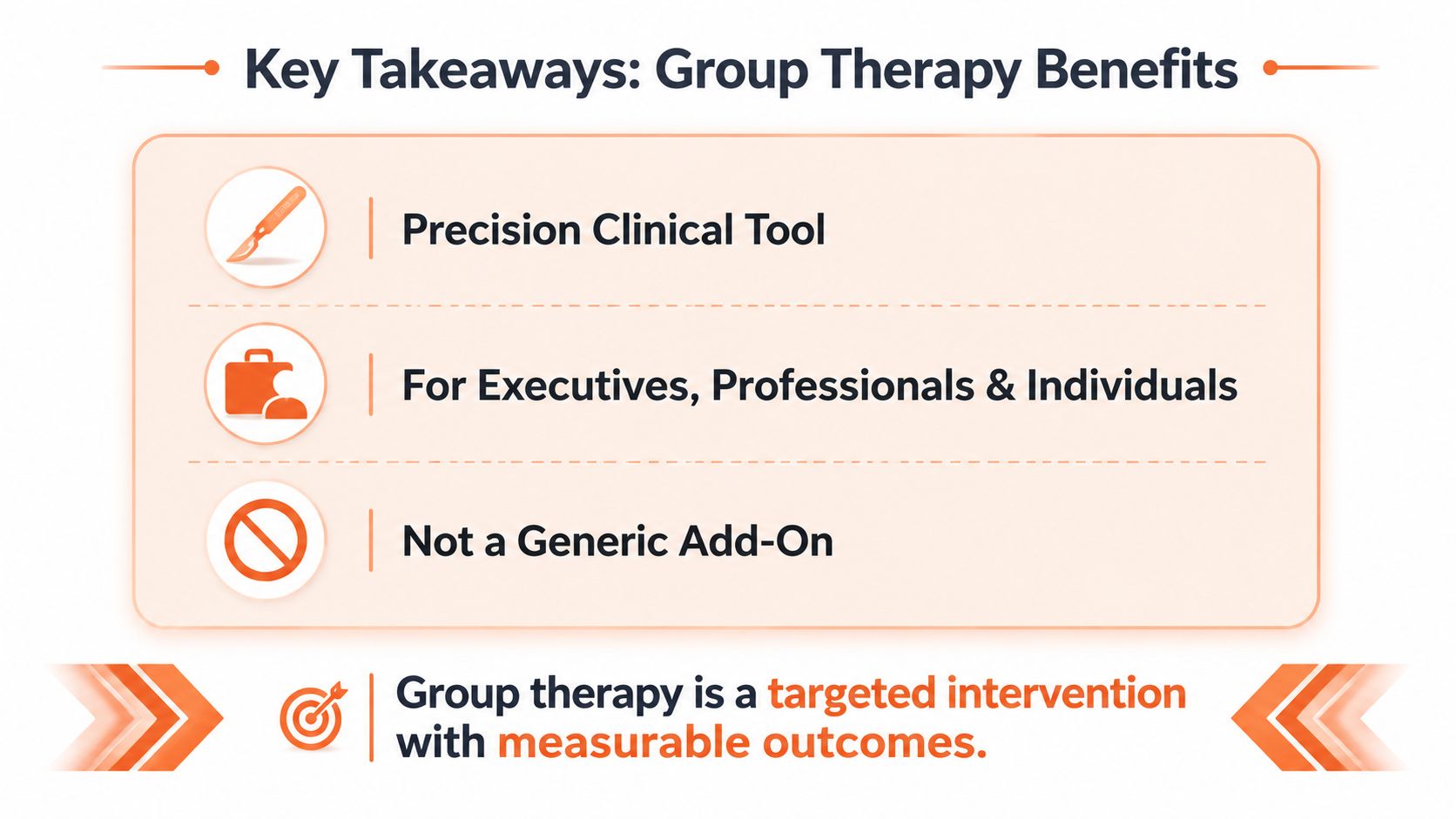
A privacy-sensitive executive often walks into treatment with a specific concern. “Will I have to disclose too much, and will the room feel too exposed?” The answer, in a well-run program, is that group therapy benefits come from structure, not from forced openness. A good group gives people a contained place to hear themselves, notice patterns, and practice new responses in front of peers who are facing similar clinical work.
The mechanism is straightforward. Group psychotherapy functions like a clinical laboratory with guardrails. The therapist shapes the process, the group offers real-time feedback, and members see how their reactions change when they are not carrying the work alone. That is why group therapy can feel especially useful for licensed professionals and executives who want depth without a loose or overly social setting.
- Precision clinical tool. Group therapy targets symptoms and relationship patterns, rather than offering a general social outlet.
- For executives, professionals, and individuals. Privacy-sensitive patients often do best when the group is discreet, tightly held, and led by clinicians who understand confidentiality concerns.
- Not a generic add-on. The strongest programs integrate group with individual therapy, psychiatry, and recovery planning so the gains in session carry into daily life.
The research supports that framework. Reviews of group psychotherapy show benefit for depression and anxiety, and also point to interpersonal gains that matter in real-world recovery. A later review of anxiety treatment found group formats can be helpful for symptom relief, and a review of depression treatment found group care can be effective there as well (group psychotherapy review, anxiety meta-analysis, depression review). For the person who values privacy, the key question is not whether group therapy works in general. The question is whether the setting is built with enough discretion, a manageable group size, and a facilitation style that keeps the work clinically focused.
If you are evaluating treatment for yourself or someone you care about, ask whether the program can explain its group process as clearly as its individual care. Capo Canyon Recovery offers residential care that includes group therapy, individual sessions, and a private, executive-oriented setting, which makes it a relevant option for people who need both confidentiality and clinical structure.