
You leave residential treatment with a clear head, a discharge plan, and a calendar that already looks dangerous. Your phone is back in your hand. Messages from your board, partners, patients, clients, or flight department are waiting. Your family feels relieved, but they're also watching closely for signs that stress will pull you back into old habits.
That stretch between treatment and ordinary life is where many accomplished people feel the most exposed. In treatment, the day has structure. Outside it, you're expected to perform again. The meetings resume. Travel restarts. People assume you're fine because you sound composed.
Clinical care gives recovery its medical and psychological foundation. What often determines whether that foundation holds under pressure is the support system that follows you home. That is where peer support in recovery becomes far more than a nice addition. It becomes the bridge between insight and execution.
The Bridge from Treatment to Lifelong Recovery
A common moment arrives a day or two before discharge. An executive says some version of this: “I know what I need to do. I'm just not sure how to do it when real life starts again.”
That concern is justified. Treatment can stabilize withdrawal, clarify diagnoses, start therapy, and help a person understand patterns that drove substance use. None of that automatically solves Tuesday at 6:30 p.m. after a brutal meeting, a delayed flight, an argument at home, and the familiar urge to shut the whole thing down with alcohol, stimulants, or pills.
Where treatment ends and life begins
Recovery doesn't fail because people forget what they learned. More often, it gets shaken when they try to apply those lessons alone, in private, under pressure. A therapist may help someone identify perfectionism, secrecy, resentment, or trauma triggers. A psychiatrist may stabilize sleep, mood, or attention. Those interventions matter.
But the person still has to walk into a dinner with colleagues, decline a drink without making it a scene, manage shame after a rough day, and text someone before the urge becomes a decision.
That's why aftercare planning matters so much. A strong overview of sustaining recovery after rehab usually includes therapy, medical follow-up, relapse prevention work, and support outside the clinic.
Why peer support fills the dangerous gap
Peer support helps in the hours when clinicians aren't present. It offers contact with someone who understands the mechanics of early recovery from the inside, not only from training.
Practical rule: The period after discharge needs structure, accountability, and human connection. Willpower alone rarely carries the full load.
For professionals, this bridge has to do two jobs at once. It has to protect sobriety, and it has to fit a life that may include licensing concerns, public visibility, leadership obligations, and a very real need for discretion. If a support model ignores those realities, people often avoid it, then tell themselves they'll manage privately.
That rarely ends well. Recovery becomes more durable when support continues after treatment in a form the person will use.
What Exactly Is Peer Support
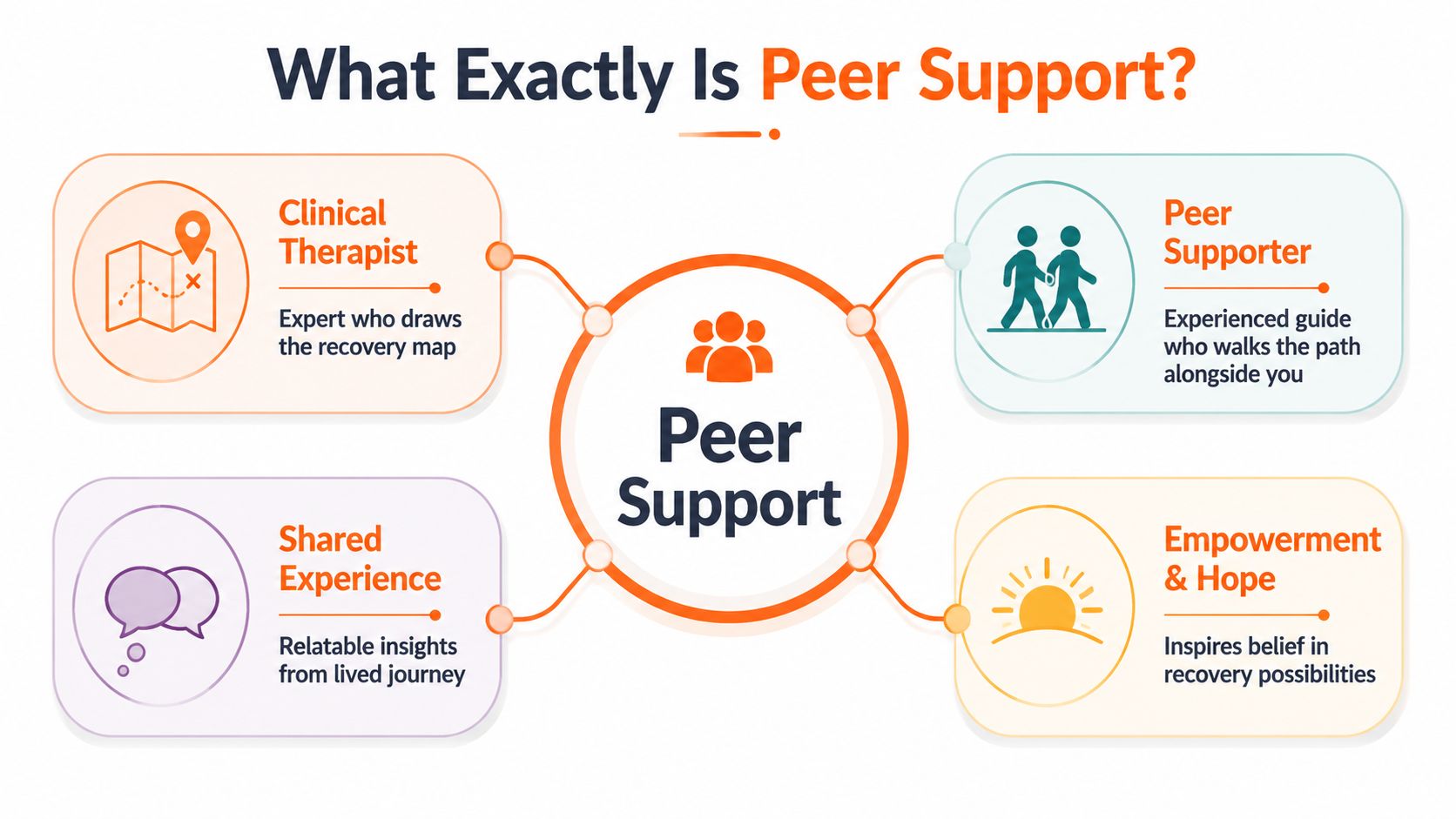
Peer support is non-clinical support from someone with lived experience of recovery who helps another person manage the day-to-day work of getting well and staying well. It is not therapy. It is not psychiatry. It is not a substitute for medical care.
A simple analogy helps. A therapist is the cartographer. They help map the terrain, identify patterns, and plan the route. A peer supporter is the guide who has walked that terrain and can say, “That turn looks harmless, but it's where people get lost. Call before you go there.”
What a peer supporter actually does
A good peer supporter helps with practical recovery tasks that often sound small but carry major weight:
- Reality-testing high-risk decisions when stress starts distorting judgment
- Helping build routines around sleep, meetings, exercise, and accountability
- Normalizing early recovery discomfort so a rough week doesn't get mistaken for failure
- Supporting follow-through with appointments, family commitments, and recovery goals
- Reducing isolation by making recovery feel lived, not theoretical
The power comes from shared experience. The person receiving support doesn't have to explain every layer of denial, bargaining, or professional image management. The peer already recognizes the language.
What peer support is not
Clarity is essential for families and professionals. Peer support works best when boundaries stay clean.
It is not:
- A replacement for treatment when detox, therapy, or psychiatric care is needed
- An unstructured friendship with blurred expectations and emotional overreach
- A place for advice without accountability
- A license to avoid clinical work by staying only in inspirational conversations
The strongest programs treat peer support as one lane in a broader system of care.
There's an interesting parallel in how organizations think about service models. Discussions about choosing support for community-driven companies often come down to the same distinction: formal expertise solves one class of problems, while community and shared experience solve another. Recovery works similarly. You need both.
A peer supporter doesn't diagnose you. They help you keep moving when insight has to become action.
For executives, that distinction matters. Many are comfortable with experts. Fewer are comfortable with vulnerability. Peer support creates a setting where credibility comes not from credentials alone, but from lived proof that change is possible.
The Different Faces of Peer Support
Not all peer support looks the same. That's good news, because people don't recover the same way. Some want community and routine. Others want a private, one-to-one relationship. Some need support embedded inside a clinical system. Others need practical accountability built around work travel, licensing issues, and family strain.
Comparing Peer Support Models
| Feature | Mutual-Aid Groups (e.g., AA/NA) | Certified Peer Specialist | Recovery Coach |
|---|---|---|---|
| Primary setting | Community meetings, in person or online | Healthcare, behavioral health, or community systems | Private practice, treatment aftercare, or independent support |
| Core role | Ongoing fellowship and shared recovery culture | Structured lived-experience support within a service system | Goal-focused support for daily recovery and life stabilization |
| Relationship format | Group-based, sometimes with a sponsor relationship | One-to-one, group, or care-team based | Usually one-to-one |
| Clinical role | Non-clinical | Non-clinical, often integrated with clinicians | Non-clinical |
| Training | Varies by fellowship role | Usually formal training and credentialing | Varies by program and background |
| Best use case | Building recovery community and regular accountability | Coordinating support around treatment and services | Personalized recovery planning and real-world implementation |
| Privacy level | Lowest control over who attends | Moderate to strong, depending on setting | Often strongest if privately arranged |
| Structure | Fixed meeting formats and traditions | Defined role within a program or organization | Flexible, tailored to the individual |
| Cost | Usually free to attend | Often covered within a program or system | Often private-pay, depending on arrangement |
| Potential drawback | May feel too public or impersonal for some professionals | Quality depends on supervision and organizational fit | Quality varies widely if not well vetted |
Mutual-aid groups
These are the most familiar form of peer support in recovery. They offer fellowship, repetition, and a place to hear recovery discussed in plain terms. For many people, that ongoing community is invaluable.
They are less ideal for someone who needs tight privacy control, dislikes open-ended sharing with strangers, or feels constrained by a specific meeting culture. Some professionals thrive there. Others never fully engage because they remain guarded.
Certified peer specialists
A certified peer specialist usually works inside a broader care setting or coordinated system. That can be useful when someone needs support tied to discharge planning, treatment adherence, service navigation, or re-entry into community life.
This model tends to work well for people who benefit from clearer boundaries and documentation. It may feel more accessible to families because the role is easier to understand inside a professional care framework.
Recovery coaches
Recovery coaches are often the best fit for executives who need flexibility and discretion. The relationship is usually practical, goal-oriented, and built around real-world functioning. A coach may help someone prepare for a business dinner, redesign a travel routine, build a trigger-response plan, or troubleshoot an escalating week before it becomes a relapse.
The best model is the one a person will actually use honestly, not the one that sounds best on paper.
A sponsor can also be part of the picture, but sponsorship belongs to specific fellowships and follows that fellowship's culture. It is not interchangeable with every other form of peer support. Wise families do best when they stop asking, “Which model is best?” and start asking, “Which model fits this person's risks, personality, privacy needs, and willingness to engage?”
The Proven Effectiveness of Peer Support
Executives usually ask the right question. Does it work?
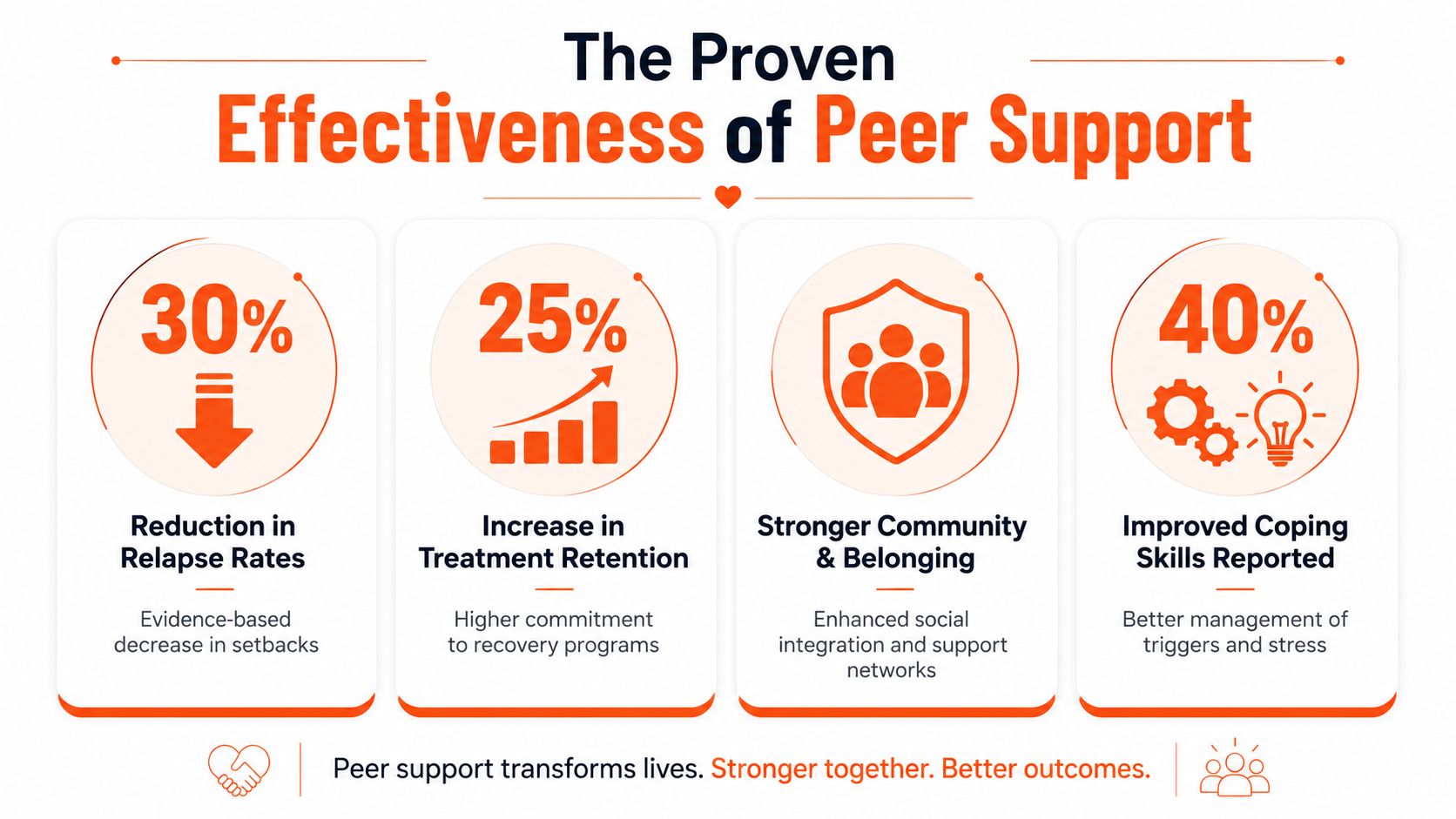
The evidence says yes, particularly when peer support is integrated with treatment rather than treated as a loose add-on. One summary reports that integrating peer support into clinical addiction treatment increases treatment retention by 20% and makes participants 2.9 times more likely to sustain abstinence compared to standard care alone, according to this review on peer support and long-term sobriety.
What the numbers mean in practice
Those figures matter because they speak to the exact points where recovery often destabilizes. Retention means people stay engaged long enough for treatment gains to consolidate. Sustained abstinence means support isn't only making people feel encouraged. It is improving meaningful outcomes.
Other reported findings in the same body of verified data point in the same direction. Active engagement in peer support was associated with a 30% greater reduction in substance use and a 35% lower risk of relapse than standard treatment protocols alone. Peer-supported programs also reported 15% to 25% fewer dropouts than traditional programs in the verified summary above.
That pattern is clinically believable. People stay connected when they feel understood, less ashamed, and less alone.
Why peer support changes behavior
Peer support works partly because it changes the emotional climate around recovery. A person who feels judged tends to hide. A person who feels understood is more likely to tell the truth sooner.
That matters in very practical ways:
- Cravings get disclosed earlier instead of after a lapse
- Setbacks become discussable rather than secret
- Treatment advice gets translated into ordinary language and ordinary life
- Hope becomes credible because someone else has lived it
There is also evidence beyond addiction treatment alone. A meta-analysis of peer support interventions for serious mental illness found statistically significant superiority over control conditions across clinical, personal, and functional recovery domains in a subgroup analysis, based on a review of 28 randomized controlled trials with 4,152 participants. That matters for professionals with co-occurring mental health concerns, where functioning and stability matter as much as symptom reduction.
For a data-driven audience, the main takeaway is straightforward. Peer support in recovery isn't sentimental window dressing. It improves the odds that people remain engaged, reduce use, and hold onto gains that treatment helped create.
How Peer Support Enhances Clinical Treatment
Clinical treatment and peer support do different jobs. When they're coordinated well, each makes the other more effective.
A therapist might help someone identify a relapse pattern. A peer supporter helps that person notice the pattern in real time on a Thursday afternoon when the old script starts up again. A psychiatrist may stabilize mood or sleep. A peer may help the person stick with the plan long enough to benefit from that stability.
The force multiplier effect
The strongest aftercare plans use peer support to reinforce what the clinical team is already teaching. That can include CBT skills, DBT distress tolerance, relapse prevention planning, medication follow-through, communication strategies, and routines that support sobriety.
Examples from practice often look simple:
- After a tense board call, the client uses an urge-surfing skill learned in therapy, then checks in with a peer instead of isolating.
- Before a work trip, the client and peer map out vulnerable moments such as airport bars, hotel loneliness, and post-meeting exhaustion.
- Following conflict at home, the peer helps the person pause, regulate, and return to the family plan instead of escalating or disappearing.
These are not separate from treatment. They are treatment translated into life.
Better follow-through with care
One of the clearest benefits is improved attendance and continuity. Verified data shows that combining professional-delivered treatment with peer support results in 51% to 52% adherence to SUD treatment appointments, compared with 38% in standard care without peer support, according to this review of peer recovery support services.
For professionals, that difference matters because treatment often breaks down in ordinary ways. Travel interferes. Deadlines pile up. Shame after a difficult week leads to avoidance. People say they're too busy, when the actual problem is that they've begun drifting.
Clinical reality: Recovery plans fail more often from disconnection than from lack of intelligence.
The same verified summary also describes reductions in hospitalization, emergency department use, re-hospitalization, and inpatient days, while outpatient service use increases. That pattern reflects what clinicians want to see. Less crisis care. More steady engagement.
What does not work
Peer support becomes less useful when roles blur. Problems start when a peer tries to act like a therapist, when a clinician dismisses lived experience as secondary, or when nobody coordinates around the same recovery goals.
It also fails when families treat the peer as an emergency substitute for a full care team. If someone is medically unstable, severely depressed, suicidal, or actively using in a dangerous way, peer support is not the first intervention. Clinical assessment is.
Used correctly, peer support doesn't compete with treatment. It helps treatment stick.
Navigating Peer Support for Executives and Professionals
For many executives, traditional peer support presents a real dilemma. They need connection, honesty, and accountability. They also need privacy. Public meetings, open online groups, or casual peer arrangements can feel too exposed.
That tension is the Executive Privacy Paradox. The very openness that helps many people in recovery can make high-profile professionals hesitate, limit disclosure, or avoid peer support entirely.

Why many professionals hold back
Verified data from an underserved-population analysis states that 39% of professionals delay treatment due to fear of stigma, while noting a lack of major frameworks offering closed-ring peer coaching with verified identity protection or NDAs specific to executives, as described in this discussion of peer coaching in underserved areas.
That concern is not vanity. It is often tied to licensing, reputation, fiduciary responsibility, hospital privileges, media exposure, investor confidence, or family visibility. People with legitimate privacy concerns are often told to “just go to a meeting.” That advice may be sincere, but it can miss the practical barrier entirely.
What confidential peer support can look like
A more suitable approach often includes a closed, highly structured model:
- Private one-to-one peer coaching with explicit confidentiality expectations and documented boundaries
- Carefully curated small groups limited to similarly situated professionals who understand reputation risk
- Integrated aftercare coordination so the peer role supports, rather than fragments, the larger treatment plan
- Remote options for travel-heavy schedules, provided privacy standards are strong
- Verified identity and professionalism so the client knows exactly who is in the room and what standards govern the work
Some families also want a support pathway that includes a trusted spouse or partner. That can work well if the peer role remains focused and the family system has its own guidance. A helpful example of a more collaborative framework appears in this discussion of a partner in recovery.
Questions executives should ask first
Not every private option is safe. Ask direct questions:
- How is confidentiality handled in writing?
- What boundaries define the peer role versus the clinical role?
- Who supervises the work, if anyone?
- What happens if there is relapse, crisis, or concern about impairment?
- How do you protect privacy during virtual communication and scheduling?
The right peer arrangement should lower shame without increasing exposure.
Executives don't need a watered-down version of recovery. They need a version they can engage in honestly. When privacy is built into the structure, participation becomes much more realistic.
How to Evaluate Peer Support Options
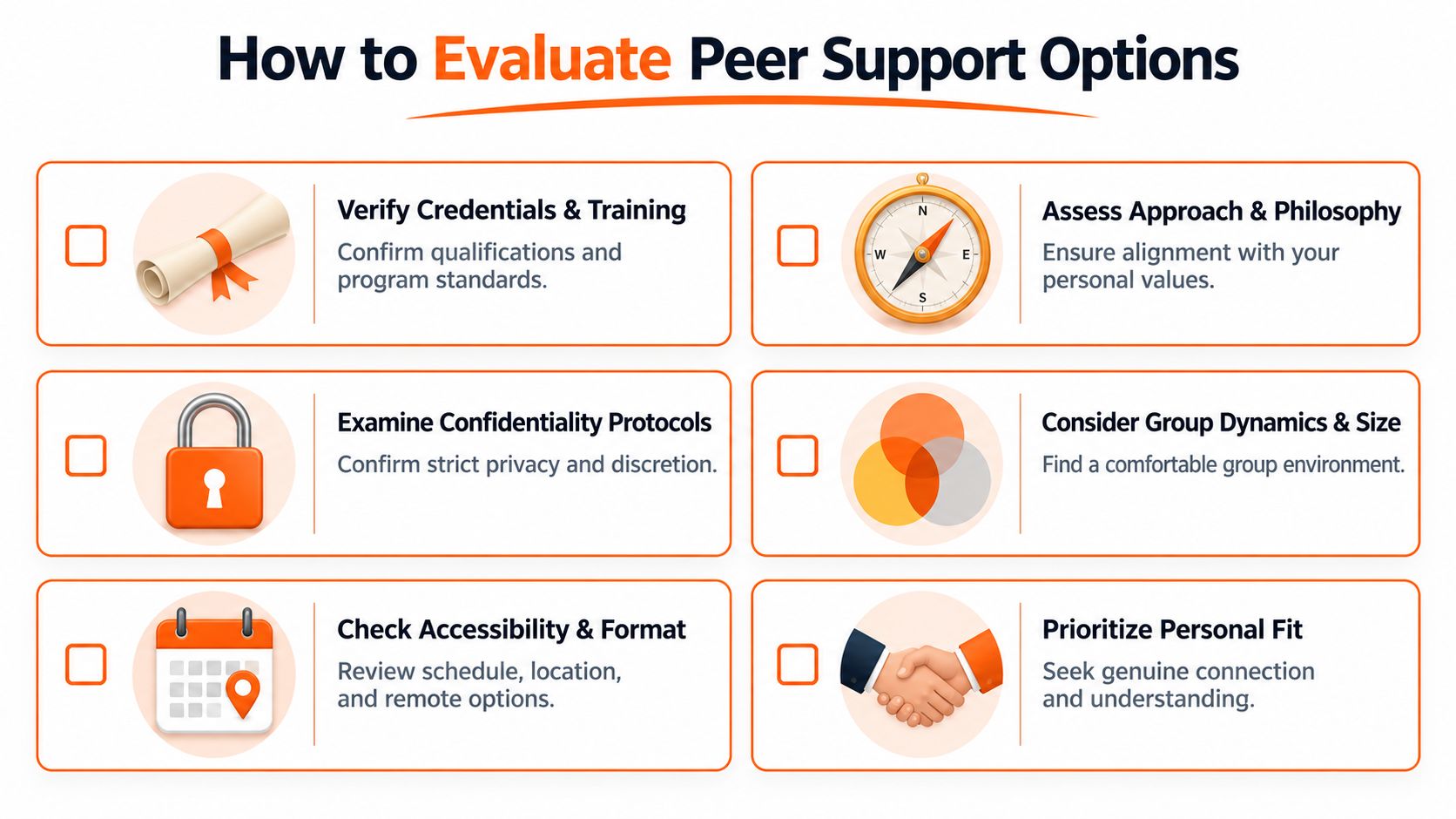
People often choose peer support the way they choose a gym membership. They go with what is close, familiar, or recommended by one person they trust. That's understandable, but it isn't enough. The right fit depends on quality, boundaries, privacy, and alignment with the rest of care.
A practical screening checklist
Use these questions before committing:
Check training and role clarity
Ask what training the person has completed, whether they hold any credential, and how they define their role. You want someone who knows where peer support ends and clinical care begins.Ask about supervision and coordination
A solid peer supporter should be comfortable coordinating with a therapist, psychiatrist, case manager, or treatment team when appropriate and authorized.Review confidentiality carefully
For professionals, this is not optional. Ask how records, communication, scheduling, and virtual sessions are handled. If the answer is casual, move on.Test for fit, not charisma
A compelling personal story is not enough. The person should help you feel more honest, more accountable, and more organized. Not more dependent.Look for experience with your kind of pressure
A peer doesn't need your exact résumé, but they should understand high-stakes work, image management, travel, and the way achievement can hide distress.Match the support to your relapse prevention plan
If you already have a recovery strategy, your peer support should reinforce it. This guide on relapse prevention strategies is a useful reminder that consistency beats inspiration.
Red flags families should take seriously
Some warning signs are easy to miss because they're wrapped in warmth or enthusiasm.
Watch for:
- Boundary drift such as texting at all hours without purpose, oversharing, or becoming the person's whole support system
- Grandiose promises that imply relapse can be prevented through motivation alone
- Resistance to collaboration with clinicians or family systems when coordination is clearly needed
- Financial pressure that feels manipulative or vague
- A one-size-fits-all philosophy that treats every client, profession, and diagnosis the same
What a strong option feels like
Good peer support usually feels steady. Not dramatic. Not performative. The person is reliable, grounded, and focused on the client's recovery rather than their own identity as a helper.
If families can answer three questions clearly, they are usually on firmer ground. Who is this person? What exactly is their role? How does this fit the larger treatment plan? If those answers stay fuzzy, keep looking.
Frequently Asked Questions About Peer Support
What is the difference between a sponsor and a recovery coach
A sponsor usually belongs to a specific mutual-aid fellowship and helps another member work within that fellowship's framework. A recovery coach is broader and more individualized. Coaching often focuses on daily structure, accountability, practical obstacles, and integration with a larger care plan. Neither role is therapy.
Is peer support covered by insurance
Sometimes, but it depends on the setting and how the service is delivered. Peer services embedded in treatment programs, health systems, or state-supported behavioral health settings may be handled differently than private recovery coaching. Families should ask for a plain explanation of what is included, what is billable, and what is private-pay.
Can someone continue with peer support after a relapse
Usually yes, and in many cases they should. A relapse doesn't automatically mean the peer relationship failed. It may mean the support plan needs stronger clinical backup, tighter structure, or clearer boundaries. The right response depends on safety, severity, and honesty about what happened.
A lapse should trigger reassessment, not automatic abandonment.
How do I find peer support for co-occurring disorders
Start with the clinical team. People with addiction plus anxiety, trauma, depression, bipolar disorder, or ADHD usually do best when peer support is chosen as part of an integrated plan rather than as a stand-alone add-on. Ask whether the peer supporter understands medication follow-through, symptom flare-ups, and when to escalate concerns back to clinicians.
Is group peer support always necessary
No. Some people need group belonging. Others begin more comfortably in a private format and add group support later. For executives and licensed professionals, a staged approach is often more realistic than forcing immediate participation in open groups they are not ready to trust.
What should families expect from a good peer relationship
Families should expect improved consistency, earlier disclosure of struggle, and better follow-through with recovery commitments. They should not expect the peer to police, rescue, or replace the family's own work. Healthy peer support lowers secrecy. It does not remove responsibility.
Can peer support help if someone is doing well clinically but still feels isolated
Yes. That is one of its strongest uses. Some people look stable on paper. They attend appointments, pass screenings, and say the right things. Underneath, they feel cut off, ashamed, or emotionally separate from everyone around them. Peer support can reduce that isolation in a way that formal treatment alone sometimes can't.
If you or someone you love needs a recovery plan that respects professional obligations, co-occurring mental health needs, and the need for real privacy, Capo Canyon Recovery offers detox and residential care designed for executives and professionals. Their team provides medically supervised treatment, individualized therapy, and discreet aftercare planning in a boutique setting built for people who can't afford a generic approach.