
For a urine test, cocaine metabolites are usually detectable for 2 to 4 days in occasional users, but that window can extend to 10 to 14 days in heavy or chronic users. That's the most common answer people are looking for, but it isn't a fixed rule. The specific timeline depends on which test is being used, how often cocaine was used, and how your body processes it.
For those awake late at night before a work trip, after a call from HR, or while trying to figure out what a recent use might mean for their health and career, the stress is real. People in high-responsibility roles often aren't asking out of curiosity. They're asking because there may be a licensing issue, a workplace test, a custody concern, or a private fear that use has crossed a line.
This isn't a topic that benefits from scare tactics or vague reassurance. You need a clear answer, and you need to know what the answer means in practice. A positive urine screen doesn't mean the same thing as a blood test. A hair test tells a different story than saliva. And if you're in a professional setting, the difference between a screening result and a confirmed lab result matters.
The Urgent Question Behind the Search
It is 11:40 p.m. before a flight, and an executive has just seen a message from HR about a “routine” screen. A surgeon is counting backward from a call with a licensing board. A founder is trying to decide whether one recent night is now a career problem. For people in high-responsibility roles, this question is rarely academic. It sits at the intersection of privacy, reputation, income, and health.
The answer is rarely a single number. Cocaine itself clears quickly, but testing usually focuses on what the body leaves behind after it breaks cocaine down. That is why two websites can seem to disagree while both are partly right. They may be describing different test methods, different patterns of use, or different parts of the drug's effect on the body and brain.
Why this question carries so much weight
For many professionals, a drug test has immediate consequences:
- Employment: Internal policy can trigger leave, review, or restricted duties before the full picture is clear.
- Licensing: Physicians, attorneys, pilots, executives in regulated industries, and other credentialed professionals may face reporting requirements or formal scrutiny.
- Privacy: A matter that felt contained can reach HR, risk management, a spouse, or a business partner very quickly.
- Health: Repeated cocaine use can shift from a one-time concern to a pattern that affects sleep, judgment, blood pressure, mood, and control.
Practical rule: Do not base a career decision on a friend's guess, an online forum, or a detox marketing claim. Detection windows are estimates, not promises.
The answer you actually need
For urine testing, the commonly cited range is a few days after occasional use, with a longer window in heavier or more frequent use, as noted earlier. That estimate can be directionally useful, but it is not specific enough to guide a legal, professional, or medical decision on its own. Blood, saliva, and hair testing answer different questions and can produce very different timelines.
That distinction matters in real life. I have seen professionals make avoidable mistakes because they assumed every positive result meant the same thing, or because they guessed the wrong test type. In a clinical setting, timing helps shape monitoring and safety planning. In a professional setting, it can affect documentation, disclosure, and whether a private problem stays private.
How Your Body Processes Cocaine
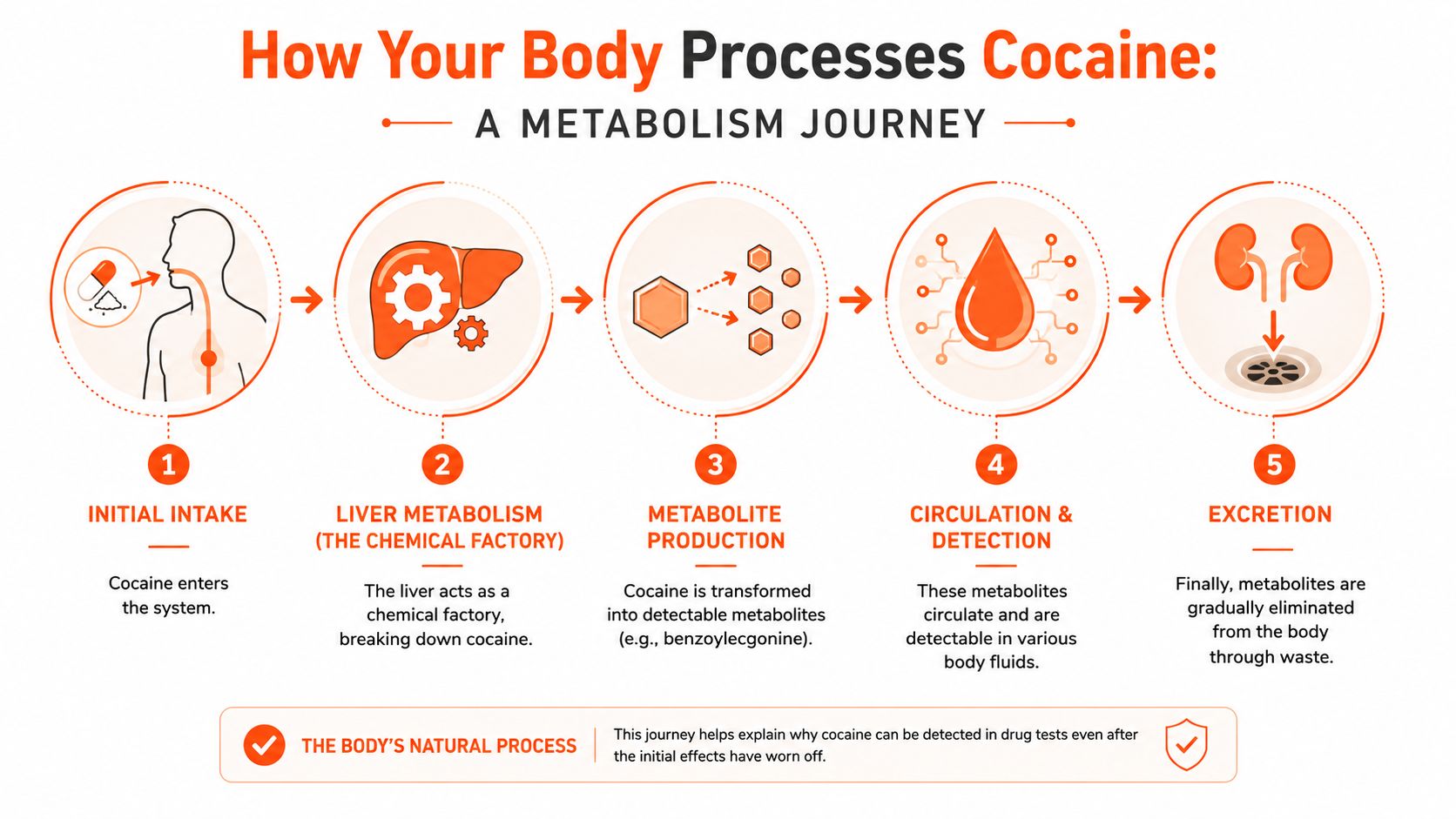
A person can wake up clear-headed, answer emails, walk into a meeting, and still carry detectable evidence of cocaine exposure. That gap is what creates risk for professionals. The drug's effects fade relatively quickly, but the body keeps processing and clearing its chemical byproducts after the high is over.
The short life of cocaine itself
Cocaine is metabolized quickly, but its byproducts linger. After use, the body begins breaking the drug down through the liver and blood almost immediately. The active drug does not remain at meaningful levels for very long, which is why the high ends well before many tests turn negative.
One commonly cited explanation from Ikon Recovery Centers notes that cocaine itself has a short half-life and is converted into metabolites such as benzoylecgonine. That metabolic step matters more for testing than the drug's short-lived stimulant effects.
Why tests look for metabolites
Standard drug screens usually target metabolites, especially benzoylecgonine, because those compounds remain in the body longer and are easier to detect reliably. A positive result reflects the body's extended cleanup process, which lasts longer than the feeling of intoxication.
For someone in a leadership role, that distinction has practical consequences. A person may feel fully normal and still produce a result that triggers HR review, monitoring, or licensing concerns. In clinical care, the same result helps determine recent exposure, pattern of use, and whether additional support is needed.
What this means in real life
The safest question is not, “Do I still feel it?” The better question is whether the body is still eliminating detectable metabolites.
I have seen professionals make costly assumptions at this stage. They equated symptom-free with test-free, returned to work too confidently, or delayed getting private advice until the problem was already documented. If you want a broader clinical explanation of why substances affect the brain and body this way, Capo Canyon offers a clear overview of the science behind how addiction works in your body.
Cocaine Detection Windows by Test Type
A test result only makes sense if you know what the test was designed to answer.
In practice, that is where people get into trouble. An executive may pass a blood test and assume the risk is over, then face a positive hair result in a licensing review or employer investigation. Urine, blood, saliva, and hair each measure a different slice of time, so the same person can have very different results depending on the specimen collected.
Side by side comparison
| Test Type | Detection Window (Occasional Use) | Detection Window (Heavy/Chronic Use) | Common Use Case |
|---|---|---|---|
| Urine | 2 to 4 days | 10 to 14 days | Workplace screening, treatment monitoring |
| Blood | Cocaine for approximately 12 hours; benzoylecgonine up to 24 to 48 hours | Up to 48 hours in chronic users | Medical, forensic, recent-use questions |
| Saliva | 1 to 2 days | 3 to 4 days | Short-window screening, recent exposure |
| Hair | Begins detecting after 7 to 10 days and can show use for up to 90 days | Can persist for at least 3 months; a 2022 paper reported up to 6 months in hair samples | Long-term pattern review, legal or employment contexts |
Urine testing
Urine is the result people are usually asking about, especially in workplace screening. These tests look for metabolites, mainly benzoylecgonine, because those compounds stay detectable longer than the drug's stimulant effects.
As noted earlier, urine testing often detects cocaine use for 2 to 4 days after occasional use and 10 to 14 days with heavy or chronic use.
That gap between how someone feels and what a urine test shows is where careers get damaged. A person can feel fully back to normal and still produce a result that triggers HR action, professional monitoring, or a difficult conversation they were not prepared to have.
Blood testing
Blood testing answers a narrower question. It is used when the main issue is whether use was recent.
According to Healthline's review of cocaine detection windows, blood tests typically detect cocaine for about 12 hours and benzoylecgonine for up to 48 hours. While a blood test provides a narrow, immediate snapshot of use, a hair test reveals a much broader record of prior exposure.
For physicians, attorneys, pilots, executives, and other professionals in sensitive roles, that difference matters. A negative blood test may help in a medical or emergency setting, but it does not settle every employment or regulatory question.
Saliva testing
Saliva testing is often used when a program wants a recent-use window without a blood draw. It can detect cocaine for 1 to 2 days in casual use and 3 to 4 days with heavy consumption, as noted earlier.
From a practical standpoint, saliva is less invasive and easier to collect. It still does not offer the longer review period that urine or hair can provide in formal monitoring, compliance, or return-to-work settings.
A saliva result usually speaks to recent exposure, not a long-term pattern.
Hair testing
Hair testing answers a different question from the start. Instead of focusing on whether cocaine was used yesterday, it looks for evidence of use over a much longer period.
Healthline reports that hair follicle testing can identify cocaine metabolites for up to 90 days, and that a 2022 scientific paper reported evidence of cocaine in hair samples up to 6 months after consumption in some cases. Hair tests also typically begin detecting cocaine 7 to 10 days after use, because the substance has to be incorporated into growing hair.
This is often the most unsettling result for high-functioning professionals. Someone may be medically stable, performing well, and testing negative on a short-window screen, yet still face a positive hair result that raises questions about judgment, disclosure, or fitness for duty. In treatment, that same information can also be useful. It helps clinicians assess pattern, risk, and what level of private support is most likely to work.
Key Factors That Influence Detection Times
A positive result can carry very different consequences for two people with the same recent use history. In executive, licensed, and safety-sensitive roles, that difference often comes down to three variables: how often cocaine was used, how the body clears it, and which specimen the program collected.
Frequency changes the risk picture
The most important question is usually whether the use was isolated or repeated over time.
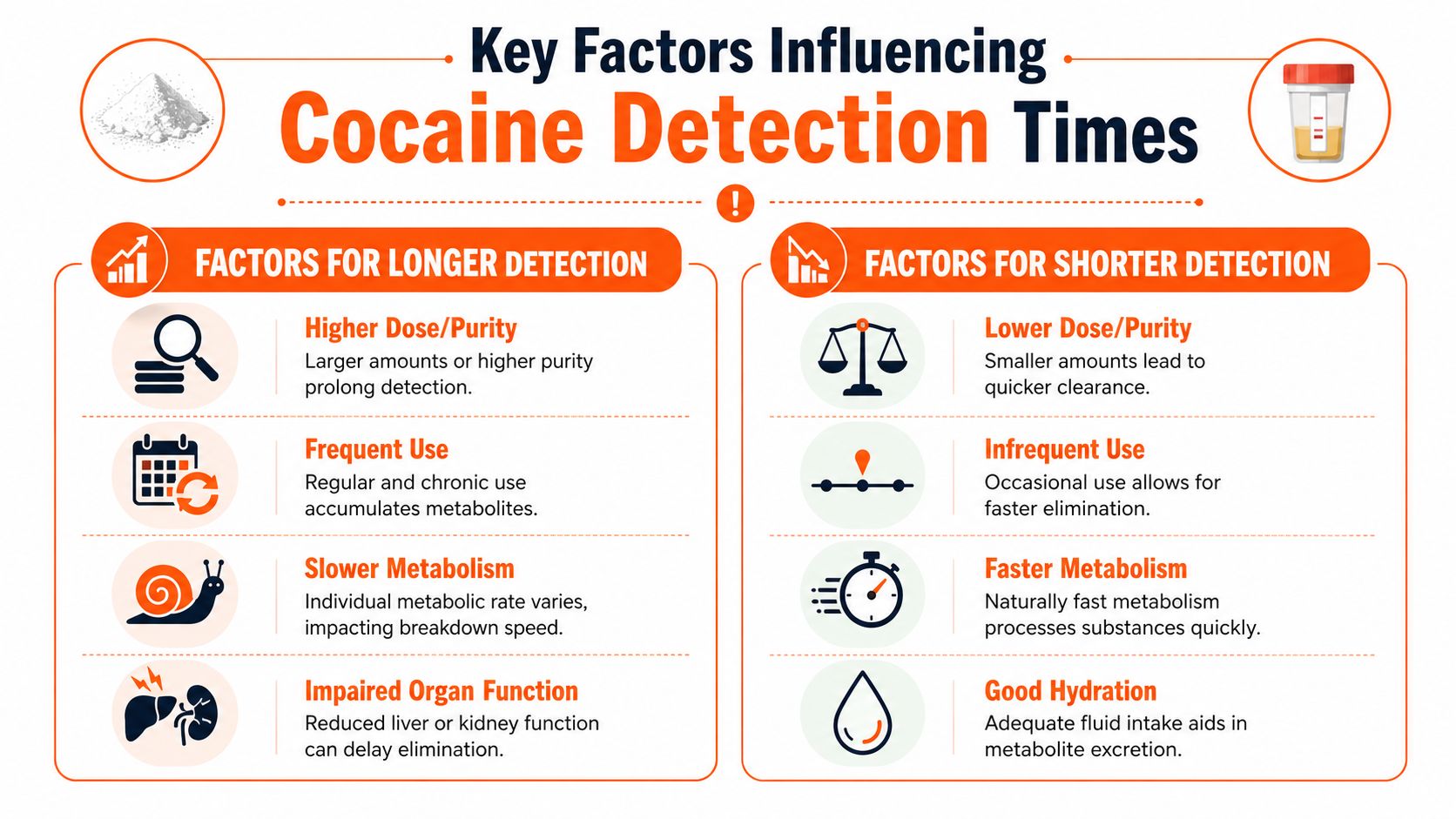
As noted earlier, urine and saliva windows tend to stretch with heavier or more frequent use because the body has more metabolite burden to eliminate. That distinction matters in real life. A person who used once at a social event may face a very different testing timeline than someone whose use has become a pattern, even if both feel "fine" by the next day.
Biology still matters
Clinicians also look at the person, not just the substance. Cocaine and its metabolites do not clear on a fixed schedule for everyone.
Several factors can shift the timeline:
- Metabolism: Some people break down substances faster than others.
- Liver and kidney function: These organs handle much of the processing and elimination.
- Hydration status: Dilution can affect urine concentration, but it does not reliably remove metabolites.
- Body composition and general health: These can influence how the body handles clearance.
None of these factors provides a reliable shortcut. They mainly explain why one person tests negative sooner while another remains positive longer.
The test type changes what is being asked
Many professionals get tripped up on this point. They ask, "How long does cocaine stay in your system?" but the laboratory is answering a narrower question based on the sample provided.
- Urine looks for metabolite excretion over recent days.
- Blood is used for a much shorter, very recent-use window.
- Saliva focuses on recent exposure in a brief timeframe.
- Hair looks for a longer pattern of use.
For someone facing an employment screen, a licensing review, or a return-to-duty process, that distinction matters more than any online estimate. The specimen type shapes the meaning of the result.
Hydration may change urine concentration. It does not reliably shorten how long cocaine metabolites remain detectable.
What people try, and why it often backfires
Under pressure, many people search for a way to beat the test. Detox drinks, excessive water intake, intense workouts, and internet remedies do not give a dependable answer to a professionally administered screen. In some cases, they create a new problem by producing a diluted or otherwise questionable sample that draws more scrutiny.
For high-performing professionals, the smarter step is to assess whether the pattern of use needs attention before a private concern becomes a public career issue. Programs designed for working professionals in confidential rehab can address substance use discreetly while protecting health, reputation, and long-term performance.
Understanding Your Drug Test Results
A test result isn't just positive or negative as commonly understood. In professional and legal settings, the process usually has layers. A preliminary screen may raise a question. A confirmatory process is what turns that question into something more formal.

A screening result is not the whole story
Initial screens are designed to identify whether a sample should be examined more closely. In treatment settings, that can guide care. In workplace settings, it may trigger review by a medical review officer or another formal process. The practical point is that a first positive isn't always the end of the conversation.
What matters next is context. What was tested. Which analyte was detected. What policy applies. Was there confirmatory testing. In a high-stakes career setting, those details matter far more than rumor or panic.
What a positive usually means
A positive result generally means the lab found evidence consistent with cocaine exposure or metabolite presence in the specimen tested. It doesn't automatically tell you whether someone was impaired at work, whether use was recent in the everyday sense, or whether the same result would appear in another specimen type.
Many professionals get blindsided by treating all positive results as interchangeable. They aren't. A blood result and a hair result carry different practical implications because they reflect different windows of detection and different kinds of evidence.
If your career, license, or custody status is on the line, don't make assumptions based on the word "positive" alone. Ask what specimen was tested and whether the result was screened or confirmed.
Why professional support matters here
A person in this position often needs more than test information. They may need help thinking through disclosure, treatment timing, work responsibilities, and how to address the underlying use without creating unnecessary exposure. For people who have to balance recovery with ongoing obligations, this overview of rehab for working professionals speaks directly to that problem.
The most useful mindset is this. Treat the result as information, not as a moral verdict. Once you understand what the lab measured, you can make better decisions about health, work, and next steps.
Next Steps and Finding Confidential Help
A search about cocaine detection often starts with a test. It often ends with a larger realization. If you're repeatedly calculating timelines, hiding use from colleagues or family, or trying to perform at a high level while managing crashes, anxiety, or secrecy, the drug test may not be the primary issue anymore.
That doesn't mean your life has to implode before you act. In fact, professionals usually do better when they respond early, discreetly, and strategically. Protecting your health is also a way of protecting your career.
What getting help can look like
Many people hesitate because they picture treatment as public, chaotic, or professionally impossible. That's often what keeps successful people stuck. In reality, the right setting should reduce disruption, not increase it.
For executives and licensed professionals, the usual concerns are predictable:
- Confidentiality: You need privacy, not a program that exposes your situation.
- Medical safety: If use has become repetitive, supervised detox may be the safest place to stop.
- Psychiatric support: Anxiety, depression, trauma, ADHD, or burnout often sit underneath stimulant use.
- Work continuity: Some people can't disappear entirely and still need controlled access to essential communication.
- Individualized care: High-functioning people often don't respond well to impersonal, one-size-fits-all environments.
When legal stress is part of the picture
Sometimes this search is happening alongside an arrest, pending charge, or family panic after a possession-related incident. If that applies, practical support matters. In addition to clinical care, some people may need reliable drug bail bond support to stabilize the immediate legal situation while they address the substance use itself.
Choosing care without making things worse
The wrong program can create new problems. A better approach is to ask direct questions before you commit. Is there medical detox. Is psychiatric care available. How private is the setting. Can professionals stay connected to urgent responsibilities in a controlled way. Does the team understand dual diagnosis, not just detox.
If you're weighing options, this guide on what to ask before choosing a detox center is a good place to start. The right next step should feel organized, discreet, and clinically sound. Not punitive.
The deeper issue isn't how to erase evidence of cocaine use. It's how to regain control before the consequences widen.
If you're ready for confidential, medically supported care, Capo Canyon Recovery offers detox and residential treatment built for professionals who need privacy, individualized attention, and the ability to stay connected to essential work responsibilities while getting well.