
A lot of executives arrive at this subject the same way. They're still performing, still leading meetings, still answering late-night emails, and still telling themselves that nothing has gone off the rails. But the private math no longer works. Sleep is thinner. Irritability is higher. One drink became several. Medication use stopped feeling temporary. The calendar looks controlled, while life feels less so.
What makes this harder at an executive level is the isolation. People depend on you. Your name may carry revenue, trust, licensing, or public visibility. That pressure makes many professionals delay treatment because they're not only afraid of withdrawal or change. They're afraid of exposure, gossip, loss of authority, and the consequences of being seen as unstable.
The Executive's Dilemma Isolation in Plain Sight
A common scene looks deceptively ordinary. A founder closes a laptop after midnight, promises this is the last stressful quarter, and reaches for the same coping tool used the night before. A physician finishes a shift and tells herself the medication is still “just to get through.” An attorney keeps winning cases while secretly planning each day around relief, secrecy, and damage control.
That's why the idea of a partner in recovery matters. Not as a sentimental add-on. As a strategic ally. Recovery is far more stable when someone or some team helps carry structure, accountability, and perspective at the moments when your own judgment is under strain.

Why isolation is so dangerous
Executives often confuse privacy with self-containment. Privacy protects dignity. Self-containment turns into silence, and silence gives substance use room to expand. If you've seen your social world shrink while your inner justifications get more polished, that's not resilience. That's a warning sign.
Many leaders first search for adjacent problems instead of the core one. They look into sleep, stress, focus, or burnout. Some of that is useful. Practical strategies for executive burnout can help you see how exhaustion and overdrive create fertile ground for unhealthy coping. But burnout management alone won't resolve an active substance problem.
Social withdrawal also intensifies risk. This is one reason how isolation fuels opioid addiction is such an important lens. People rarely recover well inside secrecy for long.
Recovery is far more common than most people think
There's also a fact many professionals need to hear early. Approximately 20.5 million adults in the United States are currently in recovery or have recovered from a substance use problem, according to national survey data summarized by the CDC. Recovery is not rare. It's not an outlier outcome reserved for other families, other careers, or other life stages.
You're not facing a strange private failure. You're facing a treatable condition that many people have already navigated successfully.
For executives, that matters. Shame says, “Someone in my position shouldn't need help.” Clinical reality says the opposite. High-responsibility people need support that matches the complexity of their lives.
Defining the Partner in Recovery Role
A partner in recovery is a role, not a title. It might be a spouse. It might be a sponsor, therapist, case manager, trusted peer, or another carefully chosen person. What matters is function. This person or team helps protect recovery when stress, rationalization, conflict, or access to substances starts to weaken it.
Think of the role like a co-pilot. The person in the primary seat still has responsibility. But the co-pilot helps monitor conditions, catch drift early, and respond before a problem becomes a crisis. In recovery, that means someone helps you stay aligned with the plan you said you wanted when you were clear-headed.
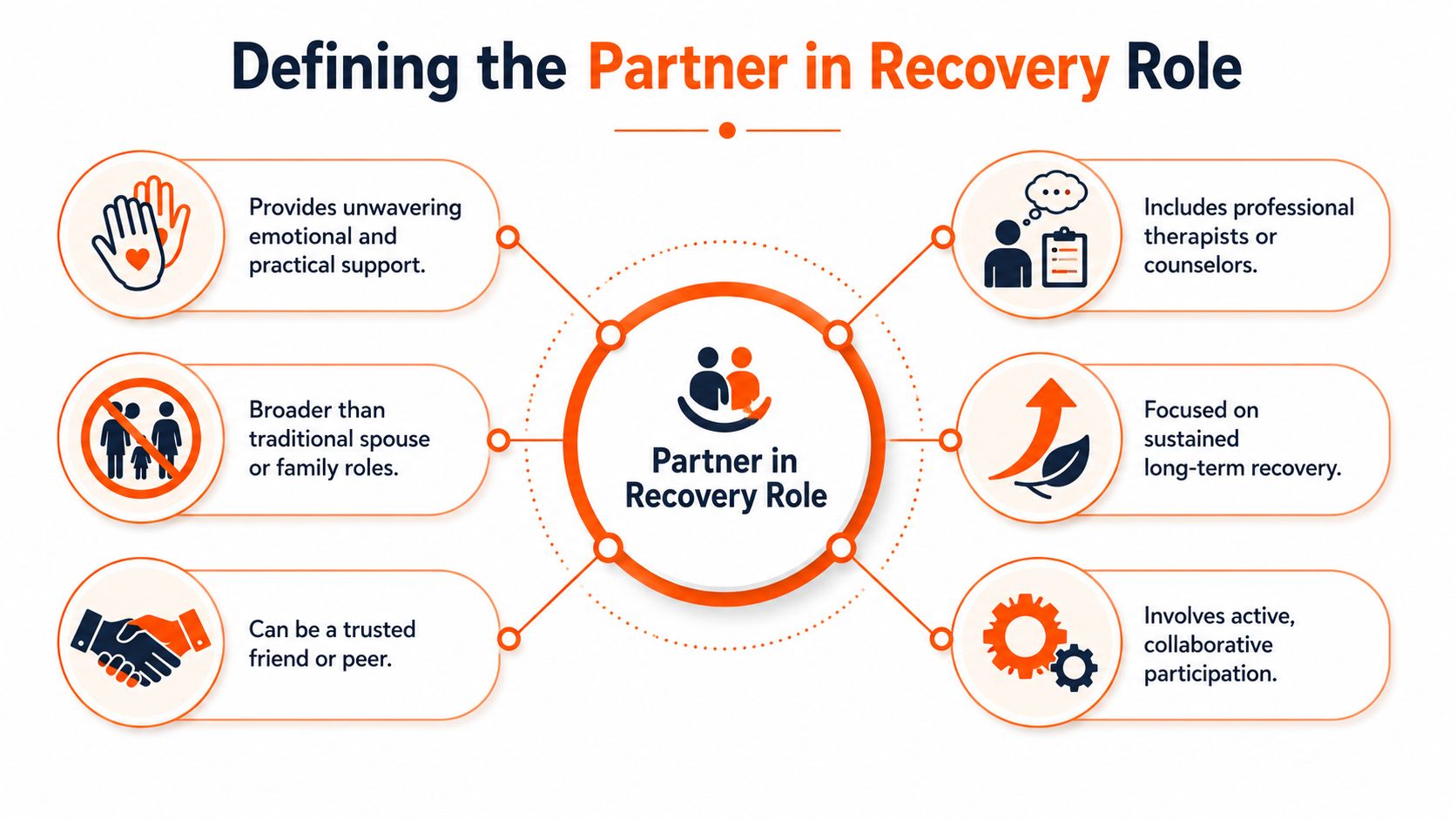
Working definition: A partner in recovery provides consistent, non-judgmental support that reinforces treatment goals, protects boundaries, and helps recovery remain active in daily life.
What the role includes
This role usually combines several tasks that are easy to blur together if you haven't named them clearly.
- Support: The person can listen without escalating shame.
- Structure: They help keep appointments, routines, and treatment commitments from becoming optional.
- Feedback: They can say, calmly and directly, when they see warning signs.
- Containment: They don't get swept into chaos, secrecy, or rescue mode.
A good partner in recovery isn't there to absorb every emotion or solve every crisis. They help keep the process grounded.
What the role does not include
Confusion starts when support turns into overreach. A spouse may think love means surveillance. A colleague may think accountability means frequent check-ins about private clinical material. A friend may confuse empathy with making excuses.
That's where many recovery arrangements fail. The role works best when everyone understands that support is different from control.
A partner in recovery strengthens follow-through. They don't replace treatment, enforce sobriety by force, or become your full-time emotional regulator.
For executives, this distinction is especially important. High-functioning professionals often attract helpers who are impressed, intimidated, or overly protective. None of those reactions create stable recovery. Clear roles do.
The Four Key Types of Recovery Partners
Individuals generally do better with more than one kind of support. A single person can't usually meet every need without strain, role confusion, or burnout. The strongest recovery plans use a small network where each partner has a defined lane.
The clinical partner
This is your therapist, psychiatrist, physician, nurse, case manager, or treatment team. Their value comes from training, objectivity, and the ability to make evidence-based decisions when emotions are running high.
A clinical partner addresses withdrawal risk, co-occurring mental health symptoms, medication decisions, treatment planning, relapse patterns, and aftercare coordination. They can say things a spouse or friend can't say effectively because their role isn't entangled with marriage, parenting, office politics, or family history.
Their boundary is also clear. They provide care. They are not friends, confidants-on-demand, or personal assistants.
The personal partner
This is often a spouse, sibling, close friend, or trusted adult family member. Personal partners matter because they see daily behavior in real time. They often notice sleep changes, irritability, isolation, mood shifts, or subtle return-to-use patterns before anyone else does.
Their best contribution is steady support paired with limits. They can help reduce chaos at home, support treatment participation, and respond quickly when the person in recovery starts slipping into old routines.
Their biggest risk is emotional overinvolvement. A personal partner can drift into nagging, covering, rescuing, or arguing about whether a problem “really” exists. Once the relationship becomes a courtroom, recovery usually suffers.
The peer partner
This may be a sponsor, sober peer, or non-family accountability partner. Peer support works because it combines credibility with relatability. The person has lived experience and can often identify minimization faster than people who haven't been there.
For professionals who can't lean on family because of privacy concerns, this model can be especially useful. Research discussed in this article on reciprocal support and recovery processes describes principles that fit this role well, including “non-threatening accountability” and “listening without giving advice.” That style is often more effective than lectures.
The limitation is scope. A peer partner is not a clinician. They shouldn't manage detox concerns, diagnose mental health conditions, or become the only person holding the recovery plan together.
The professional partner
In an executive setting, this can include a carefully chosen HR contact, an EAP representative, a licensing advocate, an attorney handling leave coordination, or another trusted professional who helps protect work stability during treatment.
This type of partner isn't there for emotional processing. They help manage practical exposure. Time away. Documentation. Communications. Re-entry planning. Confidentiality decisions. They reduce the operational chaos that often keeps leaders from entering care at the right time.
Their boundary is straightforward. They support employment and professional continuity. They are not your therapist or sponsor.
Comparing your partners in recovery
| Partner Type | Primary Role | Key Responsibilities | Crucial Boundaries |
|---|---|---|---|
| Clinical Partner | Treatment and medical oversight | Assessment, therapy, medication support, relapse planning, care coordination | Must remain clinically objective and professionally boundaried |
| Personal Partner | Daily relational support | Encouragement, noticing warning signs, supporting routines, communicating concerns | Must not police, rescue, cover up, or try to “cure” |
| Peer Partner | Experience-based accountability | Check-ins, honest reflection, modeling recovery habits, support during cravings or stress | Must not act as clinician or sole safety net |
| Professional Partner | Workplace and privacy support | Leave planning, documentation, confidential coordination, re-entry logistics | Must stay within professional role and avoid clinical advice |
Recovery becomes more durable when each partner has one clear lane instead of everyone trying to do everything.
Responsibilities and Healthy Boundaries in Partnership
Support helps recovery. Unstructured support can undermine it. That's the paradox many families and executives miss. People often think love means constant access, constant reassurance, and constant intervention. In practice, recovery is stronger when support is active but contained.
There's also meaningful evidence behind involving significant others in treatment. When significant others are actively involved in addiction treatment, the individual in recovery experiences approximately a 6% reduction in substance use frequency, and those improved outcomes endure for 12 to 18 months post-treatment, as reported in this review of significant-other-involved treatment. The key phrase is “actively involved.” Not reactive. Not intrusive. Structured.
What healthy partners do
A good partner in recovery helps the person stay connected to the plan during difficult moments, not just easy ones.
- Listen for patterns: Pay attention to changes in sleep, withdrawal from family, defensiveness, and sudden secrecy.
- Name concerns directly: Say what you observe without diagnosing or attacking character.
- Support treatment participation: Encourage therapy, family sessions, peer meetings, and aftercare appointments.
- Help identify triggers: High-conflict events, travel, professional setbacks, loneliness, and unstructured evenings often matter more than people admit.
- Protect routines: Meals, sleep, movement, medication adherence, and predictable schedules reduce instability.
One practical resource for loved ones is this guidance for caregivers on family boundaries. The language is broad, but the principle applies well in recovery. Clarity protects both people.
What healthy partners refuse to do
Partners often need permission to stop doing things that feel helpful but aren't.
- Don't enable: Don't buy substances, hide consequences, call in excuses, or smooth over legal or professional fallout.
- Don't become a detective: Searching phones, interrogating, and trying to outsmart deception usually turns the home into a surveillance system.
- Don't absorb blame: Addiction affects the relationship, but one partner didn't cause another adult's substance use.
- Don't take over treatment: Loved ones can reinforce a plan. They can't replace a clinician.
- Don't negotiate safety: If a partner feels triggered, unsafe, or chronically destabilized, that has to be addressed openly.
If this balance feels unfamiliar, setting healthy boundaries with others in recovery is often where the essential work starts.
Clinical rule: Boundaries are not punishments. They are the structure that keeps support from turning into chaos.
What doesn't work in executive households
In high-performing families, the most common mistakes are polished ones. Couples turn recovery into a performance project. Someone drafts rules but never discusses resentment. A spouse becomes the compliance officer. An executive promises transparency while continuing to manage appearances.
Those arrangements look organized. They usually fail because no one is speaking plainly. Healthy partnership requires honesty, not just systems.
How to Choose a Trustworthy Recovery Partner
Not everyone who cares about you is qualified to support your recovery well. Some people are loving but chaotic. Others are loyal but avoidant. Some mean well and still make the situation worse by minimizing, moralizing, or trying to manage your life.
Executives need to be especially selective. Privacy concerns are real. So are power dynamics. A poorly chosen support person can create exposure, dependency, or conflict that makes treatment harder to sustain.

Questions worth asking
Before you rely on someone, ask direct questions. Their answers matter less than their tone and self-awareness.
- How do you view my recovery goals? You want someone who respects sobriety as a priority, not someone who treats it as temporary damage control.
- Can you hold a boundary without anger? Accountability delivered with contempt won't help.
- Are you comfortable staying in your lane? A trustworthy partner doesn't need to know everything to be useful.
- How do you respond when people disappoint you? Recovery includes setbacks, hard conversations, and inconvenient truths.
- Can you keep this confidential? For executives, this is not a minor preference. It is often a condition of safety.
Red flags that deserve attention
Some warning signs are easy to miss because they're wrapped in closeness or loyalty.
- They have a history of enabling: If they routinely protect people from consequences, expect more of the same.
- They make recovery about themselves: Hurt feelings are real, but chronic self-centering weakens support.
- They're highly judgmental: Shame rarely produces stable sobriety.
- They have unresolved substance issues of their own: Shared history doesn't always equal healthy support.
- They confuse advice with listening: Many people rush to fix. Few can stay present.
For some professionals, the best answer is not a family member at all. The role may be better filled by a structured non-family accountability partner who can offer support without emotional spillover. That model is especially relevant where discretion matters. In professional recovery circles, the most useful stance often involves “non-threatening accountability” and “listening without giving advice.” Those qualities can be hard to find in intimate relationships and easier to build intentionally in a chosen ally.
A trustworthy recovery partner respects privacy, tells the truth, and doesn't need to dominate the process to feel important.
A practical standard for executives
If someone would be dangerous to disappoint, they're often the wrong first-line recovery partner. Board members, direct reports, and close business counterparts may care about you, but the role can become contaminated by money, authority, or fear.
Choose people who can tolerate honesty. Choose people who won't trade your vulnerability for influence. Choose people who can support recovery without becoming another audience you have to manage.
Why Your Treatment Center Is Your Most Critical Partner
For an executive, the most reliable primary partner in recovery is often not a single person. It's a treatment center built to operate as an integrated professional ally. That matters because recovery at this level usually involves more than stopping substance use. It may involve detox, psychiatric evaluation, therapy, family coordination, work containment, and aftercare planning all at once.
A strong center functions like a coordinated support system. The medical team manages safety and stabilization. Therapists address thought patterns, stress responses, trauma, and co-occurring conditions. Case management handles logistics, family communication, and next-step planning. Each piece reduces the burden on the patient and prevents the spouse or colleague from carrying roles they were never trained to hold.

What professional partnership looks like in practice
Executives need more than encouragement. They need a setting that can hold complexity without broadcasting it. In practical terms, that usually means a private environment, individualized treatment, support for co-occurring mental health needs, and enough clinical contact each week to catch problems early instead of discussing them after they've expanded.
It also means the program has to respect reality. Some professionals can't disappear from all responsibilities. In those cases, tech access, confidential communication protocols, and structured work boundaries become clinically relevant, not merely convenient.
Why this role is foundational
A spouse may be loving. A sponsor may be wise. A trusted friend may be available at the right moment. None of them replace an organized clinical structure.
That's why the treatment center belongs at the center of the recovery partnership. It creates the plan, coordinates the players, and adjusts the level of care as needs change. It also bridges the critical question many executives ask once they stabilize, which is what happens after residential care ends. The answer should never be “good luck.” It should look more like a thoughtful plan to continue treatment after attending an executive rehab.
Treatment works best when support isn't improvised. It's designed, coordinated, and sustained.
Building Your Support System Today
If you're reading this while trying to keep a complicated life from slipping any further, don't wait for a dramatic collapse to justify help. Recovery usually begins more effectively when someone acts early, while insight is still available and options are still broad.
Start with a simple audit. Who in your life can listen calmly? Who can hold a boundary? Who knows how to stay confidential? Who has been trying to help but is stuck in rescuing, anger, or denial? Those answers will tell you whether you already have a partner in recovery, or only people reacting around the problem.
Then make one deliberate move.
- Choose one conversation: Ask a potential partner whether they can support recovery without controlling it.
- Name one boundary: Remove one person, place, or routine that consistently destabilizes you.
- Engage one professional resource: Don't build the whole plan alone when clinical support can organize it properly.
For executives, this is not weakness management. It's risk management, health protection, and leadership maturity. The people who recover best usually stop trying to “handle it privately” and start building a system that can hold the truth.
If you need a confidential, clinically grounded place to start, Capo Canyon Recovery helps executives and professionals build that support system with medically supervised detox, individualized residential treatment, dual-diagnosis care, family involvement when appropriate, and an executive-focused environment designed for privacy, discretion, and continuity. Reaching out to their admissions team is a practical first step when you need a real partner in recovery, not just good intentions.