
You're answering emails, preparing for a board meeting, and trying to sound calm on a call while your chest is tight and your mind is already three disasters ahead. You tell yourself to push through. Maybe you open one more tab, rehearse one more answer, reread one more message before sending it.
From the outside, it can look like diligence. From the inside, it often feels like being trapped in a loop you can't shut off.
That loop is the anxiety cycle. It's common, predictable, and treatable. Anxiety disorders affect approximately 31.1% of U.S. adults at some point in their lives, and generalized anxiety disorder affects 6.8 million adults annually, or about 3.1% of the population. Without intervention, many people stay stuck far longer than they should, but evidence-based treatment can change that pattern. For professionals, the challenge isn't only reducing anxiety. It's learning how to do it without abandoning responsibility, privacy, or momentum.
Understanding the Anatomy of an Anxiety Cycle
A familiar version starts like this. You're due to present to senior leadership at 9:00 a.m. At 7:30, you see the calendar alert. That's the trigger. Your mind answers with an anxious thought such as, “If I stumble, they'll see I'm not ready.” Your body joins in with physical sensations like a racing heart, shallow breathing, or a tight jaw. Then comes the behavior that feels helpful in the moment: postponing the meeting, overchecking slides, asking for repeated reassurance, or mentally escaping into other work.
That pattern isn't random. The anxiety cycle typically follows a 4-step pattern: trigger → anxious thought → physical sensation → avoidance behavior, and 70% to 90% of individuals engage in avoidance behaviors that keep the cycle going, according to the National Institute of Mental Health overview of anxiety statistics.
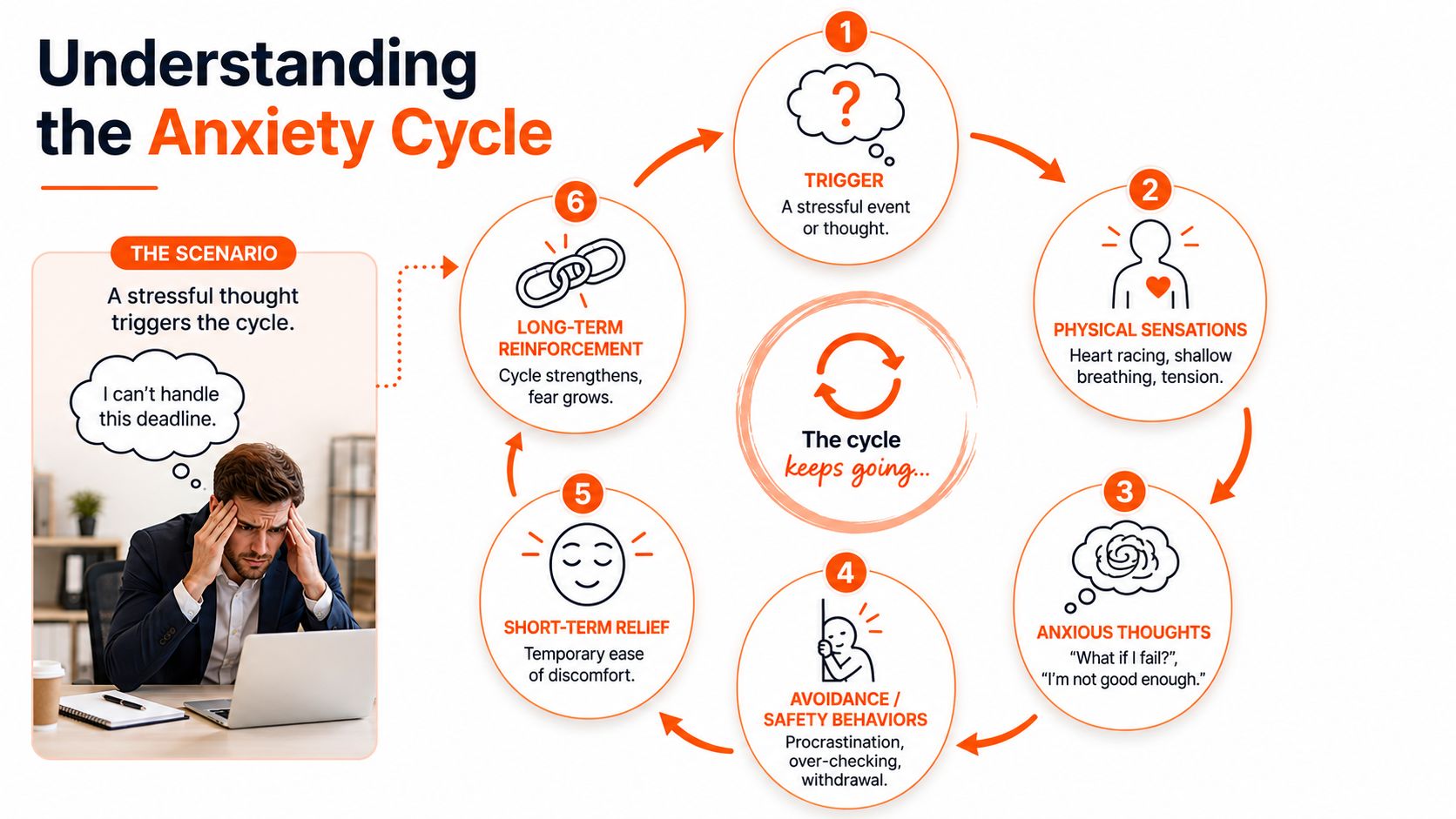
Why avoidance feels good and works badly
Avoidance is seductive because it gives fast relief. If you delay the hard conversation, the tension dips. If you leave the networking event, your body settles. If you keep checking and refining, you feel briefly safer.
The problem is what your brain learns next. It doesn't conclude, “I can handle discomfort.” It concludes, “That situation really was dangerous, and escape saved me.”
Practical rule: Anything that lowers anxiety immediately but shrinks your life later deserves scrutiny.
For executives and professionals, avoidance rarely looks dramatic. It's often polished. It can look like perfectionism, excessive preparation, strategic withdrawal, or delegating away any task that carries uncertainty. Those behaviors often get rewarded at work, which is one reason anxiety can hide in plain sight.
The cycle is mechanical, not mysterious
Once you can name the sequence, you can interrupt it. That alone changes the conversation from “What's wrong with me?” to “Where in the loop am I right now?”
A simple map helps:
| Stage | What it looks like at work |
|---|---|
| Trigger | A presentation, deadline, conflict, travel, silence from a client |
| Anxious thought | “I'm about to blow this” or “If I don't control every detail, it will fail” |
| Physical sensation | Heart racing, stomach drop, restlessness, heat, tension |
| Avoidance or safety behavior | Procrastinating, overpreparing, checking, reassurance-seeking, withdrawal |
If your stress is compounded by relocation, academic pressure, or cultural adaptation, resources on understanding expat and student anxiety can help put those added layers in context.
Immediate Tools to Interrupt an Anxiety Spiral
When anxiety spikes, don't start by debating your thoughts. Start with your nervous system.
That's not a motivational slogan. It's a clinical reality. Attempting to logically argue with anxious thoughts while the body is in high arousal has a success rate of less than 20%, while using a physiological grounding technique first increases the effectiveness of cognitive strategies to over 75%, according to Avid Counseling's explanation of anxiety spirals and grounding.

Use grounding before analysis
The goal in the first few minutes isn't insight. It's downshifting your body enough that your judgment comes back online.
Try the 5-4-3-2-1 grounding technique:
- Name 5 things you can see. Look for details, not categories. “A silver binder clip” works better than “office stuff.”
- Notice 4 things you can feel. Your feet in your shoes, your back against the chair, the fabric on your sleeve.
- Identify 3 things you can hear. HVAC hum, keyboard clicks, traffic outside.
- Recognize 2 things you can smell. Coffee, paper, soap, air.
- Find 1 thing you can taste. Water, mint, toothpaste, whatever is present.
This technique works because it moves attention out of catastrophic projection and into direct sensory input.
Anxiety pulls you into prediction. Grounding returns you to information.
Breathe in a way your body can use
Many professionals tell me they've “tried breathing” and it did nothing. Usually, they were taking quick upper-chest breaths while still multitasking. That doesn't reliably calm an activated system.
Use a simpler version:
- Place one hand on your abdomen. You want the lower hand to move more than the upper one.
- Inhale gently through your nose. Don't force a huge breath.
- Exhale longer than you inhale. Keep the pace easy and sustainable.
- Repeat for a few rounds while staying still. The stillness matters.
If your anxiety shows up at night as exhaustion mixed with overactivation, material on help for tired but wired sleepers may be useful alongside broader nervous system work.
Use a brief mindfulness reset
A short mindfulness practice can stop the spiral from becoming a lost hour. If you want structured support, guided practices on meditation and mindfulness can give you a more repeatable routine.
Keep the script practical:
- Name the state. “My body is in alarm.”
- Drop the argument. Don't try to prove your thoughts wrong yet.
- Stay with one anchor. Breath, feet on floor, or contact with the chair.
- Return each time your mind runs. That return is the exercise.
These tools don't solve the underlying fear. They create enough stability to choose your next action instead of being driven by the spiral.
Building Resilience with Short-Term Routines
You can't ground your way out of an overloaded life forever. Immediate tools matter, but your daily baseline matters just as much. Professionals break the anxiety cycle more reliably when they reduce the conditions that keep the nervous system chronically primed.
Create a container for worry
Unscheduled worry expands to fill every gap in the day. A structured Worry Window helps contain it. Setting aside a strict 15 to 30 minute daily period for anxious thoughts can reduce total rumination time by 40% to 50%, based on the clinical guidance summarized by Psych Central in its coverage of the anxiety cycle.
The method is straightforward:
- Pick a fixed time. Late afternoon often works better than bedtime.
- Write the concern down when it appears. Don't solve it on the spot unless action is required.
- Return to it during the Worry Window. If it still matters, think it through then.
- End when time is up. The boundary is part of the treatment.
This isn't suppression. It's containment.
Build routines your workday can tolerate
High performers often abandon good routines because they imagine the ideal version first. A sustainable plan is smaller and less impressive.
Consider this comparison:
| Routine area | Fragile version | Sustainable version |
|---|---|---|
| Sleep | “I'll get perfect sleep every night” | Keep a more consistent wind-down and reduce late stimulation |
| Exercise | Hour-long daily workouts | Short movement blocks you'll actually do |
| Nutrition | Strict overhaul | Fewer skipped meals and more predictable intake |
| Recovery | Weekend crash only | Short resets during the workweek |
The point is regulation, not perfection.
Reduce background activation
A resilient baseline usually includes a few nonnegotiables:
- Protect sleep timing. Anxiety worsens when your body never gets a predictable off-ramp.
- Move on purpose. Even brief movement helps discharge accumulated activation.
- Eat before you're depleted. A dysregulated body is more likely to misread normal stress as threat.
- Limit constant input. Endless news, notifications, and reactive email checking keep the system scanning.
Clinical observation: The routines that work best are the ones a busy person can repeat during a difficult week, not just during a good one.
For professionals, the standard isn't “wellness.” It's operational stability. Your routines should make it easier to think clearly under pressure, not become another performance metric you fail.
Cognitive Strategies to Rewire Anxious Thinking
Long-term change happens when you stop obeying anxiety's rules. That doesn't mean forcing positive thoughts. It means changing how you respond to fear, uncertainty, and discomfort.
Challenge the thought after you settle the body
Once you're grounded, examine the anxious thought with precision. Don't ask, “How do I feel about this?” Ask better questions:
- What is the specific prediction?
- What evidence supports it?
- What evidence doesn't?
- What's a more accurate statement than the worst-case story?
A useful shift is from certainty language to probability language. “This will go badly” becomes “I'm predicting a bad outcome because I feel activated.”
That's a core Cognitive Behavioral Therapy move. If you want a deeper overview of how that treatment model works, Cognitive Behavioral Therapy for anxiety and related patterns lays out the basics clearly.
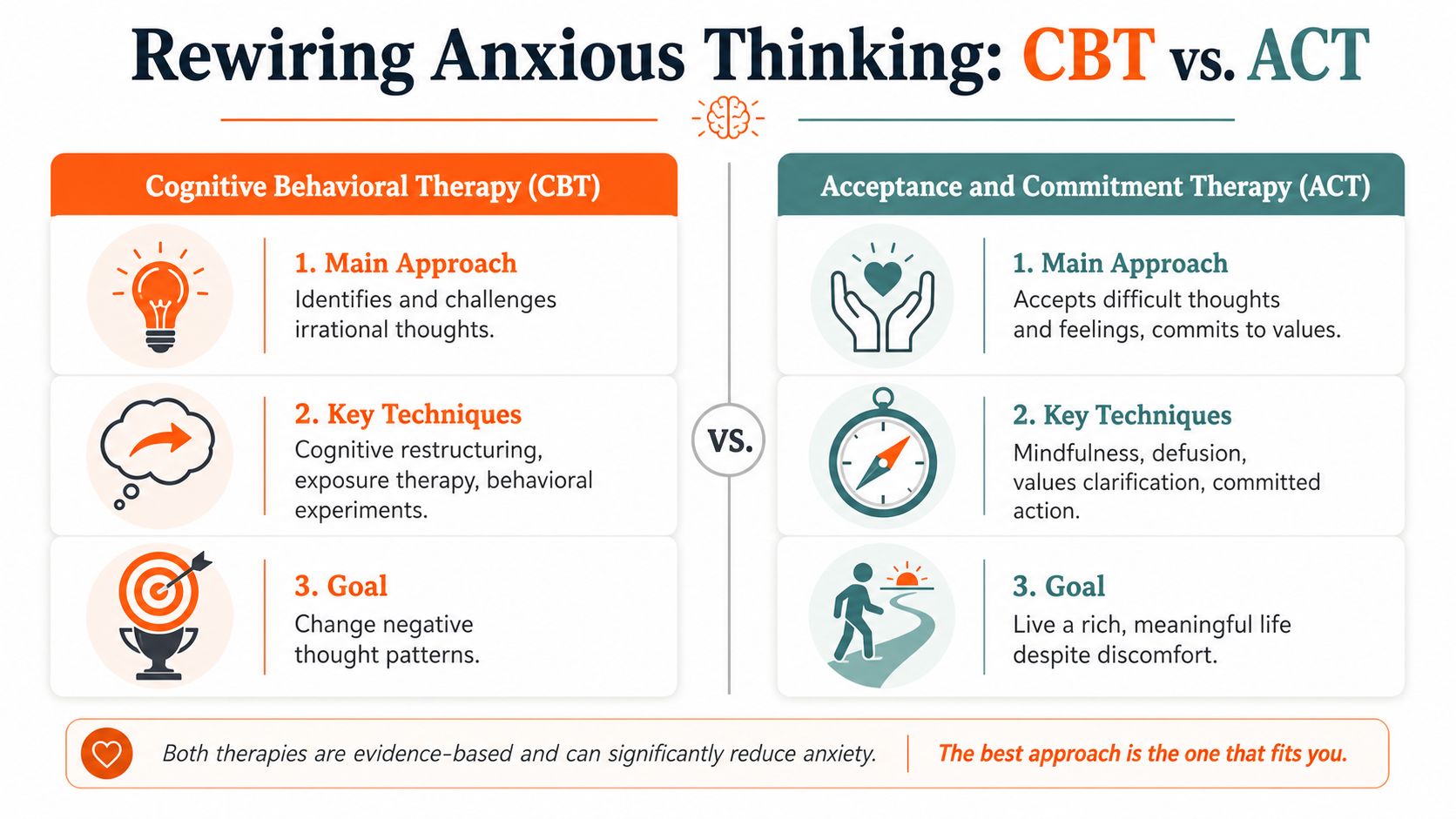
Stop using safety behaviors as a hidden escape hatch
The most effective answer to anxiety is usually graded exposure without safety behaviors. That means facing what you fear in manageable steps while dropping the rituals you use to feel artificially safe.
A critical part of this process is staying in the anxiety-provoking situation for at least 90 seconds without escaping, because that window often allows physiological arousal to peak and begin declining, according to Psych Central's discussion of habituation and the anxiety cycle.
Common professional safety behaviors include:
- Reassurance-seeking. Sending an unnecessary “Just checking this is okay” email.
- Overpreparing. Reviewing material far past the point of usefulness.
- Concealment rituals. Keeping your camera off, avoiding eye contact, staying silent to reduce exposure.
- Exit planning. Sitting near the door, building excuses to leave early, or mentally preparing an escape.
If you keep the feared situation and the safety behavior together, your brain often credits the ritual, not your own capacity.
Use small behavioral experiments
Professionals do better with exposure when it's translated into concrete tests.
Try examples like these:
- Delay sending the reassurance email.
- Speak once in the meeting without overrehearsing the sentence.
- Submit the draft after one competent review instead of six.
- Stay in the difficult conversation long enough to notice the anxiety rise and fall.
Practice cue: Aim for “tolerable and repeatable,” not heroic.
ACT adds another useful layer. Instead of trying to eliminate every anxious thought, you can let the thought exist and still act according to your values. In plain terms, that means anxiety gets a seat in the car, but not the steering wheel.
That's often the turning point in learning how to break the anxiety cycle. The goal isn't to never feel anxious. It's to stop organizing your decisions around avoiding anxiety.
When to Seek Professional Treatment
Self-help has limits. If anxiety is steadily narrowing your work, relationships, sleep, or decision-making, it's time to stop treating it like a private efficiency problem and start treating it like a clinical issue.
This matters even more when substance use has entered the picture.

Know when anxiety is no longer self-contained
Professional adults often wait too long because they're still functioning on paper. They're still working, still leading, still producing. But functioning and coping aren't the same thing.
Watch for signs such as:
- Work becoming narrower. You avoid travel, presentations, conflict, or visibility.
- Recovery habits becoming compulsive. Alcohol, sedatives, cannabis, or other substances become your main off-switch.
- Relationships absorbing the overflow. Irritability, withdrawal, or constant reassurance needs start shaping home life.
- Your tools stop working. Grounding helps less, avoidance grows, and your world gets smaller.
Co-occurring substance use changes the treatment sequence
This is the point many generic anxiety articles miss. An estimated 54% of individuals with anxiety disorders also have a substance use disorder, and for this dual-diagnosis population, neurobiological stabilization through medically supervised detox must often precede effective cognitive work, according to Therapy in a Nutshell's discussion of the anxiety cycle and dual diagnosis.
If someone is drinking to sleep, using pills to get through meetings, or relying on substances to blunt panic, the clinical question changes. You don't start with thought logs alone. You first assess whether the brain and body are stable enough to benefit from therapy.
That sequence matters because untreated withdrawal, rebound anxiety, and substance-driven mood instability can make psychological strategies feel ineffective when the problem is partly physiological.
What high-quality treatment should include
For professionals, good treatment should be both evidence-based and logistically realistic. Privacy matters. So does continuity of care. So does the ability to maintain limited essential contact with work when appropriate.
Look for care that includes:
- Thorough assessment. Anxiety, trauma, sleep, mood, substance use, and medical factors all need review.
- Integrated treatment. CBT, DBT, ACT, and trauma-informed approaches such as EMDR or Brainspotting may all have a role.
- Medication evaluation when indicated. Not everyone needs medication, but some do.
- A setting that matches severity. Outpatient works for some. Others need detox or residential structure.
- Executive-compatible planning. Confidentiality, discretion, and boundaries around work access should be explicit.
If anxiety and substance use are intertwined, treatment that addresses recovery and mental health together is essential. Guidance on why addressing anxiety is pivotal for recovery is especially relevant for people who have used alcohol or drugs to manage distress.
The right level of care should reduce chaos, not add to it.
Seeking treatment isn't a sign that you can't handle pressure. It's often the first sign that you're handling it intelligently.
Creating a Sustainable Relapse Prevention Plan
Breaking the loop once is important. Preventing the next loop from gradually rebuilding is what protects your life and work over time.
For professionals, relapse prevention should be written down. Anxiety gets persuasive when you're tired, overloaded, or under scrutiny. A plan reduces decision-making in the moment.
Track your early warning signs
A relapse into an anxiety cycle doesn't happen all at once. The pattern usually returns in small, rationalized ways.
Your list might include:
- Behavioral shifts. More checking, more postponing, more reassurance-seeking.
- Body signals. Tight chest in the morning, shallow breathing on calls, jaw tension at night.
- Thought changes. More catastrophic forecasting, more all-or-nothing conclusions.
- Lifestyle drift. Skipped meals, shortened sleep, canceled recovery routines.
The earlier you catch the pattern, the easier it is to interrupt.
Build a response plan for predictable triggers
A useful prevention plan matches trigger to action.
| Trigger | Early response |
|---|---|
| High-stakes presentation | Ground first, limit overpreparation, speak before anxiety fades |
| Conflict conversation | Write the key point, not the whole script, then stay in the exchange |
| Evening rumination | Use the Worry Window and a fixed shutdown routine |
| Urge to self-medicate | Pause, contact support, and address the state directly rather than sedating it |
This approach respects reality. It assumes stress will happen and prepares for it.
Protect treatment from work pressure
One barrier deserves direct attention. 42% of executives avoid seeking mental health treatment because they fear work disruption, according to Psych Hub's discussion of anxiety spirals in working professionals.
That fear is understandable. It's also costly when it leads to delay, partial engagement, or dropping out as soon as things improve. The solution isn't pretending work doesn't matter. It's choosing treatment models and boundaries that let care coexist with legitimate responsibility.
A strong prevention plan usually includes:
- Named supports. Therapist, physician, sponsor, trusted partner, or colleague.
- Clear thresholds. Specific signs that mean “I need more help now.”
- Work boundaries. Limits on after-hours exposure, crisis scanning, or self-imposed availability.
- Follow-through appointments. Not just crisis care, but maintenance.
Anxiety management isn't a side project. For a high-performing professional, it's part of maintaining judgment, stamina, and leadership capacity.
If anxiety has become tied to alcohol, medications, or other substances, and you need care that protects both your privacy and your ability to stay connected to essential responsibilities, Capo Canyon Recovery offers medically supervised detox, residential treatment, and dual-diagnosis care designed for executives and professionals. Their program combines psychiatric oversight, evidence-based therapy, and a discreet, tech-friendly setting for people who need serious treatment without a chaotic or impersonal environment.