
You may be functioning at a high level and still feel strangely absent from your own life.
The pattern is familiar in executives and professionals. You wake before your alarm, clear messages before getting out of bed, push through meetings, override hunger, ignore the tension in your chest, and call it discipline. By late afternoon, your body is sending clear signals. Tight jaw. Shallow breathing. Irritability. Fatigue. Trouble focusing. You register them, but you don't respond. Then the evening handoff begins. Alcohol, sedatives, stimulants, overwork, compulsive scrolling, or some other reliable way to stop feeling what your body has been trying to say all day.
That state isn't weakness. It's disconnection. And in recovery, learning to reconnect mind body isn't a wellness extra. It's part of the clinical work.
For high-performing people, the challenge is practical as much as emotional. You don't want vague advice. You don't want a retreat model that assumes your responsibilities disappear. You need approaches that respect privacy, preserve dignity, and fit inside a life that still has pressure in it.
Why High-Performers Feel Disconnected from Their Bodies
A senior professional can walk into a room looking composed and still be running on pure adaptation. Outwardly, performance holds. Internally, the body is carrying the cost.
In practice, this often starts long before substance use becomes a problem. A leader learns that discomfort is inconvenient. Hunger can wait. Sleep can wait. Grief can wait. Panic gets renamed as drive. Physical warning signs become background noise. Over time, the person becomes highly skilled at reading a market, a team, or a negotiation, but poor at reading their own nervous system.
A useful way to understand this is simple. The same traits that help someone excel under pressure can also train them to bypass themselves. Efficiency, endurance, emotional containment, and constant availability can look admirable. Under chronic strain, they also create the conditions for disconnection.
One guide to the body's stress response is Capo Canyon's explanation of the relationship between stress and our bodies. The key clinical point is straightforward. Stress doesn't stay in your head. It shows up in sleep, digestion, muscle tension, mood, impulse control, and the urge to seek relief fast.
What this looks like in real life
Most professionals don't describe the problem as “mind-body disconnection.” They say things like:
- “I'm fine until I stop moving.” Quiet feels intolerable because stillness exposes what momentum has been covering.
- “I didn't realize how bad it was until I was home.” The workday masks symptoms that become obvious only when stimulation drops.
- “I know I'm stressed, but I can't feel much else.” Emotional flattening often travels with bodily numbness.
- “I only notice my body when it forces the issue.” Insomnia, panic, pain, or cravings become the first language the body can still use effectively.
Clinical reality: If you can't detect stress early, you're more likely to manage it late. Late management is where addictive behavior often enters.
Addiction widens this split. Once substances become a primary regulator, the body stops feeling like a trusted source of information and starts feeling like a problem to suppress. Recovery asks for the reverse. You learn to notice signals sooner, respond with more precision, and tolerate internal states without immediately trying to shut them down.
For executives, that work has to be discreet and functional. It has to help you stay effective, not disappear from your life.
The Neuroscience Behind Mind-Body Reconnection
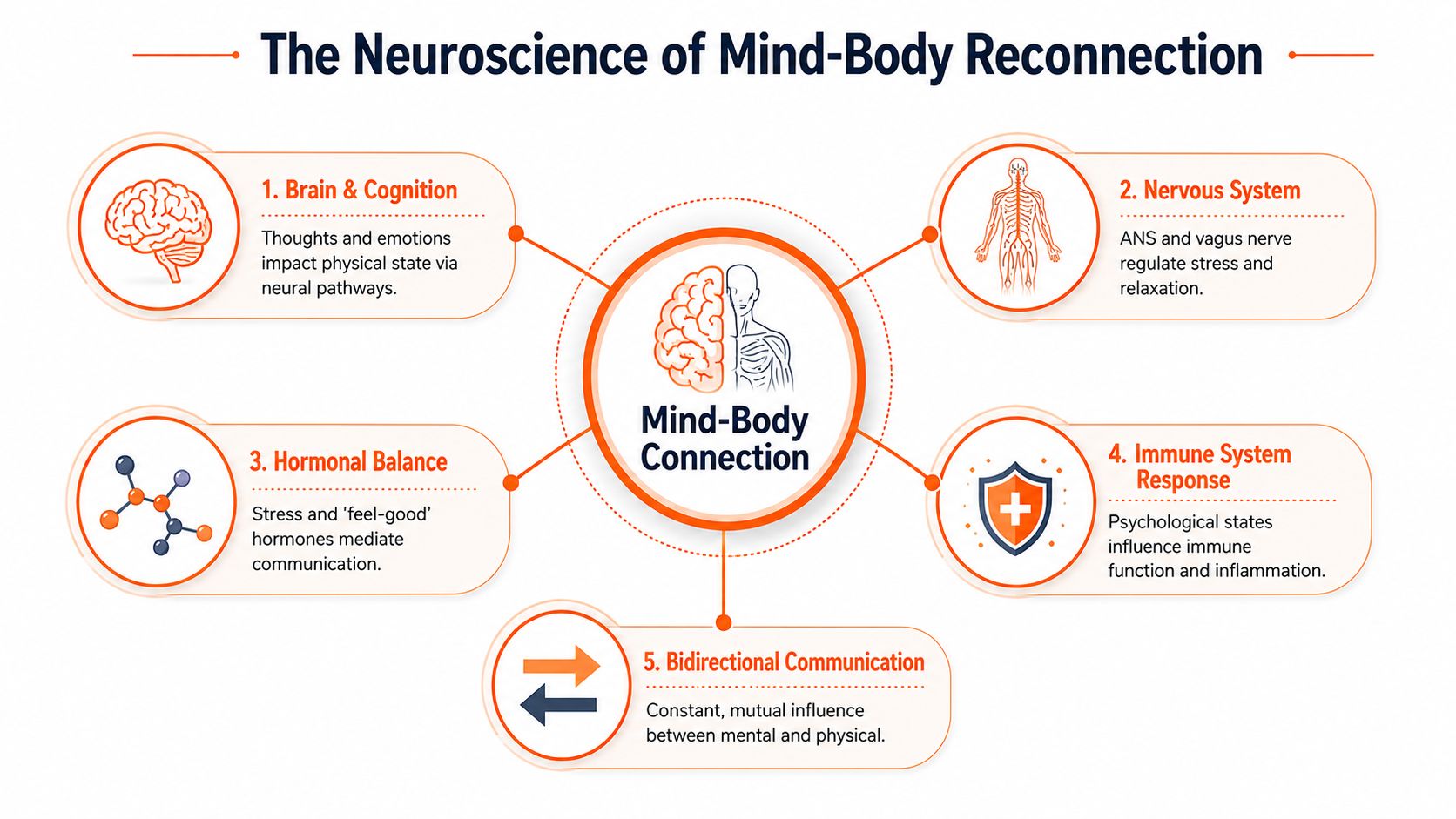
Analytical people often engage better when they understand mechanism. That helps here, because the mind-body connection isn't a metaphor.
A Washington University School of Medicine report on the SCAN network describes a 2023 discovery of the Somato-Cognitive Action Network, a neural network that physically links motor control with systems involved in thinking, planning, and regulation of involuntary functions such as blood pressure and heart rate. The same report notes that approximately 15% of the brain's motor cortex is directly plugged into cognitive planning networks. That matters because it gives a biological explanation for something clinicians have observed for years. Mental state and physical state are structurally linked.
Why that changes the conversation
If thought, movement, and physiological regulation are linked in the brain, then body-based interventions stop looking “soft” or secondary. They become clinically rational.
That's why a person can walk into a therapy session intellectually convinced they're safe, while their pulse, breath, posture, and muscle tone tell a different story. The nervous system isn't being irrational. It's expressing a state through circuits that are tied to both cognition and body regulation.
A concise way to conceptualize this:
| System | What you notice | Why it matters in recovery |
|---|---|---|
| Cognitive | Rumination, urgency, narrowed thinking | Impairs judgment and increases reactivity |
| Autonomic | Shallow breathing, racing heart, agitation | Pushes the body toward threat mode |
| Motor | Restlessness, collapse, bracing, jaw tension | The body “acts out” the internal state |
| Interoceptive | Numbness or poor signal detection | Makes early self-correction harder |
The science behind addiction also supports this integrated view. Capo Canyon's overview of the science behind how addiction works in your body is useful because it frames substance use as a whole-body process, not a character issue or a failure of will.
Why movement and regulation techniques work
When people ask why breathwork, movement, or mindful exercise can affect mood and cravings, the answer isn't mystical. These practices change the input the brain receives from the body, and they change the output the brain sends back.
A 2023 meta-analysis in Scientific Reports found that mind-body exercise enhanced activation in the left anterior cingulate cortex within the default mode network and deactivated the left supramarginal gyrus within the ventral attention network, with the increase in default mode network activation associated with years of practice. It also reported modulation of connectivity between attention networks involved in focus and distraction control. For a practical reader, the takeaway is simple. Repeated mind-body practice appears to shape the networks involved in attention and emotional regulation.
That neuroplastic angle is why many clinicians pay attention to factors that support BDNF. If you want a practical companion resource on exercise-related mechanisms, BionicGym's guide to BDNF optimization is worth reading alongside your treatment plan.
The body is not a side door into recovery. For many people, it's the fastest route back to self-awareness.
Core Practices for Mind-Body Integration in Recovery
Knowing the science helps. Daily practice changes the outcome.
The most effective mind-body work in recovery is usually not dramatic. It's repeatable, contained, and realistic enough that you'll keep doing it when motivation drops. The point isn't to become spiritual overnight. The point is to restore signal detection, improve regulation, and reduce the gap between what you think and what you feel.

Mindfulness and meditation
Mindfulness is the skill of noticing internal and external experience without immediately reacting to it. In recovery, that matters because cravings, shame, irritability, and anxiety often escalate in the space between sensation and action.
You don't need long silent sits to start. For many professionals, a body scan works better because it gives the mind a task. Sit down, place both feet on the floor, and move your attention from jaw to shoulders to chest to hands to abdomen. Don't fix anything at first. Just identify what's there.
One useful primer on this is Capo Canyon's piece on ways meditation can help during recovery. It's especially relevant for people who think meditation means emptying the mind. It doesn't. It means seeing clearly enough to choose your next move well.
What works:
- Short, consistent practice: Two or three minutes done reliably beats ambitious sessions you abandon.
- Concrete prompts: “What am I feeling in my chest?” is better than “relax.”
- Use before predictable triggers: Before the drive home, before an argument, before bed.
What doesn't:
- Forcing calm: Trying to make yourself serene usually creates more frustration.
- Treating mindfulness as a performance metric: If you turn it into another achievement task, you miss the point.
Breathwork that actually fits a workday
Breathwork is one of the fastest ways to interrupt escalating activation because you can do it without leaving your office, your hotel room, or your parked car.
The key is control without strain. Slow, even breathing can help downshift an overactivated state. If you want a straightforward external resource, this guide to controlled breathing offers a practical starting point.
A simple approach many people tolerate well:
- Sit upright with both feet grounded.
- Inhale gently through the nose.
- Exhale a little longer than the inhale.
- Repeat for a few cycles without forcing depth.
The goal isn't to produce a special state. The goal is to reduce the mismatch between a pressured mind and an overloaded nervous system.
Practical rule: If a breathing exercise makes you feel trapped, dizzy, or more agitated, modify it. Good regulation work feels stabilizing, not punishing.
Yoga and mindful movement
Some people reconnect mind body faster through movement than through stillness. That's common in high-performers who feel flooded when asked to close their eyes and sit with themselves.
Mindful movement works because it turns attention outward and inward at the same time. You notice balance, muscle activation, breath rhythm, and tension patterns while staying engaged. Yoga, walking with attention, mobility work, and slow resistance training can all serve this purpose.
A useful distinction helps here:
- Exercise for output can improve mood, energy, and sleep.
- Movement for awareness helps you notice where you brace, collapse, rush, or disconnect.
You need both, but they aren't the same thing.
Somatic therapies and trauma-informed body work
For some people, disconnection isn't only stress. It's trauma. The body may hold threat responses long after the event has passed, which is why insight alone sometimes doesn't produce change.
That's where structured somatic work can help. In a clinical setting, this might involve tracking activation, noticing impulses to freeze or flee, orienting to safety, and learning how to complete stress responses gradually rather than getting overwhelmed by them.
A recent PubMed-listed study on intensive mind-body interventions reported statistically significant short-term changes including decreased functional integration in the default mode and salience networks, reduced whole-brain modularity, upregulation of BDNF (p = 0.001), enhanced in vitro neurite outgrowth (p = 0.01), and activation of endogenous opioid pathways (p = 0.03). It also reported shifts in inflammatory and anti-inflammatory signaling. For treatment, the practical point is that intensive mind-body interventions can produce measurable neural and biochemical changes relevant to stress, pain, and adaptation.
The non-negotiables people try to skip
Executives often want the elegant intervention and resist the basics. That's understandable. It's also a mistake.
Mind-body integration is harder when the foundation is unstable. Pay attention to:
- Sleep: Even strong coping skills weaken when sleep is fragmented.
- Food timing: Long gaps without eating can worsen irritability and impulsivity.
- Hydration and caffeine boundaries: These influence anxiety more than many professionals admit.
- Transitions: Most relapse-prone moments happen in unstructured handoff periods, not during peak performance windows.
If you want a realistic toolkit, start small. One grounding practice in the morning, one regulation tool during work, one downshift ritual at night. That's enough to begin rebuilding trust between mind and body.
How Therapy Can Deepen Mind-Body Work
Mind-body practices help you notice and regulate. Therapy helps you understand and resolve what keeps pulling the system off center.
That difference matters. A breathing exercise may lower activation before a difficult call. It won't, by itself, unwind the trauma, grief, perfectionism, shame, or chronic fear that taught your body to stay on alert in the first place. For many professionals, the deepest disconnection isn't lack of knowledge. It's unresolved material that the body still treats as active.
When insight alone stops working
People get frustrated. They can explain their patterns with accuracy. They know why they overwork, numb out, or react sharply under stress. Yet in the moment, the body still takes over.
That's not hypocrisy. It's state-dependent learning. Under pressure, the nervous system reaches for what feels familiar and protective, not what sounds sensible in a calm conversation.
A good therapist helps translate body signals into clinically useful information:
- Tight chest before conflict may signal threat anticipation.
- Numbness during emotional conversations may reflect shutdown.
- Restlessness and urgency may be the body's version of avoiding grief or vulnerability.
Why EMDR and DBT fit this work
EMDR can be useful when traumatic memories or distressing experiences feel “stuck.” It uses bilateral stimulation within a structured clinical process to help the brain and nervous system reprocess material that hasn't been integrated well. Clients often notice that the story becomes more coherent and the body reaction becomes less intense.
DBT helps in a different way. It gives people practical skills for distress tolerance, mindfulness, and emotional regulation. For executives, DBT is often appealing because it is concrete. It teaches what to do when emotion rises fast, when urges hit hard, or when a difficult conversation triggers a disproportionate response.
Therapy gives context to sensation. Somatic practices tell you that your body is activated. Good psychotherapy helps you understand why, and what to do next.
The strongest treatment plans usually combine both domains. You learn how to settle the body in real time, and you work through the drivers of dysregulation over time. That's what makes reconnection durable instead of situational.
Reconnecting While Maintaining Your Career and Privacy
Professionals often delay treatment for two reasons. They think they can't step back without professional damage, and they worry that seeking help will expose them.
Both concerns are understandable. Neither should force you into a model that doesn't fit your life.
A Psyche guide discussing embodiment at work references a 2025 study of 1,200 executives in which 68% reported “body amnesia” during work hours, meaning they ignored physical stress signals. That finding captures the problem well. Many professionals don't need more advice about escaping responsibility. They need methods they can use while still carrying it.

What fits a demanding schedule
The right question isn't “Can I pause my whole life?” It's “What level of treatment or support lets me recover without creating unnecessary collateral damage?”
For many executives, useful mind-body work looks like this:
- Between meetings: Two minutes with both feet grounded, eyes open, tracking breath and shoulder tension.
- Before a high-stakes presentation: A short breathing cycle with longer exhalations instead of a drink, pill, or panic spiral.
- After conflict: A brief walk without the phone, focusing on pace, posture, and jaw release before responding.
- At night: A fixed decompression ritual that tells the nervous system work is over.
The point is not to make your life smaller. It's to stop using constant activation as the price of competence.
Privacy is part of treatment design
Confidentiality concerns are not vanity. For licensed professionals, founders, executives, and public-facing leaders, privacy affects whether they seek help at all.
That includes digital privacy. If reputational exposure is a serious concern, it can help to review practical tools that erase your digital footprint and reduce unnecessary online exposure outside the treatment context.
It also helps to choose care environments that understand work reality. Tech access, private rooms, individualized scheduling, and a small, discreet setting are not luxuries for this audience. They are often what makes treatment possible. A generic program may insist on a complete shutdown. Sometimes that's necessary. Often it's not. The better approach is clinical flexibility with clear boundaries.
What doesn't work is pretending you can outthink physiology indefinitely. If your body has become the place where stress, craving, and exhaustion go to hide, recovery has to include the body while respecting the life you still need to manage.
Taking the First Step Toward Integrated Recovery
Individuals often don't need more information before they seek help. They need a cleaner decision framework.
If you're trying to reconnect mind body on your own and you notice steady improvement, that's useful. Keep going. But self-guided work has limits. If alcohol or drugs are involved, if withdrawal may be medically risky, if trauma or depression is active, or if you keep returning to the same cycle despite insight and effort, clinical support usually becomes the safer choice.
The treatment question isn't whether you should use body-based practices or therapy. It's whether your care model integrates them well.
What integrated care should include
Look for a program that combines:
- Medical oversight: Especially when detox, medication changes, or psychiatric symptoms are in play.
- Dual diagnosis capability: Substance use and anxiety, trauma, depression, bipolar disorder, or ADHD often interact.
- Evidence-based psychotherapy: Modalities such as CBT, DBT, ACT, EMDR, or Brainspotting should be available based on need.
- Somatic and integrative work: Breathwork, mindfulness, movement, and body-based regulation should support, not replace, clinical treatment.
- A realistic environment for professionals: Privacy, individualized attention, and room for essential responsibilities matter.
This kind of setting matters because outcomes improve when treatment addresses the whole system. A 2020 systematic review cited in Scientific Reports found that mind-body therapies were associated with a moderate to large effect on pain reduction and a significant reduction in opioid dosage, with meditation alone showing a 30 to 40% improvement in pain outcomes in that review. Those findings support a practical conclusion. Evidence-based mind-body care has measurable value when it's embedded in a serious treatment plan.
A visual sense of that kind of environment helps.
A calmer way to decide
You do not have to commit to a public identity as “someone in treatment.” You do not have to blow up your career to get better. You do need a plan that matches the seriousness of what's happening.
A confidential conversation with a qualified program can clarify whether you need detox, residential treatment, dual diagnosis care, or a different level of support. The right next step should reduce confusion, not increase it.
If your current way of coping depends on ignoring your body, then healing has to include learning how to hear it again.
Capo Canyon Recovery offers confidential detox and residential care for executives, professionals, and high-profile clients who need serious treatment without unnecessary disruption to work or privacy. If you're looking for integrated care that combines medical oversight, psychiatric support, evidence-based therapy, and mind-body practices in a discreet setting, contact Capo Canyon Recovery to explore a personalized path forward.