
You've probably had the same thought more than once. The prescription that once made life workable is now taking more planning, more caution, and more energy than you want to admit. You may be sleeping poorly, feeling anxious between doses, or wondering whether the line between medical use and dependence has already been crossed.
That moment is where benzodiazepine addiction treatment starts for many, not with a dramatic crisis, but with a growing realization that stopping on your own might not be safe. The modern clinical answer is rarely “detox and done.” It's usually stabilization, gradual tapering, therapy, and ongoing follow-up, because the problem is often both physical and psychological, and the recovery plan has to fit both.
For a quick self-check on whether your use pattern may need medical review, this benzodiazepine addiction screening guide can help you frame the right questions before you call anyone.
Understanding Benzodiazepine Addiction Treatment
The hardest part for many people is accepting that a medication can be both legitimate and problematic at the same time. Benzodiazepines are often prescribed for anxiety, insomnia, muscle spasm, or seizure-related conditions, but a person can still develop physical dependence after steady use, and that dependence can exist even without the chaotic pattern people usually associate with addiction.
That distinction matters. Dependence means the body has adapted to the drug and may react if it's reduced too fast. A use disorder adds loss of control, compulsive use, or continued use despite harm. Someone may start with a clean prescription history and still end up needing structured care.
What treatment actually includes
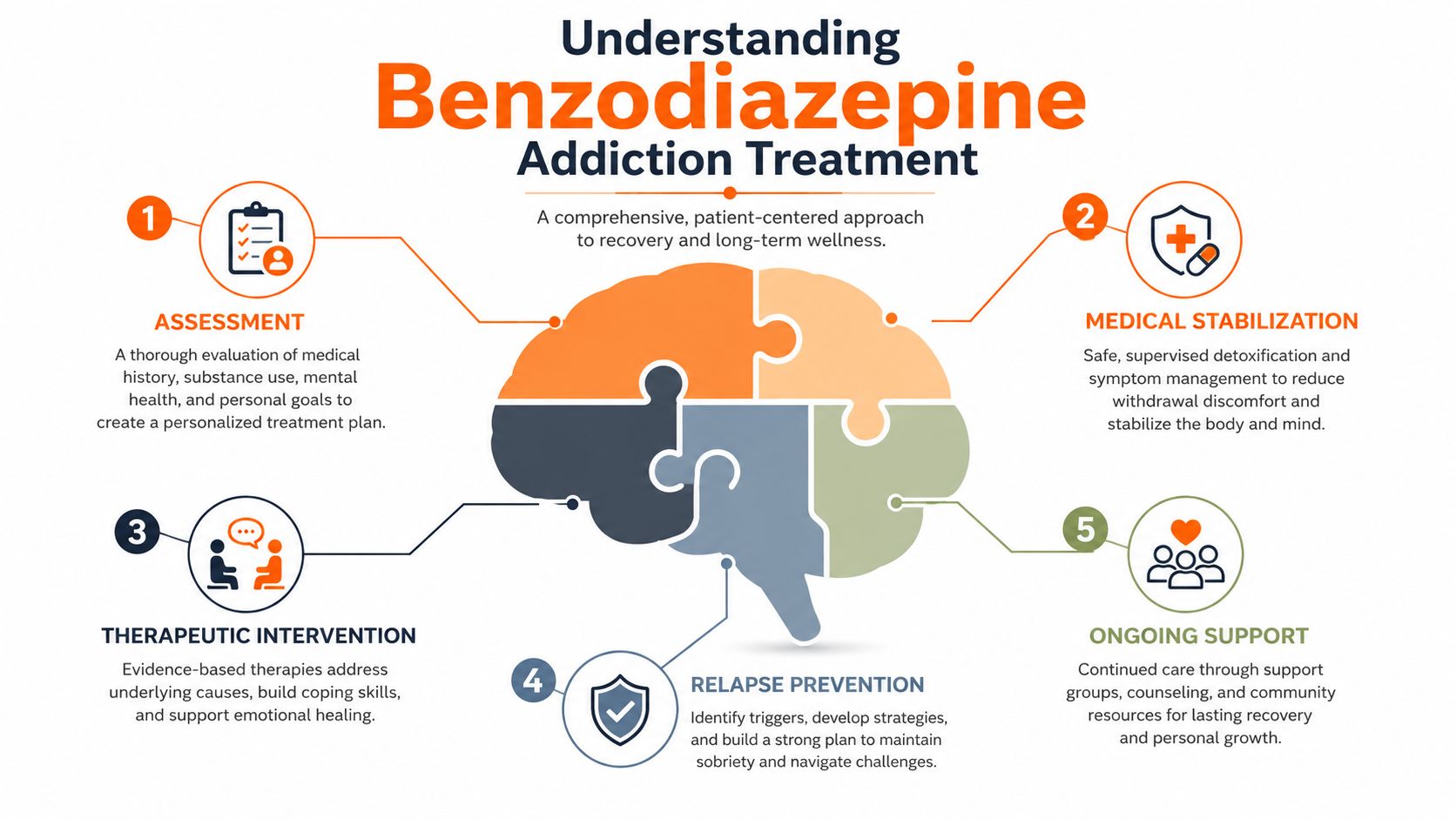
A safe plan usually has more than one layer. First comes assessment, where a clinician looks at dose, duration, other medications, mental health, and past withdrawal problems. Then comes medical stabilization, because people often need to feel steady before they can taper.
Practical rule: if the first question is “How fast can I stop?”, the safer question is usually “How do I stop without destabilizing my sleep, mood, work, or safety?”
That's why the modern model is stabilization plus taper plus therapy. If your days are still full of meetings, childcare, travel, or public-facing work, the goal isn't to yank the medication away. It's to build a plan that protects you while your nervous system relearns how to function without relying on the drug.
The process often takes longer than people expect, but it's also more humane. You're not being asked to prove toughness. You're being asked to reduce risk while creating a path that can hold in real life, not just in theory.
How Common Benzodiazepine Problems Really Are
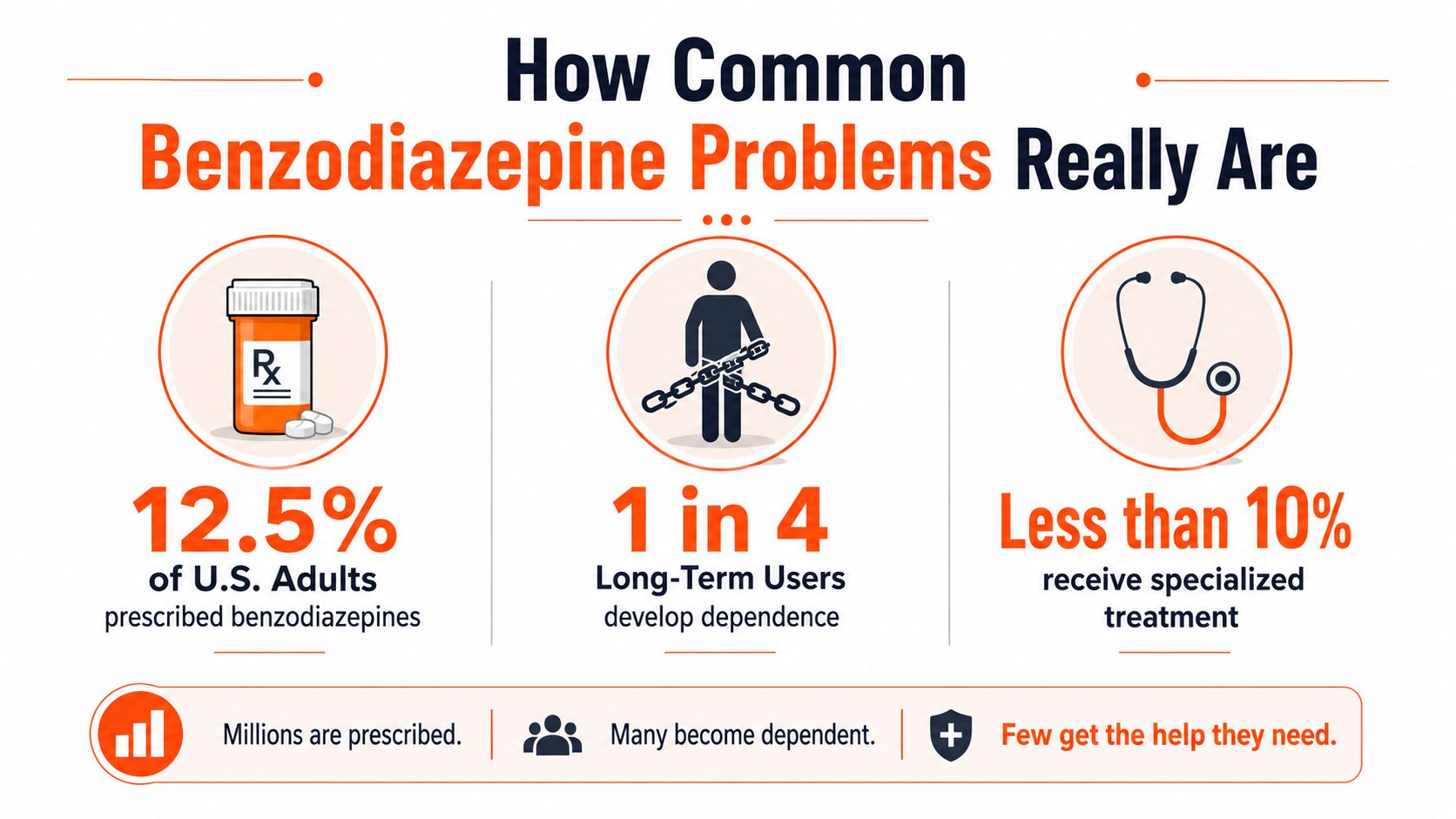
The scale of benzodiazepine use in the United States is large enough that this can't be treated as a fringe issue. In 2015 to 2016, about 30.5 million adults used benzodiazepines in the prior year, 5.2 million misused them at least once, and an estimated 0.5 million met criteria for a benzodiazepine use disorder, including about 0.3 million with dependence and 0.2 million with abuse, according to the national analysis summarized in this review of the data. Another analysis from the same survey period reported 30.6 million adults (12.6%) used benzodiazepines, 25.3 million (10.4%) used them as prescribed, and 5.3 million (2.2%) misused them, with misuse making up 17.2% of all benzodiazepine use (national survey analysis).
Those numbers matter clinically because treatment can't be designed only for illicit use. A large share of people needing help are taking medication they were originally given by a prescriber, which means treatment has to address prescribed users, diverted use, and mixed patterns with equal seriousness.
Why the treatment setting keeps expanding
The clinical picture became even clearer as admissions rose over time. SAMHSA reported that annual admissions for benzodiazepine and narcotic pain reliever combination cases increased 569.7% from 5,032 in 2000 to 33,701 in 2010, and 45.7% of those admissions involved a co-occurring psychiatric disorder (SAMHSA admissions data).
That shift tells you something important. Benzodiazepine treatment now sits at the intersection of detox, psychiatry, and primary care. It's not a single-substance problem in many patients, and it's not solved by a short stay and a discharge packet.
People often arrive thinking they need a stronger willpower plan. In reality, they usually need a more accurate clinical plan.
Why Abrupt Cessation Is Dangerous
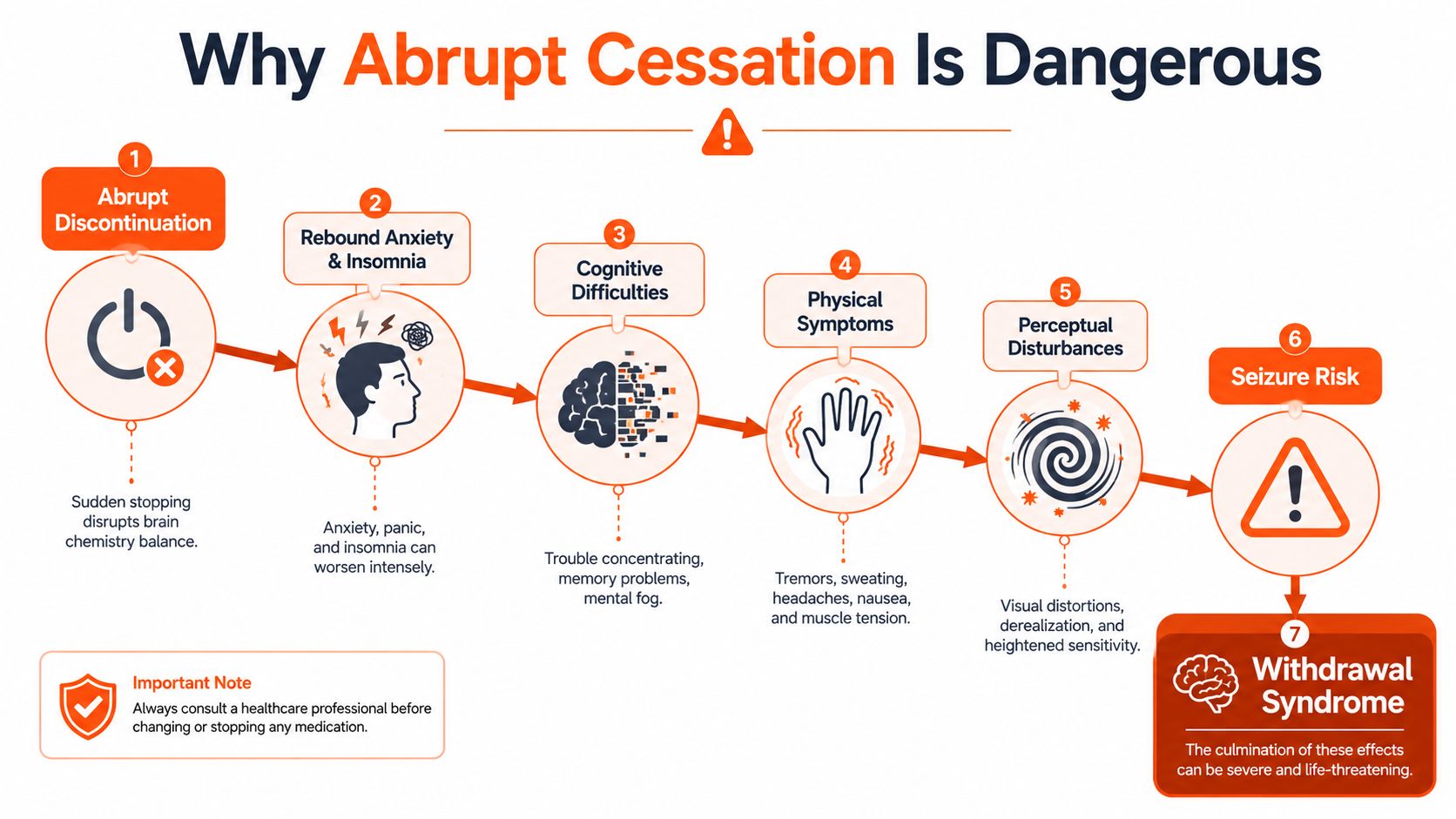
Cold turkey sounds decisive, but benzodiazepines don't usually reward decisiveness. Once the body has adapted, abrupt stopping can trigger a withdrawal syndrome that ranges from rebound anxiety and insomnia to perceptual disturbances and seizures. The risk isn't theoretical, which is why the clinical guidance emphasizes gradual tapering under supervision rather than sudden discontinuation (ASAM tapering guidance).
Physical dependence can develop after more than a month of use, especially when dosing has been regular. That doesn't mean everyone who has used a benzodiazepine for a while is addicted in the behavioral sense, but it does mean the nervous system may react badly if the drug disappears too fast.
How tapering is usually done
The common technical approach is to convert shorter-acting agents to a longer-acting benzodiazepine such as diazepam, then taper over weeks to months. That creates a smoother drop in blood levels, which usually makes symptoms more manageable and allows the clinician to adjust the pace if withdrawal shows up.
If you want a practical sense of how this is planned, this guide to what a benzo taper looks like is useful because it translates the concept into a stepwise process.
The people who need a higher level of care are usually not hard to identify. They're the ones with long duration use, high doses, co-occurring psychiatric illness, or a history of withdrawal complications. Those factors don't automatically mean inpatient treatment, but they do push the conversation toward a setting with more monitoring.
Levels of Care From Detox to Outpatient
The right setting depends less on shame and more on risk. A person with a stable job, low-dose use, good support, and no complicated medical history may be able to taper as an outpatient. Someone with prior withdrawal problems, high-dose dependence, or unstable mental health usually needs a setting with closer supervision.
Matching level of care to patient risk
| Level of Care | Best Suited For | Key Supports |
|---|---|---|
| Medically managed detox | People at higher risk of withdrawal complications | 24-hour nursing, symptom monitoring, medication adjustment |
| Residential inpatient | Long-term dependence, co-occurring psychiatric illness, or need for structure | Daily schedule, psychiatric oversight, therapy, supervised taper |
| Partial hospitalization | People who need intensive support but can sleep elsewhere | Daytime clinical programming, medication monitoring, therapy |
| Intensive outpatient | Lower-risk patients who still need frequent support | Several sessions weekly, relapse-prevention work, taper follow-up |
| Standard outpatient | Stable patients with mild dependence and good external support | Periodic visits, medication review, therapy referrals |
If you're comparing settings, the question is not “Which one is strongest?” It's “Which one matches my risk profile without over- or under-treating me?”
What each setting actually provides
Detox is about medical safety and stabilization, not complete recovery by itself. Residential care adds structure, nursing, psychiatric oversight, and separation from triggers. Outpatient programs preserve work and family routines, but they work best when the patient is stable enough to handle the taper without constant hands-on monitoring.
For some people, the decision is shaped by life logistics as much as medicine. An executive who can't disappear for a month needs a different design than someone who can fully step away, and that's a legitimate treatment issue rather than a convenience issue.
The levels of care in rehab matter here because benzodiazepine treatment isn't one-size-fits-all. The best plan is the one that keeps you medically safe and reachable in your real life.
Medications and Psychotherapy That Work
Medication alone rarely solves benzodiazepine addiction, and therapy alone usually is not enough when withdrawal risk is active. The strongest evidence-based pattern is careful tapering paired with psychological treatment, especially when anxiety, insomnia, or panic was part of the original reason the drug was started.
What the evidence supports
A review in the clinical literature found that CBT plus taper can reduce benzodiazepine use in the short term, but the effect is not sustained at six months, which is why durable recovery usually needs more than one short intervention (clinical review on treatment approaches). That does not make CBT less valuable. It means CBT is most useful when it is part of a longer relapse-prevention plan, with medication changes paced carefully enough for the nervous system to adjust.
For high-dose, long-term dependence, one specialized approach is slow subcutaneous flumazenil infusion, or FLU-SSI. A reported case series discussed this method in people treated between 2012 and 2014, and the authors described a pharmacologic “resetting” of GABA-A receptor tolerance. They also said more study is needed on dose, duration, and safety before it can be considered routine therapy.
Therapy names matter less than the job each one does
- CBT helps patients identify the thought loops that trigger use and replace them with more durable coping strategies.
- DBT is useful when emotional regulation, impulsivity, or crisis-driven use keeps showing up.
- ACT helps people tolerate distress without immediately reaching for symptom suppression.
- EMDR may help when trauma keeps driving anxiety or hyperarousal.
- Brainspotting is often used when emotional material feels hard to process in more traditional talk therapy.
The practical question is which therapy matches the problem in front of you. If the pattern is panic plus avoidance, CBT often fits. If the pattern is emotional whiplash, DBT may fit better. If trauma is driving the medication use, trauma-focused work belongs in the plan rather than being postponed until after tapering is finished.
Capo Canyon Recovery is one option that combines medically supervised detox, residential care, and evidence-based therapies in a private setting, with tech-friendly policies for clients who need to stay connected to work. That kind of structure can be useful when treatment has to fit a demanding schedule rather than replace it completely.
Dual Diagnosis and the Underlying Drivers of Use
A patient may look as if the benzodiazepine is the whole problem, but it is often the fastest tool they found for managing something else that was never fully treated. Anxiety, insomnia, chronic pain, trauma, depression, and other substance use disorders can all shape the treatment plan because the medication may have become the quickest way to blunt distress.
When those drivers stay active, the pattern tends to repeat. The person stops, feels worse, restarts, and then assumes they have failed. In practice, the larger problem is usually that the underlying condition never had a complete treatment plan.
Why integrated care works better
A PubMed-reviewed clinical summary stresses that co-occurring conditions such as chronic pain, anxiety, and insomnia should be addressed directly in treatment planning (clinical summary on co-occurring conditions). That matters because recovery is not just about removing the benzodiazepine. It also means giving the person another way to function when stress, pain, or sleeplessness returns.
A recent editorial also notes that affective symptoms such as anhedonia may predict greater benzodiazepine demand in people treated for opioid use disorder. In practical terms, emotional flatness and a reduced sense of reward can drive medication-seeking just as powerfully as anxiety does.
If a benzodiazepine first became useful because insomnia, panic, trauma, or pain were untreated, recovery has to include care for that driver. Otherwise the empty space left by the medication is usually filled quickly.
The strongest programs treat the diagnosis and the driver together. That may mean psychiatry, therapy, sleep treatment, pain planning, and substance use care in the same plan rather than in separate silos. For executives and other professionals who cannot disconnect from work, that often means building treatment around predictable meetings, protected sleep windows, and a medication plan that is stable enough to fit real-world demands without turning work stress into a trigger.
Relapse Prevention and Aftercare That Lasts
The weeks after structured treatment are where many people get overconfident or under-supported. They leave the controlled environment, the stress comes back, and the brain starts offering the old shortcut again. That's why aftercare has to be built before discharge, not improvised afterward.
What a durable aftercare plan includes
A good plan usually has ongoing psychiatric follow-up, medication monitoring, and continued therapy. It also needs practical routines around sleep, stress, travel, and family expectations, because the risk of relapse often rises when life gets busy rather than when life gets dramatic.
For a high-functioning adult returning to demanding work, relapse prevention can look very ordinary. It might include a morning check-in with a clinician, standing therapy appointments, a firm cutoff for evening work, and a written plan for what to do if insomnia or panic ramps up again.
The real timeline of recovery
Benzodiazepine recovery is often measured in months and years, not days. That's not a sign of failure. It's the reality of rewiring a nervous system that has learned to expect rapid chemical relief.
A practical aftercare structure often contains:
- Medication reviews to make sure the taper stays safe and doesn't drift.
- Sober support networks so the person isn't carrying the entire load alone.
- Sleep routines that reduce the likelihood of late-night rescue dosing.
- Stress-management habits such as exercise, breathwork, or scheduled decompression.
- Therapy for triggers so anxiety, trauma, or work pressure doesn't hijack the plan.
The goal is not to create a perfect life before discharge. The goal is to build enough support that normal life doesn't become a relapse trigger.
Executive and Professional Treatment Considerations
Executives, physicians, attorneys, founders, pilots, and other licensed professionals often face a different problem from the one most rehab brochures assume. They may need care without losing privacy, without abandoning critical responsibilities, and without a visible break that ripples through a business or practice.
That's why traditional models that ban phones and laptops can become a real barrier. For some people, the issue isn't resistance to treatment. It's that they can't disappear, and the treatment setting has to reflect that reality.
What to look for in a professional-focused program
A workable executive program usually offers privacy, small census, private rooms, 24/7 nursing, and psychiatric oversight. Tech-friendly policies matter too, because some patients need to keep up with urgent messages, legal matters, clinical schedules, or operational decisions while they're stabilizing.
The better question isn't whether a program feels luxurious. It's whether it protects safety, confidentiality, and work continuity at the same time. That includes clear boundaries around laptop and phone use, a calm environment that reduces overstimulation, and staff who understand that a patient can be both medically vulnerable and operationally responsible.
For a reader comparing options, here's the practical checklist:
- Confidentiality controls that limit exposure and protect reputation.
- Workspace-friendly accommodations so essential work doesn't stall.
- Integrated dual-diagnosis care for anxiety, depression, trauma, ADHD, or bipolar disorder when present.
- Individual therapy access that's frequent enough to move the plan forward.
- Aftercare coordination so discharge doesn't feel like free-fall.
Capo Canyon Recovery operates as a licensed detox and residential program in Mission Viejo, with 24/7 nursing, psychiatric support, private rooms, and a tech-friendly policy designed for professionals who can't fully disconnect. It's built for people who need treatment to be clinically serious and operationally realistic at the same time.
If you're trying to figure out whether your use needs supervised tapering, dual-diagnosis care, or a private residential setting, talk with a team that can assess all three. Capo Canyon Recovery offers detox and residential care with medical oversight, privacy, and support for professionals who still need to keep critical parts of life moving while they heal.