
You're probably reading this with one real situation in mind, not an abstract quality framework. Maybe you're a family member trying to understand why every provider seems to have a different story, or you're a clinician trying to keep a patient safe across detox, residential care, and aftercare without losing the thread. The care coordination benefits that matter most show up in moments like those, when one missing medication list, one delayed handoff, or one unclear follow-up plan can change the whole course of care.
In addiction treatment, the stakes get even higher when privacy matters, work can't fully stop, and mental health symptoms are part of the picture. A coordinated program doesn't just “communicate better.” It creates a visible path so the nurse, psychiatrist, therapist, case manager, family, and outside providers aren't improvising in the dark.
What Care Coordination Actually Looks Like at 3 AM
An executive arrives for medically supervised detox at 3 AM with a phone still buzzing, a co-occurring anxiety diagnosis already documented somewhere else, and a family member waiting for an update that won't violate privacy. In a fragmented setup, the overnight nurse might not have the medication list, the psychiatrist might not see prior records until later, and the employer may get called without a clear communication plan. That's how confusion grows, and confusion is expensive in both clinical and human terms.
In a coordinated setup, the first hour looks different. The nurse already has the intake record and medication history, the admitting clinician knows what matters for withdrawal safety, and the case manager has a plan for who can be contacted, when, and about what. The morning psychiatrist isn't starting from scratch, which matters when the person in bed also has anxiety, insomnia, or another mental health issue that can complicate withdrawal.
The difference is not softer care, it's fewer blind spots
The bedside value of coordination is practical. Someone has already decided who owns the medication reconciliation, who reviews outside records, and who follows up after the level of care changes. That reduces avoidable duplication and lowers the chance that one clinician makes a decision based on incomplete information.
CMS describes coordination as organizing care across multiple participants so the right clinical data reaches the right clinician at the right time, with the aim of avoiding unnecessary duplication, preventing medical errors, and delivering safe, appropriate, effective care through care coordination guidance from CMS. That's not a slogan. It's the difference between a patient being treated as a whole person and being treated as a stack of disconnected episodes.
Practical rule: if nobody can answer who is responsible for the next step, the program is not coordinated yet.
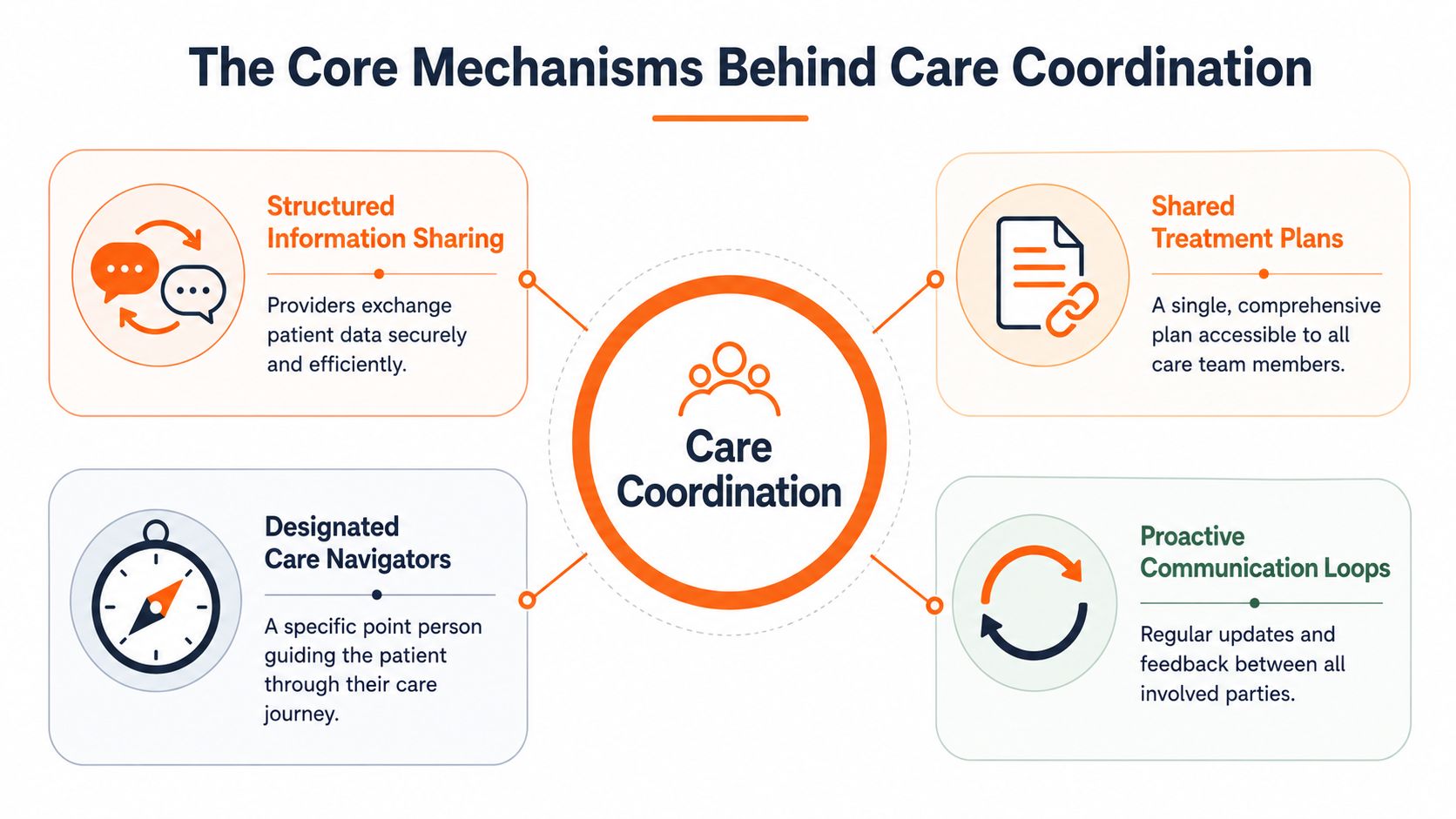
The Core Mechanisms Behind Coordination
The phrase care coordination gets used loosely, but the working parts are concrete. The program has to move information, assign ownership, and keep the plan alive as the patient moves from one setting to another. If any one of those pieces is missing, the rest starts to wobble.
Information, plans, and accountability have to travel together
Structured information sharing means the medication list, prior diagnoses, safety concerns, and outside records follow the patient instead of living in separate silos. Shared treatment plans mean every clinician is writing into one agreed roadmap, not maintaining parallel versions of the truth. Designated navigators give the patient one person who knows what happens next, which matters when people are tired, embarrassed, or overwhelmed.
Proactive communication loops are the final piece. Those are the scheduled touchpoints where the team checks whether the plan still fits, whether a transfer happened cleanly, and whether follow-up has been booked. Without them, handoffs become assumptions.
What each mechanism prevents
A good coordination process can help avoid duplicate labs, repeated history-taking, and medication conflicts that are often the result of missing context rather than bad care. It also creates faster escalation when something changes, especially during detox, psychiatric stabilization, or discharge planning. For addiction treatment, where anxiety, depression, trauma, and substance use can all interact, that kind of organized review is not administrative decoration, it's clinical safety infrastructure.
A useful way to think about it is simple. Information sharing lowers the chance of error, shared plans lower the chance of contradiction, named accountability lowers the chance of abandonment, and communication loops lower the chance that follow-up drifts away. Coordination works when those four things happen on purpose.
Benefits by Stakeholder Group
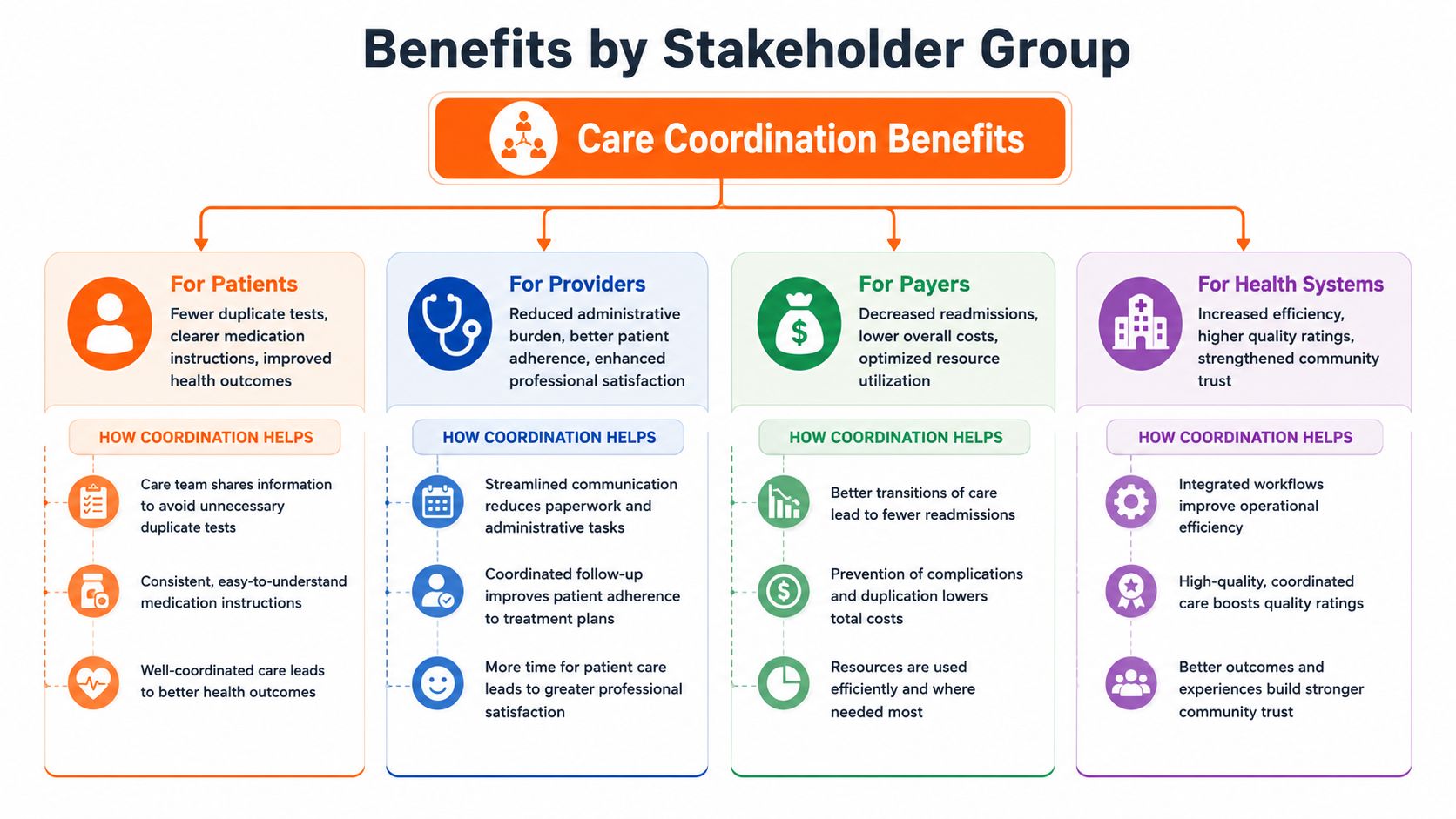
A coordination system changes different parts of care in different ways, and the bedside impact is easiest to see during a chaotic discharge or a handoff between settings. Patients experience fewer repeated questions and fewer conflicting instructions. Providers spend less time piecing together records and more time making decisions. Families get a clearer answer to a simple question, who is responsible for what next.
For patients and families
Patients benefit when the plan is clear enough to follow after a stressful admission, transfer, or discharge. Families benefit when one person can explain what is happening, what they should do, what they should not do, and which warning signs should prompt a call. In addiction care, that clarity matters even more because shame, fatigue, and information overload make it easy to miss instructions.
Privacy and dual diagnosis add another layer. In residential and executive addiction treatment, the patient may be protecting work, family, or public reputation at the same time they are trying to stay engaged in care. Coordination helps by reducing the number of times the same story has to be retold, by keeping psychiatric, medical, and substance use information aligned, and by giving the family a single contact point instead of a maze of departments. That is where coordination changes the experience from confusion to a workable plan.
For people with multiple conditions, the payoff is not just emotional. A large U.S. study found that better patient-reported care coordination was associated with better clinical performance on 9 of 13 HEDIS measures, including cancer screening and diabetes-care measures, with gaps of 5 or more percentage points on 7 measures between the highest and lowest coordination groups (study). That is a concrete sign that coordination can improve guideline-concordant care, not only satisfaction.
For providers, payers, and health systems
Providers gain a fuller picture at the point of care, which reduces the scramble to reconstruct what happened somewhere else. That matters most during transitions, when medication lists, psychiatric notes, outside records, and discharge instructions can easily drift apart. In a coordinated program, the clinician is working from one shared plan instead of trying to reconcile several incomplete versions of the truth.
Payers and health systems look at coordination differently, but the basic logic is the same. Better coordination can reduce avoidable utilization, limit duplicate work, and support stronger performance against quality benchmarks. CMS describes care coordination as a way to organize patient care activities and share information so the patient's needs and preferences are known and communicated at the right time (CMS care coordination). For health systems, that definition matters because it connects the clinical workflow to the administrative and financial side of care.
In addiction treatment, the same pattern shows up in a more demanding setting. Residential programs, executive treatment, and step-down care all depend on timing, confidentiality, and clean communication between therapists, prescribers, discharge planners, and outside clinicians. Coordination helps the program avoid duplicate assessments, reduces the chance that medication changes are missed, and makes follow-up more likely to happen after discharge. That is why families often experience coordination as relief, and why systems experience it as fewer preventable failures.
A family usually does not ask for “coordination.” They ask, “Who do I call, and what happens next?” Good programs answer that question before discharge.
Measurable Outcomes and What Good Looks Like
A handoff is only as good as what happens after it. If a program says it coordinates care, but no one can show whether patients receive follow-up, avoid duplicate work, or leave with a shared plan, the process is still too loose to trust. Good coordination leaves fingerprints in the chart, the calendar, and the next site of care.
| Metric | Evidence-Backed Signal | Strongest Population |
|---|---|---|
| HEDIS quality measures | Better coordination was associated with better performance on 9 of 13 measures, with 5 or more percentage point gaps on 7 measures (study) | Health plan and chronic-care populations |
| Savings per beneficiary-episode | $4,295 in savings over the inpatient stay plus 90 days after hospitalization in a Medicaid analysis (JAMA Network Open) | Medicaid acute care populations |
| Savings per quarter | $1,643 in savings per beneficiary per quarter versus control hospitals | Medicaid acute care populations |
| Monthly expenditures | Some Medicare demonstration programs showed 9% to 14% lower monthly expenditures, but total savings were mixed | Medicare demonstration programs |
The table is not a scorecard for every setting. It is a way to show that coordination becomes visible when you measure what changes after discharge. In detox, residential treatment, and step-down care, the same logic applies even if the metric changes. Track whether follow-up happens, whether discharge instructions reach the next clinician without delay, and whether the patient is not forced to repeat the same story at every handoff.
For residential and executive addiction treatment, the population matters as much as the metric. A dual-diagnosis executive may need privacy controls, psychiatric follow-up, and a plan that fits work continuity, so a good outcome can look like a cleaner transition rather than a dramatic intervention. A family may care less about the language of coordination than about whether the aftercare appointment is scheduled and the right people know what to expect. For that reason, programs should pair outcome data with practical checkpoints, especially around cleaner transitions into continuing care.
The cost side still matters, but it should be read carefully. In a Medicaid analysis published in JAMA Network Open, an acute care intervention tied to better coordination was associated with $4,295 in savings per beneficiary-episode and $1,643 in savings per beneficiary per quarter, along with lower emergency department use, fewer follow-up visits, and fewer hospitalizations and readmissions. Earlier Medicare demonstration evidence showed lower monthly expenditures in some programs, while total savings remained mixed, which is a reminder that results depend on how the program is built, who it serves, and how tightly the handoffs are managed.
The practical question stays simple. Are there fewer gaps, faster follow-up, and better continuity, or just a better story about teamwork?
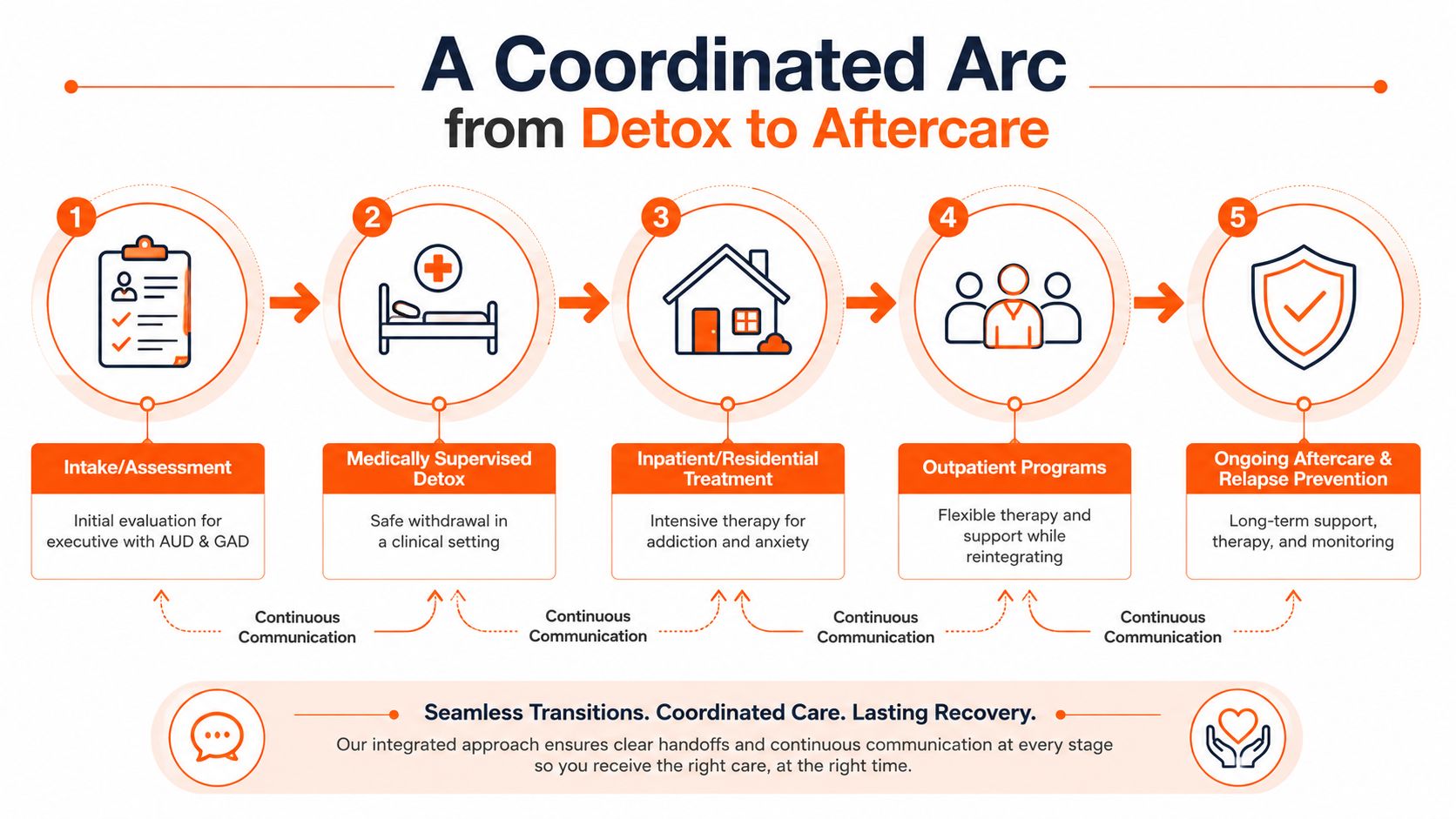
A Coordinated Arc From Detox to Aftercare
A dual-diagnosis executive often needs a path that respects both the medical risk and the professional reality. Detox is not separate from the rest of treatment, it's the first place where coordination either holds or falls apart. If the team treats each level of care as isolated, the patient spends the whole episode translating information instead of healing.
From intake to residential care
At intake, the team should identify the substance use pattern, the mental health picture, the work obligations, and any confidentiality concerns that shape communication. During detox, the clinical priorities are safety, withdrawal monitoring, and medication stabilization under 24/7 oversight. In residential treatment, the plan should expand into therapy, family involvement when appropriate, and ongoing psychiatric review so symptoms don't get treated as separate problems.
A coordinated program uses that handoff to keep the story intact. The intake summary should be available to the detox nurse, the psychiatrist, and the residential therapist, so no one starts over with a blank chart. That matters in dual diagnosis care because an anxiety spike, a sleep problem, or a medication change can affect the whole plan.
From discharge to aftercare
The transition out of residential care is where many programs lose momentum. A good handoff includes outpatient linkage, clear relapse-prevention planning, and a communication protocol that protects work responsibilities without exposing private clinical details. If the patient goes home with only a verbal promise to “follow up later,” the gap is already open.
For a structured example of continuity planning, see Capo Canyon Recovery's case management services, which are described as coordinating, planning, providing, evaluating, and monitoring services and recovery resources for the client. That kind of function matters because aftercare doesn't succeed by accident. It succeeds when someone owns the next call, the next appointment, and the next clinical update.
Implementation Elements That Make Coordination Work
Strong coordination is built, not wished into existence. Programs need a named case manager, a shared treatment plan, regular multidisciplinary review, transition protocols, family communication rules, and post-discharge linkage. Without those pieces, “coordination” becomes a label that no one can operationalize.

The operating model should be visible
A named case manager gives every client one person accountable for tracking the moving parts. A shared treatment plan keeps psychiatry, therapy, nursing, and family work aligned. Weekly multidisciplinary review helps catch changes in symptoms, medication response, or discharge readiness before they turn into last-minute surprises.
The strongest benefit signal in high-acuity and behavioral-health settings appears when coordination is paired with multidisciplinary team management and continuity controls, because fragmentation raises failure points during transitions, medication changes, and follow-up. That's especially relevant in addiction treatment, where a single missed handoff can undo a week of progress. Programs should therefore measure whether each transition had a documented owner, not just whether the patient was “told” what to do.
What to monitor in practice
- Case manager assignment: every client should know who their point person is.
- Plan sharing: nursing, psychiatry, therapy, and family work should draw from one current plan.
- Transition protocol: detox to residential, residential to outpatient, and discharge to aftercare should each have a defined checklist.
- Family communication: the program should spell out who can receive updates and under what consent rules.
- Follow-up linkage: the next appointment should be scheduled before discharge, not left to memory.
If any one of those steps is missing, the outcome metrics in the previous section get harder to move. That's why implementation matters more than branding.
Common Misconceptions About Coordination Benefits
A common mistake is to treat coordination as the same thing as being nice, responsive, or available by text. Those things help, but coordination is really about decision ownership. Who holds the medication list, who updates the plan, and who follows the patient after the level of care changes are the questions that show whether the system works.
Another misconception is that coordination always saves money. Earlier Medicare demonstration evidence from 2002 to 2006 found mixed results, with some programs showing 9% to 14% lower monthly expenditures but no net savings overall, as noted earlier. Financial return depends on design, risk, and how intensely the program coordinates care. A program that looks coordinated on paper can still miss the handoff points that drive costs.
A third misconception is that the benefits are evenly distributed across all populations. They are not. A critical review found the strongest evidence for benefit in congestive heart failure, diabetes, severe mental illness, stroke, and depression, while broader reviews also found gains in continuity, mortality, and symptom reduction in selected groups. For children with special health care needs, adequate coordination was associated with higher odds of unmet needs being filled for services like OT, speech therapy, PT, home health, durable medical equipment, and communication aids, with adjusted odds ratios ranging from 2.10 to 7.62 (AHRQ chartbook).
That is the right expectation to bring to any program. Coordination is powerful, but it is not magic, and it is not equally useful in every setting. A residential program serving executives with addiction and dual diagnosis has different pressure points than a general outpatient clinic. Privacy rules, work continuity, and family communication all change the way coordination has to be built. The question is whether the program has the right structure for the population it serves, and whether the handoffs are clear enough to hold when symptoms, schedules, or discharge plans change.
What to Look for When Choosing a Coordinated Program
Ask how many clients each case manager supports, how often multidisciplinary review happens, and whether the treatment plan is shared across detox, residential care, and aftercare. Ask how family communication is handled, how privacy is protected for executives and licensed professionals, and how the program tracks follow-up after discharge. If the answers are vague, the coordination probably is too.
A helpful comparison point is this guide on continuing treatment after executive rehab, because aftercare is where coordination either becomes visible or disappears. Capo Canyon Recovery describes a small census of about five clients, 24/7 nursing and psychiatric support across detox and residential care, at least four individual sessions weekly across disciplines, dual diagnosis treatment, a tech-friendly policy that allows cell phones and laptops, and DHCS licensing under #300359AP. Those are the kinds of concrete features families and referring clinicians should ask about anywhere.
If you need a program that treats coordination as part of clinical care, not an afterthought, Capo Canyon Recovery offers detox, residential treatment, dual diagnosis support, and case management built around private executive care. If you're comparing programs for yourself, a loved one, or a referral, visit Capo Canyon Recovery and ask how they handle transitions, follow-up, privacy, and aftercare before you make a decision.