
You can still look composed on the outside and be running on fumes on the inside. You're answering emails, showing up to meetings, maybe even hitting deadlines, but everything takes more effort than it should, sleep doesn't restore you, and your mind keeps circling the same flat, exhausted thoughts. That's not a weakness problem. It's a treatment problem, and if you want to manage depression without drugs, you need a real plan, not a pile of wellness slogans.
The right way to approach this is to treat non-drug depression care like a clinical pathway, not a motivational project. Structured psychotherapy, behavioral targets, sleep regularity, movement, and measurement all matter because depression is maintained by habits, avoidance, and physiology as much as mood. The evidence base is strong enough to justify that approach, especially for mild-to-moderate depression, where CBT has produced response rates very close to second-generation antidepressants in review literature, 45.5% vs 44.2% (BMJ Open review). A widely cited trial also reported 43% for CBT versus 50% for antidepressants at 8 weeks, with no statistically significant difference between the two (BMJ Open review).
If you want this to work, stop thinking in terms of “Should I try therapy or walk more?” and start thinking in terms of a sequence. Start with the therapy fit, add a daily structure that supports it, track whether you're improving, and know exactly when self-management is no longer enough. The point is not to prove you can white-knuckle through depression. The point is to build a path that works while your life keeps moving.
For a plain-language overview of what mental health includes, this primer is a useful anchor: What Is Mental Health?
Why Non-Drug Depression Care Deserves a Real Plan
A high-functioning person with depression often looks fine to everyone else. You are still performing, but you are doing it with dulled pleasure, slower thinking, irritability, and an energy bill that never stops climbing. That is exactly why casual advice fails. You do not need more reminders to exercise or think positive. You need a plan that respects your schedule, your privacy, and the fact that depression responds best to a structured approach rather than wishful thinking.
A strong case for a practical plan is that structured psychotherapy can work about as well as antidepressants for many people with mild-to-moderate depression. The literature is not saying medication is useless. It is saying psychotherapy is a real treatment option, not a backup for people who cannot handle care. CBT, in particular, has a serious evidence base because it targets the thought loops and avoidance patterns that keep depression in place. That matters if you want to keep working, stay private, and make decisions based on data rather than panic.
What a real non-drug plan includes
A useful plan has four moving parts. Therapy gives you a clinical container. Behavioral activation gets you moving before motivation returns. Daily structure stabilizes sleep, appetite, and stress. Measurement tells you whether the plan is working or just sounding good.
Practical rule: if your plan does not tell you what to do this week, what to measure, and when to escalate, it is not treatment. It is advice.
That also explains why broad self-help language can be misleading. The more functional you are, the easier it is to overestimate how long you can coast before symptoms force the issue. Good non-drug care is deliberate, repeated, and adjusted based on response. For a plain-language overview of what mental health includes, this primer is a useful anchor: What Is Mental Health?
Evidence-Based Therapies That Work Without Medication
The first move is to match the therapy to the problem pattern, not to the label. If depression is being driven by negative self-talk and rigid assumptions, CBT is usually the cleanest fit. If emotional flooding and impulsive reactions are taking over, DBT skills are more useful. If you keep waiting to act until you feel better, ACT pushes committed behavior in the presence of discomfort. If trauma sits at the center, EMDR deserves consideration. If you are withdrawn and inert, behavioral activation is the blunt tool that often matters most. If grief, conflict, or role transitions are driving the depression, IPT is usually the sharper option.
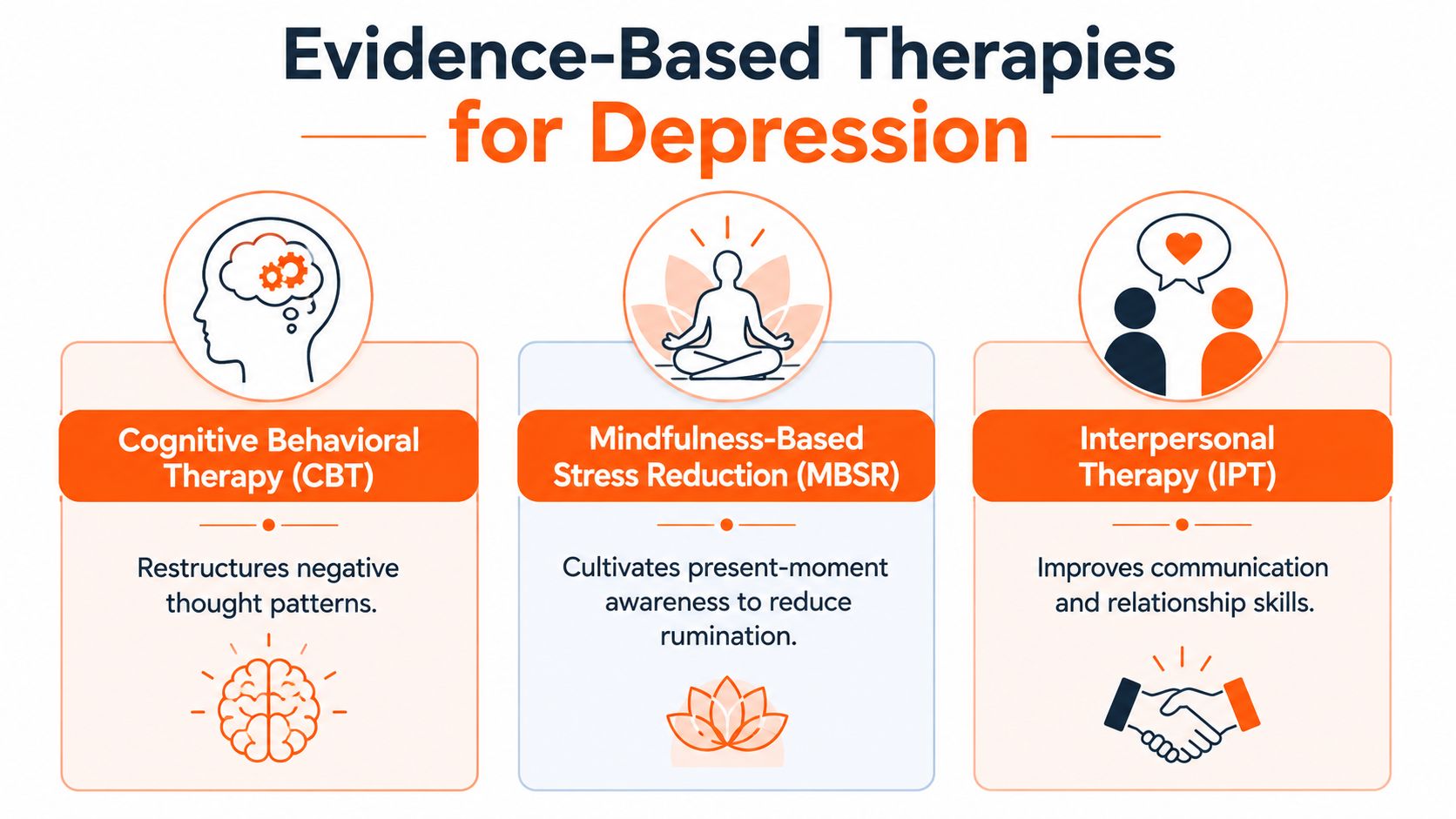
CBT deserves special attention because its evidence base is unusually strong. It is a structured treatment that targets the thought loops and avoidance patterns that keep depression in place. For a working professional, that makes it a practical starting point. It is skills-based, time-limited, and easy to measure. You can track whether the work is changing your thinking, your avoidance, and your follow-through. For a straightforward clinical overview of how CBT is framed, this page is a useful reference: Cognitive Behavioral Therapy
Therapy approaches compared
| Therapy | Primary Target | Typical Format | Best-Fit Presentation |
|---|---|---|---|
| CBT | Negative thought loops, hopeless assumptions | Weekly structured sessions | Rumination, self-criticism, perfectionism |
| DBT | Emotion regulation, distress tolerance | Weekly skills and therapy work | Mood swings, impulsive coping, overwhelm |
| ACT | Avoidance, values drift | Weekly sessions with action focus | Stuckness, fear-based inaction |
| EMDR | Trauma-linked distress | Therapist-led trauma processing | Depression tied to traumatic memory |
| Behavioral Activation | Withdrawal, inertia, low reinforcement | Weekly planning and review | Flatness, isolation, low drive |
| IPT | Grief, role transitions, conflict | Weekly interpersonal work | Relationship strain, loss, life changes |
Choosing therapy by brand name instead of by mechanism is a common mistake. If avoidance is the main problem, even a very insightful therapist has to guide you into action. If relationship conflict is driving the depression, insight alone will not fix it. Weekly contact matters because depression improves through repetition, not through isolated moments of inspiration.
Behavioral Activation Done Right
Behavioral activation is often underdone, perhaps because it feels too simple to matter. It matters precisely because depression shrinks behavior first. You stop exercising, stop answering messages, stop opening the email that makes you tense, and then your day gets smaller. Mood follows that shrinkage.
A professional example is easy to recognize. The calendar is full, but the person has stopped working out, postponed personal calls, and let unread messages stack up. The fix is not a giant life overhaul. It's one target avoidance pattern, one small mastery activity per day, and one weekly review of whether the activity happened. That's it.
A simple weekly protocol
Pick the behavior that best represents the depression loop. If isolation is the issue, schedule one call. If inertia is the issue, schedule a walk. If dread is the issue, schedule the task you've been avoiding in a smaller form. The target has to be specific enough that you can mark it complete or incomplete.
Keep the score on completion, not mood. Mood lags behind action more often than people expect.
The weekly rhythm should be boring on purpose. Put the activity on the calendar at the same time each day if possible, then review it after two weeks. If completion is low, the target was too big, too vague, or too dependent on motivation. Shrink it. If completion is steady and mood still isn't moving, that's a sign to add more structure or step up the clinical support.
For a clean framework on behavior change and recovery stages, this is a useful companion: The Stages of Behavioral Change in Recovery
The point of behavioral activation is not to “stay busy.” It's to rebuild reinforcement. Depression teaches your brain that action isn't worth the effort. Scheduled action disproves that, one repeatable win at a time.
Daily Structure That Stabilizes Mood
Sleep irregularity, sedentary days, erratic eating, and unmanaged stress all push depression in the wrong direction. People tend to treat them as four separate problems, then fail at all four. They work better as one coordinated routine. If you want your non-drug plan to hold, your day needs a spine.
The National Institute of Mental Health advises that 30 minutes a day of walking can boost mood, alongside regular sleep, healthy meals, and social connection (NIMH). That advice is basic for a reason. It's the foundation. More rigorous research supports the same direction, with home-based psychological intervention reducing post-treatment symptoms and combined psychological intervention plus exercise showing even larger effects, plus higher remission rates in the combined approach. You don't need to memorize the math to use the lesson. You need a day that doesn't constantly destabilize you.
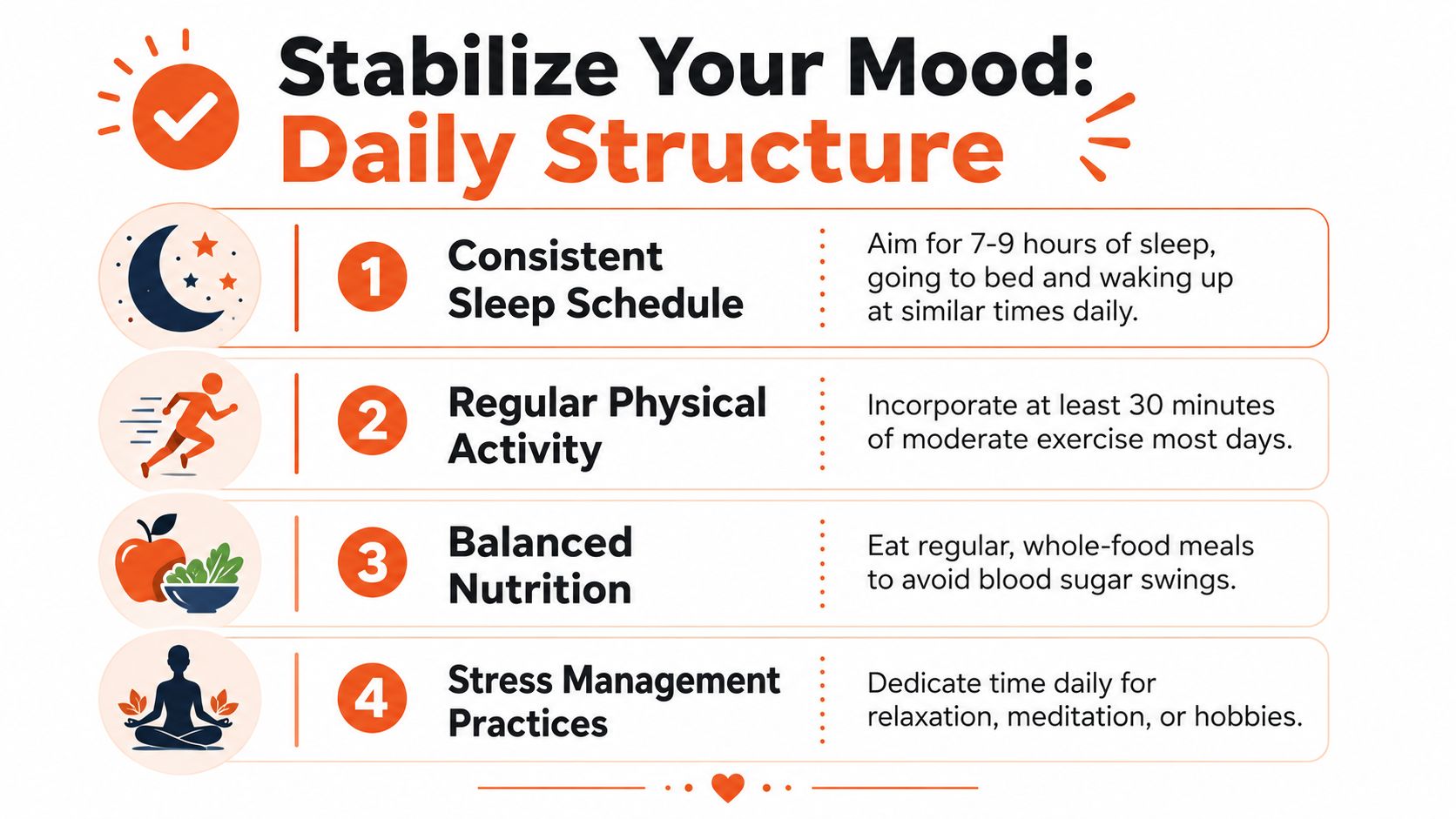
The Daily Structure That Holds
Start with a fixed wake time and a wind-down routine. That gives your nervous system a predictable start and end to the day. Keep the same sleep window as often as you can, because irregular mornings and late nights make everything else harder to maintain. Add movement at roughly the same time each day, even if it's just a walk, because consistency matters more than intensity early on.
Keep meals regular and simple. The NIMH guidance supports healthy meals, and nutrition research in the verified data points to a real risk signal around sugar intake, where men consuming 67 grams or more of sugar per day were 23% more likely to be diagnosed with depression than men eating 40 grams or less. I would not turn that into a dramatic food rulebook. I would use it as a reason to stop living on sugar spikes and crashes if mood is already fragile.
Build one short midday stress reset. That could be a breathing break, a quiet walk, or five minutes away from screens. The point is to interrupt rumination before it takes over the afternoon.
A stable routine won't cure depression by itself, but an unstable routine will keep sabotaging every other intervention.
Measuring Progress Without Obsessing
Depression tricks people into thinking nothing is changing because they're judging by feeling alone. That's a bad metric. If you're doing the work, you need a simple system that shows whether the work is adding up. The goal is not to become a spreadsheet person. The goal is to stop guessing.
Use three signals each week. First, track one short mood or symptom rating. Second, count how many behavioral activation tasks you completed. Third, write down one note about what triggered a low day. That gives you a clinical view without drowning in detail. It also keeps you from overvaluing one bad afternoon or one unusually good morning.
How to read the pattern
If mood is flat but task completion is rising, the plan may be early but working. If mood and completion are both sliding, the structure is too weak or the depression is deeper than you first thought. If low days keep getting triggered by the same thing, you've found a maintenance problem, not just a symptom.
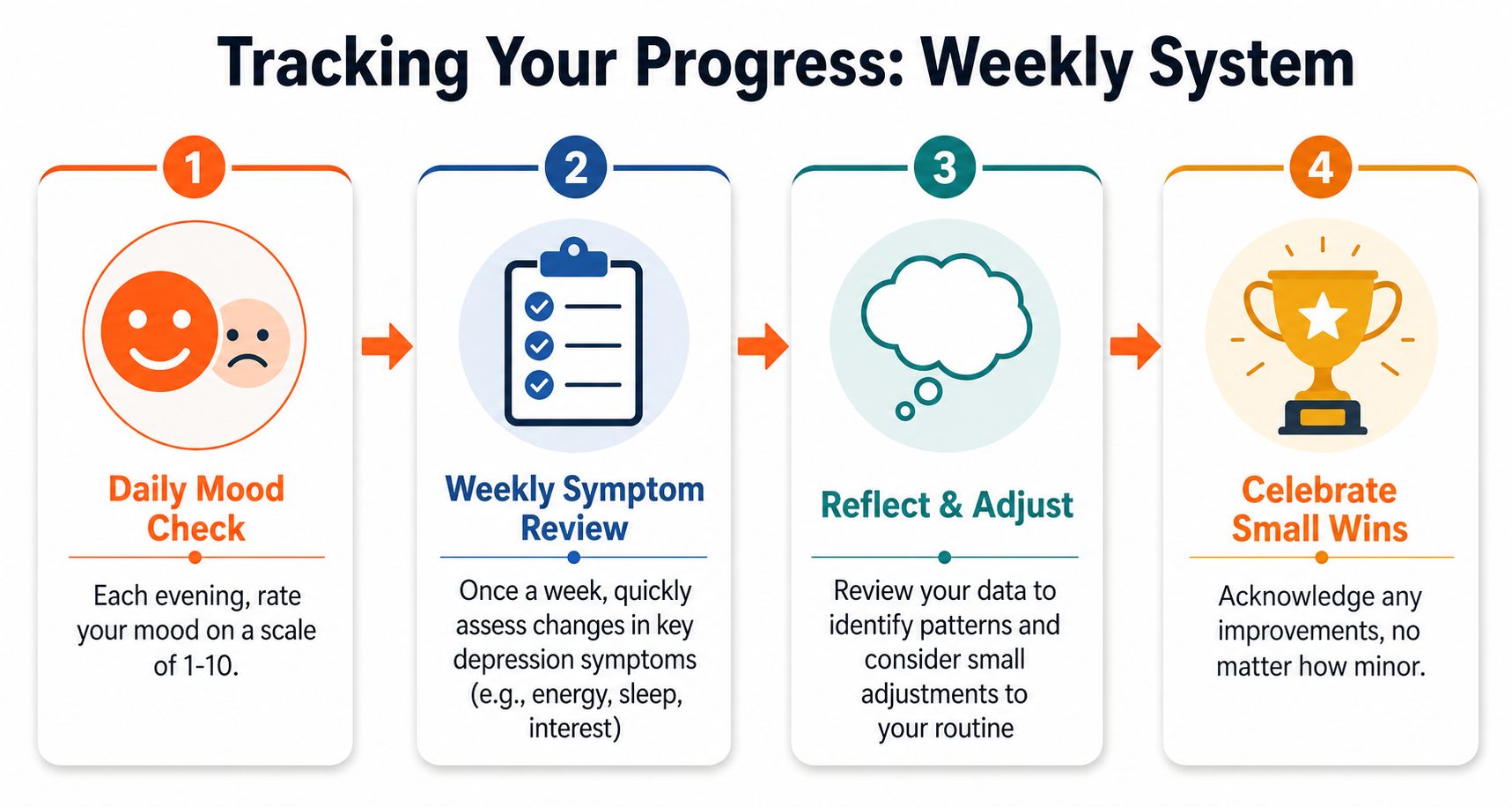
A good review cycle is weekly, with a broader read at the 4 to 8 week mark. Improvement often shows up first as better follow-through, less avoidance, or more stable mornings before it feels like happiness. That's why measurement matters. It catches progress before your mood language does.
Useful standard: if your data is unchanged for several weeks, the current plan isn't strong enough. Don't keep repeating a weak intervention and call it resilience.
When Self-Management Isn't Enough and What Comes Next
Handling depression alone is not always safer. It can be slower, more isolating, and more expensive in lost function than getting structured help early. If symptoms last more than a couple of weeks, if alcohol or other substances are creeping up, if suicidal thoughts appear, or if work performance starts slipping in ways you can't correct, stop trying to self-manage this as a solo project. Major guidance also says to seek help when symptoms persist or there's any self-harm risk (Mayo Clinic).
A real clinical step-up matters significantly. The right program doesn't just say “try harder.” It evaluates whether depression is tangled up with anxiety, trauma, insomnia, or substance use, then matches treatment intensity to the problem. That may mean psychotherapy with closer monitoring, dual-diagnosis care, or a more structured residential setting if privacy, work continuity, and symptom severity all need to be managed at once.
For executives and professionals, confidentiality is often the deciding factor. A treatment setting needs to support privacy, clinical oversight, and enough structure that you're not constantly negotiating your care around your calendar. Capo Canyon Recovery is one option that offers residential treatment with dual diagnosis care, individual therapy, and a tech-friendly environment for clients who need to keep essential work responsibilities moving while they get support.
What to look for in the next level of care
Choose a team that can assess co-occurring problems, not just mood. Look for therapists and clinicians who work in a measured way, with a defined treatment plan and regular reassessment. If the setting feels vague, unstructured, or overly generic, it's the wrong fit for a depression plan that needs precision.
A good rule is simple. If you've been trying the basics and you're still getting worse, don't confuse independence with progress. Get a structured evaluation and let the care level match the reality of the symptoms.
Bringing It All Together This Week
The non-drug path that works is built on three habits, not ten. Choose a therapy that matches the problem, schedule one daily behavioral action, and stabilize your sleep, movement, and meals so the rest of the plan has something solid underneath it. Then track one weekly mood signal, one completion count, and one trigger note so you can see whether you're improving or just hoping.
The one routine that holds it all together is a repeatable week. Same wake time, same movement slot, same therapy cadence, same review day. That's what turns depression care from a mood experiment into a treatment process.
The signal to escalate is also simple. If symptoms keep going past a couple of weeks, if substances are rising, if suicidal thoughts show up, or if work and daily life are starting to slide, stop self-managing and bring in a clinician. Depression gets harder to treat when people wait too long to ask for structured help.
Capo Canyon Recovery provides residential, clinician-led support for adults who need privacy, dual diagnosis care, and a stable daily structure while they address depression and related problems. If you need a confidential step-up that keeps essential work responsibilities in view, visit Capo Canyon Recovery and ask about a treatment plan that fits your situation.