
You're probably reading this because the usual advice hasn't fit. Maybe you're running a company, carrying a license, or protecting a reputation, and the idea of vanishing into a standard 28-day program feels unrealistic. The clinical need is real, but so is the need to stay private, keep essential work moving, and avoid a treatment plan that treats everyone the same.
That tension is exactly where evidence based addiction treatment matters. The right program doesn't just offer a list of therapies, it matches the person to the right intensity, the right medical oversight, and the right clinical mix from day one. NIDA's research-based guide makes the treatment gap impossible to ignore, by 2011, 21.6 million people age 12 or older in the United States needed treatment for an illicit drug or alcohol use problem, but only 2.3 million received it, and that gap is the reason real evidence-based care has to be more than a brochure promise (NIDA research-based guide).
The Moment a Standard Program Stops Fitting
The failure point is usually obvious. A person can still show up to work, answer emails, sit through meetings, and keep the family life from collapsing, but the drinking, pill use, or relapse cycle has stopped responding to willpower and weekend-level support. At that point, a generic program starts to look less like care and more like theater.
For executives, licensed professionals, and public-facing clients, the problem isn't just substance use. It's the collision between clinical urgency and real-world obligations. You need detox if withdrawal is unsafe, you need psychiatric support if anxiety or depression is part of the picture, and you need privacy if exposure would cost you professionally. A one-size-fits-all stay ignores all three.
Why matching matters more than the label
The strongest programs don't sell a brand name, they build a match. NIDA notes that longstanding approaches like methadone maintenance, therapeutic communities, and outpatient drug-free programs have been evaluated repeatedly and shown to be effective, which is the point, evidence-based care is a toolkit, not a slogan (NIDA research-based guide). That matters because the best fit for one patient may be detox and medication stabilization, while another needs longer residential work with dual-diagnosis psychiatry.
If a program can't tell you how it matches level of care to withdrawal risk, psychiatric complexity, and home environment, it's not really doing evidence-based treatment, it's doing intake theater.
For families and advocates, this is the moment to stop asking, “Is it a rehab?” and start asking, “Does it fit the clinical and practical reality of this person?” That shift changes everything. It moves the conversation away from marketing and toward whether the facility can treat the problem in front of you.
What Evidence Based Addiction Treatment Truly Means
Evidence based addiction treatment is a framework, not a brand. It rests on replicated clinical evidence, manualized protocols, and structured assessment that identifies what the patient needs before the first treatment day begins (PMC article on empirical validation standards). If a program uses the phrase but cannot explain how it assesses risk, severity, and fit, the term is decorative.
The three pillars that separate care from marketing
The technical standard is strict. A modality counts as empirically validated only if it shows positive outcomes in at least two randomized controlled trials, or in a large series of more than nine single-case experiments, with confirmation by at least two independent research teams. That bar exists for a reason. It keeps guesswork, fads, and personality-driven treatment cultures from passing as science.
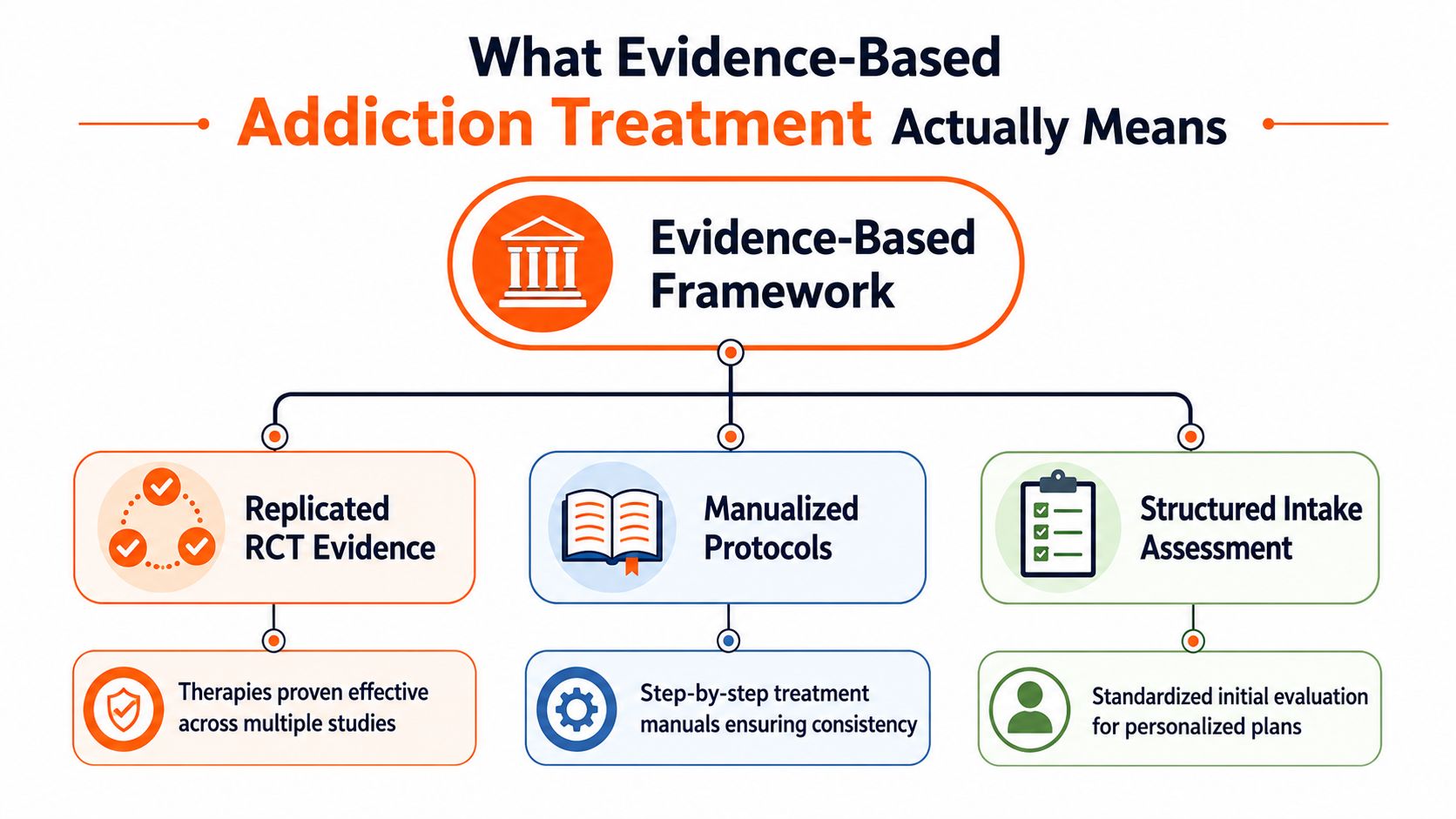
The other pillar is assessment quality. A serious intake examines withdrawal risk, psychiatric comorbidity, legal pressure, family context, motivation, and the recovery environment before deciding whether detox, residential care, or another level is appropriate. That is not paperwork. It is the mechanism that determines whether the patient gets enough structure, enough time, and enough medical support.
If you are comparing programs, ask a simple question. Does the intake lead to a clinical rationale, or just a bed offer? A credible center explains why the person belongs in a specific setting, not just why the room looks good.
For anyone dealing with mood symptoms alongside alcohol use, a useful resource is an analysis of co-occurring depression and alcohol treatment support, because untreated depression often changes the treatment plan. For a practical model of this broader approach, see Capo Canyon's evidence-based therapy overview, which reflects how a residential program should think about matching care.
The Validated Modalities That Form the Modern Toolkit
A serious program does not crown one therapy and call it treatment. It assigns each modality a job. Cognitive behavioral therapy handles thought patterns and relapse triggers, dialectical behavior therapy helps with emotion regulation and distress tolerance, acceptance and commitment therapy supports values-based action, trauma therapies address unresolved trauma, motivational interviewing supports engagement, and medication belongs in the plan when the diagnosis calls for it.

What each modality is specifically designed for
Cognitive behavioral therapy is the workhorse. It helps patients identify triggers, challenge distorted thinking, and build relapse-prevention habits. That is why programs with real relapse-prevention planning should name CBT plainly, not hide behind vague words like “therapy.” Capo Canyon's structured approach to cognitive behavioral therapy shows the kind of clinical specificity you should expect in an admissions conversation.
Dialectical behavior therapy is useful when emotional volatility, impulsivity, or self-destructive patterns shape the clinical picture. Acceptance and commitment therapy helps people act in line with values instead of staying trapped in avoidance. Motivational interviewing matters early, because many patients are ambivalent, and good clinicians know how to work with that without turning intake into a lecture.
Trauma care and medication are not optional extras
EMDR and Brainspotting belong in the plan when trauma is driving substance use, but they work as trauma-focused interventions, not as standalone addiction treatment. A credible program uses them inside a coordinated clinical strategy. Medication-assisted treatment belongs where it is clinically indicated, especially when withdrawal management or cravings require medical support. NIDA's research-based guide makes the broader point clearly, effective treatment is a matched set of interventions that have been evaluated and refined over time.
A serious program can explain why each modality is there, what symptom it targets, and what would happen if it were removed.
If a facility lists eight therapies but cannot explain indication, sequencing, and clinical ownership, it does not have an integrated model. It has a menu.
How a Real Residential Program Sequences the Care
The day starts with stabilization, not inspiration. If detox is needed, medical supervision comes first, because no amount of group processing fixes unmanaged withdrawal. From there, the program should shift into psychiatric assessment, structured individual therapy, and daily clinical observation, with the intensity rising or falling based on what the patient is doing, not what the schedule says on paper.
A credible day is structured, not crowded
A real residential schedule usually has a spine. You should see individual work, group work, psychoeducation, and case management arranged around the patient's condition and responsibilities. In a stronger executive track, that can mean multiple individual touchpoints each week across therapist, case manager, and psychiatry, plus technology access for essential professional duties so the patient doesn't have to choose between treatment and work continuity.
The specific mix matters more than the word “luxury.” A private room can support sleep and privacy, but it doesn't improve outcomes if the clinical day is thin. A strong program uses those comforts to create consistency, reduce friction, and keep the patient engaged long enough for the therapy to do its job.
What to look for in the sequence
A well-run program should be able to describe the flow in plain English:
- Detox first when needed. Safety and symptom control come before anything else.
- Psychiatric oversight early. Dual-diagnosis care belongs in the first phase, not later as an add-on.
- Individual therapy at real frequency. Not just one meeting and a group pass.
- Family work when appropriate. Addiction affects the system, not just the individual.
- Aftercare planning before discharge. A good discharge plan starts early, not on the last day.
For medication support during stabilization, a practical example is Capo Canyon's medication stabilization, which fits the kind of structured sequencing a residential program should be able to explain. When a facility can't walk you through how detox, psychiatry, therapy, and discharge planning connect, that's a warning sign.
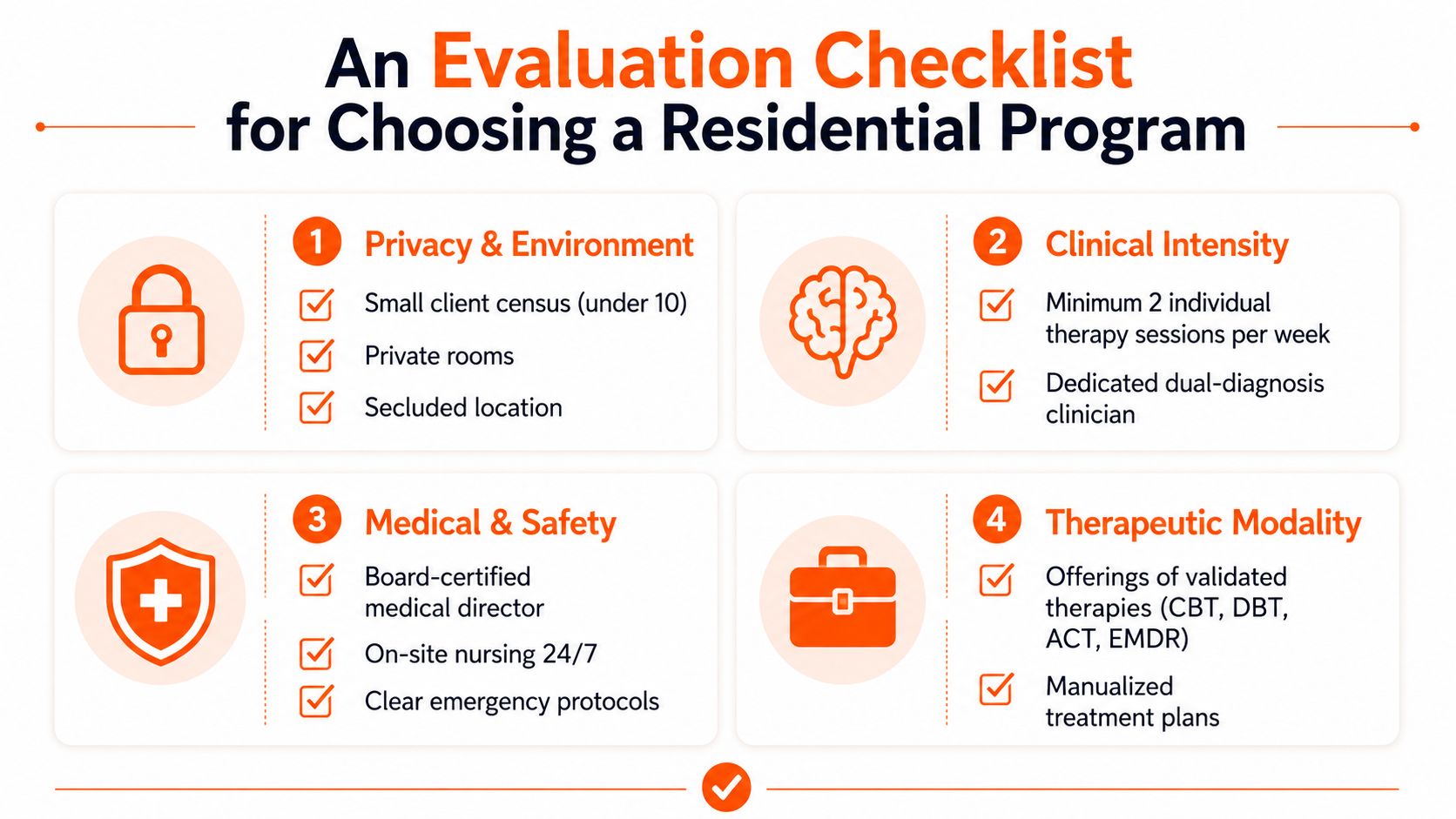
An Evaluation Checklist for Choosing a Residential Program
Don't judge a residential program by its website photos. Judge it by the questions it can answer without dodging. A private, boutique setting can be helpful, but only if it supports actual clinical depth, not just exclusivity.
The questions that expose a weak program
Start with privacy. Ask, “How many clients are on site at one time?” and “Are rooms private?” Small census matters because high-functioning clients often need discretion and more direct clinician access. Then ask whether the program is designed for executives, licensed professionals, or high-profile clients, because those settings tend to understand the pressure points better.
Move straight to intensity. Ask, “How many individual therapy sessions are guaranteed each week?” and “Is psychiatry on-site or only available by telehealth?” If the answer is vague, the program is probably group-heavy. You also want to know whether the team can treat co-occurring depression, anxiety, trauma, bipolar disorder, or ADHD without passing the patient off to a separate provider.
Safety and continuity are non-negotiable
Ask about detox coverage, nursing coverage, and emergency protocols. A serious center should be able to explain who is on site, who responds after hours, and how medication changes are monitored. If the answer sounds improvised, keep looking.
Then ask about aftercare. A good residential program doesn't treat discharge as a paperwork event; it coordinates the next phase of care and keeps the plan realistic. For families and executives, that matters because the test is what happens when the patient leaves the building.
If a center won't answer direct questions about staffing, therapy frequency, and psychiatric oversight, assume the brochure is doing the heavy lifting.
One more issue deserves attention, insurance and self-pay transparency. Admissions should clearly explain coverage verification, private-pay options, and what is included. If billing is fuzzy before admission, it usually gets worse after admission.
Why Access Still Fails Even When the Evidence Is Strong
The hard truth is that good treatments don't automatically reach the people who need them. SAMHSA says less than 10% of people who need treatment have sustained access to care, and that number captures a system problem, not a knowledge problem (SAMHSA low-barrier models advisory). We know more than enough about what helps. The failure is often in delivery.
The obstacles are practical, not philosophical
The barriers are familiar, and they're ugly in real life. Stigma keeps people quiet. Inadequate training leaves clinicians underprepared. Financial barriers block admission. Regulatory restrictions can slow medication treatment. And if the setting isn't integrated, the patient ends up bouncing between therapy, medicine, and crisis care instead of receiving one coordinated plan (SAMHSA low-barrier models advisory).
For executives and professionals, the barrier stack is even tighter. Privacy concerns can stop a person from making the first call. Continuity-of-work concerns can delay care until a crisis forces the issue. Reputational risk can make an otherwise rational person choose delay over treatment. That's why discreet, low-friction entry matters so much.
The next frontier isn't inventing a new therapy. It's making proven care easier to enter, easier to stay in, and easier to complete.
That's also why integrated and trauma-informed models are getting more attention. They reduce friction and make treatment usable for people who can't disappear from their lives for a month. In practice, the best program is often the one a high-functioning person can say yes to today.
What Executives and High-Profile Clients Require
Executives, entrepreneurs, physicians, attorneys, pilots, and other high-profile clients usually need a different structure than the average residential stay. Privacy matters, but privacy alone is not enough. They need a program small enough to know them, medically prepared enough to stabilize them, and flexible enough to respect the fact that treatment starts without pausing the rest of their life.
The essential requirements are clinical, not cosmetic
A small census matters because it protects confidentiality and gives clinicians more time on actual treatment. Private rooms matter because they support rest, work coordination, and emotional containment. 24/7 nursing matters because withdrawal and medication stabilization do not follow office hours. On-site psychiatry matters because dual-diagnosis care cannot be treated as an afterthought for high-functioning clients with depression, anxiety, trauma, or attention problems.
Capo Canyon Recovery is one example of a licensed Mission Viejo program built around these realities, with a confidential residential setting, tech-friendly access, and executive-oriented care. If you are comparing options, a corporate transportation guide for executive client logistics can help with the details of getting a client to and from admission discreetly, but transportation is just transportation. It does not substitute for a clinically serious program.
Amenities only matter if they support treatment
Chef-prepared meals, Wi-Fi, and desk space are useful only when they help a client stay engaged in therapy and stay medically stable. They are not the reason to choose a center. The reason to choose a center is whether it can deliver real assessment, real psychiatry, real medication management, and enough individual contact to change behavior.
Ask direct questions. Is there a dedicated dual-diagnosis clinician? How often does psychiatry see the client? Can the team keep treatment intensity in place while allowing essential work access? If the answers stay vague, the setting may look premium but function like a thin program with a nicer lobby.
Making the Decision This Week
The decision should come down to four things, private space, real assessment, daily medical and psychiatric support when needed, and enough individual therapy to match the diagnosis. Nice extras can help with comfort, but they're not the clinical standard. If a program can't explain its matching process, staffing, and aftercare, keep moving.
Schedule an admissions call with a licensed center that can walk you through detox coverage, dual-diagnosis capability, and weekly therapy frequency in plain language. Waiting for a crisis is not a strategy. It's a risk factor.
Capo Canyon Recovery in Mission Viejo offers licensed detox and residential care with private rooms, executive-oriented support, and evidence-based treatment planning for substance use and co-occurring conditions. If you need care that respects privacy while still meeting a serious clinical standard, visit Capo Canyon Recovery and ask the admissions team how they match treatment intensity to your situation.