
You're in treatment, or you're getting ready to enter it, and the practical question is already on the table. Which medications should stay, which should change, who's watching for side effects, and how do you keep this private while you're still managing work, family, and recovery?
Psychiatric medication management is the clinical process that answers those questions in real time. In residential care, it's not a single prescription and a handshake. It's a monitored plan that accounts for symptoms, withdrawal, sleep, substance use, diagnostic uncertainty, and the fact that the right medication today may need adjustment next week.
In the United States, psychiatric medication is already a major part of treatment. The CDC reported that in 2020, 16.5% of adults had taken prescription medication for their mental health in the past 12 months, out of 20.3% who had received any mental health treatment, and that medication use exceeded counseling or therapy alone in that same year (CDC data brief on mental health treatment). That matters because it shows how central medication is for many people who are trying to stay functional while they heal.
What Psychiatric Medication Management Means in Recovery
An executive can arrive in treatment looking composed and still be clinically complex. The surface story may be anxiety, depression, burnout, or insomnia, while the fuller picture includes alcohol, stimulants, cannabis, withdrawal, old prescriptions, and a calendar that never stopped moving.
Psychiatric medication management is a repeating clinical process. It asks, at each step, whether the current medication still fits the current patient. In dual diagnosis care, the plan has to account for mood, sleep, cravings, cognition, safety, and the possibility that a substance has been masking or intensifying symptoms all along.
Practical rule: if the history is incomplete, the medication plan has to stay flexible until the team sees how the patient responds in a stable setting.
For many people, the first real benefit of residential treatment is not the first pill. It is the fact that the medication plan finally gets observed closely enough to be adjusted with discipline. Psychiatry, nursing, and therapy can then work as one system, with each discipline adding a different kind of clinical information.
If you are comparing levels of care, medication stabilization in residential treatment is the right lens. The goal is steady symptom control without creating new problems that later have to be undone.
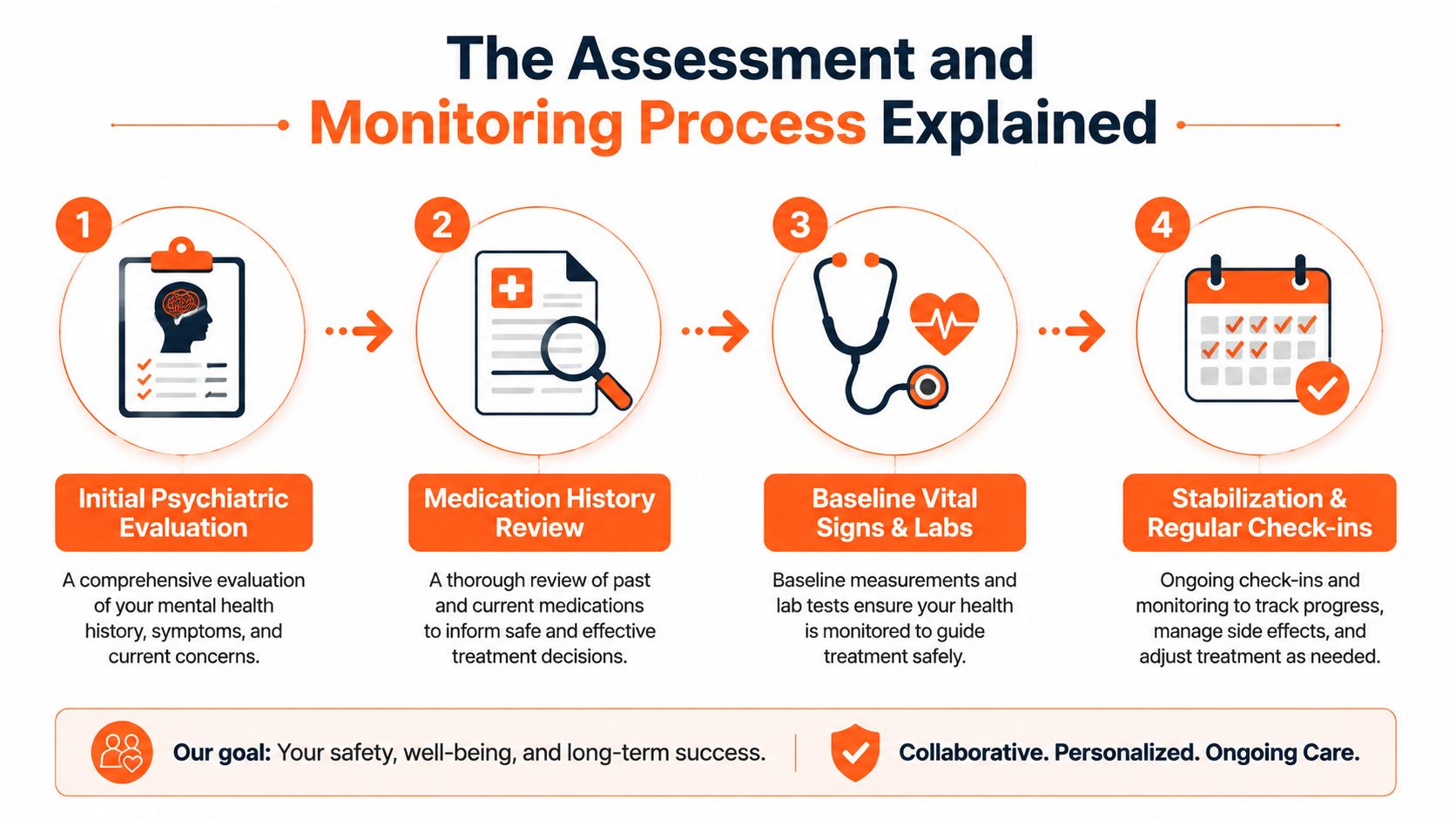
The Assessment and Monitoring Process Explained
A residential intake should start by clarifying what is being treated. In executive-level care, that means sorting out symptoms that were present before admission from symptoms shaped by alcohol, stimulants, cannabis, withdrawal, sleep loss, or a medication change that never got followed closely enough.
The evaluation has to rebuild the clinical picture from several sources when records are thin. A psychiatrist may rely on direct interview, collateral input when appropriate, nursing observations, and what the patient does over several days in the program. That matters because one office visit rarely shows the full pattern. Residential care does.
Vital signs and lab timing also matter. Lithium is a standard reference point in psychiatric medication management because it has a narrow therapeutic index and must be monitored with timed blood levels. Clinical reviews describe its half-life as roughly 14 to 30 hours, note that steady state is usually reached in about 5 to 7 days, and recommend drawing blood 12 ± 1 hours after the last dose. See the review on lithium monitoring for the clinical details.
What the first days usually involve
The first phase usually combines psychiatrist evaluation, medication reconciliation, and nursing observation. Staff review current prescriptions, recent stops, past adverse reactions, and any overlap that could raise the risk of sedation, activation, or toxicity. If the patient arrives with incomplete records, the team has to work from the medication list in front of them, not from assumptions.
That process is more cautious when the diagnosis is still unsettled. A stimulant withdrawal picture can resemble depression. Alcohol withdrawal can look like anxiety or agitation. A prior antidepressant may have helped once, or it may have worsened sleep, mixed symptoms, or impulsivity. In a confidential setting, the team has to sort out those trade-offs without rushing to a clean label that the history does not support.
- Initial Psychiatric Evaluation. The psychiatrist reviews symptoms, risks, prior treatment, and current medications.
- Medication History Review. The team checks for interactions, duplication, abrupt stops, and past adverse reactions.
- Baseline Vital Signs and Labs. Nursing and medical staff establish a safe reference point for follow-up.
- Stabilization and Regular Check-ins. The plan is adjusted as the patient's response becomes clearer.
Monitoring continues after the first order is written. For lithium, follow-up is recommended after initiation, after dose changes, and whenever toxicity, relapse, or nonadherence is suspected. That same logic applies to medication-assisted treatment, where the clinical question is never only whether a drug was prescribed, but whether the dose, timing, side effects, and recovery goals still fit the patient. A prescription can be handed out in minutes. A protocol creates accountability over time.
Common Medication Classes for Co-Occurring Disorders
A medication plan in dual diagnosis care starts with the problem the team is trying to solve. The same drug can be reasonable in one case and a poor fit in another if the symptom pattern, substance history, sleep, and side effect tolerance point in different directions. In confidential residential treatment, that decision also has to fit the pace of therapy and the privacy expectations of an executive-level setting.
How clinicians usually think about the main classes
| Medication Class | Primary Uses | Key Monitoring Considerations |
|---|---|---|
| Antidepressants | Depression, anxiety, PTSD, OCD symptoms | Sleep changes, activation, interaction risk, delayed response |
| Mood stabilizers | Bipolar spectrum symptoms, mood swings, irritability | Timing, blood levels when indicated, signs of toxicity |
| Anti-anxiety agents | Acute anxiety, panic, agitation | Sedation, dependence risk, effect on recovery goals |
| Antipsychotics | Severe mood instability, psychosis, agitation, augmentation | Metabolic effects, daytime sedation, movement side effects |
| ADHD medications | Attention and impulse-control problems | Misuse risk, appetite and sleep effects, diagnostic clarity |
Antidepressants are often chosen when the goal is to build a steadier baseline rather than to create immediate sedation. Mood stabilizers become part of the discussion when the history suggests cycling moods, impulsivity, or a pattern of worsening after antidepressant exposure. Antipsychotics may be used for acute stabilization or for augmentation, especially when sleep, agitation, or thought organization need closer control.
For people with overlapping substance use, the balance is therapeutic benefit on one side and assessment clarity plus dependence risk on the other. The medication should reduce distress enough to support recovery work, while still allowing the team to see what symptoms remain and why. That is one reason experienced programs treat medication as one part of a larger protocol, with psychiatry, nursing, and therapy all watching for different pieces of the picture.
Lithium is a good example of why monitoring matters. Clinical guidance calls for follow-up after initiation, after dose changes, and whenever toxicity, relapse, or nonadherence is suspected, because the margin between benefit and harm can narrow quickly if the regimen drifts. That same discipline applies to medication-assisted treatment concepts, where the question is whether the medication, the dose, the timing, and the side effects still support the patient's recovery goals. A prescription can be written quickly. A protocol keeps the plan accountable over time.
Medication Safety During Detox and Early Stabilization
Detox is a period where medication errors become more likely if staffing is thin or the process is rushed. A patient may arrive with a long-standing psychiatric regimen, then immediately face withdrawal, sleep disruption, and symptoms that can look psychiatric even when part of the picture is physiologic.
Abrupt discontinuation is a poor default for that reason. Some medications need a taper rather than a stop, and the team has to separate withdrawal from relapse instead of assuming every distress signal means the original diagnosis has worsened. Nursing observations matter because they catch changes that a once-daily check-in can miss.
Continuity of care during detox keeps patients safer than reactive medication changes.
In a residential setting, 24/7 nursing support gives the team a chance to watch for sedation, dehydration, blood pressure changes, agitation, and emerging side effects while the medication plan is being refined. That matters especially early on, when the patient's history is still settling and the line between detox symptoms and psychiatric symptoms can be hard to draw. 24-hour nursing during detox supports that close monitoring and gives the team a clearer view of what is medication-related and what is part of withdrawal.
The operational piece matters just as much as the clinical one. Therapy needs to know whether fatigue or agitation is tied to medication. Psychiatry needs to know whether the patient slept, ate, or decompensated overnight. Nursing needs to know what changed after the last dose. In confidential residential care, that coordination is what keeps medication decisions tied to real-time observations instead of assumptions.

Navigating Diagnostic Uncertainty and Incomplete Records
A lot of people enter care without clean records, and some enter without a diagnosis that has been tested over time. That's not a minor paperwork issue. It changes the medication risk profile.
A rapid review found there are “no widely accepted clinical guidelines” and “little to no research” for prescribing in transition and low-threshold settings, and it specifically warns clinicians to screen for prior manic, hypomanic, or mixed symptoms before treating depression because undiagnosed bipolar disorder can alter medication choice and risk (rapid review on prescribing in uncertain settings). That's the kind of caution most consumer content leaves out, even though it's one of the main reasons residential medication management exists.
What good clinicians watch for
- Mood history that doesn't fit a simple depression narrative. Past bursts of energy, decreased sleep, impulsive decisions, or mixed symptoms change the whole plan.
- Medication overlap. Multiple prescribers can mean duplicated drugs, conflicting instructions, or side effects that get mistaken for new illness.
- Symptom timing. If symptoms rise and fall with substance use, withdrawal, or medication changes, the diagnosis may still be evolving.
- Family and collateral history. People often remember episodes or patterns the patient left out, whether by design or because the timeline is hard to reconstruct.
The point isn't to delay treatment indefinitely. It's to avoid locking in the wrong treatment too early. A high-touch residential model gives the team time to stabilize first, then refine the diagnosis with more confidence, which is a much safer sequence when the history is messy.
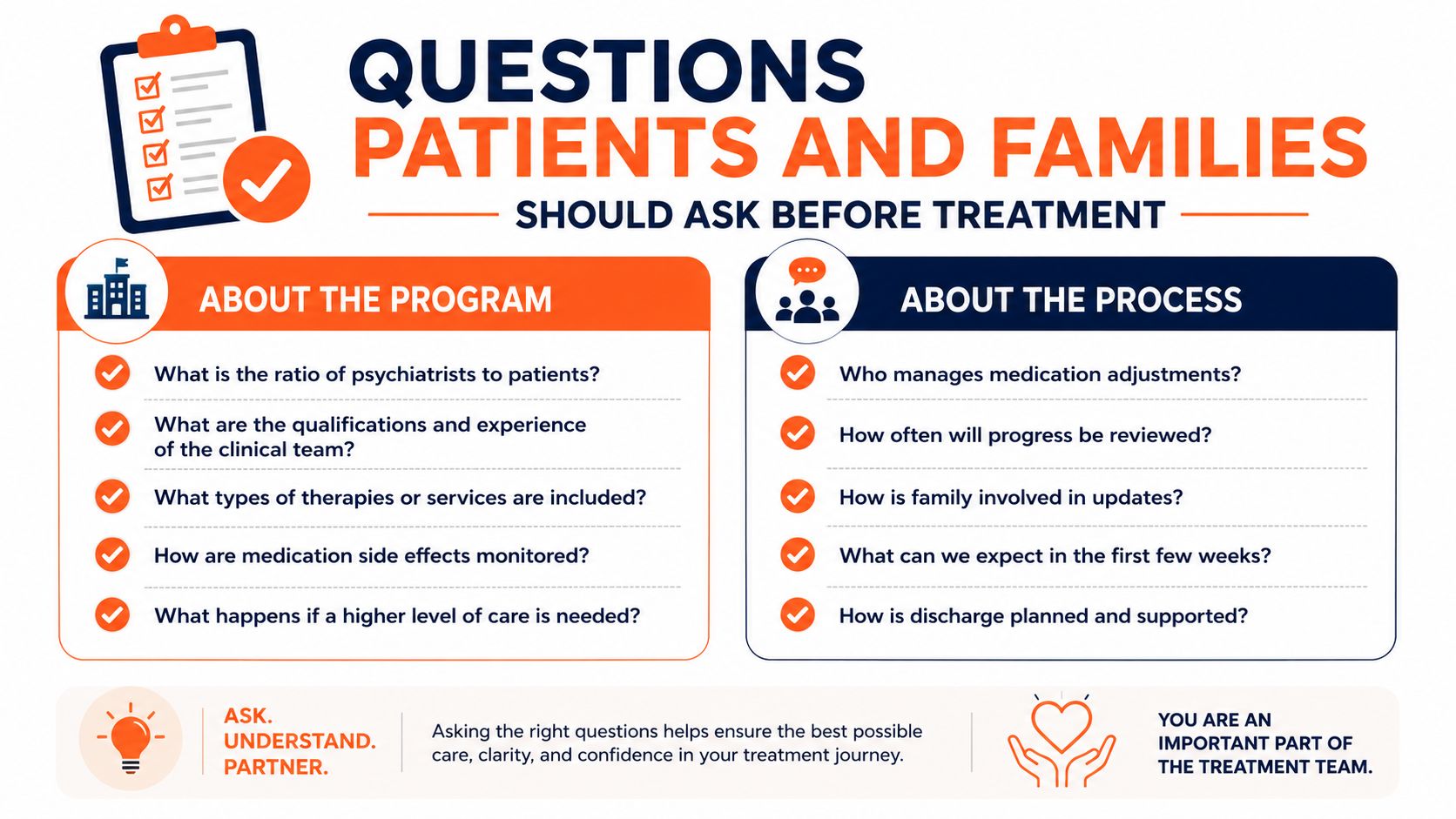
Questions Patients and Families Should Ask Before Treatment
If a program says it offers psychiatric medication management, ask how that looks on an ordinary Tuesday, not just on paper. The answer should tell you whether the care is individualized or just administrative.
About the program
- Who prescribes and monitors the medications? You want clarity on whether psychiatry is on-site, available regularly, and integrated with the rest of the team.
- How are side effects tracked? Good programs use nursing observation, scheduled follow-up, and direct patient reporting, not casual check-ins.
- What happens if the diagnosis changes? The team should be able to explain how they revise the plan when bipolarity, trauma, ADHD, or substance-related symptoms become clearer.
About the process
- How fast are medication changes reviewed? In a residential setting, slow administrative turnaround is a weak sign.
- Who tells therapy and nursing about the change? If psychiatry works in isolation, the plan will be less safe.
- How is family communication handled? Families need updates, but only within the patient's confidentiality boundaries and consent.
A strong program doesn't just answer these questions. It answers them in plain language. For executives and licensed professionals, that matters because privacy concerns are real, and vague reassurances don't substitute for a defined process.
How Capo Canyon Recovery Delivers Executive-Level Medication Management
A confidential residential setting can still be clinically precise, and that combination is what many professionals need when work can't stop. Capo Canyon Recovery operates as a boutique program in Mission Viejo with 24/7 nursing and on-site psychiatric support, a small census of about five clients at a time, and minimum four weekly individual sessions that involve therapy, case management, and psychiatry.

The practical advantage is straightforward. Medication changes can be watched closely, therapy can feed real-time observations back to psychiatry, and nursing can flag problems early instead of waiting for the next appointment. The tech-friendly policy also matters for executives and professionals who need to remain reachable for essential responsibilities without turning treatment into a public event.
That model fits the actual pressure many high-performing people are under. They need care that respects confidentiality, keeps treatment coordinated, and doesn't treat privacy as an afterthought. In programs like this, medication management isn't separated from the rest of residential care, it's part of the same coordinated structure that helps people stabilize without losing their footing.
If you're evaluating private treatment for yourself or a family member, start with the medication process, not the brochure language. Capo Canyon Recovery can walk you through how psychiatric medication management, detox oversight, and residential therapy work together in a discreet setting, so you can ask sharper questions and choose care with confidence.