
You're probably doing this at the worst possible time, after a long night, a hard conversation, or a moment that made it clear something has to change now. You typed inpatient treatment near me because you want a bed, a plan, and a real answer, not a page full of generic rehab blurbs and sponsored listings.
That frustration is justified. In the U.S. treatment system, true inpatient options are a small slice of the market, while outpatient care dominates facility offerings, which is why the search results often feel misaligned with the problem you're trying to solve. If someone is medically unstable, dealing with withdrawal, or needs a controlled environment because home is not workable, proximity matters, but clinical fit matters more.
Why This Search Is Harder Than It Looks
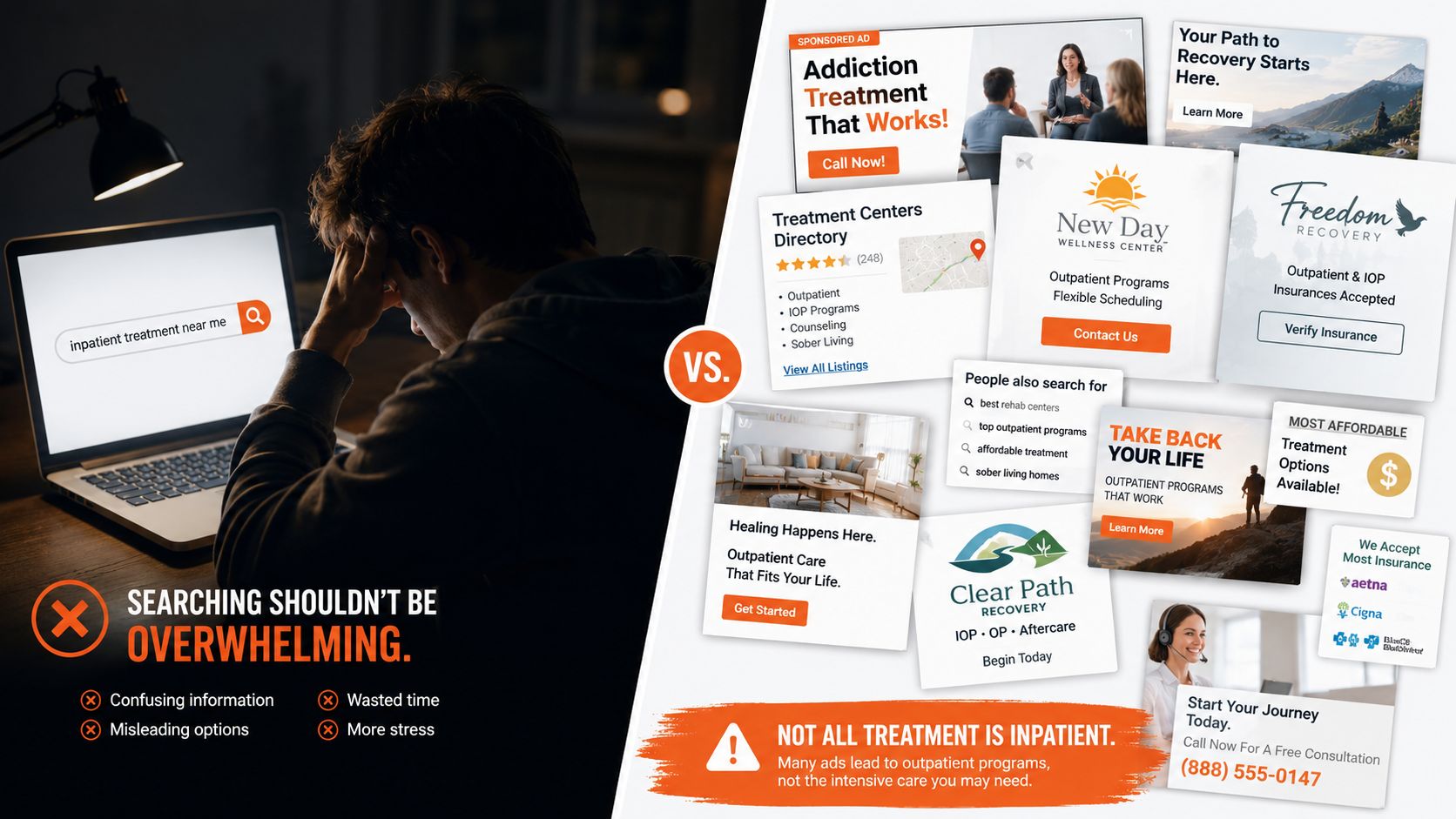
A lot of people start the same way. It's late, the laptop is open, and someone is typing inpatient treatment near me while a spouse, adult child, or assistant stands nearby trying to sort through the options. The screen fills with ads, directories, and outpatient clinics that all sound helpful until you realize they are not overnight programs.
The hard truth is that the market is skewed. Analysts at the Urban Institute analysis found that inpatient treatment is offered by only a small slice of substance use treatment facilities, while outpatient care is far more common and residential care sits somewhere in between. That is why your map results look crowded, but the actual options feel thin.
Read the search as a fit problem
The mistake is treating this as a geography question. The core question is what level of care this person needs and which nearby facility can deliver it. If the person needs overnight supervision, psychiatric backup, detox support, or dual-diagnosis treatment, a nearby outpatient office is the wrong answer no matter how polished the website looks.
A second structural issue matters too. Many facilities focus on one part of the problem, not both. If depression, trauma, bipolar disorder, ADHD, or anxiety is part of the picture, you cannot assume every “inpatient” label means integrated care. A facility should be able to tell you plainly whether it treats co-occurring mental health conditions and how that care is built into the program.
Practical rule: If a facility cannot clearly tell you who supervises overnight care, how withdrawal is handled, and whether it treats co-occurring mental health conditions, keep looking.
The right mental model is simple. Search for the level of care, then sort by location, privacy, insurance, and specialty needs. For a more local lens on choosing the right facility, the same logic applies to finding the right locally based treatment, where the best option is the one that matches the problem, not the one that appears first.
That lens matters even more for professionals who cannot fully step away from work. A true fit has to account for privacy, communication limits, and whether the program can handle a person who needs treatment without turning their entire life upside down. If you are comparing high-touch travel decisions with the same level of scrutiny, the logic is similar to how people find luxury jets for ski trips, where the question is whether the service fits the trip.
What Inpatient Treatment Means
Inpatient treatment is an overnight, supervised level of care. In substance use and mental health settings, that usually means the person lives on site, follows a structured therapy schedule each day, and can reach nursing or medical staff quickly if withdrawal symptoms, psychiatric distress, or other complications appear. The distinction from lower-intensity care is straightforward, coverage is continuous.
That is what separates inpatient care from outpatient therapy, intensive outpatient programming, and sober living. Weekly counseling can help, and it can support recovery, but it is not inpatient care. If someone goes home each night, they are not in a 24/7 clinically supervised setting.
Residential, inpatient, and what marketing sometimes blurs
Some facilities use the word residential loosely. In practice, residential or inpatient addiction treatment is generally a 24/7 live-in level of care with structured daily therapy, continuous supervision, and the ability to respond quickly when symptoms escalate (Start Your Recovery). In hospital-style inpatient settings, nursing is available around the clock, and a physician or advanced practice provider is often on-site 24/7.
That distinction matters because some programs sound immersive but function more like group housing. If a center offers beds but no meaningful medical coverage, it may be a step-down or housing model, not true inpatient treatment. Do not let a polished admissions page replace a direct answer about supervision, nursing, and medical response.
If the person needs withdrawal monitoring, psychiatric stabilization, or a safe reset away from daily stressors, overnight supervision is the point. Anything less is a different service.
The cleanest way to think about it is simple. Inpatient care is for people who need to be observed, supported, and stabilized while they begin recovery. It is not just a place to sleep while attending therapy. It is a treatment setting where the environment itself is part of the intervention. For a fuller comparison of care levels, see the difference between outpatient and inpatient rehab.
Inpatient vs Detox, PHP, and IOP at a Glance
A lot of confusion disappears once you place each service on the continuum. Detox handles withdrawal. Inpatient and residential programs provide around-the-clock structure. PHP and IOP keep people in treatment for much of the day but send them home at night. Standard outpatient is lighter still.
| Level of Care | Supervision | Medical Coverage | Typical Stay | Best Fit |
|---|---|---|---|---|
| Detox | High during withdrawal | Medical monitoring focused on stabilization | Short-term | People with acute withdrawal risk |
| Inpatient / Residential | Continuous, 24/7 | Nursing, and in some settings physician or advanced practice oversight | Often 30 to 90 days | People who need overnight structure and support |
| PHP | Daytime clinical structure | Limited compared with inpatient | Usually more intensive than IOP | People who need strong support but can safely sleep at home |
| IOP | Several hours per week | Limited | Step-down or entry point for some | People with stability, transportation, and home support |
| Standard outpatient | Scheduled visits | Minimal | Ongoing | People with lower acuity and stable routines |
Detox alone is not a substitute for residential treatment. It can manage withdrawal, but it does not replace the daily therapy, supervision, and stabilization work that inpatient care provides. The better question is not “Do I need detox or rehab,” it's “What comes after detox if the person still can't safely function at home?”
When a lower level is enough
If the person is stable, medically safe, and has a supportive home environment, PHP or IOP may be enough. Those options can work well when the main need is structure, accountability, and therapy rather than overnight containment. They're also easier to fit around family obligations, work, and transportation.
For a more detailed comparison of those trade-offs, see outpatient vs inpatient rehab.
The direct takeaway is this. If someone needs constant monitoring, inpatient is the right conversation. If they need intensive support but not sleep-on-site care, don't overbuy a higher level just because it sounds more serious.
Signs Inpatient Care Is the Right Next Step
The strongest signal is clinical risk. If withdrawal could become dangerous, if there's been a recent overdose, or if the person has already failed outpatient treatment, inpatient care deserves immediate attention. The same is true when substance use is tangled with depression, trauma, bipolar disorder, or another psychiatric condition that needs more than weekly follow-up.
The other signal is the home environment. If the person can't stay safe, can't stop using at home, or is living in a chaotic setting with no real support, then “try harder outpatient” is lazy advice. It ignores the fact that environment drives relapse risk.
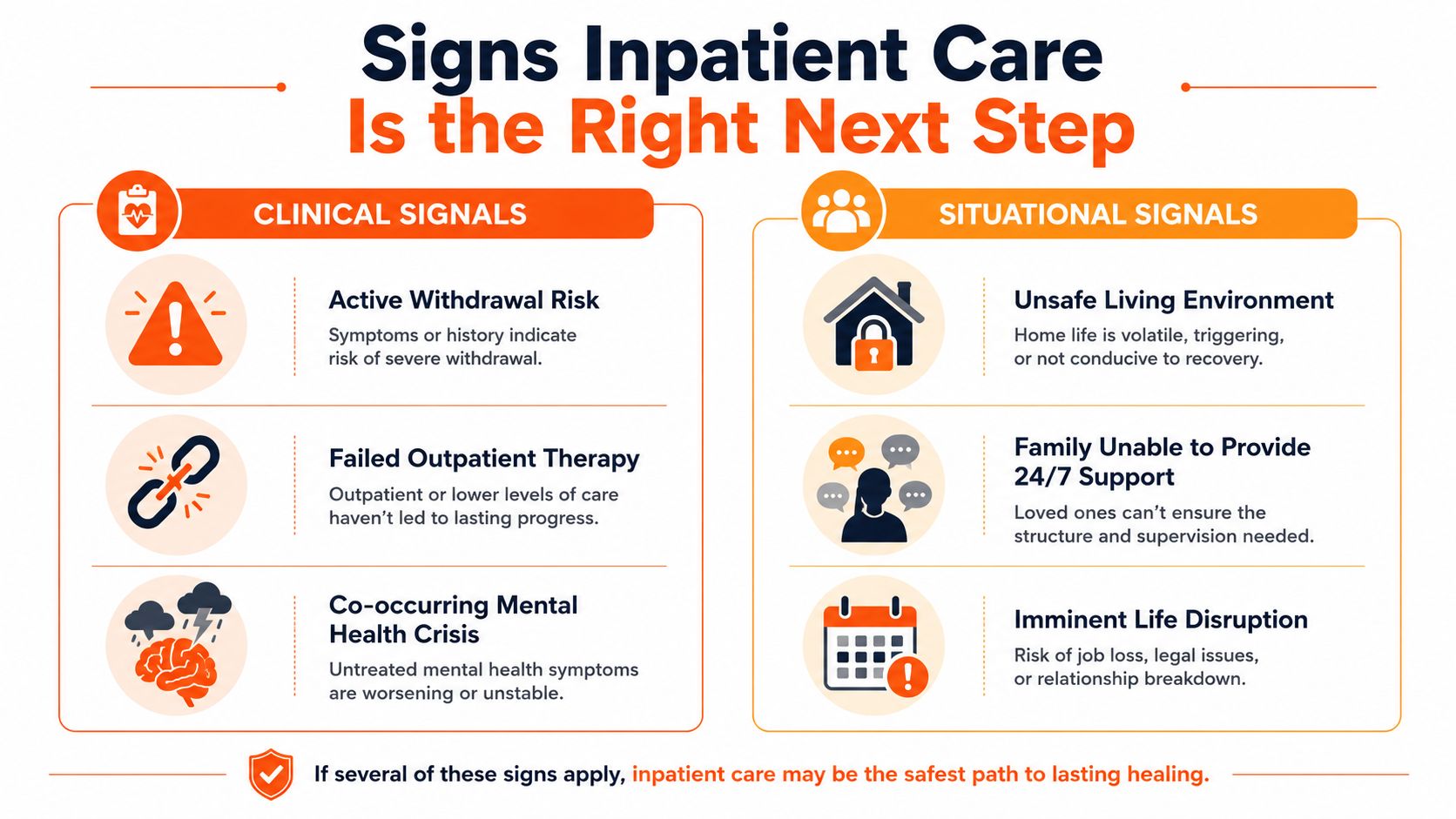
The signals I take seriously
- Active withdrawal risk. If stopping use could trigger severe symptoms, the person needs medical oversight.
- Failed outpatient attempts. If therapy and accountability haven't held, the next step usually needs more containment.
- Co-occurring mental health crisis. When substance use and psychiatric symptoms are feeding each other, integrated care matters.
- Unsafe living situation. A bad home environment can undo good intentions fast.
- Lack of 24/7 family support. Caregivers burn out. Inpatient care gives everyone room to breathe.
- Imminent life disruption. A court date, license issue, job risk, or family crisis can make structure essential.
For executives and licensed professionals, privacy is part of the clinical picture. If a person's career depends on discretion, a crowded program with weak confidentiality controls may be a bad fit even if it technically offers the right level of care. You're not just looking for treatment, you're looking for a setting that protects dignity while stabilizing the underlying problem.
Bottom line: If the person needs safety, privacy, and real medical support at the same time, inpatient is not overreacting. It's the appropriate level of care.
How to Search and Evaluate Nearby Facilities
A “near me” search only helps if you already know what kind of bed you need. For someone in withdrawal, with psychiatric symptoms, or with a safety problem at home, the first filter is clinical fit, not driving distance. Nearby programs are often outpatient or a lower level of care, so start by sorting out which facilities provide inpatient or residential treatment, which ones handle dual diagnosis, and which ones can respect privacy for a professional who cannot fully step away from work.
Start with a locator that lets you filter intelligently. Facility directories can sort by location, insurance, treatment type, special programs, languages, and payment options, which is the only reason a search like this works at all (NAMI's locator guidance). A search result is useless if the facility does not take the right insurance, cannot treat co-occurring disorders, or does not have the specialty track the person needs.
Then widen the search. Check your state's license lookup. Use independent directories to see whether the program is residential, detox, or inpatient. If you are also sorting out family coverage and payment flexibility, affordable care for families can help you think through broader coverage options, but it does not replace direct verification with the facility.
What to verify before you call back
- State licensure. Ask for the license number and confirm it independently.
- Medical coverage. Find out who is on site overnight and who can respond to a psychiatric or withdrawal issue.
- Dual-diagnosis capability. Do not accept vague language. Ask how anxiety, depression, trauma, bipolar disorder, or ADHD are handled.
- Insurance and payment. Confirm whether they verify benefits and whether self-pay is available.
- Special populations and privacy. Ask about executive tracks, professional monitoring, language support, and confidentiality protocols.
One local directory even calls out publicly funded programs for people who cannot pay, while other resource lists show that residential, detox, MAT, and transitional services are often separated by level of care in a given market (Addictions.com Rockford directory). That is the problem. The bed you need may exist, but not in the exact package the search ads promise.
Do not stop at website copy. Call admissions and ask blunt questions. A good program answers them without hesitation.
Key Questions to Ask Before You Admit
A real admissions conversation should feel practical, not theatrical. If someone is being admitted, you need to know what happens on day one, who makes the clinical decisions, and how the facility handles both treatment needs and life outside the unit. That matters even more when work obligations, reputational concerns, privacy, or family logistics are part of the decision.
Start with the medical team. If admissions cannot clearly explain who handles withdrawal, who prescribes medication, and how psychiatric symptoms are monitored, the program is not ready for a serious case. Then ask how the daily schedule works without letting them hide behind brochure language.

Ask in four clusters
- Clinical. Who is on the medical team, what therapies are used, and how is dual diagnosis treated?
- Insurance. What will you verify, what might still be out of pocket, and what happens if the stay needs authorization?
- Facility. Is the program licensed, how private is it, and what are the visitation and tech policies?
- Aftercare. How do you handle step-down planning, medication follow-up, and referrals after discharge?
That financial conversation matters because inpatient addiction care is a medical service with a real cost profile, not a vague wellness promise. Analysts at Health System Tracker reported that inpatient mental health and substance use treatment made up a meaningful share of commercial inpatient stays, with average total costs and out-of-pocket costs that vary by admission type. The point is simple. Ask what the facility expects the final bill to look like, what insurance it will verify, and what your family may still owe after authorization.
For families and referral sources, the right question is not “Can you take them today?” It is “Can you treat this level of severity safely, privately, and with a discharge plan that will hold?” If you also need help with the therapist side of the handoff after discharge, see finding the right mental health professional.
What the First Days and a Typical Stay Look Like
The first call is a screening, not a full clinical workup. Admissions wants the substance pattern, withdrawal risk, mental health history, current medications, and whether the person can safely wait for a bed. Once the person arrives, the first hours focus on assessment, belongings, a medical review, and confirming that the initial plan matches the actual level of risk.
If detox is needed, stabilization comes first. That can mean close monitoring, medication support, and frequent check-ins until symptoms settle. After that, the daily schedule becomes the main treatment tool.
A normal day is more structured than people expect
A typical residential day usually includes individual therapy, group work, psychiatric follow-up when needed, meals, and protected time for rest. In a more flexible program for professionals, there may also be time set aside for necessary communication or limited work tasks, but that should never replace treatment.
Structure is there for a reason. Repetition, regulation, and steady contact help staff catch problems before they turn into crises. A short stay can help, but a longer structured stay is often the better call when the home environment is unstable or the illness involves several layers.
The first 72 hours matter because they show whether the level of care is right. If the person is still medically unstable, the program should increase support, not act as if the crisis has already passed.
Length of stay matters too. As noted earlier, NAMI says inpatient stays commonly run 30 to 90 days, and longer stays are linked with better outcomes in many programs. That does not mean every person needs the same timeline. It does mean you should avoid any program that seems eager to discharge someone before they are clinically ready. For families comparing a more discreet option, private rehab settings are often worth a close look because they can combine residential care with a smaller census and more privacy than a standard facility.
Aftercare, Outcomes, and Choosing a Private Executive Track
A good inpatient stay is only the start. The people who hold onto progress usually leave with a clear step-down plan, including ongoing therapy, medication management, and structured follow-up. Depending on the situation, that next level may be outpatient care, transitional housing, sober living, or another supervised setting.
Executives, licensed professionals, and high-profile clients need a tighter set of choices. Many programs are too public, too noisy, or too rigid for someone who has to stay somewhat connected to work. If a facility bans technology outright, runs a large census, or does not offer real dual-diagnosis treatment, it is a weak fit even if the website sounds impressive.
One practical option is a private rehab setting that combines detox and residential care with a smaller census, private rooms, and tech access. Capo Canyon Recovery is a licensed California facility in Mission Viejo that offers detox and residential treatment with 24/7 nursing, on-site psychiatric support, a tech-friendly policy, and a small census of about five clients at a time. It also offers an executive track, dual-diagnosis care, and structured individual sessions, which is the kind of setup many professionals need.
Do not keep chasing the closest result. Screen for clinical fit, privacy, and discharge planning. A serious program should be able to explain the medical plan, the privacy model, and the aftercare path without forcing you to translate marketing copy.
If you need a discreet place to start, Capo Canyon Recovery can walk you through a confidential intake and insurance verification. If you are comparing nearby options for yourself or someone you love, use the criteria above to separate true inpatient care from programs that only look similar online.