
You've been telling yourself this is temporary. One more quarter, one more launch, one more round of layoffs, one more week of sleeping badly and getting through it anyway. Then the signs get harder to ignore, you're waking at 3 a.m., your chest feels tight before meetings, and the drink that used to take the edge off is starting to feel like part of the routine.
That's usually the point where work stress treatment stops being a vague idea and becomes a practical decision. For executives and high-performing professionals, the core question isn't whether stress is “normal.” It's whether the stress has started to shape sleep, judgment, health, family life, or substance use in a way that can't be managed by pushing harder.
Recognizing When Work Stress Becomes a Health Crisis
A senior leader can look fully functional from the outside and still be in real trouble. They're still closing deals, still answering email, still showing up for the board meeting, but they're using alcohol to come down at night, skipping meals, clenching their jaw through the day, and living on shallow sleep. The cost shows up first in the body, then in mood, then in decision-making.
That pattern is common because high-functioning people are trained to absorb pressure. They also tend to delay help until they've already lost margin. The danger is that chronic strain doesn't stay neatly contained at work, it follows people home, into relationships, and into whatever habits they use to get through the evening.
Practical rule: if stress is driving sleep loss, irritability, increased drinking, or a steady drop in concentration, it's no longer a bad week. It's a health issue.
The old advice, take a vacation, meditate more, just set boundaries, can help at the edges. It doesn't solve a problem when the job itself is the engine of the strain and the coping strategy has become part of the cycle. In those cases, work stress treatment has to look bigger than self-care slogans.
High performers often ask for proof that things are serious enough to justify care. The better test is simple, if stress keeps returning despite rest, if you're compensating with substances, or if you're starting to protect work at the expense of your health, that's a signal to act. The goal isn't to label yourself weak. The goal is to stop pretending the body can carry chronic overload forever.
The Real Drivers of Workplace Stress
A hard charging executive can look functional from the outside and still be running on a failing system. The meetings happen, the reports go out, the team gets answers, but the person is carrying chronic strain, using alcohol to shut off at night, and relying on sheer discipline to get through the day. That is usually not a willpower problem. It is a work design problem.
The World Health Organization says stress at work is often driven by workload, management style, poor communication, and work–life imbalance, and it recommends changing working conditions and training managers and workers instead of placing the burden only on the individual WHO guidance on mental health at work. That matters in practice because a person can do every coping exercise correctly and still return to the same pressure system on Monday.
A 2025 APA survey points to the same reality from a different angle. 56% of workers cited low salaries, 54% cited long hours, and 52% cited lack of growth or advancement as significant contributors to work stress, while 87% said employer actions would help their mental health APA survey summary within WHO fact sheet. For high-functioning professionals, the stress often gets hidden inside responsibility, visibility, and the pressure to remain available even when the body is already signaling overload.
What that means in practice
If someone is burned out because their role has no boundaries, therapy alone will not change the inbox. If the culture rewards constant availability, coaching alone will not create downtime. Individual care still matters, but it works best when the environment is also addressed.
Clinical reality: treatment works better when it targets both the person's coping patterns and the conditions that keep triggering those patterns.
That is why modern care includes more than symptom relief. It may involve manager training, return-to-work planning, and changes in how the job is structured. It also means asking blunt questions about whether the current role leaves any room for recovery, especially when the person is still partly connected to work during treatment and trying to protect privacy at the same time.
The burden data supports that broader view. In Great Britain, the Health and Safety Executive estimated 964,000 workers were suffering from work-related stress, depression, or anxiety in 2024/25, with an average prevalence rate of 2,040 cases per 100,000 workers across 2022/23 to 2024/25. In 2022/23, the Mental Health Foundation reported an estimated 875,000 affected workers and 17.1 million working days lost HSE stress statistics. Those figures are one reason this cannot be treated as a minor wellness issue.
In practice, the gap shows up most clearly among executives and other high-performing professionals who cannot disappear from their roles. Generic EAP advice often assumes a clean break from work and a low level of accountability. Real treatment has to account for partial availability, confidential scheduling, and the risk that stress is being managed with alcohol or other substances after hours. That is where practical work-related stress care, including mindfulness strategies for job-related stress, can help when it is paired with a realistic plan for work demands and recovery time.
For people who are trying to maintain performance while addressing burnout, the trade-off is straightforward. More privacy can mean less immediate oversight, but less care intensity can leave the underlying pattern untouched. More structured care can create better accountability and safer support, but it may require more transparency and coordination. A program focused on wellness for a balanced work life makes sense only when it matches the person's actual work pressure, not an idealized version of it.
Evidence-Based Treatment Approaches That Work
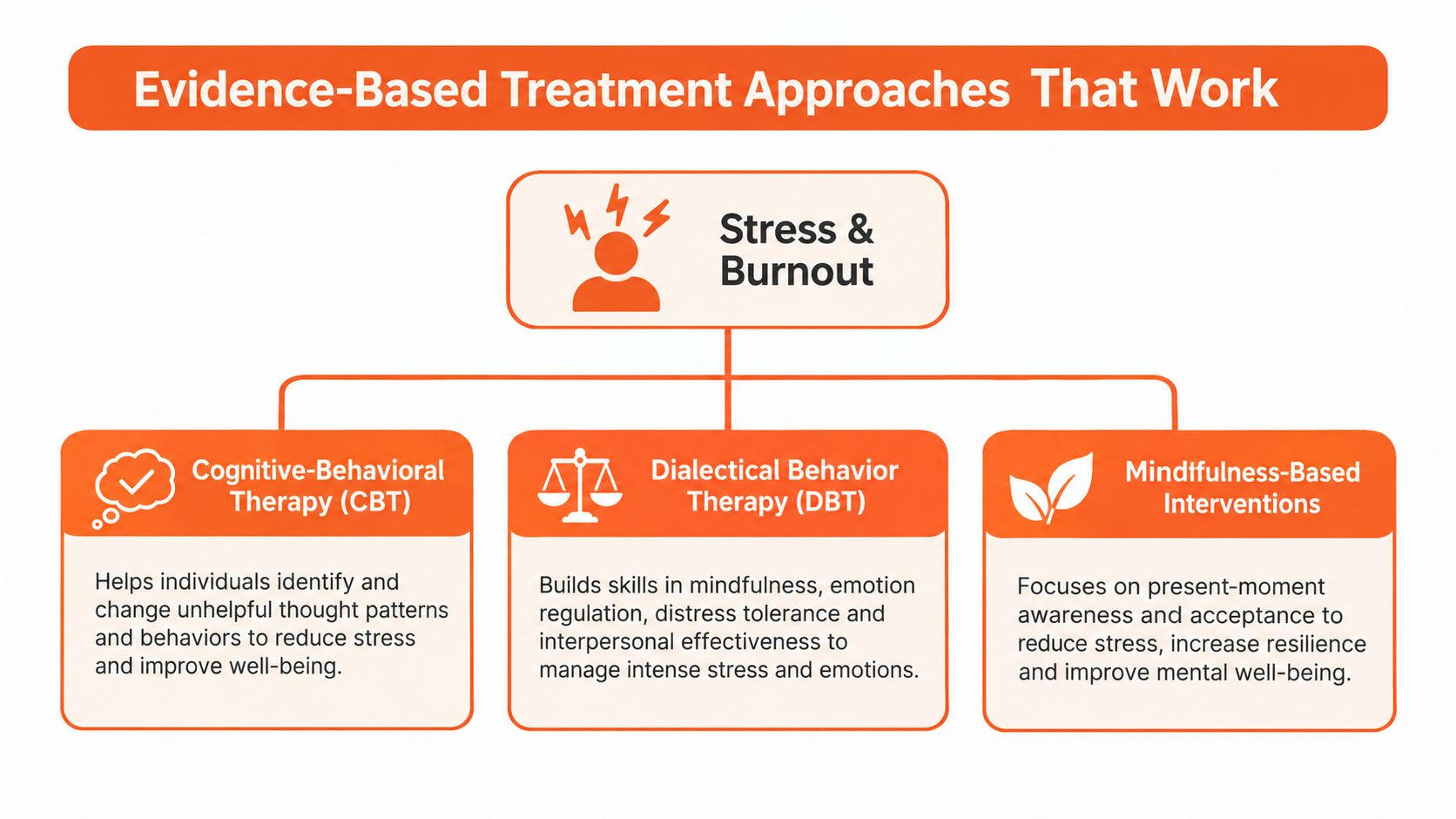
The most useful treatments are the ones that change how stress lands in daily life. Cognitive-behavioral therapy, DBT skills, acceptance-based work, relaxation training, and digital supports each do different jobs, and the right mix depends on whether the main issue is panic, rumination, sleep disruption, anger, avoidance, or substance use.
Cognitive-behavioral approaches are often the backbone because they help people identify the thought loops that keep the stress response spinning. That's useful for professionals who default to over-control, perfectionism, or constant threat scanning. DBT skills can be a better fit when emotions feel intense, reactive, or hard to regulate, especially when arguments, shame, or impulsive coping are part of the picture. Mindfulness-based work helps people notice stress earlier, before the day becomes one long emergency response.
The evidence also supports practical, work-compatible tools. A meta-analysis of workplace stress interventions found that cognitive-behavioral and other stress-management techniques improve employees' psychological health, while flextime and telecommuting also improve psychological health. It also found that relaxation techniques were associated with better job performance meta-analytic evidence. For a high-performing professional, that matters because treatment can't be judged only by how calm someone feels. It also has to preserve functioning.
A useful adjunct is digital care that lowers friction. A smartphone-based intervention grounded in the Job Demands-Resources model reduced perceived stress and sleeping troubles, and improved subjective well-being and resilience after 4 weeks, with effects sustained at 6 weeks digital intervention study. That kind of support is relevant for people who can't fully disconnect from work while they're in treatment.
If you want a broader personal framework for recovery habits, the article on wellness for a balanced work life is a useful complement to formal care. It's not a substitute for clinical treatment, but it helps reinforce the day-to-day discipline that burnout recovery depends on.
The internal resource on mindfulness for job-related stress is also worth a look if your stress shows up as constant mental overdrive rather than a single dramatic crisis.
Choosing the Right Care Setting for Your Situation
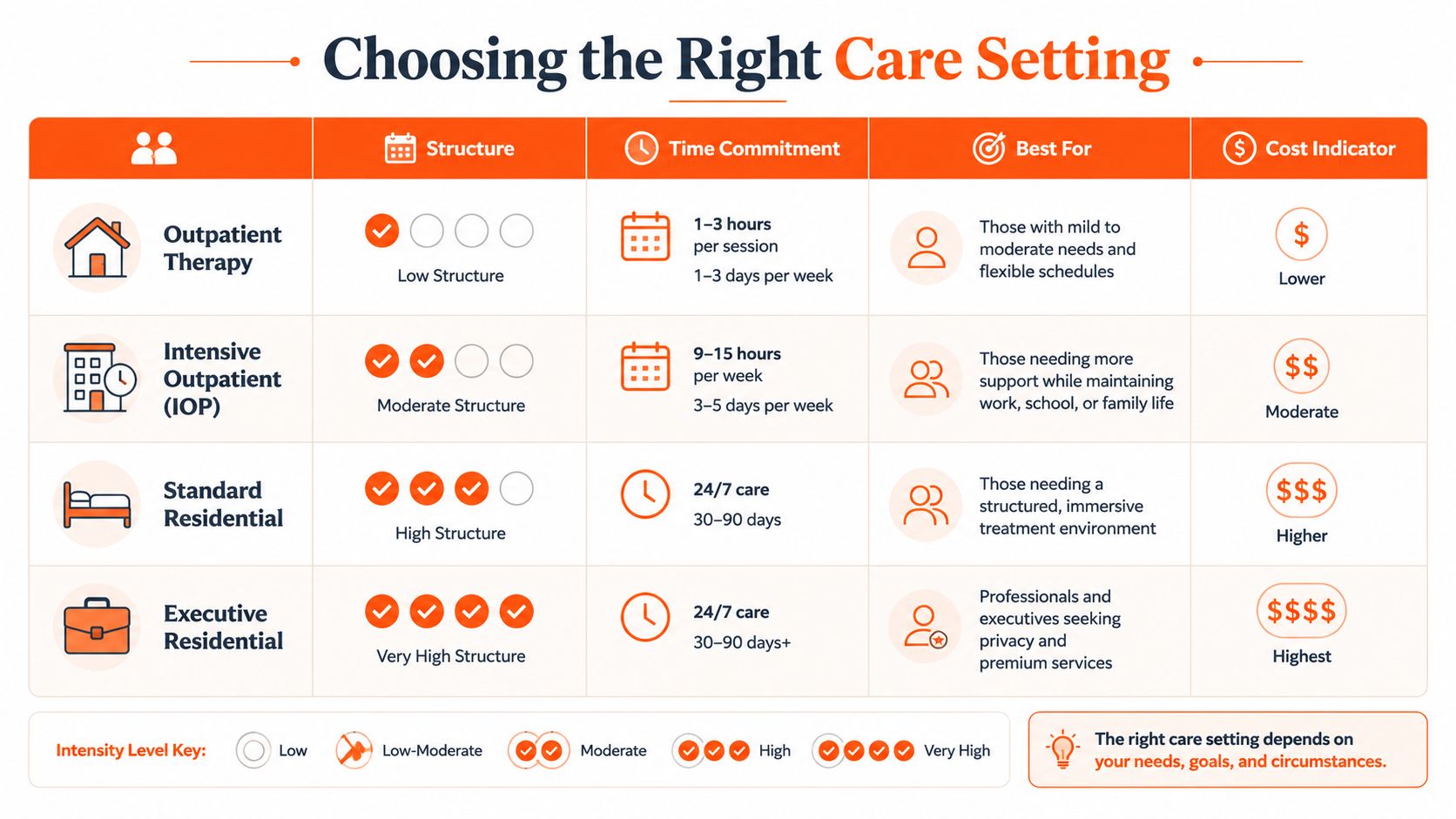
The setting matters as much as the therapy model. Outpatient therapy works when someone has enough stability to keep working and still use the sessions well. Intensive outpatient care adds structure without full separation from daily life. Residential care is the right call when the stress load is too high, sleep is collapsing, or substance use is making it unsafe to keep trying to manage everything in place.
The mistake I see most often is choosing the least disruptive option instead of the most appropriate one. That usually happens when a professional is trying to preserve privacy, avoid downtime, or keep a role from wobbling. Those concerns are real, but if the setting is too light for the level of impairment, the person often ends up cycling through half-measures and getting worse.
Executive-focused residential programs fill a gap that standard outpatient care doesn't. They're built for people who need confidentiality, space, and clinical intensity at the same time. In practical terms, that can mean private rooms, small client censuses, technology access, and staff used to working with licensed professionals, business owners, and other high-exposure clients.
Privacy is not the same thing as minimal care. The right program protects confidentiality while still giving enough structure to change the pattern.
When comparing programs, ask how much work access is allowed, how therapy is scheduled, and how quickly a clinician can adjust the plan if symptoms spike. A program that gives you comfort but not enough clinical support can be almost as risky as a program that provides care but makes it impossible to keep essential responsibilities moving.
When Work Stress and Substance Use Collide
This is the part many executives avoid saying out loud. Chronic stress and substance use often get tangled together. The pattern is easy to recognize once it's named, stress drives drinking or medication misuse, the substance use worsens sleep and anxiety, work gets harder, and the person feels more pressure to use again.
That cycle is why dual-diagnosis treatment matters. If a program treats stress but ignores alcohol or drug use, the coping loop stays intact. If it treats substance use but ignores the stress load that helped create it, relapse risk stays high. The conditions reinforce each other, so the treatment has to address both at once.
The CDC's guidance on worker mental health emphasizes active coping and support, and WHO includes individualized interventions, return-to-work planning, and access to occupational health services CDC guidance. Those are useful principles, but they're often not translated into a plan for the person who still has to lead a team, manage clients, or protect a reputation while getting well.
That gap is where many generic EAP referrals fall short. They may point someone toward counseling, but they rarely address the full reality of a professional who is using substances to stay functional. The better question is not, “Can I just keep coping and go to therapy once a week?” It's, “What level of treatment can interrupt the cycle without forcing a complete collapse of my responsibilities?”
The Capo Canyon article on how stress affects addiction recovery speaks directly to that overlap. The key clinical point is simple, if stress and substance use are feeding each other, both have to be in the treatment plan from day one.
How Executive Programs Enable Recovery Without Career Disruption
The practical advantage of executive programs is that they reduce the false choice between getting treatment and keeping your life from unraveling. A good program doesn't pretend you can run a company from a hammock, but it also doesn't demand total professional disappearance when limited contact is clinically appropriate.
The features that matter most are straightforward. Tech-friendly policies make it possible to handle essential communication. Private rooms with desks, Wi-Fi, and quiet support focused work blocks. Small census settings mean staff can tailor the plan instead of treating everyone the same. And 24/7 nursing and psychiatric support make it possible to manage withdrawal, medication stabilization, and symptom changes safely.
The Capo Canyon piece on balancing recovery and work in executive rehab programs matches what I see clinically. When treatment is designed for this population, the person can stay engaged enough to protect key responsibilities without staying so connected that recovery never gets traction.
That balance is especially important for privacy. High-profile clients and licensed professionals often need discretion as much as they need therapy. A boutique environment with a low client count can reduce exposure, and private bedrooms give people a place to rest, work briefly, and decompress without constant social pressure.
The strongest programs also keep clinical work frequent enough to matter. Capo Canyon's model includes at least four individual sessions weekly across therapy, case management, and psychiatry, which is the kind of intensity that can shift behavior when stress and substance use are both active. That level of contact is very different from a check-in-and-wait approach.
Evaluating Treatment Options and Taking the Next Step
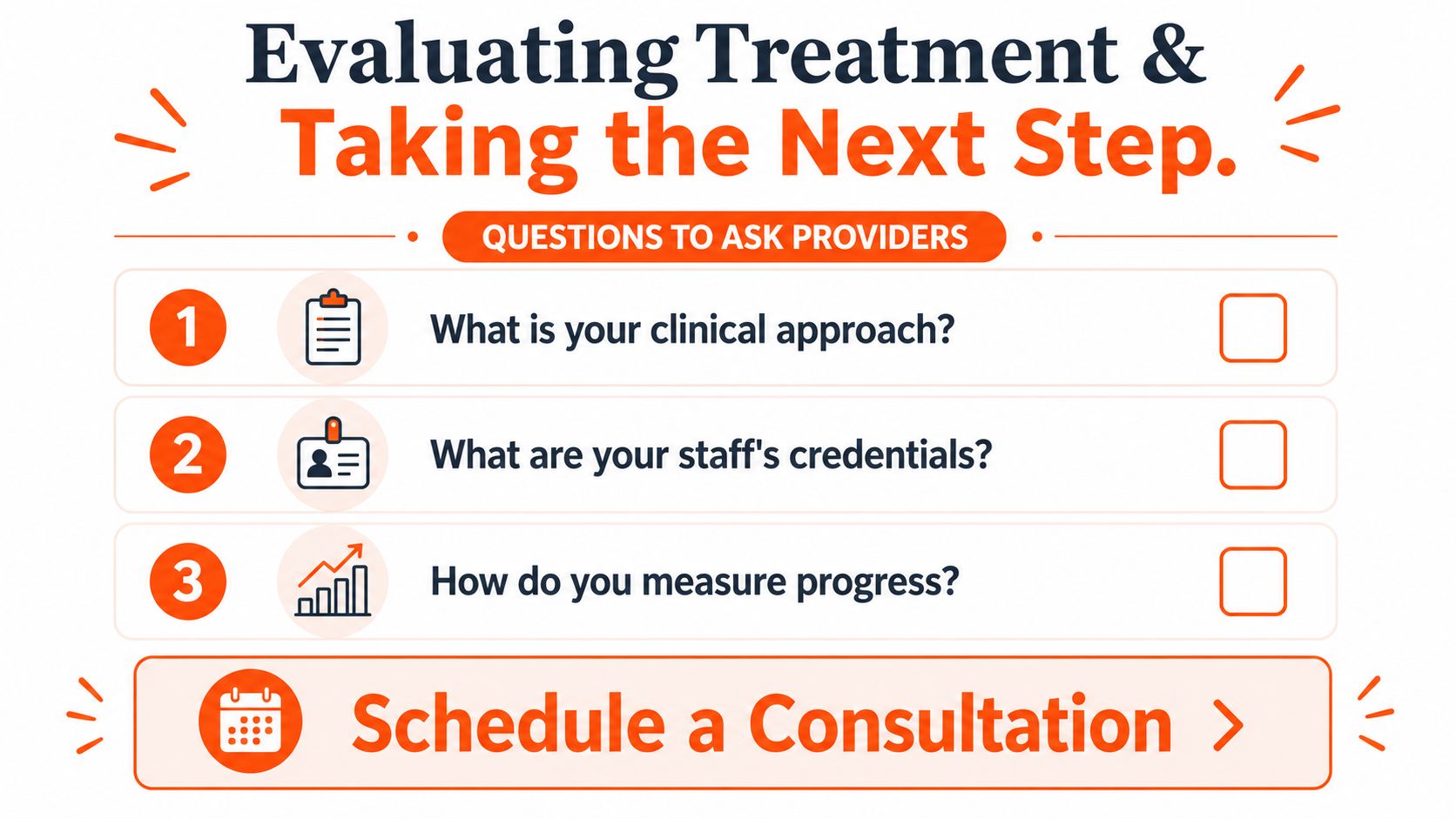
Start with the questions that tell you whether a program can really treat your situation. Ask what therapies they use, who provides them, how often you'll meet individually, how they handle co-occurring mental health and substance use issues, and what their technology policy looks like for professionals who can't fully disconnect.
You should also ask about staffing and privacy. A serious program should be able to explain staff credentials, client-to-staff ratios, confidentiality protections, and how it handles communication with employers, family members, or outside clinicians. If the answers are vague, rushed, or overly sales-driven, that's a warning sign.
A few red flags matter more than polished marketing:
- Large, impersonal groups. If everyone gets the same schedule and same talking points, the program may not be built for nuanced professional needs.
- Rigid no-technology rules. If you have legitimate work obligations and the program won't discuss controlled access, that can create avoidable conflict.
- No dual-diagnosis capability. If stress, anxiety, depression, trauma, or ADHD are part of the picture, a single-focus addiction model may miss the underlying cause.
- No clear progress markers. If the program can't explain how it tracks stabilization and readiness for step-down care, ask more questions.
Insurance verification and private-pay conversations should happen early, not after you've committed emotionally. Ask what's covered, what requires preauthorization, and whether there are alternatives if the plan doesn't pay for the level of care you need. Financial clarity reduces the temptation to choose a weaker program because it's easier to approve.
When you make the first call, have a short summary ready, current symptoms, substance use if present, sleep problems, medications, and whether you need to stay partially connected to work. The right center won't punish you for being candid. It will use that information to match you with a level of care that fits.
If you're weighing whether stress, sleep loss, and substance use have crossed the line into a real treatment issue, Capo Canyon Recovery offers a confidential residential setting with dual-diagnosis care, executive accommodations, and technology access for essential work responsibilities. Visit Capo Canyon Recovery to review their approach and ask whether their program is a fit for your situation.