
Offering an EAP employee assistance program doesn't automatically make employees feel safe enough to use it. That assumption is especially dangerous with executives, physicians, attorneys, pilots, and other licensed professionals, whose concerns often involve confidential substance use, impaired performance, licensing consequences, or reputational exposure. The practical question isn't whether support exists. It's whether a person can reach it quickly, privately, and without wondering who will find out.
EAPs remain valuable first points of contact. They can provide brief counseling, crisis response, work-life referrals, and triage into more specialized care. But a program can be widely available and still fail the people with the most to lose. The difference usually comes down to trust, access, and referral quality, not another reminder in the employee newsletter.
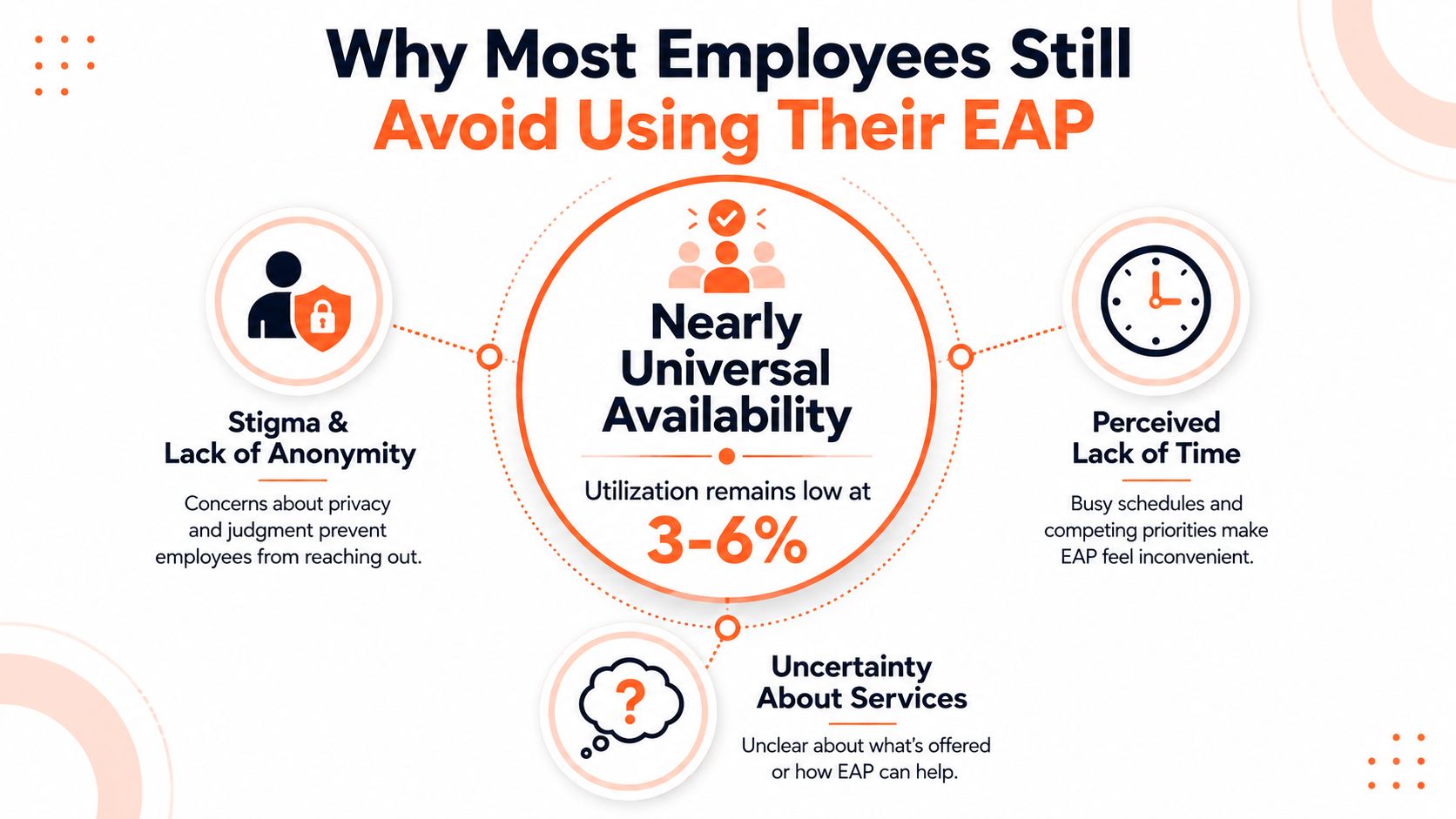
Why Most Employees Still Avoid Using Their EAP
The popular advice is simple: promote the EAP more often. Better communications help, but they don't solve the central problem for many professionals. An employee may know the benefit exists and still avoid it because the perceived cost is professional exposure.
Industry reporting states that 98% of mid-to-large companies offer an EAP, while only about 4% of employees use one annually. The same reporting identifies lack of awareness at 47%, stigma at 43%, confidentiality concerns at 40%, benefits complexity at 39%, and limited resources at 33% as leading barriers. These figures are reported in ADP's analysis of mental health benefits employees will actually use.
Awareness doesn't create trust
An executive who suspects an employer might learn about alcohol use won't be reassured by a colorful benefits flyer. A physician may worry that a referral creates a record discoverable by a licensing authority. An attorney may fear that a colleague will recognize the treatment provider, or that an insurance inquiry will reveal more than intended.
The risk may be real, misunderstood, or both. In each case, the employee needs a clear explanation of who receives information, what gets documented, and which records remain outside the employer's systems. Vague promises of confidentiality often make the concern worse.
Practical rule: If an employee can't explain the privacy boundary in plain language, the EAP hasn't made access feel confidential.
Design also matters. A phone tree that routes a distressed employee through several transfers, a provider directory filled with outdated contacts, or a referral that requires repeated retelling can stop care before it begins. Executives often have demanding schedules and limited tolerance for administrative uncertainty. They need a discreet point of contact, rapid triage, and a referral partner that understands professional obligations.
Employers should also manage reputational risk, especially when a worker holds a public-facing or regulated role. A thoughtful reputational risk management approach treats privacy as an operational requirement, not a slogan. Utilization should therefore be interpreted as feedback about program design. Low use may mean employees don't need help, but it may also mean the pathway feels unsafe or cumbersome.
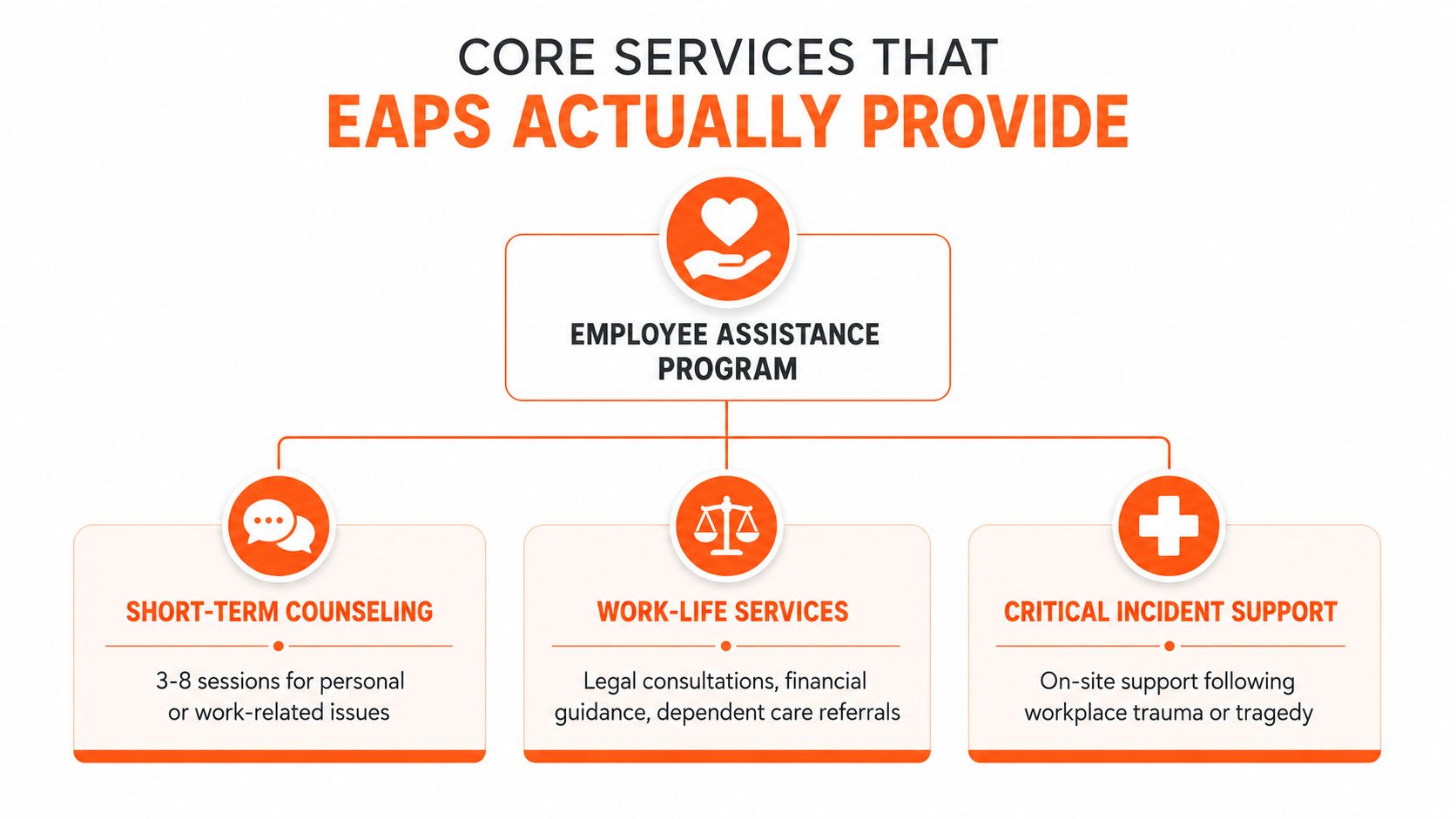
Core Services That EAPs Actually Provide
An EAP is generally a voluntary, employer-sponsored support service for personal and work-related problems. Its job is to offer early assistance, assess immediate needs, and connect the employee with an appropriate next step. It isn't usually designed to replace long-term psychotherapy, full-scale psychiatric treatment, or medically supervised addiction care.
What happens during an EAP contact
A typical contact begins with identity and eligibility verification, followed by a private discussion of the concern. The counselor may ask about symptoms, substance use, safety, work functioning, family circumstances, and existing treatment. The purpose isn't to conduct a complete specialty evaluation in one call. It's to determine the safest and most useful level of support.
Common services include:
- Short-term counseling: Brief sessions can address grief, work conflict, acute stress, anxiety, adjustment problems, and other situational concerns.
- Substance use assessment: A counselor can explore patterns of alcohol or drug use, consequences, motivation, withdrawal risk, and the need for specialty evaluation.
- Crisis intervention: EAP teams may help after a workplace death, traumatic event, serious accident, or other destabilizing incident.
- Work-life referrals: Employees may receive help locating legal consultations, financial guidance, childcare resources, eldercare support, or community services.
- Manager consultation: Supervisors can seek guidance about responding to concerning behavior without attempting to diagnose or counsel an employee.
Traditional EAPs often operate as short-duration interventions. One benchmark reports an average of 2.5 counseling sessions per case, with a 4.5% average case-level utilization rate and a 3.6% median, as summarized by Meditopia's EAP utilization review. Those figures describe a brief-support model, not a promise that every employee receives the same number of sessions.
The limits should be stated early
A counselor might help an executive stabilize after a difficult board meeting, identify a therapist, or arrange an assessment for escalating alcohol use. If the person is experiencing withdrawal risk, suicidal thinking, psychosis, severe mood instability, or a persistent substance use disorder, the EAP should move from counseling to coordinated clinical care.
The best EAP encounter ends with a clear plan. That may be another brief session, a community referral, a psychiatric appointment, or direct coordination with a detox or residential provider. The employee shouldn't have to guess which step comes next.
Confidentiality Protections and Executive Concerns
Confidentiality determines whether many high-responsibility employees will make the first call. Executives and licensed professionals aren't only asking whether an EAP is confidential in general. They're asking whether an employer will learn about their specific concern, whether a claim will identify treatment, and whether a licensing board could obtain records through a later process.
EAP providers commonly operate separately from the employer, with employers receiving aggregated information rather than an individual's counseling details. That separation is important, but it must be explained accurately. Privacy protections depend on the provider, the service involved, the consent obtained, the payment route, and the laws that apply.
Separate the privacy questions
Employer reporting is one issue. An employer may receive broad utilization or service-category reporting, but that doesn't mean it should receive a named employee's clinical narrative. Employees should ask directly whether individual names, diagnoses, appointment details, or referral reasons are shared.
Clinical records are another issue. HIPAA may govern protected health information in covered healthcare settings, but people shouldn't assume every EAP interaction has identical legal treatment. Substance use treatment records may also involve the federal confidentiality rules under 42 CFR Part 2, depending on the provider and the record.
Insurance and referral workflows create a separate point of exposure. An EAP may be able to offer a private counseling benefit without an insurance claim. Higher-level care, however, often requires eligibility verification, authorization, clinical records, and consent to coordinate with the treatment provider. That doesn't make the referral unsafe, but it does mean the employee should understand what information will move and why.
A confidentiality conversation should happen before referral, not after a professional has already disclosed sensitive details.
Licensed professionals may also worry about licensing boards, malpractice carriers, credentialing files, and mandatory reporting rules. No provider can promise that every record is immune from every lawful request. A responsible coordinator explains the limits, obtains only necessary consent, and avoids sending an entire clinical history when a focused summary will support admission.
For professionals considering addiction treatment, a confidential rehab pathway should include a direct explanation of documentation, communication, technology use, and outside-party contact. Privacy isn't just an intake form. It includes reception procedures, staff conversations, shared spaces, voicemail, email, transportation, and the way a referral appears in an employer's benefits system.
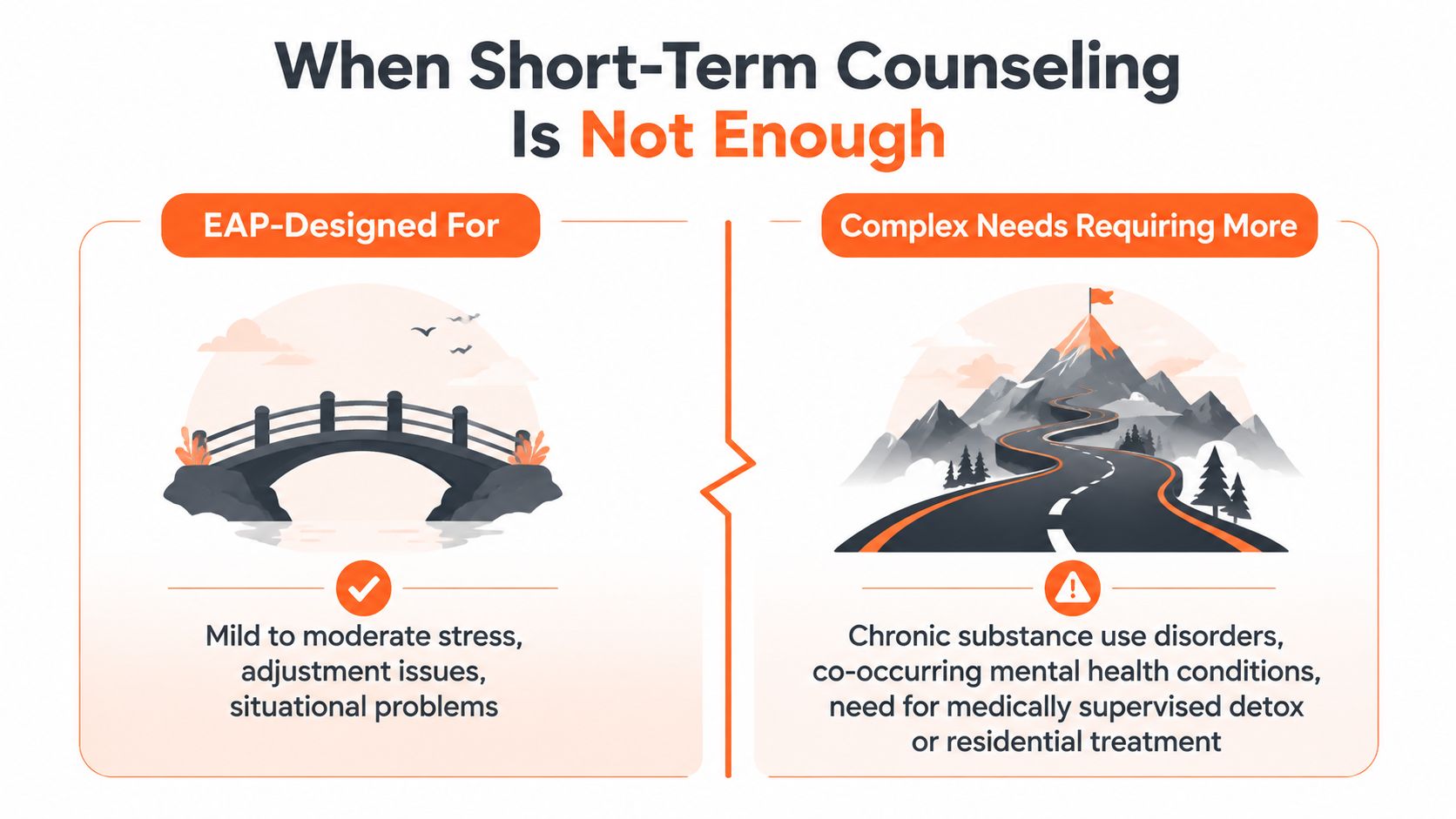
When Short-Term Counseling Is Not Enough
Short-term EAP counseling works well when the problem is contained and the person can remain medically and psychologically safe outside a structured setting. A professional dealing with acute stress, grief, a relationship crisis, or a manageable adjustment problem may benefit from brief counseling and a reliable outpatient referral.
That model changes when substance use has become chronic, withdrawal is possible, or mental health symptoms complicate recovery. A person who needs detox can't safely substitute supportive conversation for medical monitoring. Someone with trauma, bipolar disorder, depression, anxiety, or ADHD may need integrated psychiatric assessment rather than a referral list.
The clinical breakpoint
EAP counselors look for warning signs that brief care won't be adequate. These can include escalating use, failed attempts to stop, dangerous intoxication, withdrawal symptoms, overdose history, severe insomnia, suicidal thoughts, hallucinations, major functional decline, or an unsafe home environment. The assessment should also consider whether the employee can participate voluntarily and whether immediate emergency intervention is required.
The available evidence shows why this transition matters. One 2024 report found that 79% of referrals were for mental health, while a separate industry report described nearly eight in ten referrals as mental health counseling. Yet a 2025 report noted that only 42% of callers needing therapy were accepted in one model. These figures appear in the AllOne Health Annual Report, and they illustrate a practical concern: the EAP may be the front door, but the door doesn't guarantee successful entry into appropriate care.
| EAP counseling may fit | Higher-level care may be needed |
|---|---|
| Situational stress or adjustment concerns | Chronic substance use with loss of control |
| Mild to moderate symptoms with stable functioning | Withdrawal risk or medical instability |
| A person who can use outpatient support safely | Co-occurring conditions requiring psychiatric oversight |
| Short-term problem solving | Detoxification, residential treatment, or extended care |
The handoff often fails when the counselor gives the employee a phone number and closes the case. A stronger pathway includes a warm transfer, consent-based information sharing, insurance review, and confirmation that the receiving program can meet the person's clinical and professional needs.
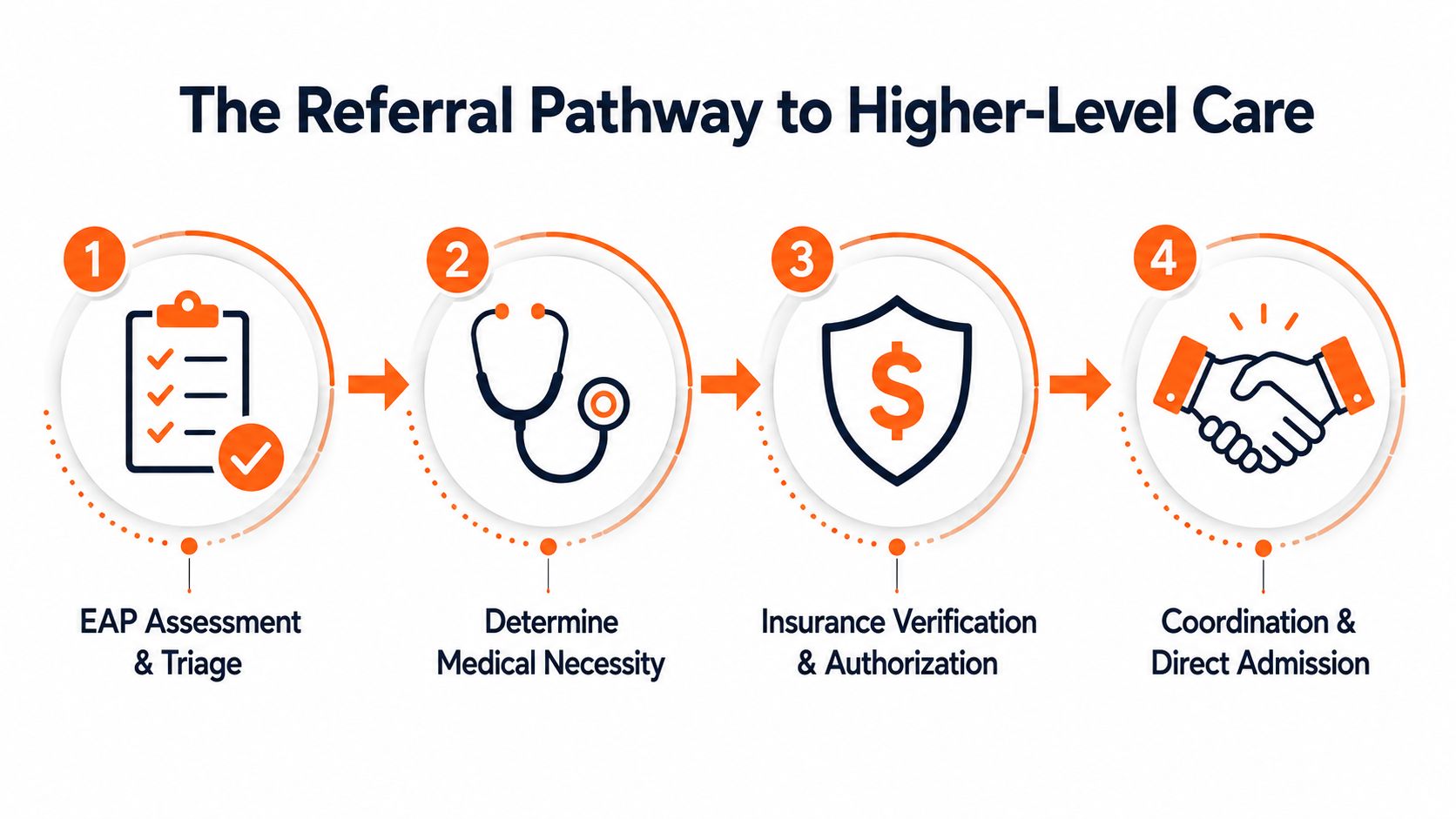
The Referral Pathway to Higher-Level Care
A referral to detox or residential treatment should feel like a coordinated clinical process, not a search engine exercise. The employee may be frightened, ambivalent, intoxicated, exhausted, or worried about missing work. Every unnecessary delay increases the chance that the person disengages.
Four steps make the transition safer
1. EAP assessment and triage. The counselor gathers enough information to identify urgency, safety concerns, substance use severity, mental health symptoms, medical conditions, and immediate support needs. If there is imminent danger, emergency services take priority over routine placement.
2. Determine medical necessity. The EAP or an affiliated clinician identifies the appropriate level of care. Detox, residential treatment, partial hospitalization, intensive outpatient care, and outpatient therapy serve different clinical situations. A facility should receive the relevant history, current medications, recent use, withdrawal concerns, and risk information with the employee's authorization.
3. Verify insurance and authorization. A case manager confirms benefits, network status, deductibles, exclusions, authorization requirements, and any clinical documentation requested by the payer. Insurance verification isn't the same as a guarantee of payment, so the employee should receive a clear explanation of expected financial responsibility.
4. Coordinate direct admission. The referring counselor and receiving program agree on timing, transportation, arrival instructions, medication needs, technology rules, and family communication. The employee should know who will answer the phone and what happens if symptoms worsen before admission.
What executives should request
An executive shouldn't have to disclose sensitive details to multiple uncoordinated intake teams. Ask whether the EAP can make a warm referral, whether the treatment center has experience with licensed professionals, how work communication is handled, and whether the program can protect privacy during arrival and ongoing care.
EAP professionals should maintain a small, vetted referral network rather than relying on generic directories. Case management services can help coordinate clinical information, benefits, family communication, and continuity after discharge. The objective is not merely placement. It's a transition that preserves safety, dignity, and treatment momentum.
Measuring EAP Value Beyond Utilization Rates
Utilization is easy to report, but it can be a poor definition of success. A low number may reflect privacy fears, unclear access, or a brief intervention that resolved a problem quickly. A high number may reflect strong engagement, but it doesn't automatically demonstrate appropriate triage or meaningful outcomes.
Historical adoption shows how established EAPs have become. A review found that 59% of Fortune 500 companies had formal EAPs by 1979, the estimated number of U.S. companies offering them rose to about 12,000 by 1985, and about 60% of full-time U.S. workers were employed in settings with an EAP by 2002 to 2003. Later surveys reported 70% of employers in 2004 and about 75% of businesses in 2007 to 2008 offered one, according to this historical review of EAP development. Availability is therefore a mature benchmark. It shouldn't be mistaken for access that employees trust.
A more useful scorecard
Employers should review whether employees can reach a qualified clinician, how quickly referrals are accepted, whether higher-acuity cases receive a warm handoff, and whether the program communicates privacy clearly. Useful measures can include:
- Time to first contact: How long does an employee wait after requesting help?
- Referral completion: How many employees successfully connect with the recommended provider?
- Clinical fit: Are referrals matched to substance use, psychiatric, cultural, geographic, and professional needs?
- Continuity: Does the EAP confirm that the next provider received essential information and that the employee has a follow-up plan?
- Employee experience: Do users understand confidentiality, cost, and available services?
- Organizational outcomes: Where valid data exists, do absenteeism, turnover, disability, and emergency-care patterns change over time?
ROI evidence supports looking beyond raw usage. One peer-reviewed analysis reported a total return of $5.39 for every $1 invested, including $3.24 from reduced outpatient mental health and substance-use treatment costs, $2.01 from reduced absenteeism, presenteeism, and turnover, and $0.13 from workplace support services, as reported in this EAP utilization and ROI analysis. A UK EAPA report cited an average return of £7.27 per £1 spent in the same source.
| ROI Component | Return per $1 Invested | Primary Driver |
|---|---|---|
| Reduced outpatient mental health and substance-use treatment costs | $3.24 | Avoided or reduced downstream care costs |
| Reduced absenteeism, presenteeism, and turnover | $2.01 | Productivity and workforce stability |
| Workplace support services | $0.13 | Support connected to workplace functioning |
| Total reported return | $5.39 | Combined employer impact |
Those findings don't mean every program produces the same return. They do show why employers should examine referral quality and recovery outcomes, not just the percentage of employees who call.
What Specialty Treatment Centers Need from EAPs
Specialty providers need more than an employee's name and a request for admission. They need a clinically useful picture of the presenting problem, current substance use, withdrawal risk, medications, medical history, psychiatric symptoms, safety concerns, and prior treatment. The referral should include only information necessary for care and should move with documented consent.
The receiving program also needs to understand the professional context. An executive may need privacy around travel, arrival, communication, and family involvement. A licensed professional may need a treatment plan that addresses monitoring obligations, work boundaries, documentation questions, and a safe return-to-practice process. Those needs don't change the clinical standard, but they affect coordination.
Strong referral relationships answer practical questions
An EAP should know:
- Admission criteria: Which symptoms, medical conditions, and substance use patterns can the program safely manage?
- Level-of-care limits: When should the employee go to emergency care, detox, residential treatment, or outpatient services?
- Insurance process: Who verifies benefits, requests authorization, and explains financial responsibility?
- Communication rules: What can the EAP share, with whom, and under what consent?
- Workplace continuity: Can the patient access a phone or laptop in a structured way without undermining treatment?
- Aftercare planning: Who coordinates therapy, psychiatry, monitoring, family support, and continuing care after discharge?
For executives, a treatment setting must balance privacy with accountability. Capo Canyon Recovery is a licensed detox and residential addiction treatment center in Mission Viejo, Orange County, California, offering 24/7 nursing and psychiatric oversight, dual diagnosis treatment, an executive treatment track, private bedrooms, structured technology access, insurance verification, and aftercare coordination. Its small residential setting serves approximately five clients at a time, which is a stated program feature rather than a guarantee of any individual outcome.
The strongest EAP partnerships don't end when an employee is admitted. They establish a consent-based communication plan, clarify who handles urgent questions, and begin discharge planning early. That continuity is what turns an EAP from a referral source into a reliable bridge between workplace support and specialty treatment.
If an EAP referral has reached the point where detox, residential care, or dual diagnosis treatment is being considered, contact Capo Canyon Recovery to discuss confidential intake, insurance verification, executive-focused care, and coordinated admission. The team can help EAP professionals, clinicians, families, and licensed professionals understand the next clinical step without leaving the employee to handle it alone.