
You're back in the executive suite, but your recovery plan is still sitting in a clinician's file and your employer's expectations are still unwritten. The board wants reassurance, your team wants direction, and you're trying to determine whether a full calendar will support your recovery or destabilize it.
That tension is why return to work planning can't be reduced to a clearance letter and a start date. For executives, the plan must protect clinical progress while addressing confidentiality, decision-making capacity, workload, travel, regulatory duties, and the professional credibility you've built over years.
What Return to Work Planning Actually Means for Executives
A senior investment partner once described his planned return as “coming back on Monday.” That was the entire plan. No agreement about client dinners, no limit on late-night deal work, no designated person to contact if sleep deteriorated, and no communication protocol for the partners. His clinician supported a gradual resumption of work, but the organization had translated that into a date rather than a structure.
That's the planning gap executives face. Return to work planning is a coordinated operating plan, not a calendar appointment. It connects medical clearance, functional capacity, job design, communication boundaries, monitoring, and recovery support. Each part answers a different risk question.
A useful plan identifies:
- What you can safely do now: The duties, hours, cognitive demands, travel, and interpersonal exposure that fit your current functioning.
- What must be delayed: High-risk responsibilities, overnight work, extensive travel, or situations that could undermine stabilization.
- Who knows what: The information HR, your manager, the board, regulators, and external stakeholders need.
- How progress will be measured: Specific milestones, scheduled check-ins, and rules for scaling duties up or down.
- What happens if recovery becomes unstable: A private escalation pathway that doesn't depend on making a clear decision during a crisis.
The evidence supports treating planning as a serious intervention. In a major 2025 national survey, 61.8% of injured workers had a return-to-work plan. Among those workers, 94.0% had returned to work at some point, compared with 81.7% of workers without a plan, according to Safe Work Australia's 2025 national survey analysis. The same survey found that 88.9% had returned to work at any time, while 78.8% were working when surveyed, which shows why “I went back once” and “I'm working sustainably” aren't interchangeable outcomes.
Practical rule: If the plan doesn't specify duties, limits, communication, review dates, and escalation steps, it isn't finished.
Executives and licensed professionals also carry responsibilities that may not apply to other employees. A physician may need to consider patient safety and medical licensing obligations. An attorney may face bar-related requirements. A pilot may have an aviation medical framework. The question isn't only whether you feel ready. It's whether your current functioning supports the responsibilities attached to your role.
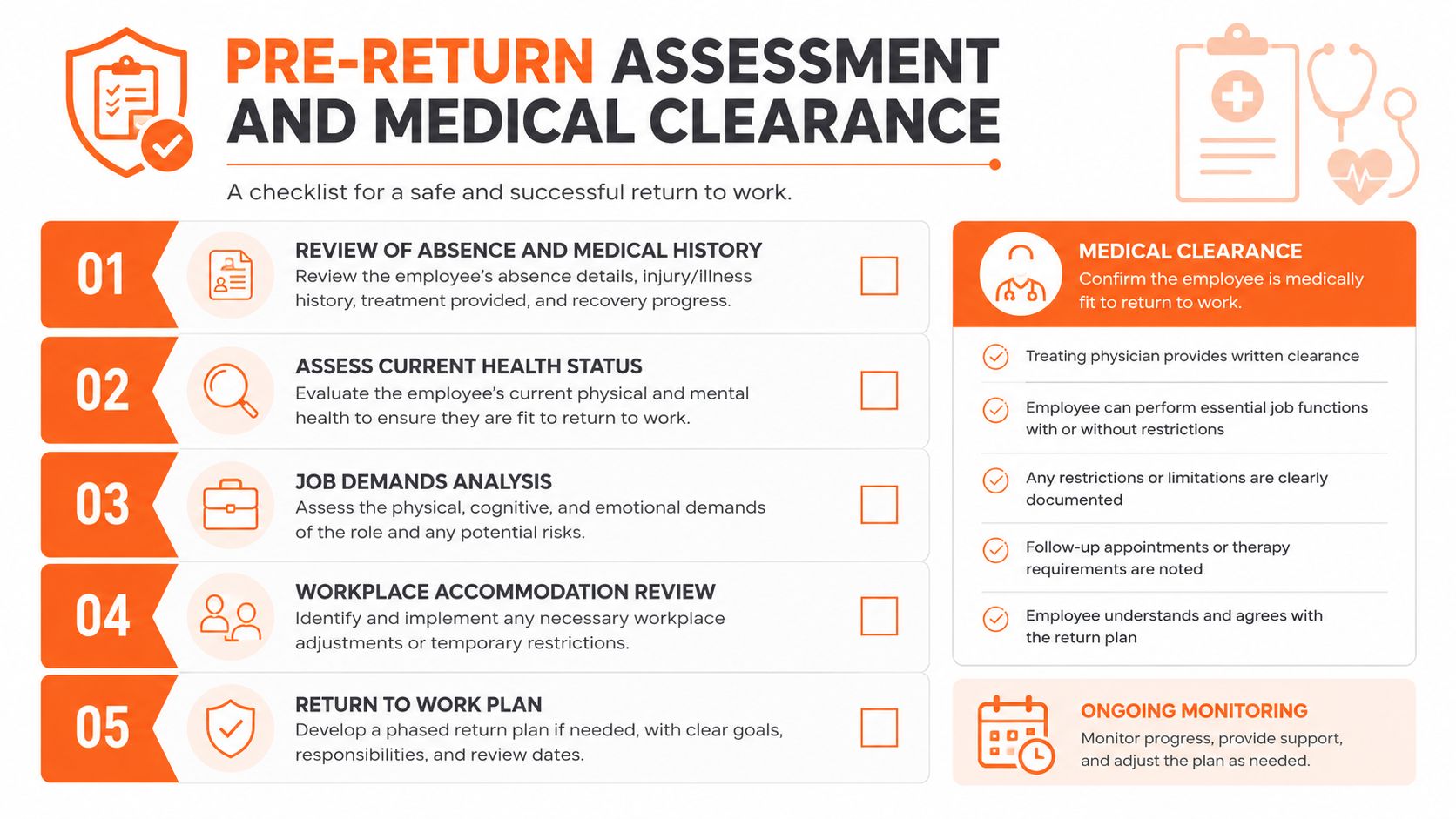
Pre-Return Assessment and Medical Clearance
Don't negotiate a return date before you know what the job demands and how those demands interact with your current recovery. A useful assessment has three layers, and a generic “fit for duty” note usually covers none of them well.
Start with clinical clearance
Ask the treating clinician for a dated, role-specific assessment. It should identify the work activities reviewed, current restrictions, recommended accommodations, anticipated review points, and the conditions under which duties can expand or contract. “Cleared to return to work” leaves too much room for an employer to interpret clearance as full capacity.
The clinician doesn't need to disclose a diagnosis to the employer when functional information is sufficient. The document can address matters such as sustained concentration, schedule tolerance, sleep stability, medication effects, stress exposure, travel, driving, safety-sensitive decisions, and the ability to respond to urgent demands.
Medical clearance should also reflect treatment status. If medication has recently changed, withdrawal symptoms are unresolved, or co-occurring anxiety, depression, trauma, bipolar symptoms, or ADHD are interfering with performance, those issues belong in the clinical risk discussion. A return plan built on wishful thinking will fail under the first serious deadline.
Translate symptoms into job functions
A functional review asks what happens during a real workday, not whether you can perform well for a short appointment. Review:
- Cognitive load: Can you sustain attention through financial review, legal analysis, clinical decisions, or complex negotiations?
- Energy and sleep: Can you maintain the proposed schedule without using exhaustion as proof of commitment?
- Emotional regulation: Can you manage conflict, criticism, urgency, and public-facing pressure?
- Task switching: Can you move between meetings, calls, documents, and decisions without losing accuracy?
- Safety and judgment: Are there duties where impairment could harm patients, clients, employees, passengers, or the public?
Request an assessment that links these functions to specific duties. A licensed professional may need separate consideration of fitness to practice, supervision, prescribing, courtroom work, flight operations, or access to controlled substances.
Separate employer evaluation from treatment
An employer may request an independent medical examination or occupational assessment. That evaluation serves the employer's process, while the treating team's role is to support recovery and explain clinical limitations. They should communicate only with appropriate authorization and within defined boundaries.
For licensed roles, consult the relevant regulator, licensing counsel, or professional monitoring body before making assumptions about disclosure. Rules differ by profession and jurisdiction. Your plan should name who will obtain that advice, what question they'll ask, and how the answer affects duties.
Building a Phased Return Schedule That Protects Recovery
A senior executive can agree to return on Monday and discover by Tuesday that every urgent request has become their responsibility. Set the schedule before re-entry. Put duties, limits, review dates, and escalation rules in writing, then treat the document as a working protocol rather than a promise to endure any workload.
The accommodation evidence identifies recurring needs among workers with health limitations, including a gradual return, reduced workload, improved work organization, and regular supervisor feedback, as summarized in the Journal of Occupational Rehabilitation evidence. For an executive, translate each category into a concrete operating decision.
A gradual return may exclude overnight deal cycles, international travel, evening events, or a full board-meeting schedule. Workload reduction may remove hiring authority temporarily, narrow client coverage, or assign operational follow-through to a deputy. Add safeguards for high-consequence decisions, such as a second reviewer or a defined approval threshold.
Use a schedule with decision rules
The table below is a planning model, not a medical prescription. The treating clinician and employer must adapt it to the role, symptoms, safety requirements, and recovery status.
| Week | Workload | Meetings & Travel | Supervisor Check-In |
|---|---|---|---|
| Week one | Core duties only, with nonessential projects paused | Short internal meetings, no overnight travel, no evening events | Brief check-in at the start and end of each workday |
| Week two | Add selected responsibilities if symptoms remain stable | Limited external meetings, travel only when clinically appropriate | Daily check-in, with a formal review at week's end |
| Week three | Expand decision-making and team leadership gradually | Reintroduce selected high-value meetings, keep travel capped | Several brief check-ins during the week |
| Week four | Move toward steady-state duties without removing safeguards abruptly | Resume broader exposure only after review of workload tolerance | Weekly review and a documented next-phase decision |
“Half-time” does not define a safe workload. Half a schedule filled with crisis calls, board preparation, and travel may exceed a full day of predictable work. Specify the number and type of meetings, decision authority, response expectations, travel, after-hours availability, and recovery breaks. For a board or regulator, this detail also demonstrates controlled continuity without disclosing private clinical information.
Build an exit ramp
Every phase needs a clear step-back rule. Repeated sleep disruption, escalating anxiety, missed treatment commitments, medication side effects, impaired concentration, or a return to substance-related routines should trigger review, not a test of willpower.
Name the person who receives the concern, the person authorized to reduce duties, and the time frame for a decision. Agree on neutral wording for the change so the executive can pause or narrow responsibilities without releasing a diagnosis or treatment history. Keep the recovery priority visible in every review, even when professional credibility and external expectations are pressing.
Workplace Communications and Confidentiality
Executives often over-disclose because they're trying to look accountable, or under-communicate because they're trying to preserve control. Both approaches create avoidable problems. The right standard is minimum necessary information, delivered to the right audience, in writing.
Create an information map
HR generally needs administrative facts, such as leave status, restrictions, documentation, and the accommodation process. Your direct manager needs functional guidance, including scheduling limits, meeting exposure, travel restrictions, and the review cadence. The board or partners may need continuity information, such as who holds interim authority and when they'll receive a business update.
Clients and external stakeholders usually don't need medical details. A simple statement can explain that you're resuming responsibilities through a structured transition and that your team remains available. Don't volunteer a diagnosis, treatment history, medication information, or recovery narrative to make the message seem more convincing.
Informal channels require equal discipline. Ask HR and your manager to prevent medical details from appearing in Slack threads, all-hands announcements, shared calendars, or broad email chains. Your calendar can show “medical appointment” or a neutral private block rather than a revealing label.
Use a written script
A communication script prevents pressure-driven disclosures:
“I'm returning under a structured work plan. My responsibilities will expand in stages, with [designated person] handling [specific duties] during the initial phase. Please direct questions about scheduling or work accommodations to [named contact]. Personal medical information remains confidential.”
For the board, add the governance facts they need: interim authority, decision rights, reporting lines, and the date of the next business review. Don't turn a board update into a treatment disclosure.
The Americans with Disabilities Act creates an accommodation framework, but it doesn't answer every professional licensing question. Physicians, attorneys, pilots, and other licensed professionals should obtain advice specific to their regulator and jurisdiction. A medical board, bar association, or airline medical office may apply rules that differ from ordinary workplace disclosure practices.
If treatment or privacy concerns are central to your planning, review confidential addiction treatment options as part of a broader care discussion. The point isn't secrecy at the expense of safety. It's controlled information sharing that protects both professional obligations and clinical privacy.
Reasonable Accommodations and Legal Obligations
An executive may be ready to resume leadership while still needing limits on schedule, travel, decision load, or after-hours access. A workable plan connects those limits to job functions, assigns someone to enforce them, and sets a review point. Under the ADA, covered employers may need to provide reasonable accommodations through an interactive process for qualified employees with disabilities, unless doing so creates undue hardship. The Pregnant Workers Fairness Act creates separate accommodation duties for qualifying pregnancy, childbirth, or related medical conditions. These laws establish rights, not a complete return plan.
Distinguish legal rights from recovery needs
A formal accommodation should link a documented functional limitation to a specific job adjustment. Options may include a modified schedule, additional breaks, reduced nonessential duties, written instructions, a quieter workspace, limited travel, or temporary changes to on-call expectations. Informal support can include a mentor, a deputy handling urgent escalations, protected treatment appointments, or a temporary agreement to avoid alcohol-centered business events.
The employer does not have to accept every requested arrangement. It must participate in the process and assess effective alternatives. Test any proposed substitute against the actual functional need. A different schedule may work. A vague promise to “be flexible” does not provide protected treatment time or a defined limit on after-hours demands.
Accommodation approval is not the same as accommodation delivery. Confirm who changes the calendar, who redirects work, who covers urgent decisions, and who receives reports when the plan fails.
Put every accommodation in writing
Your request should state the functional limitation, requested adjustment, expected duration or review point, and person responsible for implementation. Describe recovery needs as work requirements, not preferences. “I'd like fewer meetings” is weak. “I need meetings grouped into defined blocks with recovery time between them because sustained meeting exposure currently affects concentration and symptom stability” gives the employer an actionable request.
Keep the plan separate from broad board or team communications. Share operational facts, such as interim authority, decision rights, reporting lines, and review dates. Do not disclose treatment details to establish professional credibility. Licensed professionals should obtain advice specific to their regulator and jurisdiction, because medical boards, bar associations, airline medical offices, and other regulators may impose duties that differ from ordinary workplace practice.
Track whether the schedule was honored, work stayed within scope, travel limits held, and supervisor check-ins occurred. If the arrangement fails, document the gap and request prompt review through HR. Serious disputes may require employment counsel, disability counsel, or professional licensing advice.
Integrating Relapse Prevention With Job Duties
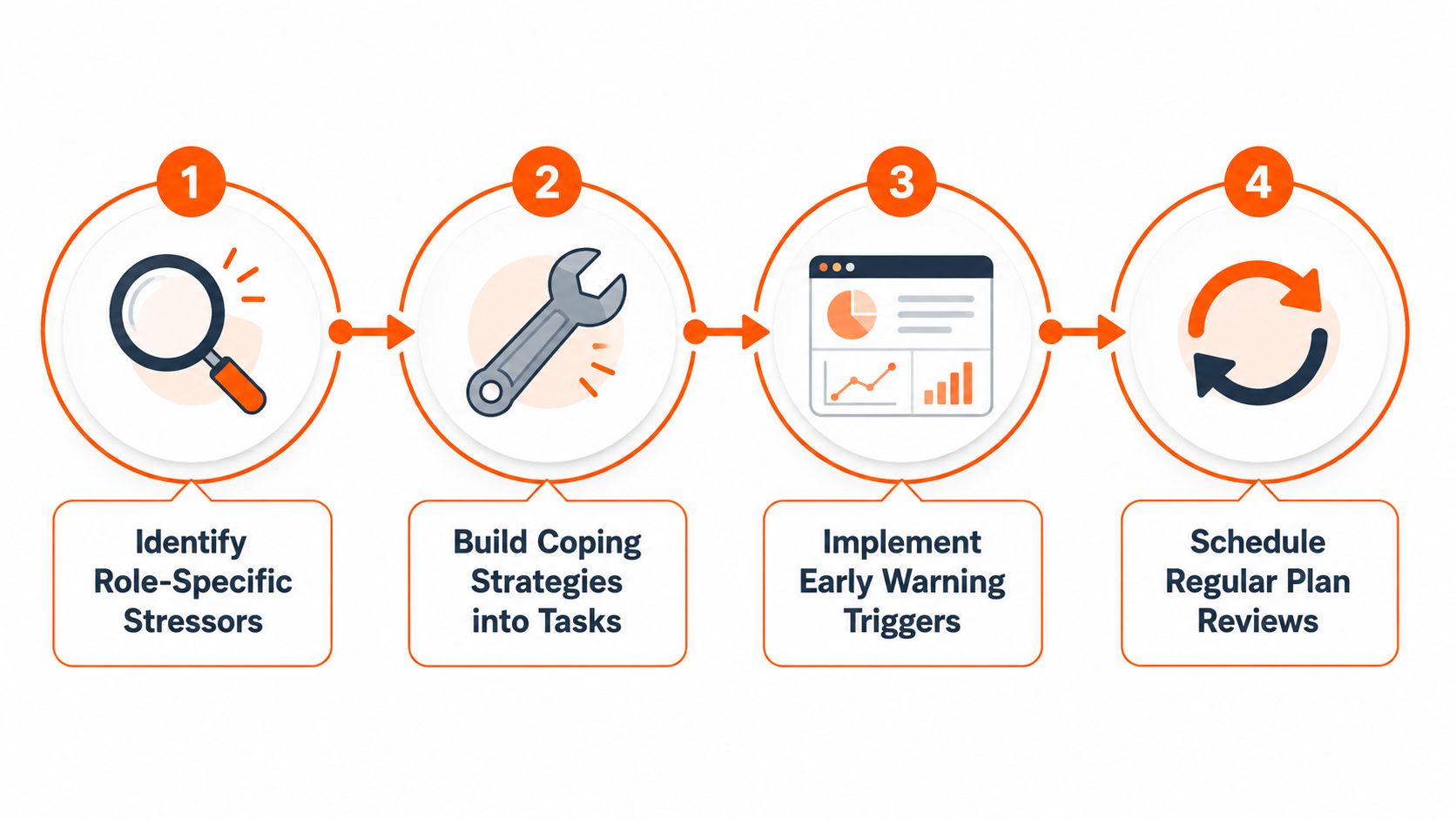
Work is where recovery gets tested. The plan should name the situations most likely to destabilize you and establish a response before those situations appear on the calendar.
Start with a role-specific trigger review:
- Client entertainment: Decide which events you'll attend, what you'll drink, how you'll leave, and who can cover if the setting becomes unsafe.
- Late-night deadlines: Set a cutoff, identify the person who takes over after it, and prohibit fatigue from becoming a badge of leadership.
- High-stakes presentations: Rehearse the content, limit same-day demands, and arrange a private decompression period afterward.
- Travel and isolation: Schedule treatment contact, recovery support, medication access, sleep protection, and a clear return protocol.
- On-call pressure: Define what counts as an emergency and who serves as the backup.
Aftercare appointments, therapy, peer-support meetings, and medication reviews belong on the working calendar. Use private calendar entries and communicate only the availability restriction to the employer. A treatment appointment doesn't become less important because a board meeting appears beside it.
A relapse-prevention plan also needs observable warning signs. These might include missed appointments, a return to old routines, deteriorating sleep, increasing secrecy, skipped meals, escalating irritability, or renewed access to substances. The plan should state what you'll do when a trigger fires, not merely identify the trigger.
Recovery safeguard: A warning sign is useful only when it has an assigned response and a named person who can help carry it out.
Write a simple escalation sequence. First, pause the affected duty. Next, contact the designated clinical or recovery support. Then notify the agreed workplace contact using functional language, such as “I need to reduce today's workload and activate the coverage plan.” The response should protect safety without forcing you to disclose a diagnosis to colleagues.
For additional planning ideas, review relapse prevention strategies and adapt them to the actual demands of your position. The strongest plan treats recovery commitments as part of job design, not as private intentions that work is allowed to cancel.
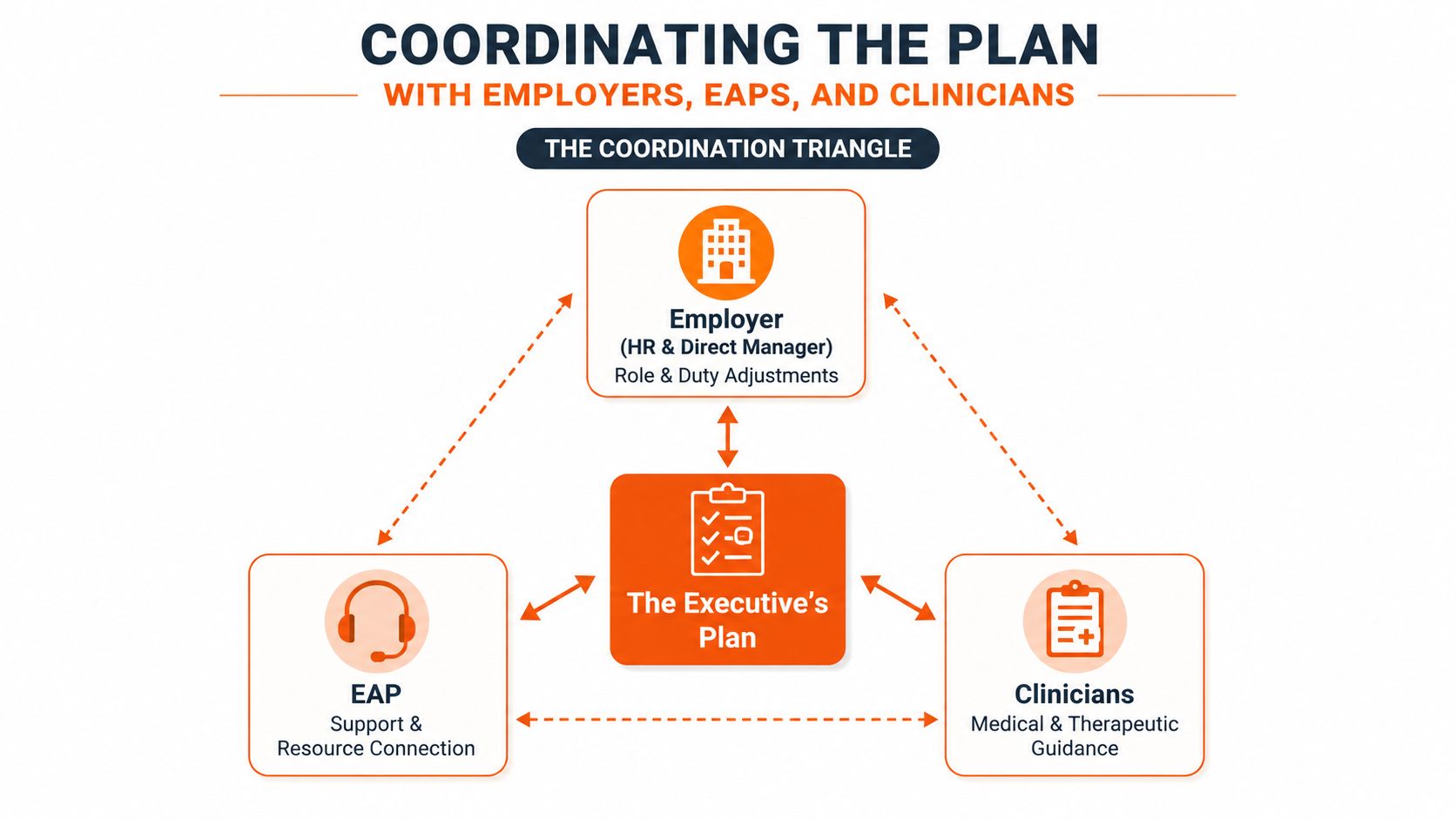
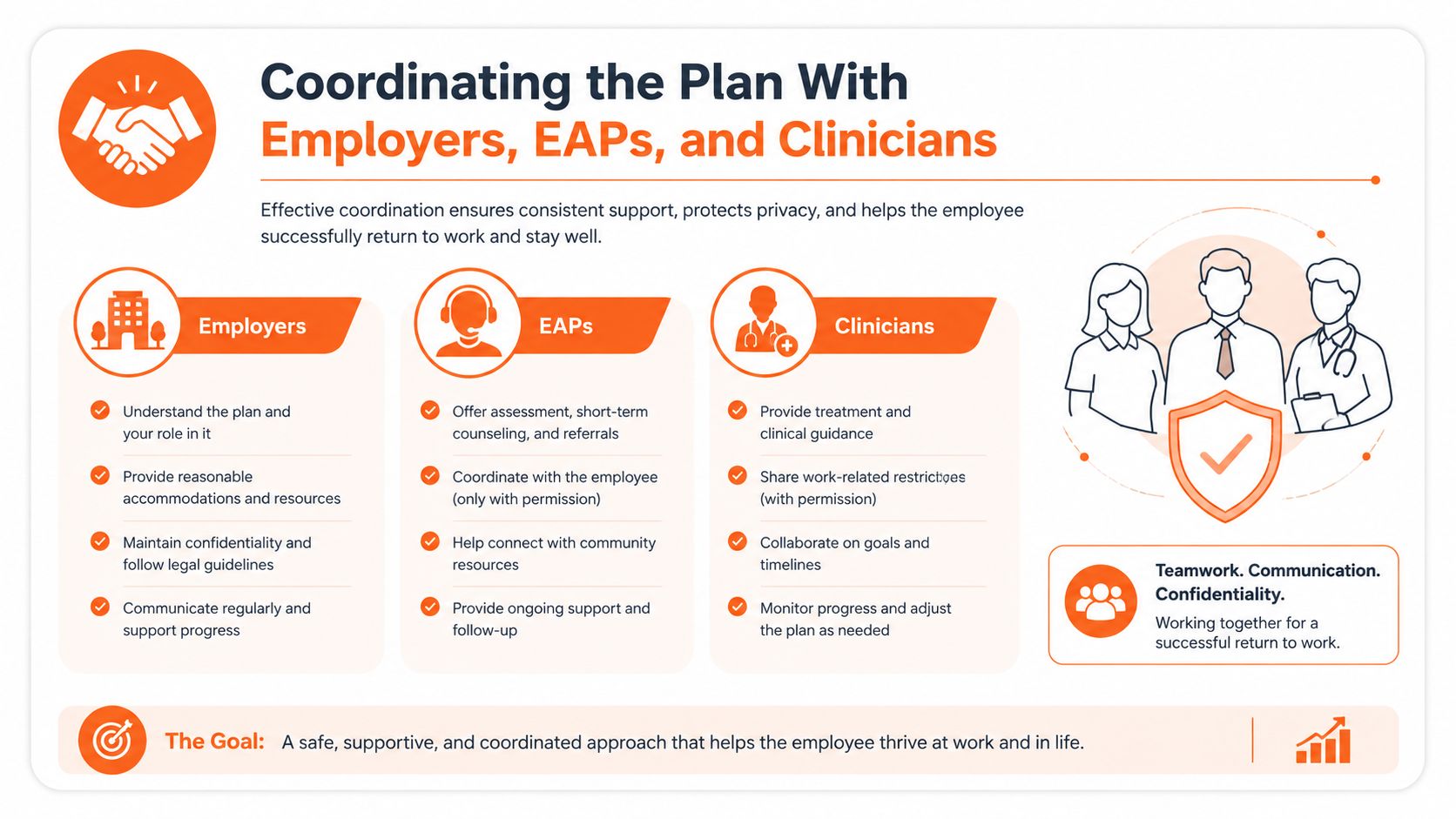
Coordinating the Plan With Employers, EAPs, and Clinicians
A plan fails when ownership is unclear. The executive shouldn't be responsible for translating clinical recommendations into every workplace decision while also managing recovery. Assign each deliverable to a person and put the arrangement on one page.
The employer owns role design, scheduling, coverage, accommodation implementation, and workplace check-ins. The clinical team owns medical recommendations, treatment milestones, medication monitoring, and clinical escalation guidance. An EAP or case manager can help coordinate resources and communication, but it shouldn't receive more medical information than necessary.
Build the one-page operating sheet
Include:
- Current duties: What you'll perform now, what's deferred, and who covers deferred work.
- Functional restrictions: The limits that affect hours, travel, concentration, urgency, or safety-sensitive tasks.
- Communication rules: Who receives administrative information, who receives functional information, and who receives nothing.
- Review dates: When the executive, manager, HR, and clinical team will assess progress.
- Escalation rules: The signs that require a pause, clinical contact, schedule reduction, or urgent intervention.
- Decision authority: Who can modify duties when the plan isn't working.
Use case management services when coordination requires a dedicated professional to keep employers, clinicians, and aftercare providers aligned. The exact participants will vary, but the boundaries should remain explicit.
The 2025 Safe Work Australia survey found that the proportion of workers with a return-to-work plan had remained relatively steady since 2016, supporting the view that structured planning is a durable recovery practice rather than a passing HR preference. Earlier national strategy guidance also linked early and written planning with stronger return outcomes, reporting that a plan within the first 30 days could increase the odds of returning to work by up to 1.7 times, while a written plan after 30 days could increase those odds by 3.4 times in the cited historical evidence from the National Return to Work Strategy.
Don't wait for the first difficult week to discover that nobody knows who makes the next decision. Schedule the coordination meeting, confirm the boundaries, and rehearse the escalation path before the return date.
Capo Canyon Recovery provides individualized detox, residential treatment, medication stabilization, dual diagnosis care, and aftercare coordination for executives and licensed professionals who need privacy while planning a safe return to work. Visit Capo Canyon Recovery to discuss a clinically structured treatment and reintegration plan with the admissions team.