
Capo Canyon Logo
  • Home
  • Who We Are
    • Meet Our Team
    • Explore Our Facility
    • Executive Rehab in OC
    • Private Rooms
    • Tech Friendly
    • Chef Prepared Meals
  • Programs
    • Drug & Alcohol Detox
    • Dual Diagnosis Treatment
    • Executive Program
    • Work From Rehab
    • Private Treatment
    • Residential Treatment
    • Medication Stabilization
    • Extended Care Program
  • What We Treat
    • Adderall Treatment
    • Addiction Treatment
    • ADHD Treatment
    • Alcohol Treatment
    • Anxiety Treatment
    • Benzo Addiction Treatment
    • Bipolar Disorder Treatment
    • Cocaine Addiction Treatment
    • Depression Treatment
    • Fentanyl Addiction
    • Ketamine Addiction Treatment
    • Opiate Addiction Treatment
    • Prescription Drugs Treatment
    • Process Addiction Treatment
    • Marijuana Addiction Treatment
    • Meth Addiction Treatment
    • Trauma Treatment
  • Modalities
    • Acceptance and Commitment Therapy
    • Art Therapy
    • Brainspotting
    • Cognitive Behavioral Therapy
    • EMDR
    • Evidence Based Therapy
    • Family Therapy
    • Holistic Therapy Services
    • Individual Therapy
  • Admissions
    • Verify Insurance
    • What to Bring
    • FAQs
    • Why Choose a Luxury Rehab
    • Blog
  • Contact
(949) 382-1100
Call or Text
Capo Canyon Logo
(949) 382-1100
Call or Text
  • Home
  • Who We Are
    • Meet Our Team
    • Explore Our Facility
    • Executive Rehab in OC
    • Private Rooms
    • Tech Friendly
    • Chef Prepared Meals
  • Programs
    • Drug & Alcohol Detox
    • Dual Diagnosis Treatment
    • Executive Program
    • Work From Rehab
    • Private Treatment
    • Residential Treatment
    • Medication Stabilization
    • Extended Care Program
  • What We Treat
    • Adderall Treatment
    • Addiction Treatment
    • ADHD Treatment
    • Alcohol Treatment
    • Anxiety Treatment
    • Benzo Addiction Treatment
    • Bipolar Disorder Treatment
    • Cocaine Addiction Treatment
    • Depression Treatment
    • Fentanyl Addiction
    • Ketamine Addiction Treatment
    • Opiate Addiction Treatment
    • Prescription Drugs Treatment
    • Process Addiction Treatment
    • Marijuana Addiction Treatment
    • Meth Addiction Treatment
    • Trauma Treatment
  • Modalities
    • Acceptance and Commitment Therapy
    • Art Therapy
    • Brainspotting
    • Cognitive Behavioral Therapy
    • EMDR
    • Evidence Based Therapy
    • Family Therapy
    • Holistic Therapy Services
    • Individual Therapy
  • Admissions
    • Verify Insurance
    • What to Bring
    • FAQs
    • Why Choose a Luxury Rehab
    • Blog
  • Contact
Capo Canyon Logo
READ MORE
Uncategorized
August 20by 0 Comments

Navigating the Insurance Verification Process for Treatment

You're trying to get an executive into treatment quickly. The bed is available, the family has agreed on a plan, and the patient may already be experiencing withdrawal. Then admissions asks for the insurance card, policy details, clinical records, and authorization before the stay can begin. A missing group number or an unclear benefit answer can turn an urgent admission into a day of phone calls.

That delay matters. Up to 20% of initial claims may contain eligibility errors, and 48% of providers report that registration or check-in data is somewhat or not accurate, according to industry reporting on insurance verification in healthcare. Verification catches errors in member identification, active coverage, plan type, benefits, and network status before they become denials or unexpected bills.

For executives, the insurance verification process is a logistics problem with a short decision window. You need the right documents, the right questions, and a written record of every payer answer. You also need to understand what happens after eligibility is confirmed, because verified coverage doesn't automatically mean residential detox or inpatient treatment is approved.

Why Insurance Verification Comes Before Anything Else in Treatment

An executive may have agreed to enter detox tonight, yet admission can stall while a treatment center checks the plan. The center must confirm active coverage, behavioral health benefits, network status, and any prior authorization requirement. Until those answers are documented, the available bed and the patient's admission plan remain uncertain.

Insurance verification is a front-end clinical and financial gatekeeper. It identifies the level of care the payer may review, whether detox or residential treatment falls within the benefits, what records utilization reviewers expect, and whether the facility can bill under the plan. Eligibility issues account for a substantial share of claim denials, as noted earlier in the healthcare revenue-cycle guidance on verification.

Practical rule: An active card does not complete verification. It starts the process.

A documented check gives the family a clearer estimate of deductible exposure, coinsurance, copays, exclusions, and out-of-network penalties. It also prevents an executive from entering treatment assuming the payer will cover a service that requires separate approval. Read the benefit response against the planned stay, especially if residential detox may continue into residential care.

The 24 to 48 hour decision window

Urgent admissions rarely allow a slow administrative process. Families are weighing withdrawal risk, work obligations, travel, privacy, and the patient's willingness to accept help. A coverage problem discovered after treatment begins can disrupt placement and create an avoidable financial dispute.

Use the first day to assemble records, start the eligibility check, and call the payer with a specific question list. Ask whether residential detox is covered, what cost sharing applies, whether the facility is in network, and whether authorization is required for each level of care. Request the payer's reference number and the representative's name.

Use the second day to resolve mismatched member details, obtain the benefit summary, and submit clinical records for review. When the Explanation of Benefits arrives, check the service description, dates, billed amount, allowed amount, deductible, coinsurance, patient responsibility, denial or adjustment reason, and appeal instructions. An EOB is not an authorization letter, and it does not replace a written coverage determination.

Escalate beyond a phone call when the representative gives conflicting answers, refuses to identify the applicable benefit, or cannot explain a denial. Ask for the response in writing and submit a written payer escalation with the patient identifiers, call reference number, requested level of care, clinical rationale, and the exact decision needed. Keep the record with the admissions and insurance verification process so the treatment team can coordinate placement without guessing about reimbursement.

The workflow is simple to state and demanding to execute: verify the right benefit, document every answer, secure authorization promptly, and recheck coverage during the stay.

What Information to Gather Before You Call the Insurer

Treat the first call like a pre-flight checklist. The insurer's representative can only verify what matches the payer's records, and a single mismatch can send the conversation back to the beginning. Put every document in one secure folder before anyone calls.

Patient and policy identification

Start with the patient's legal name exactly as it appears on the insurance card, date of birth, member ID, policy number, and group number. Add the policy holder's full name, date of birth if available, and relationship to the patient. The policy holder may be a spouse, parent, or employer-sponsored account holder rather than the person entering treatment.

The phone number on the back of the card should be your first payer contact. Identify the product type, such as HMO, PPO, EPO, or POS, because network rules and referral requirements can differ sharply between products. Keep a copy of the insurance card, a recent Explanation of Benefits, and the Summary Plan Description if the employer provides one. Those documents often clarify benefit language that a front-line representative may summarize quickly.

Clinical facts for behavioral health

The verification team will need enough clinical context to identify the correct behavioral health pathway. Prepare the primary substance involved, current withdrawal symptoms, recent use, prior treatment episodes, co-occurring mental health concerns, and the referring clinician's name and contact details.

You don't need to improvise a clinical narrative during the call. Ask the treating or referring provider for an assessment, medication list, diagnosis information, and notes describing why the proposed level of care is appropriate. For an executive, a concise account of work impairment, safety concerns, relapse risk, and failed lower levels of care can help the authorization team assemble a coherent record.

A professional infographic titled Insurance Verification Checklist detailing key requirements for pre-flight medical logistics and patient data.

Employer and scheduling details

For employer-sponsored coverage, save the HR or benefits administrator's contact information. The insurer handles claims and benefits, but an employer's plan administrator may clarify plan documents, eligibility dates, or a group-level issue that customer service can't resolve.

Write down the target admission date, preferred level of care, facility tax identification information if available, and the names of anyone authorized to speak with the payer. Organization reduces repeated calls and prevents contradictory information. It also gives the admissions team a complete packet instead of scattered screenshots and partial messages.

How the Verification Call and Electronic Check Actually Work

A reliable insurance verification process uses two tracks. The first is a live call to the payer's behavioral health or provider-services department. The second is an electronic eligibility inquiry through the insurer's portal or a clearinghouse. Neither track should be treated as infallible.

Begin the call with a precise request: “I'm verifying behavioral health benefits for a planned substance use treatment admission.” Give the patient's identifiers, facility details, proposed level of care, and anticipated admission date. Ask the representative to confirm active eligibility for that date, not merely whether a policy exists.

Ask benefit questions that match the admission

Use a written script so the call doesn't drift into generalities. Ask:

  • Level of care: Are medically supervised detox, residential treatment, inpatient services, PHP, and IOP covered separately?
  • Cost sharing: What deductible applies, how much has been met, and what copay or coinsurance applies to each level?
  • Maximum exposure: What is the out-of-pocket maximum, and which treatment charges count toward it?
  • Limits: Are there day, session, frequency, diagnosis, or benefit-period limits?
  • Exclusions: Does the plan exclude substance use treatment, certain medications, or specific facility types?
  • Network status: Is the facility contracted for this exact product, and are behavioral health services administered by another company?
  • Authorization: Is prior authorization required before admission, and who submits it?
  • Review process: What clinical records are required, and where should they be sent?

A phone answer is useful only when you can prove what was said. Record the representative's name or identifier, department, date, time, call reference number, and the exact wording of important coverage statements. If the representative says the facility is in network, ask whether that applies to the facility, the clinician, and the patient's specific plan.

Compare the electronic result with the phone answer

An electronic 270/271 eligibility transaction can return core eligibility and benefit information through a payer portal or clearinghouse. It may show active coverage, plan identifiers, and selected benefit fields, but it can omit behavioral health exclusions, facility-specific network details, or authorization requirements.

Portal data may also differ from the phone answer because the systems refresh at different times or route behavioral health benefits to a separate administrator. Treat discrepancies as an escalation trigger. Ask the payer to identify which department controls the benefit and request written confirmation when the financial exposure is significant.

Electronic checks can take one to four business hours, while phone verification may be completed the same day, depending on the payer and the information available, as outlined in eligibility verification research for healthcare providers. If the representative can't reconcile conflicting information, request a supervisor before ending the call.

In-Network vs Out-of-Network and What It Changes

Network status can change the economics of treatment more than the headline benefit percentage suggests. An in-network facility has a contract with the payer and accepts negotiated rates for covered services. An out-of-network facility may bill at its own rate, leave the patient responsible for a separate deductible, and expose the patient to balance billing.

For a residential detox admission, ask the payer to verify the facility against the exact plan product, not just the insurance company's name. A national insurer may operate multiple products with different networks. “The carrier is accepted” doesn't answer whether this facility is contracted for this member's plan.

The financial difference

In network, the payer's allowed amount typically controls the claim calculation. The patient may still owe a deductible, copay, or coinsurance, but the contracted provider generally can't bill above the negotiated amount for covered services.

Out of network, the plan may apply a higher deductible or separate out-of-network cost sharing. The payer's allowed amount may be lower than the facility's billed charge, and the patient could be billed for the difference. Some plans offer no out-of-network behavioral health benefit at all.

Factor In-Network Out-of-Network
Contracted rate The facility accepts the payer's negotiated rate for covered services. The facility may use its own charges, subject to the plan's allowed amount.
Deductible The plan's in-network deductible generally applies. A separate or higher out-of-network deductible may apply.
Out-of-pocket maximum Covered patient responsibility usually accumulates under the in-network maximum. Charges may accumulate under a different maximum or may not count fully.
Balance billing Usually restricted by the provider contract for covered services. The patient may face the difference between the billed charge and allowed amount.
Single-case agreement Usually unnecessary because a contract already exists. The facility may request a one-time agreement with the payer.
Claim submission The facility commonly submits the claim. The patient or facility may need to submit reimbursement paperwork.

Ask specifically whether the facility can negotiate a single-case agreement. This one-time contract can establish a negotiated rate when no standard contract exists, but it must be confirmed before admission. Ask who initiates it, whether the payer will treat the facility at in-network rates, what services it covers, and whether the agreement includes the entire planned episode.

Families should also ask how to file an out-of-network claim, whether the insurer reimburses the patient or provider, and whether travel or lodging benefits exist. The financial decision belongs before admission, not after the first bill. For additional context on coverage questions, review how insurance may cover addiction treatment, then confirm every detail directly with the payer.

Prior Authorization After a Successful Verification

Eligibility answers one question: is the patient covered under the plan? Prior authorization answers a different question: will the payer approve the proposed service at the requested level of care? A patient can have active benefits and still face a denial if the request lacks clinical support, exceeds a plan limit, or arrives without the required documentation.

Federal reporting has made authorization performance more visible. Under CMS-0057-F, insurers must report approval and denial shares, appeal overturn rates, and processing times. For the first public reporting cycle covering 2025, insurers disclosed 85.4 million standard prior-authorization determinations and 9.6 million denials, according to KFF's analysis of prior-authorization metrics. Median standard denial rates were 7.2% for Medicare Advantage, 12.1% for Medicaid managed care, 14.0% for CHIP, and 14.1% for Marketplace plans, according to the same source.

Build the clinical packet before submission

The reviewer needs a defensible reason for the requested level of care. Send a physician or qualified clinician assessment, diagnosis information, substance-use history, current withdrawal or safety concerns, medication details, and documentation of prior treatment attempts. Include the clinical criteria supporting detox or residential treatment, not just a statement that the patient wants admission.

A strong packet also explains why a lower level of care is insufficient, what risks require structured treatment, and how the team will approach discharge planning. Include a preliminary discharge plan with continuing-care needs, family involvement, psychiatric follow-up, medication management, and recovery supports. Do not wait for a denial to discover that the record lacks this context.
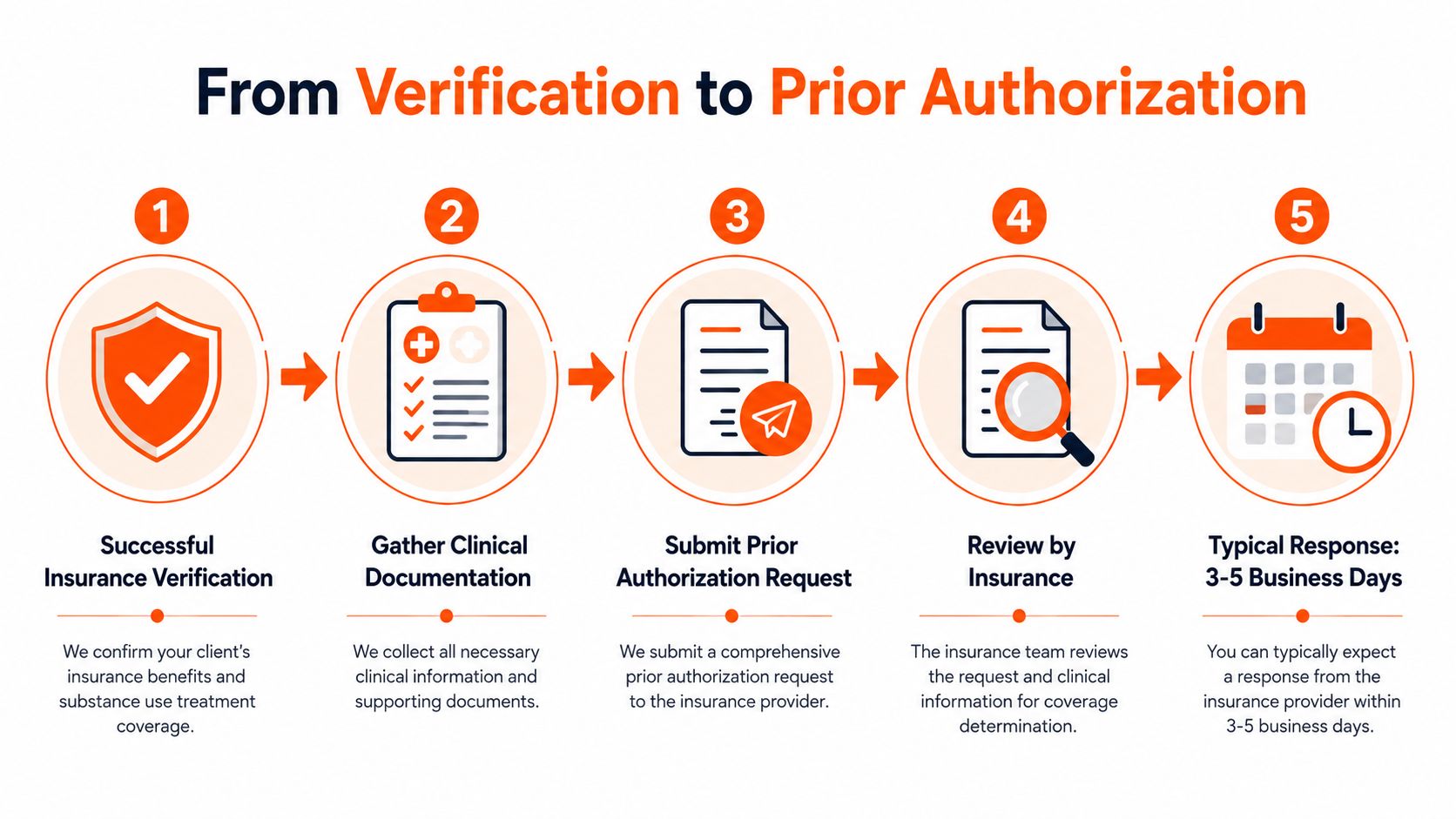
A five-step infographic showing the insurance verification and prior authorization workflow for substance use treatment providers.

Understand the decision clock

Urgent reviews may receive faster handling than standard requests, but the payer's stated deadline controls. Standard reviews can take several business days, and missing records can restart the practical clock even when the formal request has been submitted. Ask for the authorization case number, submission timestamp, assigned reviewer or department, and the exact deadline for a decision.

Common denial reasons include incomplete medical-necessity documentation, unclear criteria for the requested level of care, missing prior treatment history, and benefit limits already reached. A denial isn't the time for a general complaint. Request the clinical rationale, identify the missing evidence, and ask whether a peer-to-peer review is available.

If the payer denies the request, move quickly. Have the treating clinician participate in peer-to-peer review when permitted, then submit a written appeal within the plan's required window. Keep the case management services team informed so clinical records, payer communications, and discharge planning remain aligned.

Common Pitfalls and How to Reverify Mid-Treatment

A clean admission-day verification doesn't guarantee uninterrupted payment for a residential stay. Coverage can change, the payer can demand continued-stay evidence, and a transition from detox to residential care can create a new authorization requirement.

Three failures appear repeatedly:

  • Assuming the first approval covers the entire stay: An authorization may cover only an initial period or level of care. Schedule a proactive review before the approved period ends.
  • Missing benefit or eligibility changes: Employment changes, plan updates, and administrative corrections can alter coverage. Confirm the patient's status at regular touchpoints.
  • Treating level-of-care transitions as automatic: Detox, residential, PHP, and IOP may use different benefit rules, codes, or review standards. Ask for the next approval before the transition occurs.
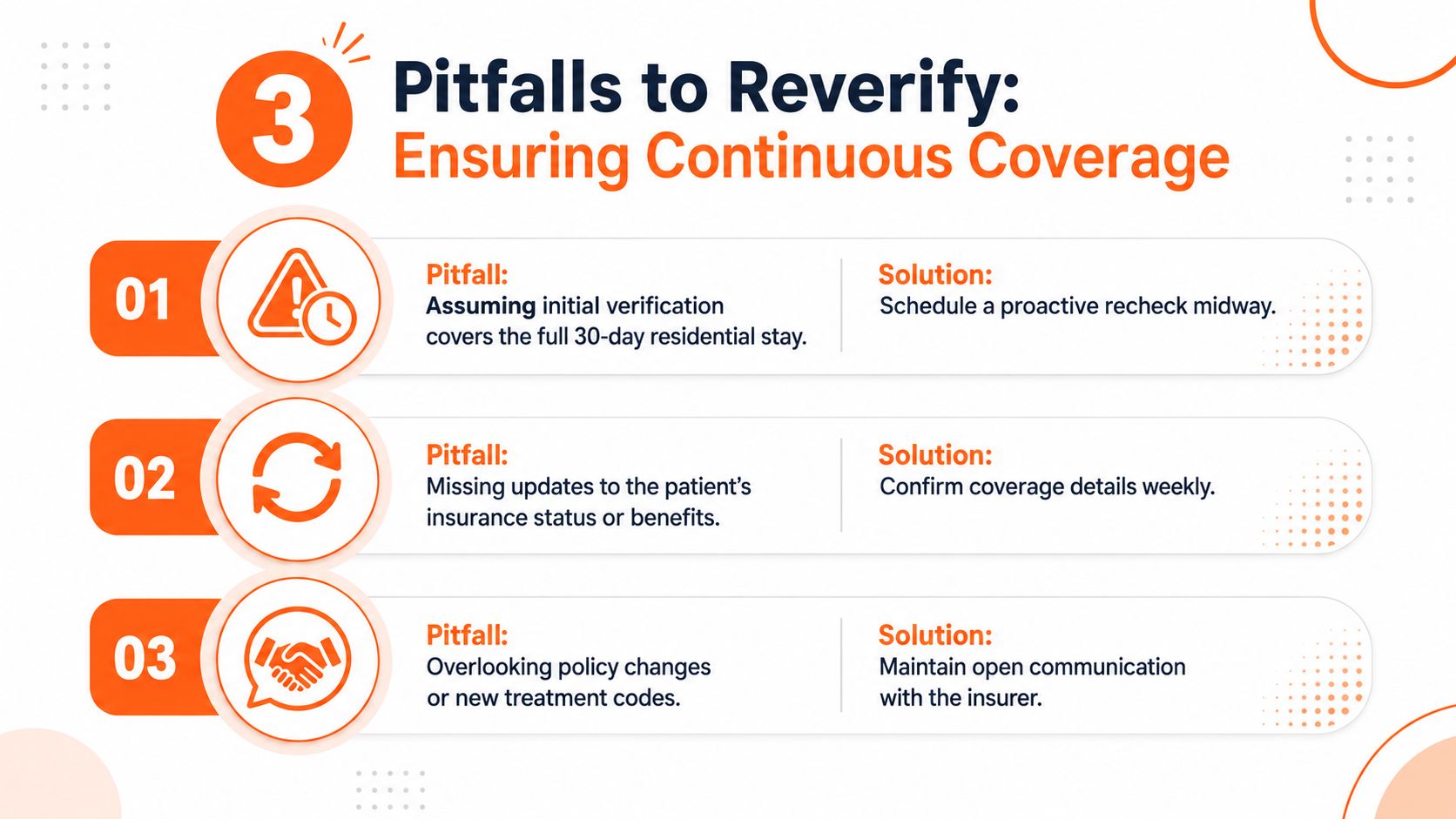
An infographic listing three common pitfalls in insurance verification and their solutions to ensure continuous medical coverage.

Set reverification checkpoints

Put calendar reminders on day 7, day 14, and day 21 of a planned residential episode. At each checkpoint, document active eligibility, remaining authorized days, continued-stay requirements, next review date, network status, and the name and reference number associated with the payer contact.

Read every Explanation of Benefits when it arrives. For residential detox, check the service dates, facility identity, procedure or revenue codes, allowed amount, deductible application, coinsurance, denial or adjustment codes, and patient responsibility. The EOB isn't an invoice, but it can reveal a mismatch before discharge creates a large balance.

Escalation rule: If a phone representative gives an answer that conflicts with the authorization letter or EOB, request written clarification. A written payer escalation is appropriate when the dispute affects a treatment transition, a material balance, or a pending discharge.

A Practical Timeline for Working With Capo Canyon Recovery

Executives and families need a sequence they can act on, not a vague promise that someone will “check the insurance.” Use the first 48 hours to move four workstreams forward: intake, eligibility, clinical documentation, and authorization.

Day one

At hour zero, contact admissions and provide the patient's identifying information, insurance card, target admission date, and planned level of care. Explain whether the patient is experiencing withdrawal, has immediate safety concerns, or needs a private executive setting.

Within the first two hours, complete the secure intake and upload or send the insurance documents and clinical records you already have. The admissions team can identify missing information before the payer call rather than after a representative asks for it.

By the end of day one, initiate the electronic benefits check and live payer verification. Request answers about deductible status, out-of-pocket maximum calculations, residential and PHP benefits, detox coverage, network classification, authorization requirements, and any travel reimbursement clause.

Day two

By midday on day two, request a written coverage summary or documented call outcome. Resolve conflicts between the portal response and the representative's answer, and obtain the payer reference number.

By the close of day two, submit the prior-authorization request with the clinical assessment, diagnosis, treatment history, medical-necessity rationale, and preliminary discharge plan. Confirm where the request was sent and when the payer's review clock began.

Admission coordination should proceed once the authorization reference number and level-of-care decision are confirmed. If the payer has not decided, ask what remains missing and whether the case can be escalated for an urgent review.

For a private, licensed detox and residential program in Mission Viejo, Capo Canyon Recovery offers insurance verification and admissions coordination for executives and professionals, including benefit and out-of-pocket review. Call the admissions line with your insurance card and clinical information ready, and ask the team to verify the plan, coordinate prior authorization, and identify the next concrete step toward admission.


READ MORE
Uncategorized
July 15by 0 Comments

Your Partner in Recovery: An Executive’s Guide to Support

A lot of executives arrive at this subject the same way. They're still performing, still leading meetings, still answering late-night emails, and still telling themselves that nothing has gone off the rails. But the private math no longer works. Sleep is thinner. Irritability is higher. One drink became several. Medication use stopped feeling temporary. The calendar looks controlled, while life feels less so.

What makes this harder at an executive level is the isolation. People depend on you. Your name may carry revenue, trust, licensing, or public visibility. That pressure makes many professionals delay treatment because they're not only afraid of withdrawal or change. They're afraid of exposure, gossip, loss of authority, and the consequences of being seen as unstable.

The Executive's Dilemma Isolation in Plain Sight

A common scene looks deceptively ordinary. A founder closes a laptop after midnight, promises this is the last stressful quarter, and reaches for the same coping tool used the night before. A physician finishes a shift and tells herself the medication is still “just to get through.” An attorney keeps winning cases while secretly planning each day around relief, secrecy, and damage control.

That's why the idea of a partner in recovery matters. Not as a sentimental add-on. As a strategic ally. Recovery is far more stable when someone or some team helps carry structure, accountability, and perspective at the moments when your own judgment is under strain.

A sophisticated businessman stands in a high-rise office looking out at a scenic city skyline at sunset.

Why isolation is so dangerous

Executives often confuse privacy with self-containment. Privacy protects dignity. Self-containment turns into silence, and silence gives substance use room to expand. If you've seen your social world shrink while your inner justifications get more polished, that's not resilience. That's a warning sign.

Many leaders first search for adjacent problems instead of the core one. They look into sleep, stress, focus, or burnout. Some of that is useful. Practical strategies for executive burnout can help you see how exhaustion and overdrive create fertile ground for unhealthy coping. But burnout management alone won't resolve an active substance problem.

Social withdrawal also intensifies risk. This is one reason how isolation fuels opioid addiction is such an important lens. People rarely recover well inside secrecy for long.

Recovery is far more common than most people think

There's also a fact many professionals need to hear early. Approximately 20.5 million adults in the United States are currently in recovery or have recovered from a substance use problem, according to national survey data summarized by the CDC. Recovery is not rare. It's not an outlier outcome reserved for other families, other careers, or other life stages.

You're not facing a strange private failure. You're facing a treatable condition that many people have already navigated successfully.

For executives, that matters. Shame says, “Someone in my position shouldn't need help.” Clinical reality says the opposite. High-responsibility people need support that matches the complexity of their lives.

Defining the Partner in Recovery Role

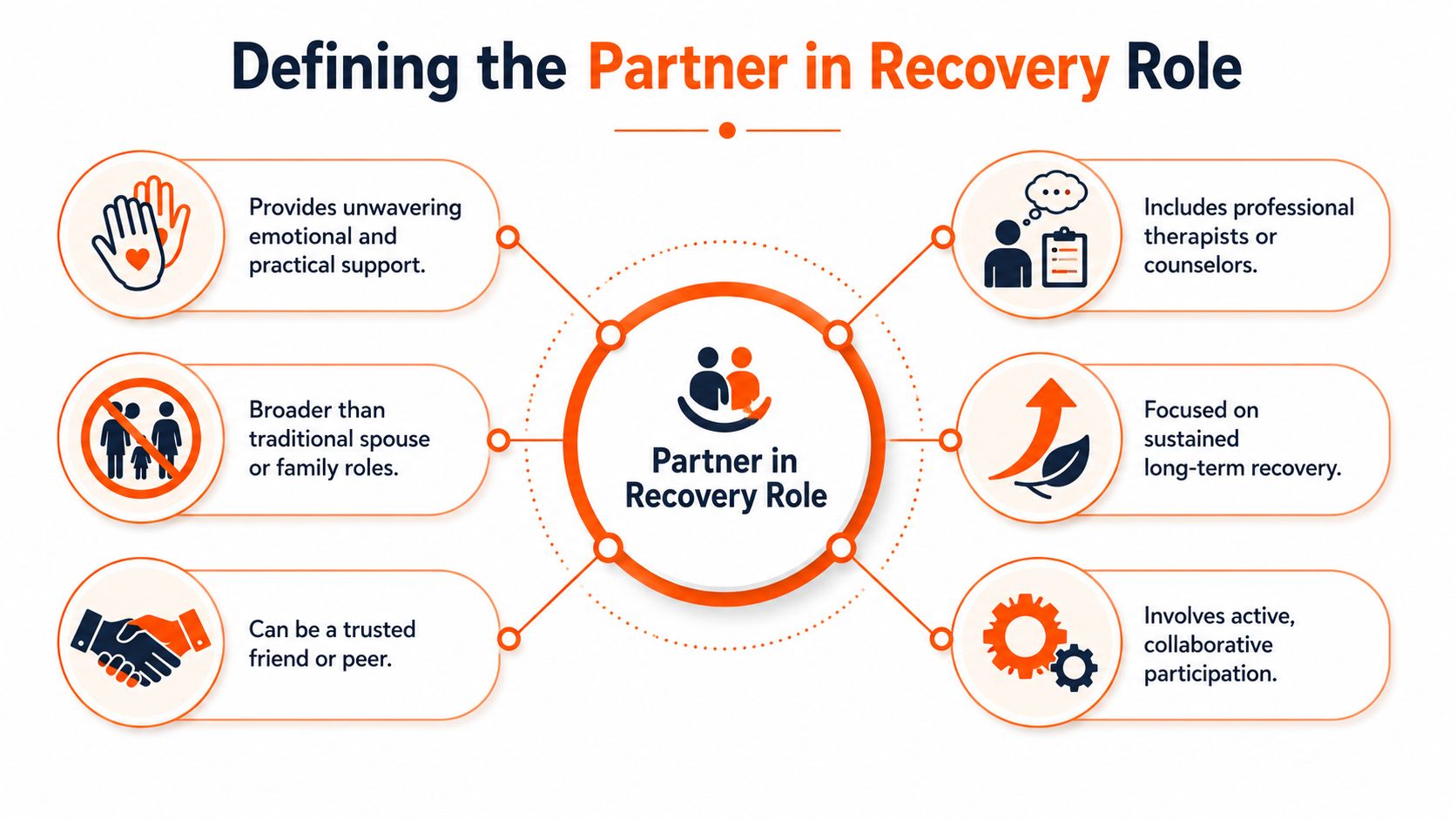
A partner in recovery is a role, not a title. It might be a spouse. It might be a sponsor, therapist, case manager, trusted peer, or another carefully chosen person. What matters is function. This person or team helps protect recovery when stress, rationalization, conflict, or access to substances starts to weaken it.

Think of the role like a co-pilot. The person in the primary seat still has responsibility. But the co-pilot helps monitor conditions, catch drift early, and respond before a problem becomes a crisis. In recovery, that means someone helps you stay aligned with the plan you said you wanted when you were clear-headed.

A diagram defining the Partner in Recovery role, highlighting its collaborative, supportive, and long-term recovery focus.

Working definition: A partner in recovery provides consistent, non-judgmental support that reinforces treatment goals, protects boundaries, and helps recovery remain active in daily life.

What the role includes

This role usually combines several tasks that are easy to blur together if you haven't named them clearly.

  • Support: The person can listen without escalating shame.
  • Structure: They help keep appointments, routines, and treatment commitments from becoming optional.
  • Feedback: They can say, calmly and directly, when they see warning signs.
  • Containment: They don't get swept into chaos, secrecy, or rescue mode.

A good partner in recovery isn't there to absorb every emotion or solve every crisis. They help keep the process grounded.

What the role does not include

Confusion starts when support turns into overreach. A spouse may think love means surveillance. A colleague may think accountability means frequent check-ins about private clinical material. A friend may confuse empathy with making excuses.

That's where many recovery arrangements fail. The role works best when everyone understands that support is different from control.

A partner in recovery strengthens follow-through. They don't replace treatment, enforce sobriety by force, or become your full-time emotional regulator.

For executives, this distinction is especially important. High-functioning professionals often attract helpers who are impressed, intimidated, or overly protective. None of those reactions create stable recovery. Clear roles do.

The Four Key Types of Recovery Partners

Individuals generally do better with more than one kind of support. A single person can't usually meet every need without strain, role confusion, or burnout. The strongest recovery plans use a small network where each partner has a defined lane.

The clinical partner

This is your therapist, psychiatrist, physician, nurse, case manager, or treatment team. Their value comes from training, objectivity, and the ability to make evidence-based decisions when emotions are running high.

A clinical partner addresses withdrawal risk, co-occurring mental health symptoms, medication decisions, treatment planning, relapse patterns, and aftercare coordination. They can say things a spouse or friend can't say effectively because their role isn't entangled with marriage, parenting, office politics, or family history.

Their boundary is also clear. They provide care. They are not friends, confidants-on-demand, or personal assistants.

The personal partner

This is often a spouse, sibling, close friend, or trusted adult family member. Personal partners matter because they see daily behavior in real time. They often notice sleep changes, irritability, isolation, mood shifts, or subtle return-to-use patterns before anyone else does.

Their best contribution is steady support paired with limits. They can help reduce chaos at home, support treatment participation, and respond quickly when the person in recovery starts slipping into old routines.

Their biggest risk is emotional overinvolvement. A personal partner can drift into nagging, covering, rescuing, or arguing about whether a problem “really” exists. Once the relationship becomes a courtroom, recovery usually suffers.

The peer partner

This may be a sponsor, sober peer, or non-family accountability partner. Peer support works because it combines credibility with relatability. The person has lived experience and can often identify minimization faster than people who haven't been there.

For professionals who can't lean on family because of privacy concerns, this model can be especially useful. Research discussed in this article on reciprocal support and recovery processes describes principles that fit this role well, including “non-threatening accountability” and “listening without giving advice.” That style is often more effective than lectures.

The limitation is scope. A peer partner is not a clinician. They shouldn't manage detox concerns, diagnose mental health conditions, or become the only person holding the recovery plan together.

The professional partner

In an executive setting, this can include a carefully chosen HR contact, an EAP representative, a licensing advocate, an attorney handling leave coordination, or another trusted professional who helps protect work stability during treatment.

This type of partner isn't there for emotional processing. They help manage practical exposure. Time away. Documentation. Communications. Re-entry planning. Confidentiality decisions. They reduce the operational chaos that often keeps leaders from entering care at the right time.

Their boundary is straightforward. They support employment and professional continuity. They are not your therapist or sponsor.

Comparing your partners in recovery

Partner Type Primary Role Key Responsibilities Crucial Boundaries
Clinical Partner Treatment and medical oversight Assessment, therapy, medication support, relapse planning, care coordination Must remain clinically objective and professionally boundaried
Personal Partner Daily relational support Encouragement, noticing warning signs, supporting routines, communicating concerns Must not police, rescue, cover up, or try to “cure”
Peer Partner Experience-based accountability Check-ins, honest reflection, modeling recovery habits, support during cravings or stress Must not act as clinician or sole safety net
Professional Partner Workplace and privacy support Leave planning, documentation, confidential coordination, re-entry logistics Must stay within professional role and avoid clinical advice

Recovery becomes more durable when each partner has one clear lane instead of everyone trying to do everything.

Responsibilities and Healthy Boundaries in Partnership

Support helps recovery. Unstructured support can undermine it. That's the paradox many families and executives miss. People often think love means constant access, constant reassurance, and constant intervention. In practice, recovery is stronger when support is active but contained.

There's also meaningful evidence behind involving significant others in treatment. When significant others are actively involved in addiction treatment, the individual in recovery experiences approximately a 6% reduction in substance use frequency, and those improved outcomes endure for 12 to 18 months post-treatment, as reported in this review of significant-other-involved treatment. The key phrase is “actively involved.” Not reactive. Not intrusive. Structured.

What healthy partners do

A good partner in recovery helps the person stay connected to the plan during difficult moments, not just easy ones.

  • Listen for patterns: Pay attention to changes in sleep, withdrawal from family, defensiveness, and sudden secrecy.
  • Name concerns directly: Say what you observe without diagnosing or attacking character.
  • Support treatment participation: Encourage therapy, family sessions, peer meetings, and aftercare appointments.
  • Help identify triggers: High-conflict events, travel, professional setbacks, loneliness, and unstructured evenings often matter more than people admit.
  • Protect routines: Meals, sleep, movement, medication adherence, and predictable schedules reduce instability.

One practical resource for loved ones is this guidance for caregivers on family boundaries. The language is broad, but the principle applies well in recovery. Clarity protects both people.

What healthy partners refuse to do

Partners often need permission to stop doing things that feel helpful but aren't.

  • Don't enable: Don't buy substances, hide consequences, call in excuses, or smooth over legal or professional fallout.
  • Don't become a detective: Searching phones, interrogating, and trying to outsmart deception usually turns the home into a surveillance system.
  • Don't absorb blame: Addiction affects the relationship, but one partner didn't cause another adult's substance use.
  • Don't take over treatment: Loved ones can reinforce a plan. They can't replace a clinician.
  • Don't negotiate safety: If a partner feels triggered, unsafe, or chronically destabilized, that has to be addressed openly.

If this balance feels unfamiliar, setting healthy boundaries with others in recovery is often where the essential work starts.

Clinical rule: Boundaries are not punishments. They are the structure that keeps support from turning into chaos.

What doesn't work in executive households

In high-performing families, the most common mistakes are polished ones. Couples turn recovery into a performance project. Someone drafts rules but never discusses resentment. A spouse becomes the compliance officer. An executive promises transparency while continuing to manage appearances.

Those arrangements look organized. They usually fail because no one is speaking plainly. Healthy partnership requires honesty, not just systems.

How to Choose a Trustworthy Recovery Partner

Not everyone who cares about you is qualified to support your recovery well. Some people are loving but chaotic. Others are loyal but avoidant. Some mean well and still make the situation worse by minimizing, moralizing, or trying to manage your life.

Executives need to be especially selective. Privacy concerns are real. So are power dynamics. A poorly chosen support person can create exposure, dependency, or conflict that makes treatment harder to sustain.

Two men having a serious conversation at a wooden table in a brightly lit coffee shop.

Questions worth asking

Before you rely on someone, ask direct questions. Their answers matter less than their tone and self-awareness.

  • How do you view my recovery goals? You want someone who respects sobriety as a priority, not someone who treats it as temporary damage control.
  • Can you hold a boundary without anger? Accountability delivered with contempt won't help.
  • Are you comfortable staying in your lane? A trustworthy partner doesn't need to know everything to be useful.
  • How do you respond when people disappoint you? Recovery includes setbacks, hard conversations, and inconvenient truths.
  • Can you keep this confidential? For executives, this is not a minor preference. It is often a condition of safety.

Red flags that deserve attention

Some warning signs are easy to miss because they're wrapped in closeness or loyalty.

  • They have a history of enabling: If they routinely protect people from consequences, expect more of the same.
  • They make recovery about themselves: Hurt feelings are real, but chronic self-centering weakens support.
  • They're highly judgmental: Shame rarely produces stable sobriety.
  • They have unresolved substance issues of their own: Shared history doesn't always equal healthy support.
  • They confuse advice with listening: Many people rush to fix. Few can stay present.

For some professionals, the best answer is not a family member at all. The role may be better filled by a structured non-family accountability partner who can offer support without emotional spillover. That model is especially relevant where discretion matters. In professional recovery circles, the most useful stance often involves “non-threatening accountability” and “listening without giving advice.” Those qualities can be hard to find in intimate relationships and easier to build intentionally in a chosen ally.

A trustworthy recovery partner respects privacy, tells the truth, and doesn't need to dominate the process to feel important.

A practical standard for executives

If someone would be dangerous to disappoint, they're often the wrong first-line recovery partner. Board members, direct reports, and close business counterparts may care about you, but the role can become contaminated by money, authority, or fear.

Choose people who can tolerate honesty. Choose people who won't trade your vulnerability for influence. Choose people who can support recovery without becoming another audience you have to manage.

Why Your Treatment Center Is Your Most Critical Partner

For an executive, the most reliable primary partner in recovery is often not a single person. It's a treatment center built to operate as an integrated professional ally. That matters because recovery at this level usually involves more than stopping substance use. It may involve detox, psychiatric evaluation, therapy, family coordination, work containment, and aftercare planning all at once.

A strong center functions like a coordinated support system. The medical team manages safety and stabilization. Therapists address thought patterns, stress responses, trauma, and co-occurring conditions. Case management handles logistics, family communication, and next-step planning. Each piece reduces the burden on the patient and prevents the spouse or colleague from carrying roles they were never trained to hold.

Screenshot from https://capocanyon.com

What professional partnership looks like in practice

Executives need more than encouragement. They need a setting that can hold complexity without broadcasting it. In practical terms, that usually means a private environment, individualized treatment, support for co-occurring mental health needs, and enough clinical contact each week to catch problems early instead of discussing them after they've expanded.

It also means the program has to respect reality. Some professionals can't disappear from all responsibilities. In those cases, tech access, confidential communication protocols, and structured work boundaries become clinically relevant, not merely convenient.

Why this role is foundational

A spouse may be loving. A sponsor may be wise. A trusted friend may be available at the right moment. None of them replace an organized clinical structure.

That's why the treatment center belongs at the center of the recovery partnership. It creates the plan, coordinates the players, and adjusts the level of care as needs change. It also bridges the critical question many executives ask once they stabilize, which is what happens after residential care ends. The answer should never be “good luck.” It should look more like a thoughtful plan to continue treatment after attending an executive rehab.

Treatment works best when support isn't improvised. It's designed, coordinated, and sustained.

Building Your Support System Today

If you're reading this while trying to keep a complicated life from slipping any further, don't wait for a dramatic collapse to justify help. Recovery usually begins more effectively when someone acts early, while insight is still available and options are still broad.

Start with a simple audit. Who in your life can listen calmly? Who can hold a boundary? Who knows how to stay confidential? Who has been trying to help but is stuck in rescuing, anger, or denial? Those answers will tell you whether you already have a partner in recovery, or only people reacting around the problem.

Then make one deliberate move.

  • Choose one conversation: Ask a potential partner whether they can support recovery without controlling it.
  • Name one boundary: Remove one person, place, or routine that consistently destabilizes you.
  • Engage one professional resource: Don't build the whole plan alone when clinical support can organize it properly.

For executives, this is not weakness management. It's risk management, health protection, and leadership maturity. The people who recover best usually stop trying to “handle it privately” and start building a system that can hold the truth.


If you need a confidential, clinically grounded place to start, Capo Canyon Recovery helps executives and professionals build that support system with medically supervised detox, individualized residential treatment, dual-diagnosis care, family involvement when appropriate, and an executive-focused environment designed for privacy, discretion, and continuity. Reaching out to their admissions team is a practical first step when you need a real partner in recovery, not just good intentions.

READ MORE
Addiction and Rehab NewsDetox and RecoveryTreatment Services
November 22by Capo Canyon0 Comments

Effects of Alcohol on Your Body

Alcohol is distributed around your body by your blood as you drink and even the smallest amount can have a physiological effect. You’ll lose a small amount of alcohol as it leaves your body in your breath and urine but your tolerance will depend heavily on how much you’ve had to eat. Food that is high in fat slows down the absorption of alcohol into your bloodstream and it will take longer to feel intoxicated although there are other, more damaging effects of alcohol on your overall health to take into consideration. 

READ MORE
Healthy Living
July 20by Capo Canyon0 Comments

Making Drug Rehab Work the Second Time

Most people have heard of the traditional approach to addiction recovery promoted by AA and NA. However, holistic rehab programs have become much more popular in recent years as people turn to non-religious or secular alternatives. Among the components of a holistic rehab program are creative activities such as Art or Music Therapy. Both have been proven to be extremely beneficial as part of an addiction treatment program.

READ MORE
Healthy Living
June 11by Capo Canyon0 Comments

Understanding Chronic Pain and How to Treat It

Most people have heard of the traditional approach to addiction recovery promoted by AA and NA. However, holistic rehab programs have become much more popular in recent years as people turn to non-religious or secular alternatives. Among the components of a holistic rehab program are creative activities such as Art or Music Therapy. Both have been proven to be extremely beneficial as part of an addiction treatment program.

READ MORE
Healthy Living
April 23by Capo Canyon0 Comments

What is Mental Health?

Most people have heard of the traditional approach to addiction recovery promoted by AA and NA. However, holistic rehab programs have become much more popular in recent years as people turn to non-religious or secular alternatives. Among the components of a holistic rehab program are creative activities such as Art or Music Therapy. Both have been proven to be extremely beneficial as part of an addiction treatment program.

READ MORE
Healthy Living
February 26by Capo Canyon0 Comments

Long Term Recovery From Trauma / PTSD

Most people have heard of the traditional approach to addiction recovery promoted by AA and NA. However, holistic rehab programs have become much more popular in recent years as people turn to non-religious or secular alternatives. Among the components of a holistic rehab program are creative activities such as Art or Music Therapy. Both have been proven to be extremely beneficial as part of an addiction treatment program.

READ MORE
Healthy Living
January 27by Capo Canyon0 Comments

Create Your Happy Book

Most people have heard of the traditional approach to addiction recovery promoted by AA and NA. However, holistic rehab programs have become much more popular in recent years as people turn to non-religious or secular alternatives. Among the components of a holistic rehab program are creative activities such as Art or Music Therapy. Both have been proven to be extremely beneficial as part of an addiction treatment program.

READ MORE
Detox and RecoveryHealthy Living
December 18by Capo Canyon0 Comments

Recovery Story

Most people have heard of the traditional approach to addiction recovery promoted by AA and NA. However, holistic rehab programs have become much more popular in recent years as people turn to non-religious or secular alternatives. Among the components of a holistic rehab program are creative activities such as Art or Music Therapy. Both have been proven to be extremely beneficial as part of an addiction treatment program.

READ MORE
Detox and RecoveryHealthy Living
November 21by Capo Canyon0 Comments

Pandemic Overshadow Opioid Crisis

Most people have heard of the traditional approach to addiction recovery promoted by AA and NA. However, holistic rehab programs have become much more popular in recent years as people turn to non-religious or secular alternatives. Among the components of a holistic rehab program are creative activities such as Art or Music Therapy. Both have been proven to be extremely beneficial as part of an addiction treatment program.

  • 1
  • 2
  • 3
  • …
  • 11
Recent Posts
  • Navigating the Insurance Verification Process for Treatment
  • PTSD and Substance Use: Integrated Treatment for Executives
  • CBT for Addiction Recovery: What It Is and Why It Works
  • Alcohol Addiction Rehab California: A Personal Recovery
  • EAP Employee Assistance Programs: A Complete Guide
Categories
  • Addiction
  • Addiction and Rehab News
  • Detox and Recovery
  • Detox Services
  • Healthy Communication
  • Healthy Living
  • Holistic Services
  • Sobriety
  • Treatment Services
  • Uncategorized

Need help? Call our caring admissions team at (949) 382-1100

Recent Reviews

"I needed to work quite a bit while I was in rehab and I was able to make every conference call and respond to every email without missing a step."
KayCapo Alumni
“The staff actually listens and pays attention, which matters more than people realize when you’re struggling.”
JenniferCapo Alumni
"The small number of clients is a huge benefit — everyone gets really personalized service and treatment."
JayCapo Alumni

Navigating the Insurance Verification Process for Treatment

Read More »

PTSD and Substance Use: Integrated Treatment for Executives

Read More »

CBT for Addiction Recovery: What It Is and Why It Works

Read More »

Navigating the Insurance Verification Process for Treatment

August 20, 2026

You're trying to get an executive into treatment quickly. The bed is available, the family has

Read More »

PTSD and Substance Use: Integrated Treatment for Executives

August 19, 2026

You finish a difficult board meeting, return to a quiet hotel room, and pour a drink

Read More »

CBT for Addiction Recovery: What It Is and Why It Works

August 18, 2026

You're responsible for decisions, people, and outcomes all day, yet a private concern keeps interrupting your

Read More »

Alcohol Addiction Rehab California: A Personal Recovery

August 17, 2026

You're leading a company, managing a practice, flying routes, defending clients, or carrying responsibility for people

Read More »

Begin Confidentially

Name(Required)
NAATP logo
joint logo
DHCS

Licensed by the State Department of Health Care Services #300359AP expires 10/31/26

Capo Canyon Logo

Capo Canyon Recovery offers licensed and accredited detox and residential treatment in Orange County. Call us to start your recovery journey today.

Twitter Facebook-f Instagram

Treatment

  • Stabilization
  • Residential Inpatient
  • Addiction Therapies
  • Holistic Treatment
  • Dual Diagnosis
  • Privacy Policy

Who We Are

  • About Us
  • Tour Facility
  • FAQs
  • Admissions
  • Verify Insurance
  • Blog
  • Contact

Contact

  • Mission Viejo, CA 92675
  • (949) 382-1100
  • [email protected]

© 2026 All rights reserved