
Capo Canyon Logo
  • Home
  • Who We Are
    • Meet Our Team
    • Explore Our Facility
    • Executive Rehab in OC
    • Private Rooms
    • Tech Friendly
    • Chef Prepared Meals
  • Programs
    • Drug & Alcohol Detox
    • Dual Diagnosis Treatment
    • Executive Program
    • Work From Rehab
    • Private Treatment
    • Residential Treatment
    • Medication Stabilization
    • Extended Care Program
  • What We Treat
    • Adderall Treatment
    • Addiction Treatment
    • ADHD Treatment
    • Alcohol Treatment
    • Anxiety Treatment
    • Benzo Addiction Treatment
    • Bipolar Disorder Treatment
    • Cocaine Addiction Treatment
    • Depression Treatment
    • Fentanyl Addiction
    • Ketamine Addiction Treatment
    • Opiate Addiction Treatment
    • Prescription Drugs Treatment
    • Process Addiction Treatment
    • Marijuana Addiction Treatment
    • Meth Addiction Treatment
    • Trauma Treatment
  • Modalities
    • Acceptance and Commitment Therapy
    • Art Therapy
    • Brainspotting
    • Cognitive Behavioral Therapy
    • EMDR
    • Evidence Based Therapy
    • Family Therapy
    • Holistic Therapy Services
    • Individual Therapy
  • Admissions
    • Verify Insurance
    • What to Bring
    • FAQs
    • Why Choose a Luxury Rehab
    • Blog
  • Contact
(949) 382-1100
(949) 382-1100
Capo Canyon Logo
  • Home
  • Who We Are
    • Meet Our Team
    • Explore Our Facility
    • Executive Rehab in OC
    • Private Rooms
    • Tech Friendly
    • Chef Prepared Meals
  • Programs
    • Drug & Alcohol Detox
    • Dual Diagnosis Treatment
    • Executive Program
    • Work From Rehab
    • Private Treatment
    • Residential Treatment
    • Medication Stabilization
    • Extended Care Program
  • What We Treat
    • Adderall Treatment
    • Addiction Treatment
    • ADHD Treatment
    • Alcohol Treatment
    • Anxiety Treatment
    • Benzo Addiction Treatment
    • Bipolar Disorder Treatment
    • Cocaine Addiction Treatment
    • Depression Treatment
    • Fentanyl Addiction
    • Ketamine Addiction Treatment
    • Opiate Addiction Treatment
    • Prescription Drugs Treatment
    • Process Addiction Treatment
    • Marijuana Addiction Treatment
    • Meth Addiction Treatment
    • Trauma Treatment
  • Modalities
    • Acceptance and Commitment Therapy
    • Art Therapy
    • Brainspotting
    • Cognitive Behavioral Therapy
    • EMDR
    • Evidence Based Therapy
    • Family Therapy
    • Holistic Therapy Services
    • Individual Therapy
  • Admissions
    • Verify Insurance
    • What to Bring
    • FAQs
    • Why Choose a Luxury Rehab
    • Blog
  • Contact
Capo Canyon Logo

Category: Uncategorized

READ MORE
Uncategorized
August 20by 0 Comments

Navigating the Insurance Verification Process for Treatment

You're trying to get an executive into treatment quickly. The bed is available, the family has agreed on a plan, and the patient may already be experiencing withdrawal. Then admissions asks for the insurance card, policy details, clinical records, and authorization before the stay can begin. A missing group number or an unclear benefit answer can turn an urgent admission into a day of phone calls.

That delay matters. Up to 20% of initial claims may contain eligibility errors, and 48% of providers report that registration or check-in data is somewhat or not accurate, according to industry reporting on insurance verification in healthcare. Verification catches errors in member identification, active coverage, plan type, benefits, and network status before they become denials or unexpected bills.

For executives, the insurance verification process is a logistics problem with a short decision window. You need the right documents, the right questions, and a written record of every payer answer. You also need to understand what happens after eligibility is confirmed, because verified coverage doesn't automatically mean residential detox or inpatient treatment is approved.

Why Insurance Verification Comes Before Anything Else in Treatment

An executive may have agreed to enter detox tonight, yet admission can stall while a treatment center checks the plan. The center must confirm active coverage, behavioral health benefits, network status, and any prior authorization requirement. Until those answers are documented, the available bed and the patient's admission plan remain uncertain.

Insurance verification is a front-end clinical and financial gatekeeper. It identifies the level of care the payer may review, whether detox or residential treatment falls within the benefits, what records utilization reviewers expect, and whether the facility can bill under the plan. Eligibility issues account for a substantial share of claim denials, as noted earlier in the healthcare revenue-cycle guidance on verification.

Practical rule: An active card does not complete verification. It starts the process.

A documented check gives the family a clearer estimate of deductible exposure, coinsurance, copays, exclusions, and out-of-network penalties. It also prevents an executive from entering treatment assuming the payer will cover a service that requires separate approval. Read the benefit response against the planned stay, especially if residential detox may continue into residential care.

The 24 to 48 hour decision window

Urgent admissions rarely allow a slow administrative process. Families are weighing withdrawal risk, work obligations, travel, privacy, and the patient's willingness to accept help. A coverage problem discovered after treatment begins can disrupt placement and create an avoidable financial dispute.

Use the first day to assemble records, start the eligibility check, and call the payer with a specific question list. Ask whether residential detox is covered, what cost sharing applies, whether the facility is in network, and whether authorization is required for each level of care. Request the payer's reference number and the representative's name.

Use the second day to resolve mismatched member details, obtain the benefit summary, and submit clinical records for review. When the Explanation of Benefits arrives, check the service description, dates, billed amount, allowed amount, deductible, coinsurance, patient responsibility, denial or adjustment reason, and appeal instructions. An EOB is not an authorization letter, and it does not replace a written coverage determination.

Escalate beyond a phone call when the representative gives conflicting answers, refuses to identify the applicable benefit, or cannot explain a denial. Ask for the response in writing and submit a written payer escalation with the patient identifiers, call reference number, requested level of care, clinical rationale, and the exact decision needed. Keep the record with the admissions and insurance verification process so the treatment team can coordinate placement without guessing about reimbursement.

The workflow is simple to state and demanding to execute: verify the right benefit, document every answer, secure authorization promptly, and recheck coverage during the stay.

What Information to Gather Before You Call the Insurer

Treat the first call like a pre-flight checklist. The insurer's representative can only verify what matches the payer's records, and a single mismatch can send the conversation back to the beginning. Put every document in one secure folder before anyone calls.

Patient and policy identification

Start with the patient's legal name exactly as it appears on the insurance card, date of birth, member ID, policy number, and group number. Add the policy holder's full name, date of birth if available, and relationship to the patient. The policy holder may be a spouse, parent, or employer-sponsored account holder rather than the person entering treatment.

The phone number on the back of the card should be your first payer contact. Identify the product type, such as HMO, PPO, EPO, or POS, because network rules and referral requirements can differ sharply between products. Keep a copy of the insurance card, a recent Explanation of Benefits, and the Summary Plan Description if the employer provides one. Those documents often clarify benefit language that a front-line representative may summarize quickly.

Clinical facts for behavioral health

The verification team will need enough clinical context to identify the correct behavioral health pathway. Prepare the primary substance involved, current withdrawal symptoms, recent use, prior treatment episodes, co-occurring mental health concerns, and the referring clinician's name and contact details.

You don't need to improvise a clinical narrative during the call. Ask the treating or referring provider for an assessment, medication list, diagnosis information, and notes describing why the proposed level of care is appropriate. For an executive, a concise account of work impairment, safety concerns, relapse risk, and failed lower levels of care can help the authorization team assemble a coherent record.

A professional infographic titled Insurance Verification Checklist detailing key requirements for pre-flight medical logistics and patient data.

Employer and scheduling details

For employer-sponsored coverage, save the HR or benefits administrator's contact information. The insurer handles claims and benefits, but an employer's plan administrator may clarify plan documents, eligibility dates, or a group-level issue that customer service can't resolve.

Write down the target admission date, preferred level of care, facility tax identification information if available, and the names of anyone authorized to speak with the payer. Organization reduces repeated calls and prevents contradictory information. It also gives the admissions team a complete packet instead of scattered screenshots and partial messages.

How the Verification Call and Electronic Check Actually Work

A reliable insurance verification process uses two tracks. The first is a live call to the payer's behavioral health or provider-services department. The second is an electronic eligibility inquiry through the insurer's portal or a clearinghouse. Neither track should be treated as infallible.

Begin the call with a precise request: “I'm verifying behavioral health benefits for a planned substance use treatment admission.” Give the patient's identifiers, facility details, proposed level of care, and anticipated admission date. Ask the representative to confirm active eligibility for that date, not merely whether a policy exists.

Ask benefit questions that match the admission

Use a written script so the call doesn't drift into generalities. Ask:

  • Level of care: Are medically supervised detox, residential treatment, inpatient services, PHP, and IOP covered separately?
  • Cost sharing: What deductible applies, how much has been met, and what copay or coinsurance applies to each level?
  • Maximum exposure: What is the out-of-pocket maximum, and which treatment charges count toward it?
  • Limits: Are there day, session, frequency, diagnosis, or benefit-period limits?
  • Exclusions: Does the plan exclude substance use treatment, certain medications, or specific facility types?
  • Network status: Is the facility contracted for this exact product, and are behavioral health services administered by another company?
  • Authorization: Is prior authorization required before admission, and who submits it?
  • Review process: What clinical records are required, and where should they be sent?

A phone answer is useful only when you can prove what was said. Record the representative's name or identifier, department, date, time, call reference number, and the exact wording of important coverage statements. If the representative says the facility is in network, ask whether that applies to the facility, the clinician, and the patient's specific plan.

Compare the electronic result with the phone answer

An electronic 270/271 eligibility transaction can return core eligibility and benefit information through a payer portal or clearinghouse. It may show active coverage, plan identifiers, and selected benefit fields, but it can omit behavioral health exclusions, facility-specific network details, or authorization requirements.

Portal data may also differ from the phone answer because the systems refresh at different times or route behavioral health benefits to a separate administrator. Treat discrepancies as an escalation trigger. Ask the payer to identify which department controls the benefit and request written confirmation when the financial exposure is significant.

Electronic checks can take one to four business hours, while phone verification may be completed the same day, depending on the payer and the information available, as outlined in eligibility verification research for healthcare providers. If the representative can't reconcile conflicting information, request a supervisor before ending the call.

In-Network vs Out-of-Network and What It Changes

Network status can change the economics of treatment more than the headline benefit percentage suggests. An in-network facility has a contract with the payer and accepts negotiated rates for covered services. An out-of-network facility may bill at its own rate, leave the patient responsible for a separate deductible, and expose the patient to balance billing.

For a residential detox admission, ask the payer to verify the facility against the exact plan product, not just the insurance company's name. A national insurer may operate multiple products with different networks. “The carrier is accepted” doesn't answer whether this facility is contracted for this member's plan.

The financial difference

In network, the payer's allowed amount typically controls the claim calculation. The patient may still owe a deductible, copay, or coinsurance, but the contracted provider generally can't bill above the negotiated amount for covered services.

Out of network, the plan may apply a higher deductible or separate out-of-network cost sharing. The payer's allowed amount may be lower than the facility's billed charge, and the patient could be billed for the difference. Some plans offer no out-of-network behavioral health benefit at all.

Factor In-Network Out-of-Network
Contracted rate The facility accepts the payer's negotiated rate for covered services. The facility may use its own charges, subject to the plan's allowed amount.
Deductible The plan's in-network deductible generally applies. A separate or higher out-of-network deductible may apply.
Out-of-pocket maximum Covered patient responsibility usually accumulates under the in-network maximum. Charges may accumulate under a different maximum or may not count fully.
Balance billing Usually restricted by the provider contract for covered services. The patient may face the difference between the billed charge and allowed amount.
Single-case agreement Usually unnecessary because a contract already exists. The facility may request a one-time agreement with the payer.
Claim submission The facility commonly submits the claim. The patient or facility may need to submit reimbursement paperwork.

Ask specifically whether the facility can negotiate a single-case agreement. This one-time contract can establish a negotiated rate when no standard contract exists, but it must be confirmed before admission. Ask who initiates it, whether the payer will treat the facility at in-network rates, what services it covers, and whether the agreement includes the entire planned episode.

Families should also ask how to file an out-of-network claim, whether the insurer reimburses the patient or provider, and whether travel or lodging benefits exist. The financial decision belongs before admission, not after the first bill. For additional context on coverage questions, review how insurance may cover addiction treatment, then confirm every detail directly with the payer.

Prior Authorization After a Successful Verification

Eligibility answers one question: is the patient covered under the plan? Prior authorization answers a different question: will the payer approve the proposed service at the requested level of care? A patient can have active benefits and still face a denial if the request lacks clinical support, exceeds a plan limit, or arrives without the required documentation.

Federal reporting has made authorization performance more visible. Under CMS-0057-F, insurers must report approval and denial shares, appeal overturn rates, and processing times. For the first public reporting cycle covering 2025, insurers disclosed 85.4 million standard prior-authorization determinations and 9.6 million denials, according to KFF's analysis of prior-authorization metrics. Median standard denial rates were 7.2% for Medicare Advantage, 12.1% for Medicaid managed care, 14.0% for CHIP, and 14.1% for Marketplace plans, according to the same source.

Build the clinical packet before submission

The reviewer needs a defensible reason for the requested level of care. Send a physician or qualified clinician assessment, diagnosis information, substance-use history, current withdrawal or safety concerns, medication details, and documentation of prior treatment attempts. Include the clinical criteria supporting detox or residential treatment, not just a statement that the patient wants admission.

A strong packet also explains why a lower level of care is insufficient, what risks require structured treatment, and how the team will approach discharge planning. Include a preliminary discharge plan with continuing-care needs, family involvement, psychiatric follow-up, medication management, and recovery supports. Do not wait for a denial to discover that the record lacks this context.
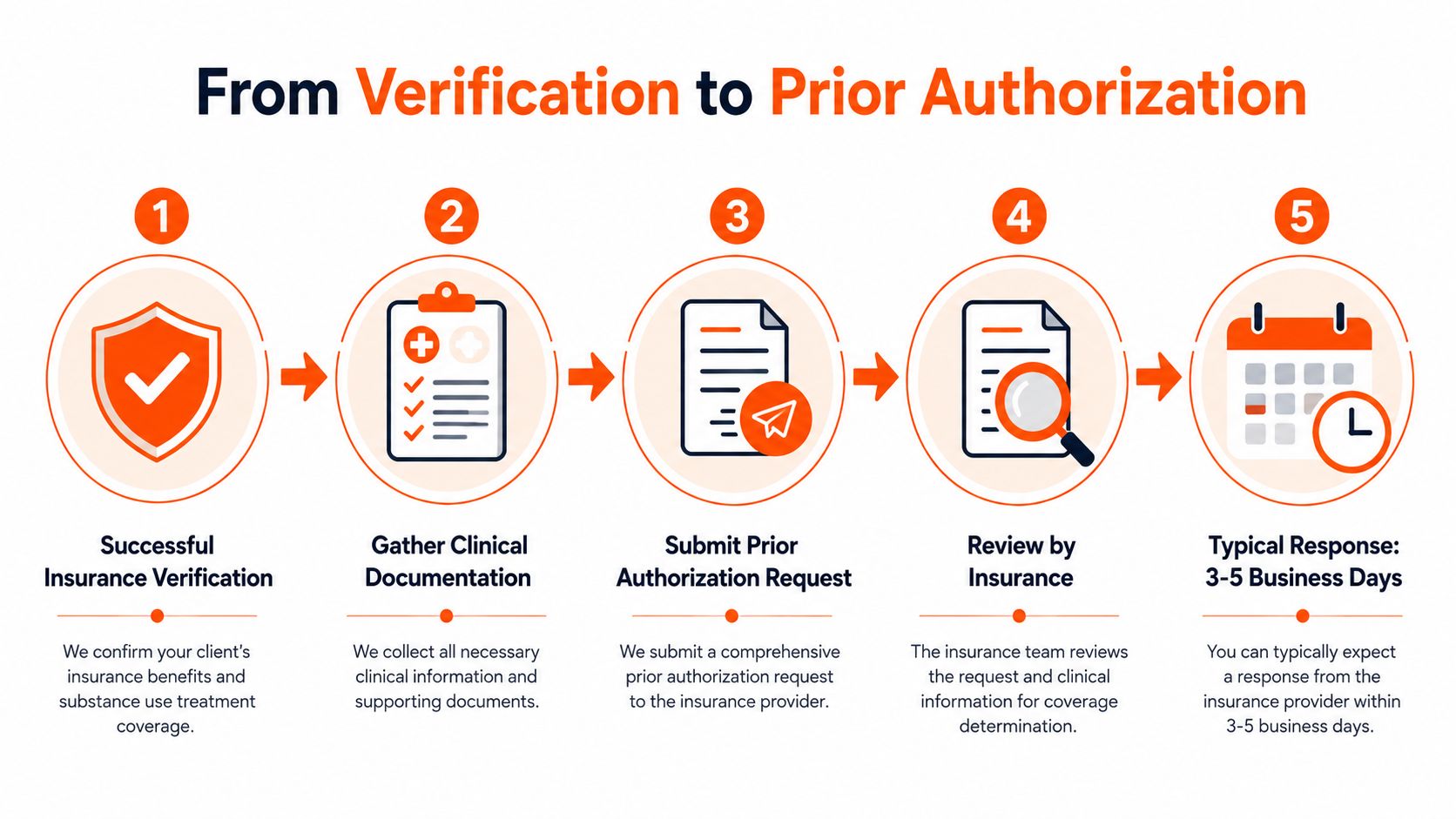
A five-step infographic showing the insurance verification and prior authorization workflow for substance use treatment providers.

Understand the decision clock

Urgent reviews may receive faster handling than standard requests, but the payer's stated deadline controls. Standard reviews can take several business days, and missing records can restart the practical clock even when the formal request has been submitted. Ask for the authorization case number, submission timestamp, assigned reviewer or department, and the exact deadline for a decision.

Common denial reasons include incomplete medical-necessity documentation, unclear criteria for the requested level of care, missing prior treatment history, and benefit limits already reached. A denial isn't the time for a general complaint. Request the clinical rationale, identify the missing evidence, and ask whether a peer-to-peer review is available.

If the payer denies the request, move quickly. Have the treating clinician participate in peer-to-peer review when permitted, then submit a written appeal within the plan's required window. Keep the case management services team informed so clinical records, payer communications, and discharge planning remain aligned.

Common Pitfalls and How to Reverify Mid-Treatment

A clean admission-day verification doesn't guarantee uninterrupted payment for a residential stay. Coverage can change, the payer can demand continued-stay evidence, and a transition from detox to residential care can create a new authorization requirement.

Three failures appear repeatedly:

  • Assuming the first approval covers the entire stay: An authorization may cover only an initial period or level of care. Schedule a proactive review before the approved period ends.
  • Missing benefit or eligibility changes: Employment changes, plan updates, and administrative corrections can alter coverage. Confirm the patient's status at regular touchpoints.
  • Treating level-of-care transitions as automatic: Detox, residential, PHP, and IOP may use different benefit rules, codes, or review standards. Ask for the next approval before the transition occurs.
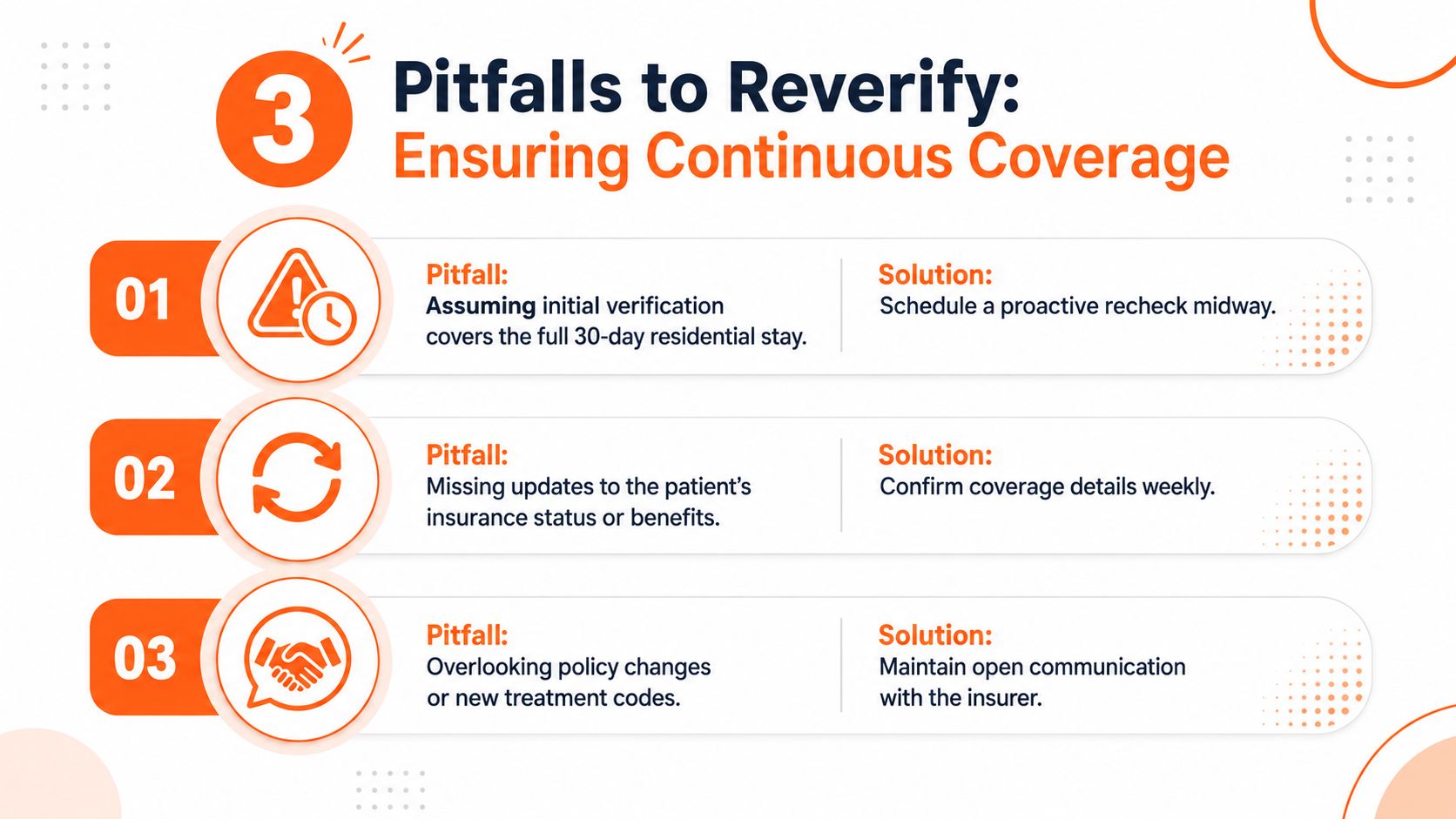
An infographic listing three common pitfalls in insurance verification and their solutions to ensure continuous medical coverage.

Set reverification checkpoints

Put calendar reminders on day 7, day 14, and day 21 of a planned residential episode. At each checkpoint, document active eligibility, remaining authorized days, continued-stay requirements, next review date, network status, and the name and reference number associated with the payer contact.

Read every Explanation of Benefits when it arrives. For residential detox, check the service dates, facility identity, procedure or revenue codes, allowed amount, deductible application, coinsurance, denial or adjustment codes, and patient responsibility. The EOB isn't an invoice, but it can reveal a mismatch before discharge creates a large balance.

Escalation rule: If a phone representative gives an answer that conflicts with the authorization letter or EOB, request written clarification. A written payer escalation is appropriate when the dispute affects a treatment transition, a material balance, or a pending discharge.

A Practical Timeline for Working With Capo Canyon Recovery

Executives and families need a sequence they can act on, not a vague promise that someone will “check the insurance.” Use the first 48 hours to move four workstreams forward: intake, eligibility, clinical documentation, and authorization.

Day one

At hour zero, contact admissions and provide the patient's identifying information, insurance card, target admission date, and planned level of care. Explain whether the patient is experiencing withdrawal, has immediate safety concerns, or needs a private executive setting.

Within the first two hours, complete the secure intake and upload or send the insurance documents and clinical records you already have. The admissions team can identify missing information before the payer call rather than after a representative asks for it.

By the end of day one, initiate the electronic benefits check and live payer verification. Request answers about deductible status, out-of-pocket maximum calculations, residential and PHP benefits, detox coverage, network classification, authorization requirements, and any travel reimbursement clause.

Day two

By midday on day two, request a written coverage summary or documented call outcome. Resolve conflicts between the portal response and the representative's answer, and obtain the payer reference number.

By the close of day two, submit the prior-authorization request with the clinical assessment, diagnosis, treatment history, medical-necessity rationale, and preliminary discharge plan. Confirm where the request was sent and when the payer's review clock began.

Admission coordination should proceed once the authorization reference number and level-of-care decision are confirmed. If the payer has not decided, ask what remains missing and whether the case can be escalated for an urgent review.

For a private, licensed detox and residential program in Mission Viejo, Capo Canyon Recovery offers insurance verification and admissions coordination for executives and professionals, including benefit and out-of-pocket review. Call the admissions line with your insurance card and clinical information ready, and ask the team to verify the plan, coordinate prior authorization, and identify the next concrete step toward admission.

READ MORE
Uncategorized
August 19by 0 Comments

PTSD and Substance Use: Integrated Treatment for Executives

You finish a difficult board meeting, return to a quiet hotel room, and pour a drink before you've taken off your shoes. Sleep comes more easily that way. By morning, you're answering messages, leading the team, and appearing composed, even though your body is still braced for danger. The substance use may look controlled from the outside, while trauma symptoms shape your decisions, relationships, sleep, and capacity to recover.

For executives and other high-functioning professionals, treatment often gets delayed for practical reasons. You may worry about confidentiality, licensure, reputation, income, or the effect of stepping away from work. Yet postponing care can allow both conditions to become more tightly connected. Integrated treatment for PTSD and substance use addresses the trauma and the substance use disorder as related clinical problems, not as separate failures of discipline.

When Trauma and Substance Use Collide in High-Functioning Lives

A senior professional I'll call Daniel had built a career around composure. He could manage a crisis, negotiate under pressure, and keep difficult information from showing on his face. After a traumatic event earlier in life, however, certain conflicts left him restless and watchful. He began drinking at night to quiet the physical tension and fall asleep. The next morning, he used caffeine to feel alert, worked longer hours, and told himself the pattern was temporary.

Nothing collapsed at once. He kept his appointments, met deadlines, and remained available to his family. That apparent stability made it harder for him to recognize that alcohol had become part of his trauma-management system. He wasn't drinking only for pleasure. He was trying to control hyperarousal, intrusive memories, emotional discomfort, and the silence that arrived when the day finally ended.

Why capable people wait

High achievement can conceal impairment. Professionals often compensate by working harder, traveling with carefully planned routines, avoiding situations that trigger memories, or using substances only in private. They may also believe they need to reach a more serious point before treatment is justified.

Career concerns add another layer. A physician may fear professional scrutiny. An attorney may worry about clients and colleagues. An entrepreneur may believe the company can't function without constant access. A private treatment setting, clear confidentiality practices, and a plan for essential communication can reduce those barriers, but the clinical decision still requires honesty about safety and availability.

Practical rule: If a substance is required to sleep, calm down, face a meeting, tolerate intimacy, or stop unwanted memories, it deserves clinical attention even when work performance remains intact.

Trauma doesn't always appear as a dramatic flashback. It can look like irritability, emotional distance, insomnia, compulsive overwork, exaggerated startle responses, avoidance of certain people or places, or an inability to relax without alcohol or medication. Substance use then narrows the person's options further. The executive may still be functioning, but functioning has become expensive, fragile, and dependent on a coping method that creates its own risks.

Seeking help is not an admission that you're incapable. It's a strategic decision to protect judgment, health, relationships, and the career you've worked to build.

The Prevalence of Co-Occurring PTSD and Substance Use Disorders

A high-functioning professional can maintain a demanding schedule while meeting criteria for both PTSD and a substance use disorder. This is a well-established clinical pattern, not an unusual complication. Analysis of the National Comorbidity Survey found lifetime PTSD prevalence of 7.8% and lifetime substance use disorder prevalence of 26.6%. People with PTSD were 2 to 4 times more likely than people without PTSD to meet criteria for an SUD (National Comorbidity Survey findings on PTSD and substance use).

The overlap appears across substance categories. Among men with PTSD, lifetime comorbidity reached 51.9% for alcohol use disorders and 34.5% for drug use disorders. Among women with PTSD, the corresponding figures were 27.9% for alcohol use disorders and 26.9% for drug use disorders. More recent U.S. survey data found that 46.4% of people with PTSD met criteria for any SUD, while 22.3% met criteria for a drug use disorder.

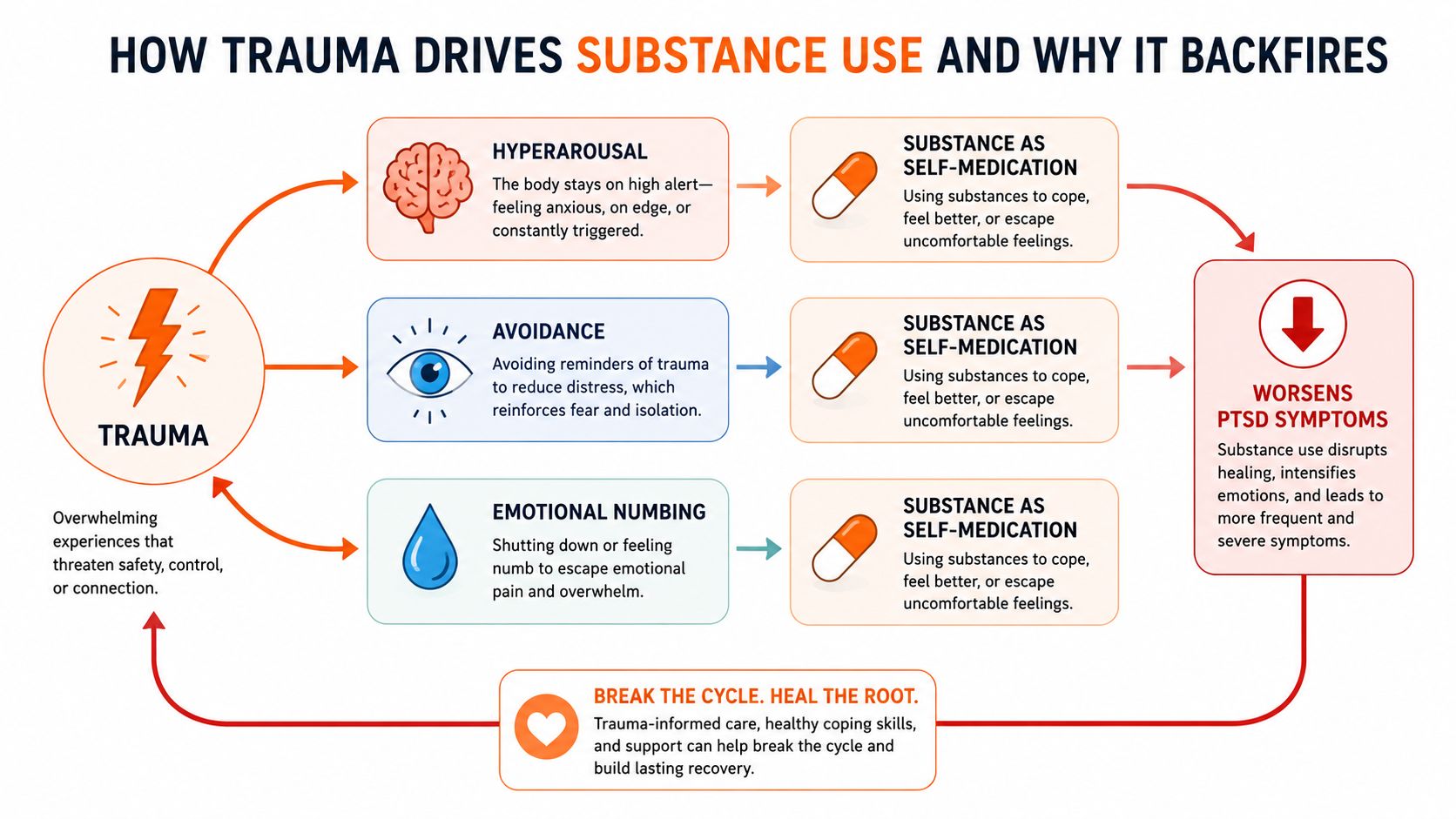
A diagram illustrating how trauma causes substance use and creates a cycle that worsens PTSD symptoms.

What the numbers mean in practice

These figures do not predict an individual's course or establish which condition came first. They support screening in both directions. A person entering treatment for alcohol or drug problems should be assessed for trauma symptoms. Someone seeking PTSD care should also be asked about alcohol, prescription medication, cannabis, stimulants, and other substances without judgment.

The same pattern appears in treatment settings. A review reported that 20% to 50% of treatment-seeking SUD patients had a lifetime PTSD diagnosis, while 15% to 40% met PTSD criteria in the prior year. Among treatment-seeking PTSD patients, about 20% met criteria for a current SUD, and broader PTSD samples showed alcohol use disorder in about 35% of cases (review of PTSD and SUD comorbidity).

A 2014 systematic review found substantial variation among studies. Comorbid alcohol misuse in PTSD ranged from 9.8% to 61.3%, while PTSD among alcohol-misuse populations ranged from 2.0% to 63.0%. Differences in samples, definitions, and assessment methods explain part of that spread, but most estimates exceeded 10%. For executives and other professionals, the practical implication is clear: privacy-conscious assessment must address trauma and substance use together, rather than waiting for one problem to resolve before examining the other.

How Trauma Drives Substance Use and Why It Backfires

Substance use often begins as an understandable attempt to change an unbearable internal state. Alcohol may soften vigilance and make sleep feel possible. A sedating medication may reduce panic. A stimulant may temporarily counter exhaustion and emotional flatness. The relief is real, but it's usually short-lived.

This pattern is called negative reinforcement. The person repeats a behavior because it removes or reduces something unpleasant, such as fear, agitation, shame, intrusive memories, or emotional numbness. The brain learns that the substance works quickly, even when the longer-term consequences include disrupted sleep, rebound anxiety, impaired emotional regulation, and stronger avoidance.

The biology underneath the pattern

PTSD and substance use disorders involve overlapping biological systems. The comorbidity has been associated with neurotransmitter disruption, dysregulation of the hypothalamic-pituitary-adrenal axis, structural brain differences, and shared genetic risk factors (review of PTSD and substance use neurobiology).

That doesn't mean biology removes responsibility or makes change impossible. It means the problem is more complex than deciding to stop. Trauma can keep the stress system activated, while substance use can interfere with the person's ability to regulate that activation. Withdrawal may intensify anxiety, sleep disruption, irritability, or physical distress, which can then be misread as proof that the substance is necessary.

The result is a self-reinforcing loop:

  • Trigger: A memory, conflict, sensory reminder, or work situation activates trauma symptoms.
  • Relief-seeking: The person uses alcohol or another substance to reduce distress quickly.
  • Short-term benefit: Tension, fear, or intrusive thought may temporarily recede.
  • Longer-term cost: Sleep, mood, judgment, and stress regulation deteriorate.
  • Renewed vulnerability: The next trigger feels harder to manage without the substance.

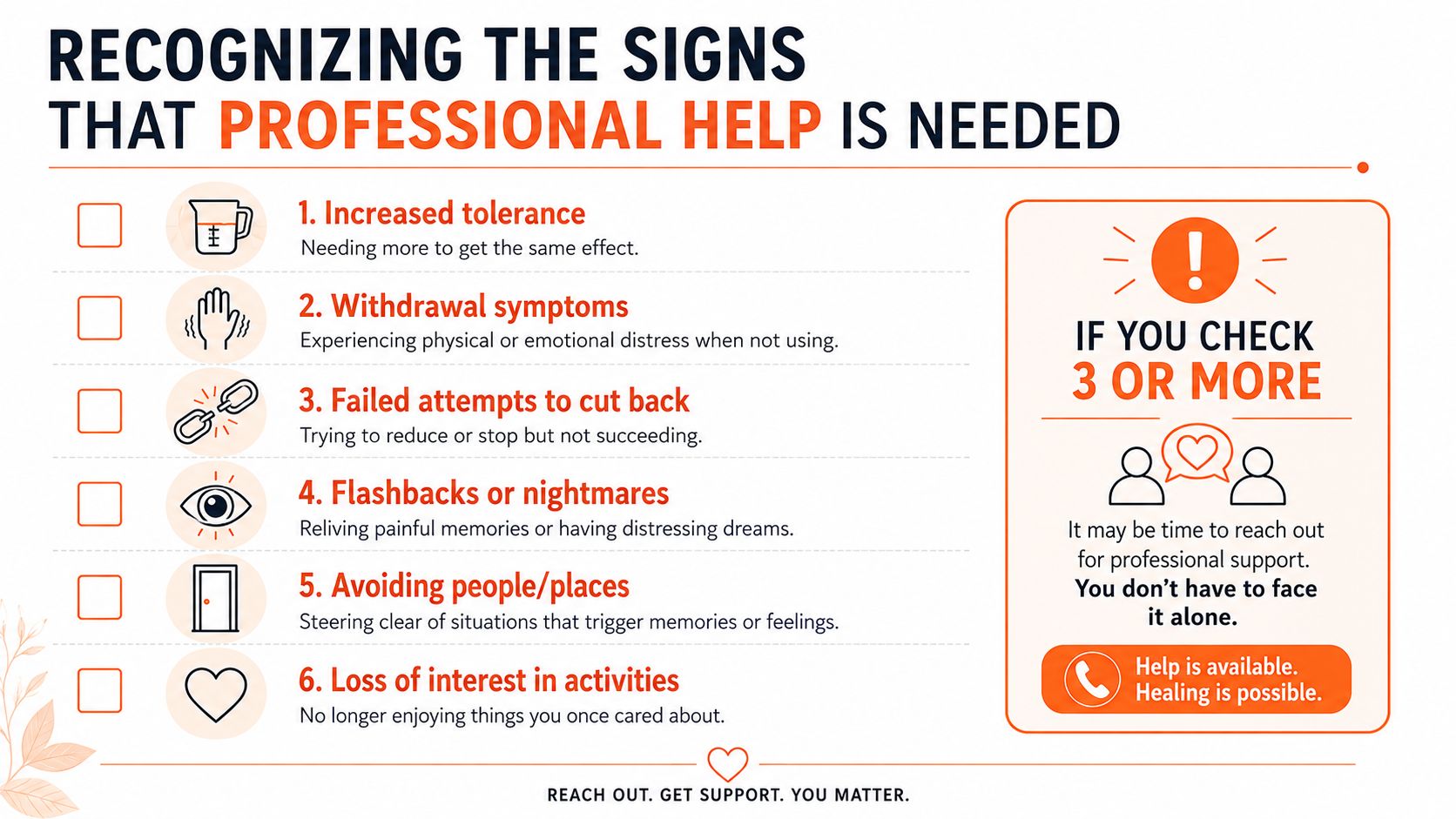
A checklist infographic titled Recognizing The Signs That Professional Help Is Needed listing six mental health symptoms.

Willpower may help someone interrupt a behavior briefly, but it doesn't resolve the trauma cues, biological dysregulation, or learned expectation of immediate relief. Effective care has to make sobriety safer while teaching alternative ways to manage the symptoms that drove substance use in the first place.

Recognizing the Signs That Professional Help Is Needed

You don't need to wait for a public crisis to request an evaluation. A clinical assessment makes sense when substance use and trauma symptoms begin influencing one another, especially when attempts to manage either problem alone keep failing.

Start with direct questions. Ask yourself whether you're using more often, using more than planned, or arranging your schedule around access to a substance. Consider whether you've tried to cut back and returned to the same pattern, or whether you experience physical or emotional discomfort when you stop. Then examine the trauma side: unwanted memories, nightmares, hypervigilance, avoidance, emotional numbness, or a persistent sense that danger is nearby.

Patterns that deserve attention

Some signs are easy to rationalize in a professional environment. A calendar may hide missed obligations, while a private office hides escalating use. Look for changes that persist or interact:

  • Sleep dependence: You can't settle at night without drinking or taking medication.
  • Increasing tolerance: The previous amount no longer creates the same effect.
  • Concealment: You minimize use, hide supplies, or give different explanations to different people.
  • Avoidance: You withdraw from people, places, conversations, or activities connected with trauma.
  • Emotional narrowing: Work remains possible, but pleasure, connection, and spontaneity disappear.
  • Failed control: You set rules about when or how much you'll use, then repeatedly break them.

Family members and colleagues should avoid turning the conversation into an interrogation. Choose a private moment, describe observable changes, and ask what support would feel safe. “I've noticed you're sleeping poorly and withdrawing after difficult meetings” is more productive than labeling someone as irresponsible or addicted.

A useful starting point: Ask, “What does the substance help you avoid feeling, remembering, or experiencing?”

Urgent medical help is necessary when there's an immediate risk of overdose, dangerous withdrawal, severe confusion, suicidal thinking, or inability to stay safe. Otherwise, the first step can be a confidential evaluation with a provider experienced in dual diagnosis care. The assessment should cover trauma history, current symptoms, substance patterns, medications, sleep, medical risks, work demands, and available support.

A comparison infographic showing how integrated treatment for PTSD and substance use outperforms sequential treatment methods.

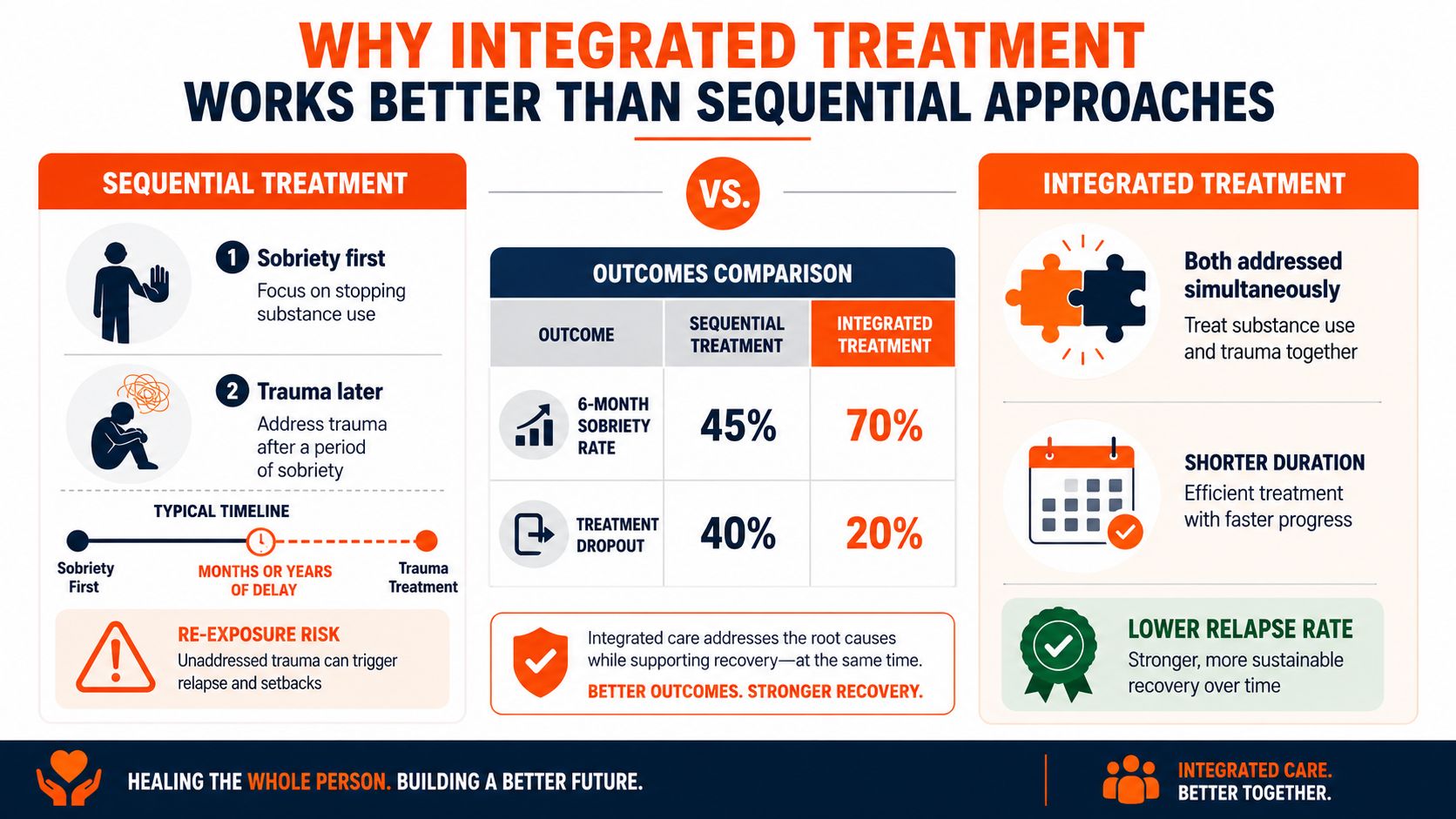
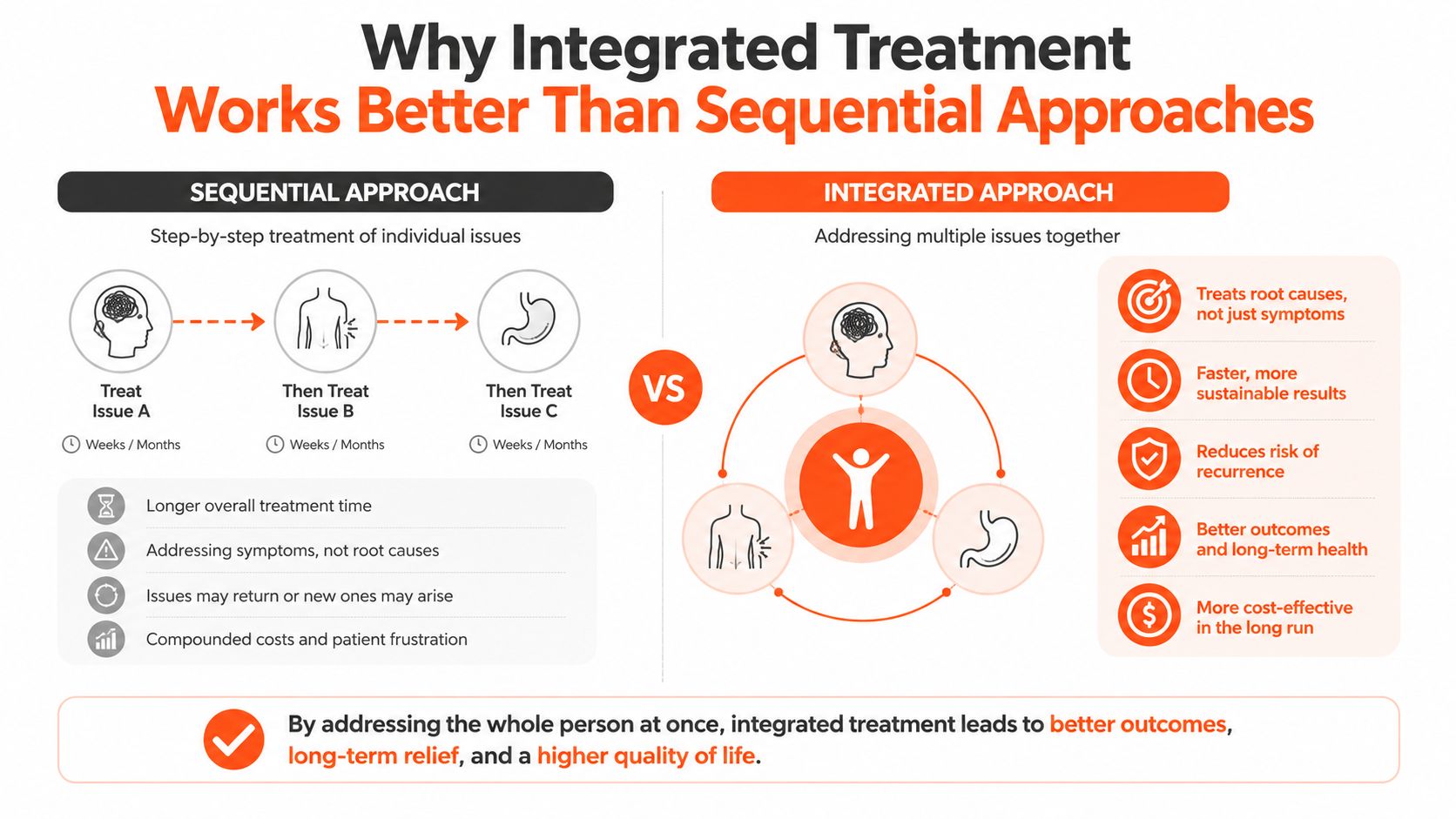
Why Integrated Treatment Works Better Than Sequential Approaches

The traditional sequence sounds logical: stop using first, stabilize later, and address trauma after sobriety is established. That approach can be appropriate in certain medical situations, particularly when intoxication or withdrawal creates immediate danger. But as a general rule, forcing people to complete one treatment before receiving help for the other condition often leaves the main driver of use untouched.

Integrated care treats PTSD and SUD within one coordinated plan. The team can stabilize withdrawal, reduce cravings, build emotion-regulation skills, and introduce trauma-focused work at a pace matched to the person's safety and readiness. The patient doesn't have to prove perfect sobriety before clinicians take the trauma seriously.

Sequential care has a predictable weakness

If a person uses substances to suppress nightmares or hyperarousal, sobriety can initially expose the symptoms that the substance was masking. If treatment then postpones trauma care indefinitely, the person may leave with fewer short-term coping tools and the same underlying triggers. Re-exposure to demanding work, family conflict, travel, or trauma reminders can make return to use more likely.

Integrated programs don't push someone into intense trauma processing on the first day. They establish stabilization, medical oversight, coping skills, and a collaborative treatment relationship. Trauma-focused therapy can then proceed without treating substance use as an unrelated issue.

A 2024 review linked PTSD and SUD comorbidity with higher acuity, poorer treatment completion, and worse prognosis, while identifying integrated treatment and trauma-focused psychotherapy combined with pharmacotherapy as promising approaches (2024 review of PTSD and SUD treatment). A 2025 Project Harmony analysis found that reductions in alcohol and drug severity were mediated by reductions in PTSD severity during treatment. In practical terms, substance outcomes may improve when clinicians directly reduce the trauma symptoms that sustain use.

An infographic comparing sequential treatment approach versus an integrated approach for health, emphasizing holistic care benefits.

The trade-off is that integrated care requires more coordination and clinical judgment. The team must monitor destabilization, medication interactions, cravings, sleep, and safety while trauma work develops. For many patients, that complexity is precisely why dual diagnosis treatment for executives is more clinically coherent than moving between disconnected programs.

What Evidence-Based Treatment Actually Involves

Treatment begins with assessment, not assumptions. Clinicians need to determine whether withdrawal requires medical supervision, which substances are involved, how severe trauma symptoms are, whether there are medical or psychiatric complications, and what the person must maintain professionally during care.

Stabilization comes before deeper trauma work

Medically supervised detox can provide continuous monitoring while the body adjusts to the absence of alcohol or drugs. Withdrawal can produce significant physical and psychological symptoms, and trauma-related distress may feel sharper when a substance no longer dampens it. Nursing and psychiatric oversight allow the team to respond to changing symptoms, review medications, and create a safer transition into residential treatment.

Residential care then provides structure without reducing treatment to confinement. A typical plan may combine individual therapy, group work, psychoeducation, psychiatric appointments, family involvement when appropriate, sleep support, nutrition, and carefully selected complementary services. The clinical schedule should be intensive enough to create momentum but flexible enough to account for fatigue, medical needs, and trauma-related avoidance.

Modalities should serve a coherent plan

Trauma-focused cognitive behavioral therapy helps patients identify trauma-linked beliefs, avoidance patterns, and behavioral responses. It can connect thoughts, body sensations, emotions, and actions so the patient can respond to reminders without automatically reaching for a substance.

EMDR uses structured bilateral stimulation while the patient processes traumatic memories. The therapist monitors arousal and pacing rather than asking the patient to endure distress without support.

DBT teaches concrete skills for distress tolerance, emotional regulation, mindfulness, and interpersonal effectiveness. Those skills are especially useful when cravings rise after conflict or when trauma symptoms produce impulsive decisions.

ACT helps patients notice painful internal experiences without organizing their entire life around avoiding them. The work emphasizes values and committed action, which can be particularly relevant to professionals whose identities have narrowed around achievement and control.

Medication management may address trauma-related symptoms, sleep, anxiety, mood instability, or cravings. Medication isn't a substitute for psychotherapy, and it should be reviewed alongside substance history, withdrawal risk, medical conditions, and the person's response over time. A program such as evidence-based addiction treatment at Capo Canyon Recovery may combine detox, residential care, psychiatric monitoring, individual therapy, group therapy, and modalities including CBT, DBT, ACT, EMDR, and Brainspotting.

The strongest plan is individualized. It answers practical questions, including how often the person meets with clinicians, how family participates, how work communication is handled, and what happens after discharge.

Treatment Considerations for Executives and Professionals

Executives don't need a treatment program built around status. They need one that understands privacy, decision fatigue, professional obligations, and the consequences of poorly coordinated care. A person responsible for a company or licensed practice may need to remain reachable for a narrow set of essential matters without allowing work to become an escape from treatment.

Confidentiality begins with the setting and the operating policies. A small census can reduce exposure and make it easier for clinicians to know the patient's history in detail. Private rooms provide space for rest, reflection, and limited work when clinically appropriate. Technology access can allow a patient to handle urgent communication through a cell phone or laptop, while boundaries keep the device from consuming the treatment day.

What executive-focused care should include

Look for specific features rather than relying on labels:

  • Clinical access: Frequent individual sessions with a therapist, case manager, and psychiatric professionals create more opportunities to identify problems before they become crises.
  • Medical coverage: Continuous nursing and psychiatric oversight support safer detoxification, medication changes, and stabilization.
  • Privacy practices: Ask who can access records, how visitors are managed, and how staff handle professional or public-facing clients.
  • Work boundaries: A credible plan distinguishes essential communication from habitual checking, delegation, and avoidance.
  • Continuity: The program should coordinate aftercare, outpatient therapy, medication follow-up, and professional monitoring when relevant.

A private setting can make treatment more feasible, but privacy shouldn't mean isolation from accountability. The patient still needs honest assessment, observable goals, and a team willing to challenge rationalizations. A flexible schedule should support recovery, not recreate the conditions that allowed substance use to remain hidden.

Specialized rehab for executives may include private accommodations, technology-friendly policies, individualized treatment, and a lower client-to-staff ratio. Capo Canyon Recovery describes a small residential environment, private rooms, cell phone and laptop access, 24/7 nursing and psychiatric support, insurance verification, and private-pay arrangements. Those are logistical features, not guarantees of outcome, so prospective patients should ask how the clinical team measures progress and handles setbacks.

The financial and career calculation deserves a broader frame. A short-term interruption can be uncomfortable, but untreated trauma-driven substance use can impair judgment, relationships, health, and professional reliability for much longer. Getting an evaluation is a way to make that decision with facts instead of waiting for circumstances to make it for you.

Treatment Outcomes and Building a Sustainable Recovery

Recovery rarely looks like the disappearance of every difficult memory. A more credible goal is improved regulation, fewer trauma-driven reactions, safer decisions, sustained reduction or abstinence from harmful substances, and the ability to respond to triggers without losing control.

After residential care, the plan should remain specific. It may include ongoing trauma therapy, medication follow-up, recovery meetings or other peer support, family work, sleep protection, and a written response for cravings or nightmares. Professionals also need a return-to-work strategy that identifies travel risks, high-conflict meetings, late-night routines, and the people authorized to help when symptoms rise.

Progress needs monitoring

A patient and treatment team can track practical indicators:

  • Are sleep and concentration improving without relying on substances?
  • Can the person tolerate trauma reminders with coping skills?
  • Are cravings becoming less urgent or less frequent?
  • Has communication with family or colleagues become more direct?
  • Is the professional schedule supporting recovery rather than hiding deterioration?

Complex PTSD deserves careful attention in this process. A 2025 study found that complex PTSD symptom severity, particularly affect dysregulation, negative self-concept, and relationship disturbance, was positively associated with psychological dependence, while PTSD symptoms alone were not. The finding supports individualized formulation rather than assuming every patient uses substances for the same reason (study of complex PTSD symptoms and psychological dependence).

A setback is information, not proof that treatment failed. It may show that trauma work moved too quickly, support was reduced too soon, work demands were underestimated, or a medication needs review. The right response is prompt clinical contact and adjustment, not secrecy.

You can protect your career more effectively by building a recovery system before returning to full pressure. If trauma and substance use are already affecting sleep, judgment, relationships, or safety, contact a qualified dual diagnosis provider and ask for a confidential assessment. Capo Canyon Recovery offers medically supervised detox, residential care, psychiatric oversight, trauma-focused therapies, and executive-oriented support for professionals who need privacy while addressing both conditions.


If PTSD symptoms and substance use are affecting your sleep, judgment, or ability to lead, contact Capo Canyon Recovery for a confidential discussion about integrated detox and residential treatment. Visit Capo Canyon Recovery to review executive-focused care options and take the next step with a team equipped to address trauma and substance use together.

READ MORE
Uncategorized
August 18by 0 Comments

CBT for Addiction Recovery: What It Is and Why It Works

You're responsible for decisions, people, and outcomes all day, yet a private concern keeps interrupting your judgment: what happens if stress, cravings, or another difficult night pushes you back toward substance use? Many executives delay treatment because they expect vague conversations about the past rather than a structured method they can evaluate.

CBT for addiction recovery offers a more practical framework. It helps you identify the situations that activate use, examine the thoughts that intensify an urge, and rehearse a safer response before pressure peaks. The approach is useful, but it isn't a universal solution. Its value depends on the substance involved, the phase of treatment, co-occurring mental-health conditions, and whether therapy is delivered alone or as part of a coordinated plan. The most useful question isn't, “Does CBT work?” It's, “For whom, for which substance, at what stage, and alongside what other care?”

Why CBT Matters in Addiction Recovery

A person entering treatment may be physically stable enough to participate while still feeling uncertain about therapy. They may wonder whether talking about thoughts can really change drinking, drug use, or compulsive behavior. CBT answers that concern with a clear operating model: thoughts influence emotions, emotions influence behavior, and behavior reinforces future expectations.

That doesn't mean a person chooses addiction through faulty thinking. Substance use can involve biological dependence, withdrawal, learned habits, trauma, psychiatric symptoms, and environmental pressure. CBT gives clinicians a way to work with the behavioral and cognitive parts of that system while medical professionals address withdrawal, medication needs, and physical safety.

A structured alternative to generic counseling

Generic counseling might give someone space to describe what happened. CBT adds a working agenda. A therapist may ask the client to:

  • Track triggers: Record situations, people, emotions, and thoughts that precede use.
  • Test automatic conclusions: Examine whether a thought is accurate, useful, or distorted by shame, fear, or urgency.
  • Practice coping responses: Rehearse actions for cravings, conflict, fatigue, and high-pressure decisions.
  • Review results: Assess what happened after the client used a skill and adjust the plan.

This structure often suits high-functioning professionals who want therapy to connect to observable decisions. The work is collaborative, but it's also active. Clients usually practice between sessions rather than waiting for insight to appear in the therapy room.

Practical rule: A strong CBT plan should tell you what the client is practicing, what risk it addresses, and how the clinical team will review progress.

CBT has become a common evidence-based component of residential and outpatient addiction care because clinicians can adapt its tools to different substances, settings, and treatment goals. Still, “common” doesn't mean “sufficient.” A residential program may use CBT alongside detox support, psychiatric evaluation, group therapy, medication management, family involvement, and aftercare planning. The approach matters because it supplies a cognitive and behavioral toolkit, not because it replaces the rest of treatment.

For an executive, that distinction protects against two opposite mistakes. One is dismissing therapy as unstructured conversation. The other is treating CBT as a standalone guarantee. Effective care uses its structure while matching the treatment plan to the individual.

The CBT Loop Explained Through a Real Scenario

Consider a senior leader leaving a tense board meeting. A director challenged a major decision, the discussion ended without resolution, and the leader drives home replaying every exchange. The external event is the trigger. The automatic thought might be, “I've lost control, and I can't face tomorrow unless I shut this off.”

That thought creates anxiety, anger, and humiliation. Those emotions increase physiological tension and narrow attention toward immediate relief. The person remembers that alcohol or another substance has provided quick relief before. The behavior follows, and the short-term reduction in distress teaches the brain that using is an effective response to similar pressure.

CBT maps this sequence without reducing it to a single cause:

  1. Situation: A public challenge or unresolved work conflict.
  2. Thought: “I can't tolerate this,” or “I need something now.”
  3. Feeling and body response: Anxiety, shame, agitation, racing thoughts, or physical tension.
  4. Behavior: Buying alcohol, contacting a supplier, isolating, or using.
  5. Consequence: Immediate relief followed by impaired sleep, regret, conflict, or renewed pressure.

The therapist doesn't tell the client to “think positively.” Instead, the client learns to pause between the thought and the behavior. They may write down the prediction, ask what evidence supports it, identify what the thought leaves out, and choose a response that reduces danger. That response could include calling a recovery contact, leaving the high-risk environment, eating, resting, using a grounding exercise, or attending a scheduled support meeting.

A diagram illustrating core CBT techniques used in addiction treatment, including cognitive restructuring, relapse prevention, behavioral activation, and contingency management.

The goal isn't to eliminate every uncomfortable thought. It's to make the sequence visible early enough that the person has options. Repeated practice turns the method into a usable skill, much like rehearsing a crisis protocol before a business disruption occurs. The client learns to respond to a trigger rather than allowing the trigger, thought, emotion, and behavior to run as one automatic chain.

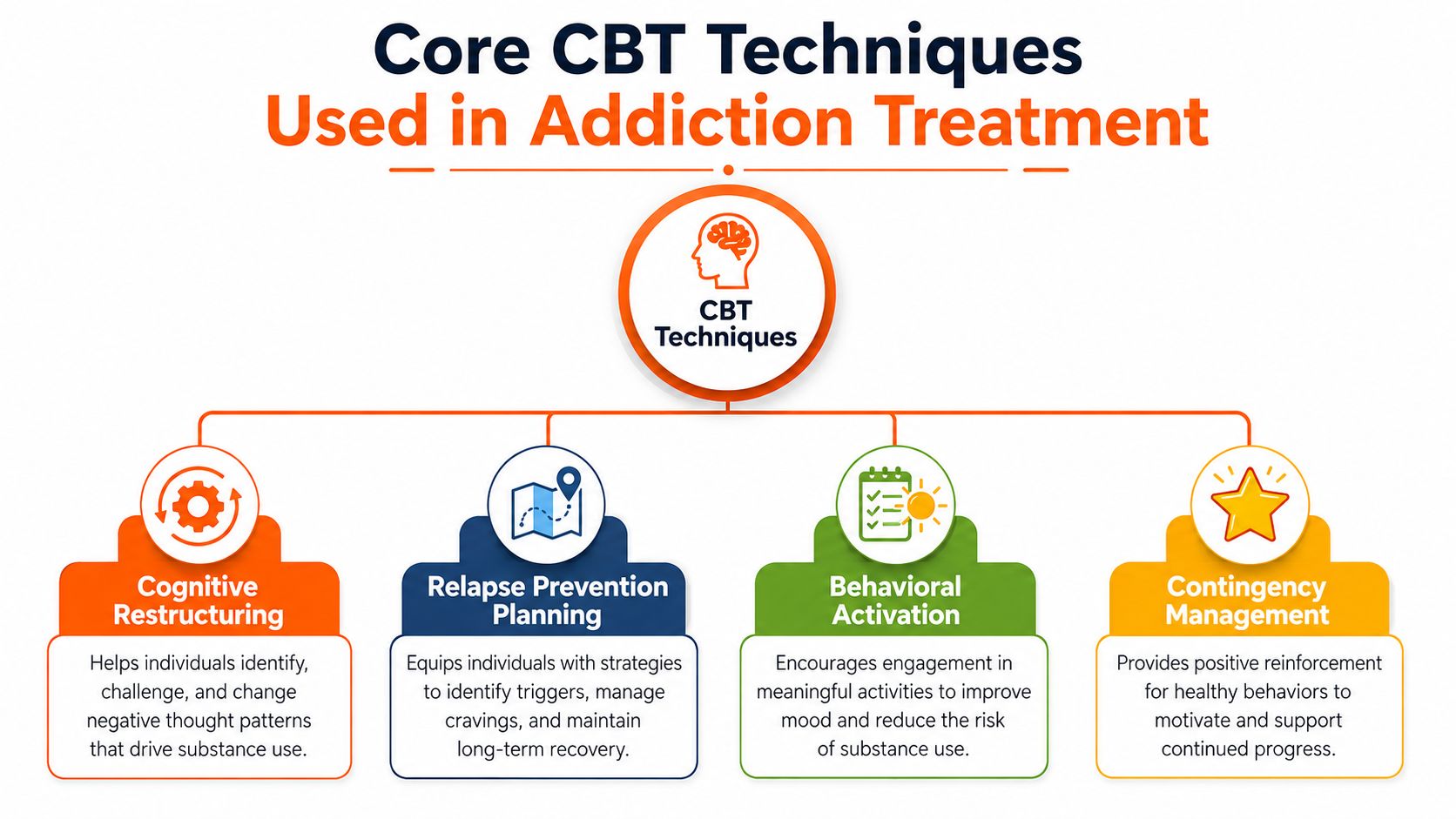
Core CBT Techniques Used in Addiction Treatment

CBT becomes easier to understand when you see what happens during an actual treatment day. The techniques overlap, but they solve different problems. Cognitive restructuring changes the interpretation. Behavioral activation changes the routine. Coping-skills training prepares for pressure. Relapse-prevention planning organizes the response when risk rises.

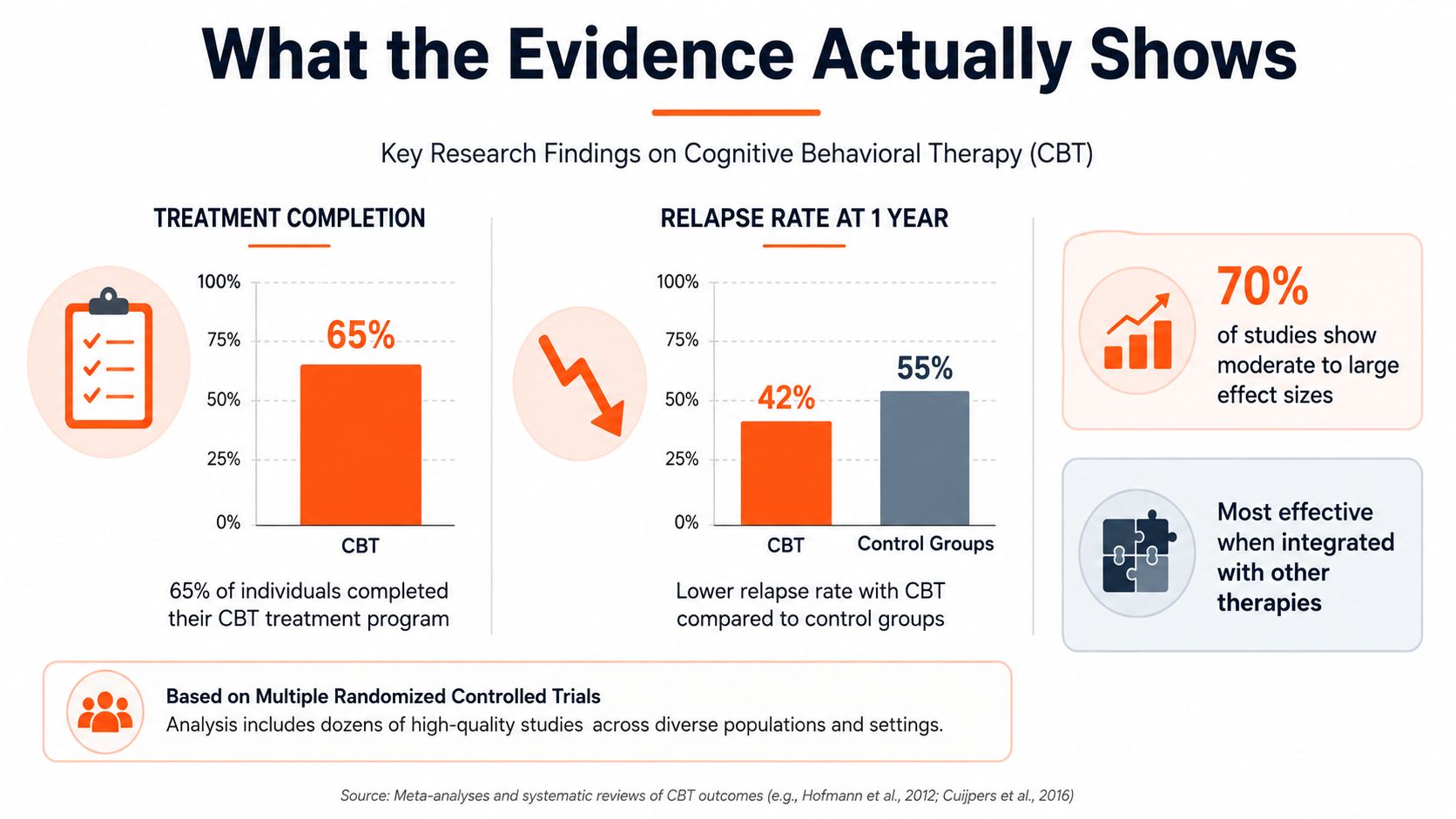
An infographic showing research statistics on CBT effectiveness, including treatment completion rates, relapse rates, and overall impact.

Cognitive restructuring

A client may say, “The damage is done, so there's no point stopping today.” The therapist helps separate facts from conclusions. The client might identify the thought as all-or-nothing reasoning, list what has happened, and create a more accurate alternative: “There are consequences I need to address, but stopping now still changes what happens next.”

The exercise isn't forced optimism. It's reality testing. Between sessions, the client may keep a thought record with the situation, automatic thought, emotion, evidence, alternative interpretation, and resulting action.

Relapse-prevention planning

A relapse plan converts warning signs into decisions made in advance. The client identifies high-risk situations, such as conflict, travel, isolation, fatigue, access to substances, or contact with certain people. For each situation, the plan names an early action and an escalation step.

For example, if an intense craving appears after a difficult call, the first action might be leaving the office and contacting a clinician. If the craving continues, the next step could involve a support person, urgent clinical contact, or a safer supervised setting. The plan works best when it's specific enough to follow under stress.

Behavioral activation

Substance use often crowds out sleep, exercise, relationships, hobbies, and ordinary responsibilities. Behavioral activation rebuilds activity deliberately rather than waiting to feel motivated. A therapist might ask a client to schedule a walk, prepare a meal, attend a peer meeting, or complete a manageable work task, then record how the activity affected mood and craving.

The intervention addresses an important practical problem: an empty, dysregulated day can leave more room for rumination and impulsive decisions. Small actions create structure while the client's energy and confidence recover.

Coping-skills training

Coping skills are rehearsed responses for moments when thinking becomes less flexible. Practice may include urge surfing, paced breathing, grounding, refusal language, problem-solving, communication, and planning around exposure to substances. A therapist might role-play a business dinner where alcohol is offered, then help the client develop a short response that protects privacy without creating unnecessary discussion.

These skills need repetition. The client isn't expected to remember a long list during a craving. Treatment narrows the list to a few actions that can be practiced, measured, and carried into aftercare.

What the Evidence Shows

CBT deserves neither inflated praise nor casual dismissal. Research indicates that its effects vary by substance, format, and treatment context. Support is strongest for alcohol and tobacco, while findings for other drugs are more mixed. The useful question is not merely whether “CBT works for addiction,” but whether evidence supports its use for a particular substance, treatment phase, comparison group, and delivery format. The 2025 meta-analysis of stimulant-use trials found increased short-term abstinence compared with minimal care, although the evidence had low certainty and substantial variation across studies.

CBT can also contribute to a treatment plan without being superior in every comparison. Some clients may benefit most from behavioral skills combined with medication, incentives, medical monitoring, peer support, or another therapy selected for their clinical needs. The treatment model functions more like a toolkit than a single uniform solution.

Treatment phase changes the interpretation

A 2025 multilevel meta-analysis found that relapse reduction was sharpest during the first three months after CBT, then partially rebounded and stabilized after six months. The review evidence on CBT and relapse patterns supports planning beyond discharge rather than treating the end of residential care as the end of treatment.

The pattern does not mean CBT stops helping after the early period. It suggests that gains need reinforcement as clients return to work, travel, family stress, social exposure, and independent decision-making. Treatment phase therefore changes how outcomes should be judged. Early improvement and longer-term maintenance are related, but they are not the same result.

Dual diagnosis requires integration

A 2025 systematic review found that CBT-based interventions helped some substance-use or mental-health outcomes in dual-diagnosis populations, but they often were not clearly better than usual addiction approaches. The practical conclusion is clear: integrated care is the central issue, not CBT alone.

A person with alcohol use and panic symptoms may need psychiatric assessment, medication decisions, exposure-based work, coping skills, and relapse planning. Someone with trauma symptoms may need carefully timed trauma treatment rather than immediate cognitive challenge around every painful belief. Programs evaluating evidence-based addiction treatment should explain how clinicians coordinate these components and decide which intervention fits each phase.

Inside a Typical CBT Session at a Residential Program

A residential CBT session usually begins with a brief check-in. The client and therapist review sleep, mood, cravings, substance-related thoughts, major events, and any safety concerns. This information helps the therapist decide whether the session should focus on a planned skill, an urgent trigger, withdrawal-related distress, or coordination with the medical and psychiatric team.

The pair then set an agenda. A client might choose to examine a difficult conversation with a spouse, review a craving log, or practice a response to an upcoming professional obligation. The therapist guides the work, but the client participates in selecting the problem and evaluating whether the skill fits real life.

Individual and group work serve different purposes

Individual CBT offers privacy for sensitive material, including professional consequences, family conflict, trauma symptoms, or fears about reputation. Group CBT adds rehearsal and perspective. A participant can hear how another person identifies a trigger, practice refusal language aloud, and receive feedback from peers who understand the pressure of recovery.

A session may focus on cognitive restructuring, trigger mapping, behavioral activation, or coping practice. The therapist keeps the exercise concrete. Instead of discussing “stress” as a general concept, the client might analyze a specific evening, identify the first warning sign, and choose an action for the next similar situation.

Homework extends the treatment beyond scheduled care. It may involve completing a thought record, practicing a grounding method, scheduling a healthy activity, contacting a support person, or testing a new communication response. The next session reviews what happened, including failures, because an unsuccessful attempt contains information about timing, intensity, access, or fit.

Residential schedules can also coordinate CBT with medical monitoring, psychiatry, case management, family work, and psychoeducation. That coordination keeps therapy connected to discharge planning. The client isn't just learning an idea. They're building a repeatable response that must function outside the protected treatment environment.

How CBT Fits With DBT, EMDR, and Dual Diagnosis Care

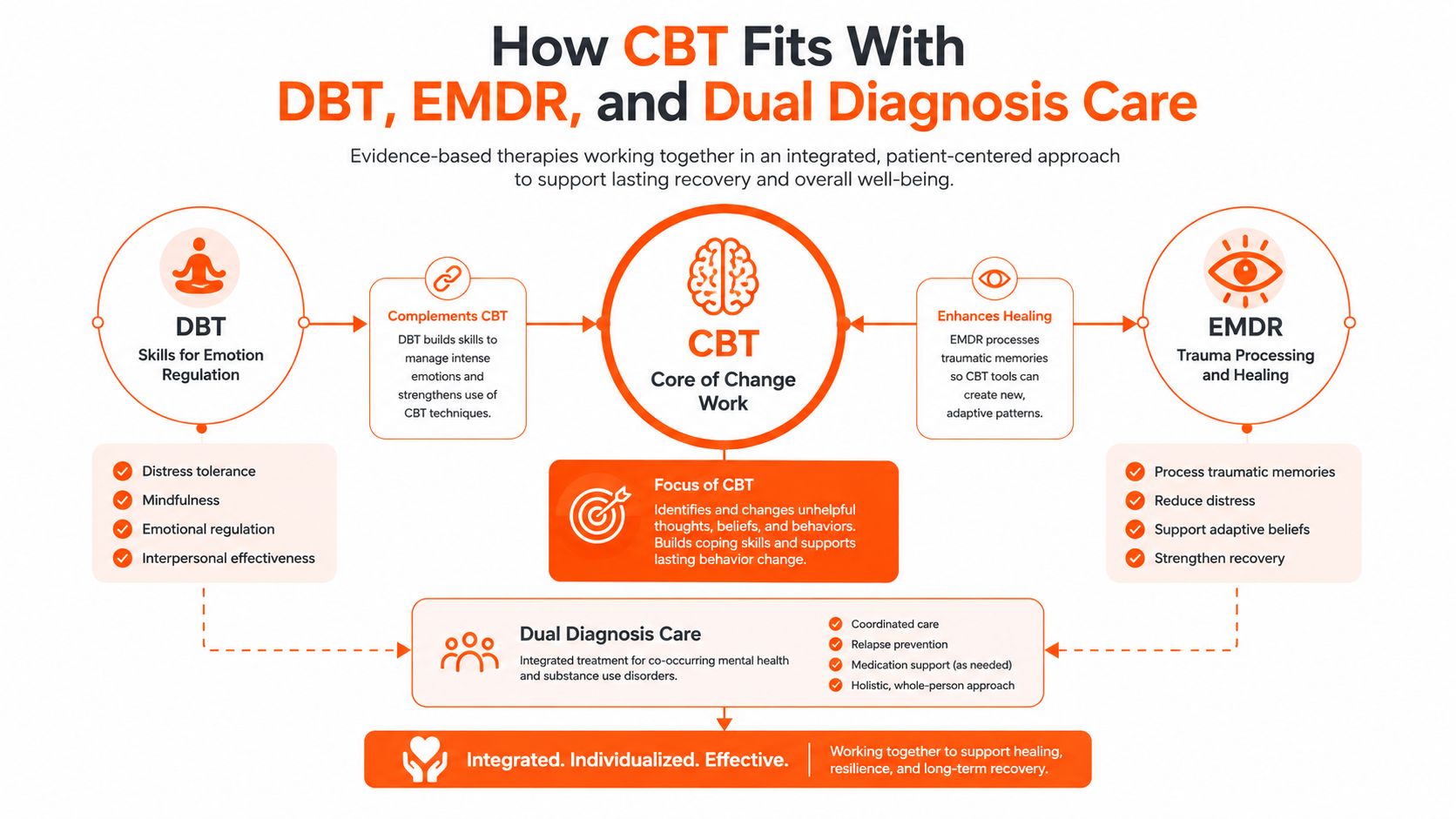
CBT is often one part of a broader clinical design. DBT can add emotion-regulation, distress-tolerance, mindfulness, and interpersonal-effectiveness skills when impulsivity or intense emotions make substance use more likely. CBT may then help the client examine the thoughts attached to the emotional surge and plan behavior for the next high-risk situation.

ACT approaches motivation through values and committed action. A client may recognize that honesty, health, family presence, or professional responsibility matters, even while cravings remain. CBT can translate that recognition into specific plans, such as identifying the thought that blocks a valued action and rehearsing a different response.

Trauma-focused modalities require careful assessment and timing. EMDR or Brainspotting may be considered when trauma symptoms contribute to avoidance, hyperarousal, shame, or substance use. CBT can support stabilization and day-to-day coping while the treatment team determines whether and when trauma processing is clinically appropriate.

Medication and psychiatric care belong in the same conversation

Anxiety, depression, ADHD, bipolar symptoms, and trauma can change how a person experiences cravings, sleep disruption, concentration problems, and emotional distress. Medication stabilization and monitoring may therefore be part of the plan. Therapy and medication aren't competing explanations. They address different clinical needs and should be coordinated by a team that can monitor response and risk.

The evidence supports this integrated emphasis. The dual-diagnosis review cited above found benefits in some outcomes without showing that CBT consistently outperformed usual addiction care. That's why a program's ability to assess and coordinate care may matter more than its use of a single branded modality. Readers researching dual diagnosis treatment should ask how psychiatric care, substance-use treatment, trauma work, and skills training interact.

A diagram illustrating how CBT integrates with DBT, EMDR, and Dual Diagnosis care for holistic recovery.

The executive advantage comes from coordination. A professional with multiple demands may need private individual work, practical coping rehearsal, psychiatric oversight, family involvement, and an aftercare plan that fits real responsibilities. One therapy can't provide all of that.

Relapse Prevention as an Ongoing Practice

A relapse-prevention plan shouldn't sit in a folder after discharge. It should function as a living operating document that changes when the client's environment changes. Early work identifies predictable risks, such as work travel, conflict, fatigue, isolation, access to substances, or a return to a social setting organized around use.

The client and treatment team then attach actions to each risk. A plan might specify who to call, where to go, what to remove from the environment, which appointment to schedule, and how to respond after a lapse. The aim is faster, safer intervention, not perfection. A lapse becomes a clinical signal that the plan needs revision, not evidence that treatment has failed.

Maintenance protects early gains

The evidence summarized in the 2025 meta-analysis indicates that relapse reduction is strongest in the first three months after CBT, then partially rebounds and stabilizes after six months. That pattern makes aftercare design a core treatment question. A person may need booster sessions, continuing therapy, medication follow-up, peer support, family accountability, or structured digital exercises.

Newer digital CBT research reported meaningful gains in abstinence, craving, and anxiety. The emerging implication is not that an app should replace a clinician. Digital tools may extend practice between appointments, while hybrid models combine clinician judgment with reminders, worksheets, check-ins, and accessible coping exercises.

Executives should also plan for predictable disruptions. Travel, board deadlines, business dinners, and confidential work obligations can interfere with appointments or recovery routines. An aftercare coordinator can help build alternatives before the disruption occurs, rather than asking the client to improvise while under pressure.

Practical maintenance questions include:

  • Booster access: Can the client schedule follow-up CBT when risk increases?
  • Digital support: Does the program recommend a secure, clinically appropriate tool?
  • Medication continuity: Who manages prescriptions, monitoring, and changes?
  • Crisis escalation: What happens if cravings intensify or a lapse occurs?
  • Work reintegration: How will treatment routines adapt to travel and professional demands?

A strong plan treats recovery skills as ongoing practice. The objective is stabilization that can withstand ordinary stress, not a promise that difficult thoughts or urges will never return. For additional planning ideas, review these relapse-prevention tips alongside guidance from a qualified treatment team.

Choosing a Program That Uses CBT Effectively

A program can advertise CBT without delivering a meaningful CBT process. Before admission, ask how clinicians use the approach, how often clients practice skills, how progress is reviewed, and how the plan changes when a client's substance use or psychiatric symptoms don't respond as expected.

Start with the clinical basics:

  • Qualified delivery: Ask which licensed or credentialed clinicians provide individual and group CBT.
  • Session frequency: Confirm how many individual sessions are included and whether sessions involve therapy, case management, psychiatry, or multiple disciplines.
  • Personalized targets: Ask how the team identifies triggers, automatic thoughts, coping gaps, and measurable treatment goals.
  • Integrated care: Find out how CBT connects with DBT, ACT, EMDR, medication management, family therapy, and medical oversight.
  • Aftercare design: Ask whether the discharge plan includes continuing therapy, booster sessions, digital support, medication follow-up, and crisis procedures.

The setting also affects engagement. Executives and licensed professionals may need privacy, smaller groups, private rooms, reliable internet, and limited technology restrictions so they can handle essential responsibilities without turning treatment into a remote-work arrangement. Those accommodations should support participation, not allow work to crowd out clinical care.

Ask how the program handles detox and residential transitions. A person in withdrawal may need nursing and psychiatric oversight before intensive cognitive work is realistic. Once medically stable, the team can increase skills practice, identify high-risk patterns, involve family when appropriate, and coordinate the next level of care.

Capo Canyon Recovery is one option for people evaluating private addiction treatment. Its programs include medically supervised detox, residential care, dual-diagnosis services, CBT alongside DBT, ACT, EMDR, and Brainspotting, medication monitoring, individual therapy across disciplines, and aftercare coordination. The executive track includes a small residential environment, private rooms, and a tech-friendly policy for essential professional communication.

Use the first conversation to test fit rather than accept broad promises. Ask for a sample schedule, the credentials of the clinicians, the process for handling co-occurring conditions, and the specific support available after discharge. A thoughtful program should answer plainly and explain how its clinical decisions will be adapted to the person, substance, treatment phase, and risks involved.


If you're evaluating private treatment for yourself, a colleague, or a family member, visit Capo Canyon Recovery to learn how its medically supervised detox, residential care, CBT-based treatment, dual-diagnosis services, and executive accommodations fit together. Contact the team to discuss clinical needs, privacy requirements, professional obligations, and the next appropriate step.

READ MORE
Uncategorized
August 17by 0 Comments

Alcohol Addiction Rehab California: A Personal Recovery

You're leading a company, managing a practice, flying routes, defending clients, or carrying responsibility for people who depend on your judgment. The drinking may still look controlled from the outside, but mornings are harder, decisions take longer, and the private effort required to keep alcohol use invisible keeps growing. The question isn't whether you can continue working. It's whether continuing this way is safer than entering treatment now.

For executives and licensed professionals, alcohol addiction rehab in California has to solve more than alcohol withdrawal. It must address confidentiality, clinical risk, technology access, psychiatric needs, professional obligations, and the transition back to real life. A polished setting can help, but amenities don't replace medical oversight, individualized therapy, or a plan that remains usable after discharge.

Why Executives Hesitate to Enter Alcohol Rehab in California

A chief executive may recognize the problem after a missed meeting, a troubling health result, or a conversation with a spouse. A physician may worry about licensing consequences. An attorney may fear that colleagues will interpret treatment as weakness. A business owner may believe the company can't function without daily involvement. These concerns are practical, not excuses, and a viable program has to take them seriously.

The mistake is treating rehab as an all-or-nothing disappearance. Some people need complete separation from devices and work while they stabilize. Others need limited, structured access to a phone or laptop for essential obligations. The clinical question is whether technology supports recovery or becomes a way to avoid it. A private workspace, scheduled communication windows, and clear boundaries can be more useful than an unrestricted device policy.

Clinical rule: Privacy should reduce unnecessary exposure, not shield a person from honest assessment, accountability, or treatment participation.

The cost of waiting

Professionals often delay because the immediate consequences of admission feel more visible than the consequences of continued drinking. That calculation can ignore impaired judgment, deteriorating relationships, medical complications, and the risk of a withdrawal episode outside clinical supervision. The long-term cost of delaying professional addiction treatment deserves a direct discussion with a qualified clinician, not a decision made during a late-night crisis.

A strong intake process should identify what must be protected, what can be delegated, and what cannot continue during treatment. The team may coordinate with a trusted family member, executive assistant, attorney, physician health program, or employer representative, but only with appropriate consent. Confidentiality isn't a marketing adjective. It's an operational practice involving admissions, transportation, records, communication, visitors, and staff training.

Treatment as a structured intervention

The right program doesn't promise that a client can keep working normally. It determines which responsibilities are clinically compatible with care. Detox may require near-total attention to medical stabilization. Residential treatment may allow limited contact while requiring consistent therapy, sleep, meals, medication management, and recovery work.

That distinction matters. A program designed around comfort alone may leave the central disorder undertreated. A program designed around rigid disconnection may be impossible for someone responsible for a company or regulated practice. High-quality care makes the trade-off explicit and builds a plan around safety first.

The Scale of Alcohol Use Disorder and Treatment Access in California

California has a large treatment system, yet demand exceeds access. 2023 state estimates counted 1,153,000 Californians receiving substance use treatment and 6,135,000 classified as needing it. The same figures indicate that about 81.4% of people classified as needing care were not receiving it, according to SAMHSA's California state estimates.

Alcohol creates a distinct access problem because socially accepted drinking can conceal clinically serious use. California's adult alcohol-use-disorder factsheet reported that 12% of adults age 18 and older met criteria for alcohol use disorder in 2021. It also reported that 11% of those adults said they needed but did not receive treatment at a specialty facility during the past year. For executives and licensed professionals, privacy concerns, work obligations, and limited technology access can make that gap harder to address.

The DHCS Statewide Needs Assessment recorded alcohol use disorder among 6.28% of Californians age 12 and older in 2018–2019, compared with 7.87% in 2008–2009. The decline does not remove the need for treatment. It highlights why referral decisions still require attention to medical supervision, psychiatric complexity, confidentiality procedures, and the client's ability to participate in care without exposing sensitive professional information.

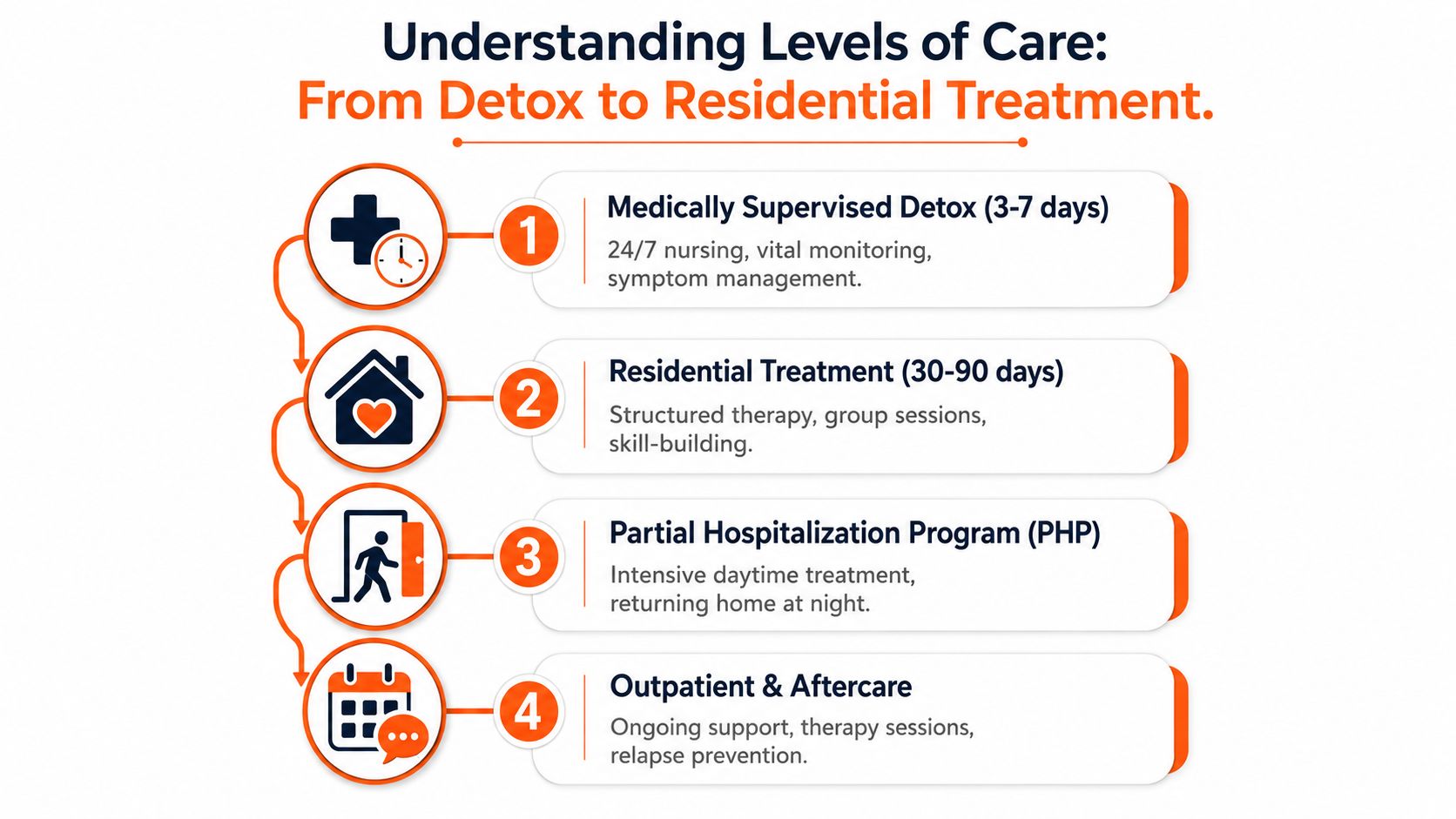
A diagram illustrating the four progressive levels of addiction treatment from detox to outpatient care.

Why residential care remains important

The California NSSATS profile listed 1,734 substance-abuse treatment facilities and 70,034 clients in treatment on March 31, 2020. Its broader context reported an annual average past-year alcohol use disorder prevalence of 6.0%, representing about 2.0 million people, during 2017–2019.

Those figures do not place every client in residential treatment. Outpatient care can fit people with low withdrawal risk, stable housing, reliable attendance, and sufficient support. Residential care warrants stronger consideration when alcohol use remains persistent, the home setting is unstable, psychiatric symptoms are active, or earlier outpatient attempts have not produced durable change.

California's system also recorded 96,960 people enrolled in substance-use treatment on a single day in March 2019, according to the same profile. A large system offers choices, but it also increases referral responsibility. Before admission, the referring professional should verify the facility's license, medical capability, level of care, privacy practices, technology arrangements, and discharge coordination.

Understanding Levels of Care From Detox to Residential Treatment

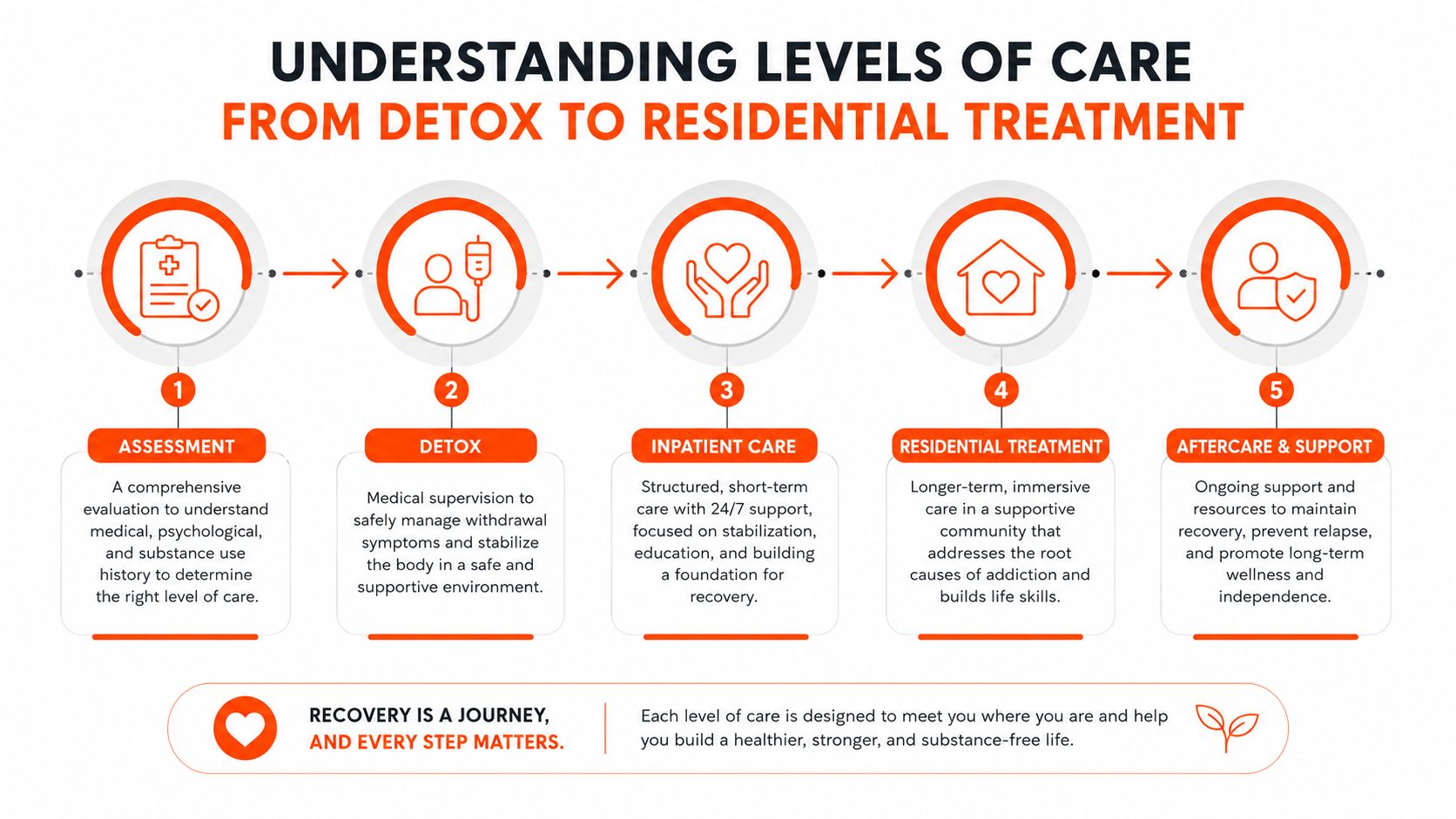
Treatment levels aren't interchangeable. The appropriate starting point depends on withdrawal history, current alcohol use, medical conditions, psychiatric symptoms, home support, and the person's ability to remain safe outside a structured setting. A clinician should assess those factors before placement rather than allowing a client to choose based only on room type or location.

An infographic showing the five stages of addiction treatment, from initial assessment to ongoing aftercare support.

Medically supervised detox

Alcohol withdrawal can escalate quickly, particularly after sustained heavy use or a history of complicated withdrawal. Evidence-based inpatient protocols emphasize continuous clinical monitoring, including nursing assessment of vital signs and symptom progression, alongside supportive care such as fluids, electrolyte replacement, thiamine before glucose, folate, and symptom control. The NCBI clinical guidance on alcohol withdrawal management explains why medical supervision matters during this phase.

Detox is not the same as rehabilitation. It addresses immediate physiological stabilization, but it doesn't by itself change the routines, beliefs, relationships, psychiatric symptoms, or professional pressures that maintain alcohol use. A safe detox plan should include a clear handoff into residential, partial hospitalization, intensive outpatient, or another clinically suitable level.

Residential treatment

Residential care provides a controlled environment where clients can sleep consistently, receive medication monitoring, attend therapy, and practice recovery skills without managing alcohol access at home. The day usually combines individual sessions, groups, psychiatric appointments, case management, meals, rest, and planned contact with family or professional supports.

The value isn't just being away from alcohol. Residential structure gives clinicians repeated opportunities to observe sleep, anxiety, irritability, cravings, medication response, participation, and interpersonal patterns. That information helps the team refine treatment instead of relying on a single intake interview.

A useful overview of the different levels of care in rehab can help families understand why a client may move between services rather than remain at one intensity throughout recovery.

PHP, outpatient care, and aftercare

A partial hospitalization program offers intensive daytime treatment while the client returns to a residence at night. It can work when the person has a safe living environment and enough stability to manage evenings without residential supervision. Intensive outpatient and standard outpatient services provide progressively less structure, making them useful for continuing therapy, relapse-prevention planning, medication management, and accountability.

California's 2025 planning report shows how outpatient-heavy the system is. It reported that 29.6% of outpatient clients and 7.1% of intensive day-care clients stayed 31 days or longer, while 9.6% of outpatient stays lasted 30 days or fewer, according to the 2025 DHCS SNAP Report. Those figures don't determine an individual's treatment duration, but they illustrate why placement decisions and continuity planning deserve attention.

How Executive and Private Programs Differ From Standard Rehab

“Executive rehab” should describe a care design, not a decorative package. A private room, attractive meals, and a quiet setting may improve comfort, but they don't establish clinical quality. The meaningful differences involve census, staffing, communication rules, psychiatric access, documentation, and whether the program can maintain treatment intensity while accommodating essential responsibilities.

Feature Standard Residential Program Executive or Private Program
Census and setting May serve a broader mix of clients in a larger environment Often emphasizes a smaller, more discreet setting
Technology access May restrict phones and laptops broadly May permit structured access for essential work or family communication
Privacy Shared spaces and standard admissions procedures may be common May use private rooms, controlled communication, and discreet logistics
Clinical contact Treatment may rely heavily on scheduled groups May offer more individual therapy, case management, and psychiatric coordination
Work obligations Usually expects a clearer separation from professional duties May plan limited, clinically appropriate work contact
Personalization Standardized tracks can support consistency Treatment plans may be more tailored to professional, psychiatric, and family needs

What technology can and can't do

A technology-friendly policy isn't automatically therapeutic. Unrestricted access can let a client manage crises, monitor business activity, or contact family. It can also preserve compulsive work patterns, expose the client to stress, or interfere with sleep and group participation. The program should explain when devices are allowed, where they can be used, who can contact the client, and what happens if technology starts undermining treatment.

Privacy must be operational

Privacy includes more than a secluded address. Ask how the facility handles arrival and departure, records, visitors, phone calls, staff conversations, roommate assignments, and communication with employers or professional representatives. A small census may make discretion easier, but the facility still needs formal confidentiality procedures and a clear consent process.

Clinical substance over cosmetic appeal

Executive-focused care is worthwhile when it improves engagement and continuity without diluting accountability. Ask for the weekly schedule, individual therapy frequency, psychiatric availability, nursing coverage, group composition, family involvement, and discharge process. If the admissions conversation centers on scenery while avoiding withdrawal management or dual diagnosis, that's a warning sign.

Dual Diagnosis and Evidence-Based Therapy for Professionals

Alcohol is often the visible behavior, not the whole diagnosis. A professional may drink to quiet panic before a presentation, sleep after prolonged overwork, blunt trauma memories, manage attention difficulties, or escape depressive thinking. Anxiety, depression, trauma, ADHD, and bipolar symptoms each require different assessment and treatment decisions, and alcohol can complicate the presentation of all of them.

A dual-diagnosis program should integrate psychiatric evaluation with substance-use treatment rather than placing mental health concerns in a separate, loosely connected track. Clinicians need to distinguish intoxication, withdrawal, medication effects, mood episodes, trauma responses, and longstanding symptoms. That process takes observation over time, collateral information when appropriate, and regular communication among therapists, nurses, psychiatrists, and case managers.

Matching therapy to the clinical problem

Cognitive behavioral therapy can help clients identify automatic thoughts, drinking cues, avoidance patterns, and decisions that increase risk. Dialectical behavior therapy can strengthen distress tolerance, emotional regulation, interpersonal effectiveness, and crisis skills. Acceptance and commitment therapy helps clients act according to values even when cravings, shame, or anxiety remain present.

Trauma-focused work requires pacing. EMDR or Brainspotting may be appropriate for some clients, but neither should become a fashionable add-on delivered without stabilization and clinical judgment. A person in acute withdrawal, severe sleep disruption, or an unstable mood episode may first need safety, medication support, and grounding skills.

What individualized care looks like

High-intensity treatment shouldn't mean filling every hour with generic groups. It should mean that the team can answer specific questions:

  • What maintains the drinking? Work stress, trauma, loneliness, insomnia, access, relationships, mood instability, or another factor?
  • What changes first? Withdrawal safety, sleep, medication response, anxiety, drinking cues, or family boundaries?
  • How is engagement measured? Attendance alone isn't enough. The team should track participation, skill use, symptom changes, and follow-through.
  • Who coordinates the return home? A case manager should connect treatment recommendations with psychiatry, therapy, family supports, professional monitoring, and continuing care.

California's statewide needs assessment describes tracking substance-use-disorder prevalence, service utilization, client outcomes, and program performance across relevant populations, as discussed in the UCLA summary of the statewide needs assessment. That emphasis reflects an important clinical principle: admission is only the beginning. Retention, meaningful participation, and continuity deserve equal attention.

A checklist infographic outlining important licensing and quality standards to verify before choosing an addiction rehab facility.

Licensing and Quality Markers to Verify Before Admission

California gives families and referral professionals a concrete starting point. A residential alcohol or drug recovery facility that provides services such as detoxification, individual or group sessions, or treatment planning must be licensed by the California Department of Health Care Services, as explained in the DHCS facility licensing requirements. The state also requires at least one DHCS Level of Care Designation and/or ASAM residential certification that matches the facility's program.

That requirement doesn't tell you everything about a program, but it separates verifiable operations from vague marketing. Confirm the facility's license directly, ask which services the license covers, and determine whether the designation matches the care being promised.

An infographic checklist for evaluating educational institutions through licensing, accreditation, and quality standards before admission.

Questions that reveal clinical capacity

Use the admissions call to test specifics rather than collect general assurances:

  1. Who manages withdrawal? Ask whether nurses monitor symptoms continuously, whether a physician or psychiatric prescriber is available, and what happens if symptoms become more severe.
  2. Who provides psychiatric care? Clarify the prescriber's role, appointment frequency, medication-review process, and response to mood instability or severe anxiety.
  3. How is the plan individualized? Request examples of how therapy, medication, family work, and discharge planning change based on assessment.
  4. What does staffing look like? Ask which disciplines are on site, how overnight coverage works, and who handles emergencies.
  5. What happens after discharge? The answer should include appointments, medication continuity, crisis planning, family communication, and step-down care where appropriate.

Accreditation can provide another quality signal, but it shouldn't replace direct questions. A facility may hold respected credentials and still be a poor fit for a client who needs privacy, technology access, trauma treatment, or substantial psychiatric oversight.

Marketing claims to challenge

Be cautious with promises of guaranteed sobriety, effortless confidentiality, or treatment that fits smoothly around every professional obligation. Recovery requires time, discomfort, honest participation, and a willingness to change daily behavior. A program that won't explain its boundaries may be selling an experience rather than delivering a treatment plan.

Due diligence standard: Verify the license, identify the actual clinicians, inspect the level-of-care structure, and ask how the program responds when a client becomes medically or psychiatrically unstable.

Insurance, Private Pay, and Regional Considerations in Southern California

Insurance verification should happen before admission whenever possible. Ask the facility to confirm benefits, authorization requirements, covered levels of care, exclusions, deductibles, and the process for continued-stay reviews. Coverage doesn't guarantee placement, and authorization doesn't guarantee that a particular program can meet the client's clinical or privacy needs.

Private pay can offer more flexibility, but it doesn't remove the need for scrutiny. Families should request a written explanation of what the quoted arrangement includes, such as detox, residential treatment, psychiatry, medication management, therapy, laboratory services, transportation, and continuing care coordination. They should also ask what may create separate charges.

The insurance coverage guide for addiction treatment can help families prepare for those conversations, but a facility's financial team still needs to verify the individual policy and explain its limitations.

Choosing a region strategically

Southern California offers geographic separation from a client's usual routines, professional network, or home environment. That distance can support privacy and reduce immediate access to alcohol, but it can also complicate family participation, follow-up appointments, and return-to-work planning. Orange County may be convenient for clients from the region, while clients elsewhere in California may prefer a setting that creates more separation.

Location should follow clinical fit. Compare medical coverage, psychiatric capability, census, privacy procedures, tech rules, therapy intensity, and discharge coordination before comparing scenery or brand reputation. A coastal address can't compensate for weak continuity of care.

For referral professionals, regional planning also matters because capacity changes. California's planning system includes waiting-list and capacity tracking when counties reach high occupancy, which shows that placement logistics remain active constraints rather than solved administrative details. Ask about the current admission pathway, expected timing, and what happens if the preferred level of care isn't immediately available.

Next Steps and Common Questions About California Alcohol Rehab

A practical admission process starts with a clinical conversation, not a tour. The person seeking care, or a trusted advocate with permission, should describe current alcohol use, prior withdrawal, medical history, psychiatric symptoms, medications, previous treatment, work demands, and immediate safety concerns. Accurate information helps the program decide whether it can safely provide care or whether another setting is more appropriate.

A workable decision sequence

  1. Request a clinical screening. Ask who conducts it and whether a medical or psychiatric professional reviews the information.
  2. Verify credentials. Confirm DHCS licensing and the relevant level-of-care designation or ASAM residential certification.
  3. Clarify privacy and technology. Get the device policy, communication boundaries, private-room availability, and confidentiality procedures in writing.
  4. Review the clinical schedule. Ask about nursing, psychiatry, individual therapy, groups, family work, medication management, and case management.
  5. Plan the work transition. Identify delegated responsibilities, emergency contacts, message boundaries, and a realistic return-to-work process.
  6. Build continuing care before discharge. Arrange therapy, psychiatry, recovery support, medication follow-up, and a response plan for cravings or psychiatric deterioration.

Common questions from professionals and families

Can I keep my phone or laptop during treatment?
Some executive-oriented programs permit devices under defined conditions. That may support essential communication, but access should be limited enough to protect sleep, therapy participation, and emotional stability. Ask for the exact policy rather than assuming “executive” means unrestricted access.

Will residential treatment make my absence obvious?
No program can promise that others won't notice an absence. A facility can reduce unnecessary exposure through discreet admissions, controlled communication, confidential records, and careful coordination. The client should discuss professional obligations with the treatment team before admission.

How long will I need to stay?
Duration depends on withdrawal risk, medical stability, psychiatric symptoms, treatment engagement, home support, and progress toward a safe next level. A responsible program won't guarantee a fixed result or push a client into a shorter stay solely to preserve convenience.

What if anxiety, trauma, ADHD, depression, or bipolar symptoms are involved?
The program should assess and treat those conditions alongside alcohol use. Ask who provides psychiatric care, how medication decisions are monitored, which therapies are available, and how clinicians distinguish substance-related symptoms from an independent mental health disorder.

Can I detox at home?
That decision requires medical assessment. Because alcohol withdrawal can become dangerous, a person with significant use, prior complications, medical vulnerability, or uncertain history shouldn't assume home detox is safe. Contact a qualified medical professional or emergency service when severe symptoms or immediate danger are present.

What should referral sources send at intake?
Provide a concise clinical summary, medication list, recent risk information, withdrawal history, diagnoses under consideration, current providers, consent status, and the reason for seeking a particular level of care. Clear documentation helps the receiving team respond quickly and reduces avoidable delays.

The most useful first call is direct. Ask what the facility can safely treat, what it can't provide, how it protects confidentiality, and how it will support the client after discharge.


Capo Canyon Recovery offers licensed detox and residential treatment in Mission Viejo, with 24/7 nursing and psychiatric oversight, dual-diagnosis care, individual therapy, and an executive treatment pathway that permits structured access to phones and laptops. Visit Capo Canyon Recovery to discuss privacy-conscious alcohol rehab options in Orange County and request an assessment.

READ MORE
Uncategorized
August 16by 0 Comments

EAP Employee Assistance Programs: A Complete Guide

Offering an EAP employee assistance program doesn't automatically make employees feel safe enough to use it. That assumption is especially dangerous with executives, physicians, attorneys, pilots, and other licensed professionals, whose concerns often involve confidential substance use, impaired performance, licensing consequences, or reputational exposure. The practical question isn't whether support exists. It's whether a person can reach it quickly, privately, and without wondering who will find out.

EAPs remain valuable first points of contact. They can provide brief counseling, crisis response, work-life referrals, and triage into more specialized care. But a program can be widely available and still fail the people with the most to lose. The difference usually comes down to trust, access, and referral quality, not another reminder in the employee newsletter.

Why Most Employees Still Avoid Using Their EAP

The popular advice is simple: promote the EAP more often. Better communications help, but they don't solve the central problem for many professionals. An employee may know the benefit exists and still avoid it because the perceived cost is professional exposure.

Industry reporting states that 98% of mid-to-large companies offer an EAP, while only about 4% of employees use one annually. The same reporting identifies lack of awareness at 47%, stigma at 43%, confidentiality concerns at 40%, benefits complexity at 39%, and limited resources at 33% as leading barriers. These figures are reported in ADP's analysis of mental health benefits employees will actually use.

An infographic showing three main reasons why employees avoid utilizing company employee assistance programs despite universal availability.

Awareness doesn't create trust

An executive who suspects an employer might learn about alcohol use won't be reassured by a colorful benefits flyer. A physician may worry that a referral creates a record discoverable by a licensing authority. An attorney may fear that a colleague will recognize the treatment provider, or that an insurance inquiry will reveal more than intended.

The risk may be real, misunderstood, or both. In each case, the employee needs a clear explanation of who receives information, what gets documented, and which records remain outside the employer's systems. Vague promises of confidentiality often make the concern worse.

Practical rule: If an employee can't explain the privacy boundary in plain language, the EAP hasn't made access feel confidential.

Design also matters. A phone tree that routes a distressed employee through several transfers, a provider directory filled with outdated contacts, or a referral that requires repeated retelling can stop care before it begins. Executives often have demanding schedules and limited tolerance for administrative uncertainty. They need a discreet point of contact, rapid triage, and a referral partner that understands professional obligations.

Employers should also manage reputational risk, especially when a worker holds a public-facing or regulated role. A thoughtful reputational risk management approach treats privacy as an operational requirement, not a slogan. Utilization should therefore be interpreted as feedback about program design. Low use may mean employees don't need help, but it may also mean the pathway feels unsafe or cumbersome.

Core Services That EAPs Actually Provide

An EAP is generally a voluntary, employer-sponsored support service for personal and work-related problems. Its job is to offer early assistance, assess immediate needs, and connect the employee with an appropriate next step. It isn't usually designed to replace long-term psychotherapy, full-scale psychiatric treatment, or medically supervised addiction care.

What happens during an EAP contact

A typical contact begins with identity and eligibility verification, followed by a private discussion of the concern. The counselor may ask about symptoms, substance use, safety, work functioning, family circumstances, and existing treatment. The purpose isn't to conduct a complete specialty evaluation in one call. It's to determine the safest and most useful level of support.

Common services include:

  • Short-term counseling: Brief sessions can address grief, work conflict, acute stress, anxiety, adjustment problems, and other situational concerns.
  • Substance use assessment: A counselor can explore patterns of alcohol or drug use, consequences, motivation, withdrawal risk, and the need for specialty evaluation.
  • Crisis intervention: EAP teams may help after a workplace death, traumatic event, serious accident, or other destabilizing incident.
  • Work-life referrals: Employees may receive help locating legal consultations, financial guidance, childcare resources, eldercare support, or community services.
  • Manager consultation: Supervisors can seek guidance about responding to concerning behavior without attempting to diagnose or counsel an employee.

Traditional EAPs often operate as short-duration interventions. One benchmark reports an average of 2.5 counseling sessions per case, with a 4.5% average case-level utilization rate and a 3.6% median, as summarized by Meditopia's EAP utilization review. Those figures describe a brief-support model, not a promise that every employee receives the same number of sessions.

A diagram outlining the core services of Employee Assistance Programs including counseling, work-life services, and critical incident support.

The limits should be stated early

A counselor might help an executive stabilize after a difficult board meeting, identify a therapist, or arrange an assessment for escalating alcohol use. If the person is experiencing withdrawal risk, suicidal thinking, psychosis, severe mood instability, or a persistent substance use disorder, the EAP should move from counseling to coordinated clinical care.

The best EAP encounter ends with a clear plan. That may be another brief session, a community referral, a psychiatric appointment, or direct coordination with a detox or residential provider. The employee shouldn't have to guess which step comes next.

Confidentiality Protections and Executive Concerns

Confidentiality determines whether many high-responsibility employees will make the first call. Executives and licensed professionals aren't only asking whether an EAP is confidential in general. They're asking whether an employer will learn about their specific concern, whether a claim will identify treatment, and whether a licensing board could obtain records through a later process.

EAP providers commonly operate separately from the employer, with employers receiving aggregated information rather than an individual's counseling details. That separation is important, but it must be explained accurately. Privacy protections depend on the provider, the service involved, the consent obtained, the payment route, and the laws that apply.

Separate the privacy questions

Employer reporting is one issue. An employer may receive broad utilization or service-category reporting, but that doesn't mean it should receive a named employee's clinical narrative. Employees should ask directly whether individual names, diagnoses, appointment details, or referral reasons are shared.

Clinical records are another issue. HIPAA may govern protected health information in covered healthcare settings, but people shouldn't assume every EAP interaction has identical legal treatment. Substance use treatment records may also involve the federal confidentiality rules under 42 CFR Part 2, depending on the provider and the record.

Insurance and referral workflows create a separate point of exposure. An EAP may be able to offer a private counseling benefit without an insurance claim. Higher-level care, however, often requires eligibility verification, authorization, clinical records, and consent to coordinate with the treatment provider. That doesn't make the referral unsafe, but it does mean the employee should understand what information will move and why.

A confidentiality conversation should happen before referral, not after a professional has already disclosed sensitive details.

Licensed professionals may also worry about licensing boards, malpractice carriers, credentialing files, and mandatory reporting rules. No provider can promise that every record is immune from every lawful request. A responsible coordinator explains the limits, obtains only necessary consent, and avoids sending an entire clinical history when a focused summary will support admission.

For professionals considering addiction treatment, a confidential rehab pathway should include a direct explanation of documentation, communication, technology use, and outside-party contact. Privacy isn't just an intake form. It includes reception procedures, staff conversations, shared spaces, voicemail, email, transportation, and the way a referral appears in an employer's benefits system.

When Short-Term Counseling Is Not Enough

Short-term EAP counseling works well when the problem is contained and the person can remain medically and psychologically safe outside a structured setting. A professional dealing with acute stress, grief, a relationship crisis, or a manageable adjustment problem may benefit from brief counseling and a reliable outpatient referral.

That model changes when substance use has become chronic, withdrawal is possible, or mental health symptoms complicate recovery. A person who needs detox can't safely substitute supportive conversation for medical monitoring. Someone with trauma, bipolar disorder, depression, anxiety, or ADHD may need integrated psychiatric assessment rather than a referral list.

A comparison chart showing when short-term EAP counseling is appropriate versus when complex clinical care is needed.

The clinical breakpoint

EAP counselors look for warning signs that brief care won't be adequate. These can include escalating use, failed attempts to stop, dangerous intoxication, withdrawal symptoms, overdose history, severe insomnia, suicidal thoughts, hallucinations, major functional decline, or an unsafe home environment. The assessment should also consider whether the employee can participate voluntarily and whether immediate emergency intervention is required.

The available evidence shows why this transition matters. One 2024 report found that 79% of referrals were for mental health, while a separate industry report described nearly eight in ten referrals as mental health counseling. Yet a 2025 report noted that only 42% of callers needing therapy were accepted in one model. These figures appear in the AllOne Health Annual Report, and they illustrate a practical concern: the EAP may be the front door, but the door doesn't guarantee successful entry into appropriate care.

EAP counseling may fit Higher-level care may be needed
Situational stress or adjustment concerns Chronic substance use with loss of control
Mild to moderate symptoms with stable functioning Withdrawal risk or medical instability
A person who can use outpatient support safely Co-occurring conditions requiring psychiatric oversight
Short-term problem solving Detoxification, residential treatment, or extended care

The handoff often fails when the counselor gives the employee a phone number and closes the case. A stronger pathway includes a warm transfer, consent-based information sharing, insurance review, and confirmation that the receiving program can meet the person's clinical and professional needs.

The Referral Pathway to Higher-Level Care

A referral to detox or residential treatment should feel like a coordinated clinical process, not a search engine exercise. The employee may be frightened, ambivalent, intoxicated, exhausted, or worried about missing work. Every unnecessary delay increases the chance that the person disengages.

Four steps make the transition safer

1. EAP assessment and triage. The counselor gathers enough information to identify urgency, safety concerns, substance use severity, mental health symptoms, medical conditions, and immediate support needs. If there is imminent danger, emergency services take priority over routine placement.

2. Determine medical necessity. The EAP or an affiliated clinician identifies the appropriate level of care. Detox, residential treatment, partial hospitalization, intensive outpatient care, and outpatient therapy serve different clinical situations. A facility should receive the relevant history, current medications, recent use, withdrawal concerns, and risk information with the employee's authorization.

3. Verify insurance and authorization. A case manager confirms benefits, network status, deductibles, exclusions, authorization requirements, and any clinical documentation requested by the payer. Insurance verification isn't the same as a guarantee of payment, so the employee should receive a clear explanation of expected financial responsibility.

4. Coordinate direct admission. The referring counselor and receiving program agree on timing, transportation, arrival instructions, medication needs, technology rules, and family communication. The employee should know who will answer the phone and what happens if symptoms worsen before admission.

A four-step referral pathway infographic for employee assistance programs showing assessment, medical necessity, insurance, and direct admission.

What executives should request

An executive shouldn't have to disclose sensitive details to multiple uncoordinated intake teams. Ask whether the EAP can make a warm referral, whether the treatment center has experience with licensed professionals, how work communication is handled, and whether the program can protect privacy during arrival and ongoing care.

EAP professionals should maintain a small, vetted referral network rather than relying on generic directories. Case management services can help coordinate clinical information, benefits, family communication, and continuity after discharge. The objective is not merely placement. It's a transition that preserves safety, dignity, and treatment momentum.

Measuring EAP Value Beyond Utilization Rates

Utilization is easy to report, but it can be a poor definition of success. A low number may reflect privacy fears, unclear access, or a brief intervention that resolved a problem quickly. A high number may reflect strong engagement, but it doesn't automatically demonstrate appropriate triage or meaningful outcomes.

Historical adoption shows how established EAPs have become. A review found that 59% of Fortune 500 companies had formal EAPs by 1979, the estimated number of U.S. companies offering them rose to about 12,000 by 1985, and about 60% of full-time U.S. workers were employed in settings with an EAP by 2002 to 2003. Later surveys reported 70% of employers in 2004 and about 75% of businesses in 2007 to 2008 offered one, according to this historical review of EAP development. Availability is therefore a mature benchmark. It shouldn't be mistaken for access that employees trust.

A more useful scorecard

Employers should review whether employees can reach a qualified clinician, how quickly referrals are accepted, whether higher-acuity cases receive a warm handoff, and whether the program communicates privacy clearly. Useful measures can include:

  • Time to first contact: How long does an employee wait after requesting help?
  • Referral completion: How many employees successfully connect with the recommended provider?
  • Clinical fit: Are referrals matched to substance use, psychiatric, cultural, geographic, and professional needs?
  • Continuity: Does the EAP confirm that the next provider received essential information and that the employee has a follow-up plan?
  • Employee experience: Do users understand confidentiality, cost, and available services?
  • Organizational outcomes: Where valid data exists, do absenteeism, turnover, disability, and emergency-care patterns change over time?

ROI evidence supports looking beyond raw usage. One peer-reviewed analysis reported a total return of $5.39 for every $1 invested, including $3.24 from reduced outpatient mental health and substance-use treatment costs, $2.01 from reduced absenteeism, presenteeism, and turnover, and $0.13 from workplace support services, as reported in this EAP utilization and ROI analysis. A UK EAPA report cited an average return of £7.27 per £1 spent in the same source.

ROI Component Return per $1 Invested Primary Driver
Reduced outpatient mental health and substance-use treatment costs $3.24 Avoided or reduced downstream care costs
Reduced absenteeism, presenteeism, and turnover $2.01 Productivity and workforce stability
Workplace support services $0.13 Support connected to workplace functioning
Total reported return $5.39 Combined employer impact

Those findings don't mean every program produces the same return. They do show why employers should examine referral quality and recovery outcomes, not just the percentage of employees who call.

What Specialty Treatment Centers Need from EAPs

Specialty providers need more than an employee's name and a request for admission. They need a clinically useful picture of the presenting problem, current substance use, withdrawal risk, medications, medical history, psychiatric symptoms, safety concerns, and prior treatment. The referral should include only information necessary for care and should move with documented consent.

The receiving program also needs to understand the professional context. An executive may need privacy around travel, arrival, communication, and family involvement. A licensed professional may need a treatment plan that addresses monitoring obligations, work boundaries, documentation questions, and a safe return-to-practice process. Those needs don't change the clinical standard, but they affect coordination.

Strong referral relationships answer practical questions

An EAP should know:

  • Admission criteria: Which symptoms, medical conditions, and substance use patterns can the program safely manage?
  • Level-of-care limits: When should the employee go to emergency care, detox, residential treatment, or outpatient services?
  • Insurance process: Who verifies benefits, requests authorization, and explains financial responsibility?
  • Communication rules: What can the EAP share, with whom, and under what consent?
  • Workplace continuity: Can the patient access a phone or laptop in a structured way without undermining treatment?
  • Aftercare planning: Who coordinates therapy, psychiatry, monitoring, family support, and continuing care after discharge?

For executives, a treatment setting must balance privacy with accountability. Capo Canyon Recovery is a licensed detox and residential addiction treatment center in Mission Viejo, Orange County, California, offering 24/7 nursing and psychiatric oversight, dual diagnosis treatment, an executive treatment track, private bedrooms, structured technology access, insurance verification, and aftercare coordination. Its small residential setting serves approximately five clients at a time, which is a stated program feature rather than a guarantee of any individual outcome.

The strongest EAP partnerships don't end when an employee is admitted. They establish a consent-based communication plan, clarify who handles urgent questions, and begin discharge planning early. That continuity is what turns an EAP from a referral source into a reliable bridge between workplace support and specialty treatment.


If an EAP referral has reached the point where detox, residential care, or dual diagnosis treatment is being considered, contact Capo Canyon Recovery to discuss confidential intake, insurance verification, executive-focused care, and coordinated admission. The team can help EAP professionals, clinicians, families, and licensed professionals understand the next clinical step without leaving the employee to handle it alone.
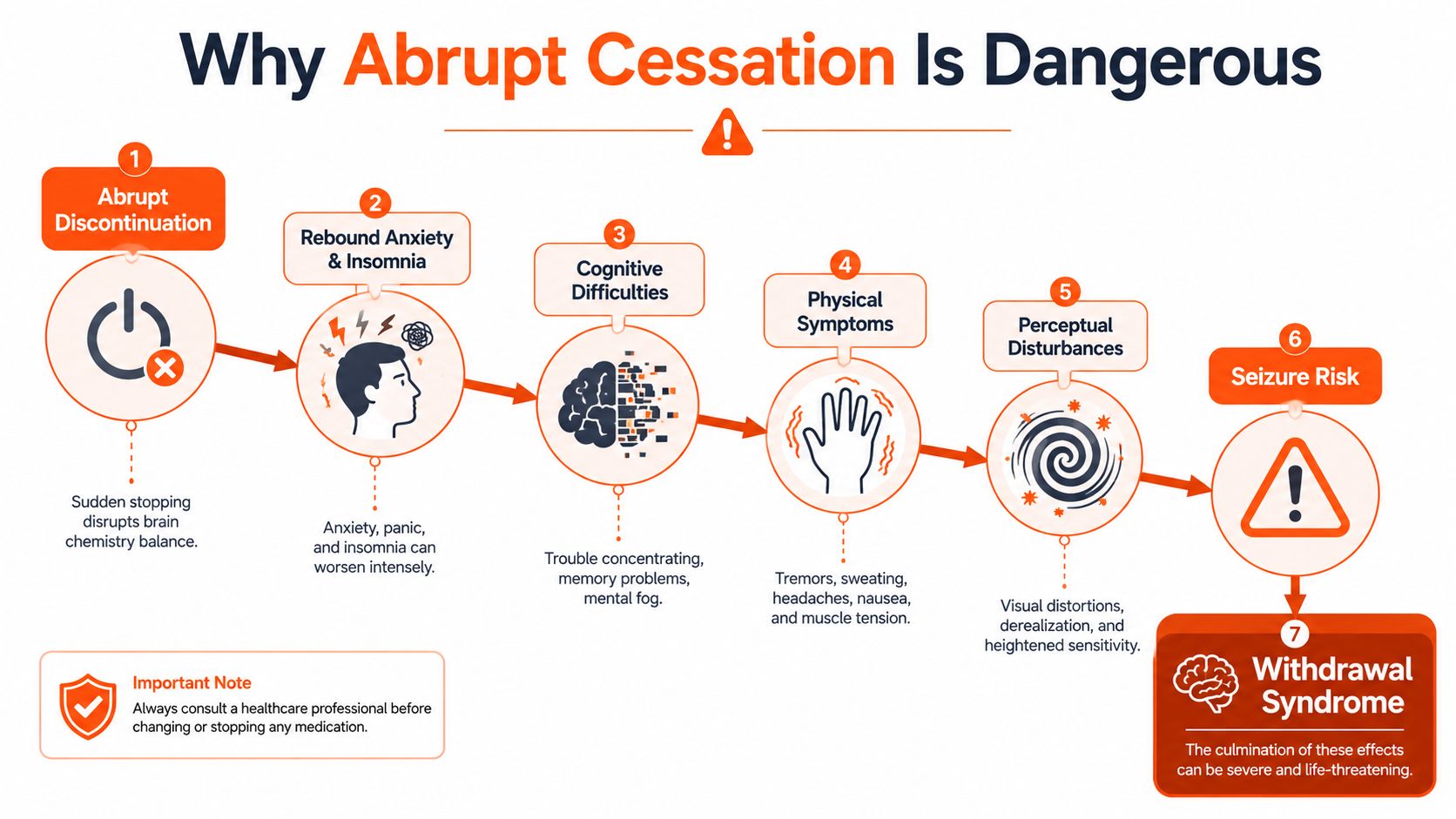
READ MORE
Uncategorized
August 15by 0 Comments

2026 Return to Work Planning Guide for Executives

You're back in the executive suite, but your recovery plan is still sitting in a clinician's file and your employer's expectations are still unwritten. The board wants reassurance, your team wants direction, and you're trying to determine whether a full calendar will support your recovery or destabilize it.

That tension is why return to work planning can't be reduced to a clearance letter and a start date. For executives, the plan must protect clinical progress while addressing confidentiality, decision-making capacity, workload, travel, regulatory duties, and the professional credibility you've built over years.

What Return to Work Planning Actually Means for Executives

A senior investment partner once described his planned return as “coming back on Monday.” That was the entire plan. No agreement about client dinners, no limit on late-night deal work, no designated person to contact if sleep deteriorated, and no communication protocol for the partners. His clinician supported a gradual resumption of work, but the organization had translated that into a date rather than a structure.

That's the planning gap executives face. Return to work planning is a coordinated operating plan, not a calendar appointment. It connects medical clearance, functional capacity, job design, communication boundaries, monitoring, and recovery support. Each part answers a different risk question.

A useful plan identifies:

  • What you can safely do now: The duties, hours, cognitive demands, travel, and interpersonal exposure that fit your current functioning.
  • What must be delayed: High-risk responsibilities, overnight work, extensive travel, or situations that could undermine stabilization.
  • Who knows what: The information HR, your manager, the board, regulators, and external stakeholders need.
  • How progress will be measured: Specific milestones, scheduled check-ins, and rules for scaling duties up or down.
  • What happens if recovery becomes unstable: A private escalation pathway that doesn't depend on making a clear decision during a crisis.

The evidence supports treating planning as a serious intervention. In a major 2025 national survey, 61.8% of injured workers had a return-to-work plan. Among those workers, 94.0% had returned to work at some point, compared with 81.7% of workers without a plan, according to Safe Work Australia's 2025 national survey analysis. The same survey found that 88.9% had returned to work at any time, while 78.8% were working when surveyed, which shows why “I went back once” and “I'm working sustainably” aren't interchangeable outcomes.

Practical rule: If the plan doesn't specify duties, limits, communication, review dates, and escalation steps, it isn't finished.

Executives and licensed professionals also carry responsibilities that may not apply to other employees. A physician may need to consider patient safety and medical licensing obligations. An attorney may face bar-related requirements. A pilot may have an aviation medical framework. The question isn't only whether you feel ready. It's whether your current functioning supports the responsibilities attached to your role.

Pre-Return Assessment and Medical Clearance

Don't negotiate a return date before you know what the job demands and how those demands interact with your current recovery. A useful assessment has three layers, and a generic “fit for duty” note usually covers none of them well.

Start with clinical clearance

Ask the treating clinician for a dated, role-specific assessment. It should identify the work activities reviewed, current restrictions, recommended accommodations, anticipated review points, and the conditions under which duties can expand or contract. “Cleared to return to work” leaves too much room for an employer to interpret clearance as full capacity.

The clinician doesn't need to disclose a diagnosis to the employer when functional information is sufficient. The document can address matters such as sustained concentration, schedule tolerance, sleep stability, medication effects, stress exposure, travel, driving, safety-sensitive decisions, and the ability to respond to urgent demands.

Medical clearance should also reflect treatment status. If medication has recently changed, withdrawal symptoms are unresolved, or co-occurring anxiety, depression, trauma, bipolar symptoms, or ADHD are interfering with performance, those issues belong in the clinical risk discussion. A return plan built on wishful thinking will fail under the first serious deadline.

A professional infographic outlining a five-step checklist for employee pre-return assessment and medical clearance procedures.

Translate symptoms into job functions

A functional review asks what happens during a real workday, not whether you can perform well for a short appointment. Review:

  • Cognitive load: Can you sustain attention through financial review, legal analysis, clinical decisions, or complex negotiations?
  • Energy and sleep: Can you maintain the proposed schedule without using exhaustion as proof of commitment?
  • Emotional regulation: Can you manage conflict, criticism, urgency, and public-facing pressure?
  • Task switching: Can you move between meetings, calls, documents, and decisions without losing accuracy?
  • Safety and judgment: Are there duties where impairment could harm patients, clients, employees, passengers, or the public?

Request an assessment that links these functions to specific duties. A licensed professional may need separate consideration of fitness to practice, supervision, prescribing, courtroom work, flight operations, or access to controlled substances.

Separate employer evaluation from treatment

An employer may request an independent medical examination or occupational assessment. That evaluation serves the employer's process, while the treating team's role is to support recovery and explain clinical limitations. They should communicate only with appropriate authorization and within defined boundaries.

For licensed roles, consult the relevant regulator, licensing counsel, or professional monitoring body before making assumptions about disclosure. Rules differ by profession and jurisdiction. Your plan should name who will obtain that advice, what question they'll ask, and how the answer affects duties.

Building a Phased Return Schedule That Protects Recovery

A senior executive can agree to return on Monday and discover by Tuesday that every urgent request has become their responsibility. Set the schedule before re-entry. Put duties, limits, review dates, and escalation rules in writing, then treat the document as a working protocol rather than a promise to endure any workload.

The accommodation evidence identifies recurring needs among workers with health limitations, including a gradual return, reduced workload, improved work organization, and regular supervisor feedback, as summarized in the Journal of Occupational Rehabilitation evidence. For an executive, translate each category into a concrete operating decision.
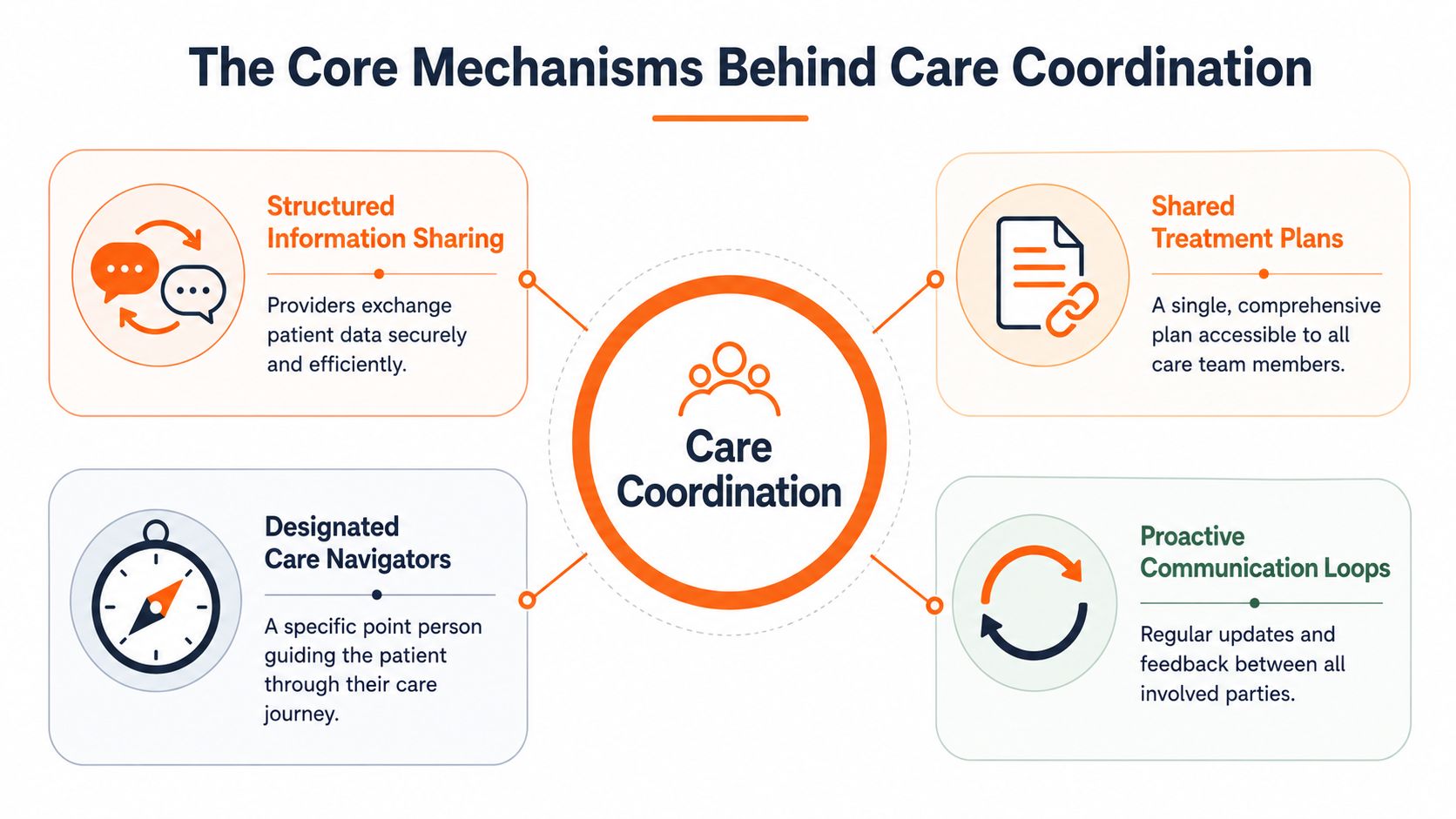
A gradual return may exclude overnight deal cycles, international travel, evening events, or a full board-meeting schedule. Workload reduction may remove hiring authority temporarily, narrow client coverage, or assign operational follow-through to a deputy. Add safeguards for high-consequence decisions, such as a second reviewer or a defined approval threshold.

Use a schedule with decision rules

The table below is a planning model, not a medical prescription. The treating clinician and employer must adapt it to the role, symptoms, safety requirements, and recovery status.
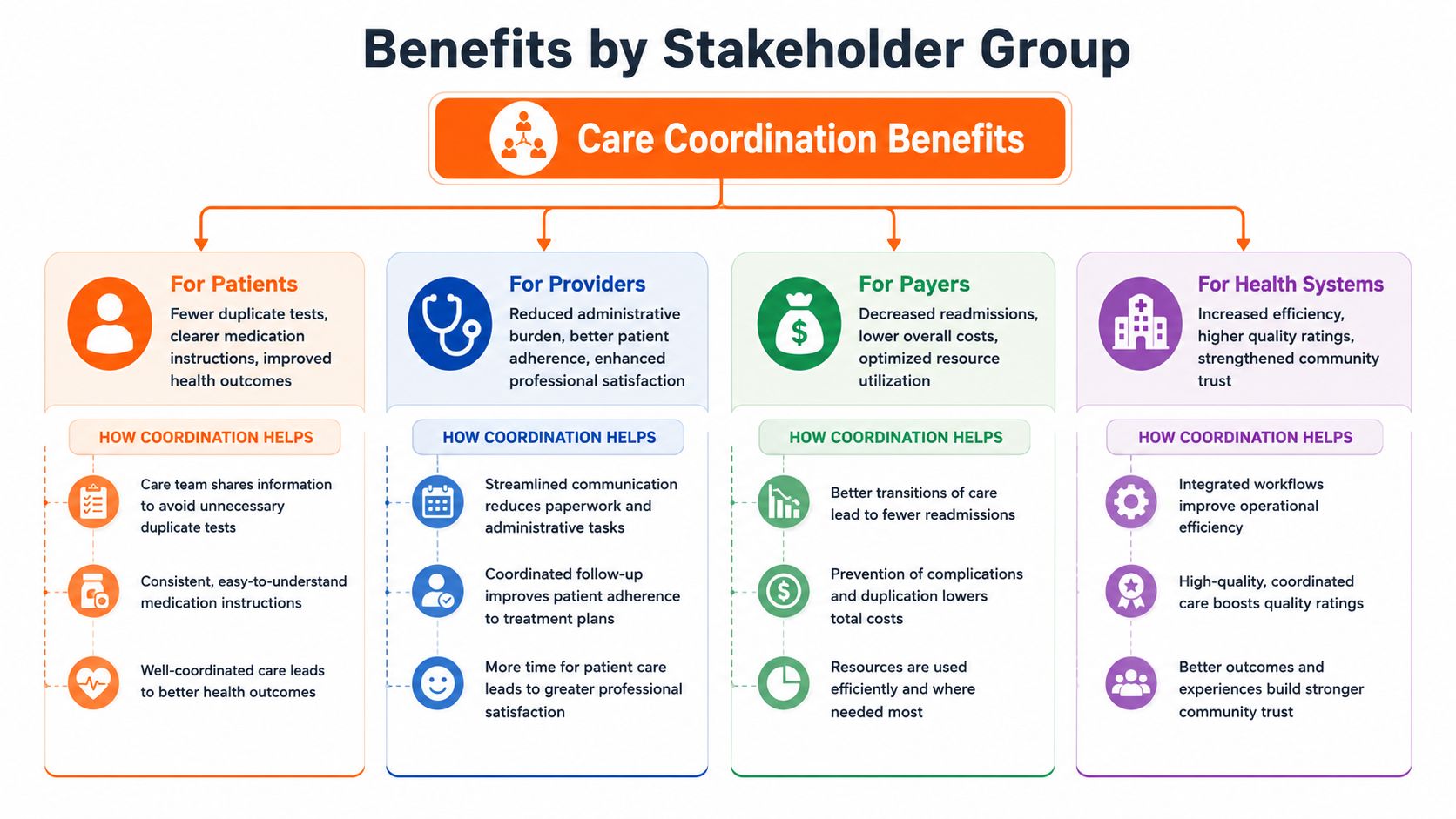
Week Workload Meetings & Travel Supervisor Check-In
Week one Core duties only, with nonessential projects paused Short internal meetings, no overnight travel, no evening events Brief check-in at the start and end of each workday
Week two Add selected responsibilities if symptoms remain stable Limited external meetings, travel only when clinically appropriate Daily check-in, with a formal review at week's end
Week three Expand decision-making and team leadership gradually Reintroduce selected high-value meetings, keep travel capped Several brief check-ins during the week
Week four Move toward steady-state duties without removing safeguards abruptly Resume broader exposure only after review of workload tolerance Weekly review and a documented next-phase decision

“Half-time” does not define a safe workload. Half a schedule filled with crisis calls, board preparation, and travel may exceed a full day of predictable work. Specify the number and type of meetings, decision authority, response expectations, travel, after-hours availability, and recovery breaks. For a board or regulator, this detail also demonstrates controlled continuity without disclosing private clinical information.
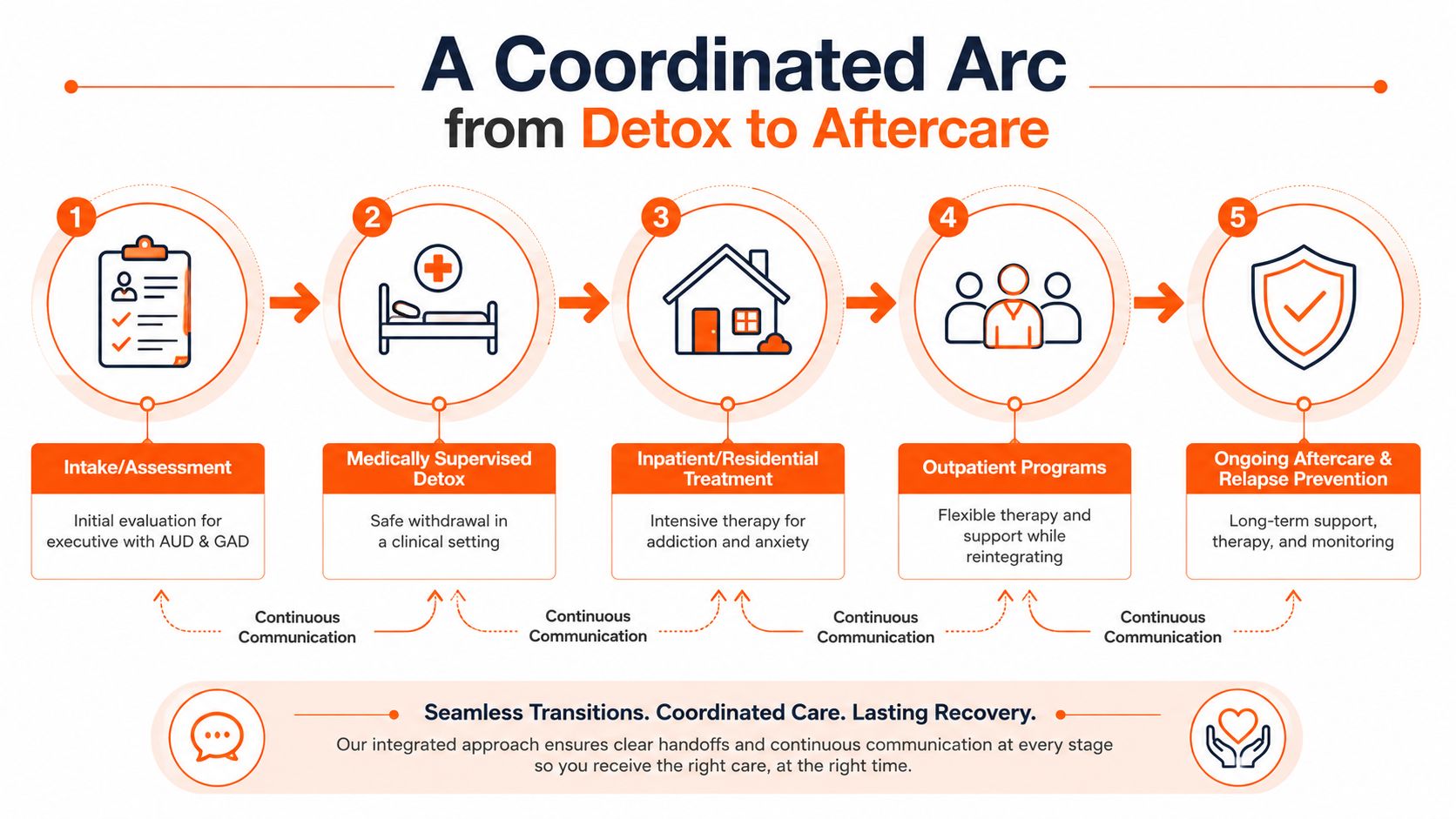
Build an exit ramp

Every phase needs a clear step-back rule. Repeated sleep disruption, escalating anxiety, missed treatment commitments, medication side effects, impaired concentration, or a return to substance-related routines should trigger review, not a test of willpower.

Name the person who receives the concern, the person authorized to reduce duties, and the time frame for a decision. Agree on neutral wording for the change so the executive can pause or narrow responsibilities without releasing a diagnosis or treatment history. Keep the recovery priority visible in every review, even when professional credibility and external expectations are pressing.


Workplace Communications and Confidentiality

Executives often over-disclose because they're trying to look accountable, or under-communicate because they're trying to preserve control. Both approaches create avoidable problems. The right standard is minimum necessary information, delivered to the right audience, in writing.

Create an information map

HR generally needs administrative facts, such as leave status, restrictions, documentation, and the accommodation process. Your direct manager needs functional guidance, including scheduling limits, meeting exposure, travel restrictions, and the review cadence. The board or partners may need continuity information, such as who holds interim authority and when they'll receive a business update.

Clients and external stakeholders usually don't need medical details. A simple statement can explain that you're resuming responsibilities through a structured transition and that your team remains available. Don't volunteer a diagnosis, treatment history, medication information, or recovery narrative to make the message seem more convincing.

Informal channels require equal discipline. Ask HR and your manager to prevent medical details from appearing in Slack threads, all-hands announcements, shared calendars, or broad email chains. Your calendar can show “medical appointment” or a neutral private block rather than a revealing label.

Use a written script

A communication script prevents pressure-driven disclosures:

“I'm returning under a structured work plan. My responsibilities will expand in stages, with [designated person] handling [specific duties] during the initial phase. Please direct questions about scheduling or work accommodations to [named contact]. Personal medical information remains confidential.”

For the board, add the governance facts they need: interim authority, decision rights, reporting lines, and the date of the next business review. Don't turn a board update into a treatment disclosure.

The Americans with Disabilities Act creates an accommodation framework, but it doesn't answer every professional licensing question. Physicians, attorneys, pilots, and other licensed professionals should obtain advice specific to their regulator and jurisdiction. A medical board, bar association, or airline medical office may apply rules that differ from ordinary workplace disclosure practices.

If treatment or privacy concerns are central to your planning, review confidential addiction treatment options as part of a broader care discussion. The point isn't secrecy at the expense of safety. It's controlled information sharing that protects both professional obligations and clinical privacy.

Reasonable Accommodations and Legal Obligations

An executive may be ready to resume leadership while still needing limits on schedule, travel, decision load, or after-hours access. A workable plan connects those limits to job functions, assigns someone to enforce them, and sets a review point. Under the ADA, covered employers may need to provide reasonable accommodations through an interactive process for qualified employees with disabilities, unless doing so creates undue hardship. The Pregnant Workers Fairness Act creates separate accommodation duties for qualifying pregnancy, childbirth, or related medical conditions. These laws establish rights, not a complete return plan.

Distinguish legal rights from recovery needs

A formal accommodation should link a documented functional limitation to a specific job adjustment. Options may include a modified schedule, additional breaks, reduced nonessential duties, written instructions, a quieter workspace, limited travel, or temporary changes to on-call expectations. Informal support can include a mentor, a deputy handling urgent escalations, protected treatment appointments, or a temporary agreement to avoid alcohol-centered business events.

The employer does not have to accept every requested arrangement. It must participate in the process and assess effective alternatives. Test any proposed substitute against the actual functional need. A different schedule may work. A vague promise to “be flexible” does not provide protected treatment time or a defined limit on after-hours demands.

Accommodation approval is not the same as accommodation delivery. Confirm who changes the calendar, who redirects work, who covers urgent decisions, and who receives reports when the plan fails.

A four-step infographic illustrating a process for identifying stressors and managing work-related mental health through a plan.

Put every accommodation in writing

Your request should state the functional limitation, requested adjustment, expected duration or review point, and person responsible for implementation. Describe recovery needs as work requirements, not preferences. “I'd like fewer meetings” is weak. “I need meetings grouped into defined blocks with recovery time between them because sustained meeting exposure currently affects concentration and symptom stability” gives the employer an actionable request.

Keep the plan separate from broad board or team communications. Share operational facts, such as interim authority, decision rights, reporting lines, and review dates. Do not disclose treatment details to establish professional credibility. Licensed professionals should obtain advice specific to their regulator and jurisdiction, because medical boards, bar associations, airline medical offices, and other regulators may impose duties that differ from ordinary workplace practice.

Track whether the schedule was honored, work stayed within scope, travel limits held, and supervisor check-ins occurred. If the arrangement fails, document the gap and request prompt review through HR. Serious disputes may require employment counsel, disability counsel, or professional licensing advice.

Integrating Relapse Prevention With Job Duties

Work is where recovery gets tested. The plan should name the situations most likely to destabilize you and establish a response before those situations appear on the calendar.

Start with a role-specific trigger review:

  • Client entertainment: Decide which events you'll attend, what you'll drink, how you'll leave, and who can cover if the setting becomes unsafe.
  • Late-night deadlines: Set a cutoff, identify the person who takes over after it, and prohibit fatigue from becoming a badge of leadership.
  • High-stakes presentations: Rehearse the content, limit same-day demands, and arrange a private decompression period afterward.
  • Travel and isolation: Schedule treatment contact, recovery support, medication access, sleep protection, and a clear return protocol.
  • On-call pressure: Define what counts as an emergency and who serves as the backup.

Aftercare appointments, therapy, peer-support meetings, and medication reviews belong on the working calendar. Use private calendar entries and communicate only the availability restriction to the employer. A treatment appointment doesn't become less important because a board meeting appears beside it.

A relapse-prevention plan also needs observable warning signs. These might include missed appointments, a return to old routines, deteriorating sleep, increasing secrecy, skipped meals, escalating irritability, or renewed access to substances. The plan should state what you'll do when a trigger fires, not merely identify the trigger.

Recovery safeguard: A warning sign is useful only when it has an assigned response and a named person who can help carry it out.

Write a simple escalation sequence. First, pause the affected duty. Next, contact the designated clinical or recovery support. Then notify the agreed workplace contact using functional language, such as “I need to reduce today's workload and activate the coverage plan.” The response should protect safety without forcing you to disclose a diagnosis to colleagues.

For additional planning ideas, review relapse prevention strategies and adapt them to the actual demands of your position. The strongest plan treats recovery commitments as part of job design, not as private intentions that work is allowed to cancel.

A diagram illustrating the coordination triangle between the executive's plan, employers, EAPs, and clinicians for support.

Coordinating the Plan With Employers, EAPs, and Clinicians

A plan fails when ownership is unclear. The executive shouldn't be responsible for translating clinical recommendations into every workplace decision while also managing recovery. Assign each deliverable to a person and put the arrangement on one page.

The employer owns role design, scheduling, coverage, accommodation implementation, and workplace check-ins. The clinical team owns medical recommendations, treatment milestones, medication monitoring, and clinical escalation guidance. An EAP or case manager can help coordinate resources and communication, but it shouldn't receive more medical information than necessary.

Build the one-page operating sheet

Include:

  • Current duties: What you'll perform now, what's deferred, and who covers deferred work.
  • Functional restrictions: The limits that affect hours, travel, concentration, urgency, or safety-sensitive tasks.
  • Communication rules: Who receives administrative information, who receives functional information, and who receives nothing.
  • Review dates: When the executive, manager, HR, and clinical team will assess progress.
  • Escalation rules: The signs that require a pause, clinical contact, schedule reduction, or urgent intervention.
  • Decision authority: Who can modify duties when the plan isn't working.

Use case management services when coordination requires a dedicated professional to keep employers, clinicians, and aftercare providers aligned. The exact participants will vary, but the boundaries should remain explicit.

An infographic detailing the coordinated return to work plan involving employers, EAPs, and clinicians for employee support.

The 2025 Safe Work Australia survey found that the proportion of workers with a return-to-work plan had remained relatively steady since 2016, supporting the view that structured planning is a durable recovery practice rather than a passing HR preference. Earlier national strategy guidance also linked early and written planning with stronger return outcomes, reporting that a plan within the first 30 days could increase the odds of returning to work by up to 1.7 times, while a written plan after 30 days could increase those odds by 3.4 times in the cited historical evidence from the National Return to Work Strategy.

Don't wait for the first difficult week to discover that nobody knows who makes the next decision. Schedule the coordination meeting, confirm the boundaries, and rehearse the escalation path before the return date.


Capo Canyon Recovery provides individualized detox, residential treatment, medication stabilization, dual diagnosis care, and aftercare coordination for executives and licensed professionals who need privacy while planning a safe return to work. Visit Capo Canyon Recovery to discuss a clinically structured treatment and reintegration plan with the admissions team.

READ MORE
Uncategorized
August 14by 0 Comments

Benzodiazepine Addiction Treatment: A Complete Guide

You've probably had the same thought more than once. The prescription that once made life workable is now taking more planning, more caution, and more energy than you want to admit. You may be sleeping poorly, feeling anxious between doses, or wondering whether the line between medical use and dependence has already been crossed.

That moment is where benzodiazepine addiction treatment starts for many, not with a dramatic crisis, but with a growing realization that stopping on your own might not be safe. The modern clinical answer is rarely “detox and done.” It's usually stabilization, gradual tapering, therapy, and ongoing follow-up, because the problem is often both physical and psychological, and the recovery plan has to fit both.

An infographic outlining the five stages of a comprehensive and patient-centered benzodiazepine addiction treatment recovery process.

For a quick self-check on whether your use pattern may need medical review, this benzodiazepine addiction screening guide can help you frame the right questions before you call anyone.

Understanding Benzodiazepine Addiction Treatment

The hardest part for many people is accepting that a medication can be both legitimate and problematic at the same time. Benzodiazepines are often prescribed for anxiety, insomnia, muscle spasm, or seizure-related conditions, but a person can still develop physical dependence after steady use, and that dependence can exist even without the chaotic pattern people usually associate with addiction.

That distinction matters. Dependence means the body has adapted to the drug and may react if it's reduced too fast. A use disorder adds loss of control, compulsive use, or continued use despite harm. Someone may start with a clean prescription history and still end up needing structured care.

What treatment actually includes

A safe plan usually has more than one layer. First comes assessment, where a clinician looks at dose, duration, other medications, mental health, and past withdrawal problems. Then comes medical stabilization, because people often need to feel steady before they can taper.

Practical rule: if the first question is “How fast can I stop?”, the safer question is usually “How do I stop without destabilizing my sleep, mood, work, or safety?”

That's why the modern model is stabilization plus taper plus therapy. If your days are still full of meetings, childcare, travel, or public-facing work, the goal isn't to yank the medication away. It's to build a plan that protects you while your nervous system relearns how to function without relying on the drug.

The process often takes longer than people expect, but it's also more humane. You're not being asked to prove toughness. You're being asked to reduce risk while creating a path that can hold in real life, not just in theory.

How Common Benzodiazepine Problems Really Are

The scale of benzodiazepine use in the United States is large enough that this can't be treated as a fringe issue. In 2015 to 2016, about 30.5 million adults used benzodiazepines in the prior year, 5.2 million misused them at least once, and an estimated 0.5 million met criteria for a benzodiazepine use disorder, including about 0.3 million with dependence and 0.2 million with abuse, according to the national analysis summarized in this review of the data. Another analysis from the same survey period reported 30.6 million adults (12.6%) used benzodiazepines, 25.3 million (10.4%) used them as prescribed, and 5.3 million (2.2%) misused them, with misuse making up 17.2% of all benzodiazepine use (national survey analysis).

Those numbers matter clinically because treatment can't be designed only for illicit use. A large share of people needing help are taking medication they were originally given by a prescriber, which means treatment has to address prescribed users, diverted use, and mixed patterns with equal seriousness.

An infographic showing statistics on benzodiazepine prescriptions, rates of dependency, and access to specialized addiction treatment.

Why the treatment setting keeps expanding

The clinical picture became even clearer as admissions rose over time. SAMHSA reported that annual admissions for benzodiazepine and narcotic pain reliever combination cases increased 569.7% from 5,032 in 2000 to 33,701 in 2010, and 45.7% of those admissions involved a co-occurring psychiatric disorder (SAMHSA admissions data).

That shift tells you something important. Benzodiazepine treatment now sits at the intersection of detox, psychiatry, and primary care. It's not a single-substance problem in many patients, and it's not solved by a short stay and a discharge packet.

People often arrive thinking they need a stronger willpower plan. In reality, they usually need a more accurate clinical plan.

Why Abrupt Cessation Is Dangerous

Cold turkey sounds decisive, but benzodiazepines don't usually reward decisiveness. Once the body has adapted, abrupt stopping can trigger a withdrawal syndrome that ranges from rebound anxiety and insomnia to perceptual disturbances and seizures. The risk isn't theoretical, which is why the clinical guidance emphasizes gradual tapering under supervision rather than sudden discontinuation (ASAM tapering guidance).

Physical dependence can develop after more than a month of use, especially when dosing has been regular. That doesn't mean everyone who has used a benzodiazepine for a while is addicted in the behavioral sense, but it does mean the nervous system may react badly if the drug disappears too fast.

A diagram illustrating the dangers of abrupt medication cessation, showing stages from initial discontinuation to withdrawal syndrome.

How tapering is usually done

The common technical approach is to convert shorter-acting agents to a longer-acting benzodiazepine such as diazepam, then taper over weeks to months. That creates a smoother drop in blood levels, which usually makes symptoms more manageable and allows the clinician to adjust the pace if withdrawal shows up.

If you want a practical sense of how this is planned, this guide to what a benzo taper looks like is useful because it translates the concept into a stepwise process.

The people who need a higher level of care are usually not hard to identify. They're the ones with long duration use, high doses, co-occurring psychiatric illness, or a history of withdrawal complications. Those factors don't automatically mean inpatient treatment, but they do push the conversation toward a setting with more monitoring.

Levels of Care From Detox to Outpatient

The right setting depends less on shame and more on risk. A person with a stable job, low-dose use, good support, and no complicated medical history may be able to taper as an outpatient. Someone with prior withdrawal problems, high-dose dependence, or unstable mental health usually needs a setting with closer supervision.

Matching level of care to patient risk

Level of Care Best Suited For Key Supports
Medically managed detox People at higher risk of withdrawal complications 24-hour nursing, symptom monitoring, medication adjustment
Residential inpatient Long-term dependence, co-occurring psychiatric illness, or need for structure Daily schedule, psychiatric oversight, therapy, supervised taper
Partial hospitalization People who need intensive support but can sleep elsewhere Daytime clinical programming, medication monitoring, therapy
Intensive outpatient Lower-risk patients who still need frequent support Several sessions weekly, relapse-prevention work, taper follow-up
Standard outpatient Stable patients with mild dependence and good external support Periodic visits, medication review, therapy referrals

If you're comparing settings, the question is not “Which one is strongest?” It's “Which one matches my risk profile without over- or under-treating me?”

What each setting actually provides

Detox is about medical safety and stabilization, not complete recovery by itself. Residential care adds structure, nursing, psychiatric oversight, and separation from triggers. Outpatient programs preserve work and family routines, but they work best when the patient is stable enough to handle the taper without constant hands-on monitoring.

For some people, the decision is shaped by life logistics as much as medicine. An executive who can't disappear for a month needs a different design than someone who can fully step away, and that's a legitimate treatment issue rather than a convenience issue.

The levels of care in rehab matter here because benzodiazepine treatment isn't one-size-fits-all. The best plan is the one that keeps you medically safe and reachable in your real life.

Medications and Psychotherapy That Work

Medication alone rarely solves benzodiazepine addiction, and therapy alone usually is not enough when withdrawal risk is active. The strongest evidence-based pattern is careful tapering paired with psychological treatment, especially when anxiety, insomnia, or panic was part of the original reason the drug was started.

What the evidence supports

A review in the clinical literature found that CBT plus taper can reduce benzodiazepine use in the short term, but the effect is not sustained at six months, which is why durable recovery usually needs more than one short intervention (clinical review on treatment approaches). That does not make CBT less valuable. It means CBT is most useful when it is part of a longer relapse-prevention plan, with medication changes paced carefully enough for the nervous system to adjust.

For high-dose, long-term dependence, one specialized approach is slow subcutaneous flumazenil infusion, or FLU-SSI. A reported case series discussed this method in people treated between 2012 and 2014, and the authors described a pharmacologic “resetting” of GABA-A receptor tolerance. They also said more study is needed on dose, duration, and safety before it can be considered routine therapy.

Therapy names matter less than the job each one does

  • CBT helps patients identify the thought loops that trigger use and replace them with more durable coping strategies.
  • DBT is useful when emotional regulation, impulsivity, or crisis-driven use keeps showing up.
  • ACT helps people tolerate distress without immediately reaching for symptom suppression.
  • EMDR may help when trauma keeps driving anxiety or hyperarousal.
  • Brainspotting is often used when emotional material feels hard to process in more traditional talk therapy.

The practical question is which therapy matches the problem in front of you. If the pattern is panic plus avoidance, CBT often fits. If the pattern is emotional whiplash, DBT may fit better. If trauma is driving the medication use, trauma-focused work belongs in the plan rather than being postponed until after tapering is finished.

Capo Canyon Recovery is one option that combines medically supervised detox, residential care, and evidence-based therapies in a private setting, with tech-friendly policies for clients who need to stay connected to work. That kind of structure can be useful when treatment has to fit a demanding schedule rather than replace it completely.

Dual Diagnosis and the Underlying Drivers of Use

A patient may look as if the benzodiazepine is the whole problem, but it is often the fastest tool they found for managing something else that was never fully treated. Anxiety, insomnia, chronic pain, trauma, depression, and other substance use disorders can all shape the treatment plan because the medication may have become the quickest way to blunt distress.

When those drivers stay active, the pattern tends to repeat. The person stops, feels worse, restarts, and then assumes they have failed. In practice, the larger problem is usually that the underlying condition never had a complete treatment plan.

Why integrated care works better

A PubMed-reviewed clinical summary stresses that co-occurring conditions such as chronic pain, anxiety, and insomnia should be addressed directly in treatment planning (clinical summary on co-occurring conditions). That matters because recovery is not just about removing the benzodiazepine. It also means giving the person another way to function when stress, pain, or sleeplessness returns.

A recent editorial also notes that affective symptoms such as anhedonia may predict greater benzodiazepine demand in people treated for opioid use disorder. In practical terms, emotional flatness and a reduced sense of reward can drive medication-seeking just as powerfully as anxiety does.

If a benzodiazepine first became useful because insomnia, panic, trauma, or pain were untreated, recovery has to include care for that driver. Otherwise the empty space left by the medication is usually filled quickly.

The strongest programs treat the diagnosis and the driver together. That may mean psychiatry, therapy, sleep treatment, pain planning, and substance use care in the same plan rather than in separate silos. For executives and other professionals who cannot disconnect from work, that often means building treatment around predictable meetings, protected sleep windows, and a medication plan that is stable enough to fit real-world demands without turning work stress into a trigger.

Relapse Prevention and Aftercare That Lasts

The weeks after structured treatment are where many people get overconfident or under-supported. They leave the controlled environment, the stress comes back, and the brain starts offering the old shortcut again. That's why aftercare has to be built before discharge, not improvised afterward.

What a durable aftercare plan includes

A good plan usually has ongoing psychiatric follow-up, medication monitoring, and continued therapy. It also needs practical routines around sleep, stress, travel, and family expectations, because the risk of relapse often rises when life gets busy rather than when life gets dramatic.

For a high-functioning adult returning to demanding work, relapse prevention can look very ordinary. It might include a morning check-in with a clinician, standing therapy appointments, a firm cutoff for evening work, and a written plan for what to do if insomnia or panic ramps up again.

The real timeline of recovery

Benzodiazepine recovery is often measured in months and years, not days. That's not a sign of failure. It's the reality of rewiring a nervous system that has learned to expect rapid chemical relief.

A practical aftercare structure often contains:

  • Medication reviews to make sure the taper stays safe and doesn't drift.
  • Sober support networks so the person isn't carrying the entire load alone.
  • Sleep routines that reduce the likelihood of late-night rescue dosing.
  • Stress-management habits such as exercise, breathwork, or scheduled decompression.
  • Therapy for triggers so anxiety, trauma, or work pressure doesn't hijack the plan.

The goal is not to create a perfect life before discharge. The goal is to build enough support that normal life doesn't become a relapse trigger.

Executive and Professional Treatment Considerations

Executives, physicians, attorneys, founders, pilots, and other licensed professionals often face a different problem from the one most rehab brochures assume. They may need care without losing privacy, without abandoning critical responsibilities, and without a visible break that ripples through a business or practice.

That's why traditional models that ban phones and laptops can become a real barrier. For some people, the issue isn't resistance to treatment. It's that they can't disappear, and the treatment setting has to reflect that reality.

What to look for in a professional-focused program

A workable executive program usually offers privacy, small census, private rooms, 24/7 nursing, and psychiatric oversight. Tech-friendly policies matter too, because some patients need to keep up with urgent messages, legal matters, clinical schedules, or operational decisions while they're stabilizing.

The better question isn't whether a program feels luxurious. It's whether it protects safety, confidentiality, and work continuity at the same time. That includes clear boundaries around laptop and phone use, a calm environment that reduces overstimulation, and staff who understand that a patient can be both medically vulnerable and operationally responsible.

For a reader comparing options, here's the practical checklist:

  • Confidentiality controls that limit exposure and protect reputation.
  • Workspace-friendly accommodations so essential work doesn't stall.
  • Integrated dual-diagnosis care for anxiety, depression, trauma, ADHD, or bipolar disorder when present.
  • Individual therapy access that's frequent enough to move the plan forward.
  • Aftercare coordination so discharge doesn't feel like free-fall.

Capo Canyon Recovery operates as a licensed detox and residential program in Mission Viejo, with 24/7 nursing, psychiatric support, private rooms, and a tech-friendly policy designed for professionals who can't fully disconnect. It's built for people who need treatment to be clinically serious and operationally realistic at the same time.

Screenshot from https://capocanyon.com


If you're trying to figure out whether your use needs supervised tapering, dual-diagnosis care, or a private residential setting, talk with a team that can assess all three. Capo Canyon Recovery offers detox and residential care with medical oversight, privacy, and support for professionals who still need to keep critical parts of life moving while they heal.

READ MORE
Uncategorized
August 13by 0 Comments

How to Manage Depression Without Drugs: A Practical Guide

You can still look composed on the outside and be running on fumes on the inside. You're answering emails, showing up to meetings, maybe even hitting deadlines, but everything takes more effort than it should, sleep doesn't restore you, and your mind keeps circling the same flat, exhausted thoughts. That's not a weakness problem. It's a treatment problem, and if you want to manage depression without drugs, you need a real plan, not a pile of wellness slogans.

The right way to approach this is to treat non-drug depression care like a clinical pathway, not a motivational project. Structured psychotherapy, behavioral targets, sleep regularity, movement, and measurement all matter because depression is maintained by habits, avoidance, and physiology as much as mood. The evidence base is strong enough to justify that approach, especially for mild-to-moderate depression, where CBT has produced response rates very close to second-generation antidepressants in review literature, 45.5% vs 44.2% (BMJ Open review). A widely cited trial also reported 43% for CBT versus 50% for antidepressants at 8 weeks, with no statistically significant difference between the two (BMJ Open review).

If you want this to work, stop thinking in terms of “Should I try therapy or walk more?” and start thinking in terms of a sequence. Start with the therapy fit, add a daily structure that supports it, track whether you're improving, and know exactly when self-management is no longer enough. The point is not to prove you can white-knuckle through depression. The point is to build a path that works while your life keeps moving.

For a plain-language overview of what mental health includes, this primer is a useful anchor: What Is Mental Health?

Why Non-Drug Depression Care Deserves a Real Plan

A high-functioning person with depression often looks fine to everyone else. You are still performing, but you are doing it with dulled pleasure, slower thinking, irritability, and an energy bill that never stops climbing. That is exactly why casual advice fails. You do not need more reminders to exercise or think positive. You need a plan that respects your schedule, your privacy, and the fact that depression responds best to a structured approach rather than wishful thinking.

A strong case for a practical plan is that structured psychotherapy can work about as well as antidepressants for many people with mild-to-moderate depression. The literature is not saying medication is useless. It is saying psychotherapy is a real treatment option, not a backup for people who cannot handle care. CBT, in particular, has a serious evidence base because it targets the thought loops and avoidance patterns that keep depression in place. That matters if you want to keep working, stay private, and make decisions based on data rather than panic.

What a real non-drug plan includes

A useful plan has four moving parts. Therapy gives you a clinical container. Behavioral activation gets you moving before motivation returns. Daily structure stabilizes sleep, appetite, and stress. Measurement tells you whether the plan is working or just sounding good.

Practical rule: if your plan does not tell you what to do this week, what to measure, and when to escalate, it is not treatment. It is advice.

That also explains why broad self-help language can be misleading. The more functional you are, the easier it is to overestimate how long you can coast before symptoms force the issue. Good non-drug care is deliberate, repeated, and adjusted based on response. For a plain-language overview of what mental health includes, this primer is a useful anchor: What Is Mental Health?

Evidence-Based Therapies That Work Without Medication

The first move is to match the therapy to the problem pattern, not to the label. If depression is being driven by negative self-talk and rigid assumptions, CBT is usually the cleanest fit. If emotional flooding and impulsive reactions are taking over, DBT skills are more useful. If you keep waiting to act until you feel better, ACT pushes committed behavior in the presence of discomfort. If trauma sits at the center, EMDR deserves consideration. If you are withdrawn and inert, behavioral activation is the blunt tool that often matters most. If grief, conflict, or role transitions are driving the depression, IPT is usually the sharper option.

An infographic showing three evidence-based therapy types for managing depression: CBT, MBSR, and IPT.

CBT deserves special attention because its evidence base is unusually strong. It is a structured treatment that targets the thought loops and avoidance patterns that keep depression in place. For a working professional, that makes it a practical starting point. It is skills-based, time-limited, and easy to measure. You can track whether the work is changing your thinking, your avoidance, and your follow-through. For a straightforward clinical overview of how CBT is framed, this page is a useful reference: Cognitive Behavioral Therapy

Therapy approaches compared

Therapy Primary Target Typical Format Best-Fit Presentation
CBT Negative thought loops, hopeless assumptions Weekly structured sessions Rumination, self-criticism, perfectionism
DBT Emotion regulation, distress tolerance Weekly skills and therapy work Mood swings, impulsive coping, overwhelm
ACT Avoidance, values drift Weekly sessions with action focus Stuckness, fear-based inaction
EMDR Trauma-linked distress Therapist-led trauma processing Depression tied to traumatic memory
Behavioral Activation Withdrawal, inertia, low reinforcement Weekly planning and review Flatness, isolation, low drive
IPT Grief, role transitions, conflict Weekly interpersonal work Relationship strain, loss, life changes

Choosing therapy by brand name instead of by mechanism is a common mistake. If avoidance is the main problem, even a very insightful therapist has to guide you into action. If relationship conflict is driving the depression, insight alone will not fix it. Weekly contact matters because depression improves through repetition, not through isolated moments of inspiration.

Behavioral Activation Done Right

Behavioral activation is often underdone, perhaps because it feels too simple to matter. It matters precisely because depression shrinks behavior first. You stop exercising, stop answering messages, stop opening the email that makes you tense, and then your day gets smaller. Mood follows that shrinkage.

A professional example is easy to recognize. The calendar is full, but the person has stopped working out, postponed personal calls, and let unread messages stack up. The fix is not a giant life overhaul. It's one target avoidance pattern, one small mastery activity per day, and one weekly review of whether the activity happened. That's it.

A simple weekly protocol

Pick the behavior that best represents the depression loop. If isolation is the issue, schedule one call. If inertia is the issue, schedule a walk. If dread is the issue, schedule the task you've been avoiding in a smaller form. The target has to be specific enough that you can mark it complete or incomplete.

Keep the score on completion, not mood. Mood lags behind action more often than people expect.

The weekly rhythm should be boring on purpose. Put the activity on the calendar at the same time each day if possible, then review it after two weeks. If completion is low, the target was too big, too vague, or too dependent on motivation. Shrink it. If completion is steady and mood still isn't moving, that's a sign to add more structure or step up the clinical support.

For a clean framework on behavior change and recovery stages, this is a useful companion: The Stages of Behavioral Change in Recovery

The point of behavioral activation is not to “stay busy.” It's to rebuild reinforcement. Depression teaches your brain that action isn't worth the effort. Scheduled action disproves that, one repeatable win at a time.

Daily Structure That Stabilizes Mood

Sleep irregularity, sedentary days, erratic eating, and unmanaged stress all push depression in the wrong direction. People tend to treat them as four separate problems, then fail at all four. They work better as one coordinated routine. If you want your non-drug plan to hold, your day needs a spine.

The National Institute of Mental Health advises that 30 minutes a day of walking can boost mood, alongside regular sleep, healthy meals, and social connection (NIMH). That advice is basic for a reason. It's the foundation. More rigorous research supports the same direction, with home-based psychological intervention reducing post-treatment symptoms and combined psychological intervention plus exercise showing even larger effects, plus higher remission rates in the combined approach. You don't need to memorize the math to use the lesson. You need a day that doesn't constantly destabilize you.

An infographic titled Stabilize Your Mood showing four daily habits: sleep, physical activity, nutrition, and stress management.

The Daily Structure That Holds

Start with a fixed wake time and a wind-down routine. That gives your nervous system a predictable start and end to the day. Keep the same sleep window as often as you can, because irregular mornings and late nights make everything else harder to maintain. Add movement at roughly the same time each day, even if it's just a walk, because consistency matters more than intensity early on.

Keep meals regular and simple. The NIMH guidance supports healthy meals, and nutrition research in the verified data points to a real risk signal around sugar intake, where men consuming 67 grams or more of sugar per day were 23% more likely to be diagnosed with depression than men eating 40 grams or less. I would not turn that into a dramatic food rulebook. I would use it as a reason to stop living on sugar spikes and crashes if mood is already fragile.

Build one short midday stress reset. That could be a breathing break, a quiet walk, or five minutes away from screens. The point is to interrupt rumination before it takes over the afternoon.

A stable routine won't cure depression by itself, but an unstable routine will keep sabotaging every other intervention.

Measuring Progress Without Obsessing

Depression tricks people into thinking nothing is changing because they're judging by feeling alone. That's a bad metric. If you're doing the work, you need a simple system that shows whether the work is adding up. The goal is not to become a spreadsheet person. The goal is to stop guessing.

Use three signals each week. First, track one short mood or symptom rating. Second, count how many behavioral activation tasks you completed. Third, write down one note about what triggered a low day. That gives you a clinical view without drowning in detail. It also keeps you from overvaluing one bad afternoon or one unusually good morning.

How to read the pattern

If mood is flat but task completion is rising, the plan may be early but working. If mood and completion are both sliding, the structure is too weak or the depression is deeper than you first thought. If low days keep getting triggered by the same thing, you've found a maintenance problem, not just a symptom.

A four-step infographic illustrating a weekly system for tracking depression progress through mood, symptoms, and reflection.

A good review cycle is weekly, with a broader read at the 4 to 8 week mark. Improvement often shows up first as better follow-through, less avoidance, or more stable mornings before it feels like happiness. That's why measurement matters. It catches progress before your mood language does.

Useful standard: if your data is unchanged for several weeks, the current plan isn't strong enough. Don't keep repeating a weak intervention and call it resilience.

When Self-Management Isn't Enough and What Comes Next

Handling depression alone is not always safer. It can be slower, more isolating, and more expensive in lost function than getting structured help early. If symptoms last more than a couple of weeks, if alcohol or other substances are creeping up, if suicidal thoughts appear, or if work performance starts slipping in ways you can't correct, stop trying to self-manage this as a solo project. Major guidance also says to seek help when symptoms persist or there's any self-harm risk (Mayo Clinic).

A real clinical step-up matters significantly. The right program doesn't just say “try harder.” It evaluates whether depression is tangled up with anxiety, trauma, insomnia, or substance use, then matches treatment intensity to the problem. That may mean psychotherapy with closer monitoring, dual-diagnosis care, or a more structured residential setting if privacy, work continuity, and symptom severity all need to be managed at once.

For executives and professionals, confidentiality is often the deciding factor. A treatment setting needs to support privacy, clinical oversight, and enough structure that you're not constantly negotiating your care around your calendar. Capo Canyon Recovery is one option that offers residential treatment with dual diagnosis care, individual therapy, and a tech-friendly environment for clients who need to keep essential work responsibilities moving while they get support.

What to look for in the next level of care

Choose a team that can assess co-occurring problems, not just mood. Look for therapists and clinicians who work in a measured way, with a defined treatment plan and regular reassessment. If the setting feels vague, unstructured, or overly generic, it's the wrong fit for a depression plan that needs precision.

A good rule is simple. If you've been trying the basics and you're still getting worse, don't confuse independence with progress. Get a structured evaluation and let the care level match the reality of the symptoms.

Bringing It All Together This Week

The non-drug path that works is built on three habits, not ten. Choose a therapy that matches the problem, schedule one daily behavioral action, and stabilize your sleep, movement, and meals so the rest of the plan has something solid underneath it. Then track one weekly mood signal, one completion count, and one trigger note so you can see whether you're improving or just hoping.

The one routine that holds it all together is a repeatable week. Same wake time, same movement slot, same therapy cadence, same review day. That's what turns depression care from a mood experiment into a treatment process.

The signal to escalate is also simple. If symptoms keep going past a couple of weeks, if substances are rising, if suicidal thoughts show up, or if work and daily life are starting to slide, stop self-managing and bring in a clinician. Depression gets harder to treat when people wait too long to ask for structured help.


Capo Canyon Recovery provides residential, clinician-led support for adults who need privacy, dual diagnosis care, and a stable daily structure while they address depression and related problems. If you need a confidential step-up that keeps essential work responsibilities in view, visit Capo Canyon Recovery and ask about a treatment plan that fits your situation.

READ MORE
Uncategorized
August 12by 0 Comments

Care Coordination Benefits That Actually Move Outcomes

You're probably reading this with one real situation in mind, not an abstract quality framework. Maybe you're a family member trying to understand why every provider seems to have a different story, or you're a clinician trying to keep a patient safe across detox, residential care, and aftercare without losing the thread. The care coordination benefits that matter most show up in moments like those, when one missing medication list, one delayed handoff, or one unclear follow-up plan can change the whole course of care.

In addiction treatment, the stakes get even higher when privacy matters, work can't fully stop, and mental health symptoms are part of the picture. A coordinated program doesn't just “communicate better.” It creates a visible path so the nurse, psychiatrist, therapist, case manager, family, and outside providers aren't improvising in the dark.

What Care Coordination Actually Looks Like at 3 AM

An executive arrives for medically supervised detox at 3 AM with a phone still buzzing, a co-occurring anxiety diagnosis already documented somewhere else, and a family member waiting for an update that won't violate privacy. In a fragmented setup, the overnight nurse might not have the medication list, the psychiatrist might not see prior records until later, and the employer may get called without a clear communication plan. That's how confusion grows, and confusion is expensive in both clinical and human terms.

In a coordinated setup, the first hour looks different. The nurse already has the intake record and medication history, the admitting clinician knows what matters for withdrawal safety, and the case manager has a plan for who can be contacted, when, and about what. The morning psychiatrist isn't starting from scratch, which matters when the person in bed also has anxiety, insomnia, or another mental health issue that can complicate withdrawal.

The difference is not softer care, it's fewer blind spots

The bedside value of coordination is practical. Someone has already decided who owns the medication reconciliation, who reviews outside records, and who follows up after the level of care changes. That reduces avoidable duplication and lowers the chance that one clinician makes a decision based on incomplete information.

CMS describes coordination as organizing care across multiple participants so the right clinical data reaches the right clinician at the right time, with the aim of avoiding unnecessary duplication, preventing medical errors, and delivering safe, appropriate, effective care through care coordination guidance from CMS. That's not a slogan. It's the difference between a patient being treated as a whole person and being treated as a stack of disconnected episodes.

Practical rule: if nobody can answer who is responsible for the next step, the program is not coordinated yet.

The Core Mechanisms Behind Coordination

The phrase care coordination gets used loosely, but the working parts are concrete. The program has to move information, assign ownership, and keep the plan alive as the patient moves from one setting to another. If any one of those pieces is missing, the rest starts to wobble.

A diagram illustrating the four core mechanisms behind care coordination including information sharing, treatment plans, navigators, and communication.

Information, plans, and accountability have to travel together

Structured information sharing means the medication list, prior diagnoses, safety concerns, and outside records follow the patient instead of living in separate silos. Shared treatment plans mean every clinician is writing into one agreed roadmap, not maintaining parallel versions of the truth. Designated navigators give the patient one person who knows what happens next, which matters when people are tired, embarrassed, or overwhelmed.

Proactive communication loops are the final piece. Those are the scheduled touchpoints where the team checks whether the plan still fits, whether a transfer happened cleanly, and whether follow-up has been booked. Without them, handoffs become assumptions.

What each mechanism prevents

A good coordination process can help avoid duplicate labs, repeated history-taking, and medication conflicts that are often the result of missing context rather than bad care. It also creates faster escalation when something changes, especially during detox, psychiatric stabilization, or discharge planning. For addiction treatment, where anxiety, depression, trauma, and substance use can all interact, that kind of organized review is not administrative decoration, it's clinical safety infrastructure.

A useful way to think about it is simple. Information sharing lowers the chance of error, shared plans lower the chance of contradiction, named accountability lowers the chance of abandonment, and communication loops lower the chance that follow-up drifts away. Coordination works when those four things happen on purpose.

Benefits by Stakeholder Group

A coordination system changes different parts of care in different ways, and the bedside impact is easiest to see during a chaotic discharge or a handoff between settings. Patients experience fewer repeated questions and fewer conflicting instructions. Providers spend less time piecing together records and more time making decisions. Families get a clearer answer to a simple question, who is responsible for what next.

An infographic titled Care Coordination Benefits showing how coordination improves outcomes for patients, providers, payers, and health systems.

For patients and families

Patients benefit when the plan is clear enough to follow after a stressful admission, transfer, or discharge. Families benefit when one person can explain what is happening, what they should do, what they should not do, and which warning signs should prompt a call. In addiction care, that clarity matters even more because shame, fatigue, and information overload make it easy to miss instructions.

Privacy and dual diagnosis add another layer. In residential and executive addiction treatment, the patient may be protecting work, family, or public reputation at the same time they are trying to stay engaged in care. Coordination helps by reducing the number of times the same story has to be retold, by keeping psychiatric, medical, and substance use information aligned, and by giving the family a single contact point instead of a maze of departments. That is where coordination changes the experience from confusion to a workable plan.

For people with multiple conditions, the payoff is not just emotional. A large U.S. study found that better patient-reported care coordination was associated with better clinical performance on 9 of 13 HEDIS measures, including cancer screening and diabetes-care measures, with gaps of 5 or more percentage points on 7 measures between the highest and lowest coordination groups (study). That is a concrete sign that coordination can improve guideline-concordant care, not only satisfaction.

For providers, payers, and health systems

Providers gain a fuller picture at the point of care, which reduces the scramble to reconstruct what happened somewhere else. That matters most during transitions, when medication lists, psychiatric notes, outside records, and discharge instructions can easily drift apart. In a coordinated program, the clinician is working from one shared plan instead of trying to reconcile several incomplete versions of the truth.

Payers and health systems look at coordination differently, but the basic logic is the same. Better coordination can reduce avoidable utilization, limit duplicate work, and support stronger performance against quality benchmarks. CMS describes care coordination as a way to organize patient care activities and share information so the patient's needs and preferences are known and communicated at the right time (CMS care coordination). For health systems, that definition matters because it connects the clinical workflow to the administrative and financial side of care.

In addiction treatment, the same pattern shows up in a more demanding setting. Residential programs, executive treatment, and step-down care all depend on timing, confidentiality, and clean communication between therapists, prescribers, discharge planners, and outside clinicians. Coordination helps the program avoid duplicate assessments, reduces the chance that medication changes are missed, and makes follow-up more likely to happen after discharge. That is why families often experience coordination as relief, and why systems experience it as fewer preventable failures.

A family usually does not ask for “coordination.” They ask, “Who do I call, and what happens next?” Good programs answer that question before discharge.

Measurable Outcomes and What Good Looks Like

A handoff is only as good as what happens after it. If a program says it coordinates care, but no one can show whether patients receive follow-up, avoid duplicate work, or leave with a shared plan, the process is still too loose to trust. Good coordination leaves fingerprints in the chart, the calendar, and the next site of care.

Metric Evidence-Backed Signal Strongest Population
HEDIS quality measures Better coordination was associated with better performance on 9 of 13 measures, with 5 or more percentage point gaps on 7 measures (study) Health plan and chronic-care populations
Savings per beneficiary-episode $4,295 in savings over the inpatient stay plus 90 days after hospitalization in a Medicaid analysis (JAMA Network Open) Medicaid acute care populations
Savings per quarter $1,643 in savings per beneficiary per quarter versus control hospitals Medicaid acute care populations
Monthly expenditures Some Medicare demonstration programs showed 9% to 14% lower monthly expenditures, but total savings were mixed Medicare demonstration programs

The table is not a scorecard for every setting. It is a way to show that coordination becomes visible when you measure what changes after discharge. In detox, residential treatment, and step-down care, the same logic applies even if the metric changes. Track whether follow-up happens, whether discharge instructions reach the next clinician without delay, and whether the patient is not forced to repeat the same story at every handoff.

For residential and executive addiction treatment, the population matters as much as the metric. A dual-diagnosis executive may need privacy controls, psychiatric follow-up, and a plan that fits work continuity, so a good outcome can look like a cleaner transition rather than a dramatic intervention. A family may care less about the language of coordination than about whether the aftercare appointment is scheduled and the right people know what to expect. For that reason, programs should pair outcome data with practical checkpoints, especially around cleaner transitions into continuing care.

The cost side still matters, but it should be read carefully. In a Medicaid analysis published in JAMA Network Open, an acute care intervention tied to better coordination was associated with $4,295 in savings per beneficiary-episode and $1,643 in savings per beneficiary per quarter, along with lower emergency department use, fewer follow-up visits, and fewer hospitalizations and readmissions. Earlier Medicare demonstration evidence showed lower monthly expenditures in some programs, while total savings remained mixed, which is a reminder that results depend on how the program is built, who it serves, and how tightly the handoffs are managed.

The practical question stays simple. Are there fewer gaps, faster follow-up, and better continuity, or just a better story about teamwork?

A Coordinated Arc From Detox to Aftercare

A dual-diagnosis executive often needs a path that respects both the medical risk and the professional reality. Detox is not separate from the rest of treatment, it's the first place where coordination either holds or falls apart. If the team treats each level of care as isolated, the patient spends the whole episode translating information instead of healing.

A five-step flowchart illustrating a coordinated care arc from initial detox to long-term addiction recovery aftercare.

From intake to residential care

At intake, the team should identify the substance use pattern, the mental health picture, the work obligations, and any confidentiality concerns that shape communication. During detox, the clinical priorities are safety, withdrawal monitoring, and medication stabilization under 24/7 oversight. In residential treatment, the plan should expand into therapy, family involvement when appropriate, and ongoing psychiatric review so symptoms don't get treated as separate problems.

A coordinated program uses that handoff to keep the story intact. The intake summary should be available to the detox nurse, the psychiatrist, and the residential therapist, so no one starts over with a blank chart. That matters in dual diagnosis care because an anxiety spike, a sleep problem, or a medication change can affect the whole plan.

From discharge to aftercare

The transition out of residential care is where many programs lose momentum. A good handoff includes outpatient linkage, clear relapse-prevention planning, and a communication protocol that protects work responsibilities without exposing private clinical details. If the patient goes home with only a verbal promise to “follow up later,” the gap is already open.

For a structured example of continuity planning, see Capo Canyon Recovery's case management services, which are described as coordinating, planning, providing, evaluating, and monitoring services and recovery resources for the client. That kind of function matters because aftercare doesn't succeed by accident. It succeeds when someone owns the next call, the next appointment, and the next clinical update.

Implementation Elements That Make Coordination Work

Strong coordination is built, not wished into existence. Programs need a named case manager, a shared treatment plan, regular multidisciplinary review, transition protocols, family communication rules, and post-discharge linkage. Without those pieces, “coordination” becomes a label that no one can operationalize.

A diverse group of healthcare professionals collaboratively reviewing patient data on a tablet in a hospital hallway.

The operating model should be visible

A named case manager gives every client one person accountable for tracking the moving parts. A shared treatment plan keeps psychiatry, therapy, nursing, and family work aligned. Weekly multidisciplinary review helps catch changes in symptoms, medication response, or discharge readiness before they turn into last-minute surprises.

The strongest benefit signal in high-acuity and behavioral-health settings appears when coordination is paired with multidisciplinary team management and continuity controls, because fragmentation raises failure points during transitions, medication changes, and follow-up. That's especially relevant in addiction treatment, where a single missed handoff can undo a week of progress. Programs should therefore measure whether each transition had a documented owner, not just whether the patient was “told” what to do.

What to monitor in practice

  • Case manager assignment: every client should know who their point person is.
  • Plan sharing: nursing, psychiatry, therapy, and family work should draw from one current plan.
  • Transition protocol: detox to residential, residential to outpatient, and discharge to aftercare should each have a defined checklist.
  • Family communication: the program should spell out who can receive updates and under what consent rules.
  • Follow-up linkage: the next appointment should be scheduled before discharge, not left to memory.

If any one of those steps is missing, the outcome metrics in the previous section get harder to move. That's why implementation matters more than branding.

Common Misconceptions About Coordination Benefits

A common mistake is to treat coordination as the same thing as being nice, responsive, or available by text. Those things help, but coordination is really about decision ownership. Who holds the medication list, who updates the plan, and who follows the patient after the level of care changes are the questions that show whether the system works.

Another misconception is that coordination always saves money. Earlier Medicare demonstration evidence from 2002 to 2006 found mixed results, with some programs showing 9% to 14% lower monthly expenditures but no net savings overall, as noted earlier. Financial return depends on design, risk, and how intensely the program coordinates care. A program that looks coordinated on paper can still miss the handoff points that drive costs.

A third misconception is that the benefits are evenly distributed across all populations. They are not. A critical review found the strongest evidence for benefit in congestive heart failure, diabetes, severe mental illness, stroke, and depression, while broader reviews also found gains in continuity, mortality, and symptom reduction in selected groups. For children with special health care needs, adequate coordination was associated with higher odds of unmet needs being filled for services like OT, speech therapy, PT, home health, durable medical equipment, and communication aids, with adjusted odds ratios ranging from 2.10 to 7.62 (AHRQ chartbook).

That is the right expectation to bring to any program. Coordination is powerful, but it is not magic, and it is not equally useful in every setting. A residential program serving executives with addiction and dual diagnosis has different pressure points than a general outpatient clinic. Privacy rules, work continuity, and family communication all change the way coordination has to be built. The question is whether the program has the right structure for the population it serves, and whether the handoffs are clear enough to hold when symptoms, schedules, or discharge plans change.

What to Look for When Choosing a Coordinated Program

Ask how many clients each case manager supports, how often multidisciplinary review happens, and whether the treatment plan is shared across detox, residential care, and aftercare. Ask how family communication is handled, how privacy is protected for executives and licensed professionals, and how the program tracks follow-up after discharge. If the answers are vague, the coordination probably is too.

A helpful comparison point is this guide on continuing treatment after executive rehab, because aftercare is where coordination either becomes visible or disappears. Capo Canyon Recovery describes a small census of about five clients, 24/7 nursing and psychiatric support across detox and residential care, at least four individual sessions weekly across disciplines, dual diagnosis treatment, a tech-friendly policy that allows cell phones and laptops, and DHCS licensing under #300359AP. Those are the kinds of concrete features families and referring clinicians should ask about anywhere.


If you need a program that treats coordination as part of clinical care, not an afterthought, Capo Canyon Recovery offers detox, residential treatment, dual diagnosis support, and case management built around private executive care. If you're comparing programs for yourself, a loved one, or a referral, visit Capo Canyon Recovery and ask how they handle transitions, follow-up, privacy, and aftercare before you make a decision.

READ MORE
Uncategorized
August 11by 0 Comments

Side Effects of Detoxing the Body Executives Should Know

You can be in the middle of a packed workweek, skip dinner, try a “clean” weekend reset, and still wake up on Monday with a pounding headache, lightheadedness, and the kind of fatigue that makes every meeting feel louder than it should. A lot of high-performing people assume those symptoms mean the detox is “working.” In practice, they often mean the body is under stress, not that toxins are leaving.

The side effects of detoxing the body are especially confusing because the word detox gets used for very different things. A commercial cleanse, alcohol reduction, and medically supervised withdrawal are not the same process, and they should never be treated that way. The wrong assumptions can turn a private wellness experiment into dehydration, electrolyte problems, or a missed withdrawal emergency.

Why Detox Side Effects Catch Professionals Off Guard

An executive usually notices the problem in the most inconvenient way possible. Day one of a juice cleanse feels disciplined, even efficient. By day two, the calendar is still full, but the body is not cooperating, with headache, dizziness, nausea, or crashing energy making normal work feel harder than the cleanse itself.

That disconnect is why this topic deserves a clear map. The phrase side effects of detoxing the body gets used for at least three different scenarios, and each one has its own risk profile. Commercial cleanses, substance withdrawal, and medically supervised detox are not interchangeable, even if marketing language tries to blur them together.

What most people expect, and what actually happens

People usually expect a short period of discomfort followed by a cleaner, sharper, lighter feeling. In practice, the body may respond with stress, low intake, or withdrawal symptoms that feel nothing like a wellness reset. The NIH's National Center for Complementary and Integrative Health says there is “little evidence” that detoxes or cleanses remove toxins, and it notes that the body already handles detoxification through the liver, kidneys, lungs, skin, and digestive tract.

That matters because many symptoms blamed on “toxins leaving” are more plausibly caused by calorie restriction, dehydration, fluid loss, or actual withdrawal. For a busy professional, that distinction changes the response. A bad morning after a cleanse may call for food, fluids, and rest, while alcohol or drug withdrawal may require medical oversight.

Practical rule: if symptoms worsen when intake drops, sleep is poor, or alcohol or other substances are removed, do not assume that means detox is “working.” Assume the regimen needs to be evaluated.

The reason discreet care exists is simple. Some people cannot disappear for a week, but they also cannot safely white-knuckle symptoms at home. They need a plan that separates a commercial cleanse from true withdrawal and protects work obligations without pretending the body can tolerate anything.

What Detoxing Really Means for the Body

A person can feel worse during a cleanse and still assume the program is “working.” In clinical terms, that assumption is shaky. The body already has a built-in detoxification system, and it runs all the time. The liver processes compounds, the kidneys filter waste, the lungs handle gas exchange, the skin participates through sweat, and the digestive tract eliminates what doesn't belong. That is basic physiology, and it is the main reason most commercial detox products are unnecessary.

An infographic showing natural body detoxification processes, including key organs, toxin sources, benefits, and healthy lifestyle habits.

Why the marketing story breaks down

The modern detox industry grew around the idea that the body needs outside help to “purify” itself. The scientific consensus has moved the other way. The NIH says there is little evidence detoxes or cleanses remove toxins, and medical literature describes detox diets as no more effective for weight loss than ordinary caloric restriction.

That matters because many detox plans are really aggressive calorie cuts with a branding layer on top. If somebody feels shaky, nauseated, or foggy, those symptoms can come from starvation, low fluid intake, or loss of electrolytes, not from toxins being expelled. The body does not need a punishment protocol to do its job.

Why the symptom story gets misread

People get misled by timing. A headache after two days of liquid meals does not prove the cleanse is clearing hidden contaminants. It may mean the person has eaten too little, drunk too little, or changed caffeine or alcohol intake too quickly.

For professionals, that distinction is more than academic. It changes the response. If the issue is a commercial cleanse, the priority is usually stopping the regimen and restoring hydration and nutrition. If the issue is alcohol, benzodiazepine, or opioid withdrawal, the priority may be monitoring, medication stabilization, and psychiatric support. For opioid withdrawal symptoms in more detail, this overview of opioid withdrawal signs and treatment considerations is a useful starting point.

The body already does the work. The question is whether the chosen regimen supports that process or adds avoidable stress to it.

That is the clean mental model. Detox products are rarely necessary. Symptoms deserve a medical lens, not a marketing one.

Common and Serious Side Effects by Substance and Timeline

The symptoms people call “detox side effects” do not all mean the same thing. The timeline matters, the substance matters, and the risk level changes fast when alcohol, benzodiazepines, or opioids are involved. A cleanse can make someone uncomfortable. Withdrawal can make someone medically unstable.

Detox Side Effects by Substance and Phase

Substance / Regimen Early (0-72h) Later (3-10 days) Serious Risk
Alcohol withdrawal Anxiety, tremor, sweating, nausea, insomnia, rapid heartbeat Symptoms can intensify, with confusion or hallucinations possible Seizures, life-threatening withdrawal, delirium, death
Benzodiazepine withdrawal Rebound anxiety, insomnia, agitation, tremor Worsening neurologic symptoms can emerge Seizures, hallucinations, life-threatening withdrawal
Opioid withdrawal Nausea, abdominal cramping, diarrhea, chills, restlessness Ongoing GI upset, sleep disruption, exhaustion Severe dehydration, relapse risk, psychiatric destabilization
Commercial cleanse or juice fast Headache, dizziness, fatigue, nausea, diarrhea Weakness, dehydration, irritability, poor concentration Electrolyte imbalance, kidney failure, infection, death in extreme cases

For opioid withdrawal symptoms in more detail, this overview of opioid withdrawal signs and treatment considerations is useful because it separates discomfort from danger.

How the serious harms show up

WebMD notes that rectally administered coffee enemas have been linked to at least three deaths, including two from severe electrolyte imbalance and one from infection. The same source warns that overly restrictive detox diets can cause diarrhea, fluid loss, dehydration, vitamin and mineral deficiencies, and protein deficiency. WebMD on detoxification risks

Open-access review literature also points to kidney failure associated with juice-cleanse diets, including a green smoothie cleanse, along with fatigue, irritability, abdominal cramping, diarrhea, nausea, and electrolyte imbalances.

The clinical takeaway is direct. If symptoms stay in the lane of mild headache or brief fatigue, the cause may be dietary restriction. If they move toward confusion, fainting, chest symptoms, severe vomiting, or neurologic changes, that is a different category entirely.

Risk Factors That Make Detox More Dangerous

A short cleanse can be manageable for one person and destabilizing for another. The difference is often reserve. People with less buffer for fluid loss, sodium shifts, or stress on the heart and kidneys can become unstable faster, especially when a detox plan depends on fasting, laxatives, or large fluid swings. That is why electrolyte disruption matters so much in these situations. When intake is too low or losses are too high, dehydration, hyponatremia, and other electrolyte imbalances can follow.

An infographic detailing various medical risk factors that can make the detoxification process dangerous for individuals.

The body does not handle added stress well

The physiology is basic. If intake drops, sodium, potassium, and magnesium can fall with it. If diarrhea or vomiting is added on top, fluid and mineral losses rise further. The result can be weakness, dizziness, arrhythmias, and cardiac instability.

Baseline health changes the risk quickly. Kidney disease, diuretic use, eating disorders, and concurrent alcohol or benzodiazepine withdrawal all reduce the body's margin for error. In those settings, the same regimen that feels like ordinary “detox symptoms” for one person can become a medical problem for another.

A practical risk checklist

  • Kidney or heart disease: there is less room for fluid and electrolyte shifts.
  • Diuretic use: sodium and potassium can fall more easily.
  • Eating disorder history: fasting and restriction can trigger unsafe patterns quickly.
  • Concurrent withdrawal: autonomic stress adds to dehydration and electrolyte loss.
  • Mental health symptoms: anxiety, depression, or trauma can worsen with sleep loss and unstable intake.

Clinical bottom line: if there is baseline organ disease, a restrictive eating history, or active substance withdrawal, unsupervised detox is not just uncomfortable. It can be hazardous.

Monitored care exists for this reason. It tracks more than discomfort and catches the point where symptoms start turning into instability. For readers considering a structured setting, a practical example is the way 24-hour nursing support during detox can help staff observe changes before they become dangerous.

How to Manage and Mitigate Detox Symptoms Safely

Safe management starts by naming the problem. If someone feels weak after a cleanse, the fix is rarely more “detox.” It's usually hydration, nutrition, rest, and stopping the regimen that created the problem. If the symptoms are from substance withdrawal, the answer is medical supervision, not more discipline.

What actually helps

The first step is to correct intake. Fluids matter, but so do electrolytes and food. A body that has been underfed or underhydrated can't stabilize on motivational language. It needs actual substrate.

If the person is detoxing from alcohol, benzodiazepines, or opioids, the safer path is a setting that can monitor symptoms, support sleep, and use medication when appropriate. That's especially important when anxiety, depression, trauma, or insomnia are already in the picture, because those conditions can make withdrawal feel much worse and more chaotic.

What clinical structure looks like

Medically supervised detox is not a luxury add-on. It's the format that makes it possible to track vitals, manage symptoms, and adjust care before trouble escalates. Capo Canyon Recovery's detox program includes 24/7 nursing and psychiatric oversight, medication stabilization, and individual therapy across disciplines. Its 24-hour nursing model during detox reflects the basic clinical idea that changing physiology needs observation, not guesswork.

That structure matters because many professionals try to stay half-connected to work while managing withdrawal. They often need a setting that can support both realities at once. In a supervised program, the team can watch for dehydration, sleep disruption, mood destabilization, and symptoms that don't belong in a simple cleanse.

A simple rule for self-management

  • Mild cleanse discomfort: stop the cleanse, hydrate, eat, reassess.
  • Confirmed withdrawal: seek monitored detox.
  • Confusion, chest symptoms, hallucinations, or seizures: emergency care.

This is not about toughness. It's about matching the response to the actual physiology.

When Detox Symptoms Are a Medical Emergency

A lot of people call everything “detox” because that word feels less alarming than “withdrawal.” Clinically, that shortcut is dangerous. Hallucinations, seizures, rapid heartbeat, and suicidal ideation are not normal cleanse reactions. They're red flags that need urgent assessment.

An infographic detailing the pros and cons of seeking emergency medical help for dangerous detox symptoms.

The symptoms that should not wait

Alcohol and benzodiazepine withdrawal can be life-threatening without medical oversight. That's not an edge case, it's a core clinical fact. If someone has tremors that are worsening, confusion, hallucinations, seizures, or a racing pulse that won't settle, home management is the wrong layer of care.

The same caution applies when a cleanse creates severe vomiting, dehydration, or collapse. Once the body starts showing instability, the question is no longer whether the regimen was “clean.” It's whether the person needs medical treatment now.

What separates an emergency from discomfort

A useful filter is simple. Mild detox discomfort tends to be inconvenient but coherent, things like low energy, headache, or transient nausea. Emergency-level symptoms impair orientation, breathing, heart rhythm, safety, or judgment.

That includes:

  • Hallucinations or confusion
  • Seizures
  • Chest pain or rapid heartbeat that doesn't ease
  • Severe vomiting or inability to keep fluids down
  • Suicidal thoughts or self-harm risk

If the symptom threatens safety, don't troubleshoot it with supplements, coffee, or another cleanse product. Get evaluated.

This is the point where the distinction between commercial detox and true withdrawal matters most. A product may promise purification, but dangerous neurologic or cardiac symptoms need clinicians, not branding.

Private Detox Care for Executives and Professionals

A partner may be trying to keep up with board calls, client deadlines, and family obligations while also dealing with withdrawal, and the pressure to look composed can delay care. A private detox setting gives that person medical support without turning treatment into a public interruption.

A man relaxing in a luxurious clinical setting while receiving an IV drip with a mountain view.

What discreet care has to provide

For executives, privacy is part of follow-through. Small census, private rooms, and rules that permit work communication can reduce the chance that treatment collides with professional obligations. Capo Canyon Recovery in Mission Viejo serves approximately five clients at a time, allows cell phones and laptops, and is licensed by the California Department of Health Care Services, #300359AP. Its private detox pathway is designed for people who need confidentiality and structure in the same setting.

That matters because many high-functioning patients are not trying to disappear from work. They are trying to stay medically stable while keeping necessary communication intact. A discreet program can support that goal without weakening the clinical side of care.

Why executive care is different from a commercial cleanse

A cleanse asks the client to push through symptoms. Medical detox asks the team to observe, adjust, and intervene when symptoms change. For professionals with co-occurring anxiety, depression, trauma, or unstable sleep, that difference can shape whether they stay safe enough to complete treatment.

Capo Canyon Recovery also provides 24/7 nursing and on-site psychiatric support, private bedrooms, chef-prepared meals, and a treatment model that includes individualized therapy and medication stabilization. Those services make care workable for someone who cannot disappear from life for a week, but also cannot safely improvise recovery at home.

The question is which approach protects both discretion and medical safety. A polished-sounding cleanse may preserve privacy on the surface, but a licensed setting is what manages risk when withdrawal symptoms are part of the picture.

Key Takeaways on Detox Side Effects and Safe Care

Most side effects of detoxing the body are better understood as the result of restriction, dehydration, electrolyte loss, or withdrawal, not toxin release. The body already detoxifies itself, and commercial cleanses rarely improve that process. When symptoms escalate, the safest next step is to separate mild discomfort from true withdrawal and act accordingly.


If you're evaluating detox for yourself or someone you advise, choose a setting that can tell the difference between a cleanse reaction and a medical withdrawal emergency. Capo Canyon Recovery offers licensed detox support, 24/7 nursing, psychiatric oversight, and a private track designed for professionals who need discretion as much as stabilization. Visit Capo Canyon Recovery to review private detox options and confirm whether the level of care fits the symptoms you're dealing with.

  • 1
  • 2
  • 3
  • …
  • 14
Recent Posts
  • Navigating the Insurance Verification Process for Treatment
  • PTSD and Substance Use: Integrated Treatment for Executives
  • CBT for Addiction Recovery: What It Is and Why It Works
  • Alcohol Addiction Rehab California: A Personal Recovery
  • EAP Employee Assistance Programs: A Complete Guide
Categories
  • Addiction
  • Addiction and Rehab News
  • Detox and Recovery
  • Detox Services
  • Healthy Communication
  • Healthy Living
  • Holistic Services
  • Sobriety
  • Treatment Services
  • Uncategorized

Need help? Call our caring admissions team at (949) 382-1100

Recent Reviews

"I needed to work quite a bit while I was in rehab and I was able to make every conference call and respond to every email without missing a step."
KayCapo Alumni
“The staff actually listens and pays attention, which matters more than people realize when you’re struggling.”
JenniferCapo Alumni
"The small number of clients is a huge benefit — everyone gets really personalized service and treatment."
JayCapo Alumni

Navigating the Insurance Verification Process for Treatment

Read More »

PTSD and Substance Use: Integrated Treatment for Executives

Read More »

CBT for Addiction Recovery: What It Is and Why It Works

Read More »

Navigating the Insurance Verification Process for Treatment

August 20, 2026

You're trying to get an executive into treatment quickly. The bed is available, the family has

Read More »

PTSD and Substance Use: Integrated Treatment for Executives

August 19, 2026

You finish a difficult board meeting, return to a quiet hotel room, and pour a drink

Read More »

CBT for Addiction Recovery: What It Is and Why It Works

August 18, 2026

You're responsible for decisions, people, and outcomes all day, yet a private concern keeps interrupting your

Read More »

Alcohol Addiction Rehab California: A Personal Recovery

August 17, 2026

You're leading a company, managing a practice, flying routes, defending clients, or carrying responsibility for people

Read More »

Begin Confidentially

Name(Required)
NAATP logo
joint logo
DHCS

Licensed by the State Department of Health Care Services #300359AP expires 10/31/26

Capo Canyon Logo

Capo Canyon Recovery offers licensed and accredited detox and residential treatment in Orange County. Call us to start your recovery journey today.

Twitter Facebook-f Instagram

Treatment

  • Stabilization
  • Residential Inpatient
  • Addiction Therapies
  • Holistic Treatment
  • Dual Diagnosis
  • Privacy Policy

Who We Are

  • About Us
  • Tour Facility
  • FAQs
  • Admissions
  • Verify Insurance
  • Blog
  • Contact

Contact

  • Mission Viejo, CA 92675
  • (949) 382-1100
  • [email protected]

© 2026 All rights reserved

Text a real person.

(949) 324-1531