
Capo Canyon Logo
  • Home
  • Who We Are
    • Meet Our Team
    • Explore Our Facility
    • Executive Rehab in OC
    • Private Rooms
    • Tech Friendly
    • Chef Prepared Meals
  • Programs
    • Drug & Alcohol Detox
    • Dual Diagnosis Treatment
    • Executive Program
    • Work From Rehab
    • Private Treatment
    • Residential Treatment
    • Medication Stabilization
    • Extended Care Program
  • What We Treat
    • Adderall Treatment
    • Addiction Treatment
    • ADHD Treatment
    • Alcohol Treatment
    • Anxiety Treatment
    • Benzo Addiction Treatment
    • Bipolar Disorder Treatment
    • Cocaine Addiction Treatment
    • Depression Treatment
    • Fentanyl Addiction
    • Ketamine Addiction Treatment
    • Opiate Addiction Treatment
    • Prescription Drugs Treatment
    • Process Addiction Treatment
    • Marijuana Addiction Treatment
    • Meth Addiction Treatment
    • Trauma Treatment
  • Modalities
    • Acceptance and Commitment Therapy
    • Art Therapy
    • Brainspotting
    • Cognitive Behavioral Therapy
    • EMDR
    • Evidence Based Therapy
    • Family Therapy
    • Holistic Therapy Services
    • Individual Therapy
  • Admissions
    • Verify Insurance
    • What to Bring
    • FAQs
    • Why Choose a Luxury Rehab
    • Blog
  • Contact
(949) 382-1100
(949) 382-1100
Capo Canyon Logo
  • Home
  • Who We Are
    • Meet Our Team
    • Explore Our Facility
    • Executive Rehab in OC
    • Private Rooms
    • Tech Friendly
    • Chef Prepared Meals
  • Programs
    • Drug & Alcohol Detox
    • Dual Diagnosis Treatment
    • Executive Program
    • Work From Rehab
    • Private Treatment
    • Residential Treatment
    • Medication Stabilization
    • Extended Care Program
  • What We Treat
    • Adderall Treatment
    • Addiction Treatment
    • ADHD Treatment
    • Alcohol Treatment
    • Anxiety Treatment
    • Benzo Addiction Treatment
    • Bipolar Disorder Treatment
    • Cocaine Addiction Treatment
    • Depression Treatment
    • Fentanyl Addiction
    • Ketamine Addiction Treatment
    • Opiate Addiction Treatment
    • Prescription Drugs Treatment
    • Process Addiction Treatment
    • Marijuana Addiction Treatment
    • Meth Addiction Treatment
    • Trauma Treatment
  • Modalities
    • Acceptance and Commitment Therapy
    • Art Therapy
    • Brainspotting
    • Cognitive Behavioral Therapy
    • EMDR
    • Evidence Based Therapy
    • Family Therapy
    • Holistic Therapy Services
    • Individual Therapy
  • Admissions
    • Verify Insurance
    • What to Bring
    • FAQs
    • Why Choose a Luxury Rehab
    • Blog
  • Contact
Capo Canyon Logo

Category: Uncategorized

READ MORE
Uncategorized
August 10by 0 Comments

How to Detox from Alcohol Safely: An Executive’s Guide

You're high-functioning, busy, and probably still getting things done while alcohol has started costing more than it gives back. That's exactly why how to detox from alcohol safely has to be treated like a medical decision, not a willpower contest, especially if you're trying to protect your privacy, your reputation, and your ability to keep working.

A safe detox plan starts with a hard truth. Alcohol withdrawal can become dangerous quickly, and the right setting depends on your risk, not your job title. If you've been telling yourself you can handle this on your own, read carefully, because the safest path is often the one that looks more structured than you expected.

The First Step Toward Safe Alcohol Detox

The moment this starts to feel real is often ordinary. You may be between meetings, on a flight, or alone late at night, and you realize you are not just drinking to unwind anymore, you are drinking to avoid feeling shaky, wired, or unable to sleep. That is not a character flaw. It suggests the body may have adapted to alcohol in a way that makes stopping more complicated than a simple decision to quit.

Safe alcohol detox begins with a different mindset. The primary goal is to stabilize safely, protect your privacy, and prevent withdrawal from becoming a medical emergency. Clinical detox is a protected window for medical support, then treatment that addresses the underlying alcohol use disorder afterward, because detox alone does not cure it NCBI StatPearls and Harvard Health summary.

For professionals, that distinction matters. A person can still lead a team, answer emails, and meet deadlines while being physically dependent on alcohol. Functioning does not mean low risk. It usually means the problem has been hidden well.

Practical rule: If alcohol has become part of how you start, end, or get through the day, do not treat detox like a weekend reset. Treat it like a monitored medical transition.

The best first move is straightforward, gather facts before deciding where detox should happen. Pay attention to what happens when you stop, whether symptoms show up quickly, and whether you have ever had shaking, confusion, or a detox attempt that became worse instead of better. Those details help determine whether home tapering is even reasonable to discuss, or whether a supervised setting is the safer choice.

Honestly Assessing Your Detox Risk Level
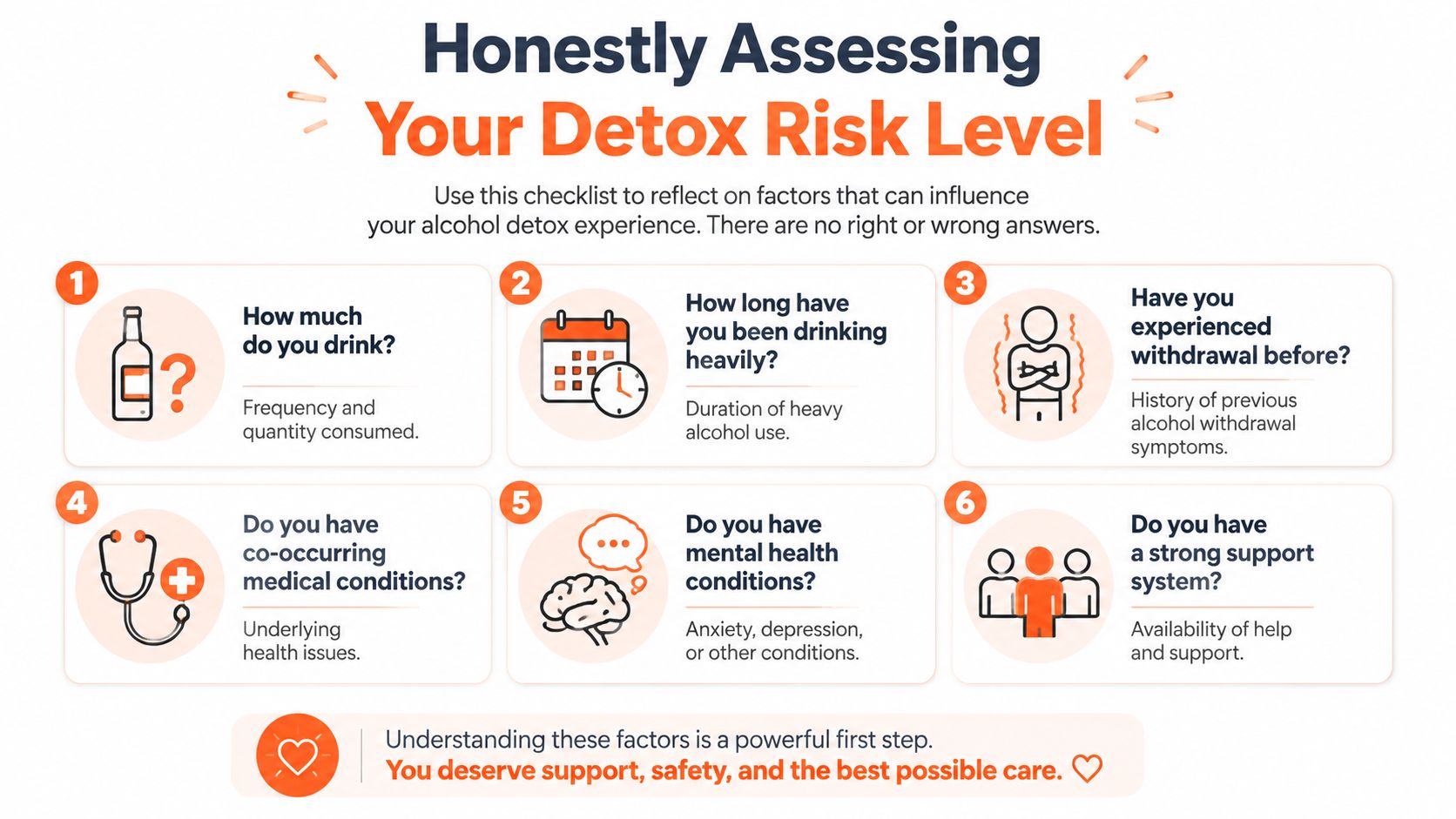
An infographic checklist for evaluating alcohol detox risk factors like drinking frequency, health conditions, and support systems.

The biggest mistake high-performing people make is confusing endurance with safety. You may be able to hold a presentation, manage a practice, or keep a company moving while drinking heavily, but the body doesn't care how polished you look on the outside. What matters is whether you're physically dependent, because withdrawal risk rises when the nervous system has adapted to regular alcohol exposure.

What should raise concern

A few patterns should push you toward medical evaluation before any detox attempt. Morning tremors, drinking to steady yourself, or needing alcohol to sleep are all signs that the body may be expecting alcohol to stay calm. So are prior withdrawal symptoms, heavy daily intake, seizures, confusion, or significant medical or mental health conditions, especially because neutral clinical guidance says the key gap in many detox articles is risk stratification, not just general advice about where detox can happen PMC clinical review.

That gap matters more for professionals than many people realize. High-functioning drinkers often delay care because they can still perform at work, then underestimate how fast withdrawal can turn. Privacy concerns are real, but privacy should never come at the expense of safety.

Use this checklist thinking:

  • Daily pattern: Do you drink most days, or only socially?
  • Withdrawal signs: Do shakes, sweating, nausea, or anxiety show up when you delay a drink?
  • Past history: Have you ever tried to stop and felt worse instead of better?
  • Health load: Do you have liver disease, heart disease, depression, anxiety, or other active medical issues?
  • Support: Is anyone around who can notice changes and get help fast?

If symptoms appear while you taper, the taper is too aggressive. That's a cue to pause and get clinician input, not a sign of weakness.

The safest interpretation is conservative. If you need alcohol to feel normal, or if you've had complicated withdrawal before, assume home detox may not be appropriate until a clinician says otherwise. That's especially true for people who value discretion, because the urge to keep things private can make them minimize risk right when risk matters most.

Medical Detox vs At-Home The Safety Decision

A person standing at a fork in the road choosing between a medical clinic and a house.

A professional with a demanding schedule can be tempted to treat detox like another problem to handle on their own at home. That instinct is understandable. It is also where people misjudge withdrawal risk.

Medical supervision is the safer choice for anyone with heavy use, prior withdrawal symptoms, seizures, confusion, or other medical risks. Alcohol withdrawal can become dangerous quickly, especially when someone has built a long pattern of functioning despite dependence. Clinical guidance from the NCBI safety fact base supports the same core point, withdrawal is unpredictable, and higher-risk cases belong in a monitored setting.

Why the setting matters

At-home detox can look attractive because it feels private, faster, and easier to fit around work. The trade-off is that withdrawal does not stay polite just because you want discretion. Shaking, sweating, vomiting, hallucinations, and disorientation can arrive after the body has already shifted into a more dangerous state.

That is why monitored detox exists. Medical detox gives you continuous observation, so changes in heart rate, blood pressure, tremor, hydration, and mental status can be caught early. It also creates room to address anxiety, depression, and other psychiatric symptoms instead of brushing them aside while you are trying to stay functional.

Privacy matters for executives, physicians, attorneys, founders, and other high-responsibility professionals. A private detox setting can protect confidentiality while still giving you nursing oversight and rapid response if symptoms worsen. The goal is not comfort for its own sake. The goal is controlled safety with as little disruption to your life as possible.

Instead of asking “Can I tough this out?,” the critical question becomes, “What happens if I'm wrong about my risk?” If the answer includes seizures, delirium, or a medical emergency you cannot manage alone, home detox is the wrong setting. For a clear example of that risk, see why you shouldn't attempt alcohol detox on your own.

The Alcohol Withdrawal Timeline What to Expect

Withdrawal is easier to face when you know it can be tracked in phases. The course varies from person to person, but published guidance consistently shows early symptoms can start within hours, with the highest danger often arriving later. A practical way to think about how to detox from alcohol safely is to watch for escalation, not just discomfort day-by-day timeline review.

Typical Alcohol Withdrawal Symptom Timeline

Time Since Last Drink Common Symptoms Potential Severe Symptoms, Seek Medical Care
6 to 12 hours Anxiety, nausea, headache, insomnia, tremor Rising heart rate, worsening agitation
12 to 24 hours More visible shaking, sweating, irritability, possible hallucinations Confusion, marked instability, worsening vital signs
24 to 48 hours Peak discomfort, tremor, agitation, fever Seizures possible, severe confusion
48 to 72 plus hours Ongoing instability, risk of delirium tremens Delirium tremens, disorientation, rapid pulse, fever
Days to weeks Lingering anxiety, poor sleep, fatigue, irritability Symptoms that keep worsening instead of settling

Published taper schedules for heavy drinkers underscore the same principle, safe withdrawal is gradual, not abrupt, and the point of a taper is to reduce symptom severity over several days rather than make a dramatic stop home detox taper examples.

What feels expected versus what doesn't

Mild anxiety, sleep disruption, and shakiness can happen early. Those symptoms still deserve attention, but they're different from confusion, hallucinations, fever, or a seizure. If the person withdrawing is getting more disoriented, not more settled, the course is no longer routine.

Clinical marker: Escalation matters more than the symptom name. If the pattern is getting worse hour by hour, don't wait it out.

The safest response is to document what's happening, then escalate care if symptoms intensify. A written log of drinks, sleep, tremor, heart rate, and symptoms can help a clinician judge whether the course is staying manageable or turning unsafe.

How Medications and Supportive Care Ensure Safety

Medical detox works because it treats withdrawal as a physiological event, not a morale problem. The nervous system has to be steadied while the body clears alcohol, and the process is safer when medication, hydration, nutrition, and observation are used together. A primary-care review recommends daily review by a GP or nurse for at least the first four days, and it advises oral thiamine 200 mg for two weeks before a medicated detox to help prevent neurological damage UHSussex guidance.

What clinicians are trying to prevent

The main safety goals are straightforward. They're trying to prevent seizures, control autonomic overactivity like a racing heart and sweating, reduce agitation, and keep you hydrated and nourished. When needed, teams use medications such as benzodiazepines to reduce withdrawal severity and lower the chance of dangerous complications. Thiamine matters because chronic alcohol use can deplete nutrients the brain depends on, so nutritional support isn't optional.

That's why medical detox isn't “substituting one drug for another.” It's using the right medicine at the right time to interrupt a potentially dangerous rebound state. The structure can also be adjusted if liver problems, anxiety, or other medical issues are present.

Supportive care is just as important as medication. Small, frequent meals, protein-rich foods, and fluids help reduce dehydration and low blood sugar risk during withdrawal. In practice, many people feel more stable once their body is no longer running on caffeine, stress, and alcohol alone.

For readers who want a closer look at the staffing side of detox, 24-hour nursing during detox explains why continuous observation changes the safety equation.

The takeaway is simple. Medication can make detox manageable, but it has to be paired with supervision, nutrition, and a clear plan for what happens if symptoms break through the expected course.

Planning Your Detox Logistics and Aftercare

The professional version of detox planning usually starts with a calendar, not a crisis. One executive I might work with often asks the same practical questions first, what do I tell my team, how much work can I keep handling, and how do I protect my privacy without disappearing from my responsibilities. Those are legitimate concerns, and they're easier to handle when detox is framed as a temporary clinical step rather than a total life interruption.

A professional woman in a blazer works at her desk with a detox schedule, planner, and aftercare plan.

Build the practical plan before day one

A privacy-conscious detox plan usually starts with a narrow circle of disclosure. Some people tell only one trusted family member or assistant. Others keep work communication minimal and use leave protections when appropriate. The point is to avoid improvising while symptoms are building, because decision-making gets harder once withdrawal starts.

A detox center can also help with the transition from the first 24 hours into ongoing treatment. Before choosing one, it's smart to ask about monitoring, psychiatric support, and whether the program understands executive schedules. What to ask before choosing a detox center is a useful checklist if you're comparing options.

The treatment gap is real. In 2024, about 28.0 million U.S. adults had alcohol use disorder, but only 7.6% received any treatment, which is one reason detox has to be paired with a real follow-through plan, not treated like the finish line NIH/NIAAA data reported in Gut.

Aftercare is part of safety

Detox stabilizes the body, but it doesn't teach the brain new ways to cope. That's why continuing care matters, whether that means residential treatment, therapy, medication support, or structured outpatient work. If you return to the same stressors without a plan, relapse risk stays high even if the withdrawal phase itself went smoothly.

A good aftercare handoff should answer three questions. What's the next level of care, who is coordinating it, and what happens if cravings, anxiety, or sleep problems return? Professionals often want the shortest possible interruption to work, but the smartest plan is the one that keeps the next 90 days from turning into another cycle.

Your Path Forward After Detox

The safest alcohol detox plan starts with honesty about risk, not optimism about control. If you have signs of dependence, a history of withdrawal, or medical or mental health concerns, supervised detox is the prudent choice. For busy professionals, the right setting should also protect privacy, support communication needs, and keep the focus on stabilization rather than disruption.

Detox is the beginning of recovery, not the end of it. Success lies in leaving withdrawal safely, then moving into care that helps you stay steady at work, at home, and in your own body.


Capo Canyon Recovery provides medically supervised alcohol detox and residential care in a private setting for professionals who need discretion, structure, and continuity. If you're deciding how to detox from alcohol safely, visit Capo Canyon Recovery to review care options that support stabilization and the transition into ongoing treatment.

READ MORE
Uncategorized
August 09by 0 Comments

Psychiatric Medication Management: A Guide for Executives

You're in treatment, or you're getting ready to enter it, and the practical question is already on the table. Which medications should stay, which should change, who's watching for side effects, and how do you keep this private while you're still managing work, family, and recovery?

Psychiatric medication management is the clinical process that answers those questions in real time. In residential care, it's not a single prescription and a handshake. It's a monitored plan that accounts for symptoms, withdrawal, sleep, substance use, diagnostic uncertainty, and the fact that the right medication today may need adjustment next week.

In the United States, psychiatric medication is already a major part of treatment. The CDC reported that in 2020, 16.5% of adults had taken prescription medication for their mental health in the past 12 months, out of 20.3% who had received any mental health treatment, and that medication use exceeded counseling or therapy alone in that same year (CDC data brief on mental health treatment). That matters because it shows how central medication is for many people who are trying to stay functional while they heal.

What Psychiatric Medication Management Means in Recovery

An executive can arrive in treatment looking composed and still be clinically complex. The surface story may be anxiety, depression, burnout, or insomnia, while the fuller picture includes alcohol, stimulants, cannabis, withdrawal, old prescriptions, and a calendar that never stopped moving.

Psychiatric medication management is a repeating clinical process. It asks, at each step, whether the current medication still fits the current patient. In dual diagnosis care, the plan has to account for mood, sleep, cravings, cognition, safety, and the possibility that a substance has been masking or intensifying symptoms all along.

Practical rule: if the history is incomplete, the medication plan has to stay flexible until the team sees how the patient responds in a stable setting.

For many people, the first real benefit of residential treatment is not the first pill. It is the fact that the medication plan finally gets observed closely enough to be adjusted with discipline. Psychiatry, nursing, and therapy can then work as one system, with each discipline adding a different kind of clinical information.

If you are comparing levels of care, medication stabilization in residential treatment is the right lens. The goal is steady symptom control without creating new problems that later have to be undone.

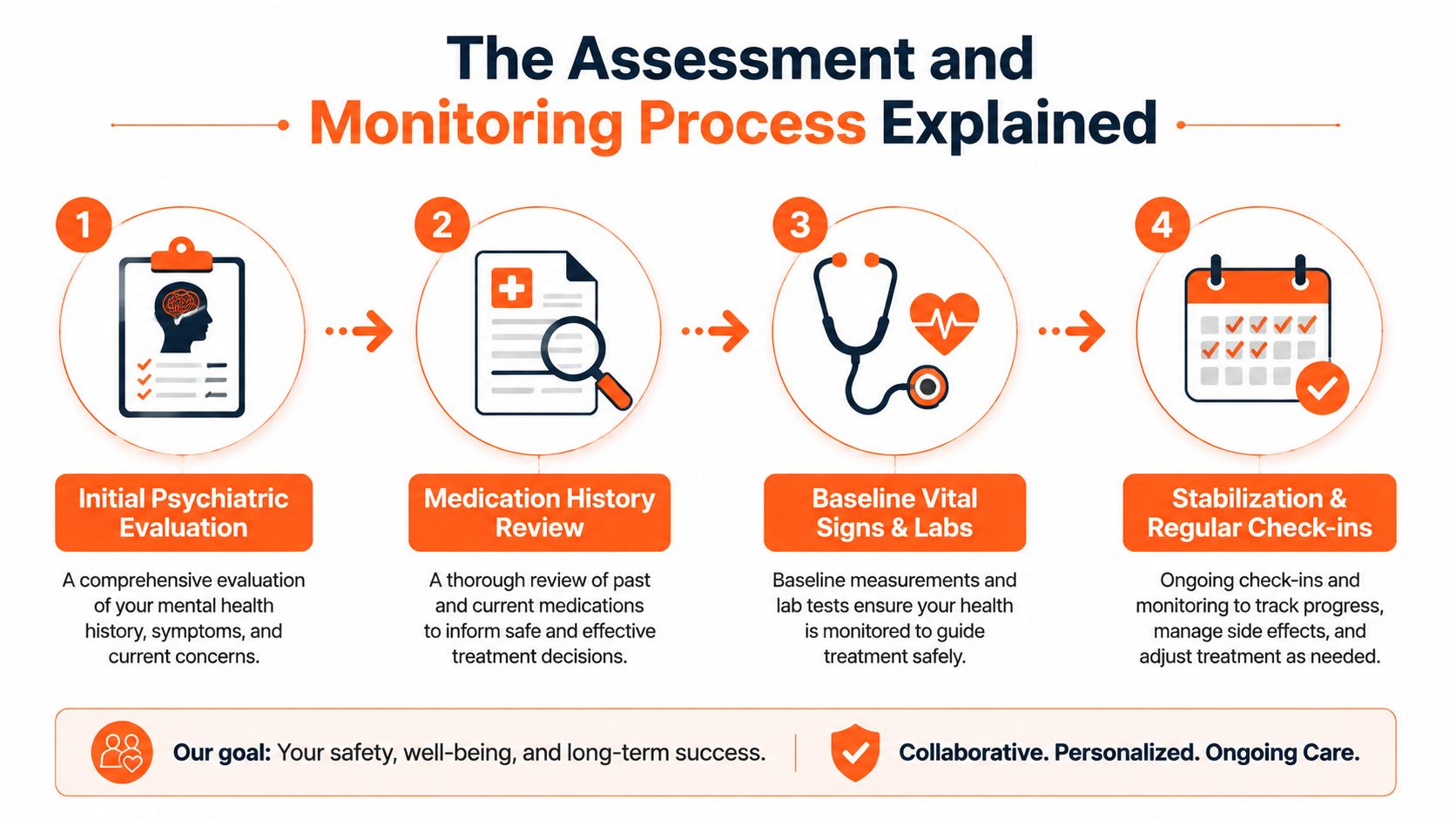
The Assessment and Monitoring Process Explained

A residential intake should start by clarifying what is being treated. In executive-level care, that means sorting out symptoms that were present before admission from symptoms shaped by alcohol, stimulants, cannabis, withdrawal, sleep loss, or a medication change that never got followed closely enough.

The evaluation has to rebuild the clinical picture from several sources when records are thin. A psychiatrist may rely on direct interview, collateral input when appropriate, nursing observations, and what the patient does over several days in the program. That matters because one office visit rarely shows the full pattern. Residential care does.

Vital signs and lab timing also matter. Lithium is a standard reference point in psychiatric medication management because it has a narrow therapeutic index and must be monitored with timed blood levels. Clinical reviews describe its half-life as roughly 14 to 30 hours, note that steady state is usually reached in about 5 to 7 days, and recommend drawing blood 12 ± 1 hours after the last dose. See the review on lithium monitoring for the clinical details.

A four-step infographic illustrating the psychiatric assessment and monitoring process for effective mental health care treatment.

What the first days usually involve

The first phase usually combines psychiatrist evaluation, medication reconciliation, and nursing observation. Staff review current prescriptions, recent stops, past adverse reactions, and any overlap that could raise the risk of sedation, activation, or toxicity. If the patient arrives with incomplete records, the team has to work from the medication list in front of them, not from assumptions.

That process is more cautious when the diagnosis is still unsettled. A stimulant withdrawal picture can resemble depression. Alcohol withdrawal can look like anxiety or agitation. A prior antidepressant may have helped once, or it may have worsened sleep, mixed symptoms, or impulsivity. In a confidential setting, the team has to sort out those trade-offs without rushing to a clean label that the history does not support.

  1. Initial Psychiatric Evaluation. The psychiatrist reviews symptoms, risks, prior treatment, and current medications.
  2. Medication History Review. The team checks for interactions, duplication, abrupt stops, and past adverse reactions.
  3. Baseline Vital Signs and Labs. Nursing and medical staff establish a safe reference point for follow-up.
  4. Stabilization and Regular Check-ins. The plan is adjusted as the patient's response becomes clearer.

Monitoring continues after the first order is written. For lithium, follow-up is recommended after initiation, after dose changes, and whenever toxicity, relapse, or nonadherence is suspected. That same logic applies to medication-assisted treatment, where the clinical question is never only whether a drug was prescribed, but whether the dose, timing, side effects, and recovery goals still fit the patient. A prescription can be handed out in minutes. A protocol creates accountability over time.

Common Medication Classes for Co-Occurring Disorders

A medication plan in dual diagnosis care starts with the problem the team is trying to solve. The same drug can be reasonable in one case and a poor fit in another if the symptom pattern, substance history, sleep, and side effect tolerance point in different directions. In confidential residential treatment, that decision also has to fit the pace of therapy and the privacy expectations of an executive-level setting.

How clinicians usually think about the main classes

Medication Class Primary Uses Key Monitoring Considerations
Antidepressants Depression, anxiety, PTSD, OCD symptoms Sleep changes, activation, interaction risk, delayed response
Mood stabilizers Bipolar spectrum symptoms, mood swings, irritability Timing, blood levels when indicated, signs of toxicity
Anti-anxiety agents Acute anxiety, panic, agitation Sedation, dependence risk, effect on recovery goals
Antipsychotics Severe mood instability, psychosis, agitation, augmentation Metabolic effects, daytime sedation, movement side effects
ADHD medications Attention and impulse-control problems Misuse risk, appetite and sleep effects, diagnostic clarity

Antidepressants are often chosen when the goal is to build a steadier baseline rather than to create immediate sedation. Mood stabilizers become part of the discussion when the history suggests cycling moods, impulsivity, or a pattern of worsening after antidepressant exposure. Antipsychotics may be used for acute stabilization or for augmentation, especially when sleep, agitation, or thought organization need closer control.

For people with overlapping substance use, the balance is therapeutic benefit on one side and assessment clarity plus dependence risk on the other. The medication should reduce distress enough to support recovery work, while still allowing the team to see what symptoms remain and why. That is one reason experienced programs treat medication as one part of a larger protocol, with psychiatry, nursing, and therapy all watching for different pieces of the picture.

Lithium is a good example of why monitoring matters. Clinical guidance calls for follow-up after initiation, after dose changes, and whenever toxicity, relapse, or nonadherence is suspected, because the margin between benefit and harm can narrow quickly if the regimen drifts. That same discipline applies to medication-assisted treatment concepts, where the question is whether the medication, the dose, the timing, and the side effects still support the patient's recovery goals. A prescription can be written quickly. A protocol keeps the plan accountable over time.

Medication Safety During Detox and Early Stabilization

Detox is a period where medication errors become more likely if staffing is thin or the process is rushed. A patient may arrive with a long-standing psychiatric regimen, then immediately face withdrawal, sleep disruption, and symptoms that can look psychiatric even when part of the picture is physiologic.

Abrupt discontinuation is a poor default for that reason. Some medications need a taper rather than a stop, and the team has to separate withdrawal from relapse instead of assuming every distress signal means the original diagnosis has worsened. Nursing observations matter because they catch changes that a once-daily check-in can miss.

Continuity of care during detox keeps patients safer than reactive medication changes.

In a residential setting, 24/7 nursing support gives the team a chance to watch for sedation, dehydration, blood pressure changes, agitation, and emerging side effects while the medication plan is being refined. That matters especially early on, when the patient's history is still settling and the line between detox symptoms and psychiatric symptoms can be hard to draw. 24-hour nursing during detox supports that close monitoring and gives the team a clearer view of what is medication-related and what is part of withdrawal.

The operational piece matters just as much as the clinical one. Therapy needs to know whether fatigue or agitation is tied to medication. Psychiatry needs to know whether the patient slept, ate, or decompensated overnight. Nursing needs to know what changed after the last dose. In confidential residential care, that coordination is what keeps medication decisions tied to real-time observations instead of assumptions.

A doctor explaining a medication plan checklist to a patient during a medical consultation session.

Navigating Diagnostic Uncertainty and Incomplete Records

A lot of people enter care without clean records, and some enter without a diagnosis that has been tested over time. That's not a minor paperwork issue. It changes the medication risk profile.

A rapid review found there are “no widely accepted clinical guidelines” and “little to no research” for prescribing in transition and low-threshold settings, and it specifically warns clinicians to screen for prior manic, hypomanic, or mixed symptoms before treating depression because undiagnosed bipolar disorder can alter medication choice and risk (rapid review on prescribing in uncertain settings). That's the kind of caution most consumer content leaves out, even though it's one of the main reasons residential medication management exists.

What good clinicians watch for

  • Mood history that doesn't fit a simple depression narrative. Past bursts of energy, decreased sleep, impulsive decisions, or mixed symptoms change the whole plan.
  • Medication overlap. Multiple prescribers can mean duplicated drugs, conflicting instructions, or side effects that get mistaken for new illness.
  • Symptom timing. If symptoms rise and fall with substance use, withdrawal, or medication changes, the diagnosis may still be evolving.
  • Family and collateral history. People often remember episodes or patterns the patient left out, whether by design or because the timeline is hard to reconstruct.

The point isn't to delay treatment indefinitely. It's to avoid locking in the wrong treatment too early. A high-touch residential model gives the team time to stabilize first, then refine the diagnosis with more confidence, which is a much safer sequence when the history is messy.

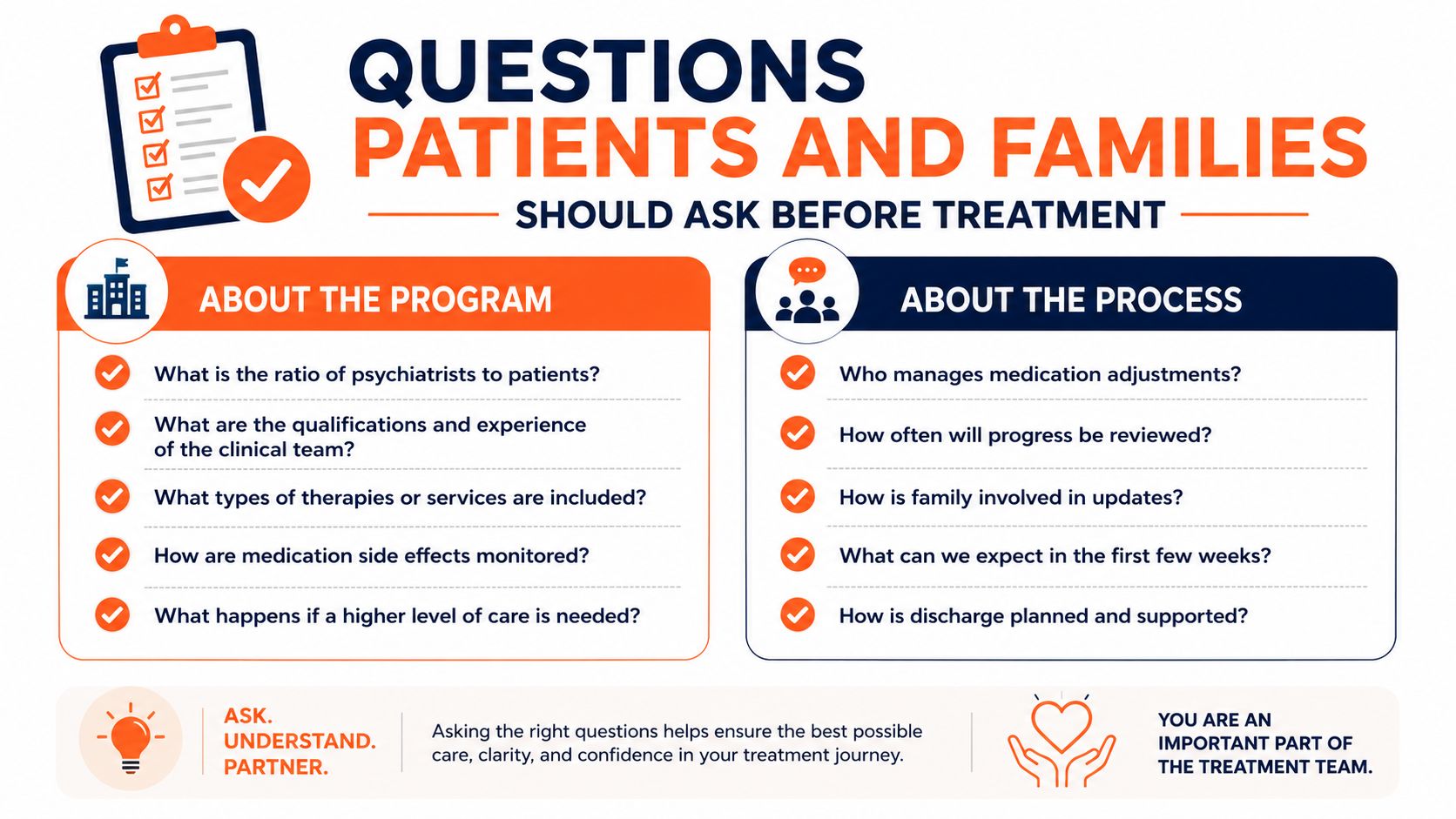
Questions Patients and Families Should Ask Before Treatment

If a program says it offers psychiatric medication management, ask how that looks on an ordinary Tuesday, not just on paper. The answer should tell you whether the care is individualized or just administrative.

An infographic list of questions for patients and families to ask before starting psychiatric treatment programs.

About the program

  • Who prescribes and monitors the medications? You want clarity on whether psychiatry is on-site, available regularly, and integrated with the rest of the team.
  • How are side effects tracked? Good programs use nursing observation, scheduled follow-up, and direct patient reporting, not casual check-ins.
  • What happens if the diagnosis changes? The team should be able to explain how they revise the plan when bipolarity, trauma, ADHD, or substance-related symptoms become clearer.

About the process

  • How fast are medication changes reviewed? In a residential setting, slow administrative turnaround is a weak sign.
  • Who tells therapy and nursing about the change? If psychiatry works in isolation, the plan will be less safe.
  • How is family communication handled? Families need updates, but only within the patient's confidentiality boundaries and consent.

A strong program doesn't just answer these questions. It answers them in plain language. For executives and licensed professionals, that matters because privacy concerns are real, and vague reassurances don't substitute for a defined process.

How Capo Canyon Recovery Delivers Executive-Level Medication Management

A confidential residential setting can still be clinically precise, and that combination is what many professionals need when work can't stop. Capo Canyon Recovery operates as a boutique program in Mission Viejo with 24/7 nursing and on-site psychiatric support, a small census of about five clients at a time, and minimum four weekly individual sessions that involve therapy, case management, and psychiatry.

A luxurious bedroom interior with a Capo Canyon Recovery welcome card placed on a wooden desk.

The practical advantage is straightforward. Medication changes can be watched closely, therapy can feed real-time observations back to psychiatry, and nursing can flag problems early instead of waiting for the next appointment. The tech-friendly policy also matters for executives and professionals who need to remain reachable for essential responsibilities without turning treatment into a public event.

That model fits the actual pressure many high-performing people are under. They need care that respects confidentiality, keeps treatment coordinated, and doesn't treat privacy as an afterthought. In programs like this, medication management isn't separated from the rest of residential care, it's part of the same coordinated structure that helps people stabilize without losing their footing.


If you're evaluating private treatment for yourself or a family member, start with the medication process, not the brochure language. Capo Canyon Recovery can walk you through how psychiatric medication management, detox oversight, and residential therapy work together in a discreet setting, so you can ask sharper questions and choose care with confidence.

READ MORE
Uncategorized
August 08by 0 Comments

Group Therapy Benefits: Evidence-Based Insights For

You've probably already had the same thought a lot of privacy-sensitive, high-functioning people have before treatment, if you step into group therapy, what exactly do you have to give up? For an executive, physician, attorney, or other licensed professional, that question isn't petty or avoidant. It's a real clinical concern about reputational exposure, loss of control, and whether a room full of strangers can possibly feel safe enough to be useful.

The short answer is that group therapy benefits are real, but they're often misunderstood. The strongest version of group work is not a confession circle. It's a structured clinical setting where people learn from one another, practice new behavior, and get relief from the burden of feeling uniquely broken. Research on group psychotherapy shows meaningful symptom improvement, durable gains in depression treatment, and strong effectiveness for anxiety disorders, including in mixed-diagnosis groups that don't require perfectly matched cohorts (group psychotherapy review, anxiety meta-analysis, depression review).

Why High-Functioning People Hesitate to Join Group Therapy

A lot of people who look highly composed on the outside are doing a quiet calculation on the inside. If you've spent years protecting your license, your reputation, your team, or your family, the idea of speaking in front of peers can feel like a bad trade. You're not just asking, “Will this help?” You're asking, “What could this cost me?”

That hesitation makes sense. For high-functioning adults, the main fears usually aren't about whether therapy works in general, they're about who will know, how much needs to be shared, and whether other participants might be too similar to be comfortable. An attorney may worry about professional overlap. A physician may worry about disclosure travel across a small local network. An executive may worry that being seen as vulnerable will weaken authority. None of that is irrational.

Privacy concerns are clinical concerns

The best way to think about this is simple. Privacy isn't a personality flaw, it's part of treatment matching. A thoughtful program has to consider confidentiality norms, group composition, and how much personal detail a member needs to disclose in order to benefit. That's especially true for boutique residential settings, where small groups can lower the social risk while still preserving the interpersonal work that makes group treatment useful.

Practical rule: if a program treats your confidentiality questions like resistance, keep looking.

The more useful question is not whether you feel comfortable at the start. Many don't. The question is whether the setting is built so that a privacy-sensitive person can participate without overexposing themselves. In other words, the goal is not maximum disclosure. The goal is enough structure that you can stay present, learn, and test new behavior safely.

What Group Therapy Actually Is and How It Works

A visual comparison infographic distinguishing group therapy from individual therapy sessions, using icons and descriptive illustrations.

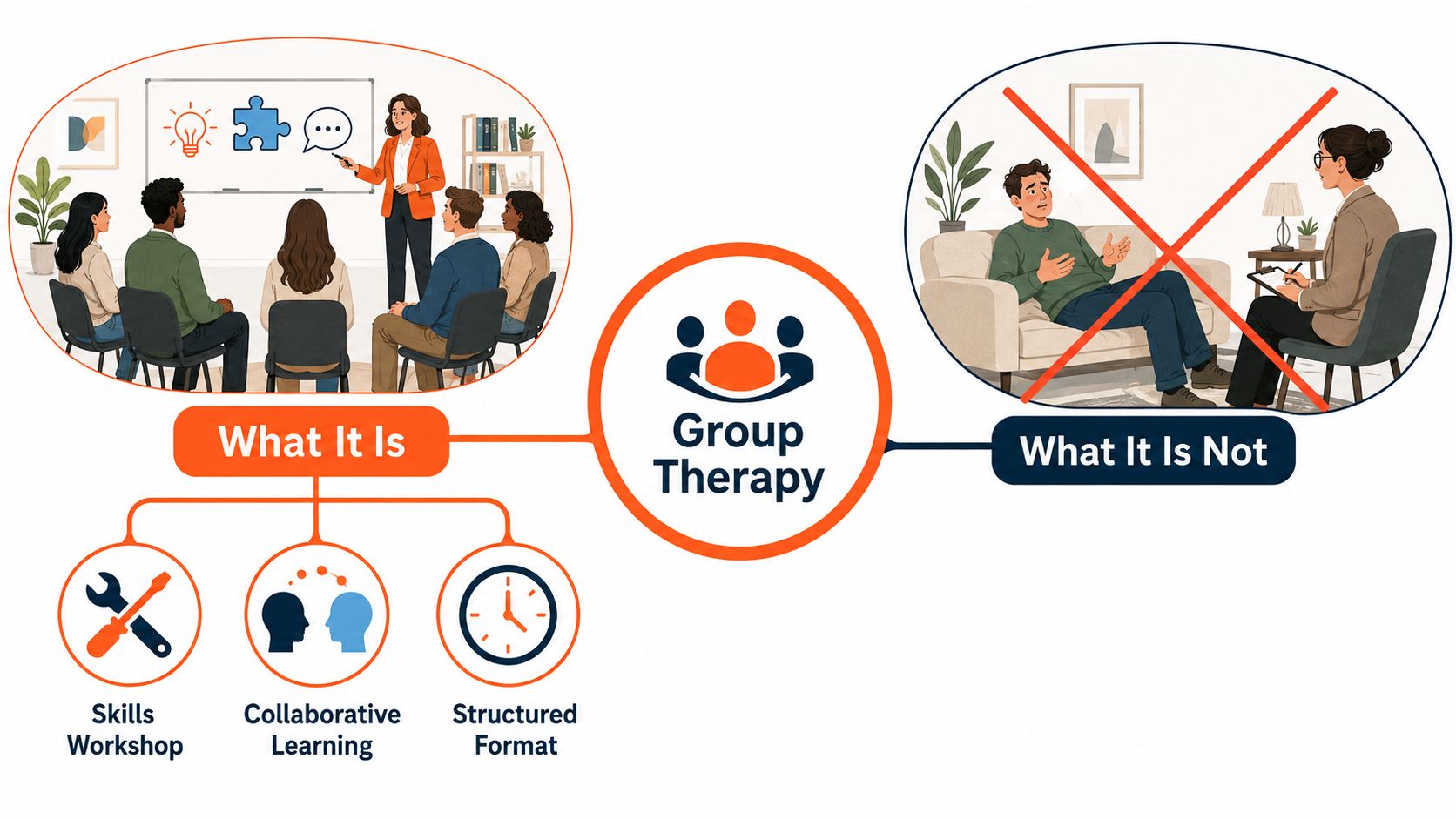
Think of group therapy less like a confession and more like a small skills workshop. One clinician guides a focused conversation, keeps the room emotionally safe, and helps people notice patterns as they happen. The room becomes a live laboratory where people can practice asking for help, setting boundaries, tolerating discomfort, or responding differently to shame.

That structure matters because several therapeutic mechanisms operate at once. Universality means hearing, “I'm not the only one.” Cohesion means the group begins to feel like a stable, reliable place. Social learning happens when one member's way of coping gives another person a better option. Interpersonal processing lets members see how they come across to others in real time. Those effects are very different from talking about problems alone.

For readers who want a deeper look at how sessions are organized in practice, this overview of process group therapy is a useful companion. The basic point is that clinically led group work is more structured than many people assume, and far more purposeful than casual conversation.

Group therapy is not the same as peer support

A support group can be helpful, but it isn't the same thing as psychotherapy. Peer-led spaces usually emphasize shared experience and fellowship. Group psychotherapy is led by a licensed clinician who uses the conversation to target symptoms, behavior change, and relational patterns. That difference explains why the room doesn't just “vent.” It works.

The distinction matters for privacy-sensitive adults because structure creates safety. A well-run group doesn't demand oversharing. It asks members to engage enough to do clinical work, then uses the therapist's facilitation to keep the conversation grounded, relevant, and contained.

Five Evidence-Based Benefits of Group Therapy

An infographic titled 5 Evidence-Based Benefits of Group Therapy featuring a numbered list with statistics and icons.

A senior executive who is used to keeping concerns private may hear “group therapy” and picture disclosure without boundaries. In practice, a well-run group is closer to a structured clinical lab than a casual conversation. The room is designed so that privacy, containment, and selective self-disclosure support the work rather than derail it.

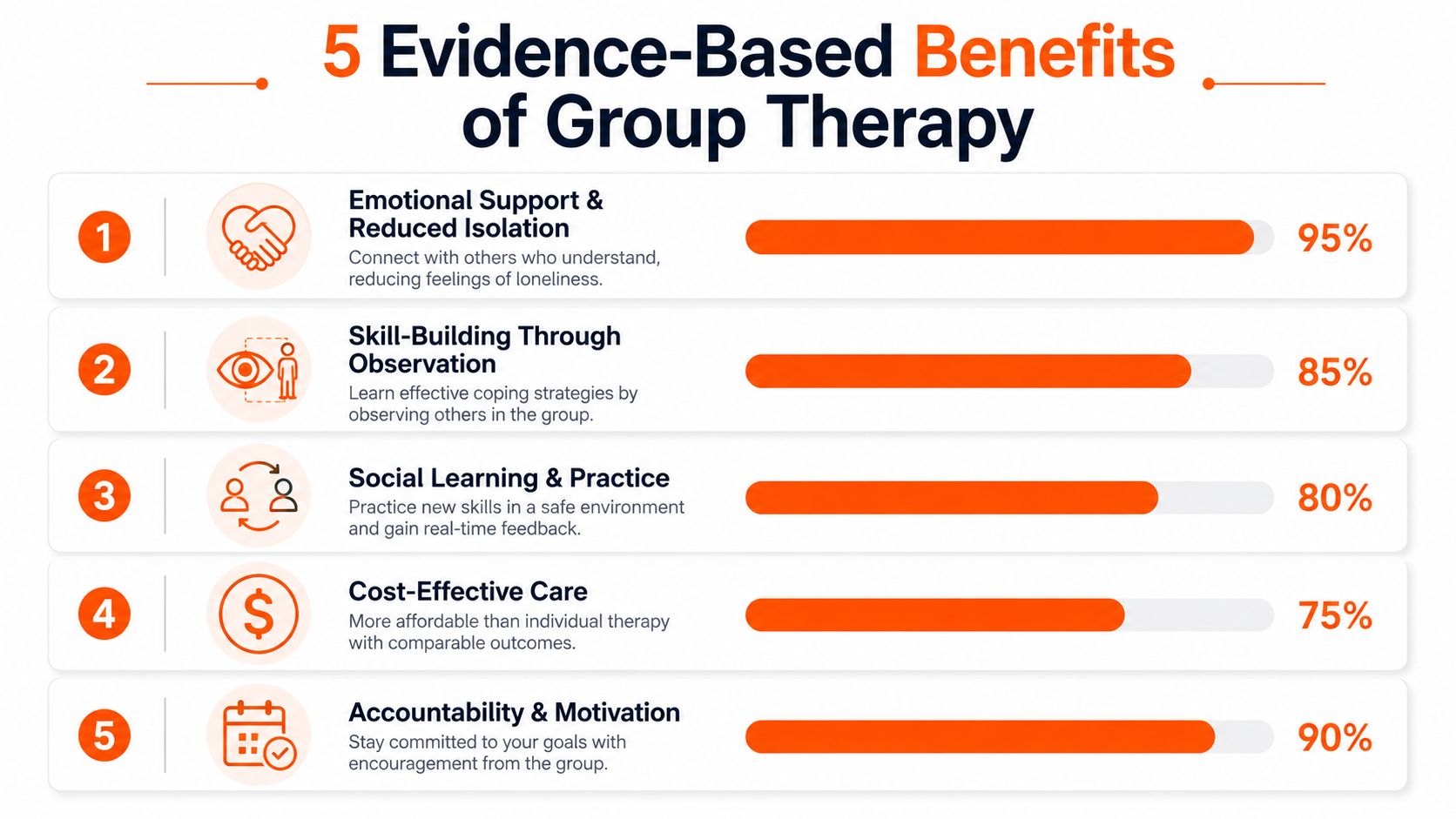
The strongest evidence comes from a pattern across studies, not from one dramatic claim. A major review of group psychotherapy reported that 45 of 48 studies on depression found it effective, and 43 of 46 studies with adequate data found significant symptom reduction. It also found that group therapy outperformed no treatment in 15 studies, with effect sizes of 1.026 immediately after treatment and 1.178 at follow-up, and it noted that a 10-session format saved 37.5% compared with individual therapy while another study found costs only 8% to 17% as much as individual therapy (group psychotherapy review). Those findings matter, and so do the clinical mechanisms behind them.

1. Emotional support and reduced isolation

For many privacy-sensitive adults, the first benefit is not emotional openness. It is the relief of being understood without having to translate every detail. Hearing another person describe the same fear, urge, or shame can weaken the private narrative that says, “This is only happening to me.”

That shift matters because isolation often keeps symptoms stuck in place. Once a member sees that others with high functioning, polished careers, and strong external control still struggle in similar ways, defensiveness often drops enough for honest work to begin.

2. Skill-building through observation and rehearsal

People learn faster when they can watch a skill before they try it. In group, the therapist can coach distress tolerance, communication, or boundary-setting while members observe how another person puts the skill into practice. Then the room gives feedback, which makes the learning concrete instead of abstract.

This is especially useful for licensed professionals and executives who are used to competence in performance settings but less practiced in receiving real-time interpersonal feedback. Group turns that feedback into something contained and useful, more like supervised rehearsal than exposure for its own sake.

3. Social learning from peers

The comparative research is striking because group and individual therapy often improve core symptoms at similar rates, while group work adds stronger relational gains. In one comparative study, group participants improved 15.8% on anxiety scores and 20% on depression scores, versus 16.6% and 21.9% in individual therapy, with overall recovery gains of about 9% in both groups. But group participants did better on interpersonal outcomes, including becoming better able to ask for help, which improved in 35% of group participants versus 22% in individual care, and in relying on others, which improved in 28% versus 24% (comparative study summary).

For readers who want a fuller explanation of how that peer process supports recovery, see our peer support in recovery page. The point is not that everyone must become socially open. The point is that witnessing carefully chosen disclosure and response can help a person test new interpersonal habits in a protected setting.

4. Accountability and structure

Group creates a rhythm. People know others will notice whether they returned, practiced the skill, or followed through on a plan. That does not have to feel exposing. In a well-facilitated group, accountability feels more like steady attention than pressure, which is often exactly what overwhelmed high achievers need.

Facilitation style matters here. A smaller, tightly held group in a boutique residential setting can preserve confidentiality while still allowing enough interaction for the work to happen. When the therapist keeps the frame clear, members do not have to overshare to benefit.

Group work is most useful when the therapist turns interaction into practice, not performance.

5. Cost-effectiveness

For families and private-pay patients, cost matters. The economic findings in the review above are hard to ignore, especially in residential care where treatment intensity can quickly add up. Group therapy can make evidence-based treatment more accessible without removing clinical depth, which is one reason integrated programs use both group and individual sessions rather than asking patients to choose only one format.

Group Therapy Compared to Individual Therapy

A useful way to compare these formats is to ask what each one makes easier. Individual therapy gives privacy, depth, and room for work that is tightly tied to one person's history. Group therapy adds a live social setting, which lets people practice how they think, ask, hesitate, and respond while other people are present. For executives and licensed professionals who are protective of confidentiality, that distinction matters more than broad slogans about “opening up.”

The comparative findings are fairly steady. Symptom relief can look similar across the two formats, but the kind of change that emerges is not identical. In the comparative study summary, group therapy and individual therapy were close on anxiety improvement, depression improvement, and overall recovery gains, while group therapy showed a clearer advantage for learning to ask for help and rely on others.

Outcome Group Therapy Individual Therapy
Anxiety symptom improvement 15.8% in one comparative study 16.6% in the same study
Depression symptom improvement 20% in one comparative study 21.9% in the same study
Overall recovery gains About 9% About 9%
Better able to ask for help 35% improved 22% improved
Better able to rely on others 28% improved 24% improved

That pattern helps explain why higher-functioning patients often do well with both formats. If the main question is symptom reduction, either setting can be useful. If the question is how a person relates to others under pressure, group therapy offers a different kind of practice. It works like a rehearsal room for relational habits, with the therapist shaping the frame so the interaction stays clinical rather than performative.

When each format fits best

Individual therapy fits deep privacy, trauma processing, identity-sensitive work, and situations where someone is not yet ready to speak in front of peers. Group therapy fits rehearsal, relational repair, and practicing new behavior with immediate feedback from other members. In residential programs, the two formats usually work best together, because a private insight can be tested in group, and a group moment can be explored more fully one-on-one.

Confidentiality and group size shape that decision. A smaller, carefully facilitated group in a boutique setting can give privacy-sensitive patients enough containment to participate without feeling exposed, while still giving them the interpersonal contact that individual work cannot provide. For some patients, including executives and licensed professionals, that structure makes group therapy feel less like public disclosure and more like guided skill practice in a protected room.

A simple rule helps here. If the work depends on maximum privacy, individual therapy should come first. If the work depends on staying connected while uncomfortable, group therapy often becomes the better classroom.

What to Expect in a Residential Group Program

Residential group therapy often feels less like a large public gathering and more like a small room that keeps a steady rhythm. For executives, licensed professionals, and other privacy-sensitive patients, that matters. A low census means fewer eyes, less anonymity concern, and a setting where each person's voice is easier to hear without turning the session into a performance. In boutique programs, the structure is usually tight, with co-led groups and a schedule that divides time between skills work, process work, and psychoeducation.

That structure is doing real clinical work. It gives the room shape. In group treatment research on anxiety, mixed-diagnosis groups have been found to perform about as well as diagnosis-specific groups, which helps explain why well-run residential programs can combine people with different presenting problems without losing focus. The point is not that every person shares the same diagnosis. The point is that the group has a clear frame, so people can practice relevant skills together even when their clinical stories differ.

What the room usually looks like

A typical program uses a licensed therapist as the main facilitator, and some settings add a second clinician or case manager. Confidentiality is usually discussed early, then reinforced often, because privacy in group is not a one-time promise. It is maintained through repeated reminders, clear rules, and a shared expectation that what is said in the room stays in the room. People are expected to speak respectfully, avoid side conversations, and protect one another's privacy after the session ends. That kind of structure helps high-functioning adults participate without feeling ungrounded.

The physical setting also affects how safe the room feels. A discreet residential environment can lower the sense of exposure that many professionals worry about before they ever walk into group. Capo Canyon Recovery's rehab setting by the beach is one example of how a small, contained setting can support that need for privacy while still keeping the work clinically focused. For people who are used to managing responsibility in public, that combination often matters more than broad claims about comfort.

How dual-diagnosis groups are handled

When anxiety, depression, trauma, or substance use all show up together, the group should not blur them into one story. Each problem needs a place in the conversation. A good program keeps the discussion organized so co-occurring symptoms are addressed rather than pushed aside, and the facilitator adjusts the focus to what members are dealing with in that session, not just what appears on the intake form. Residential group work is strongest when it can hold complexity without becoming chaotic.

When Group Therapy Is Not the Right Fit

Group therapy has limits, and honest programs say that out loud. If someone is acutely suicidal, severely psychotic in a way that disrupts safety, or so impaired that they can't tolerate a shared setting, individual stabilization usually comes first. The same is true when recent trauma is still too raw for group processing or when paranoia makes the room feel unsafe rather than containing.

Severe social anxiety can also matter, not because the person is “bad at groups,” but because the barrier may be so high that meaningful participation isn't possible yet. In those cases, a therapist may use individual work first, then step into group once the person has enough regulation to participate without shutting down.

Clinical matching matters more than ideology. A good referral is the one that fits the person in front of you, not the treatment philosophy on a brochure.

Privacy-sensitive licensed professionals deserve one more candid point. Even when confidentiality rules are clear, disclosure in group can carry professional or legal risk if someone shares too much too soon. That doesn't rule group out. It means the admission process should help the patient decide what can be safely discussed, what should stay general, and whether the setting has the right safeguards for their role and life context.

How to Choose the Right Group Therapy Program

The best program for a high-functioning patient is rarely the loudest one. It's the one that can explain, in plain language, how group work is protected, led, and integrated with the rest of care. If you're comparing options, start with the basics and ask the same questions every time.

A practical screening checklist

  • Licensing and accreditation. Ask whether the program is appropriately licensed, and whether the clinical services are run by licensed professionals. If you're in California, confirm the setting's DHCS licensure.
  • Staff credentials and experience. Find out who leads groups, who covers crisis needs, and how much experience the clinicians have with executives, licensed professionals, or dual-diagnosis clients.
  • Group size and composition. Ask how many people are in a typical group, how admissions are balanced, and whether the program keeps high-profile clients in smaller rooms.
  • Therapeutic approach and focus. Make sure the group work matches your needs, such as CBT, DBT, trauma-informed care, or relapse-prevention work.
  • Session format and cost. Clarify how often groups meet, how they fit with individual therapy, and what the financial structure looks like.
  • Client reviews and outcomes. Ask how the program evaluates progress, not just how it markets itself.

If you're evaluating a private residential option, Capo Canyon Recovery is one example of a program that combines group therapy, psychoeducation, and high-frequency individual care within a small-census executive setting. For licensed professionals, that mix can matter more than any single feature because it allows privacy, structure, and enough repetition for behavior change to stick.

A final question is worth asking on every admissions call. What happens if a group is too large, too exposed, or too intense for me? The answer tells you whether the program is patient-centered or just busy.

Key Takeaways on Group Therapy Benefits

An infographic titled Key Takeaways Group Therapy Benefits highlighting its role as a targeted professional clinical intervention.

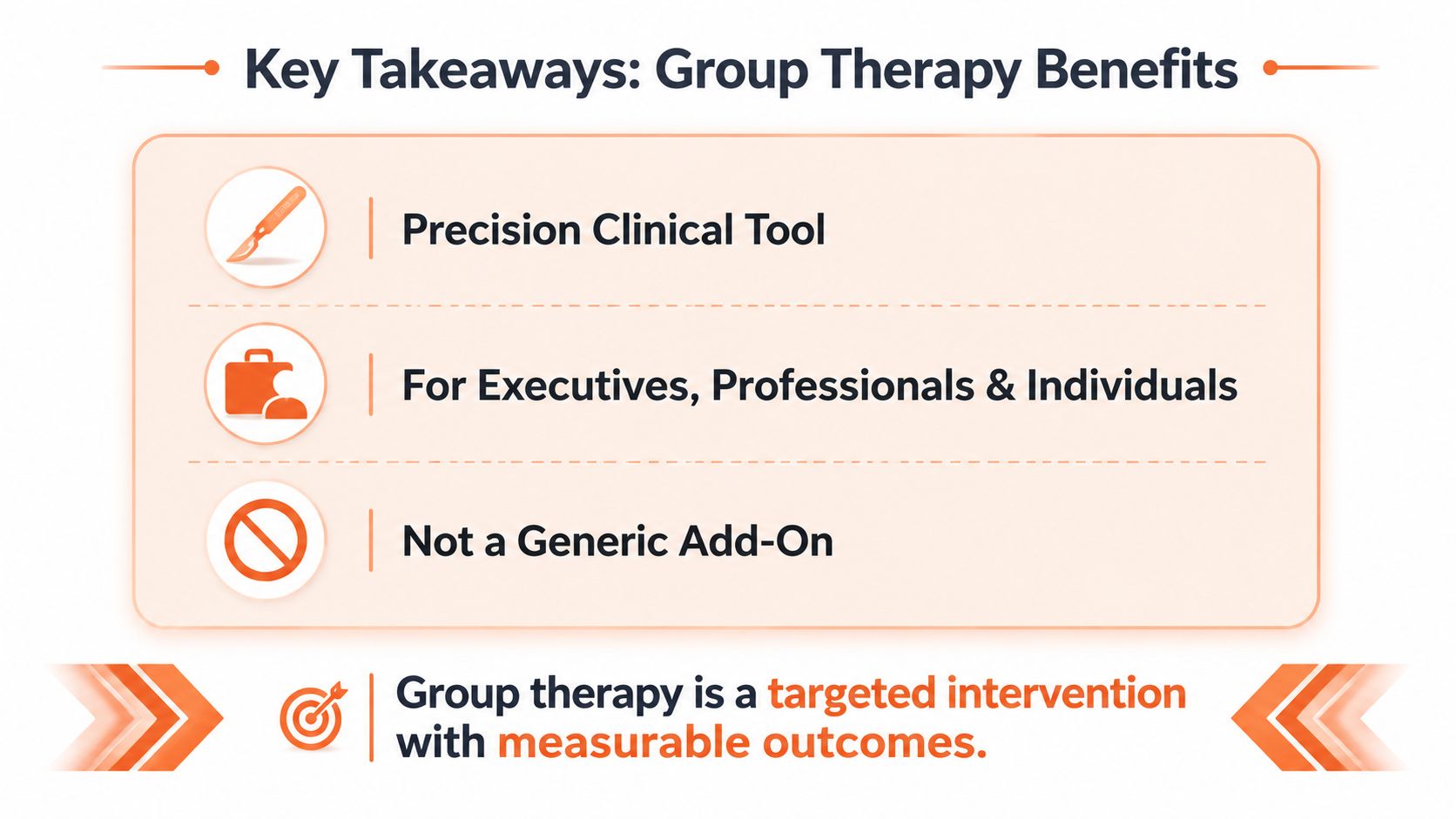
A privacy-sensitive executive often walks into treatment with a specific concern. “Will I have to disclose too much, and will the room feel too exposed?” The answer, in a well-run program, is that group therapy benefits come from structure, not from forced openness. A good group gives people a contained place to hear themselves, notice patterns, and practice new responses in front of peers who are facing similar clinical work.

The mechanism is straightforward. Group psychotherapy functions like a clinical laboratory with guardrails. The therapist shapes the process, the group offers real-time feedback, and members see how their reactions change when they are not carrying the work alone. That is why group therapy can feel especially useful for licensed professionals and executives who want depth without a loose or overly social setting.

  • Precision clinical tool. Group therapy targets symptoms and relationship patterns, rather than offering a general social outlet.
  • For executives, professionals, and individuals. Privacy-sensitive patients often do best when the group is discreet, tightly held, and led by clinicians who understand confidentiality concerns.
  • Not a generic add-on. The strongest programs integrate group with individual therapy, psychiatry, and recovery planning so the gains in session carry into daily life.

The research supports that framework. Reviews of group psychotherapy show benefit for depression and anxiety, and also point to interpersonal gains that matter in real-world recovery. A later review of anxiety treatment found group formats can be helpful for symptom relief, and a review of depression treatment found group care can be effective there as well (group psychotherapy review, anxiety meta-analysis, depression review). For the person who values privacy, the key question is not whether group therapy works in general. The question is whether the setting is built with enough discretion, a manageable group size, and a facilitation style that keeps the work clinically focused.

If you are evaluating treatment for yourself or someone you care about, ask whether the program can explain its group process as clearly as its individual care. Capo Canyon Recovery offers residential care that includes group therapy, individual sessions, and a private, executive-oriented setting, which makes it a relevant option for people who need both confidentiality and clinical structure.

READ MORE
Uncategorized
August 07by 0 Comments

Case Management Services in Executive Addiction Treatment

You're probably looking at a client who can't disappear for 30 days, can't have the wrong person find out they're in treatment, and can't afford a sloppy handoff after detox. That's exactly where case management services stop being paperwork and start functioning as the clinical control layer that keeps medical care, therapy, family communication, and aftercare moving in the same direction.

For executives, entrepreneurs, and licensed professionals, the significant risk isn't just withdrawal or cravings. It's the gap between levels of care, the missed callback, the uncoordinated discharge, the privacy breach, and the assumption that a capable person will somehow work through a chaotic recovery system on their own. That's why specialized programs build coordination into the treatment model instead of treating it like a back-office task, and why many high-profile clients look for options such as Capo Canyon Recovery's executive-focused rehab approach.

Why Executives Need More Than Standard Treatment Coordination

A chief financial officer checks into detox on a Sunday night with a phone full of board emails, a licensing issue hanging over the week, and a spouse who wants answers before the story leaks anywhere else. A standard rehab response often treats that person like every other admission, which sounds equal in theory and fails in practice. The client doesn't just need a bed, meals, and a schedule, they need someone tracking what must be protected, what can wait, and what communication has to happen correctly.

That's where case management services matter most. In substance-use treatment, case management is a structured function that coordinates, plans, provides, evaluates, and monitors services and recovery resources on behalf of the client, in collaboration with the client, so the work goes beyond scheduling appointments and sending referrals. The clinical value comes from keeping referrals, monitoring, and care-plan changes aligned over time, especially when treatment has to coexist with work obligations, family systems, and privacy concerns. The Orange County HIV case-management standards describe a model that starts with assessment, moves into an individualized care plan, and then continues with monitoring and re-evaluation, which is the same logic high-acuity addiction care depends on for continuity and adherence support.

Why fragmented care breaks down fast

Executives and licensed professionals usually don't fail because they lack motivation. They fail when detox, psychiatry, therapy, family contact, and aftercare each operate on separate tracks, with no one holding the overall picture. A client can look stable in one meeting and already be disengaging from the next step if no one is checking transitions in real time.

Practical rule: if nobody owns the handoff, the handoff will fail.

In high-profile treatment, that failure can mean more than discomfort. It can mean a missed medication adjustment, a family misunderstanding, a licensing concern that grows quieter but not smaller, or a return to work before the recovery plan is ready. Strong coordination doesn't remove the demands on the client, it prevents those demands from becoming hidden relapse triggers.

What Case Management Services Actually Do in Addiction Treatment

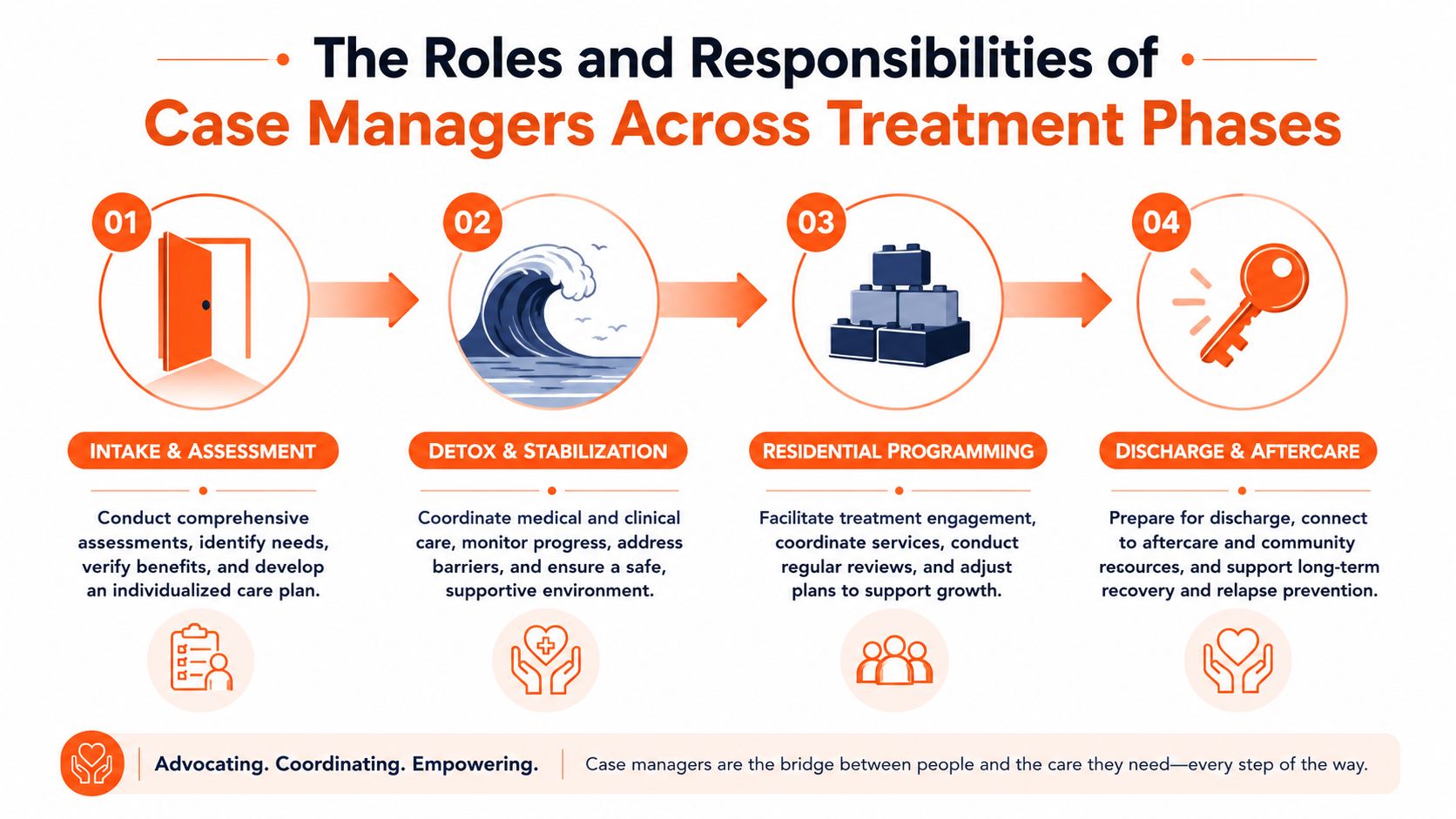
An infographic showing the four phases of case management services from intake to discharge and aftercare.

The cleanest way to understand case management is to treat it as a clinical coordination function, not an admin desk. The case manager doesn't just place calls. They hold the plan together while multiple providers are working on different parts of the same problem, and they keep checking whether the plan still fits what the client needs.

The core workflow

A sound model starts with initial needs assessment. That means more than asking what substances were used. It means identifying medical risk, psychiatric symptoms, family dynamics, legal or licensing pressure, work obligations, and the practical barriers that could interfere with treatment if nobody addresses them early. From there, the case manager helps build a detailed individualized care plan that ties services to the client's actual risks and responsibilities.

Then comes access. Case management is only useful if it creates timely access to medically appropriate services and not just a long list of names and numbers. If a client needs psychiatry, family work, or a step-down level of care, the case manager helps sequence those pieces so the client doesn't get stranded between them.

The final piece is ongoing review. Continuous monitoring and re-evaluation with adaptations are what separate active case management from static paperwork. If a client becomes withdrawn, inconsistent, or ambivalent, the case manager should detect that pattern early and adjust the plan before it becomes a dropout or relapse event.

What the role looks like in real life

In a higher-acuity addiction program, the case manager becomes the control layer between detox nursing, psychiatry, individual therapy, family work, and aftercare. If medication stabilization needs a psychiatric change, the case manager makes sure the update reaches the rest of the team. If a family meeting changes the discharge plan, the case manager keeps aftercare from lagging behind clinical reality.

Good case management doesn't add another layer of bureaucracy. It reduces the number of loose ends a client has to carry.

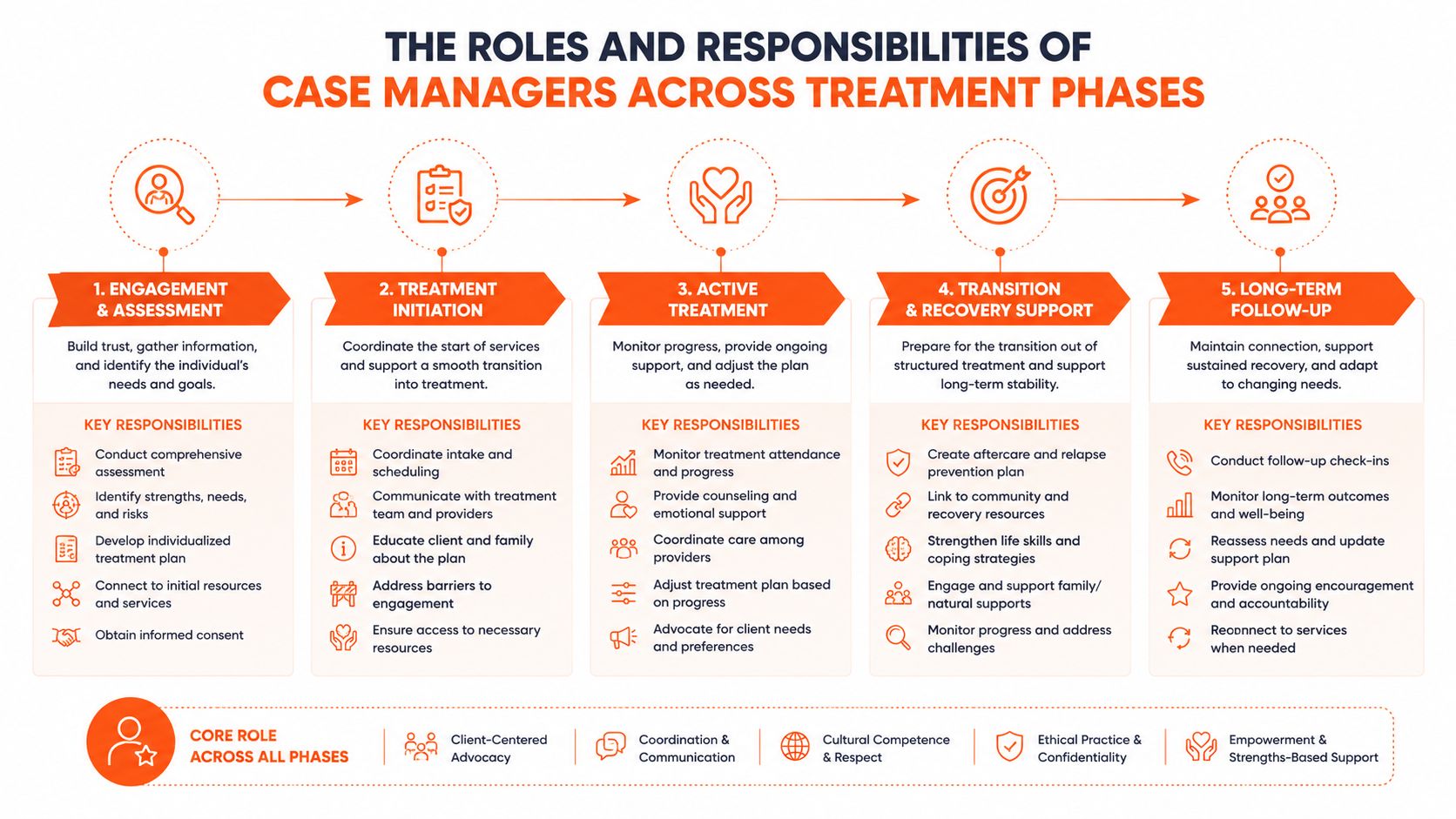
An infographic showing the five phases of case management and the key responsibilities of case managers.

The Roles and Responsibilities of Case Managers Across Treatment Phases

In detox, the case manager is usually the first person translating clinical needs into a usable plan. That starts with intake information, but it shouldn't stop there. A credible assessment needs to identify co-occurring mental health symptoms, family strain, legal pressure, and any work or licensure obligations that could create conflict once treatment begins.

During stabilization and residential care

Once the client is in detox or residential treatment, the case manager coordinates with psychiatry, nursing, and therapy so that medication changes, symptom reporting, and progress notes don't live in silos. The point is not to duplicate the clinician's job, it's to make sure the right people know what changed and why. That matters when a client presents differently in group therapy than they do during a private session, or when a psychiatric symptom needs to be tracked alongside substance-use recovery.

Family involvement also needs structure. Some clients need it, some need boundaries, and some need both at different moments in the same stay. The case manager helps decide when family contact supports recovery and when it complicates it, then keeps those decisions consistent across the care team.

For executives and licensed professionals

In executive or professional tracks, the role becomes more delicate because the client can't disconnect from every obligation. Selective communication may need to happen with a spouse, assistant, attorney, or licensing contact, but only with clear boundaries and confidentiality safeguards. The case manager protects the treatment plan while helping the client maintain essential continuity outside the facility.

That's also where a more boutique model can help. Capo Canyon Recovery describes a small-census residential setting, tech-friendly policies, and minimum weekly individual sessions across therapist, case manager, and psychiatry, which reflects the kind of frequent review these clients often need.

Aftercare starts before discharge

Discharge planning should begin while the client is still in treatment, not on the day they leave. The case manager coordinates outpatient therapy, recovery supports, sober living if needed, and follow-up touchpoints that can catch early disengagement. In serious addiction care, aftercare isn't a handout, it's a monitored transition.

How Executive Programs Deliver Case Management Differently

Boutique executive programs and large-volume facilities can both say they provide coordination, but the experience on the ground is very different. In a high-volume setting, a case manager may be covering too many clients to notice the subtle signs that someone is pulling back from treatment or avoiding an aftercare conversation. That's where standard coordination becomes reactive.

A small-census program can move differently. Fewer clients means more direct observation, more immediate plan changes, and more room for the case manager to work alongside the client instead of chasing them through a crowded schedule. It also makes it easier to coordinate private meetings, work accommodations, and family contact without turning every request into a delay.

Privacy and technology change the workflow

Executives don't just worry about substance use. They worry about exposure. A tech-friendly policy that allows phones and laptops means the case manager has to help set boundaries around work communication, not just confiscate devices and hope for the best. That includes deciding when a client can check in with the office, where they can work privately, and how to avoid turning treatment time into an always-on workday.

Private rooms, desks, and Wi-Fi support that model when they're used intentionally. They can help a client handle necessary tasks without sacrificing recovery structure. They can also reduce the friction that makes a high-profile person resist treatment in the first place.

The trade-off no one should ignore

Boutique care is not automatically superior. It works when the program uses the extra space to increase monitoring, deepen coordination, and keep confidentiality tight. If the smaller census only means a prettier setting, then it's not solving the problem.

A private room is useful. A private room with a coordinated plan is useful enough to matter.

Who Actually Receives Case Management and Who Falls Through the Cracks

A common assumption is that the clients with the biggest needs naturally get the most coordination. That isn't always true. In a Veterans Affairs audit, only 4% of RCMP members with a mental health disability condition received case management, compared with 40% of Canadian Armed Forces veterans with a similar condition, and the report identified RCMP clients with complex needs as a reach gap, according to the departmental audit and evaluation report on case management reach.

That gap matters in addiction treatment because the most complex clients are not always the easiest to keep engaged. Some are high-functioning, polite, and superficially compliant, which can mask the fact that they need more help than they request. Others avoid contact because they fear exposure, job consequences, or being seen as dependent.

The uncomfortable screening question

Who gets assigned a case manager first, the client with the loudest crisis or the one who disappears if no one reaches out? Programs that rely on self-advocacy alone tend to over-serve people who already know how to work through systems. High-need clients often need outreach, not just availability.

A PubMed study of homeless women found that about 56% had case managers, and having one was associated with better odds of using food stamps and finding shelter without difficulty, but not with improved access to WIC or reduced unmet medical needs, according to the PubMed article on case management and access among homeless women. That pattern is a warning, not a verdict. Case management helps with some access barriers, but it may miss the ones that require more assertive follow-up.

What good programs do differently

The better question is whether the program has a system for tracking who is drifting away before they leave the building or stop answering calls. That means the case manager should be looking for skipped meetings, delayed decisions, and vague discharge planning as warning signs, not benign inconveniences. It also means the program should know when standard coordination isn't enough and direct outreach is needed.

The Case Management Workflow from Intake Through Aftercare

The workflow starts before admission. Pre-admission coordination usually includes insurance verification, early screening, and some rapport-building so the client doesn't feel like they're walking into a blank process on day one. For executives, that early contact can also surface sensitive issues, such as confidentiality concerns, travel constraints, or whether outside communication needs to be filtered through a spouse, assistant, or legal representative.

Intake and assessment

At intake, the case manager helps make sense of the full picture. That includes substance-use history, but it should also identify anxiety, depression, trauma, bipolar symptoms, ADHD, and other co-occurring concerns that may need integrated psychiatric support. If those conditions are missed, the discharge plan usually becomes too narrow to hold.

Detox to residential transition

The handoff from medically supervised detox to residential programming is one of the most vulnerable points in care. The client may feel better physically, but still be mentally unstable, exhausted, or unsure about what comes next. The case manager keeps medication stabilization, therapy scheduling, and family communication aligned so the transition doesn't feel like a reset to zero.

Discharge and aftercare

Discharge planning should be active, not passive. Outpatient therapy, follow-up psychiatry, sober living when appropriate, and support group placement all need to be set up before the client leaves. In programs with a continuing-care model, a dedicated continuing care structure helps the client stay connected after discharge instead of treating graduation as the finish line.

A discharge packet is not aftercare. Real aftercare is scheduled, tracked, and followed up.

The best workflows include a plan for early warning signs. If the client starts missing contact, the case manager should know what the next step is, not wait until the situation has already worsened.

Privacy, Legal, and Insurance Considerations in Executive Case Management

For executives and licensed professionals, privacy isn't a side issue. It shapes whether they enter treatment at all. Modern case management platforms are increasingly built as cloud-based, web-based, API-enabled systems with role-based access control, encryption in transit and at rest, and audit trails, which matters because sensitive coordination has to happen without exposing every detail to every staff member. Public-sector procurement guidance also emphasizes browser access, mobile support, single-database storage, and high-availability design, plus a normalized data model with entities such as Case, Person, Task, Event, Document, Referral, Outcome, and Audit or History, all of which support traceability in regulated workflows.

That architecture has a direct clinical purpose. Staff need to coordinate with psychiatry, therapy, and aftercare while still protecting records from unnecessary access. For clients with reputational or licensing concerns, that balance is part of the treatment itself.

What to ask before admission

A referring physician or assistant should ask how the program handles HIPAA, 42 CFR Part 2, and requests from outside parties. Employers, licensing boards, attorneys, and family members may ask for information, but the program should have clear rules for what can be released, to whom, and under what authorization. If the answer is vague, the program may not be ready for high-profile cases.

Insurance is another gatekeeper. Some services are covered, some require private pay, and some clients need a blended arrangement. A solid case manager helps verify benefits, explain limits, and advocate when an insurer tries to cut the level of care before the client is clinically ready.

For a practical overview of coverage questions, Capo Canyon Recovery's insurance guidance is the kind of resource a family or assistant should review early, alongside the program's privacy policies and discharge process.

What quality looks like in practice

The test is whether the program can keep care moving without leaking information or losing the client between levels. Strong case management doesn't promise that every barrier disappears. It does reduce the chance that privacy failures, insurance friction, and weak aftercare coordination become the reason treatment falls apart.

If you're coordinating care for an executive, licensed professional, or high-profile client, ask for a treatment model that shows exactly who owns assessment, transition planning, confidentiality, and follow-up. Capo Canyon Recovery works with detox, residential care, and aftercare coordination in a private setting, so it's worth reviewing whether that structure fits the level of discretion and continuity your client needs. Visit Capo Canyon Recovery to start a confidential conversation about treatment coordination, privacy, and aftercare planning.

READ MORE
Uncategorized
August 06by 0 Comments

Modules of DBT: A Practical Guide to Each Skill

You can be in a quiet room, phone face down, trying to decide whether to answer the email, pour a drink, or text the person you just argued with. The craving is there, the shame is there, and your mind is already spinning through tomorrow's consequences. That's often the moment people start looking for the modules of DBT, because they don't need theory first, they need a way to get through the next hour without making the night worse.

Why DBT Is Taught in Separate Modules

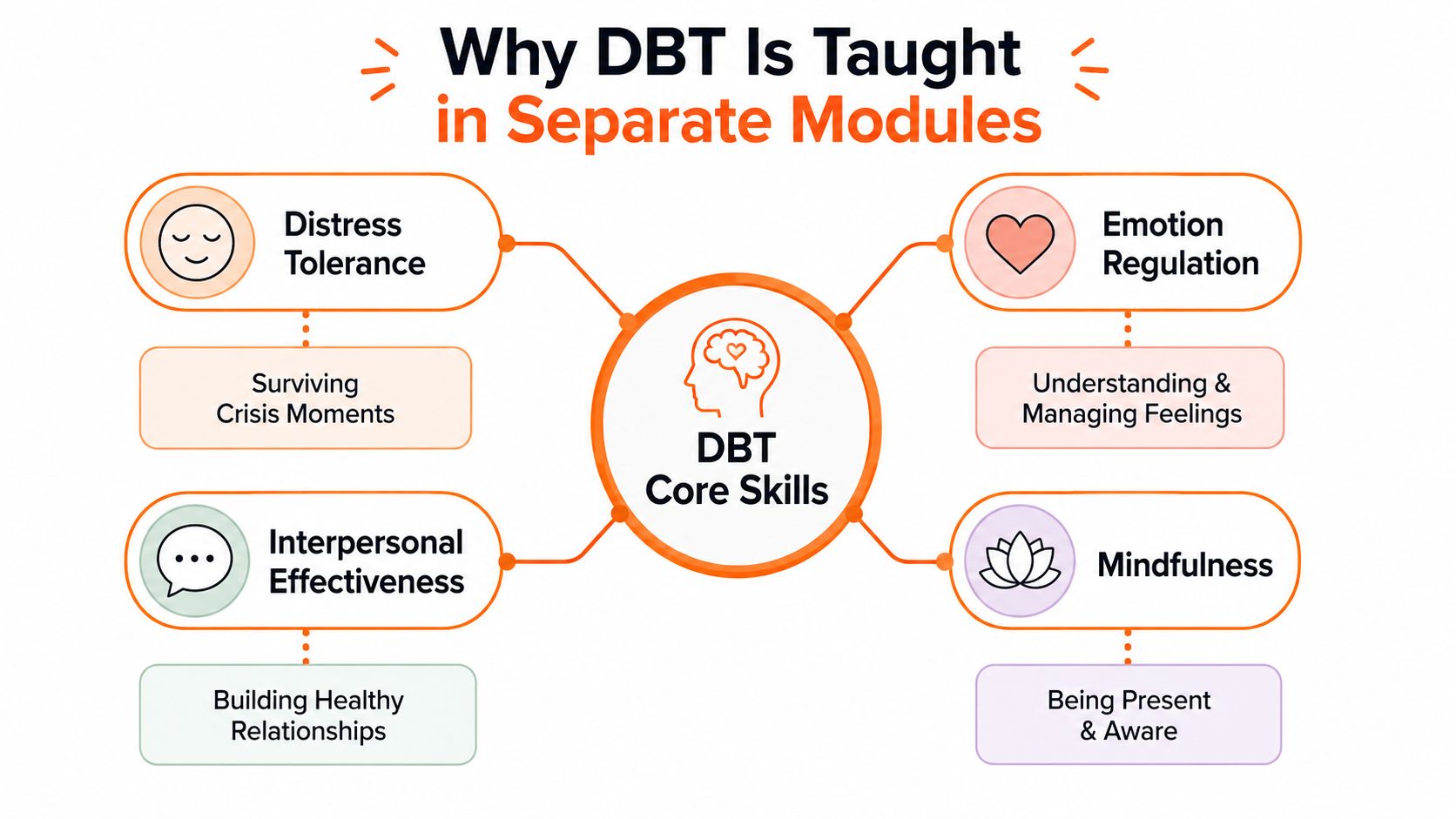
A client in early recovery usually doesn't have one problem. She may be fighting a craving at 11:30 p.m., replaying a humiliating relapse conversation, and dreading a tense message from work all at once. DBT breaks that overload into separate jobs, because staying present, surviving crisis, changing emotional habits, and handling relationships are different skills, not one skill with four names.

DBT's four skills modules are mindfulness, distress tolerance, emotion regulation, and interpersonal effectiveness. Yale Medicine describes the standard sequence as beginning with 2 weeks of mindfulness, followed by 5 to 7 weeks each for distress tolerance, interpersonal effectiveness, and emotion regulation, with the full skills sequence taking about 6 months and many patients repeating modules so the course lasts a year or longer. That modular structure is one reason DBT has moved beyond borderline personality disorder into use for substance use disorders, major depressive disorder, bipolar disorder, ADHD, and eating disorders (Yale Medicine).

A diagram illustrating the four core modules of Dialectical Behavior Therapy, including distress tolerance, interpersonal effectiveness, emotion regulation, and mindfulness.

Acceptance skills and change skills

The cleanest way to think about the modules of DBT is to split them into two jobs. Mindfulness and distress tolerance are acceptance skills, they help you notice what's happening and get through it without escalation. Emotion regulation and interpersonal effectiveness are change skills, they help you shape patterns that keep repeating.

That split matters in recovery. When someone is flooded, the first task is often not insight, it's stabilization. A private residential program can sequence the work the same way a clinician would think about it, first calming the nervous system, then helping the client make better choices once the intensity drops. Capo Canyon's overview of DBT describes the approach in that broader clinical context, which makes it easier to see how a treatment team can combine DBT with other care in a residential setting (Capo Canyon DBT overview).

Practical rule: if the client is panicking, the first question is “What keeps this from getting worse?” not “What caused every part of it?”

The separation into modules also helps people feel less lost. Instead of trying to memorize a giant workbook all at once, they learn one cluster of skills, practice it, and then move to the next cluster. That pace is especially useful for adults in residential care who are trying to manage withdrawal, shame, sleep disruption, and real-life obligations at the same time.

Mindfulness as the Foundation Module

Mindfulness is the first module because it gives clients something sturdier than impulse. It means noticing what's happening inside and around you without immediately obeying it. In early recovery, that might look like noticing, “My jaw is tight, my chest is hot, and I want to call my dealer,” before the craving turns into action.

DBT mindfulness is usually taught through the what and how skills. The what skills are to observe, describe, and participate. The how skills are to do that nonjudgmentally, one-mindfully, and effectively. Put in plain language, the module teaches people to notice facts, name them clearly, and stay with one task instead of getting yanked around by every thought.

If you want a quick practice, do this for two minutes. Sit still, breathe slowly, and name three things you can feel in your body, three thoughts that are present, and three urges that are active. Don't argue with any of them. Just label them, then return to the breath. A short exercise like that can make the difference between reacting on autopilot and buying yourself a few seconds of choice, which is often where recovery starts.

A meditation routine can support that habit when a person is detoxing, sleeping badly, or feeling emotionally raw, and Capo Canyon's recovery guidance on meditation fits naturally with that kind of grounding work (meditation during recovery).

What mindfulness looks like in daily recovery

In real life, mindfulness shows up in tiny decisions. You pause before opening a triggering text from a parent. You notice the exact minute a craving starts instead of calling it “bad luck” after the fact. You hear yourself getting defensive in a group session and choose to wait before speaking.

That's why mindfulness comes first in the modules of DBT. If a person can't notice the wave, the next skill doesn't have much to work with. Mindfulness doesn't solve every problem, but it creates the gap between feeling and acting, and that gap is often the first meaningful win in early sobriety.

Distress Tolerance for Surviving Crisis Moments

Distress tolerance is the DBT module for moments when you can't fix the problem yet. The bank is closed, the argument isn't resolved, the craving has hit hard, or it's 2 a.m. and your mind won't stop looping. This module doesn't promise relief on command. It teaches you how not to add gasoline to a painful moment.

The core skills that people actually use

The DBT distress tolerance toolbox includes TIPP, self-soothing, ACCEPTS, and radical acceptance. TIPP uses temperature, intense exercise, paced breathing, and progressive relaxation to bring the body down fast. Self-soothing uses the five senses. ACCEPTS helps with distraction through activities, contributions, comparisons, emotions, pushing away, thoughts, and sensations. Radical acceptance means stopping the fight against what already happened so you can respond instead of ruminate.

A person in early recovery might use TIPP after a wave of panic hits in the middle of the night. They might splash cold water on their face, do a brisk walk, slow the breath, then unclench the shoulders. If the urge is still loud, self-soothing can help, a warm shower, a clean blanket, a familiar scent, or soft music. If the mind keeps circling the same thought, ACCEPTS gives it somewhere else to go long enough for the urge to lose momentum.

When the crisis can't be solved tonight, the goal is to get through tonight safely.

This is why distress tolerance belongs with mindfulness as an acceptance-oriented module. Both are about stabilizing the moment instead of forcing a solution too early. That difference matters in detox and residential care, where clients often need a sequence of small, concrete steps before they're ready for deeper change work.

Emotion Regulation for Reducing Vulnerability

Emotion regulation is where DBT starts changing the pattern, not just surviving the episode. The module treats emotions as signals, not orders. A craving, a burst of rage, or a shame spiral may tell you something important, but it doesn't have to decide your next move.

From reactivity to intention

The first step is learning to identify and name emotions clearly. Many adults in early recovery skip that part because they're used to calling everything “stress” or “fine.” DBT slows that down. A client learns to check the facts before reacting, which means asking whether the feeling matches the situation or whether old assumptions are driving it.

Then comes opposite action, the skill that asks for the behavior opposite the emotion's urge when the facts don't justify the reaction. If shame says hide, opposite action may mean showing up. If fear says avoid, it may mean making the call. The point is not to deny emotion, it's to stop emotion from being the only voice in the room.

The PLEASE skill is the body-based part of the module. It reminds people to treat PhysicaL illness, balance Eating, avoid mood-Altering substances, balance Sleep, and get Exercise. That's not glamorous, but it's often the foundation of steadier mood in residential care.

For substance use specifically, emotion regulation matters because relapse is often tied to mood crashes, impulsive decisions, and shame after a slip. This module gives clients a way to notice the pattern earlier and interrupt it before the cycle tightens. In that sense, it pairs naturally with the interpersonal module, since many emotional blowups become relational blowups too.

Interpersonal Effectiveness for Relationships and Boundaries

Interpersonal effectiveness is the module that helps a person speak clearly without burning bridges or disappearing to keep the peace. That matters in families, in recovery groups, and in workplaces where reputation still counts. For executives and licensed professionals, it can be the difference between asking for support and spiraling.

Three goals at once

DBT frames this module around three goals, getting what you want, keeping the relationship, and maintaining self-respect. Many are used to choosing one of those at the expense of the others. They ask too aggressively and damage the connection, or they protect the relationship and abandon their own needs.

The DEAR MAN script helps with effective asking. It guides the speaker to describe the situation, express feelings, assert the request, reinforce the benefit, stay mindful, appear confident, and negotiate when needed. The GIVE skill helps preserve relationships through gentleness, interest, validation, and an easy manner. The FAST skill protects self-respect by keeping responses fair, not overapologizing, sticking to values, and being truthful.

A professional in recovery might use DEAR MAN to tell a colleague, “I can't take that client meeting at 7 p.m., but I can review the deck by noon tomorrow.” A parent might use GIVE to say no without becoming cold. A physician, lawyer, founder, or first responder may need FAST because shame can push them to say yes when they should be setting a limit.

Clinician's note: healthy boundaries sound calmer than most people expect, and they usually take fewer words than the old conflict style.

This module supports relational repair, which is often a hidden task of early sobriety. People may need to apologize, renegotiate roles, or ask for space while they stabilize. Interpersonal effectiveness gives them a structure so those conversations don't become another crisis.

How the Modules Are Sequenced in Real Programs

A person in early recovery may walk into treatment feeling flooded by cravings, shame, conflict, and a short fuse. In that state, a rigid syllabus can feel too abstract to use. Real DBT programs adjust the order of the modules so the person can get relief first, then build the next skill on top of that foundation.

Textbooks often present DBT as if everyone moves through the same track at the same pace. In practice, clinicians start where the person is most stuck. Yale Medicine describes a common sequence that begins with mindfulness, then moves through the other core modules over time, with repetition built in when a skill needs more practice (Yale Medicine). That pacing fits adults who are dealing with real-life instability, not classroom neatness.

Standard DBT Skills Modules at a Glance
Module Function Typical Weeks Example Skills
Mindfulness Notice and label experience without reacting 2 weeks Observe, describe, participate
Distress Tolerance Get through crises without making them worse 5 to 7 weeks TIPP, self-soothing, ACCEPTS
Interpersonal Effectiveness Ask, say no, and set boundaries 5 to 7 weeks DEAR MAN, GIVE, FAST
Emotion Regulation Reduce vulnerability and shift patterns over time 5 to 7 weeks Check the facts, opposite action, PLEASE

The order is not fixed when a person arrives in residential care with more than one problem at once. A client who is emotionally flooded may need acceptance skills earlier so they can stay in the room long enough to learn. Someone whose main struggle is impulsive conflict or weak boundaries may benefit from change skills sooner. Clinicians often observe that healthy boundaries sound calmer than people expect, because the goal is not to win an argument, it is to speak clearly and stay regulated.

Residential programs also sequence DBT around the realities of early recovery. A person may need a crisis skill before they can sit through a relapse trigger discussion, or a mindfulness practice before they can name what is driving the urge to use. In a private setting, that work can be paced around individual sessions, group sessions, and homework without forcing the person to pretend life is orderly. Programs that treat co-occurring disorders can also adapt the sequence for depression, anxiety, trauma, ADHD, or bipolar symptoms, which often change how quickly someone can absorb new material, as seen in dual diagnosis treatment at Capo Canyon.

The repetition matters. If a client cannot use a skill under stress, the answer is usually more practice, not a different label for failure. A treatment team may return to the same module after a rough week, or slow the pace when shame, fatigue, or cravings make new learning harder. That flexibility is one reason DBT modules fit residential care for executives and other adults who need privacy, schedule flexibility, and support that matches the shape of recovery.

Why DBT Modules Fit Substance Use and Co-Occurring Disorders

Clients often assume DBT is only for crisis-heavy psychiatric care. The fit is broader. People searching for the modules of DBT are often trying to make sense of alcohol use, drug use, depression, anxiety, trauma, ADHD, or bipolar symptoms that have made daily life feel unsteady. DBT fits that reality because each module addresses a different part of the recovery mess.

A balanced infographic comparing the pros and cons of using DBT modules for treating substance use disorders.

Why the fit is strong

A craving can arrive like a wave. Distress tolerance gives a person something concrete to do while that wave is passing. Mindfulness helps them notice the craving before it becomes automatic. Emotion regulation targets the impulsivity, mood crashes, and shame that often keep relapse going. Interpersonal effectiveness helps repair relationships that may have strained or broken during active use.

The skills themselves also have support in the research. A major 2024 systematic review and meta-analysis of stand-alone DBT skills training reported improvement in borderline personality disorder clinical severity, depression, and global psychopathology, along with a pooled dropout rate of 29%, which means about 71% retention. Analysts at PubMed reported those findings.

That matters in dual diagnosis care because early drop-off is common in many therapies. DBT's skills-first approach gives clients concrete actions before they are ready to examine every part of the story. For substance use treatment, that can be the difference between a person feeling flooded and a person staying long enough to benefit.

Capo Canyon's dual diagnosis treatment places DBT in that broader context, alongside care for co-occurring conditions and substance use.

What clients often misunderstand

DBT does not have to wait for a person to be in full psychiatric crisis. The modules can help with cravings, shame, conflict, and emotional flooding even when the full protocol is not the main focus. In early recovery, that is often the practical need, because a person may have to get through one intense hour before they can think about the whole week. Residential programs often rely on DBT for clients who need structure without losing flexibility.

What to Expect from DBT in a Private Residential Program

In a private residential setting, DBT usually shows up as part of a bigger clinical plan, not as a stand-alone class. A boutique program can weave the modules into individual therapy, group work, and psychoeducation, so the client learns the skill, practices it, and then talks through how it landed in real life. That matters for executives and professionals who need privacy, schedule flexibility, and the ability to stay connected to essential work responsibilities.

A numbered list infographic outlining the six core components of a Dialectical Behavior Therapy residential program.

How the setting changes the experience

Capo Canyon Recovery is a licensed detox and residential treatment center in Mission Viejo, Orange County. It serves a small census of approximately five clients at a time, which creates a more confidential environment than a large group census and allows for individualized attention. The program also supports cell phones and laptops, which can matter for professionals who can't disappear from critical responsibilities for weeks at a time.

DBT is also paired there with other evidence-based approaches, including CBT, ACT, EMDR, and Brainspotting, so the treatment plan can address both behavior change and the underlying material driving use. The setting includes individual therapy, group therapy, medication support, and case management, which helps the DBT skills land in a broader recovery routine rather than staying abstract.

A private residential program should also be able to answer practical questions clearly. Ask how the modules are sequenced, whether individual sessions happen alongside group, how the team adapts DBT for dual diagnosis, and how privacy is protected for licensed professionals or high-profile clients. Those questions matter more than marketing language because the test is whether the program can fit the modules to the client's actual life.

If you're comparing treatment options, ask for a clear explanation of how the modules of DBT would be used with your symptoms, your schedule, and your work obligations. If a private residential setting is the right level of care, start with Capo Canyon Recovery and ask how its DBT-informed approach is structured for executive privacy, dual-diagnosis support, and daily skill practice.

READ MORE
Uncategorized
August 05by 0 Comments

ADHD and Substance Abuse: A Guide for Executives

You've got the version of this problem that never shows up in public: the calendar is full, the board still expects answers, the inbox keeps moving, and you're using coffee, alcohol, cannabis, or something prescribed “just to get through the week.” The catch is that the thing that feels like a productivity problem may be ADHD and substance abuse showing up at the same time, and that combination changes what good treatment looks like.

Understanding the ADHD and Substance Abuse Connection

A senior leader can look polished on the outside and still be running on a shaky internal system. Deadlines get met, but only after late nights, escalating caffeine, or a quiet dependence on something that takes the edge off focus, restlessness, or overwhelm.

That pattern is easy to misread as stress management. In practice, it often reflects untreated ADHD symptoms colliding with a workplace that rewards speed, constant context-switching, and emotional control.

The clinical link is not subtle. In the U.S. National Comorbidity Survey Replication, 15.2% of adults with ADHD also met criteria for a substance use disorder, compared with 5.6% of adults without ADHD, according to SAMHSA's review of the evidence in this clinical summary. A peer-reviewed review summarized there also found 23.1% of people diagnosed with ADHD had a substance use disorder.

Practical rule: If a person with ADHD is also using substances to sleep, focus, calm down, or “take the edge off,” treat that as a dual-diagnosis question, not a character issue.

For executives and other high-functioning professionals, that matters because the outward signs can stay hidden for years. Performance masking can delay care, while the underlying pattern keeps getting reinforced by high stress, privacy concerns, and a culture that rewards pushing through.

ADHD treatment options for adults only make sense when the clinical picture is accurate. If substance use is part of the picture, the treatment plan needs to account for both conditions from the start.

The Scope of Co-Occurring ADHD and Addiction

A busy professional can look stable on the outside and still be carrying a substance problem that has been folded into daily routines. In ADHD care, that matters because the overlap is broad enough to change how screening is done, especially when the person is high-functioning and has learned to compensate.

Clinicians reviewing the evidence in the national behavioral health review note that people with ADHD were about 2 to 3 times more likely to develop nicotine, alcohol, marijuana, cocaine, or other substance use disorders than those without ADHD. The point is not that ADHD leads to addiction in every case. The point is that the risk is high enough to require active assessment, not casual reassurance.

An infographic showing that 25% of adults with ADHD have substance use disorders and 3x increased risk.

Why the numbers matter in practice

A Canadian nationally representative survey, summarized in Alcohol and Alcoholism, found lifetime SUD prevalence of 51.3% in adults aged 20 to 39 with ADHD, compared with 23.6% in peers without ADHD. Within that same sample, lifetime alcohol use disorder was 36% versus 19%, cannabis use disorder 23% versus 10%, and other drug use disorder 18% versus 5%.

Those differences are large enough to matter in day-to-day care. They point to a dual-diagnosis pattern that can hide in plain sight, especially in adults who are still meeting deadlines, traveling often, and keeping up appearances while relying on substances to stay organized, sleep, or decompress. A 2021 report summarized in the same source also described young adults with ADHD as 69% more likely to have had an SUD than those without ADHD.

What clinicians should take from that

The risk is not tied to one substance class. A population-based epidemiologic study found higher ADHD symptoms were associated with increased odds of regular nicotine use, multiple-drug use, and alcohol dependence, with odds ratios of 1.33, 2.54, and 3.58 respectively, as reported in Journal of Attention Disorders. The association held across ADHD subtypes, with no substance preference and no sex differences.

For executives and other professionals, that broad pattern changes the clinical question. “It's only wine at night” or “it's just marijuana” can still reflect a coping system that has become part of how someone manages attention, stress, and recovery after work. The substance may be socially normalized. The treatment question is whether it has become a stable workaround for untreated symptoms.

Most people do not present saying, “I have two disorders.” They present saying, “I can't shut my brain off,” or “I need something to get through the day.”

Why ADHD Increases Substance Abuse Risk

The mechanism is not mysterious once you look at behavior and reward together. ADHD creates problems with attention regulation, impulse control, and follow-through, while substances can temporarily mimic relief by changing how a person feels, focuses, or sleeps. That makes them feel like a fast solution, even when they worsen the underlying cycle.

A woman working at a desk filled with scattered papers and sticky notes while holding coffee.

Self-medication is often about function, not pleasure

People with untreated ADHD don't always use substances to “get high” in the way outsiders assume. They may be trying to quiet mental noise, blunt emotional reactivity, improve sleep, or force themselves into a workable state for a meeting, flight, presentation, or long day of decision-making.

That's why the self-medication pattern can stay hidden inside successful careers. An executive may say the alcohol helps them decompress, or the stimulant prescription helps them perform, while the issue is that their nervous system never learned a durable way to regulate attention and stress.

Why untreated ADHD keeps the loop going

Once the substance becomes part of the coping routine, it starts covering symptoms that should have been treated directly. The person gets short-term relief, then rebounds into worse organization, more fatigue, and greater frustration tolerance problems. That leads to more use, not less.

A useful way to think about it is this, substances can become a workaround for executive dysfunction. The workaround may help tonight, but it usually makes tomorrow harder.

If someone says a substance is the only thing that helps them focus, sleep, or tolerate work, that's often the point where a full ADHD assessment becomes essential.

The clinical implication is straightforward. You don't solve ADHD-driven substance use by preaching abstinence alone, and you don't solve ADHD by treating only the addiction. Both conditions need to be named, measured, and addressed in the same care plan.

The Assessment Gap in Addiction Treatment

Addiction treatment often assumes the diagnosis will be obvious once the substance use is stabilized. In real clinics, that assumption breaks down. ADHD can hide behind withdrawal, sleep loss, depression, anxiety, and the general chaos of early recovery.

An authoritative clinical review noted that undiagnosed ADHD in an SUD clinic population in south London was around 12%, according to NCBI Bookshelf. That's a meaningful missed-diagnosis rate in a setting where the condition should be on the checklist.

Why ADHD gets missed

The first problem is symptom overlap. Restlessness, distractibility, impulsivity, and poor sleep can all appear during withdrawal or early abstinence, which makes it easy to mistake chronic ADHD for a temporary recovery issue. The second problem is attribution bias, clinicians may assume every attention problem comes from substance use and stop looking.

That mistake has downstream costs. Untreated or unrecognized ADHD is linked to poorer engagement, more severe comorbidity, polydrug use, and suicidal behaviors in the review summarized by NCBI. For a professional trying to hold a career together, that can look like repeated partial recoveries, not one obvious crisis.

The treatment gap after diagnosis

A recent Penn State report found that in teens and young adults with ADHD, stimulant prescribing dropped after a substance use disorder diagnosis. Ongoing stimulant treatment fell by about 15%, and new stimulant prescriptions fell by more than 17%, as reported in Penn State Health News. That doesn't prove stimulants should always continue, but it does show how often treatment gets interrupted.

For executives, the practical risk is undertreatment. A person may enter recovery and lose access to ADHD care at the exact moment when executive function support matters most. That can destabilize work performance, increase shame, and make relapse more likely.

What dual diagnosis means in addiction care is simple in theory and often missed in practice. If both disorders are present, both have to be assessed with enough detail to separate chronic ADHD from substance-related symptoms.

Evidence-Based Treatment Approaches for Dual Diagnosis

Good treatment starts with sequencing, not guesswork. If substance use is active and destabilizing, the first goal is often safety and stabilization. If the person can't sleep, is medically unsafe, or is cycling through intoxication and withdrawal, ADHD medication decisions need to wait until the clinical picture is clearer.

What integrated care looks like

The strongest practical model is integrated care, because both disorders shape the other. A review in PMC reports that about one quarter of adults entering SUD treatment meet ADHD criteria, and that people with both disorders often have earlier onset, faster progression to SUD, more polydrug use, more hospitalizations, and lower adherence.

That's why a dual-diagnosis program needs to do more than label symptoms. It should coordinate psychiatry, therapy, monitoring, and relapse prevention in one plan instead of handing the person from one silo to another.

What treatment usually includes

A sound plan often combines medication management and psychotherapy, but the order matters.

  • Stabilize substance use first when needed. If alcohol, opioids, or another drug is driving medical instability, that has to be addressed before fine-tuning ADHD treatment.
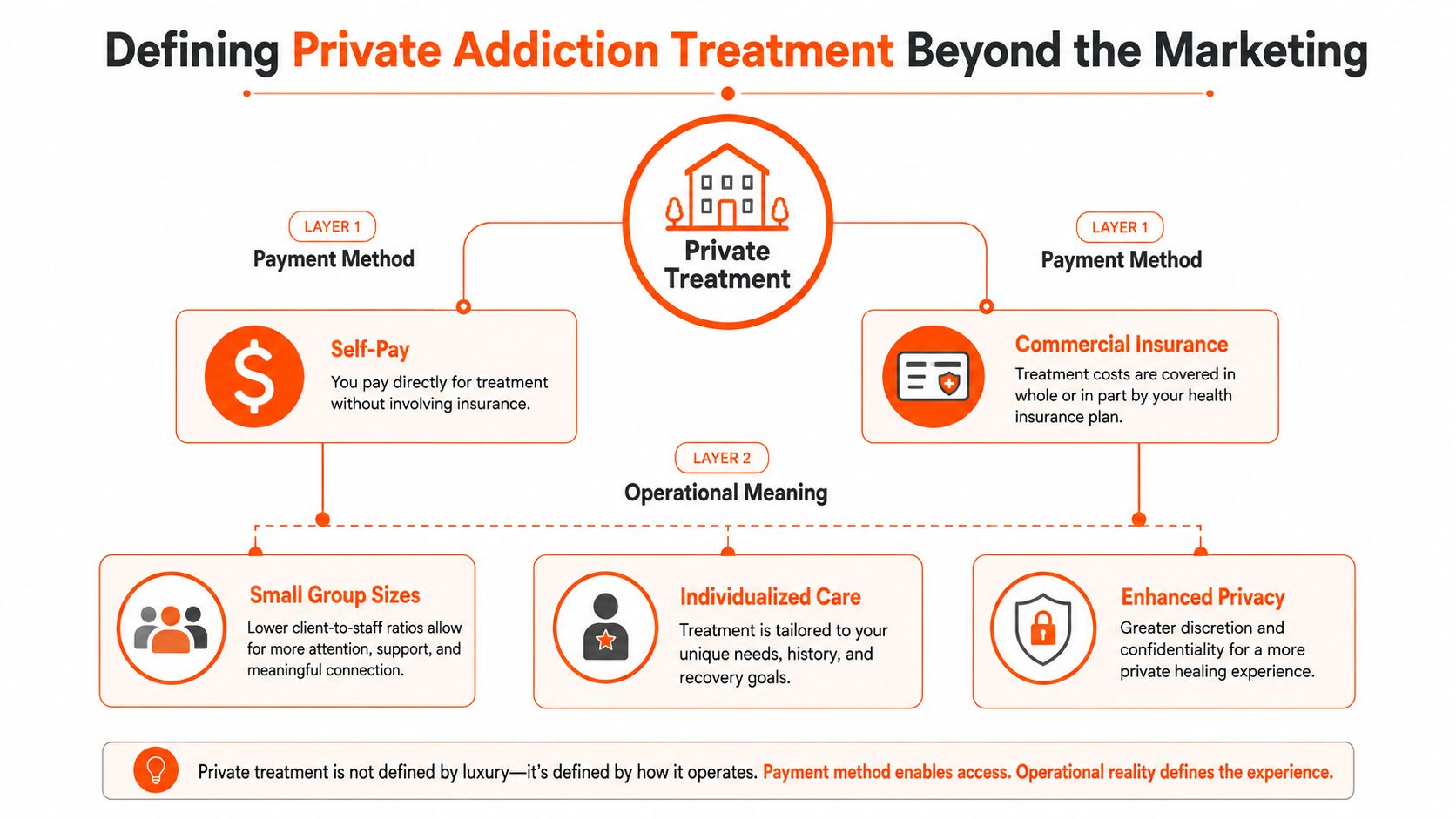
  • Reassess ADHD once withdrawal settles. That helps separate baseline symptoms from temporary recovery effects.
  • Use behavioral therapy alongside medication. CBT, DBT, and ACT can help with planning, emotional regulation, urges, and shame-driven avoidance.
  • Monitor closely for misuse or diversion. This is especially important in people with a history of stimulant misuse or high access to controlled substances.
  • Adjust over time. Dual diagnosis care isn't static, because work stress, sleep, travel, and recovery stability all affect symptom burden.

Medication can improve ADHD symptoms, but its effect on substance outcomes is inconsistent unless the SUD is already stabilized, according to the review above. That's the practical trade-off many programs don't say out loud. Treating the attention problem without managing the addiction can be premature. Treating the addiction while ignoring ADHD can leave the person unable to use recovery skills well enough to stay engaged.

A three-step evidence-based treatment approach infographic for managing dual diagnosis of ADHD and substance use disorders.

Executive and Professional Treatment Considerations

A senior partner who has been missing deadlines, drinking more after client dinners, and hiding stimulant use will not benefit from a program that expects him to step away from work without a plan. That is the reality for physicians, attorneys, founders, and senior managers, where treatment has to account for privacy, continuity, and the consequences of being absent.

A medically supervised setting can reduce the administrative burden while keeping care clinically focused. Capo Canyon Recovery is one example of a program that offers detox, residential treatment, dual diagnosis care, and an executive track with a tech-friendly policy that allows cell phones and laptops, which can matter for people balancing treatment with critical work obligations. For professionals who need treatment designed for professionals, an executive dual-diagnosis program can address both recovery and the practical demands of maintaining work responsibilities.

A businessman in a suit looks out of a high-rise window at a sunset cityscape.

Why privacy changes engagement

Executives often delay care because exposure feels riskier than symptoms. They worry about boards, partners, staff, clients, licensing boards, and reputation. If a program cannot protect confidentiality or lower the sense of public scrutiny, the patient may avoid care altogether or leave before treatment has time to work.

Small census and individualized attention matter because they reduce the feeling of being lost in a crowd. For a person who already struggles with attention, a high-volume program can become another system to track, and that can raise the chance of disengagement.

What to look for in a professional program

  • Dual-diagnosis capability so ADHD is not treated as an afterthought.
  • Medical oversight for detox, medication changes, and psychiatric monitoring.
  • Flexible access to work tools when the patient has unavoidable responsibilities.
  • Frequent individual therapy rather than relying only on group programming.
  • Clear medication monitoring so stimulants, non-stimulants, and other psychiatric medications are handled carefully.

The best fit is not always the most restrictive program. It is the one that can hold both realities at once, the need for real recovery and the need to remain functional in a demanding professional role.

Taking the Next Step Toward Integrated Recovery

If you're trying to decide whether your situation is “stress,” “burnout,” or something more complicated, look at pattern, not just intensity. Repeated self-medication, chronic disorganization, missed deadlines, sleep disruption, and a history of substance use together warrant a dual-diagnosis evaluation.

A good program won't force you to choose between protecting your career and getting honest clinical care. It will tell you how it screens for ADHD, how it handles active or recent substance use, how medication is monitored, and how the plan changes as sobriety stabilizes.

The right question isn't, “Can I keep working while I get help?” It's, “Can this program treat both conditions without making me less safe, less private, or less functional?”

For executives and other professionals, that answer has to include discretion, medical oversight, and a realistic plan for maintaining essential obligations. If a treatment team can't explain all three, keep looking.


Capo Canyon Recovery provides medically supervised detox, residential dual diagnosis treatment, and an executive track designed for professionals who need privacy and limited disruption to essential work. If you're evaluating care for ADHD and substance abuse, visit Capo Canyon Recovery to review how its program supports stabilized recovery while accommodating the realities of professional life.

READ MORE
Uncategorized
August 04by 0 Comments

Substance Induced Psychosis: Signs, Causes, Treatment

You can be in a board meeting, on a flight, or staring at your inbox at 2 a.m. and still know something is off. A colleague says you've sounded guarded, your sleep is broken, and small details feel loaded with meaning. For many high-functioning adults, that's the point where substance induced psychosis stops being a distant clinical term and becomes a real safety issue.

This condition can look like panic, burnout, intoxication, or a “bad reaction,” but it's more serious than any of those labels suggest. It's a psychiatric emergency that needs medical evaluation, not a wait-and-see approach. In real-world care settings, it shows up often enough that clinicians screen for recent substance exposure as part of first-line psychosis assessment, because SIP accounts for a meaningful share of first-episode psychoses entering care and can appear in up to 25% of first hospital admissions for psychosis (Cambridge Psychological Medicine).

Understanding Substance Induced Psychosis

A senior executive can look “fine” on the outside and still be sliding into psychosis on the inside. They may keep presentations polished, keep travel schedules intact, and still become convinced that coworkers are talking about them, that emails contain hidden messages, or that someone is watching their home. That gap between external performance and internal reality is one reason substance induced psychosis gets missed early.

What It Is, and What It Isn't

Substance induced psychosis means hallucinations, delusions, confused thinking, or severe paranoia that arise in the context of substance use, withdrawal, or medication exposure. It is not the same thing as ordinary intoxication, and it's not just a “rough night” or a temporary change in mood. It's also different from a panic attack, though the two can overlap in how terrifying they feel.

The key issue is timing. Symptoms appear in connection with the substance, and they can outlast the period of obvious intoxication. That's why clinicians treat the situation seriously even when the person is articulate, employed, and able to keep up appearances.

Practical rule: if reality testing is breaking down, the safest assumption is that the person needs urgent psychiatric evaluation, not more reassurance.

The term also matters because it helps families and employers stop guessing. A person isn't “choosing” bizarre beliefs, and they aren't being dramatic. They're experiencing a disturbance in perception and thought that can escalate quickly without treatment.
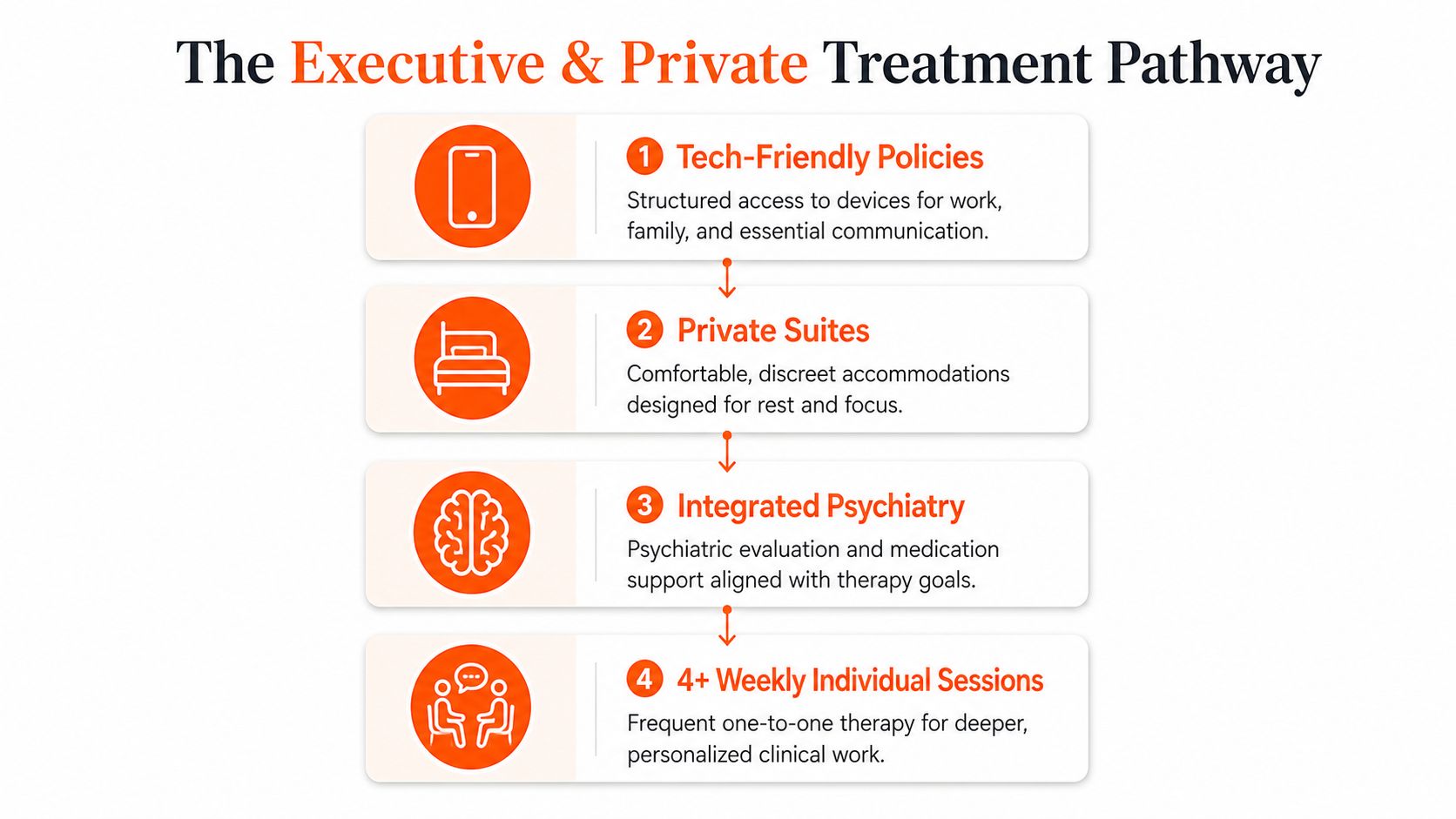
Why High-Functioning People Miss the Warning Signs

Professionals often compensate well at first. They delegate, overwork, isolate, or explain away odd experiences as stress, jet lag, or lack of sleep. That can delay care until the symptoms become obvious, public, or dangerous.

A common misconception is that psychosis only happens after years of obvious addiction. The data don't support that simplification. In Scandinavian registry and catchment-area studies, annual incidence rates were about 6.5 to 14.1 per 100,000 person-years, and SIP accounted for 6.5% to 10.3% of first-episode psychoses entering early intervention services (Cambridge Psychological Medicine). That means clinicians are not dealing with a rare curiosity. They're dealing with a real pattern in acute psychiatric care.

How Different Substances Trigger Psychotic Episodes

Different drugs strain the brain in different ways, so the clinical picture is not the same from one substance to the next. A person who becomes suspicious after stimulants may need a different stabilization plan than someone who becomes disoriented after a hallucinogen, a dissociative, or sedative withdrawal. Contemporary reviews describe substance-specific and polysubstance risk as a major issue in modern care, especially with cannabinoids, amphetamines, cocaine, hallucinogens, alcohol, nicotine, kratom, cathinones, and some medications (Open Psychology Journal).

A diagram illustrating how different substances like stimulants, hallucinogens, sedatives, and cannabis trigger psychotic episodes.

The Brain Pathways Are Not the Same

The best-supported mechanisms differ by class. Stimulants and cathinones primarily increase synaptic dopamine, cannabis-related agents act through CB1 receptor agonism, classic psychedelics act via 5-HT2A agonism, and dissociatives such as ketamine and PCP produce psychosis-like states through NMDA receptor antagonism (PMC review). A senior executive may describe the experience as stress or burnout, but the underlying biology can point in very different directions.

That difference matters at the bedside. Dopamine-heavy episodes tend to look like paranoia, hallucinations, and formication, the crawling-skin sensation some people describe. Psychedelic states more often bring visual distortions and dissociation. NMDA blockade can create both positive and negative symptoms, plus behavioral disturbance. For families and colleagues, it may all look like someone is “not themselves,” while the clinical team is trying to identify which system has been pushed out of balance.

Clinical insight: the symptom profile often gives a clue about the dominant neurochemical disturbance, which helps the team choose the right level of observation and medication.

Why Stimulants and Cannabis Need Special Attention

For stimulants, the mechanism is especially direct. Amphetamines raise dopamine in the synaptic cleft by blocking reuptake and reversing transporters, while also increasing intracellular dopamine and norepinephrine, which can drive striatal hyperdopaminergia and downstream cortical glutamate release (PMC stimulant review). Repeated or high-dose exposure can sensitize D2 signaling, so symptoms may continue after the person has stopped using the drug. When stimulants are mixed with sleep loss, pressure to perform, or private self-medication, the risk rises further. For a worried family member, understanding ativan withdrawal timelines can also help distinguish stimulant-driven agitation from benzodiazepine withdrawal, which can produce a very different kind of instability.

Cannabis is different, but it is not benign. Reviews of Substance-Induced Psychosis consistently identify cannabinoids as psychotogenic, and modern high-potency products complicate the picture because the user may not know how much exposure they've had (Open Psychology Journal). Polysubstance use makes the picture even murkier, because the brain is not reacting to one clean variable. In practice, that is often the challenge with high-functioning professionals, the substance exposure may be hidden, the schedule may still look intact, and the psychosis can be mistaken for stress until it is no longer subtle.

Recognizing the Warning Signs and Symptoms

The early signs are often subtle enough to get rationalized away. A partner may notice the person sleeping far less, jumping from idea to idea, or becoming suspicious of harmless comments. A colleague may see missed deadlines, odd interpretation of normal feedback, or abrupt withdrawal from a usually social routine.

An infographic titled Recognizing the Warning Signs and Symptoms, contrasting early warning signs and active psychotic symptoms.

Early Signals Families and Teams Often Notice First

These warning signs don't prove psychosis by themselves, but they should lower the threshold for a psychiatric check. The person may become guarded, sleep poorly, or start reading threat into ordinary interactions. They may also seem unusually preoccupied, detached, or difficult to redirect.

  • Paranoia: The person starts assuming others have bad intentions without evidence.
  • Confused thinking: They lose track of conversations, goals, or ordinary sequence.
  • Hallucination-like experiences: They may mention seeing or hearing things others don't notice.

The reason these signs matter is simple. A person who still appears high-functioning can still be losing contact with reality in specific moments, and those moments can become longer and more frequent.

Symptoms That Need Immediate Medical Attention

Once the person is describing fixed false beliefs, hearing voices, or speaking in a way that doesn't connect logically, the situation is urgent. Severe agitation is especially concerning because it can raise the risk of accidental harm, conflict, or medical complications. The literature on acute management notes that some presentations need only monitoring, while stimulant- or agitation-driven cases may require short-term antipsychotics and sometimes benzodiazepines (Open Psychology Journal).

  • Delusions: Strong beliefs that are clearly false and not corrected by evidence.
  • Disorganized speech: Thoughts come out in fragments or abrupt shifts.
  • Agitation: The person seems unable to settle, reason, or safely engage.

If the person is a professional who insists they're “still functioning,” don't let that reassure you. A person can answer emails, attend meetings, and still be psychotic.

Substance Induced Psychosis vs Primary Psychotic Disorders

The fear I hear most often from families is blunt. “Does this mean schizophrenia?” The honest answer is that one episode of psychosis does not automatically mean a lifetime diagnosis, but it does mean the person needs careful follow-up.

Feature Substance Induced Psychosis Primary Psychotic Disorder
Typical timing Appears around substance use, intoxication, withdrawal, or medication exposure Develops independently of substance exposure
Course Often improves after the substance clears and the person stabilizes Persists across time and usually needs long-term management
Key clue Symptoms line up with recent use and may recede with sobriety Symptoms continue during sobriety or recur without substance use
Diagnostic focus Recent substance history, toxicology, and observation over time Symptom persistence, functional decline, and broader psychiatric history

The difference that matters most is sobriety. If symptoms disappear when the substance is gone, that supports SIP. If they continue or return without new exposure, clinicians worry about a primary psychotic disorder or an underlying vulnerability that the substance exposed rather than caused.

For families who are also sorting out co-occurring use and mental health symptoms, dual diagnosis treatment for executives is a useful framework to understand why both problems have to be addressed together.

The Evaluation and Diagnosis Process

The evaluation starts with safety, not labels. A good clinician wants to know what was used, when it was used, whether there's been sleep loss, and whether any medical issue could be driving the presentation. That includes collateral information from family, partners, or coworkers, because someone in psychosis may not give a reliable history.

A five-step flowchart illustrating the medical evaluation and diagnosis process for substance induced psychosis.

What Clinicians Usually Look At First

The first pass is a broad medical screen. That can include a physical exam, psychiatric interview, and toxicology testing, with neurological assessment if the picture is unclear. The purpose isn't to “catch” the patient. It's to rule out other causes and confirm whether substances are part of the picture.

  1. Initial consultation. Clinicians collect a detailed medical and substance-use history.
  2. Physical exam. They look for signs that another medical condition is involved.
  3. Psychiatric interview. They assess thoughts, speech, perception, and behavior.
  4. Laboratory tests. Urine or blood screening helps identify recent substance exposure.
  5. Diagnostic criteria review. The team compares findings against standard psychiatric criteria.

Privacy Matters, Especially for Professionals

Executives and licensed professionals often delay care because they fear exposure more than symptoms. They worry about board notifications, employer contact, and reputational fallout. In practice, a confidential, medically supervised setting can lower that barrier and make honest disclosure more likely.

The most useful information is often what the patient is embarrassed to say first.

That's why direct, nonjudgmental questions matter. Did sleep disappear before the paranoia started? Was there a stimulant binge? Was cannabis used daily? Those details can change the diagnosis and the care plan.

Treatment Approaches for Acute and Long-Term Recovery

Acute treatment starts with stabilization, not lectures. If someone is frightened, disorganized, or agitated, the first job is to keep them safe, hydrated, monitored, and medically assessed. In severe cases, short-term antipsychotic medication can reduce hallucinations and delusions, and benzodiazepines may be used cautiously when agitation is intense (Open Psychology Journal).

Acute Care and What Comes After

Once the immediate crisis settles, the plan has to address the underlying pattern of use. Detox alone doesn't teach someone how to respond to stress, travel, insomnia, pressure, or the habits that kept the substance cycle going. Without that work, recurrence stays on the table.

Effective care usually combines several layers:

  • Medically supervised detox: This matters when withdrawal or intoxication is part of the problem, especially if the person needs 24/7 nursing and psychiatric oversight.
  • Medication management: Antipsychotics, sleep support, and careful monitoring can help symptoms settle.
  • Individual therapy: CBT, DBT, trauma-focused work, EMDR, ACT, and Brainspotting can be matched to the person's triggers and coping style.
  • Family involvement: Loved ones often need coaching on boundaries, observation, and communication.
  • Integrated psychiatric care: Co-occurring anxiety, depression, bipolar symptoms, ADHD, or trauma need treatment too.

The reason integrated treatment matters is straightforward. If the person keeps using to manage insomnia, panic, or shame, the psychosis risk doesn't really go away. If the psychotic symptoms are treated while the substance use driver is ignored, relapse becomes more likely.

When Symptoms Don't Resolve Quickly

Some people improve quickly once the substance clears. Others don't. Persistent symptoms need a deeper psychiatric reassessment, because the substance may have uncovered a vulnerability that now needs ongoing care.

That's where setting matters. A discreet residential program, or in some cases a specialized dual-diagnosis setting like Capo Canyon Recovery's executive treatment track, can provide medication monitoring, therapy, and work-sensitive structure without forcing the person to choose between care and every professional responsibility.

Why Executives Need Discreet, Tech-Friendly Treatment

Executives don't just fear treatment, they fear interruption. They worry about leaving a business at a critical moment, losing access to essential communication, or exposing a private struggle to people who don't need to know. Those concerns are real, and they're a major reason some high-functioning professionals delay care until the situation becomes more severe than it needed to be.

A professional man in a business suit consults with a doctor via a video call on his laptop.

What a Work-Compatible Setting Actually Solves

A tech-friendly, private setting does more than preserve convenience. It makes it easier for a person to enter care before the crisis escalates into a public or legal problem. Private bedrooms, Wi-Fi, workspace access, and a policy that allows essential phone and laptop use can keep a patient connected to core responsibilities while still giving the team room to stabilize symptoms.

That matters because treatment adherence improves when the patient doesn't feel forced into an all-or-nothing choice. For a physician, attorney, founder, or senior manager, the ability to answer a limited set of critical messages can be the difference between stepping into treatment now and waiting until the situation gets worse.

What to Look For in a Program

  • Small census: Less noise, more privacy, and more individualized attention.
  • 24/7 medical oversight: Especially important if intoxication, withdrawal, or agitation is part of the picture.
  • Psychiatric support on site: Psychosis needs real psychiatric assessment, not just generic counseling.
  • Flexible communication policies: Essential for continuity of work and family contact.
  • Private rooms and workspaces: They reduce stress and support recovery routines.

For some people, that combination is the only realistic way to accept help early. It also reduces the pressure to hide symptoms, which is one of the biggest barriers in this population.

Prognosis, Prevention, and Moving Forward

A client I think about often was doing everything right on paper, until sleep loss and stimulant use tipped him into paranoia. He got help quickly, accepted monitoring, and stepped away from the substance that had been driving the crisis. He didn't need a perfect life plan, he needed a safer one.

Prognosis depends on the substance, the severity of the episode, and whether symptoms stop when the drug is removed. The most important prevention step is straightforward, sustained abstinence from the trigger substance, followed by psychiatric follow-up if symptoms linger or return. Families can help by watching for sleep loss, social withdrawal, and suspicious thinking, then acting early instead of arguing with the content of the delusion.

Recovery is possible, but it works best when it's treated as a medical issue with behavioral consequences, not a moral failure. If you recognize these signs in yourself or someone you care about, don't wait for a crisis to become obvious. Get an urgent psychiatric assessment and choose a setting that can handle both the substance issue and the mental health risk.


If you're trying to figure out what kind of care fits a private, high-responsibility life, Capo Canyon Recovery provides medically supervised detox, residential treatment, and dual diagnosis support in a confidential setting. Their executive-friendly model is built for people who need psychiatric care without losing sight of work obligations, privacy, or family communication.

READ MORE
Uncategorized
August 03by 0 Comments

Withdrawals from Ativan: Timeline, Risks, and Safe Detox

You've been taking Ativan for months, maybe longer, and the dose that once felt like a quiet backup plan now feels like a decision. You're not just asking whether you can stop, you're asking whether you can step away without shaking in a meeting, missing sleep before travel, or explaining anything to the people around you. That hesitation is rational, especially when privacy, reputation, and the original anxiety all sit in the same room.

A lot of high-functioning people reach this point after a stretch of prescribed use for anxiety, insomnia, or a period of intense work pressure. The question isn't whether the medication helped. The question is what happens when your nervous system has adjusted to it and you try to remove it. For some people, that adjustment shows up as withdrawals from Ativan, and the pattern can be fast, uncomfortable, and harder to predict than they expected.

The Executive Facing an Ativan Decision

A senior leader rarely looks for Ativan withdrawal information because they want a generic detox explanation. They're usually trying to answer a more private question, one they may not even say out loud in the first call. Can I taper off without losing composure at work, and who, exactly, would know if I needed help?

That's a different problem from “I'm uncomfortable.” It involves calendars, board meetings, investor calls, travel, and the fact that a visible lapse can create more stress than the medication was originally meant to solve. It also means the fear of withdrawal is not irrational fear, it's often a realistic assessment of what an unstable week could cost professionally. For some people, that's the moment they start looking at a confidential rehab pathway instead of trying to do this in silence.

What usually changes first

The early sign isn't always dramatic. Many people notice that a dose they used to skip now feels noticeably harder to miss, or that sleep gets thinner and more fragile when travel, stress, or a late-night email pile up. That doesn't prove addiction by itself, but it does suggest the body may have begun to rely on the drug.

Practical rule: when a medication starts shaping your schedule, your sleep, and your sense of control, the decision is no longer just about convenience.

There's also a common split between two fears. One fear is medical, the possibility of symptoms. The other is social, the possibility that asking for help means losing privacy or authority. Those concerns deserve to be treated as part of the clinical plan, not as excuses or vanity.

The most useful next step is not to “push through” a rough week and hope for the best. It's to figure out whether your history suggests a low-risk taper, a medically supervised outpatient taper, or a higher level of monitored care. That judgment depends on your dose, duration, and what else is in the picture.

What Ativan Does and Why Withdrawal Happens

Ativan, or lorazepam, strengthens the calming effect of GABA, the brain's main braking system. In practical terms, it quiets an over-alert nervous system. FDA labeling lists lorazepam's elimination half-life at about 12 hours in official prescribing information, which helps explain why withdrawal can show up sooner than many people expect, especially when a schedule is already under strain.

The simplest way to understand it is through the body's own adjustment. If a system has been running with outside support for long enough, it stops behaving as if that support is optional. Remove it too fast, and the nervous system does not glide back to baseline, it swings the other way for a while.
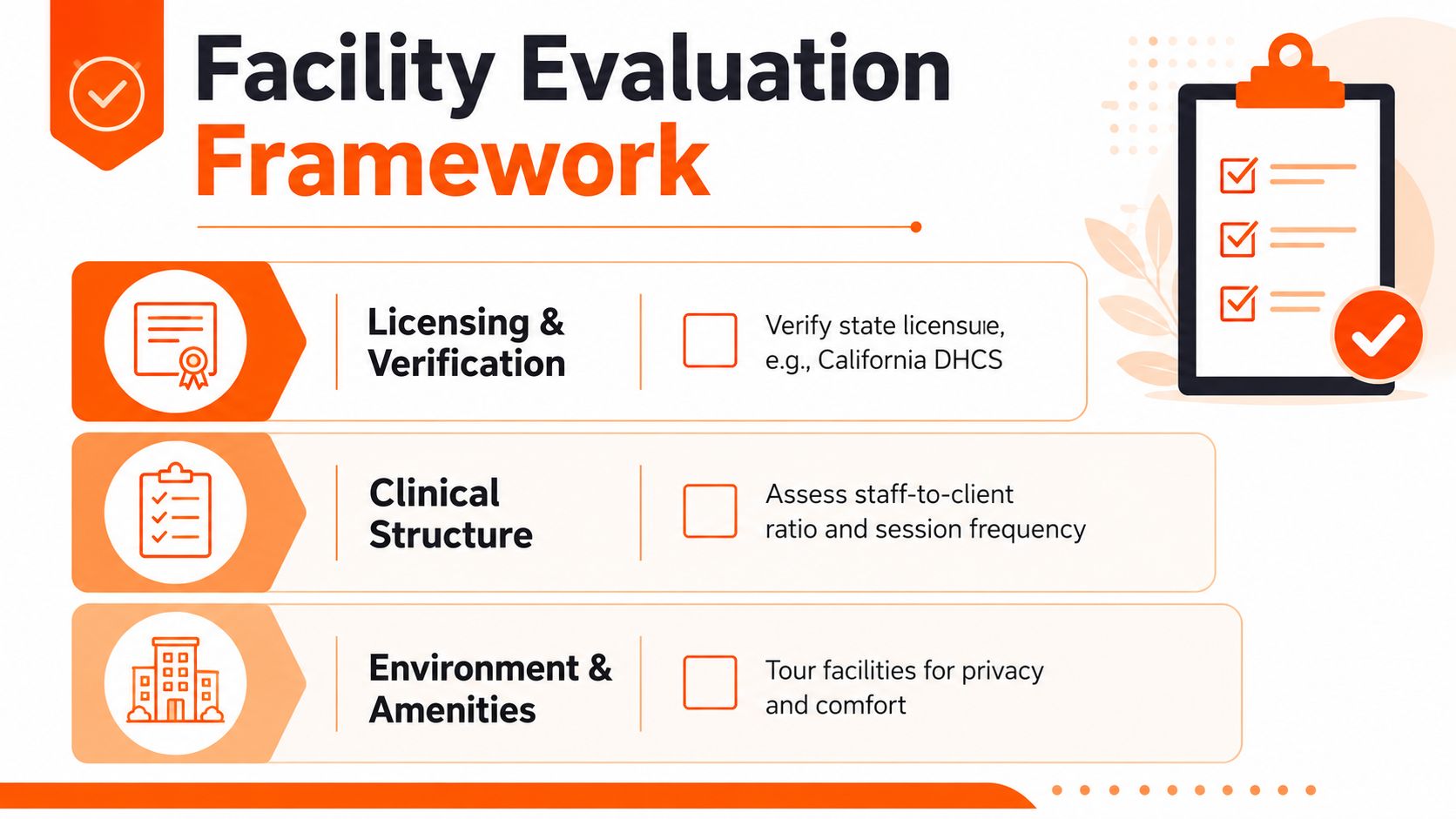
Ativan does that to the nervous system. The brain adapts to the drug being present, then reacts when the drug is removed. That reaction is withdrawal, and it is a physiological response to a changed chemical state, not a character flaw or a lack of discipline.

A timeline graphic illustrating the three phases of Ativan withdrawal, including symptoms and duration of each phase.

The mechanism in plain English

When someone uses Ativan repeatedly, the brain stops assuming the drug will always be available. That adaptation is why the first signs can be rebound anxiety, insomnia, or a body that feels louder than usual. The main point is simple, withdrawal reflects adaptation, not weakness.

For readers trying to judge their own risk, understanding whether you may be addicted to benzodiazepines is part of the decision, because dependence can develop even when the medication started as a legitimate prescription. The FDA also notes that withdrawal risk rises with higher dose, longer duration of use, and abrupt dose reduction in safety labeling changes for lorazepam. That matters for professionals who assume a prescribed dose stays safe just because it was appropriate at the start.

Withdrawal is the brain's overcorrection after being held calm by a benzodiazepine.

That sentence often helps when explaining the situation to a spouse, partner, or colleague, because it makes clear why the problem feels physical as well as mental. It also explains why tapering works better than stopping cold. The brain adjusts more safely when the change is gradual.

The Ativan Withdrawal Timeline You Can Plan Around

An executive who has been taking Ativan on a regular basis usually wants one answer first, how much time needs to be protected. The timing matters because Ativan is relatively short-acting, and clinical summaries note that withdrawal can begin within 8 to 24 hours after the last dose, with acute symptoms often lasting about 1 to 4 weeks. People often expect day one to be the hardest day, but the course can shift depending on dose history, tapering, and how quickly the nervous system reacts.

The first phase is onset. A person may feel more anxious, sleep less, or notice a faster pulse before the day is over. The next phase is acute withdrawal, where symptoms can intensify and the nervous system feels less forgiving. After that comes the longer tail, which is where many readers get confused because they assumed the worst should already be behind them.

Acute and protracted phases are not the same problem

Population data show that benzodiazepine withdrawal is common, not rare. One review estimates that 50 to 80% of people who take benzodiazepines continuously for a few weeks or longer experience withdrawal symptoms when the dose is reduced, while a smaller share experience severe withdrawal. Another commonly cited estimate is that about 40% of people who have used benzodiazepines for more than six months develop moderate to severe withdrawal symptoms if they stop abruptly.

That does not mean every patient follows the same course. It means planning for withdrawal is reasonable, especially when privacy, work obligations, and the fear of being visibly out of commission are part of the decision. The acute phase can be intense, but the longer phase is where people start doubting themselves because the symptoms recur in waves instead of staying fixed.

Reviews also summarize that roughly 10 to 25% of long-term benzodiazepine users may experience protracted withdrawal, where symptoms can recur intermittently for months and, in some cases, resolve within about a year, as noted in consumer clinical summaries of the literature. That is one reason “I felt better for a few days” does not always mean the process is finished.

Phase Typical window What it can feel like
Onset 8 to 24 hours after the last dose Anxiety, insomnia, palpitations
Acute phase About 1 to 4 weeks Rebound symptoms, escalating discomfort, unstable sleep
Protracted phase Months or longer in some cases Lingering anxiety, cognitive fog, mood swings that fade gradually

For many executives, the operational lesson is simple. Do not schedule a critical public-facing week around the first few days after stopping a short-acting benzodiazepine. The curve can move faster than your calendar does.

Why Withdrawal Severity Varies From Person to Person

Two executives can take the same Ativan dose and have very different withdrawals. One may get through a taper with manageable insomnia and anxiety. Another, with a longer pattern of nightly use, may face agitation, rebound symptoms, and a harder return to normal sleep. The question is not whether withdrawal can happen, but how much nervous system adaptation has already taken place, and how much privacy risk a person is willing to accept while finding out.

Several factors shape the course. Dose matters, but so do duration, age, other medications, and whether the person is stopping on their own or under supervision. The FDA has warned that withdrawal can appear after recommended doses after as little as one week in lorazepam safety labeling changes, so a prescription taken exactly as written still does not guarantee a mild taper. For an executive who is trying to stay functional and out of view, that uncertainty is the problem.

A person on a short, stable course is not in the same position as someone who has used Ativan nightly for months and then stops suddenly. Co-occurring opioid exposure changes the safety picture, and alcohol use can make withdrawal harder to control. The more the brain is asked to adjust at once, the less predictable the outcome becomes.

What changes the odds

Risk factor Why it matters Direction of risk
Higher dose More physiologic adaptation to reverse Higher
Longer duration The brain has had more time to compensate Higher
Abrupt reduction The nervous system has no buffer Higher
Co-occurring opioid exposure Safety concerns rise when sedatives and opioids overlap Higher
Co-occurring alcohol exposure Withdrawal and instability can become harder to manage Higher

The most important issue is safety, not just comfort. A JAMA Network Open study of more than 350,000 adults on stable long-term benzodiazepines found that discontinuation was associated with a 1-year mortality incidence of 5.5% in patients without opioid exposure versus 3.5% in nondiscontinuers, an absolute difference of 2.1 percentage points. Among patients with opioid exposure, mortality was 6.3% versus 3.9%, an absolute difference of 2.4 percentage points. The study also reported higher rates of nonfatal overdose, suicidal ideation, and emergency department use after discontinuation.

Those findings do not mean tapering should be avoided. They mean the plan should be deliberate, supervised, and matched to the person's actual risk. For the executive reader, the useful question is whether the taper is being designed around your history, your job demands, and your privacy constraints. A plan like that usually starts with a structured benzodiazepine taper, not with guesswork.

Tapering, Outpatient Detox, and Residential Detox Compared

A self-managed taper can feel discreet and efficient, which is why many executives start there. It also leaves you alone with the part of withdrawal that can worsen after you have already committed to the plan. If symptoms spike, there is no same-day reassessment unless you arrange it yourself.

A comparison chart showing three detox paths for addiction: self-managed, outpatient medical taper, and residential detox options.

Outpatient medical tapering sits between self-management and residential care. It gives you prescriber oversight, medication adjustments, and someone to contact when symptoms change. That can be a good fit for lower-risk cases, but it still depends on the person staying medically stable at home and handling the days between visits without a setback.

How the settings differ in practice

Setting What it offers Main limitation
Self-managed taper Full privacy, full control No clinical backstop if symptoms escalate
Outpatient medical taper Prescriber guidance, periodic monitoring Limited response to sudden instability
Residential detox 24/7 nursing and psychiatric support Requires stepping away from normal life temporarily

A supervised residential setting matters most when withdrawal severity is hard to predict, when co-occurring conditions need active stabilization, or when the home environment does not support rest and consistency. In that setting, autonomic signs, sleep disruption, and psychiatric symptoms can be monitored closely instead of being inferred between appointments.

For readers comparing options, a benzodiazepine taper can follow different clinical paths depending on the level of care becomes less about finding a universal schedule and more about matching the setting to the risk. A short taper after limited use is a different clinical problem from withdrawal after months of nightly dosing.

Clinical trade-off: the more severe or uncertain the withdrawal history, the less sense it makes to rely on privacy alone as your safety plan.

What Medically Supervised Ativan Detox Looks Like Day to Day

The first day is usually assessment, not heroics. Staff review dose history, timing of last use, sleep pattern, other medications, and any history of seizures, panic, alcohol use, or opioid exposure. If a longer-acting benzodiazepine is clinically indicated, the taper can be converted in a controlled way rather than by guesswork.

From there, the work is to keep the nervous system stable enough for the taper to proceed. That usually means monitoring heart rate, blood pressure, sleep quality, anxiety, tremor, and mental status, with changes made as symptoms shift. The target is not to make someone feel nothing. It is to prevent a sudden physiological swing that can turn a planned detox into a medical setback.

What a supervised day often includes

  • Intake and medication review: The team confirms what was taken, when, and what else is in the picture.
  • Vital-sign monitoring: Staff watch for autonomic changes such as tachycardia or hypertension.
  • Medication stabilization: The taper is adjusted to reduce abrupt spikes in symptoms.
  • Psychiatric screening: Anxiety, insomnia, depression, and panic are addressed alongside withdrawal.
  • Aftercare planning: The next level of care is arranged before discharge, not after a crisis.

Co-occurring diagnoses matter here. If the original Ativan prescription was covering panic disorder, insomnia, trauma-related hyperarousal, or generalized anxiety, those symptoms do not disappear just because the medication is reduced. A good detox unit treats that reality directly and does not pretend withdrawal and the original condition can be separated by willpower.

Day to day, the patient's job is to report symptoms clearly and stay engaged. The team's job is to keep the process steady enough that the taper does not become a medical emergency. That is the difference between a plan and a gamble.

Privacy, Work Continuity, and the Executive Treatment Track

For executives, the largest barrier is often not doubt about treatment. It is the fear that stepping into care will expose a problem that has been kept private for years. That concern is legitimate, because a program that does not respect confidentiality, professional obligations, and discreet communication can add pressure instead of reducing it.

A private, small-census setting changes the calculation. Capo Canyon Recovery, for example, offers a licensed detox and residential addiction treatment environment with 24/7 nursing and psychiatric oversight, private rooms, a tech-friendly policy, and an executive treatment track for professionals who need to stay reachable for essential work while receiving care. It also provides dual-diagnosis support for conditions such as anxiety, depression, trauma, bipolar disorder, and ADHD, which matters when withdrawal sits on top of the problem that led to the prescription in the first place.

What privacy really means in treatment

Privacy is not just a quiet building. It is limited census, controlled access, discreet communication, and a treatment rhythm that does not force a public collapse. In a small program, staff can coordinate around a board call, a legal filing, or a client emergency without turning the person's life into a spectacle.

That matters because the return to function is often as important as the taper itself. When people can keep essential work contact, sleep in a private room, and get psychiatric support without being pulled into a large, impersonal unit, they are more likely to stay engaged. They are also less likely to delay care until symptoms become harder to manage.

The trade-off is straightforward. If privacy is the reason you have waited, you need a setting where privacy is built into the care model rather than added after the fact. Otherwise, the delay itself becomes the risk.

How to Choose a Program and Take the Next Step

Start with questions that show how seriously the program treats benzodiazepine withdrawal. Ask whether the facility is licensed, whether nursing is present around the clock, and whether psychiatric support is available on-site. Then ask how the team handles co-occurring anxiety, insomnia, trauma, or depression, because those problems often sit behind the original Ativan use.

A six-step guide infographic for choosing an educational program and taking the next career step.

Questions to ask any Ativan detox program

Question area What to ask
Licensing Is the program licensed for detox and residential care?
Monitoring Is nursing available 24/7?
Psychiatry Is a psychiatrist involved in medication decisions?
Co-occurring care How are anxiety, depression, trauma, or insomnia treated?
Privacy What does the physical setting look like, and who has access?
Technology Can I keep limited access to phone and laptop for essential work?
Aftercare What happens after detox, and who coordinates the handoff?

The first call should also clarify insurance verification, private-pay options, and how quickly the team can assess your case. Waiting rarely makes withdrawal easier. It usually gives the nervous system more time to stay adapted to the medication, and it gives your professional life more time to absorb the cost of another disrupted week.

If you're weighing withdrawals from Ativan against the demands of work, privacy, and safety, the next move is to talk to a team that understands all three. Capo Canyon Recovery offers medically supervised detox and residential care for people who need discretion, medical monitoring, and a practical plan for returning to life after tapering.

READ MORE
Uncategorized
August 02by 0 Comments

Private Addiction Treatment: What High-Profile Clients Need

You're probably reading this with one eye on the calendar and the other on your inbox. Maybe you've already told yourself you'll deal with the drinking, the pills, or the sleep medication after the next board meeting, after the next hearing, after the next case closes, after the next quarter lands. That delay is exactly how private addiction treatment becomes less about comfort and more about whether you'll enter care before the situation forces the issue.

The hard truth is that high-profile clients don't just need treatment, they need treatment that doesn't expose them unnecessarily. The label private addiction treatment can mean two very different things, one is just a payment stream, the other is confidentiality-grade care with a small census, controlled communications, and real clinical intensity. If you're a professional, an owner, a physician, an attorney, or anyone whose reputation can be damaged by a careless admissions process, that distinction changes everything.

Why Privacy Changes the Treatment Decision

A senior executive can usually afford a better room. What they can't afford is a sloppy admission that sends information to the wrong place, or a program that looks premium online but handles billing, phone access, and family calls like a standard rehab. That's why the decision isn't “Can I pay for private treatment?” It's “Can I get into care without widening the circle?”

The people most capable of paying are often the people most exposed by getting help. Their license, board seat, client relationships, referral network, and public credibility can all become collateral if privacy isn't designed into the program from the start. When fear of exposure keeps someone out of detox, the cost isn't theoretical, it delays medically supervised stabilization and makes the first days of care harder to enter cleanly.

Practical rule: If a program can't explain exactly how it protects privacy across admissions, billing, work access, and aftercare, it's not executive-appropriate, no matter how polished the brochure looks.

That's why privacy should be treated like a clinical variable, not a luxury. The more visible someone is, the more likely they are to put off care until the situation becomes urgent. A discreet setting with disciplined communication rules makes it more likely they'll walk in, stay through withdrawal, and tolerate the early discomfort long enough to stabilize.

Capo Canyon's own overview of its reputation-protection approach is a useful example of how privacy gets framed operationally, not just cosmetically, in this discussion of balancing recovery and privacy. That's the right lens. Privacy isn't about making treatment feel upscale. It's about reducing the barriers that keep the right people from getting treatment at all.

Defining Private Addiction Treatment Beyond the Marketing

A diagram defining private addiction treatment through payment methods and operational factors like care quality.

Start with the simplest meaning. Private addiction treatment can mean a self-pay program or one financed through commercial insurance rather than a public system. That defines how care is paid for, not how care is run. A facility can be privately financed and still be crowded, impersonal, and weak on confidentiality.

What the label should signal

A real private program should show operational features that high-profile clients can verify before they commit. The strongest quality signal is a measurement-based care loop, repeated assessments, explicit goals, outcome tracking, and treatment-plan changes as symptoms shift. The clinical text in NCBI's treatment material stresses repeated reassessment, monitoring progress, and maintaining an individual record that preserves privacy, while a private-program outcome paper argues that quality improves when programs track standardized outcomes at intake, during treatment, and at discharge rather than relying on anecdotes NCBI treatment guidance.

That means you should look for more than branding. A credible private program should be able to answer plain questions about who sees your chart, how often your care is reassessed, and how the team changes treatment when anxiety, withdrawal, or medication response shifts. If they can't answer that cleanly, you're looking at marketing, not a care model.

Simple filter: Payment stream tells you who's paying. Operations tell you whether the program delivers true privacy.

Use this checklist when reviewing a facility website or talking to admissions:

  • Confidential admissions: They should explain how they handle calls, paperwork, and family verification without oversharing.
  • Small census: Fewer clients usually means more individual attention and less exposure.
  • Named clinical staff: You should know who is managing detox, psychiatry, case management, and therapy.
  • Outcome tracking: Ask how they measure progress, not just whether they “tailor care.”
  • Controlled access: Private doesn't mean hidden, it means access is intentionally limited.
  • Treatment-plan flexibility: If symptoms worsen, the plan should change quickly.

NCBI's treatment text says programs should repeatedly reassess medical, psychological, and social needs, monitor progress with written notes and biological testing, and keep an individual record that preserves privacy NCBI treatment guidance. That is the standard to use. Concierge meals, nicer rooms, and tasteful branding are secondary.

Levels of Care Compared Across the Treatment System

Private residential care sits in a narrow but important part of the treatment system. It is not automatically better, and it is not the right answer for every person. It makes sense when the case calls for controlled surroundings, frequent clinical contact, and a level of discretion that outpatient care usually cannot provide.

The distinction shows up in completion patterns. In a large U.S. analysis, outpatient care accounted for 84.6% of treatment episodes but had a 51.9% completion rate, while residential treatment had a 64.5% completion rate, and residential clients were more than three times as likely to complete treatment as those in outpatient settings Recovery Answers analysis. That does not make residential the answer for everyone. It shows that structure matters, especially when someone cannot reliably stay engaged at home.

Treatment Levels at a Glance

Level of Care Setting Completion Profile Privacy Control
Outpatient Patient lives at home and attends scheduled sessions Lower completion than residential in the cited U.S. analysis Moderate, because the client stays visible in daily life
Residential Live-in treatment with structured supervision 64.5% completion in the cited analysis Recovery Answers analysis Higher, because the environment is controlled
Private residential Residential care with smaller census and tighter communications Strong fit for complex or high-visibility cases, if the program is clinically deep Highest when the facility intentionally designs for confidentiality
Standard inpatient High-structure medical setting, often used for acute stabilization Best viewed as stabilization first, rehabilitation second Variable, usually clinical rather than discreet

The point is placement, not prestige. Private residential works best when a person needs enough containment to get through detox, enough therapy to address root causes, and enough privacy to stay in treatment without professional fallout.

Capacity shapes that choice too. SAMHSA's 2022 national survey counted 14,854 substance use treatment facilities and 1,623,647 clients in treatment on March 31, 2022, with an 86.8% survey response rate SAMHSA. KFF's analysis of the same data notes that treatment beds average 34 beds per 100,000 people, which helps explain why smaller private residential programs fill a real capacity niche in major markets KFF analysis. In plain terms, you are not shopping in an endless market. Better-run private programs tend to be selective because their model depends on tight operations, not sheer volume.

What the Executive and Private Pathways Include

A four-step infographic illustrating the executive and private treatment pathway for mental health and addiction recovery.

An executive pathway changes treatment in practical ways, not decorative ones. Laptops and phones are not allowed because the program is indulgent. They are allowed because some patients cannot disappear from work for weeks without creating new crises that become relapse triggers. For licensed professionals and business owners, controlled access to technology can support clinical stability, not serve as a perk.

The features that matter

A credible executive pathway usually includes private rooms, integrated psychiatry, dual-diagnosis treatment, and a small census. Capo Canyon describes a small census of approximately five clients at a time, 24/7 nursing, on-site psychiatric support, and minimum four weekly individual sessions across therapy, case management, and psychiatry. It also says it allows cell phones and laptops and offers private bedrooms, chef-prepared meals, and care for co-occurring conditions such as anxiety, depression, trauma, bipolar disorder, and ADHD. If you are evaluating any facility, those are the operational details that matter, not whether the furniture photographs well.

Small census gives clinicians more time to adjust medication, address withdrawal symptoms, and catch psychiatric drift before it turns into a setback. For a client with anxiety, depression, trauma, bipolar disorder, or ADHD, untreated symptoms can drive relapse risk. The faster the team responds, the less likely the stay becomes a static, one-size-fits-all routine.

Here is the practical reading of the executive features.

  • Tech-friendly policy: Useful when the client must keep essential work contact alive.
  • Private suites or bedrooms: They lower exposure and give people a place to rest, work, or decompress.
  • Integrated psychiatry: Required when substance use and mental health issues overlap.
  • Frequent individual sessions: A sign that the program values direct clinical work, not just group attendance.
  • Diet-customized meals: Helpful when withdrawal, medication changes, or medical issues affect appetite and tolerance.

A day-at-a-glance description of this kind of flow is laid out in Capo Canyon's executive rehab overview. Use that kind of detail as a benchmark. If a program cannot explain how its daily structure works, it probably cannot deliver the high-touch experience it advertises.

Costs, Insurance, and the Confidentiality Mechanics

The money question is not just “Can I afford it?” It's “Who learns about it?” That's the part most comparison sites gloss over. Billing paths can create paper trails, and those paper trails can land in places the client never intended.

What billing changes, and what it doesn't

Private pay usually gives the client the cleanest confidentiality posture because there's no insurer processing every service line. Commercial insurance can reduce out-of-pocket burden, but it can also create explanation-of-benefits notices and other disclosure points that may reach spouses, employers on shared plans, or administrative stakeholders depending on the policy structure. That's why the better admissions teams talk plainly about billing disclosure before anyone signs.

Out-of-network arrangements can sometimes preserve more discretion than a fully in-network setup, but only if the program explains how claims are handled and what gets sent where. The key issue is not whether insurance is “bad.” It's whether the client understands the privacy tradeoff before treatment begins. If the person is a physician, attorney, pilot, or board-level executive, that tradeoff can matter as much as the clinical model.

Ask admissions who receives the claim, what the insurer sees, and whether there's any way to reduce disclosure before the first service is billed.

The same logic applies after discharge. Privacy risks don't stop at the treatment door. Sober living referrals, aftercare handoffs, and communication with referring clinicians all need guardrails. If the program is casual about those transitions, it can undo the privacy it promised during intake. Strong programs coordinate continuity without oversharing.

A direct question is better than a vague comfort check. Ask whether the program can separate clinical coordination from unnecessary disclosure, and ask how it handles communication with employers, family, and outside providers. The right answer should sound specific, not rehearsed.

Capo Canyon's insurance page is a useful reference point for the kinds of questions clients should ask about coverage and disclosure, especially if they want to understand how private-pay and insurance options can affect privacy, does insurance cover addiction treatment. If a facility can't walk you through the confidentiality mechanics with that level of clarity, keep looking.

How to Evaluate a Facility Before You Commit

A good facility tour feels like a clinical interview, not a sales pitch. You're not just judging whether the place looks calm. You're checking whether it can safely treat a complicated person without leaking information or relying on testimonials to cover weak infrastructure.

Start with verification, not vibes

First, confirm licensure. Capo Canyon says it is licensed by the California Department of Health Care Services, DHCS #300359AP. That's the kind of concrete detail you want for any facility, because licensing tells you the program is operating under real regulatory oversight rather than soft branding. Once licensure is confirmed, move to the structure of care.

Then ask about staffing and clinical depth. A private setting should be able to explain staff-to-client ratio, frequency of individual therapy, dual-diagnosis capability, and medication-assisted treatment availability without hesitation. The federal quality guidance on addiction treatment highlights personalization, continuous monitoring, and adequate time in treatment as key signs of higher-quality care, and it also notes large variation in supportive services and medication availability across facilities RTI quality guidance. That variation is exactly why you need specifics.

Questions to ask on the tour

  • Licensing and oversight: “Who licenses you, and what does that license cover?”
  • Clinical contact: “How many individual sessions do clients receive each week?”
  • Psychiatry and medication: “Is psychiatric support on-site, and how fast can medication be adjusted?”
  • Dual diagnosis: “How do you treat anxiety, depression, trauma, bipolar disorder, or ADHD alongside substance use?”
  • Family involvement: “What gets shared with family, and what stays confidential?”
  • Outcome tracking: “How do you measure progress from intake to discharge?”

A visual guide for a facility evaluation framework featuring three key criteria for selecting a treatment center.

If a facility leans hard on testimonials but can't produce clinical details, that's a warning sign. The same goes for a place that talks a lot about comfort and barely at all about monitoring, medication, or reassessment. Good private care should be able to document its work.

Preparing for Admission Without Losing the Run of Things

The smartest executives treat admission like a business transition. They don't vanish. They triage. They decide who needs to know, what needs to be covered, and what can wait until after stabilization. That approach reduces chaos before intake and lowers the odds that work pressure will pull them out too early.

The 72-hour checklist that keeps things calm

Start with a small circle. Tell only the people who need to know, and be specific about what you want them to handle. One person can cover calendar triage, another can handle client communication, and another can field urgent family matters. If too many people know, the privacy risk goes up for no benefit.

Then lock down the first detox window. Phones and laptops may be permitted in some executive programs, but you should still assume the first hours or days will be medically focused. Clear your inbox, set realistic out-of-office language, and tell trusted contacts that replies may be delayed. That's better than half-working while trying to stabilize.

Practical rule: Leave with fewer decisions pending, not more. Admissions goes smoother when work is already in motion before you arrive.

What to bring should stay simple. Bring the documents the facility requests, the prescriptions it needs to review, and the clothing you'll wear. Leave behind anything that complicates confidentiality or distracts you from treatment, especially devices or materials you don't need right away. If the program allows tech access, that doesn't mean you should use it the moment you walk in.

Before discharge, ask for an aftercare bridge. You want the next step arranged before you leave, not improvised under pressure. That includes therapy follow-up, medication continuity, and any sober living or referral coordination that fits the case. The best admissions process ends with a plan that protects both recovery and privacy instead of dumping the client back into a high-pressure role without support.

Questions Families and Referring Clinicians Ask Most

Can someone keep their license while in care? Usually yes, if the program handles communication carefully and the client follows the relevant reporting rules. Can an EAP be involved without oversharing? Yes, but only if admissions and case management define what gets disclosed and what stays private. If a co-occurring condition flares, the program should change the plan quickly rather than treat it as an inconvenience. Aftercare should be set before discharge, with medication, therapy, and work reintegration coordinated in advance.


Capo Canyon Recovery focuses on private, medically supervised detox and residential treatment for executives and professionals who need privacy, structure, and real clinical support while staying connected to essential responsibilities. If you're weighing treatment options for yourself or someone you advise, visit Capo Canyon Recovery and look for a program that can explain its confidentiality, staffing, and aftercare in plain English before you ever step inside.

READ MORE
Uncategorized
August 01by 0 Comments

What Is Medication Assisted Treatment? a Clear Guide

You can manage a company, keep a board meeting on schedule, and still be privately wondering whether your opioid use has crossed a line you can't keep hiding. The hard part is that the problem doesn't always look dramatic from the outside. It often looks like missed sleep, tighter workarounds, a shrinking tolerance for stress, and a quiet sense that the next crisis is always one inconvenience away.

Medication-assisted treatment, or MAT, is the clinical answer to that kind of situation. It is not a quick detox trick and it isn't just one medication. It's a combined pharmacotherapy + behavioral-care model that uses FDA-approved medicines with counseling and support to reduce cravings, blunt euphoric reinforcement, and lower relapse risk, with treatment usually moving from withdrawal management into stabilization and then maintenance (CDC clinical overview of MAT).

A professional infographic titled Medication-Assisted Treatment explaining its components of medication, therapy, support, and positive outcomes.

What Medication-Assisted Treatment Actually Means

For a professional trying to keep life intact, MAT is best understood as a treatment architecture, not a single prescription. The medication is there to steady the nervous system so the person can think clearly, sleep more predictably, and participate in care without being constantly pulled back toward opioids. The behavioral side is there because stabilization alone doesn't rebuild routines, repair triggers, or address the stress patterns that drove use in the first place.

Why detox alone usually isn't enough

Detox can clear the body, but it doesn't reliably clear the craving loop. That's the gap MAT is designed to close. By reducing withdrawal discomfort and the brain's pull toward euphoric reinforcement, MAT gives people a chance to stay engaged long enough for real recovery work to start.

The United States has a large treatment gap that makes this easier to understand in practical terms. In 2022, the CDC reported that 9,367,000 adults needed opioid use disorder treatment, but only 2,353,000 received medications for OUD, which equals 25.1% of those in need; the same report said 55.2% received any OUD treatment, and 30% received treatment that did not include medication (CDC MMWR report). That tells you two things at once, MAT is evidence-based, and access still falls far short of need.

Practical rule: if a program offers only a short detox and no ongoing medication plan, it's not giving MAT the way modern addiction care usually defines it.

People also get tripped up by the word “assisted.” It doesn't mean the patient is passive. It means the medication does part of the stabilization work so the person can do the harder, human work of recovery, judgment, boundaries, disclosure, and rebuilding trust. For many professionals, that distinction matters because the goal is not sedation or escape, it's reliable functioning.

How MAT Works in the Brain and Body

Opioid dependence changes the brain's reward and stress signaling. MAT uses medications that interact with opioid receptors in different ways, and that's why the options don't all feel or behave the same clinically. A useful way to think about it is a thermostat or dimmer switch, not an on-off switch.

Three pharmacologic roles that matter

Methadone is a full opioid agonist. It activates opioid receptors in a steady, long-acting way, which helps suppress withdrawal and cravings without producing the rapid highs and crashes that reinforce illicit use. Buprenorphine is a partial agonist, so it activates receptors less strongly and has a ceiling effect that helps reduce overdose risk relative to full agonists. Naltrexone is an opioid antagonist, which means it blocks opioid effects rather than stimulating the receptor.

Those differences shape the clinical feel of treatment. Methadone can be a strong fit when someone needs a more powerful receptor signal, buprenorphine is often used when office-based treatment and privacy matter, and naltrexone is often considered when blocking opioid effects is the goal. The goal in all three cases is the same, to quiet craving, reduce reward from illicit opioids, and let the brain recover over time (NACO MAT overview).

An infographic illustrating medication action as agonist, partial agonist, or antagonist using a thermostat and dimmer switch.

Why the first weeks are supervised

Early treatment is where the clinical risk is highest. A person's tolerance, last use, sleep, other medications, and psychiatric symptoms all affect how induction goes. That's why MAT is usually paired with medical oversight at the beginning, then adjusted as the patient stabilizes. The medication is doing important work, but it's not a set-it-and-forget-it process.

The right dose is the one that stops the cycle without producing a new problem, and that takes observation, not guesswork.

For readers trying to understand what is medication assisted treatment in real terms, the key point is this. MAT is not trying to make opioid use “invisible.” It's trying to make recovery possible by stabilizing physiology enough for behavior change to stick. If you want to understand what withdrawal feels like before starting care, this overview of opioid withdrawal symptoms helps put the early phase in context.

Common Medications Used in MAT Today

The medication choices depend on the condition being treated. For opioid use disorder, the main medicines are methadone, buprenorphine, and naltrexone. For alcohol use disorder, clinicians commonly use naltrexone, acamprosate, and disulfiram as part of a medication plan, usually together with therapy and medical monitoring.

A simple way to sort these options is by what each drug does to the brain's reward system. Some medicines reduce withdrawal and craving by activating opioid receptors in a controlled way, some block those receptors, and some help maintain abstinence after alcohol use stops. That difference matters for an executive reader because privacy, work schedules, psychiatric care, and the level of supervision all affect which option can fit real life.

Core MAT Medications at a Glance

Medication Used For Mechanism Typical Setting
Methadone Opioid use disorder Full opioid agonist, long-acting receptor activation Highly regulated opioid treatment programs
Buprenorphine Opioid use disorder Partial opioid agonist with ceiling effect Office-based or supervised settings
Naltrexone Opioid use disorder, alcohol use disorder Opioid antagonist, blocks opioid effects Oral tablets or extended-release injection
Acamprosate Alcohol use disorder Supports abstinence by helping restore balance after alcohol cessation Oral outpatient use
Disulfiram Alcohol use disorder Creates an unpleasant reaction if alcohol is consumed Oral supervised or monitored use

Methadone is usually the most structured option. It is often used when a higher level of daily oversight is helpful, especially early on or when stability has been hard to maintain. Buprenorphine is often the most flexible for privacy and schedule demands, because it can be prescribed in office-based settings and used in a wider range of care plans.

Naltrexone works differently from both. It blocks opioid effects rather than activating receptors, so it can be useful for relapse prevention in selected patients who are already opioid-free. For people balancing work obligations or concerns about discretion, that distinction matters, since the medication plan has to fit both the clinical picture and the practical one.

Alcohol medications address a different problem set. Naltrexone can reduce the rewarding pull of alcohol, acamprosate supports abstinence after stopping alcohol, and disulfiram acts as a deterrent by making drinking unpleasant when taken as directed. Safety matters with all of them, especially when liver function, other sedating medications, pregnancy, or co-occurring psychiatric treatment are part of the picture, so the choice should be made with a clinician who reviews the full medication list and medical history.

For people comparing options in a practical way, the setting often matters as much as the medication itself. Methadone usually requires the most supervision. Buprenorphine can often fit into a workday more discreetly. Naltrexone can fit a maintenance plan when abstinence is already established and adherence is realistic. For a closer look at how stabilization is handled in supervised care, see this medication stabilization resource.

Starting and Monitoring MAT at a Supervised Facility

The first contact is usually more straightforward than people expect. A confidential intake gathers the substance use history, current medications, psychiatric symptoms, and the level of withdrawal risk, then the team decides whether the person needs detox first or can move directly into induction. In a supervised setting, that decision is medical, not moral.

A flowchart infographic outlining the five-step Medication Assisted Treatment process at a healthcare facility.

What intake and induction actually look like

The assessment phase is where clinicians sort out the practical risks. They check recent opioid exposure, other substance use, sleep disruption, depression, anxiety, and any medical issues that could complicate induction. If the person is starting buprenorphine, the team watches for withdrawal timing so the first dose doesn't trigger avoidable distress. If methadone is selected, dosing changes are handled slowly and deliberately.

Daily monitoring is not decorative. Nursing may track vital signs, sleep, cravings, mood, and response to dose changes, while clinicians adjust the plan based on how the patient is functioning. That matters because the goal isn't to stop withdrawal. It's to find a dose that supports stability without creating sedation, agitation, or a false sense that the work is finished.

A residential setting adds a layer of safety that home induction usually can't match. Someone in early treatment may be sleep-deprived, anxious, and unsure how they'll respond to the medication. Being in a monitored environment reduces the chance that a bad first night becomes a return to use.

Clinical advantage: supervised induction lets the team separate withdrawal, medication side effects, and anxiety, which are often confused in the first few days.

For people who need care without being cut off from responsibilities, a program such as Capo Canyon Recovery's opioid treatment track is one example of how detox, stabilization, and residential monitoring can be organized in one place. The value of that model is predictability, not theater, the patient knows who is watching, who is adjusting the dose, and who is handling the psychiatric side of the picture.

Evidence of Effectiveness and Persistent Misconceptions

The strongest case for MAT is clinical. A review of medication-assisted treatment statistics reported that buprenorphine-based MAT reduces overdose mortality by 40% to 60% in opioid-dependent patients (world metrics review). That kind of outcome matters when overdose risk sits in the background of ordinary life. The same review also notes the scale of the problem around opioid misuse and treatment costs, which helps explain why a medication plan is usually judged by whether it keeps a person alive, engaged, and medically stable.

What the Evidence Supports

MAT is associated with better retention, lower illicit opioid use, and better day-to-day functioning because it reduces the biologic pressure to keep using. The medication does not do every part of recovery for the patient. It creates enough stability for therapy, routines, and accountability to start working, which is often the hidden variable in whether treatment holds.

The most common objection is that MAT is “replacing one drug with another.” Clinically, that framing misses how treatment is designed. Therapeutic doses of methadone or buprenorphine are used to stabilize receptor activity, not to produce intoxication. The medication is part of a structured plan, rather than a free-standing substitute for street opioids.

A second misconception is that MAT is a quick fix. The medication can start reducing withdrawal and cravings early, but recovery still takes time, especially when trauma, depression, anxiety, insomnia, or a high-pressure job are part of the picture. Access is uneven because stigma, training gaps, insurance barriers, and regulatory friction still shape who can start treatment and where, including rural and underserved communities.

People usually do not fail MAT because the idea is weak. They struggle because the system around the medication is incomplete.

That is the more useful lens for executives and licensed professionals. The question is whether treatment can be delivered in a way that preserves privacy, keeps the person medically safe, and gives them enough structure to stay engaged while work, psychiatric care, and a small residential setting are all part of the plan.

Integration With Therapy and Residential Care

Medication works best when it's not asked to do everything. In a residential program, MAT is coordinated with individual therapy, group work, and dual diagnosis care so the patient doesn't leave psychiatric symptoms untouched while the body stabilizes. That matters for people whose opioid use grew out of anxiety, trauma, burnout, insomnia, or untreated mood symptoms.

Why integrated care changes the outcome

When the physiology is calmer, therapy has a better chance of landing. A person who's no longer fighting withdrawal every hour can focus on patterns, shame, conflict, and boundary setting. That's why good residential care pairs MAT with evidence-based therapies such as CBT, DBT, ACT, and EMDR when clinically appropriate, rather than treating medication as the whole story.

Capo Canyon Recovery is one example of a small residential setting built around that model. It offers detox and residential care with 24/7 nursing and psychiatric oversight, medication stabilization and monitoring, and minimum four weekly individual sessions across therapist, case manager, and psychiatry, which gives the medication plan more clinical follow-through than a brief, medication-only visit would.

That kind of structure is especially relevant for executives and licensed professionals. Their substance use often intersects with sleep disruption, constant availability, reputational anxiety, and a habit of keeping symptoms compartmentalized. MAT can stabilize the body while the therapy team works on the patterns that made compartmentalizing feel necessary in the first place.

If the program also supports privacy and work continuity, treatment becomes more realistic. A small census, private bedrooms, and on-site psychiatry reduce the friction that keeps people delaying care. A medication plan is easier to sustain when the rest of the environment is designed for discreet, focused recovery.

Insurance, Privacy, and How to Begin Treatment

Individuals don't hesitate because they doubt treatment in the abstract. They hesitate because they need to know whether insurance will work, whether anyone at work will find out, and whether they can stay functional while they step away. Those are practical questions, and they deserve practical answers.

The first three steps

Start with a confidential call. A clinician or admissions team can gather the basics, verify insurance, and decide whether the safest first step is detox, medication stabilization, or a direct residential admission. After that comes the assessment, where the team reviews the substance use pattern, psychiatric needs, and any work or privacy concerns that affect the plan.

A small, tech-friendly residential setting can make this easier for professionals who can't disappear completely. At Capo Canyon Recovery, cell phones and laptops are allowed, so a person can keep up with essential obligations while still entering a medically supervised program. The setting is also intentionally small, with about five clients at a time, which gives privacy a much more concrete meaning than a brochure ever could.

If you're comparing options, ask about what happens after admission, not just whether the center “offers MAT.” Ask who monitors dose changes, how psychiatric care is handled, and whether the program can support work continuity without compromising confidentiality. Those questions tell you more than a marketing page does.

Questions Professionals Commonly Ask Before Starting MAT

How long does MAT last?
Long enough to be medically useful. Some people need a shorter course, others need maintenance for much longer, and the right duration depends on stability, relapse risk, and co-occurring conditions.

Can it be tapered later?
Sometimes, yes. Tapering should be planned with a clinician, not improvised, because the risk isn't just discomfort, it's returning to use when tolerance has fallen.

Will this affect licensing or board issues?
That depends on the profession and jurisdiction, so the safest move is to ask the admissions or clinical team how confidentiality is handled and to get separate legal or licensing guidance when needed.

Can privacy really hold in a residential program?
It can, when the census is small, the rooms are private, and the staff treats confidentiality as part of care rather than a side benefit.

If your concern is whether treatment can fit a real professional life, the answer is yes, but only if the program is built for it. The medication matters, the monitoring matters, and the environment matters just as much.


Capo Canyon Recovery provides medically supervised detox, residential stabilization, psychiatric support, and a private setting designed for professionals who need discretion and ongoing connection to essential responsibilities. If you're evaluating MAT for yourself or someone you care about, visit Capo Canyon Recovery to review the program and make a confidential first contact.

  • 1
  • 2
  • 3
  • 4
  • …
  • 14
Recent Posts
  • Navigating the Insurance Verification Process for Treatment
  • PTSD and Substance Use: Integrated Treatment for Executives
  • CBT for Addiction Recovery: What It Is and Why It Works
  • Alcohol Addiction Rehab California: A Personal Recovery
  • EAP Employee Assistance Programs: A Complete Guide
Categories
  • Addiction
  • Addiction and Rehab News
  • Detox and Recovery
  • Detox Services
  • Healthy Communication
  • Healthy Living
  • Holistic Services
  • Sobriety
  • Treatment Services
  • Uncategorized

Need help? Call our caring admissions team at (949) 382-1100

Recent Reviews

"I needed to work quite a bit while I was in rehab and I was able to make every conference call and respond to every email without missing a step."
KayCapo Alumni
“The staff actually listens and pays attention, which matters more than people realize when you’re struggling.”
JenniferCapo Alumni
"The small number of clients is a huge benefit — everyone gets really personalized service and treatment."
JayCapo Alumni

Navigating the Insurance Verification Process for Treatment

Read More »

PTSD and Substance Use: Integrated Treatment for Executives

Read More »

CBT for Addiction Recovery: What It Is and Why It Works

Read More »

Navigating the Insurance Verification Process for Treatment

August 20, 2026

You're trying to get an executive into treatment quickly. The bed is available, the family has

Read More »

PTSD and Substance Use: Integrated Treatment for Executives

August 19, 2026

You finish a difficult board meeting, return to a quiet hotel room, and pour a drink

Read More »

CBT for Addiction Recovery: What It Is and Why It Works

August 18, 2026

You're responsible for decisions, people, and outcomes all day, yet a private concern keeps interrupting your

Read More »

Alcohol Addiction Rehab California: A Personal Recovery

August 17, 2026

You're leading a company, managing a practice, flying routes, defending clients, or carrying responsibility for people

Read More »

Begin Confidentially

Name(Required)
NAATP logo
joint logo
DHCS

Licensed by the State Department of Health Care Services #300359AP expires 10/31/26

Capo Canyon Logo

Capo Canyon Recovery offers licensed and accredited detox and residential treatment in Orange County. Call us to start your recovery journey today.

Twitter Facebook-f Instagram

Treatment

  • Stabilization
  • Residential Inpatient
  • Addiction Therapies
  • Holistic Treatment
  • Dual Diagnosis
  • Privacy Policy

Who We Are

  • About Us
  • Tour Facility
  • FAQs
  • Admissions
  • Verify Insurance
  • Blog
  • Contact

Contact

  • Mission Viejo, CA 92675
  • (949) 382-1100
  • [email protected]

© 2026 All rights reserved

Text a real person.

(949) 324-1531