
• Facility Tour
  • Verify Insurance
  • Admissions
Call or Text
(800) 804-8714
Capo Canyon Logo
Capo Canyon Logo
  • Home
  • Who We Are
    • Meet Our Team
    • Explore Our Facility
    • Executive Rehab in OC
    • Private Rooms
    • Wi-Fi & Tech-Friendly Executive Rehab in Orange County, CA
    • Chef-Prepared Meals for Executive Rehab
  • Programs
    • Drug & Alcohol Detox
    • Dual Diagnosis Treatment
    • Executive Program
    • Work From Rehab
    • Private Addiction Treatment for Executives in Orange County, CA
    • Residential Treatment
    • Medication Stabilization for Executives in Orange County, CA
    • Extended Care Rehab for Executives in Orange County, CA
  • What We Treat
    • Adderall Addiction Treatment
    • Addiction Treatment
    • Residential ADHD Treatment for Executives & Professionals in Orange County, CA
    • Alcohol Use Disorder Treatment
    • Anxiety Treatment for Working Professionals in Orange County, CA
    • Residential Benzodiazepine Addiction Treatment in Orange County, CA
    • Bipolar Disorder Treatment in Orange County, CA
    • Residential Cocaine Addiction Treatment in Orange County, CA
    • Depression Treatment for Executives
    • Residential Fentanyl Addiction Treatment for Executives in Orange County, CA
    • Residential Ketamine Addiction Treatment for Professionals in Orange County, CA
    • Opiate Addiction Treatment for Executives in Orange County, CA
    • Prescription Drug Misuse Treatment
    • Process Addiction Treatment for Executives in Orange County, CA
    • Residential Marijuana Addiction Treatment in Orange County, CA
    • Meth Addiction Treatment
    • Trauma Treatment for Executives in Orange County, CA
  • Modalities
    • Acceptance & Commitment Therapy for Professionals in Orange County, CA
    • Art Therapy for Executives in Recovery in Orange County, CA
    • Brainspotting Therapy for Executives in Orange County, CA
    • CBT Addiction Treatment for Executives in Orange County, CA
    • EMDR Therapy for Executive Addiction Treatment in Orange County, CA
    • Evidence-Based Therapy for Executives in Orange County, CA
    • Family Therapy for Executives in Orange County, CA
    • Residential Holistic Addiction Therapy for Executives in Orange County, CA
    • Individual Therapy
  • Admissions
    • Verify Insurance Coverage for Residential Detox & Rehab in Orange County, CA
    • What to Bring to Executive Residential Rehab in Orange County, CA
    • Orange County Executive Rehab & Detox FAQs
    • Why Choose a Luxury Rehab
    • Blog
  • Contact
Explore Facility
Check Insurance
Why Luxury Rehab
Get Started
A Private, Personalized Path to Recovery

Experience a higher standard of addiction treatment in a peaceful, luxurious setting.

At Capo Canyon, we provide personalized clinical care in a private, comfortable setting where you can focus fully on your recovery.

(800) 804-8714

Call or Text

READ MORE
Uncategorized
August 09by 0 Comments

Psychiatric Medication Management: A Guide for Executives

You're in treatment, or you're getting ready to enter it, and the practical question is already on the table. Which medications should stay, which should change, who's watching for side effects, and how do you keep this private while you're still managing work, family, and recovery?

Psychiatric medication management is the clinical process that answers those questions in real time. In residential care, it's not a single prescription and a handshake. It's a monitored plan that accounts for symptoms, withdrawal, sleep, substance use, diagnostic uncertainty, and the fact that the right medication today may need adjustment next week.

In the United States, psychiatric medication is already a major part of treatment. The CDC reported that in 2020, 16.5% of adults had taken prescription medication for their mental health in the past 12 months, out of 20.3% who had received any mental health treatment, and that medication use exceeded counseling or therapy alone in that same year (CDC data brief on mental health treatment). That matters because it shows how central medication is for many people who are trying to stay functional while they heal.

What Psychiatric Medication Management Means in Recovery

An executive can arrive in treatment looking composed and still be clinically complex. The surface story may be anxiety, depression, burnout, or insomnia, while the fuller picture includes alcohol, stimulants, cannabis, withdrawal, old prescriptions, and a calendar that never stopped moving.

Psychiatric medication management is a repeating clinical process. It asks, at each step, whether the current medication still fits the current patient. In dual diagnosis care, the plan has to account for mood, sleep, cravings, cognition, safety, and the possibility that a substance has been masking or intensifying symptoms all along.

Practical rule: if the history is incomplete, the medication plan has to stay flexible until the team sees how the patient responds in a stable setting.

For many people, the first real benefit of residential treatment is not the first pill. It is the fact that the medication plan finally gets observed closely enough to be adjusted with discipline. Psychiatry, nursing, and therapy can then work as one system, with each discipline adding a different kind of clinical information.

If you are comparing levels of care, medication stabilization in residential treatment is the right lens. The goal is steady symptom control without creating new problems that later have to be undone.

The Assessment and Monitoring Process Explained

A residential intake should start by clarifying what is being treated. In executive-level care, that means sorting out symptoms that were present before admission from symptoms shaped by alcohol, stimulants, cannabis, withdrawal, sleep loss, or a medication change that never got followed closely enough.

The evaluation has to rebuild the clinical picture from several sources when records are thin. A psychiatrist may rely on direct interview, collateral input when appropriate, nursing observations, and what the patient does over several days in the program. That matters because one office visit rarely shows the full pattern. Residential care does.

Vital signs and lab timing also matter. Lithium is a standard reference point in psychiatric medication management because it has a narrow therapeutic index and must be monitored with timed blood levels. Clinical reviews describe its half-life as roughly 14 to 30 hours, note that steady state is usually reached in about 5 to 7 days, and recommend drawing blood 12 ± 1 hours after the last dose. See the review on lithium monitoring for the clinical details.
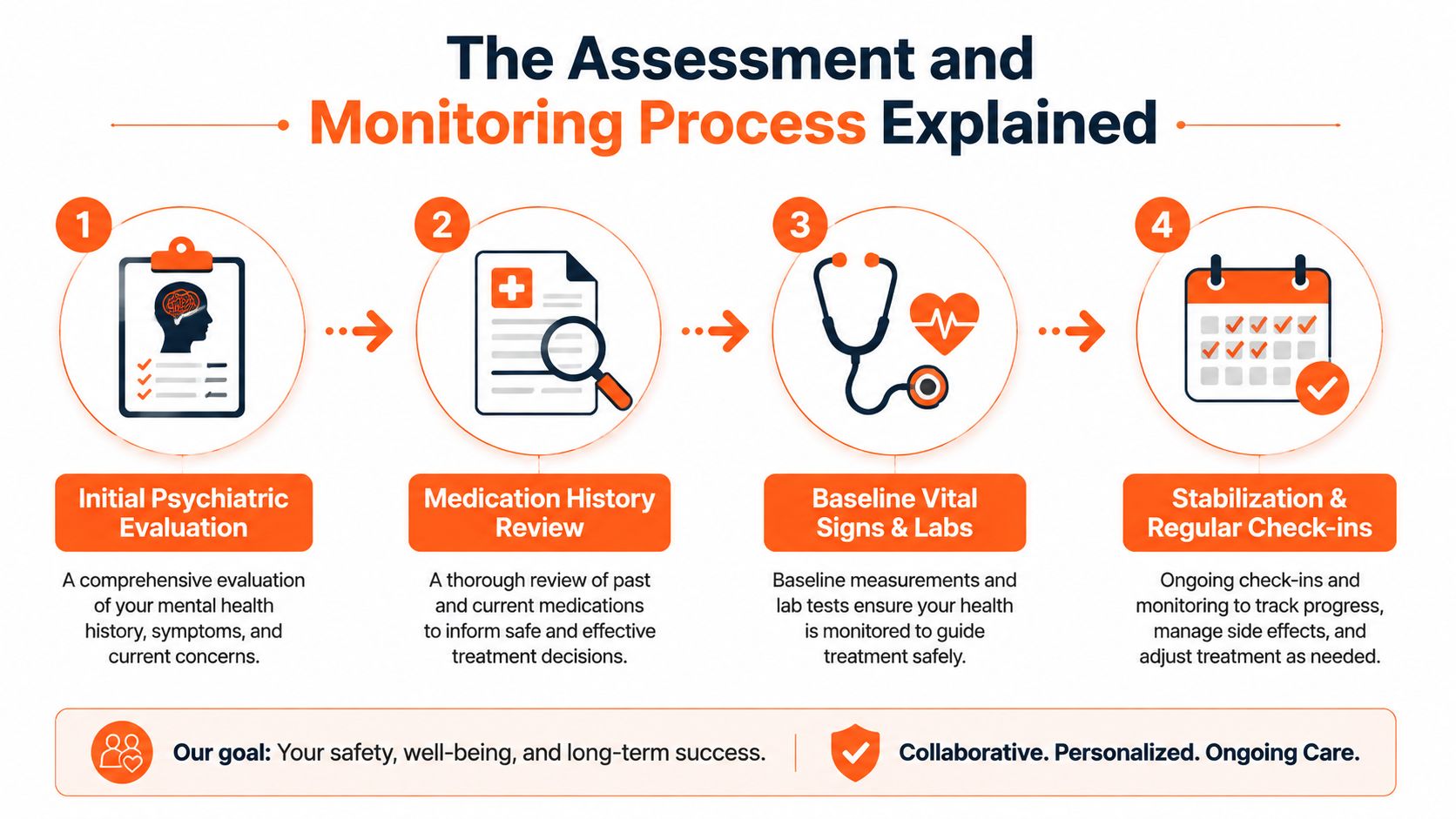
A four-step infographic illustrating the psychiatric assessment and monitoring process for effective mental health care treatment.

What the first days usually involve

The first phase usually combines psychiatrist evaluation, medication reconciliation, and nursing observation. Staff review current prescriptions, recent stops, past adverse reactions, and any overlap that could raise the risk of sedation, activation, or toxicity. If the patient arrives with incomplete records, the team has to work from the medication list in front of them, not from assumptions.

That process is more cautious when the diagnosis is still unsettled. A stimulant withdrawal picture can resemble depression. Alcohol withdrawal can look like anxiety or agitation. A prior antidepressant may have helped once, or it may have worsened sleep, mixed symptoms, or impulsivity. In a confidential setting, the team has to sort out those trade-offs without rushing to a clean label that the history does not support.

  1. Initial Psychiatric Evaluation. The psychiatrist reviews symptoms, risks, prior treatment, and current medications.
  2. Medication History Review. The team checks for interactions, duplication, abrupt stops, and past adverse reactions.
  3. Baseline Vital Signs and Labs. Nursing and medical staff establish a safe reference point for follow-up.
  4. Stabilization and Regular Check-ins. The plan is adjusted as the patient's response becomes clearer.

Monitoring continues after the first order is written. For lithium, follow-up is recommended after initiation, after dose changes, and whenever toxicity, relapse, or nonadherence is suspected. That same logic applies to medication-assisted treatment, where the clinical question is never only whether a drug was prescribed, but whether the dose, timing, side effects, and recovery goals still fit the patient. A prescription can be handed out in minutes. A protocol creates accountability over time.

Common Medication Classes for Co-Occurring Disorders

A medication plan in dual diagnosis care starts with the problem the team is trying to solve. The same drug can be reasonable in one case and a poor fit in another if the symptom pattern, substance history, sleep, and side effect tolerance point in different directions. In confidential residential treatment, that decision also has to fit the pace of therapy and the privacy expectations of an executive-level setting.

How clinicians usually think about the main classes

Medication Class Primary Uses Key Monitoring Considerations
Antidepressants Depression, anxiety, PTSD, OCD symptoms Sleep changes, activation, interaction risk, delayed response
Mood stabilizers Bipolar spectrum symptoms, mood swings, irritability Timing, blood levels when indicated, signs of toxicity
Anti-anxiety agents Acute anxiety, panic, agitation Sedation, dependence risk, effect on recovery goals
Antipsychotics Severe mood instability, psychosis, agitation, augmentation Metabolic effects, daytime sedation, movement side effects
ADHD medications Attention and impulse-control problems Misuse risk, appetite and sleep effects, diagnostic clarity

Antidepressants are often chosen when the goal is to build a steadier baseline rather than to create immediate sedation. Mood stabilizers become part of the discussion when the history suggests cycling moods, impulsivity, or a pattern of worsening after antidepressant exposure. Antipsychotics may be used for acute stabilization or for augmentation, especially when sleep, agitation, or thought organization need closer control.

For people with overlapping substance use, the balance is therapeutic benefit on one side and assessment clarity plus dependence risk on the other. The medication should reduce distress enough to support recovery work, while still allowing the team to see what symptoms remain and why. That is one reason experienced programs treat medication as one part of a larger protocol, with psychiatry, nursing, and therapy all watching for different pieces of the picture.

Lithium is a good example of why monitoring matters. Clinical guidance calls for follow-up after initiation, after dose changes, and whenever toxicity, relapse, or nonadherence is suspected, because the margin between benefit and harm can narrow quickly if the regimen drifts. That same discipline applies to medication-assisted treatment concepts, where the question is whether the medication, the dose, the timing, and the side effects still support the patient's recovery goals. A prescription can be written quickly. A protocol keeps the plan accountable over time.

Medication Safety During Detox and Early Stabilization

Detox is a period where medication errors become more likely if staffing is thin or the process is rushed. A patient may arrive with a long-standing psychiatric regimen, then immediately face withdrawal, sleep disruption, and symptoms that can look psychiatric even when part of the picture is physiologic.

Abrupt discontinuation is a poor default for that reason. Some medications need a taper rather than a stop, and the team has to separate withdrawal from relapse instead of assuming every distress signal means the original diagnosis has worsened. Nursing observations matter because they catch changes that a once-daily check-in can miss.

Continuity of care during detox keeps patients safer than reactive medication changes.

In a residential setting, 24/7 nursing support gives the team a chance to watch for sedation, dehydration, blood pressure changes, agitation, and emerging side effects while the medication plan is being refined. That matters especially early on, when the patient's history is still settling and the line between detox symptoms and psychiatric symptoms can be hard to draw. 24-hour nursing during detox supports that close monitoring and gives the team a clearer view of what is medication-related and what is part of withdrawal.

The operational piece matters just as much as the clinical one. Therapy needs to know whether fatigue or agitation is tied to medication. Psychiatry needs to know whether the patient slept, ate, or decompensated overnight. Nursing needs to know what changed after the last dose. In confidential residential care, that coordination is what keeps medication decisions tied to real-time observations instead of assumptions.

A doctor explaining a medication plan checklist to a patient during a medical consultation session.

Navigating Diagnostic Uncertainty and Incomplete Records

A lot of people enter care without clean records, and some enter without a diagnosis that has been tested over time. That's not a minor paperwork issue. It changes the medication risk profile.

A rapid review found there are “no widely accepted clinical guidelines” and “little to no research” for prescribing in transition and low-threshold settings, and it specifically warns clinicians to screen for prior manic, hypomanic, or mixed symptoms before treating depression because undiagnosed bipolar disorder can alter medication choice and risk (rapid review on prescribing in uncertain settings). That's the kind of caution most consumer content leaves out, even though it's one of the main reasons residential medication management exists.

What good clinicians watch for

  • Mood history that doesn't fit a simple depression narrative. Past bursts of energy, decreased sleep, impulsive decisions, or mixed symptoms change the whole plan.
  • Medication overlap. Multiple prescribers can mean duplicated drugs, conflicting instructions, or side effects that get mistaken for new illness.
  • Symptom timing. If symptoms rise and fall with substance use, withdrawal, or medication changes, the diagnosis may still be evolving.
  • Family and collateral history. People often remember episodes or patterns the patient left out, whether by design or because the timeline is hard to reconstruct.

The point isn't to delay treatment indefinitely. It's to avoid locking in the wrong treatment too early. A high-touch residential model gives the team time to stabilize first, then refine the diagnosis with more confidence, which is a much safer sequence when the history is messy.

Questions Patients and Families Should Ask Before Treatment

If a program says it offers psychiatric medication management, ask how that looks on an ordinary Tuesday, not just on paper. The answer should tell you whether the care is individualized or just administrative.
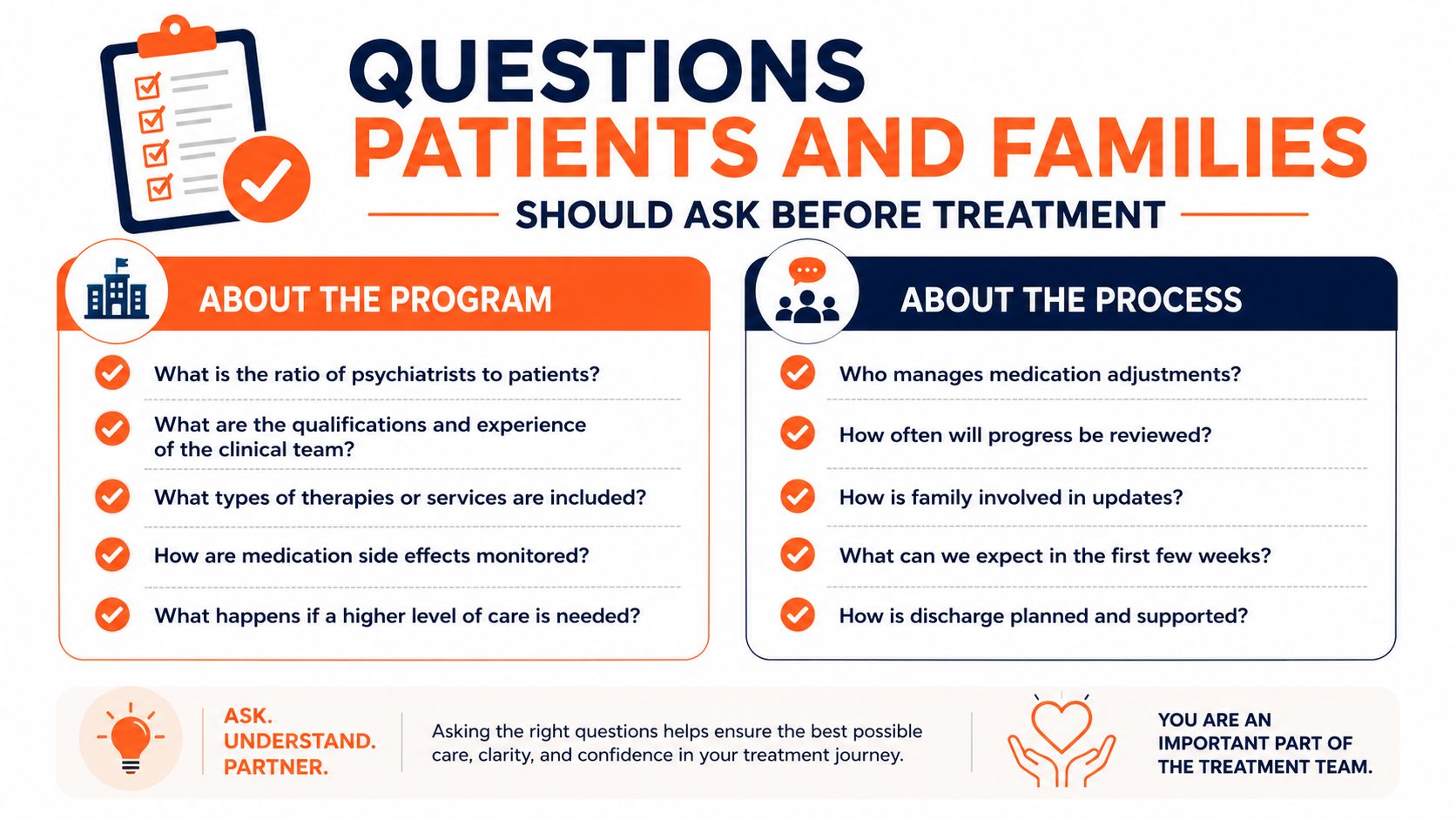
An infographic list of questions for patients and families to ask before starting psychiatric treatment programs.

About the program

  • Who prescribes and monitors the medications? You want clarity on whether psychiatry is on-site, available regularly, and integrated with the rest of the team.
  • How are side effects tracked? Good programs use nursing observation, scheduled follow-up, and direct patient reporting, not casual check-ins.
  • What happens if the diagnosis changes? The team should be able to explain how they revise the plan when bipolarity, trauma, ADHD, or substance-related symptoms become clearer.

About the process

  • How fast are medication changes reviewed? In a residential setting, slow administrative turnaround is a weak sign.
  • Who tells therapy and nursing about the change? If psychiatry works in isolation, the plan will be less safe.
  • How is family communication handled? Families need updates, but only within the patient's confidentiality boundaries and consent.

A strong program doesn't just answer these questions. It answers them in plain language. For executives and licensed professionals, that matters because privacy concerns are real, and vague reassurances don't substitute for a defined process.

How Capo Canyon Recovery Delivers Executive-Level Medication Management

A confidential residential setting can still be clinically precise, and that combination is what many professionals need when work can't stop. Capo Canyon Recovery operates as a boutique program in Mission Viejo with 24/7 nursing and on-site psychiatric support, a small census of about five clients at a time, and minimum four weekly individual sessions that involve therapy, case management, and psychiatry.

A luxurious bedroom interior with a Capo Canyon Recovery welcome card placed on a wooden desk.

The practical advantage is straightforward. Medication changes can be watched closely, therapy can feed real-time observations back to psychiatry, and nursing can flag problems early instead of waiting for the next appointment. The tech-friendly policy also matters for executives and professionals who need to remain reachable for essential responsibilities without turning treatment into a public event.

That model fits the actual pressure many high-performing people are under. They need care that respects confidentiality, keeps treatment coordinated, and doesn't treat privacy as an afterthought. In programs like this, medication management isn't separated from the rest of residential care, it's part of the same coordinated structure that helps people stabilize without losing their footing.


If you're evaluating private treatment for yourself or a family member, start with the medication process, not the brochure language. Capo Canyon Recovery can walk you through how psychiatric medication management, detox oversight, and residential therapy work together in a discreet setting, so you can ask sharper questions and choose care with confidence.

READ MORE
Uncategorized
July 19by 0 Comments

Reconnect Mind Body: An Executive’s Guide to Recovery

You may be functioning at a high level and still feel strangely absent from your own life.

The pattern is familiar in executives and professionals. You wake before your alarm, clear messages before getting out of bed, push through meetings, override hunger, ignore the tension in your chest, and call it discipline. By late afternoon, your body is sending clear signals. Tight jaw. Shallow breathing. Irritability. Fatigue. Trouble focusing. You register them, but you don't respond. Then the evening handoff begins. Alcohol, sedatives, stimulants, overwork, compulsive scrolling, or some other reliable way to stop feeling what your body has been trying to say all day.

That state isn't weakness. It's disconnection. And in recovery, learning to reconnect mind body isn't a wellness extra. It's part of the clinical work.

For high-performing people, the challenge is practical as much as emotional. You don't want vague advice. You don't want a retreat model that assumes your responsibilities disappear. You need approaches that respect privacy, preserve dignity, and fit inside a life that still has pressure in it.

Why High-Performers Feel Disconnected from Their Bodies

A senior professional can walk into a room looking composed and still be running on pure adaptation. Outwardly, performance holds. Internally, the body is carrying the cost.

In practice, this often starts long before substance use becomes a problem. A leader learns that discomfort is inconvenient. Hunger can wait. Sleep can wait. Grief can wait. Panic gets renamed as drive. Physical warning signs become background noise. Over time, the person becomes highly skilled at reading a market, a team, or a negotiation, but poor at reading their own nervous system.

A useful way to understand this is simple. The same traits that help someone excel under pressure can also train them to bypass themselves. Efficiency, endurance, emotional containment, and constant availability can look admirable. Under chronic strain, they also create the conditions for disconnection.

One guide to the body's stress response is Capo Canyon's explanation of the relationship between stress and our bodies. The key clinical point is straightforward. Stress doesn't stay in your head. It shows up in sleep, digestion, muscle tension, mood, impulse control, and the urge to seek relief fast.

What this looks like in real life

Most professionals don't describe the problem as “mind-body disconnection.” They say things like:

  • “I'm fine until I stop moving.” Quiet feels intolerable because stillness exposes what momentum has been covering.
  • “I didn't realize how bad it was until I was home.” The workday masks symptoms that become obvious only when stimulation drops.
  • “I know I'm stressed, but I can't feel much else.” Emotional flattening often travels with bodily numbness.
  • “I only notice my body when it forces the issue.” Insomnia, panic, pain, or cravings become the first language the body can still use effectively.

Clinical reality: If you can't detect stress early, you're more likely to manage it late. Late management is where addictive behavior often enters.

Addiction widens this split. Once substances become a primary regulator, the body stops feeling like a trusted source of information and starts feeling like a problem to suppress. Recovery asks for the reverse. You learn to notice signals sooner, respond with more precision, and tolerate internal states without immediately trying to shut them down.

For executives, that work has to be discreet and functional. It has to help you stay effective, not disappear from your life.

The Neuroscience Behind Mind-Body Reconnection

Analytical people often engage better when they understand mechanism. That helps here, because the mind-body connection isn't a metaphor.

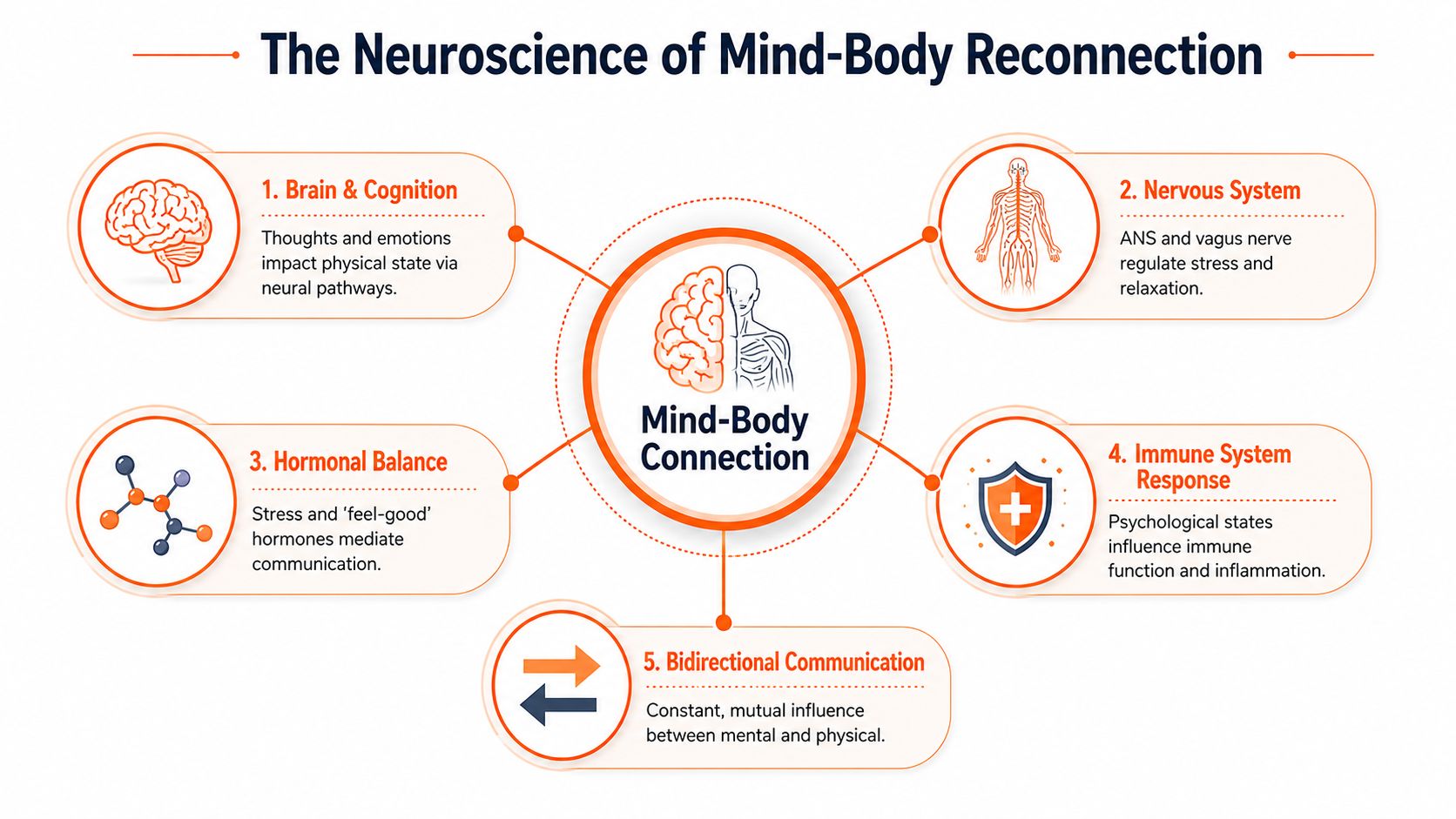
A Washington University School of Medicine report on the SCAN network describes a 2023 discovery of the Somato-Cognitive Action Network, a neural network that physically links motor control with systems involved in thinking, planning, and regulation of involuntary functions such as blood pressure and heart rate. The same report notes that approximately 15% of the brain's motor cortex is directly plugged into cognitive planning networks. That matters because it gives a biological explanation for something clinicians have observed for years. Mental state and physical state are structurally linked.

A diagram illustrating the neuroscience of mind-body reconnection through five key biological and psychological systems.

Why that changes the conversation

If thought, movement, and physiological regulation are linked in the brain, then body-based interventions stop looking “soft” or secondary. They become clinically rational.

That's why a person can walk into a therapy session intellectually convinced they're safe, while their pulse, breath, posture, and muscle tone tell a different story. The nervous system isn't being irrational. It's expressing a state through circuits that are tied to both cognition and body regulation.

A concise way to conceptualize this:

System What you notice Why it matters in recovery
Cognitive Rumination, urgency, narrowed thinking Impairs judgment and increases reactivity
Autonomic Shallow breathing, racing heart, agitation Pushes the body toward threat mode
Motor Restlessness, collapse, bracing, jaw tension The body “acts out” the internal state
Interoceptive Numbness or poor signal detection Makes early self-correction harder

The science behind addiction also supports this integrated view. Capo Canyon's overview of the science behind how addiction works in your body is useful because it frames substance use as a whole-body process, not a character issue or a failure of will.

Why movement and regulation techniques work

When people ask why breathwork, movement, or mindful exercise can affect mood and cravings, the answer isn't mystical. These practices change the input the brain receives from the body, and they change the output the brain sends back.

A 2023 meta-analysis in Scientific Reports found that mind-body exercise enhanced activation in the left anterior cingulate cortex within the default mode network and deactivated the left supramarginal gyrus within the ventral attention network, with the increase in default mode network activation associated with years of practice. It also reported modulation of connectivity between attention networks involved in focus and distraction control. For a practical reader, the takeaway is simple. Repeated mind-body practice appears to shape the networks involved in attention and emotional regulation.

That neuroplastic angle is why many clinicians pay attention to factors that support BDNF. If you want a practical companion resource on exercise-related mechanisms, BionicGym's guide to BDNF optimization is worth reading alongside your treatment plan.

The body is not a side door into recovery. For many people, it's the fastest route back to self-awareness.

Core Practices for Mind-Body Integration in Recovery

Knowing the science helps. Daily practice changes the outcome.

The most effective mind-body work in recovery is usually not dramatic. It's repeatable, contained, and realistic enough that you'll keep doing it when motivation drops. The point isn't to become spiritual overnight. The point is to restore signal detection, improve regulation, and reduce the gap between what you think and what you feel.

A diagram illustrating core mind-body integration practices including mindfulness, movement, creative expression, and nature connection.

Mindfulness and meditation

Mindfulness is the skill of noticing internal and external experience without immediately reacting to it. In recovery, that matters because cravings, shame, irritability, and anxiety often escalate in the space between sensation and action.

You don't need long silent sits to start. For many professionals, a body scan works better because it gives the mind a task. Sit down, place both feet on the floor, and move your attention from jaw to shoulders to chest to hands to abdomen. Don't fix anything at first. Just identify what's there.

One useful primer on this is Capo Canyon's piece on ways meditation can help during recovery. It's especially relevant for people who think meditation means emptying the mind. It doesn't. It means seeing clearly enough to choose your next move well.

What works:

  • Short, consistent practice: Two or three minutes done reliably beats ambitious sessions you abandon.
  • Concrete prompts: “What am I feeling in my chest?” is better than “relax.”
  • Use before predictable triggers: Before the drive home, before an argument, before bed.

What doesn't:

  • Forcing calm: Trying to make yourself serene usually creates more frustration.
  • Treating mindfulness as a performance metric: If you turn it into another achievement task, you miss the point.

Breathwork that actually fits a workday

Breathwork is one of the fastest ways to interrupt escalating activation because you can do it without leaving your office, your hotel room, or your parked car.

The key is control without strain. Slow, even breathing can help downshift an overactivated state. If you want a straightforward external resource, this guide to controlled breathing offers a practical starting point.

A simple approach many people tolerate well:

  1. Sit upright with both feet grounded.
  2. Inhale gently through the nose.
  3. Exhale a little longer than the inhale.
  4. Repeat for a few cycles without forcing depth.

The goal isn't to produce a special state. The goal is to reduce the mismatch between a pressured mind and an overloaded nervous system.

Practical rule: If a breathing exercise makes you feel trapped, dizzy, or more agitated, modify it. Good regulation work feels stabilizing, not punishing.

Yoga and mindful movement

Some people reconnect mind body faster through movement than through stillness. That's common in high-performers who feel flooded when asked to close their eyes and sit with themselves.

Mindful movement works because it turns attention outward and inward at the same time. You notice balance, muscle activation, breath rhythm, and tension patterns while staying engaged. Yoga, walking with attention, mobility work, and slow resistance training can all serve this purpose.

A useful distinction helps here:

  • Exercise for output can improve mood, energy, and sleep.
  • Movement for awareness helps you notice where you brace, collapse, rush, or disconnect.

You need both, but they aren't the same thing.

Somatic therapies and trauma-informed body work

For some people, disconnection isn't only stress. It's trauma. The body may hold threat responses long after the event has passed, which is why insight alone sometimes doesn't produce change.

That's where structured somatic work can help. In a clinical setting, this might involve tracking activation, noticing impulses to freeze or flee, orienting to safety, and learning how to complete stress responses gradually rather than getting overwhelmed by them.

A recent PubMed-listed study on intensive mind-body interventions reported statistically significant short-term changes including decreased functional integration in the default mode and salience networks, reduced whole-brain modularity, upregulation of BDNF (p = 0.001), enhanced in vitro neurite outgrowth (p = 0.01), and activation of endogenous opioid pathways (p = 0.03). It also reported shifts in inflammatory and anti-inflammatory signaling. For treatment, the practical point is that intensive mind-body interventions can produce measurable neural and biochemical changes relevant to stress, pain, and adaptation.

The non-negotiables people try to skip

Executives often want the elegant intervention and resist the basics. That's understandable. It's also a mistake.

Mind-body integration is harder when the foundation is unstable. Pay attention to:

  • Sleep: Even strong coping skills weaken when sleep is fragmented.
  • Food timing: Long gaps without eating can worsen irritability and impulsivity.
  • Hydration and caffeine boundaries: These influence anxiety more than many professionals admit.
  • Transitions: Most relapse-prone moments happen in unstructured handoff periods, not during peak performance windows.

If you want a realistic toolkit, start small. One grounding practice in the morning, one regulation tool during work, one downshift ritual at night. That's enough to begin rebuilding trust between mind and body.

How Therapy Can Deepen Mind-Body Work

Mind-body practices help you notice and regulate. Therapy helps you understand and resolve what keeps pulling the system off center.

That difference matters. A breathing exercise may lower activation before a difficult call. It won't, by itself, unwind the trauma, grief, perfectionism, shame, or chronic fear that taught your body to stay on alert in the first place. For many professionals, the deepest disconnection isn't lack of knowledge. It's unresolved material that the body still treats as active.

When insight alone stops working

People get frustrated. They can explain their patterns with accuracy. They know why they overwork, numb out, or react sharply under stress. Yet in the moment, the body still takes over.

That's not hypocrisy. It's state-dependent learning. Under pressure, the nervous system reaches for what feels familiar and protective, not what sounds sensible in a calm conversation.

A good therapist helps translate body signals into clinically useful information:

  • Tight chest before conflict may signal threat anticipation.
  • Numbness during emotional conversations may reflect shutdown.
  • Restlessness and urgency may be the body's version of avoiding grief or vulnerability.

Why EMDR and DBT fit this work

EMDR can be useful when traumatic memories or distressing experiences feel “stuck.” It uses bilateral stimulation within a structured clinical process to help the brain and nervous system reprocess material that hasn't been integrated well. Clients often notice that the story becomes more coherent and the body reaction becomes less intense.

DBT helps in a different way. It gives people practical skills for distress tolerance, mindfulness, and emotional regulation. For executives, DBT is often appealing because it is concrete. It teaches what to do when emotion rises fast, when urges hit hard, or when a difficult conversation triggers a disproportionate response.

Therapy gives context to sensation. Somatic practices tell you that your body is activated. Good psychotherapy helps you understand why, and what to do next.

The strongest treatment plans usually combine both domains. You learn how to settle the body in real time, and you work through the drivers of dysregulation over time. That's what makes reconnection durable instead of situational.

Reconnecting While Maintaining Your Career and Privacy

Professionals often delay treatment for two reasons. They think they can't step back without professional damage, and they worry that seeking help will expose them.

Both concerns are understandable. Neither should force you into a model that doesn't fit your life.

A Psyche guide discussing embodiment at work references a 2025 study of 1,200 executives in which 68% reported “body amnesia” during work hours, meaning they ignored physical stress signals. That finding captures the problem well. Many professionals don't need more advice about escaping responsibility. They need methods they can use while still carrying it.

A professional man meditating at his desk while overlooking a serene lake and mountain landscape.

What fits a demanding schedule

The right question isn't “Can I pause my whole life?” It's “What level of treatment or support lets me recover without creating unnecessary collateral damage?”

For many executives, useful mind-body work looks like this:

  • Between meetings: Two minutes with both feet grounded, eyes open, tracking breath and shoulder tension.
  • Before a high-stakes presentation: A short breathing cycle with longer exhalations instead of a drink, pill, or panic spiral.
  • After conflict: A brief walk without the phone, focusing on pace, posture, and jaw release before responding.
  • At night: A fixed decompression ritual that tells the nervous system work is over.

The point is not to make your life smaller. It's to stop using constant activation as the price of competence.

Privacy is part of treatment design

Confidentiality concerns are not vanity. For licensed professionals, founders, executives, and public-facing leaders, privacy affects whether they seek help at all.

That includes digital privacy. If reputational exposure is a serious concern, it can help to review practical tools that erase your digital footprint and reduce unnecessary online exposure outside the treatment context.

It also helps to choose care environments that understand work reality. Tech access, private rooms, individualized scheduling, and a small, discreet setting are not luxuries for this audience. They are often what makes treatment possible. A generic program may insist on a complete shutdown. Sometimes that's necessary. Often it's not. The better approach is clinical flexibility with clear boundaries.

What doesn't work is pretending you can outthink physiology indefinitely. If your body has become the place where stress, craving, and exhaustion go to hide, recovery has to include the body while respecting the life you still need to manage.

Taking the First Step Toward Integrated Recovery

Individuals often don't need more information before they seek help. They need a cleaner decision framework.

If you're trying to reconnect mind body on your own and you notice steady improvement, that's useful. Keep going. But self-guided work has limits. If alcohol or drugs are involved, if withdrawal may be medically risky, if trauma or depression is active, or if you keep returning to the same cycle despite insight and effort, clinical support usually becomes the safer choice.

The treatment question isn't whether you should use body-based practices or therapy. It's whether your care model integrates them well.

What integrated care should include

Look for a program that combines:

  • Medical oversight: Especially when detox, medication changes, or psychiatric symptoms are in play.
  • Dual diagnosis capability: Substance use and anxiety, trauma, depression, bipolar disorder, or ADHD often interact.
  • Evidence-based psychotherapy: Modalities such as CBT, DBT, ACT, EMDR, or Brainspotting should be available based on need.
  • Somatic and integrative work: Breathwork, mindfulness, movement, and body-based regulation should support, not replace, clinical treatment.
  • A realistic environment for professionals: Privacy, individualized attention, and room for essential responsibilities matter.

This kind of setting matters because outcomes improve when treatment addresses the whole system. A 2020 systematic review cited in Scientific Reports found that mind-body therapies were associated with a moderate to large effect on pain reduction and a significant reduction in opioid dosage, with meditation alone showing a 30 to 40% improvement in pain outcomes in that review. Those findings support a practical conclusion. Evidence-based mind-body care has measurable value when it's embedded in a serious treatment plan.

A visual sense of that kind of environment helps.

Screenshot from https://capocanyon.com

A calmer way to decide

You do not have to commit to a public identity as “someone in treatment.” You do not have to blow up your career to get better. You do need a plan that matches the seriousness of what's happening.

A confidential conversation with a qualified program can clarify whether you need detox, residential treatment, dual diagnosis care, or a different level of support. The right next step should reduce confusion, not increase it.

If your current way of coping depends on ignoring your body, then healing has to include learning how to hear it again.


Capo Canyon Recovery offers confidential detox and residential care for executives, professionals, and high-profile clients who need serious treatment without unnecessary disruption to work or privacy. If you're looking for integrated care that combines medical oversight, psychiatric support, evidence-based therapy, and mind-body practices in a discreet setting, contact Capo Canyon Recovery to explore a personalized path forward.

READ MORE
Uncategorized
July 18by 0 Comments

Peer Support in Recovery: A Guide for Professionals

You leave residential treatment with a clear head, a discharge plan, and a calendar that already looks dangerous. Your phone is back in your hand. Messages from your board, partners, patients, clients, or flight department are waiting. Your family feels relieved, but they're also watching closely for signs that stress will pull you back into old habits.

That stretch between treatment and ordinary life is where many accomplished people feel the most exposed. In treatment, the day has structure. Outside it, you're expected to perform again. The meetings resume. Travel restarts. People assume you're fine because you sound composed.

Clinical care gives recovery its medical and psychological foundation. What often determines whether that foundation holds under pressure is the support system that follows you home. That is where peer support in recovery becomes far more than a nice addition. It becomes the bridge between insight and execution.

The Bridge from Treatment to Lifelong Recovery

A common moment arrives a day or two before discharge. An executive says some version of this: “I know what I need to do. I'm just not sure how to do it when real life starts again.”

That concern is justified. Treatment can stabilize withdrawal, clarify diagnoses, start therapy, and help a person understand patterns that drove substance use. None of that automatically solves Tuesday at 6:30 p.m. after a brutal meeting, a delayed flight, an argument at home, and the familiar urge to shut the whole thing down with alcohol, stimulants, or pills.

Where treatment ends and life begins

Recovery doesn't fail because people forget what they learned. More often, it gets shaken when they try to apply those lessons alone, in private, under pressure. A therapist may help someone identify perfectionism, secrecy, resentment, or trauma triggers. A psychiatrist may stabilize sleep, mood, or attention. Those interventions matter.

But the person still has to walk into a dinner with colleagues, decline a drink without making it a scene, manage shame after a rough day, and text someone before the urge becomes a decision.

That's why aftercare planning matters so much. A strong overview of sustaining recovery after rehab usually includes therapy, medical follow-up, relapse prevention work, and support outside the clinic.

Why peer support fills the dangerous gap

Peer support helps in the hours when clinicians aren't present. It offers contact with someone who understands the mechanics of early recovery from the inside, not only from training.

Practical rule: The period after discharge needs structure, accountability, and human connection. Willpower alone rarely carries the full load.

For professionals, this bridge has to do two jobs at once. It has to protect sobriety, and it has to fit a life that may include licensing concerns, public visibility, leadership obligations, and a very real need for discretion. If a support model ignores those realities, people often avoid it, then tell themselves they'll manage privately.

That rarely ends well. Recovery becomes more durable when support continues after treatment in a form the person will use.

What Exactly Is Peer Support

Peer support is non-clinical support from someone with lived experience of recovery who helps another person manage the day-to-day work of getting well and staying well. It is not therapy. It is not psychiatry. It is not a substitute for medical care.

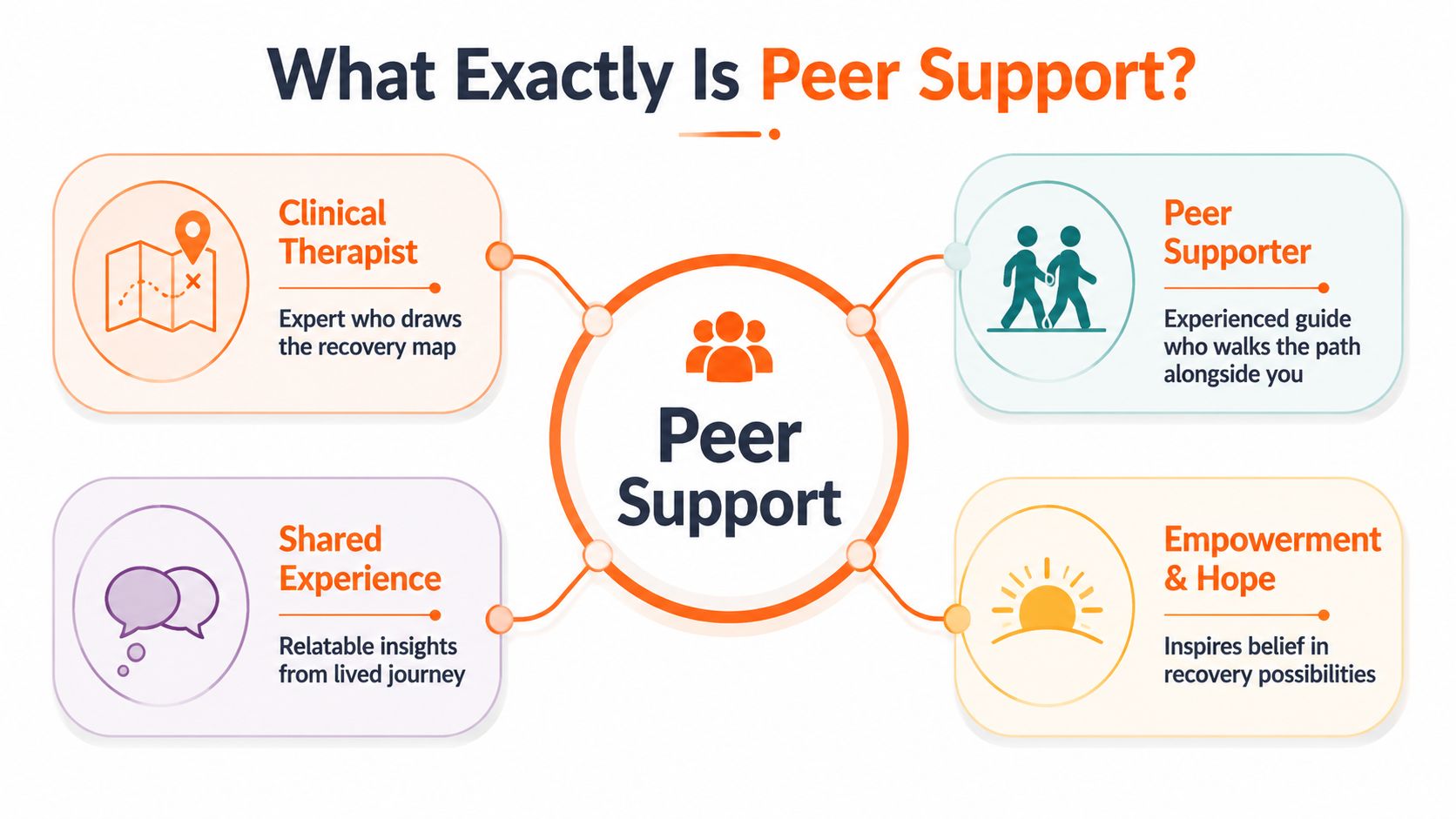
A simple analogy helps. A therapist is the cartographer. They help map the terrain, identify patterns, and plan the route. A peer supporter is the guide who has walked that terrain and can say, “That turn looks harmless, but it's where people get lost. Call before you go there.”

A diagram defining peer support through four key concepts: clinical therapist, peer supporter, shared experience, and empowerment.

What a peer supporter actually does

A good peer supporter helps with practical recovery tasks that often sound small but carry major weight:

  • Reality-testing high-risk decisions when stress starts distorting judgment
  • Helping build routines around sleep, meetings, exercise, and accountability
  • Normalizing early recovery discomfort so a rough week doesn't get mistaken for failure
  • Supporting follow-through with appointments, family commitments, and recovery goals
  • Reducing isolation by making recovery feel lived, not theoretical

The power comes from shared experience. The person receiving support doesn't have to explain every layer of denial, bargaining, or professional image management. The peer already recognizes the language.

What peer support is not

Clarity is essential for families and professionals. Peer support works best when boundaries stay clean.

It is not:

  • A replacement for treatment when detox, therapy, or psychiatric care is needed
  • An unstructured friendship with blurred expectations and emotional overreach
  • A place for advice without accountability
  • A license to avoid clinical work by staying only in inspirational conversations

The strongest programs treat peer support as one lane in a broader system of care.

There's an interesting parallel in how organizations think about service models. Discussions about choosing support for community-driven companies often come down to the same distinction: formal expertise solves one class of problems, while community and shared experience solve another. Recovery works similarly. You need both.

A peer supporter doesn't diagnose you. They help you keep moving when insight has to become action.

For executives, that distinction matters. Many are comfortable with experts. Fewer are comfortable with vulnerability. Peer support creates a setting where credibility comes not from credentials alone, but from lived proof that change is possible.

The Different Faces of Peer Support

Not all peer support looks the same. That's good news, because people don't recover the same way. Some want community and routine. Others want a private, one-to-one relationship. Some need support embedded inside a clinical system. Others need practical accountability built around work travel, licensing issues, and family strain.

Comparing Peer Support Models

Feature Mutual-Aid Groups (e.g., AA/NA) Certified Peer Specialist Recovery Coach
Primary setting Community meetings, in person or online Healthcare, behavioral health, or community systems Private practice, treatment aftercare, or independent support
Core role Ongoing fellowship and shared recovery culture Structured lived-experience support within a service system Goal-focused support for daily recovery and life stabilization
Relationship format Group-based, sometimes with a sponsor relationship One-to-one, group, or care-team based Usually one-to-one
Clinical role Non-clinical Non-clinical, often integrated with clinicians Non-clinical
Training Varies by fellowship role Usually formal training and credentialing Varies by program and background
Best use case Building recovery community and regular accountability Coordinating support around treatment and services Personalized recovery planning and real-world implementation
Privacy level Lowest control over who attends Moderate to strong, depending on setting Often strongest if privately arranged
Structure Fixed meeting formats and traditions Defined role within a program or organization Flexible, tailored to the individual
Cost Usually free to attend Often covered within a program or system Often private-pay, depending on arrangement
Potential drawback May feel too public or impersonal for some professionals Quality depends on supervision and organizational fit Quality varies widely if not well vetted

Mutual-aid groups

These are the most familiar form of peer support in recovery. They offer fellowship, repetition, and a place to hear recovery discussed in plain terms. For many people, that ongoing community is invaluable.

They are less ideal for someone who needs tight privacy control, dislikes open-ended sharing with strangers, or feels constrained by a specific meeting culture. Some professionals thrive there. Others never fully engage because they remain guarded.

Certified peer specialists

A certified peer specialist usually works inside a broader care setting or coordinated system. That can be useful when someone needs support tied to discharge planning, treatment adherence, service navigation, or re-entry into community life.

This model tends to work well for people who benefit from clearer boundaries and documentation. It may feel more accessible to families because the role is easier to understand inside a professional care framework.

Recovery coaches

Recovery coaches are often the best fit for executives who need flexibility and discretion. The relationship is usually practical, goal-oriented, and built around real-world functioning. A coach may help someone prepare for a business dinner, redesign a travel routine, build a trigger-response plan, or troubleshoot an escalating week before it becomes a relapse.

The best model is the one a person will actually use honestly, not the one that sounds best on paper.

A sponsor can also be part of the picture, but sponsorship belongs to specific fellowships and follows that fellowship's culture. It is not interchangeable with every other form of peer support. Wise families do best when they stop asking, “Which model is best?” and start asking, “Which model fits this person's risks, personality, privacy needs, and willingness to engage?”

The Proven Effectiveness of Peer Support

Executives usually ask the right question. Does it work?

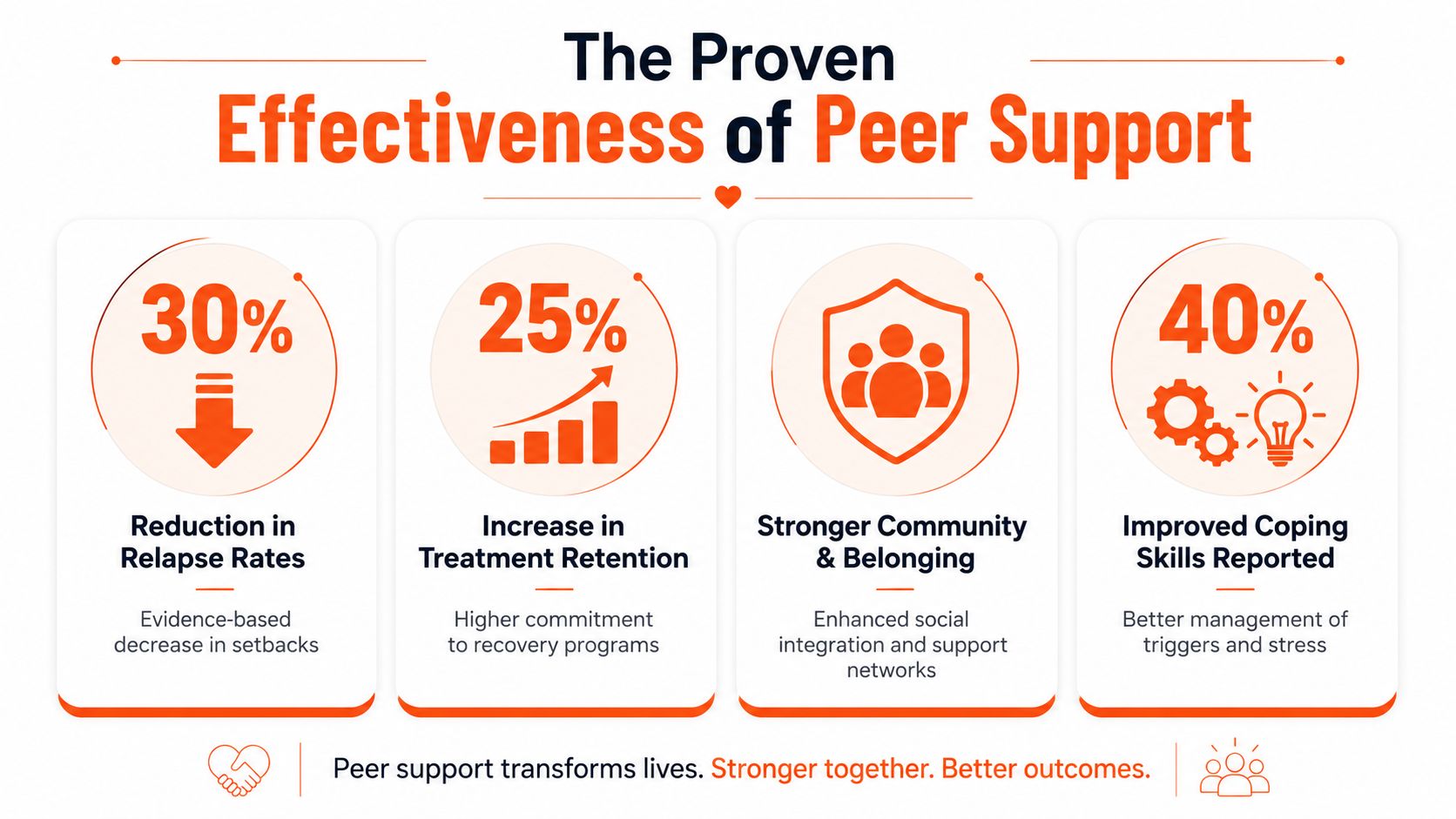
The evidence says yes, particularly when peer support is integrated with treatment rather than treated as a loose add-on. One summary reports that integrating peer support into clinical addiction treatment increases treatment retention by 20% and makes participants 2.9 times more likely to sustain abstinence compared to standard care alone, according to this review on peer support and long-term sobriety.

An infographic illustrating the proven effectiveness of peer support in recovery, showing percentage improvements in key areas.

What the numbers mean in practice

Those figures matter because they speak to the exact points where recovery often destabilizes. Retention means people stay engaged long enough for treatment gains to consolidate. Sustained abstinence means support isn't only making people feel encouraged. It is improving meaningful outcomes.

Other reported findings in the same body of verified data point in the same direction. Active engagement in peer support was associated with a 30% greater reduction in substance use and a 35% lower risk of relapse than standard treatment protocols alone. Peer-supported programs also reported 15% to 25% fewer dropouts than traditional programs in the verified summary above.

That pattern is clinically believable. People stay connected when they feel understood, less ashamed, and less alone.

Why peer support changes behavior

Peer support works partly because it changes the emotional climate around recovery. A person who feels judged tends to hide. A person who feels understood is more likely to tell the truth sooner.

That matters in very practical ways:

  • Cravings get disclosed earlier instead of after a lapse
  • Setbacks become discussable rather than secret
  • Treatment advice gets translated into ordinary language and ordinary life
  • Hope becomes credible because someone else has lived it

There is also evidence beyond addiction treatment alone. A meta-analysis of peer support interventions for serious mental illness found statistically significant superiority over control conditions across clinical, personal, and functional recovery domains in a subgroup analysis, based on a review of 28 randomized controlled trials with 4,152 participants. That matters for professionals with co-occurring mental health concerns, where functioning and stability matter as much as symptom reduction.

For a data-driven audience, the main takeaway is straightforward. Peer support in recovery isn't sentimental window dressing. It improves the odds that people remain engaged, reduce use, and hold onto gains that treatment helped create.

How Peer Support Enhances Clinical Treatment

Clinical treatment and peer support do different jobs. When they're coordinated well, each makes the other more effective.

A therapist might help someone identify a relapse pattern. A peer supporter helps that person notice the pattern in real time on a Thursday afternoon when the old script starts up again. A psychiatrist may stabilize mood or sleep. A peer may help the person stick with the plan long enough to benefit from that stability.

The force multiplier effect

The strongest aftercare plans use peer support to reinforce what the clinical team is already teaching. That can include CBT skills, DBT distress tolerance, relapse prevention planning, medication follow-through, communication strategies, and routines that support sobriety.

Examples from practice often look simple:

  • After a tense board call, the client uses an urge-surfing skill learned in therapy, then checks in with a peer instead of isolating.
  • Before a work trip, the client and peer map out vulnerable moments such as airport bars, hotel loneliness, and post-meeting exhaustion.
  • Following conflict at home, the peer helps the person pause, regulate, and return to the family plan instead of escalating or disappearing.

These are not separate from treatment. They are treatment translated into life.

Better follow-through with care

One of the clearest benefits is improved attendance and continuity. Verified data shows that combining professional-delivered treatment with peer support results in 51% to 52% adherence to SUD treatment appointments, compared with 38% in standard care without peer support, according to this review of peer recovery support services.

For professionals, that difference matters because treatment often breaks down in ordinary ways. Travel interferes. Deadlines pile up. Shame after a difficult week leads to avoidance. People say they're too busy, when the actual problem is that they've begun drifting.

Clinical reality: Recovery plans fail more often from disconnection than from lack of intelligence.

The same verified summary also describes reductions in hospitalization, emergency department use, re-hospitalization, and inpatient days, while outpatient service use increases. That pattern reflects what clinicians want to see. Less crisis care. More steady engagement.

What does not work

Peer support becomes less useful when roles blur. Problems start when a peer tries to act like a therapist, when a clinician dismisses lived experience as secondary, or when nobody coordinates around the same recovery goals.

It also fails when families treat the peer as an emergency substitute for a full care team. If someone is medically unstable, severely depressed, suicidal, or actively using in a dangerous way, peer support is not the first intervention. Clinical assessment is.

Used correctly, peer support doesn't compete with treatment. It helps treatment stick.

Navigating Peer Support for Executives and Professionals

For many executives, traditional peer support presents a real dilemma. They need connection, honesty, and accountability. They also need privacy. Public meetings, open online groups, or casual peer arrangements can feel too exposed.

That tension is the Executive Privacy Paradox. The very openness that helps many people in recovery can make high-profile professionals hesitate, limit disclosure, or avoid peer support entirely.

Three professionals in formal business attire engaging in a collaborative discussion within a sophisticated office lounge area.

Why many professionals hold back

Verified data from an underserved-population analysis states that 39% of professionals delay treatment due to fear of stigma, while noting a lack of major frameworks offering closed-ring peer coaching with verified identity protection or NDAs specific to executives, as described in this discussion of peer coaching in underserved areas.

That concern is not vanity. It is often tied to licensing, reputation, fiduciary responsibility, hospital privileges, media exposure, investor confidence, or family visibility. People with legitimate privacy concerns are often told to “just go to a meeting.” That advice may be sincere, but it can miss the practical barrier entirely.

What confidential peer support can look like

A more suitable approach often includes a closed, highly structured model:

  • Private one-to-one peer coaching with explicit confidentiality expectations and documented boundaries
  • Carefully curated small groups limited to similarly situated professionals who understand reputation risk
  • Integrated aftercare coordination so the peer role supports, rather than fragments, the larger treatment plan
  • Remote options for travel-heavy schedules, provided privacy standards are strong
  • Verified identity and professionalism so the client knows exactly who is in the room and what standards govern the work

Some families also want a support pathway that includes a trusted spouse or partner. That can work well if the peer role remains focused and the family system has its own guidance. A helpful example of a more collaborative framework appears in this discussion of a partner in recovery.

Questions executives should ask first

Not every private option is safe. Ask direct questions:

  1. How is confidentiality handled in writing?
  2. What boundaries define the peer role versus the clinical role?
  3. Who supervises the work, if anyone?
  4. What happens if there is relapse, crisis, or concern about impairment?
  5. How do you protect privacy during virtual communication and scheduling?

The right peer arrangement should lower shame without increasing exposure.

Executives don't need a watered-down version of recovery. They need a version they can engage in honestly. When privacy is built into the structure, participation becomes much more realistic.

How to Evaluate Peer Support Options

People often choose peer support the way they choose a gym membership. They go with what is close, familiar, or recommended by one person they trust. That's understandable, but it isn't enough. The right fit depends on quality, boundaries, privacy, and alignment with the rest of care.

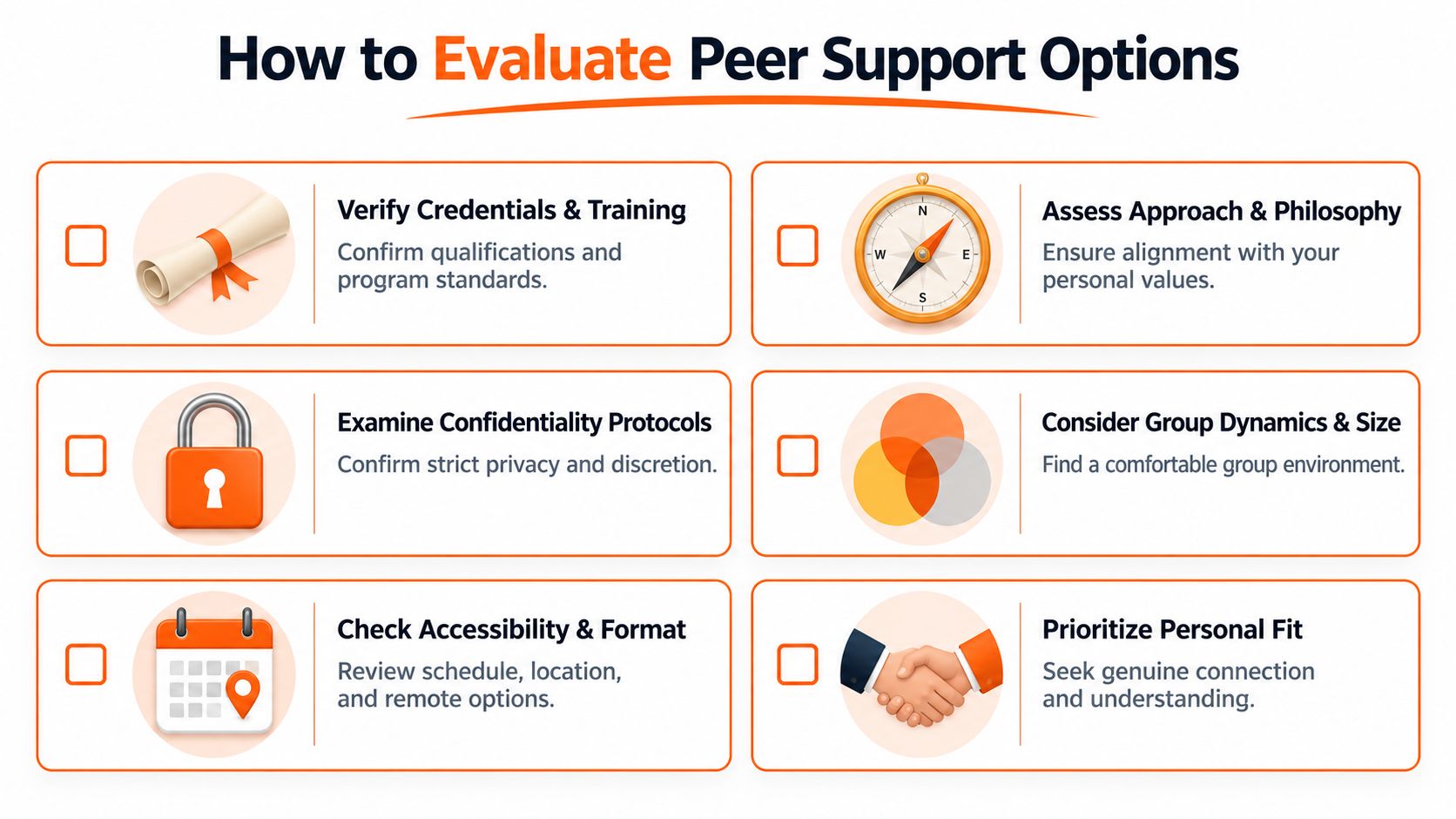
A guide infographic with six tips for evaluating peer support options in a recovery process.

A practical screening checklist

Use these questions before committing:

  • Check training and role clarity
    Ask what training the person has completed, whether they hold any credential, and how they define their role. You want someone who knows where peer support ends and clinical care begins.

  • Ask about supervision and coordination
    A solid peer supporter should be comfortable coordinating with a therapist, psychiatrist, case manager, or treatment team when appropriate and authorized.

  • Review confidentiality carefully
    For professionals, this is not optional. Ask how records, communication, scheduling, and virtual sessions are handled. If the answer is casual, move on.

  • Test for fit, not charisma
    A compelling personal story is not enough. The person should help you feel more honest, more accountable, and more organized. Not more dependent.

  • Look for experience with your kind of pressure
    A peer doesn't need your exact résumé, but they should understand high-stakes work, image management, travel, and the way achievement can hide distress.

  • Match the support to your relapse prevention plan
    If you already have a recovery strategy, your peer support should reinforce it. This guide on relapse prevention strategies is a useful reminder that consistency beats inspiration.

Red flags families should take seriously

Some warning signs are easy to miss because they're wrapped in warmth or enthusiasm.

Watch for:

  • Boundary drift such as texting at all hours without purpose, oversharing, or becoming the person's whole support system
  • Grandiose promises that imply relapse can be prevented through motivation alone
  • Resistance to collaboration with clinicians or family systems when coordination is clearly needed
  • Financial pressure that feels manipulative or vague
  • A one-size-fits-all philosophy that treats every client, profession, and diagnosis the same

What a strong option feels like

Good peer support usually feels steady. Not dramatic. Not performative. The person is reliable, grounded, and focused on the client's recovery rather than their own identity as a helper.

If families can answer three questions clearly, they are usually on firmer ground. Who is this person? What exactly is their role? How does this fit the larger treatment plan? If those answers stay fuzzy, keep looking.

Frequently Asked Questions About Peer Support

What is the difference between a sponsor and a recovery coach

A sponsor usually belongs to a specific mutual-aid fellowship and helps another member work within that fellowship's framework. A recovery coach is broader and more individualized. Coaching often focuses on daily structure, accountability, practical obstacles, and integration with a larger care plan. Neither role is therapy.

Is peer support covered by insurance

Sometimes, but it depends on the setting and how the service is delivered. Peer services embedded in treatment programs, health systems, or state-supported behavioral health settings may be handled differently than private recovery coaching. Families should ask for a plain explanation of what is included, what is billable, and what is private-pay.

Can someone continue with peer support after a relapse

Usually yes, and in many cases they should. A relapse doesn't automatically mean the peer relationship failed. It may mean the support plan needs stronger clinical backup, tighter structure, or clearer boundaries. The right response depends on safety, severity, and honesty about what happened.

A lapse should trigger reassessment, not automatic abandonment.

How do I find peer support for co-occurring disorders

Start with the clinical team. People with addiction plus anxiety, trauma, depression, bipolar disorder, or ADHD usually do best when peer support is chosen as part of an integrated plan rather than as a stand-alone add-on. Ask whether the peer supporter understands medication follow-through, symptom flare-ups, and when to escalate concerns back to clinicians.

Is group peer support always necessary

No. Some people need group belonging. Others begin more comfortably in a private format and add group support later. For executives and licensed professionals, a staged approach is often more realistic than forcing immediate participation in open groups they are not ready to trust.

What should families expect from a good peer relationship

Families should expect improved consistency, earlier disclosure of struggle, and better follow-through with recovery commitments. They should not expect the peer to police, rescue, or replace the family's own work. Healthy peer support lowers secrecy. It does not remove responsibility.

Can peer support help if someone is doing well clinically but still feels isolated

Yes. That is one of its strongest uses. Some people look stable on paper. They attend appointments, pass screenings, and say the right things. Underneath, they feel cut off, ashamed, or emotionally separate from everyone around them. Peer support can reduce that isolation in a way that formal treatment alone sometimes can't.


If you or someone you love needs a recovery plan that respects professional obligations, co-occurring mental health needs, and the need for real privacy, Capo Canyon Recovery offers detox and residential care designed for executives and professionals. Their team provides medically supervised treatment, individualized therapy, and discreet aftercare planning in a boutique setting built for people who can't afford a generic approach.

READ MORE
Uncategorized
July 12by 0 Comments

Yoga Healing Trauma: Your 2026 Executive Recovery Guide

You may be functioning at a high level and still feel strangely absent from your own life.

You answer emails, make decisions, join calls, keep promises, and push through exhaustion. Then the workday ends and your body still acts like the meeting never stopped. Your jaw stays tight. Sleep won't come easily. A small stressor feels bigger than it should. Maybe alcohol, pills, or another coping pattern started as a way to turn the volume down. For many professionals, that pattern isn't a failure of discipline. It's an attempt to manage a nervous system that no longer knows how to settle.

That is where yoga enters the conversation differently. Not as a performance practice. Not as a lifestyle trend. In trauma recovery, yoga can become a structured way to notice your body safely again, regain choice, and build enough internal stability to do deeper clinical work.

An Introduction to Yoga for Trauma Recovery

A lot of people hear "yoga healing trauma" and picture a crowded studio, loud music, difficult poses, and pressure to relax on command. If you're an executive, physician, attorney, founder, or other high-responsibility professional, that image may make you want to skip the whole idea.

That reaction makes sense.

When you've lived through trauma, chronic stress, burnout, or substance use, your relationship with your body often changes. You might live from the neck up. You notice problems only when they interrupt performance. Hunger becomes background noise. Fatigue gets overridden. Anxiety shows up as productivity. Numbness gets mistaken for control.

When functioning isn't the same as feeling well

I often think of the professional who says, "I can run a company, but I can't sit still for five minutes." Or, "I can close a deal, but I can't tell if I'm tired, angry, or scared until I'm already overwhelmed." Those aren't signs of weakness. They're signs that the body has learned to prioritize survival and output over reflection.

Trauma can leave a person feeling either too much or too little. Some professionals feel constantly activated. Others feel detached, flat, or unreal. Many move between both states depending on the day.

Yoga, when adapted for trauma, helps restore a basic skill that stress and addiction often disrupt. It helps you inhabit your body without getting flooded by it.

For a professional who needs privacy and structure, that matters. A trauma-informed yoga session doesn't ask you to perform. It asks you to notice. Where is there tension? What happens when you lengthen an exhale? Can you feel your feet on the floor? Can you choose to stop, modify, or rest without feeling you've failed?

Why this can matter in recovery

That kind of practice can become a bridge back to yourself. It supports awareness, steadiness, and a sense of control that many people lose when trauma and substance use become intertwined. In a clinical setting, it also fits naturally alongside other forms of treatment. If you want a sense of what that can look like inside a recovery program, this overview of yoga therapy for executives in rehab gives a practical example of how yoga can be integrated into care.

You don't have to be flexible, spiritual, or enthusiastic about yoga for it to help. You only need enough willingness to notice what's happening in your body and enough support to do that safely.

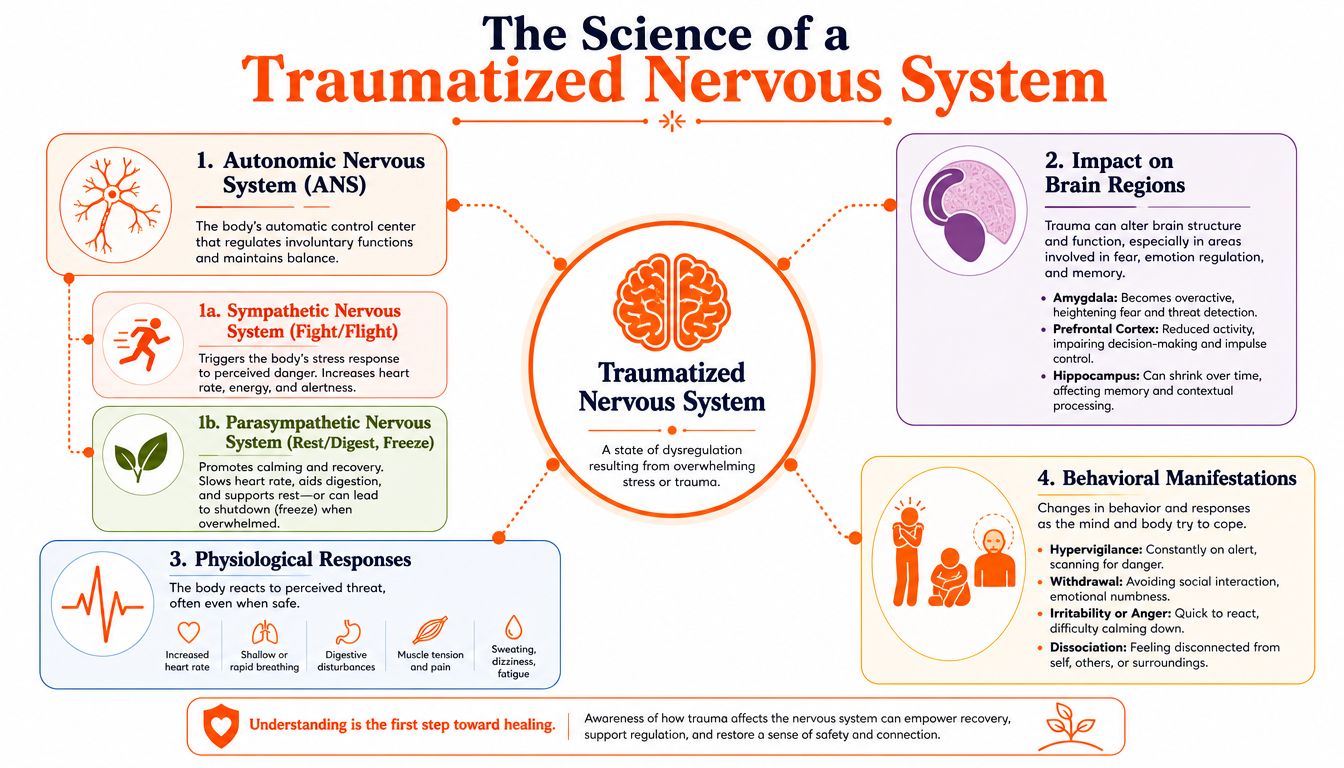
The Science of a Traumatized Nervous System

A traumatized nervous system is not irrational. It's protective. The trouble is that it can stay protective long after the danger has passed.

Many professionals understand this once they stop viewing their symptoms as personality problems. The issue often isn't that you're "too intense," "too sensitive," or "bad at coping." The issue is that your internal alarm system has learned to detect threat quickly and turn itself down slowly.

An infographic showing how trauma impacts the nervous system, brain regions, physical health, and human behavior.

Your body's accelerator and brake

A simple way to understand this is to picture a car.

Your sympathetic nervous system acts like the accelerator. It mobilizes energy. Heart rate rises. Muscles tense. Attention narrows. This is useful when you need to react fast.

Your parasympathetic nervous system functions more like a brake. It helps with rest, digestion, recovery, and settling. In some trauma states, a person can also experience a kind of shutdown response, where the system pulls back hard and the person feels numb, heavy, foggy, or disconnected.

Trauma can make the accelerator too easy to trigger, or the brake too abrupt, or both. That leads to familiar patterns:

  • Fight-like activation means irritability, impatience, jaw tension, anger, or feeling cornered quickly.
  • Flight-like activation can feel like overworking, relentless busyness, racing thoughts, or the inability to stop.
  • Freeze or shutdown may show up as exhaustion, blankness, disconnection, avoidance, or feeling emotionally far away from your own life.

Why symptoms seem to come out of nowhere

People often tell me, "Nothing happened. Why am I reacting like this?" Usually something did happen, but it happened below the level of conscious analysis.

A tone of voice. A calendar overload. A conflict that echoes an older wound. Withdrawal symptoms. Lack of sleep. The body picks up signals before the thinking mind explains them.

This is why trauma work often includes body-based practices. You can't reason your way out of every nervous system response in real time. Sometimes you need skills that work at the level where the reaction is happening.

If you want a practical companion resource on this topic, these Acheloa Wellness, Inc. resources from Acheloa Wellness, Inc. offer accessible education on nervous system regulation in everyday language.

What executives often miss

High performers frequently mistake activation for effectiveness. They say they're "good under pressure" because they can produce while flooded. But producing in a dysregulated state has costs. Sleep worsens. Relationships thin out. Cravings intensify. The body starts asking for relief in whatever form is available.

A more useful question isn't "Why can't I calm down?" It's "What has my body learned to expect?"

Practical rule: If your system has been trained by trauma, chronic stress, or addiction, calm may feel unfamiliar before it feels safe.

That doesn't mean healing isn't working. It means your nervous system is learning a new baseline.

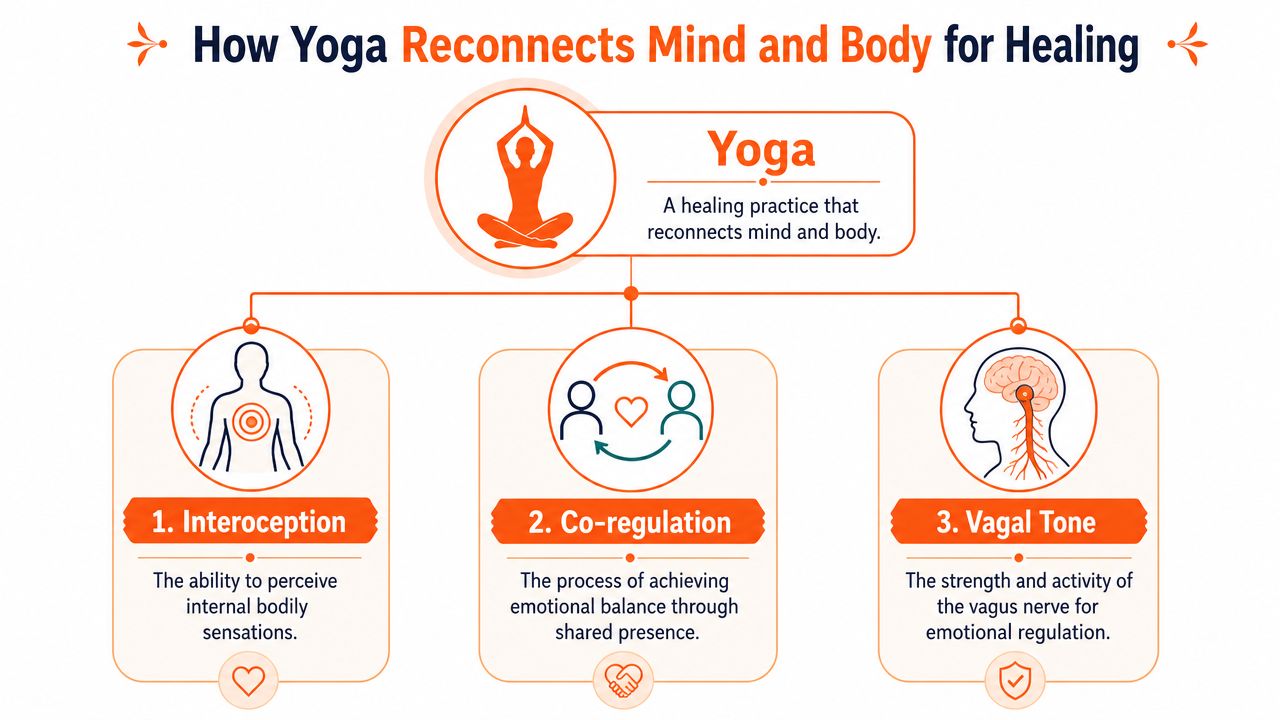
How Yoga Reconnects Mind and Body for Healing

Trauma often disrupts the feedback loop between body and mind. You may know what you think, but not what you feel physically. Or you may feel everything physically and have no language for it. Trauma-informed yoga helps restore that communication through repeated, low-pressure experiences of noticing and choosing.

An infographic titled How Yoga Reconnects Mind and Body for Healing, explaining interoception, co-regulation, and vagal tone.

Interoception and proprioception in plain language

Interoception means sensing what's happening inside your body. It includes noticing your breath, heartbeat, stomach tension, warmth, shakiness, or the first signs of overwhelm.

Proprioception means sensing where your body is in space. It helps you feel your feet pressing into the floor, your back against a chair, or your hands resting on your thighs.

These skills sound basic, but trauma can interfere with both. A person may not notice they're escalating until they're already panicked, angry, or numb. In yoga, a teacher might invite you to lift your shoulders, pause, and release. That tiny sequence teaches something important: sensation changes, and you can stay present while it does.

Breath is not just calming. It's informative

Breathwork, often called pranayama, is useful because it gives the nervous system a rhythm to organize around. But trauma-informed work uses breath carefully. For some people, deep breathing right away feels unsafe or overwhelming. The goal isn't to force relaxation. The goal is to build tolerance for noticing breath without pressure.

That might look like:

  • Counting an exhale softly rather than taking a dramatic inhale
  • Keeping eyes open if closing them increases anxiety
  • Using movement with breath so attention isn't trapped inside the body
  • Stopping early when the practice becomes too intense

This is one reason integrated care matters. Programs that combine somatic work with psychiatric and therapeutic support can adapt the practice to the person's actual needs. For readers exploring broader models of mind-body psychiatric care Philadelphia from Integrative Psychiatry of America is a useful example of how yoga may sit alongside mental health treatment rather than outside it.

Why the evidence matters

Yoga isn't just "nice to have." In a randomized controlled trial of 64 women with chronic, treatment-resistant PTSD, 52% of participants in the trauma-sensitive yoga group no longer met diagnostic criteria for PTSD after 10 weeks, compared to only 21% in the control group according to Yoga Therapy Associates trauma research.

That finding matters because it reframes yoga from a wellness add-on into a legitimate somatic intervention. It doesn't mean every person will respond the same way. It does mean body-based treatment deserves serious consideration, especially when talk-based approaches have stalled or when a person has become highly disconnected from bodily cues.

What yoga practice builds Why it helps in trauma recovery
Body awareness You catch stress earlier instead of only after escalation
Sensory grounding You have concrete anchors such as feet, breath, and posture
Choice under stress You practice modifying, pausing, or stopping without shame

A trauma-informed yoga practice works less like a workout and more like rehearsal for regulation.

Essential Principles of Trauma-Informed Practice

Not all yoga is trauma-informed. That distinction matters more than many people realize.

A standard class may be safe for some people and too activating for others. A trauma-informed class changes the structure, language, and expectations so the participant can stay oriented, autonomous, and emotionally safer in the room.

A group of people in a yoga studio practicing restorative child pose with bolsters and yoga blocks.

Choice is part of the treatment

In trauma-informed practice, choice isn't a courtesy. It's part of how the work helps.

If trauma involved powerlessness, coercion, unpredictability, or violation of boundaries, then healing often includes repeated experiences of being able to choose what happens in your body. That means you can rest, skip a pose, change position, or keep your eyes open without needing to explain yourself.

If you'd like a concise outside perspective on the broader philosophy behind this approach, these Be Your Best Self & Thrive insights from Be Your Best Self & Thrive Counseling, PLLC offer a helpful overview of trauma-informed care principles.

How the language changes the room

Trauma-informed teachers usually use invitational language rather than commands.

Compare the difference:

  • Less helpful: "Everyone close your eyes and sink deeper."

  • More supportive: "If it feels comfortable, you might lower your gaze or keep your eyes open."

  • Less helpful: "Hold this pose. Don't come out yet."

  • More supportive: "You can stay here, adjust, or take a rest if your body needs something different."

  • Less helpful: "Relax."

  • More supportive: "Notice what tension feels like right now, without forcing it to change."

That shift reduces pressure and supports nervous system stability. It also respects the fact that some people cannot access calm through direct instruction.

What to look for before you join a class

A safer trauma-informed environment often includes several features:

  • Predictable structure: The teacher explains what will happen and doesn't rely on abrupt transitions.
  • Minimal surprise touch: Physical adjustments are avoided or require explicit consent.
  • Function over appearance: The focus stays on sensation and agency, not on perfect form.
  • Permission to modify: Props, pauses, and alternate positions are treated as normal.

For people evaluating a treatment setting, the same principles apply at a larger scale. This overview of a trauma-informed approach to care shows how those ideas can extend beyond yoga into the full treatment environment.

If a class makes you feel trapped, watched, or pushed past your limits, the problem may not be you. It may be the setup.

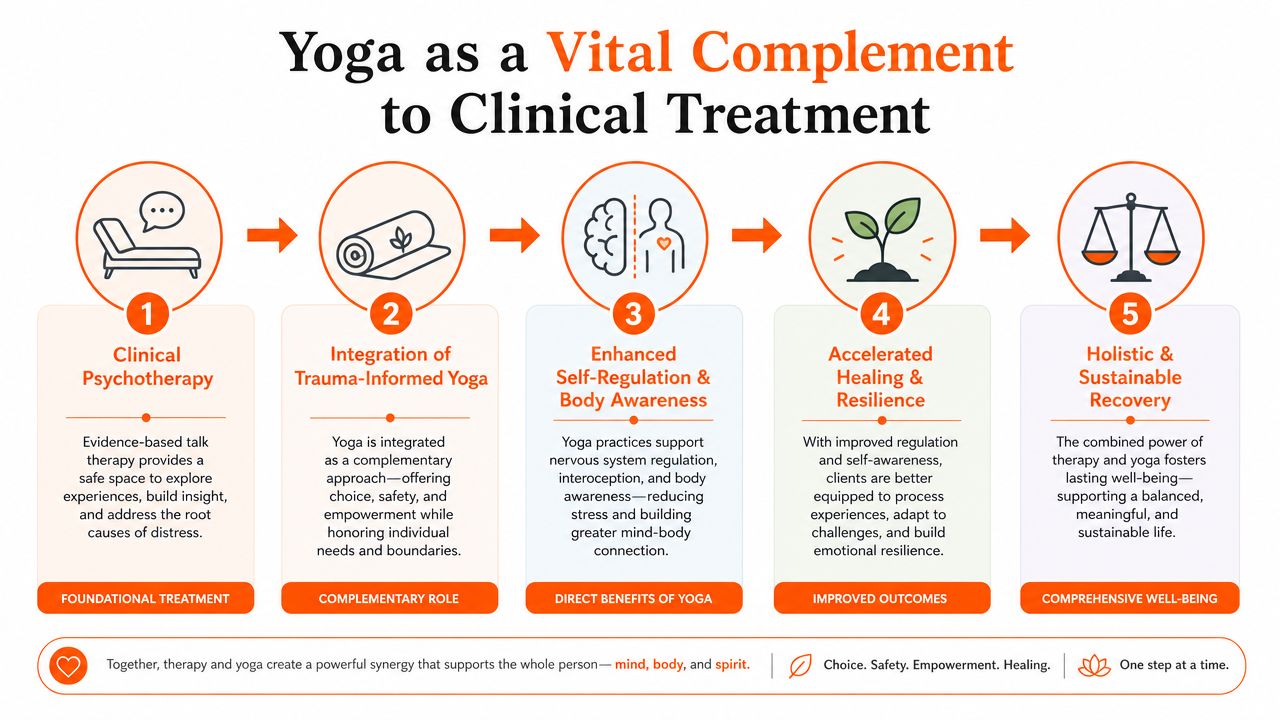
Yoga as a Vital Complement to Clinical Treatment

One of the biggest misunderstandings about yoga healing trauma is the belief that yoga should erase trauma memories on its own. That's not how it works.

Yoga can be powerful, but it has a specific role. Expert consensus clarifies that yoga cannot reliably heal trauma memories via memory reconsolidation but is essential for building the "window of tolerance" needed to tolerate trauma therapy like EMDR. It is a preparatory modality that enhances somatic safety, as described by the Trauma Informed Care Training Institute discussion of yoga.

A five-step infographic showing how yoga integrates with clinical psychotherapy to support trauma healing and recovery.

What the window of tolerance really means

The window of tolerance is the range in which you can feel emotion, think clearly, and remain present enough to process experience without tipping into panic or shutdown.

For many people with trauma and addiction, that window is narrow. A difficult therapy session can feel too exposing. A trigger can flip into craving. Withdrawal can make body sensations feel threatening. In these situations, yoga offers aid. It gives the person a way to recognize activation early and return to a more workable state.

That can make evidence-based therapies more usable, including:

  • EMDR: The person may be better able to stay present during distressing material.
  • DBT: Body awareness can support skills like distress tolerance and emotional regulation.
  • Brainspotting: Somatic tracking often becomes more accessible when a person can identify physical cues with less fear.
  • Addiction treatment: Cravings, agitation, and sleep disruption often become easier to observe without immediately acting on them.

Why this matters in dual-diagnosis care

When trauma and substance use overlap, treatment has to do more than remove the substance. It has to address what the substance was doing for the nervous system.

Some people drank to slow down intrusive activation. Others used substances to feel anything at all. Yoga can help in both directions because it teaches regulated noticing. Instead of automatically escaping a sensation, the person learns to identify it, rate it, and work with it in small doses.

That doesn't replace psychotherapy, medication management, or medical detox when those are needed. It supports them.

The executive reality

Professionals often delay treatment because standard programs feel incompatible with real life. Privacy matters. Reputation matters. Some clients need uninterrupted access to essential work communication. Others will not enter a large, impersonal setting.

The research literature notes an important gap here. While data shows yoga has high retention and moderate effects on trauma symptoms, a critical gap exists in research for high-functioning executives where privacy, cost, and the ability to maintain professional obligations are primary barriers to care, according to the PMC review on yoga and trauma-related symptoms.

That gap is one reason specialized residential care exists. A boutique executive program can combine trauma therapy, addiction treatment, psychiatric oversight, and somatic practices while still allowing essential professional continuity. One example is how a drug rehab center incorporates yoga, where yoga is integrated into a broader clinical plan rather than treated as a standalone fix.

A setting designed for executives may also reduce common barriers by offering a smaller census, private rooms, and a tech-friendly policy so clients can maintain critical responsibilities without abandoning treatment.

A practical way to think about sequencing

A simple sequence often works best:

  1. Stabilize first through detox, sleep support, psychiatric care, and nervous system regulation.
  2. Build body awareness with trauma-informed yoga and other somatic practices.
  3. Process trauma carefully with therapies such as EMDR or Brainspotting when the person can stay within tolerable limits.
  4. Rehearse daily recovery so regulation skills carry into work, relationships, and aftercare.

That sequence isn't rigid. But it reflects something many professionals need to hear. You don't have to force the deepest trauma work on day one. Your body may need preparation before it can safely do that work.

Recovery moves faster when the body stops fighting the treatment.

Finding Your Path to Healing as a Professional

If you've recognized yourself in this article, the next step isn't to prove how much you can endure alone. It's to choose care that matches the complexity of your life.

You may need treatment that protects confidentiality, addresses addiction and trauma together, and allows enough connection to work that you can step in without creating professional collapse. That isn't avoidance. It's good treatment planning.

What to look for in a professional-focused program

A strong option for professionals usually includes:

  • Small, discreet care settings: Fewer clients often means more privacy and less overstimulation.
  • Integrated treatment: Detox, psychiatry, individual therapy, group work, and somatic support should function as one plan.
  • Real executive accommodations: Access to a phone or laptop, a private room, and structured support for essential communication can remove barriers that keep people out of care.
  • Trauma competence: The program should understand that symptom control, memory processing, and addiction recovery are related but not identical tasks.

The evidence base still has limits for executive populations. As noted in the earlier research, barriers around privacy, cost, and maintaining professional obligations remain central concerns for high-functioning professionals, and specialized executive programs are designed around those realities.

Healing doesn't require you to become a different kind of person. It requires the right environment, the right sequencing, and enough support to reconnect with your body safely. For many professionals, that is the beginning of recovery.


If you're looking for confidential, structured care that addresses trauma, addiction, and the practical demands of professional life, Capo Canyon Recovery offers detox and residential treatment with integrated clinical services, trauma-focused therapies, private rooms, and a tech-friendly environment for essential work access. A private assessment can help you determine whether that level of care fits your needs now.

READ MORE
Uncategorized
July 10by 0 Comments

10 Relapse Prevention Strategies for Professionals

Monday starts with inbox triage, back-to-back calls, and a calendar that leaves no real room to breathe. If you're a business owner, physician, attorney, or senior operator in recovery, the pressure doesn't pause just because treatment ended. The same stress, isolation, travel, and expectation to perform can reopen the exact pathways that once led to substance use.

That's why relapse prevention strategies for professionals have to do more than say “avoid triggers.” Many executives can't easily turn off their phones, skip every dinner, or disappear from work life for months. They need plans that are clinically sound and realistic enough to survive a red-eye flight, a board meeting, a licensing review, or a high-conflict client call.

Relapse is also common enough that no serious clinician should treat prevention as optional. The National Institute on Drug Abuse reports that substance use disorder relapse rates consistently fall between 40% and 60%, a range comparable to other chronic medical conditions, as summarized in this relapse prevention review. For professionals, that reality argues for structure, not shame.

At Capo Canyon Recovery, this is the practical problem we help clients solve. Treatment has to fit real life, especially when privacy matters and work responsibilities can't be abandoned entirely. The strategies below are the ones that hold up under pressure when they're individualized, practiced repeatedly, and supported by a program built for executives.

1. Cognitive Behavioral Therapy for Relapse Prevention

A hand drawing a trigger map in a notebook to illustrate stress, negative thoughts, and urges.

CBT works because it gets specific. It tracks the chain between an event, the thought that follows, the feeling that builds, and the behavior that starts to look tempting. For professionals, that chain often sounds familiar: “I'm falling behind,” turns into “I'm going to blow this,” then into panic, then into craving.

The useful part isn't just insight. It's interruption. A client heading into a tense investor meeting can learn to catch catastrophic thinking before it becomes an excuse to use later that night. Someone traveling for work can plan for the vulnerable window after the conference dinner, when exhaustion and privacy combine.

What this looks like in real life

A strong CBT relapse plan usually includes a written response to recurring work triggers. That might mean a thought record after conflict with a partner, a coping card saved in your phone for airport delays, or a short therapist check-in before a known high-stress event.

At Capo Canyon, this fits well with executive treatment because the work pressure itself gets addressed instead of treated like a side issue. If negative thinking is one of your biggest relapse drivers, this guide on overcoming negative thoughts in recovery is a practical starting point.

  • Track the sequence: Write down the trigger, the thought, the feeling, and the urge the same day it happens.
  • Challenge the distortion: Replace “I failed” with something accurate and usable, such as “I'm under pressure and need support.”
  • Prepare for predictable stress: Build scripts for networking events, hotel nights, and performance reviews.

Practical rule: If a thought makes substance use sound reasonable, write it down and answer it before the day ends.

2. Dialectical Behavior Therapy Skills Training

Some professionals don't relapse because they lack intelligence or discipline. They relapse because they get overwhelmed fast, react hard, and then try to shut the reaction down with a substance. DBT is useful here because it teaches skills for the exact moments when emotion starts outrunning judgment.

An executive worried about a quarterly miss may not need more analysis. They may need distress tolerance. An attorney coming out of a brutal hearing may need emotion regulation before heading home. A founder in conflict with staff may need interpersonal effectiveness so anger doesn't become isolation, and isolation doesn't become relapse risk.

Four skill sets that matter at work

DBT gives people a framework they can carry into demanding environments.

  • Mindfulness: Notice the stress response before it controls the conversation.
  • Distress tolerance: Get through a spike in anxiety without making it worse.
  • Emotion regulation: Reduce the intensity and duration of emotional swings.
  • Interpersonal effectiveness: Set limits, ask for what you need, and handle conflict without imploding or exploding.

Executive clients frequently benefit most from repetition. Trying to learn every DBT skill at once usually backfires. One skill used consistently in a high-risk situation is worth more than a binder full of techniques you never practice.

At Capo Canyon, DBT fits naturally for professionals with co-occurring anxiety, trauma, depression, or emotional reactivity. It's especially helpful when someone says, “I'm fine until I'm suddenly not.”

The fastest way to lose access to a coping skill is to wait until a crisis to practice it.

3. Acceptance and Commitment Therapy

High performers often treat discomfort like an error that must be eliminated immediately. ACT takes the opposite approach. It teaches you to stop fighting every uncomfortable thought or feeling and start choosing behavior based on values instead.

That matters in recovery because cravings often gain strength when people argue with them, panic about them, or read them as proof they're failing. ACT helps a professional notice, “I'm having the thought that I can't handle this dinner sober,” without obeying the thought.

Values matter more than mood

This approach lands well with executives because it connects recovery to identity. Not title. Not image. Identity. A leader may decide that being honest, present, and medically well matters more than appearing invulnerable. A parent may choose to leave an event early because family stability matters more than social convenience.

A practical ACT exercise is values clarification. Name the few things that matter most outside raw achievement, then use them as a decision filter when cravings rise.

  • Work value: “I lead with clarity, not concealment.”
  • Family value: “I'm emotionally present, even when I'm stressed.”
  • Health value: “I protect sleep, treatment, and medication adherence.”
  • Integrity value: “I say what's true sooner, not later.”

ACT doesn't promise you won't feel pressure. It helps you stop letting pressure write the script. At Capo Canyon, this is especially useful for professionals who are used to controlling outcomes and feel destabilized when recovery asks for acceptance as well as action.

4. Contingency Management and Incentive-Based Relapse Prevention

Not every recovery tool has to feel profound to be effective. Contingency management is straightforward behavioral reinforcement. You connect healthy actions to meaningful rewards, and you do it consistently enough that the behavior starts to hold.

For professionals, this can be adapted in ways that feel adult and relevant. The reward doesn't have to be simplistic. It might be expanded access to a preferred wellness activity, a meaningful privilege during treatment, or a personal reward tied to milestones in therapy, monitoring, and abstinence.

Why this works for driven people

Executives usually respond well to clear expectations, defined metrics, and visible progress. A vague promise to “stay committed” is weaker than a written agreement that links attendance, testing, therapy completion, and coping practice to specific rewards. Structure reduces bargaining. It also helps clients who are used to external accountability at work but have never built it into recovery.

The caution is important. Incentives can start the process, but they won't sustain recovery by themselves. If someone only engages for the reward, the plan becomes brittle once the reward fades. The best use of contingency management is as a bridge into internal motivation, not a substitute for it.

At Capo Canyon, this approach can be folded into individualized treatment planning for professionals who need concrete accountability without public exposure. It works best when the incentives reflect the client's actual life, schedule, and values.

  • Choose rewards that matter: Generic rewards rarely hold attention.
  • Write the contract: Ambiguity invites rationalization.
  • Pair with therapy: Reinforcement works better when the underlying triggers are still being treated.

5. Mindfulness-Based Relapse Prevention

A professional woman in business attire sits meditating peacefully on a sunny office windowsill.

An executive leaves a tense board meeting, gets back to the hotel, and feels the familiar shift. Adrenaline is still high. The room is quiet. No one is watching. That is the moment mindfulness-based relapse prevention is built for.

Mindfulness helps clients notice internal cues earlier, before stress turns into autopilot behavior. In practice, that means catching the first signs of craving, resentment, exhaustion, or shame and responding with a trained skill instead of a reflex. For high-achieving professionals, that matters because relapse risk often shows up in private, after performance pressure, conflict, travel disruption, or long stretches of emotional suppression.

The trade-off is straightforward. Mindfulness is effective, but it is often misunderstood by professionals who are used to solving problems through speed and force. Sitting still can feel unproductive at first. Some clients also find that quiet practice brings up discomfort they have spent years outrunning. In treatment, that does not mean the method is failing. It means the practice needs structure, clinical support, and a form that fits the client's actual life.

Brief, repeatable exercises usually work best. A two-minute breathing practice before opening email. A body scan after a deposition or investor call. Urge surfing in a hotel room while the mind starts building a case for one drink. Clients who have rejected mindfulness in the past often do better with guided, recovery-specific instruction than with generic meditation apps. Capo Canyon helps professionals build that kind of routine into treatment and aftercare, and this guide to meditation in addiction recovery gives a clear overview of how the practice supports sobriety.

Research also supports mindfulness-based relapse prevention as a structured clinical approach, not a wellness add-on. A review published in the journal Substance Abuse and Rehabilitation describes MBRP as an intervention designed to reduce craving, increase awareness of triggers, and lower relapse risk by teaching clients to respond more skillfully to discomfort in this overview of mindfulness-based relapse prevention.

When mindfulness works, the craving may still be present. The difference is that it no longer gets to run the meeting.

6. Medication-Assisted Treatment Integration in Relapse Prevention

A managing partner finishes a week of travel, gets home exhausted, and realizes the most dangerous part of the schedule is not the board meeting or the client dinner. It is the quiet hour afterward, when withdrawal symptoms, craving, or insomnia start pushing for relief. In that moment, insight alone may not hold.

Medication-assisted treatment addresses relapse risk at the biological level. For alcohol and opioid use disorders in particular, the right medication can reduce craving, ease withdrawal, and help stabilize sleep, mood, and concentration. That stability matters for executives who need to return to demanding work without making every hour a fight against their own nervous system.

The trade-off deserves a clear explanation. MAT adds another layer of treatment planning. It requires medical oversight, attention to side effects, and honest discussion about what medication can and cannot do. It does not replace therapy, accountability, or behavior change. It gives those interventions a fair chance to work.

For professionals, that can make the difference between white-knuckling through a workday and being able to participate fully in recovery. The medications differ by diagnosis, history, and risk profile. Naltrexone may be appropriate for some people with alcohol or opioid use disorder. Buprenorphine can play a central role in opioid recovery. Decisions like these should be made with a prescriber who understands addiction treatment, psychiatric history, and the realities of high-responsibility work. The National Institute on Drug Abuse outlines how medications for opioid use disorder support longer-term recovery in this review of medications to treat opioid use disorder.

At Capo Canyon, MAT is integrated with psychiatric care, relapse prevention therapy, and individualized planning around schedule, privacy, and performance demands. That matters when a client is trying to handle investor pressure, business travel, or a return to leadership while still learning their personal warning signs. A medication plan works best when it is tied to a clear understanding of personal relapse triggers and risk patterns, not prescribed in isolation.

Used well, MAT reduces noise. Then genuine recovery work can take hold.

7. High-Risk Situation Mapping and Coping Plan Development

A person holding a printed paper titled Coping Plan for maintaining sobriety while traveling.

Generic advice fails when the trigger is specific. “Manage stress” doesn't help much if your real danger point is landing in Chicago at 9 p.m., checking into a hotel alone, and knowing no one will notice what you do for the next ten hours. High-risk mapping fixes that by forcing precision.

You identify the situations that repeatedly raise the odds of use. Then you write down exactly what you'll do when they happen. Not what you hope you'll do. What you will do.

Build the plan before the pressure hits

A useful coping plan includes internal triggers and external ones. Internal triggers include shame, anger, boredom, and post-performance letdown. External triggers include airports, deal dinners, old contacts, industry events, and access to cash or pills.

The strongest plans are action-oriented and easy to access. If you need to scroll through ten pages of notes during a craving, the plan is too complicated. Capo Canyon often helps clients build this level of specificity because professionals tend to have highly patterned risk. This guide on identifying relapse triggers is a strong companion resource.

  • Name the situation clearly: “Hotel room after conference dinner” is better than “travel.”
  • Add three responses: One behavioral, one cognitive, and one social.
  • Decide the first call: Don't wait until you're struggling to choose whom to contact.
  • Include exits: Know when you'll leave, how you'll leave, and what you'll do next.

A coping plan should feel almost overprepared. That's usually a sign it's realistic.

8. 12-Step and Mutual Support Group Integration

Ambitious people often underestimate how dangerous isolation is. They may have dozens of business contacts and still have no one they can call when the urge to use starts sounding logical. Mutual support groups fill that gap in a way clinical care alone usually can't.

The practical benefit isn't ideology. It's repetition, accessibility, and peer accountability. A sponsor, a regular meeting, or a trusted recovery peer can interrupt the secrecy that allows relapse to gather speed.

What tends to work for professionals

Professionals usually do better when they shop for fit instead of forcing themselves into the first meeting they attend. Some people want AA or NA. Others prefer SMART Recovery or another format that feels more aligned with how they think. The key is not which acronym looks best on paper. The key is whether you'll keep showing up and tell the truth when you're under pressure.

Evidence also favors participation. Individuals who actively take part in peer support groups such as Alcoholics Anonymous have statistically lower relapse rates than those who don't engage in those community networks, according to this overview of relapse rates and support participation.

For high-profile professionals, privacy concerns are real. Online meetings, discreet local groups, and sponsor relationships with clear boundaries can make long-term engagement more realistic. Capo Canyon's executive-focused environment often helps clients build that handoff from residential care into community support without making them feel exposed.

Recovery support should reduce secrecy, not create a second job you can't sustain.

9. Family Involvement and Relapse Prevention Planning

Professionals often try to protect their families from the details of recovery. The intention may be good, but the result is usually poor. When spouses, partners, or adult children don't know the warning signs, they miss the chance to respond early.

Family involvement doesn't mean putting relatives in charge of your sobriety. It means giving the people closest to you enough information to support recovery without enabling, policing, or panicking.

What families actually need to know

They need to know your common warning signs. Maybe you isolate after work, become unusually irritable, start hiding your phone, skip meals, or reconnect with old contacts. They also need a protocol. Who do they call if they're worried. What they should say. What they should avoid.

This is especially important for executives whose work stress affects the whole household. Recovery gets stronger when the family understands the pressure points and stops treating every difficult day like an emergency. At Capo Canyon, family therapy can help repair trust while setting realistic boundaries and communication rules. If your household needs added support around conflict patterns and reconnection, you can also connect with Interactive Counselling in Penticton.

One caution matters here. Family support is powerful, but it can become counterproductive if relatives try to monitor every mood change or shield the person from every consequence. Healthy involvement is informed, calm, and structured.

10. Ongoing Monitoring, Accountability Structures, and Relapse Early Warning Detection

A relapse rarely appears out of nowhere. More often, the signs show up early and get explained away. Sleep worsens. Therapy gets postponed. Meetings become optional. Honesty narrows. Work starts replacing recovery again. Monitoring helps catch those shifts before they become a full return to use.

For some professionals, formal monitoring is part of licensure or return-to-work requirements. For others, it's a voluntary structure that protects sobriety and reduces self-deception.

Accountability should be objective

The best systems combine self-report with outside verification. That can include therapy, psychiatric follow-up, random testing, sponsor calls, app-based mood tracking, and regular review of patterns. It's not about punishment. It's about getting data soon enough to intervene.

This approach also fits the long view of recovery. Clinical protocols for standardized relapse prevention commonly require a minimum of 12 weekly sessions, and evidence summarized by Recovery Answers indicates that extending care beyond the baseline 90 days of intensive programming, followed by 12 to 24 months of ongoing support, improves long-term outcomes in this review of relapse prevention programming.

At Capo Canyon, extended care and aftercare coordination are especially relevant for executives because accountability often falls apart after discharge if no one owns the next step. If you want outside structure around goals, consistency, and follow-through, working with an accountability coach can complement formal clinical support.

Relapse Prevention: 10-Strategy Comparison

Approach Implementation complexity Resource requirements Expected outcomes Ideal use cases Key advantages
Cognitive Behavioral Therapy (CBT) for Relapse Prevention Moderate, structured sessions plus homework and skill practice Licensed clinician, regular therapy sessions, worksheets/apps Reduced distorted thinking, improved coping, measurable session-to-session gains Executives with work-related stress, perfectionism, identifiable cognitive triggers Strong evidence base; practical, skill-focused tools compatible with work demands
Dialectical Behavior Therapy (DBT) Skills Training High, multi-module skills training plus individual therapy and coaching DBT-trained therapists, group skills sessions, phone coaching, long-term commitment Improved emotion regulation, distress tolerance, reduced impulsive relapse behaviors Professionals with emotional dysregulation, dual diagnosis, high-stress interpersonal roles In-the-moment coaching, structured emotion/interpersonal skills, effective for co-occurring disorders
Acceptance and Commitment Therapy (ACT) Low–Moderate, experiential exercises and values work ACT-trained clinician, values exercises, brief interventions or modules Increased psychological flexibility, values-aligned action, reduced avoidance-driven use High-achievers struggling with perfectionism or avoidance; those seeking meaning-driven recovery Values-focused, transferable psychological flexibility, can be brief and integrate with other therapies
Contingency Management (CM) / Incentive-Based Moderate, requires design and verification of incentive schedules Drug testing/verification systems, reward budget, administrative oversight Increased short-term abstinence and treatment engagement, clear measurable milestones Early recovery periods, professionals needing external motivation to sustain engagement Empirically increases abstinence rates; customizable incentives that reinforce desirable behaviors
Mindfulness-Based Relapse Prevention (MBRP) Moderate, structured 8-week program plus daily practice Trained instructors, group practice time, meditation resources/apps Reduced cravings and stress, improved impulse control and cognitive flexibility over time Stressed executives seeking stress reduction and sustainable relapse resilience Long-term, low-resource practice; enhances attention, emotion regulation, and decision-making
Medication-Assisted Treatment (MAT) Integration Moderate–High, medical oversight and coordination with therapy Prescribing psychiatrists, medications, ongoing monitoring and dosing adjustments Reduced physiological cravings and withdrawal, substantially lower relapse risk Opioid or alcohol use disorders; professionals needing biological stabilization to engage in therapy Strong neurobiological impact; improves capacity to participate in psychosocial treatments
High-Risk Situation Mapping & Coping Plan Development Low–Moderate, systematic identification and written plans Therapist-guided sessions, digital/printed plans, periodic review Greater preparedness, fewer reactive relapses, clearer action steps in triggers Executives facing predictable situational triggers (travel, events, networking) Highly personalized, proactive planning; reduces decision-making at high-risk moments
12-Step & Mutual Support Group Integration Low, peer-led meetings and sponsorship; variable structure Access to meetings (online/in-person), time for attendance, sponsor Ongoing peer accountability, reduced isolation, sustained community support Professionals seeking peer fellowship and long-term mutual support after treatment Widely available, low-cost, continuously accessible peer support and sponsorship
Family Involvement & Relapse Prevention Planning Moderate, coordinated family sessions and education Family therapist, structured sessions, educational materials, privacy planning Improved family functioning, earlier warning detection, strengthened support network Individuals with important family ties or relational damage needing repair Mobilizes natural support, enhances accountability, addresses relational drivers of relapse
Ongoing Monitoring, Accountability & Early Warning Detection Moderate–High, regular testing and structured tracking systems Drug testing services, apps/journals, clinicians, administration, possible board coordination Objective early detection of relapse risk, sustained accountability, compliance evidence Regulated professionals (physicians, pilots, attorneys) and high-risk recovery phases Provides objective data for intervention, supports licensure compliance and early response

Your Blueprint for Lasting Professional Recovery

The strongest relapse prevention strategies aren't impressive because they're complicated. They work because they're specific, practiced, and realistic under pressure. That's the difference high-achieving professionals need to understand. A plan that only works in calm conditions isn't much of a plan.

Executives face a unique set of relapse pressures. Travel disrupts routine. Success can mask suffering. Privacy concerns make it harder to ask for help early. Work culture may reward overextension, emotional suppression, and constant availability. On top of that, some professionals in recovery struggle with guilt and anxiety when they can't maintain professional obligations, and standard programs that demand total tech abstinence can push them out early, as described in this executive-focused discussion of relapse prevention. That's exactly why a work-compatible recovery plan matters.

The strategies in this guide work best when they're connected. CBT helps you challenge distorted thinking. DBT helps you survive emotional spikes. ACT keeps you tied to values instead of urges. Mindfulness slows reactivity. MAT can reduce biological vulnerability. Mutual support and family planning reduce secrecy. Monitoring catches drift early. None of these should live in isolation.

Substance-specific planning also matters. Some generic recovery content treats all relapse pathways as interchangeable, but they aren't. A recent discussion of aftercare and relapse prevention notes that opioid relapse often requires continuity with medication-assisted treatment, while alcohol relapse may be more closely tied to social isolation in this overview from American Addiction Centers. Good clinical care adjusts the plan to the substance, the co-occurring mental health picture, and the person's actual life.

That's where Capo Canyon Recovery stands out. The program is built for professionals who need privacy, individualized care, and the ability to remain connected to essential work responsibilities during treatment. With medically supervised detox, residential care, dual diagnosis treatment, psychiatric support, evidence-based therapies including CBT, DBT, and ACT, and a tech-friendly setting with private rooms, the clinical structure supports recovery without pretending your real-world obligations don't exist.

For many professionals, the next challenge after stabilization is sustainability. You need an aftercare plan that survives business travel, changing stress loads, family responsibilities, and the return of professional identity. You also need better boundaries and rhythm, not just more willpower. If that's an area you're rebuilding, these practical tips for work life balance can support the lifestyle side of recovery.

Recovery is your greatest asset because it protects every other asset. Your judgment, your license, your relationships, your credibility, and your health all depend on it. A solid relapse prevention plan doesn't restrict your future. It protects it.


If you need private, executive-focused addiction treatment that respects both your recovery and your professional reality, Capo Canyon Recovery can help. Their Mission Viejo program offers medically supervised detox, residential care, dual diagnosis treatment, medication support, family involvement, and aftercare planning in a discreet, tech-friendly setting designed for professionals who need real clinical depth without unnecessary exposure.

READ MORE
Detox and RecoveryHealthy Living
August 23by Capo Canyon0 Comments

How Exercise Can Help You During Addiction Recovery

When a person has been suffering with addiction illness, their physical health is very likely to have deteriorated as a result. A poor diet, lack of sleep, and lack of exercise combine with the dangers of substance abuse to increase the potential for long-term health problems unless treatment is sought. For this reason, physical exercise is widely considered to be a very important component of addiction treatment.

READ MORE
Detox and RecoveryHealthy LivingSobriety
July 12by Capo Canyon0 Comments

Overcoming the Stigma of Addiction

Despite our better understanding of addiction as a disease, there is still a considerable amount of stigma surrounding the issue, whether perceived or otherwise. Indeed, many people in desperate need of addiction treatment fear taking the first step for fear of being judged harshly by others. Even if this is not the case, the prospect of coming clean on substance abuse can paralyze many from reaching out for help at all.

READ MORE
Detox and RecoverySobriety
June 26by Capo Canyon0 Comments

Understanding the Five Stages of Recovery

Overcoming substance abuse is a process that takes time. How long a person’s recovery journey is depends on their individual needs and circumstances. Addiction develops over a period of time and there is no overnight cure. Here we take a look at the five stages a person experiences as they heal from substance abuse in recovery.

READ MORE
Detox and RecoveryHealthy CommunicationSobriety
June 20by Capo Canyon0 Comments

How to Talk To Your Kids about Your Addiction

It is exceptionally difficult for some people to face the challenge of telling their children about past drug or alcohol abuse. That said, it is also important to recognize that very often children are negatively influenced by a parent who has dealt with substance abuse in the past. It is not uncommon for children of addicted parents to go on to develop substance abuse issues of their own.

READ MORE
Detox and RecoveryHealthy LivingSobriety
June 14by Capo Canyon0 Comments

Helpful Tips to Enjoy a Sober Summer

Enjoying the summer isn’t always easy for people in recovery from addiction. Leaving the sanctity of a rehab center to get involved in summer activities like barbecues, beach days, pool parties and summer weddings can be challenging. Here we look at some ways to help you navigate any hurdles you may face in recovery during the summer months.

  • 1
  • 2
  • 3
Recent Posts
  • Navigating the Insurance Verification Process for Treatment
  • PTSD and Substance Use: Integrated Treatment for Executives
  • CBT for Addiction Recovery: What It Is and Why It Works
  • Alcohol Addiction Rehab California: A Personal Recovery
  • EAP Employee Assistance Programs: A Complete Guide
Categories
  • Addiction
  • Addiction and Rehab News
  • Detox and Recovery
  • Detox Services
  • Healthy Communication
  • Healthy Living
  • Holistic Services
  • Sobriety
  • Treatment Services
  • Uncategorized

Need help? Call our caring admissions team at (949) 382-1100

Recent Reviews

"I needed to work quite a bit while I was in rehab and I was able to make every conference call and respond to every email without missing a step."
KayCapo Alumni
“The staff actually listens and pays attention, which matters more than people realize when you’re struggling.”
JenniferCapo Alumni
"The small number of clients is a huge benefit — everyone gets really personalized service and treatment."
JayCapo Alumni
Insurance specialist on phone verifying treatment benefits with client holding policy card.

Navigating the Insurance Verification Process for Treatment

Read More »

PTSD and Substance Use: Integrated Treatment for Executives

Read More »
Professional therapeutic counseling session between a client and a therapist featuring a digital brain graphic overlay

CBT for Addiction Recovery: What It Is and Why It Works

Read More »
Insurance specialist on phone verifying treatment benefits with client holding policy card.

Navigating the Insurance Verification Process for Treatment

August 20, 2026

You're trying to get an executive into treatment quickly. The bed is available, the family has

Read More »

PTSD and Substance Use: Integrated Treatment for Executives

August 19, 2026

You finish a difficult board meeting, return to a quiet hotel room, and pour a drink

Read More »
Professional therapeutic counseling session between a client and a therapist featuring a digital brain graphic overlay

CBT for Addiction Recovery: What It Is and Why It Works

August 18, 2026

You're responsible for decisions, people, and outcomes all day, yet a private concern keeps interrupting your

Read More »

Alcohol Addiction Rehab California: A Personal Recovery

August 17, 2026

You're leading a company, managing a practice, flying routes, defending clients, or carrying responsibility for people

Read More »

Begin Confidentially

Name(Required)
joint logo
DHCS

Licensed by the State Department of Health Care Services #300359AP expires 10/31/28

Capo Canyon Logo

Capo Canyon Recovery offers licensed and accredited detox and residential treatment in Orange County. Call us to start your recovery journey today.

Twitter Facebook-f Instagram

Treatment

  • Stabilization
  • Residential Inpatient
  • Addiction Therapies
  • Holistic Treatment
  • Dual Diagnosis
  • Privacy Policy

Who We Are

  • About Us
  • Tour Facility
  • FAQs
  • Admissions
  • Verify Insurance
  • Blog
  • Contact

Contact

  • Mission Viejo, CA 92691
  • (949) 382-1100
  • [email protected]

© 2026 All rights reserved

  • Treatment Programs
    Explore Our Programs
    Levels of Care
    • Medical Detox
    • Medication Stabilization
    • Residential Inpatient Treatment
    • Extended Care
    Specialized Treatment
    • Executive Program
    • Dual Diagnosis Treatment
    • Holistic Treatment
    Treatment Experience
    • Working from Treatment
    • Luxury Treatment
    • Private Treatment
  • What We Treat
    Explore What We Treat
    Substance Use Disorders
    • Addiction Treatment
    • Alcohol Use Disorder Treatment
    • Drug Addiction Treatment
    Drug Specific Treatment
    • Adderall
    • Benzos
    • Cocaine
    • Fentanyl
    • Ketamine
    • Marijuana
    • Meth
    • Opiate
    • Prescription Drugs
    Mental Health Conditions
    • ADHD Treatment
    • Anxiety Treatment
    • Bipolar Disorder Treatment
    • Depression Treatment
    • Process Addiction Treatment
    • Trauma Treatment
  • Therapies & Approaches
    Explore Our Therapies
    Therapeutic Modalities
    • Cognitive Behavioral Therapy (CBT)
    • Acceptance & Commitment Therapy (ACT)
    • Brainspotting Therapy
    • EDMR Therapy
    • Evidence-Based Therapies
    • Process Group Therapy
    Holistic Therapies
    • Art Therapy
    • Holistic Addiction Therapy
    • Horticulture Therapy
    • Yoga Therapy
    Personalized Support
    • Individual Therapy
    • Family Therapy
  • About & Admissions
    Explore Our Facility
    Discover Capo Canyon
    • Who We Are
    • Meet Our Team
    • Executive Rehab
    • Private Rooms
    • Chef Prepared Meals
    • Wifi & Tech Friendly Treatment
    • Our Blog
    Resources & Information
    • Frequently Asked Questions
    • What to Bring
    • Why Choose a Luxury Rehab
    Getting Started
    • Admissions
    • Verify Insurance
    • Contact Us